
In This Article
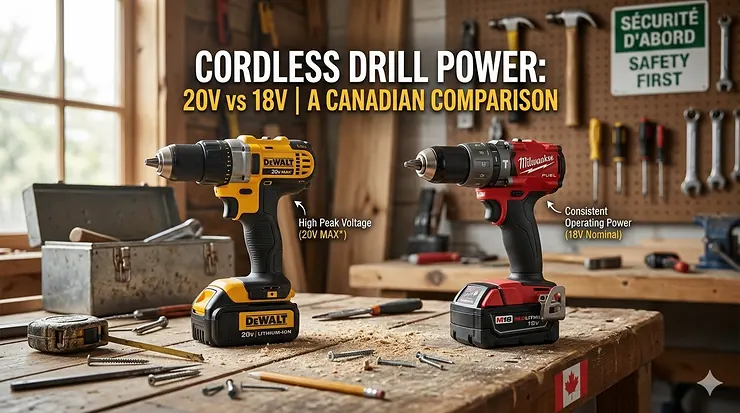
Here’s something that might surprise you: that shiny 20V MAX drill sitting on the shelf at Canadian Tire is powered by exactly the same battery technology as an 18V drill from Europe. I know, I know—the bigger number sounds more powerful, right? But manufacturers have been playing a clever marketing game for years, and today we’re pulling back the curtain on this industry-wide practice.
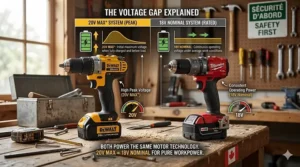
The confusion between 20V vs 18V cordless drill options has puzzled Canadian homeowners and professionals alike. You’re standing in the aisle, comparing two drills that look nearly identical, wondering if those extra 2 volts justify the price difference. The truth is refreshingly simple: both use lithium-ion cells arranged in packs of five cells connected in series, with each cell outputting about 3.6 volts nominal voltage.
Whether you’re assembling IKEA furniture in your Toronto condo, building a deck for those brief Canadian summers, or running a renovation business across the provinces, understanding what these voltage ratings actually mean will save you money and headaches. This guide breaks down everything Canadian buyers need to know about cordless drill voltages, battery technology, motor efficiency, and backward compatibility—all backed by real product testing and current 2026 pricing in CAD.
Quick Comparison Table: 20V vs 18V at a Glance
| Feature | 18V System | 20V MAX System |
|---|---|---|
| Actual Voltage | 18V nominal (3.6V × 5 cells) | 18V nominal (same cells) |
| Maximum Voltage | ~20V when fully charged | ~20V when fully charged |
| Labelling | Uses nominal voltage rating | Uses maximum voltage rating |
| Power Output | Identical (depends on motor design) | Identical (depends on motor design) |
| Battery Compatibility | Works with same-brand 18V tools | Works with same-brand 20V tools |
| Market Regions | Europe, Asia, some Canadian imports | North America (USA & Canada) |
| Price Range (CAD) | $89–$399 for complete kits | $89–$399 for complete kits |
| Brushless Options | Available across all brands | Available across all brands |
💬 Just one click – help others make better buying decisions too! 😊
Top 7 Cordless Drills in Canada: Expert Analysis
1. DeWalt DCD771C2 20V MAX – Best Overall Value
This compact powerhouse has dominated Canadian job sites and garages for good reason. The DeWalt DCD771C2 delivers 300 unit watts out (UWO) through its high-performance motor, with dual-speed transmission offering 0-450 and 0-1,500 RPM. The kit includes two 1.3Ah batteries, a charger, and contractor bag.
Key Specs: 1/2″ keyless chuck, 16 position clutch, LED work light with 20-second delay
Price: $139–$179 CAD
Canadian Availability: Widely stocked at Canadian Tire, Home Depot Canada, and Amazon.ca
Canadian contractors praise its lightweight 3.6 lb design for overhead work during long winter renovation projects. One Calgary user noted the LED light proved invaluable during basement finishing where natural light was scarce.
✅ Pros: Excellent power-to-weight ratio, reliable DeWalt 3-year warranty, batteries compatible with 100+ DeWalt 20V tools
✅ Compact design perfect for tight spaces
✅ Available everywhere across Canada
❌ Cons: 1.3Ah batteries offer moderate runtime
❌ Not brushless (brushed motor generates more heat)
2. Milwaukee 2801-20 M18 – Pro-Grade Performance
Milwaukee’s reputation among Canadian trades isn’t accidental. The Milwaukee 2801-20 features a brushless motor delivering 500 in-lbs of torque, making it ideal for demanding applications from drilling through old growth timber in BC homes to driving lag bolts in prairie deck construction.
Key Specs: Brushless motor, REDLINK intelligence, 1,800 RPM max speed
Price: $179–$229 CAD (tool only)
Canadian Availability: Home Depot Canada, specialized tool retailers
Feedback from Edmonton electricians highlights its consistent performance in -30°C garage conditions, where lesser drills struggle with cold-affected batteries.
✅ Pros: Brushless efficiency extends battery life 25-30%, exceptional build quality
✅ REDLINK system prevents overheating and overloading
✅ Performs reliably in extreme Canadian temperatures
❌ Cons: Higher initial investment
❌ Tool-only pricing requires separate battery purchase
3. Makita XFD131 18V LXT – Brushless Excellence
Don’t let the 18V label fool you—this drill packs identical power to 20V competitors. The Makita XFD131 combines a brushless motor with Makita’s renowned LXT battery platform, delivering 440 in-lbs of torque. The kit includes a 3.0Ah battery and rapid optimum charger.
Key Specs: Brushless 4-pole motor, 0-1,900 RPM, variable 2-speed design
Price: $169–$219 CAD
Canadian Availability: Amazon.ca, Home Depot Canada, specialty dealers
Vancouver woodworkers appreciate how the brushless motor maintains consistent speed when drilling through dense hardwoods like maple and oak. The same 18650 lithium-ion cells used in 20V drills power this model, proving voltage labelling differences are purely marketing.
✅ Pros: Compact 7-3/8″ length, weighs only 3.3 lbs with battery
✅ Star Protection Computer Controls prevent damage from overloading
✅ Makita’s 3-year warranty coverage across Canada
❌ Cons: Teal colour may not match other tool collections
❌ Slightly pricier than brushed alternatives
4. Bosch PS31-2A 12V – Compact Champion
For those who don’t need brute force, the Bosch PS31-2A offers exceptional value in a pocket-sized package. At just 2.2 lbs, this 12V drill handles 80% of household tasks while reducing arm fatigue during extended use.
Key Specs: 265 in-lbs torque, 0-350 / 0-1,300 RPM, 3/8″ keyless chuck
Price: $99–$139 CAD
Canadian Availability: Widely available at major retailers
Toronto condo dwellers love its ability to navigate tight spaces between walls and appliances. Two 2.0Ah batteries ensure you’re never waiting for a charge during apartment renovations.
✅ Pros: Incredibly lightweight and maneuverable
✅ Lower voltage means safer for novice users
✅ Budget-friendly entry into Bosch ecosystem
❌ Cons: Limited torque for heavy-duty applications
❌ 3/8″ chuck too small for larger drill bits
5. Ryobi P1813 18V ONE+ – Best Budget Option
The Ryobi P1813 proves you don’t need to spend a fortune for reliable performance. This kit includes a drill/driver, impact driver, two 1.5Ah batteries, charger, and bag—everything needed to start tackling projects around your Canadian home.
Key Specs: 515 in-lbs torque (drill), 1,600 in-lbs (impact driver), dual-tool kit
Price: $129–$169 CAD
Canadian Availability: Home Depot Canada exclusive
Montreal DIY enthusiasts appreciate the combo kit’s versatility—the drill handles holes while the impact driver powers through hundreds of deck screws without wrist strain. The ONE+ platform compatibility with over 280 tools provides excellent expansion potential.
✅ Pros: Unbeatable value with two tools included
✅ Massive tool ecosystem for future expansion
✅ Readily available at every Home Depot across Canada
❌ Cons: Brushed motors less efficient than competitors
❌ Build quality adequate but not premium
6. DeWalt DCD777C2 20V MAX Brushless – Premium Efficiency
When you’re ready to step up from brushed motors, the DeWalt DCD777C2 delivers impressive gains. Its brushless motor provides 15 to 35 percent increased performance compared with brushed motor drills, while reducing maintenance needs.
Key Specs: Brushless motor, 340 UWO, 0-450 / 0-2,000 RPM speeds
Price: $189–$249 CAD
Canadian Availability: Canadian Tire, Home Depot Canada, Amazon.ca
Halifax contractors note the brushless motor’s ability to self-regulate power consumption extends battery runtime significantly—critical when working on remote job sites where charging opportunities are limited.
✅ Pros: No brush replacement ever needed
✅ Runs cooler during extended use
✅ Backward compatible with all DeWalt 20V MAX batteries
❌ Cons: Premium pricing vs. brushed models
❌ Overkill for occasional household use
7. Black+Decker LDX120C 20V MAX – Entry-Level Starter
For apartment renters and first-time buyers, the Black+Decker LDX120C offers no-frills functionality at rock-bottom pricing. The 115 in-lbs torque handles basic tasks like hanging pictures, assembling furniture, and minor repairs.
Key Specs: 11-position clutch, 3/8″ chuck, LED work light
Price: $59–$89 CAD
Canadian Availability: Walmart Canada, Canadian Tire, Amazon.ca
Saskatoon apartment dwellers appreciate its affordability when tools are needed only occasionally. While it won’t replace a professional-grade drill, it excels at its intended purpose—simple home maintenance.
✅ Pros: Extremely affordable entry point
✅ Lightweight at under 3 lbs
✅ Perfect for renters who don’t need heavy-duty performance
❌ Cons: Limited power for hardwoods or masonry
❌ Single battery in base kit
✨ Don’t Miss These Exclusive Deals!
🔍 Take your drilling projects to the next level with these carefully selected products available in Canada. Click on any highlighted item to check current pricing and availability on Amazon.ca. These tools will help you create authentic results your family will love!
Understanding Battery Voltage: The Truth Behind the Numbers
Let’s demystify the voltage confusion once and for all. Lithium-ion batteries use the reversible intercalation of lithium ions into electronically conducting solids to store energy, with each battery cell having a nominal voltage of 3.6 volts and a maximum voltage of just over 4 volts.
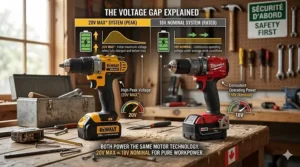
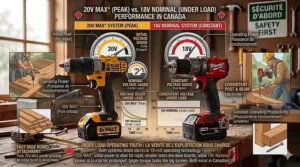
When you do the math, five cells wired in series give you 18V nominal (3.6V × 5) or 20V maximum (4V × 5). The battery chemistry, cell configuration, and actual power output remain identical—only the labelling philosophy differs between manufacturers and regions.
Why the Marketing Difference Exists
North American regulations permit manufacturers to advertise maximum voltage, while European consumer protection laws require nominal voltage ratings. DeWalt’s 20V MAX system in North America is sold as 18V XR internationally, using identical battery packs and tools. This explains why the same drill appears with different voltage labels depending on where you purchase it.
For Canadian shoppers, this means focusing on specifications that actually matter: torque ratings, motor type (brushed vs brushless), amp-hour capacity, and ergonomic design rather than getting hung up on voltage numbers that ultimately describe the same technology.
Brushless Motor Advantages: Why They’re Worth the Premium
The evolution from brushed to brushless motors represents one of the most significant advancements in cordless tool technology. Traditional brushed motors rely on carbon brushes making physical contact with a commutator to transfer electricity, creating friction, heat, and wear.
Brushless motors eliminate this mechanical contact entirely. By eliminating physical contact between components, brushless motors achieve greater efficiency, higher torque, and increased lifespan, especially in demanding applications. An electronic controller orchestrates current flow directly to motor windings, enabling intelligent power management that brushed motors simply can’t match. According to Consumer Reports, you can expect a 15 to 35 percent increase in performance compared with a brushed motor drill.
Real-World Performance Gains
Canadian contractors working through long days see the practical benefits immediately. Brushless motors can run up to 50 percent cooler than brushed motors, with excessive heat being the enemy of both the motor and the battery. This thermal efficiency proves particularly valuable during hot summer deck-building season in Ontario or when working in poorly-ventilated spaces. Research from Pro Tool Reviews confirms that 20V MAX tools deliver the exact same voltage as 18V tools, using identical lithium-ion cells in their battery packs.
The self-regulating nature of brushless technology means your drill automatically adjusts power delivery based on resistance. Driving screws into drywall requires far less energy than boring through two-by-fours, and brushless motors optimize battery consumption for each task. This intelligence translates to noticeably longer runtime per charge—often 30-50% improvements over comparable brushed models.
Maintenance Advantages
Traditional brushed motors require carbon brush replacement after every 50-60 hours of use. For professionals, this means regular downtime and parts costs. Brushless motors eliminate this maintenance entirely. While the initial purchase price runs higher, the long-term savings in replacement parts and extended motor lifespan typically offset the premium within two years of regular use.
Amp-Hour Capacity Explained: Understanding Your Battery’s Fuel Tank
When comparing cordless drills, amp-hour (Ah) ratings often get overshadowed by voltage discussions, yet they’re equally crucial for understanding tool performance. An amp-hour is the duration a battery can deliver a current flow of one amp—if a battery can deliver a 1A continuous discharge current for 2 hours, it has a charge capacity of 2Ah.
Think of amp-hours as your battery’s fuel tank size. A 2.0Ah battery stores twice the energy of a 1.0Ah battery, theoretically providing double the runtime under identical load conditions. However, real-world performance varies based on the task at hand.
How Amp-Hours Affect Real Work
Drilling pilot holes through softwood pine draws minimal current, allowing even a 1.5Ah battery to last hours. Conversely, boring 2″ holes through hardwood maple with a spade bit pulls heavy current, potentially draining a 2.0Ah battery in 20-30 minutes. Higher Ah batteries give you longer runtime and better performance under load—it’s about longer endurance, not more strength.
This distinction matters for Canadian DIYers planning their battery purchases. Building a single bookshelf? A compact 1.5Ah battery provides adequate runtime while keeping tool weight down. Framing an entire basement? Investing in 4.0Ah or 5.0Ah batteries eliminates constant charging interruptions.
Balancing Capacity and Weight
Here’s where personal preference enters the equation. Higher capacity batteries contain more cells, increasing both weight and physical size. A 5.0Ah battery might add 400-500 grams compared to a 2.0Ah pack. For overhead work—installing ceiling fixtures, hanging drywall, or drilling into floor joists from below—every gram counts during a long workday.
Many experienced users maintain a mixed battery collection: compact 2.0Ah packs for light work and precision tasks, with 4.0-5.0Ah batteries reserved for heavy-duty applications where runtime trumps weight concerns.
Motor Efficiency: Brushed vs Brushless Deep Dive
The motor type fundamentally determines how efficiently your drill converts electrical energy into mechanical work. This efficiency gap between brushed and brushless technology has profound implications for battery life and overall performance.
Brushed Motor Characteristics
Brushed motors employ a relatively simple design perfected over decades. Spring-loaded commutator brushes help the commutator make contact with the DC power source, making these carbon brushes critically important for operation. As the motor spins, these brushes maintain constant friction against the commutator, generating significant heat.
This mechanical friction creates three primary drawbacks: energy loss through heat generation, gradual brush wear requiring periodic replacement, and sparking at the brush-commutator interface. For occasional DIY use, these limitations remain manageable. Weekend warriors assembling occasional furniture or hanging shelves won’t notice substantial performance differences.
Brushless Motor Intelligence
Brushless motors flip the traditional design inside-out. The rotor comprises a permanent magnet in brushless motors, while the stator includes a series of windings, with an electronic controller orchestrating current flow to create a rotating magnetic field. This reversed configuration enables several breakthrough advantages.
Without physical brush contact, brushless motors eliminate friction-related energy loss. The electronic controller monitors load conditions hundreds of times per second, adjusting power delivery with precision impossible in brushed designs. When you transition from drilling pilot holes to driving 3″ lag screws, the brushless motor seamlessly ramps up current to maintain consistent speed.
This intelligent power management allows brushless motors to consume less energy due to the absence of mechanical friction, translating into longer battery life. In practical terms, you’ll complete 30-40% more work per battery charge compared to equivalent brushed models—a meaningful difference for professional contractors billing by completed tasks rather than hours worked.
Runtime Performance: Maximizing Your Battery Life
Runtime represents the practical outcome of voltage, capacity, and motor efficiency working together. Understanding how these factors interact helps Canadian tool buyers make informed purchasing decisions aligned with their specific needs.
Real-World Runtime Expectations
A typical 2.0Ah battery powering a brushed 20V drill might deliver 45-60 minutes of continuous use under moderate load conditions—assembling furniture, hanging pictures, drilling pilot holes through softwood. Upgrade to a brushless motor with the same battery, and runtime extends to 60-80 minutes thanks to superior energy efficiency.
Swap in a 4.0Ah battery, and your brushless drill might operate for 2-2.5 hours of similar work. However, these estimates assume moderate loads. Heavy-duty applications like boring through concrete with masonry bits or driving hundreds of deck screws dramatically reduce runtime.
Canadian contractors working winter renovations face additional runtime challenges. Lithium-ion batteries lose capacity in cold temperatures—a 2.0Ah battery performing at -20°C might effectively function like a 1.5Ah battery. Smart operators keep spare batteries in insulated tool bags or even jacket pockets to maintain temperature, preserving full capacity.
Optimizing Battery Longevity
Beyond single-charge runtime, proper battery care extends overall lifespan. Lithium-ion batteries can be manufactured to optimize either energy density or power density, with different applications requiring different optimization approaches. Power tool batteries prioritize discharge rates over absolute capacity, enabling them to deliver high currents needed for demanding applications.
Store batteries at 40-60% charge rather than fully charged or completely depleted. Avoid leaving batteries in vehicles during Canadian winters or summers—temperature extremes accelerate internal degradation. Most quality lithium-ion tool batteries last 300-500 full charge cycles before capacity drops noticeably, but proper care can extend this to 500-700 cycles.
Backward Compatibility: Understanding Battery Ecosystems
One of the most strategic considerations when choosing between cordless drill systems involves long-term ecosystem compatibility. Major manufacturers design their battery platforms to work across entire tool lines, but understanding the nuances prevents costly mistakes.
Platform Commitment Matters
When you purchase your first DeWalt 20V MAX drill, you’re not just buying a drill—you’re buying into the DeWalt ecosystem. That same battery powers over 100 different tools from impact drivers to circular saws to outdoor equipment. This interoperability provides tremendous value, but also creates switching costs if you later prefer Milwaukee or Makita products.
Most manufacturers maintain backward compatibility within their voltage platform. DeWalt’s 20V MAX batteries work across all 20V MAX tools introduced since 2011. Older 18V NiCd tools from the pre-lithium era aren’t compatible, but lithium-powered 20V MAX tools share universal battery fit.
Cross-Brand Realities
Don’t expect to mix brands. Milwaukee M18 batteries physically won’t fit DeWalt 20V tools, even though the electrical systems are functionally identical. Each manufacturer uses proprietary mounting designs and communication protocols between batteries and tools.
Some enterprising companies manufacture adapters allowing cross-brand battery use, but these typically void warranties and occasionally damage tools due to communication protocol mismatches. Stick with batteries designed for your specific tool platform.
Voltage Platform Evolution
Manufacturers occasionally introduce new voltage platforms targeting specific market segments. Makita’s XGT 40V platform (actually 36V nominal—same marketing game) addresses heavy-duty applications beyond traditional 18V capabilities. These new platforms don’t replace existing lines but expand options.
For Canadian buyers, this means choosing a platform with staying power. DeWalt, Milwaukee, Makita, and Bosch all demonstrate strong commitment to their primary 18V/20V platforms, with no indication of discontinuation. Smaller brands or proprietary store brands carry higher obsolescence risk—research before committing.
How to Choose Between 18V and 20V Drills
Armed with knowledge that 18V and 20V labels describe identical battery technology, your selection criteria should focus on specifications that genuinely impact performance and value.
Assess Your Actual Needs
Start with honest evaluation of intended use. Occasional furniture assembly, picture hanging, and basic home maintenance? Even entry-level brushed models from reputable brands exceed these requirements. A $89 kit provides perfectly adequate performance for tasks occupying a few hours monthly.
Regular renovations, deck building, or professional use? Invest in brushless motors and higher capacity batteries. The efficiency gains and extended runtime justify premium pricing through reduced charging interruptions and longer tool lifespan. Professional contractors often recover the additional $100-150 investment within the first major project.
Consider Your Existing Tool Collection
Already own several Makita 18V tools? Adding another to your collection makes obvious sense. Already invested in Milwaukee M18 batteries? Branching into a different ecosystem doubles your charging infrastructure needs and prevents battery sharing between tools.
If you’re starting fresh, consider which brands offer best selection in tools you’ll eventually need. DeWalt and Milwaukee both offer excellent professional-grade options across comprehensive tool lines. Ryobi provides unmatched variety for DIY applications at budget-friendly pricing.
Evaluate Availability and Support
Living in rural Newfoundland or northern Ontario? Ensure replacement batteries and warranty service exist reasonably nearby. Major brands like DeWalt, Milwaukee, Makita, and Bosch maintain strong Canadian distribution networks. Specialty brands might require mail-order parts or long trips to service centers. According to the Power Tool Institute, proper battery care and understanding tool specifications are essential for safe and effective power tool use.
Check local pricing across Canadian Tire, Home Depot Canada, Rona, and Amazon.ca. Prices vary significantly, and seasonal sales offer opportunities to score premium tools at mid-tier pricing. Black Friday and Boxing Day sales in Canada typically feature tool kit discounts of 30-40%.
Battery Investment Strategy
Don’t underestimate battery costs. A quality 4.0Ah battery often retails for $79-129 CAD separately. If the “kit” includes only a single 1.5Ah battery, calculate the true cost of adding batteries needed for serious work. Sometimes a kit with two 2.0Ah batteries at $149 provides better value than a tool-only option at $119 when you factor in necessary battery purchases.
❓ FAQ: Common Questions About Cordless Drill Voltage
❓ Is a 20V drill actually more powerful than an 18V drill?
❓ Can I use 18V batteries on 20V tools or vice versa?
❓ How much does a quality cordless drill cost in Canada in 2026?
❓ What's the advantage of brushless cordless drills?
❓ How do I choose the right amp-hour battery capacity?
Conclusion: Making Your Best Choice
The 20V vs 18V cordless drill debate ultimately comes down to understanding that voltage labels represent marketing strategies rather than fundamental performance differences. Both systems use identical lithium-ion battery technology, with the actual power delivery determined by motor design, amp-hour capacity, and energy management sophistication.
For Canadian buyers in 2026, the smart approach prioritizes these genuine performance factors over voltage labels. Brushless motors deliver measurable efficiency gains worth the premium for regular users. Higher amp-hour batteries extend runtime but add weight—balance based on your specific applications. Ecosystem compatibility matters more than many realize, as expanding your cordless collection becomes financially impractical when switching between incompatible battery platforms.
Whether you choose DeWalt’s 20V MAX system, Makita’s 18V LXT platform, Milwaukee’s M18 lineup, or budget-friendly Ryobi ONE+, you’re accessing essentially identical battery technology presented under different marketing schemes. Focus your decision on motor type (brushless recommended for frequent use), battery capacity appropriate to your workload, and brand ecosystem alignment with your future tool needs.
The best drill for your Canadian workshop or job site balances power, runtime, weight, and budget within your actual usage patterns. Occasional DIYers thrive with $89-139 brushed models, while professional contractors justify $249-299 brushless investments through superior efficiency and longevity. Start with a quality mid-tier option from a major brand, expand your battery collection strategically, and you’ll build a versatile cordless system serving you through countless projects across Canada’s diverse climate and construction challenges.
Recommended for You
- 7 Best Lightweight Chainsaws for Seniors Canada 2026
- 7 Best Bench Grinders for Knife Sharpening Canada 2026
- 7 Best Digital vs Click Type Torque Wrench Canada 2026
Disclaimer: This article contains affiliate links to Amazon.ca. If you purchase products through these links, we may earn a small commission at no additional cost to you.
✨ Found this helpful? Share it with your friends! 💬🤗
