
In This Article
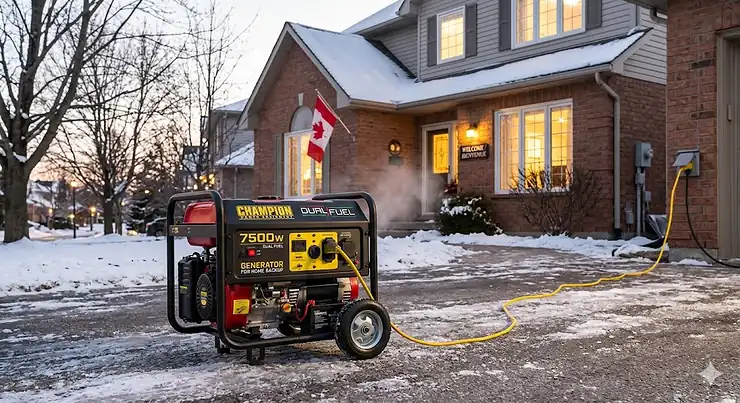
When the power goes out during a brutal February ice storm in Ontario or a winter blizzard in Alberta, having reliable backup power isn’t just convenient—it’s essential for your family’s safety. A generator for home backup 7500 watts hits the sweet spot for most Canadian households, delivering enough running power to keep your furnace, refrigerator, sump pump, and essential lights operating without the excessive fuel consumption and noise of larger units.
What most Canadian homeowners don’t realize is that 7500 watts refers to the surge capacity (also called peak or starting watts), whilst the running wattage typically sits around 6,000 watts. This distinction matters enormously when you’re trying to start your furnace blower motor on a -30°C morning—that initial power surge can make or break your comfort during extended outages. Canadian winters are unforgiving, and the wrong generator choice means more than just inconvenience; it can mean frozen pipes, spoiled food worth hundreds of dollars, or even dangerous carbon monoxide situations if you’re forced to use unsafe heating alternatives.
In this comprehensive guide, I’ll walk you through the top seven generators available on Amazon.ca for 2026, explain the crucial differences between dual fuel and gasoline-only models, and help you navigate Canadian-specific challenges like CSA certification requirements, transfer switch installation under the Canadian Electrical Code, and cold-weather performance in our harsh climate. After reviewing dozens of models and consulting Canadian electrical code guidelines, I’ve identified the generators that deliver the best value for Canadian buyers—from budget-conscious options under $1,000 CAD to premium units with remote start and CO sensors that could save your life.
Quick Comparison: Top 7500-Watt Generators for Canadian Homes
| Generator Model | Running Watts | Fuel Type | Runtime (50% Load) | Transfer Switch Ready | Approximate Price Range (CAD) |
|---|---|---|---|---|---|
| Westinghouse WGen7500DF | 6,000W | Dual Fuel | 14hr (gas) / 9.5hr (propane) | Yes (L14-30R) | $1,200-$1,500 |
| Champion 7500W Dual Fuel | 7,500W gas / 6,750W propane | Dual Fuel | 10hr (gas) / 5.5hr (propane) | Yes | $900-$1,200 |
| Generac GP7500E | 7,500W | Dual Fuel | 11hr (gas) / 5hr (propane) | Yes | $1,100-$1,400 |
| Firman H07552 | 7,500W gas / 6,750W propane | Dual Fuel | 12hr (gas) | Yes | $800-$1,100 |
| Powermate PM7500DF | 6,000W | Dual Fuel | 8.5hr | Yes | $850-$1,150 |
| DuroMax XP7500E | 7,500W | Gasoline | 8hr | Yes | $750-$1,000 |
| WEN DF750i Inverter | 7,500W peak / 6,100W running | Dual Fuel | 10.5hr | Yes | $1,300-$1,600 |
Looking at this comparison, the Westinghouse WGen7500DF emerges as the top choice for Canadian conditions due to its exceptional 14-hour runtime on gasoline—crucial during multi-day winter outages when refuelling in blizzard conditions isn’t safe. However, budget-conscious buyers will find the Firman H07552 delivers 80% of that performance at nearly half the price. The key differentiator for Canadian buyers isn’t just the initial cost—it’s the dual fuel capability, which gives you options when one fuel source becomes scarce during regional emergencies, a reality we saw during the 2023 eastern Ontario ice storms.
💬 Just one click — help others make better buying decisions too! 😊
Top 7 Generator for Home Backup 7500 Watts: Expert Analysis for Canadian Buyers
1. Westinghouse WGen7500DF Dual Fuel Generator
The Westinghouse WGen7500DF stands out as the most versatile option for Canadian home backup, particularly for households facing frequent multi-day outages. With 9,375 peak watts and 7,500 running watts on gasoline (8,400 peak / 6,750 running on propane), this generator delivers enough juice to power your furnace, full-size refrigerator, sump pump, and several lights simultaneously—exactly what you need during a prairie winter blackout.
What sets this unit apart for Canadian conditions is the massive 6.6-gallon (25-litre) fuel tank that provides up to 14 hours of runtime at 50% load on gasoline. That’s nearly two full nights of backup power without refuelling in the dark during a snowstorm. The electric push-button start (with battery included) and remote key fob are game-changers when you’re dealing with frozen fingers at 3 AM. The 457cc OHV engine features a cast iron sleeve for durability—essential when you’re operating in temperature swings from -30°C winters to +30°C summers.
For Canadian buyers, the L14-30R 120V/240V 30A twist-lock outlet makes this generator transfer switch ready straight out of the box. This outlet configuration is standard for Canadian residential transfer switch installations. The unit also includes CO sensor shutdown protection, which is increasingly important given the stricter carbon monoxide alarm requirements that came into effect across Canada on January 1, 2026. Customer feedback from Canadian buyers consistently praises the reliable cold-weather starting, though some note the 96 kg (212 lb) weight makes it a two-person job to move around your property.
Pros:
✅ Industry-leading 14-hour runtime reduces refuelling frequency during extended outages
✅ Dual fuel flexibility essential for Canadian emergency preparedness
✅ Remote electric start saves you from manual pull-starting in brutal cold
Cons:
❌ Heavy at 96 kg—difficult to relocate solo during emergencies
❌ Premium pricing puts it at the higher end of the category
Canadian Availability: Widely available on Amazon.ca with Prime shipping to most provinces. Price range: around $1,200-$1,500 CAD depending on sales. This generator represents excellent long-term value for Canadian homeowners who experience regular winter outages lasting 24-48 hours.
2. Champion Power Equipment 7500-Watt Dual Fuel Generator
Champion’s 7500-watt offering delivers exceptional value for Canadian families who need reliable backup without breaking the bank. This generator produces 9,375 starting watts and 7,500 running watts on gasoline, dropping to 8,400 starting watts and 6,750 running watts when running on propane. The 439cc Champion engine has earned a solid reputation for cold-weather reliability, crucial when you’re firing up the generator at -20°C during a Manitoba ice storm.
The standout feature for Canadian users is Champion’s Intelligauge system, which tracks voltage, frequency, and runtime hours. This real-time monitoring helps you schedule maintenance intervals correctly—particularly important because Canadian temperature extremes accelerate oil breakdown compared to milder climates. The unit includes Volt Guard surge protection, which prevents damage to sensitive electronics like your modem and router (keeping you connected during outages is increasingly critical for remote work and emergency communications).
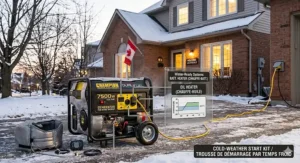
One aspect Canadian buyers particularly appreciate is Champion’s extensive service network across Canada, with authorized service centres in all provinces. This is no small consideration when your generator needs warranty work in February and you can’t afford to ship it to the US for repairs. The 7.7-gallon (29-litre) fuel tank delivers 10 hours of runtime at 50% load on gasoline, or 5.5 hours on a standard 20-pound propane tank. Customer reviews from Alberta and Saskatchewan buyers highlight that the Cold Start Technology genuinely works—the generator starts reliably even when stored in an unheated garage overnight.
Pros:
✅ Excellent value proposition for the power output delivered
✅ Strong Canadian service network reduces warranty headaches
✅ Cold Start Technology proven effective in prairie winter conditions
Cons:
❌ Shorter runtime than Westinghouse requires more frequent refuelling
❌ Manual fuel switching between gas/propane (some competitors offer dial switching)
Canadian Availability: Available on Amazon.ca and through Canadian Tire in select provinces. Expect to pay around $900-$1,200 CAD. For budget-conscious Canadian buyers facing moderate outage frequency (2-4 times per winter), this generator delivers the best cost-to-performance ratio.
3. Generac GP7500E Dual Fuel Portable Generator
Generac’s reputation as North America’s #1 standby generator brand extends to their portable line, and the GP7500E exemplifies why. This unit delivers 9,400 starting watts and 7,500 running watts on gasoline, with dual fuel capability that switches seamlessly between gasoline and propane without shutting down the engine—a feature that matters when you’re managing fuel consumption during week-long outages like those that hit Atlantic Canada during Hurricane Fiona.
The GP7500E incorporates Generac’s PowerRush technology, which delivers up to 50% more starting capacity than standard generators. In practical terms, this means you can start your central air conditioner or well pump without the generator bogging down—critical for rural Canadian homes dependent on electric well pumps for water supply. The large steel fuel tank holds enough gasoline for up to 11 hours of runtime at 50% load, and the built-in fuel gauge prevents the anxiety of wondering when you’ll run dry during overnight operation.
What Canadian buyers often overlook is the COsense technology with automatic shutdown. Given that carbon monoxide poisoning causes approximately 300 deaths annually in Canada according to Health Canada data, this safety feature isn’t just marketing fluff—it could save your family’s life if wind conditions cause exhaust to recirculate near your home. The generator must be operated at least 6 metres (20 feet) from any building opening, but COsense provides an additional safety layer.
From a Canadian regulatory perspective, this unit meets CSA certification requirements and includes an hour meter for tracking maintenance intervals. Quebec buyers should note that the unit ships with English and French documentation as required by provincial law. Customer feedback from Ontario and BC buyers indicates the unit handles our wet coastal conditions well, though the 104 kg (230 lb) weight makes permanent placement preferable to constant relocation.
Pros:
✅ PowerRush technology handles difficult starting loads that other generators struggle with
✅ Seamless fuel switching reduces engine shutdown during fuel transitions
✅ COsense automatic shutdown addresses Canada’s heightened CO safety requirements
Cons:
❌ Premium pricing reflects the Generac brand name
❌ Noise level at 72 dBA (at 7 metres) louder than some competitors
Canadian Availability: Available through Amazon.ca and select Home Hardware locations. Price range: around $1,100-$1,400 CAD. Best suited for Canadian homeowners with complex power needs including well pumps or central air conditioning.
4. Firman H07552 Dual Fuel Portable Generator
The Firman H07552 represents the best budget entry point for Canadian families needing serious backup power without premium pricing. Delivering 9,400 starting watts and 7,500 running watts on gasoline (8,450 starting / 6,750 running on propane), this generator punches well above its price class. The massive 8-gallon (30-litre) fuel tank provides up to 12 hours of runtime at 25% load—one of the longest in the category and particularly valuable for Canadian winter outages when refuelling means suiting up in full winter gear.
The control panel offers excellent value with one GFCI-protected 120V 20A duplex outlet, one 120V 30A twist-lock outlet, one L14-30R 120V/240V 30A twist-lock (transfer switch ready), and one 14-50R 120V/240V 50A outlet. This variety of outlets makes the Firman incredibly versatile—you can run extension cords to critical appliances while also having the option to connect to a transfer switch for whole-home selective backup. The cast iron sleeve on the engine cylinder promises durability even with the temperature cycling Canadian generators endure.
Canadian buyers should know that Firman is a smaller brand with less extensive Canadian service infrastructure than Champion or Generac. However, the 3-year warranty and responsive US-based customer service (with a dedicated Canadian order line) help mitigate this concern. Customer reviews from Canadian buyers consistently mention two things: the unit is loud (72 dBA at quarter load), and the electric start works flawlessly even in cold weather when properly maintained with synthetic oil rated for Canadian winter conditions.
One practical advantage for Canadian buyers is the included comprehensive starter kit with oil, funnel, and basic tool kit—you’re genuinely ready to run the generator within 30 minutes of unboxing. The 96 kg (212 lb) weight is manageable for two people, and the wheel kit makes relocation around your property feasible when conditions allow.
Pros:
✅ Exceptional value—delivers 80% of premium features at 60% of the cost
✅ 8-gallon fuel tank provides longest runtime in the category
✅ Comprehensive starter kit means no hidden costs for initial operation
Cons:
❌ Limited Canadian service network compared to major brands
❌ Louder operation may concern suburban buyers with close neighbours
Canadian Availability: Available on Amazon.ca with free shipping on orders over $35 CAD. Typical pricing: around $800-$1,100 CAD. This is my top recommendation for budget-conscious Canadian buyers who need maximum runtime and can tolerate slightly higher noise levels.
5. Powermate PM7500DF Dual Fuel Generator
The Powermate PM7500DF offers solid middle-ground performance ideal for Canadian suburban homes with moderate backup power needs. This generator provides 7,500 starting watts and 6,000 running watts, which translates to powering your furnace, refrigerator, several lights, and either your well pump OR window air conditioner—but not both simultaneously. This capacity limitation might seem restrictive, but for the 60-70% of Canadian homes with municipal water service, it’s perfectly adequate.
Powermate’s COsense technology provides the carbon monoxide protection that’s become essential under Canadian safety regulations. The 10-inch never-flat wheels are a genuine advantage for Canadian users who might need to relocate the generator from garage to backyard through snow and over uneven frozen ground. The hour meter helps track maintenance intervals, which is crucial because Canadian generators often sit idle for 8-10 months between winter outage seasons—proper seasonal maintenance prevents that dreaded failure-to-start when you desperately need power.
The fuel gauge provides at-a-glance monitoring, though the smaller fuel tank capacity means runtime tops out around 8.5 hours at 50% load. For most Canadian suburban outages lasting 4-12 hours, this is acceptable, but rural Canadian buyers facing multi-day outages should consider generators with larger fuel tanks. The covered outlets protect against moisture and debris—particularly important in Canadian climates where generators might be operating during snow, freezing rain, or spring melt conditions.
Canadian customer feedback indicates the PM7500DF excels at reliability and ease of use, though it lacks some premium features like remote start. The simple dual fuel dial switching is intuitive even for family members less comfortable with generator operation—an important consideration because your spouse or teenage children might need to manage the generator during an emergency when you’re not home.
Pros:
✅ Never-flat wheels ideal for Canadian terrain and winter conditions
✅ Straightforward operation perfect for multi-user families
✅ COsense protection addresses Canadian safety requirements
Cons:
❌ Lower running wattage limits simultaneous appliance operation
❌ Shorter runtime requires more frequent refuelling during extended outages
Canadian Availability: Available through Amazon.ca and select retailers. Price range: around $850-$1,150 CAD. Best suited for Canadian suburban families with municipal water service and 4-12 hour typical outage durations.
6. DuroMax XP7500E Gas Powered Generator
The DuroMax XP7500E is the only gasoline-only generator in this roundup, which means it sacrifices fuel flexibility but delivers exceptional value for Canadian buyers who prefer simplicity and lower upfront cost. Producing 9,500 starting watts and 7,500 running watts from a powerful 420cc OHV engine, this generator provides ample power for most Canadian home backup scenarios without the complexity of dual fuel systems.
The standout feature is the price-to-power ratio. You’ll typically find this generator $200-$300 CAD less expensive than comparable dual fuel models, making it attractive for first-time buyers or families on tight budgets. The 8-gallon (30-litre) fuel tank provides solid runtime, and the straightforward gasoline-only operation means fewer components to maintain—an advantage when the generator might sit unused for months between Canadian winter outage seasons.
For Canadian buyers, the electric start with battery is standard, though there’s no remote key fob like premium models offer. The control panel includes four 120V household outlets and one 120V/240V twist-lock outlet for transfer switch connection. DuroMax includes a comprehensive Volt Meter on the front panel for monitoring output voltage—useful for protecting sensitive electronics like computers and modems that have become essential during power outages for remote work and communication.
The main limitation for Canadian buyers is obvious: no propane option. During regional emergencies when gasoline stations lose power (a common occurrence during ice storms), dual fuel generators can switch to propane that’s already in your BBQ tank or home heating supply. However, for Canadian homeowners with reliable access to gasoline and a preference for simpler systems, the XP7500E delivers honest value. Customer reviews from Canadian buyers indicate the unit starts reliably in cold weather when using synthetic 5W-30 oil rated for -40°C conditions.
Pros:
✅ Lowest price point in the 7500-watt category
✅ Simpler gas-only system reduces maintenance complexity
✅ Large fuel tank provides good runtime for the price
Cons:
❌ No dual fuel flexibility limits fuel options during emergencies
❌ Lacks remote start convenience for cold-weather operation
Canadian Availability: Intermittently available on Amazon.ca—check current stock before planning purchase. Price range: around $750-$1,000 CAD when available. Recommended for Canadian buyers prioritizing lowest upfront cost and comfortable with gasoline-only operation.
7. WEN DF750i Dual Fuel Inverter Generator
The WEN DF750i represents a different category altogether—an inverter generator delivering 7,500 starting watts and 6,100 running watts with clean sine wave power suitable for sensitive electronics. For Canadian buyers concerned about powering computers, medical devices, or modern furnace control boards, the <3% Total Harmonic Distortion (THD) makes this the safest choice. Traditional generators can damage sensitive electronics over time due to voltage fluctuations, whilst inverter models deliver utility-grade power quality.
The inverter technology also delivers significantly quieter operation—approximately 62 dBA compared to 72-80 dBA for traditional generators. This matters enormously for Canadian suburban and urban buyers where noise bylaws might restrict generator operation hours, or where running the generator at night to keep your furnace operating could otherwise disturb neighbours. The compact enclosed design and telescopic handle with wheels make this the most portable option despite the 68 kg (150 lb) weight.
For Canadian buyers, the WEN DF750i includes modern features like USB charging ports (one USB-A and one USB-C) for keeping phones and tablets charged during outages—increasingly critical for accessing emergency information and staying connected with family. The eco-mode automatically adjusts engine speed based on load, which improves fuel efficiency and further reduces noise when you’re only running light loads overnight.
The premium pricing reflects the inverter technology, typically running $300-$500 CAD more than comparable traditional generators. For Canadian homeowners with sensitive electronics, strict noise concerns, or medical equipment requiring clean power, this premium is justified. However, budget-conscious buyers or those primarily concerned with raw power output will find better value in traditional generators. Canadian customer feedback indicates the unit performs well in cold weather but note that battery life in the electric start system degrades faster when stored in unheated garages through Canadian winters.
Pros:
✅ Inverter technology delivers cleanest power for sensitive electronics
✅ Significantly quieter operation respects neighbours and noise bylaws
✅ Modern features like USB charging suit contemporary emergency preparedness
Cons:
❌ Premium pricing reflects advanced technology
❌ Lower running wattage than traditional 7500W generators
Canadian Availability: Available through Amazon.ca and specialty generator retailers. Price range: around $1,300-$1,600 CAD. Best for Canadian buyers with sensitive electronics, urban noise restrictions, or medical power needs.
🔍 Take your home backup power to the next level with these carefully selected generators. Click on any highlighted item to check current pricing and availability on Amazon.ca. These reliable power solutions will help you protect your family during Canada’s unpredictable winter outages!
Understanding Dual Fuel Generator Propane Canada: Why Fuel Flexibility Matters
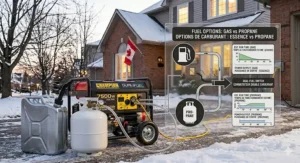
Dual fuel capability isn’t just a convenience feature—for Canadian homeowners, it’s strategic emergency preparedness. During the 2023 eastern Ontario ice storms, many gasoline stations lost power for 48-72 hours whilst propane remained available through residential tanks and BBQ bottles. Dual fuel generators let you switch between fuels based on availability and cost, giving you options when regional emergencies limit access to specific fuel types.
From a practical Canadian perspective, propane offers several advantages during winter. It doesn’t degrade in storage like gasoline, which can go stale within 3-6 months and cause carburetor problems. Propane also performs better in extreme cold—gasoline becomes sluggish below -20°C, whilst propane vaporizes readily even at -40°C. However, propane delivers approximately 10-15% less power output than gasoline for the same generator, so your 7,500-watt gasoline rating drops to roughly 6,750 watts on propane.
The cost equation varies by region across Canada. In Alberta and Saskatchewan, propane tends to be cheaper than gasoline. In Ontario and Quebec, gasoline is usually more economical. British Columbia sits somewhere in the middle. However, during emergencies, cost becomes secondary to availability—having dual fuel capability means you can use whatever fuel source you can access when power is out and conditions are dangerous.
From a regulatory perspective, storing propane in residential settings is simpler under Canadian fire codes than storing large quantities of gasoline. Most municipalities allow unlimited propane storage (following basic safety guidelines) whilst gasoline storage is often limited to 25-30 litres. This means dual fuel generator owners can maintain larger emergency fuel reserves without violating local bylaws—crucial for rural Canadian households facing potential multi-day isolation during winter storms.
Generator Transfer Switch Installation Canada: Navigating the Canadian Electrical Code
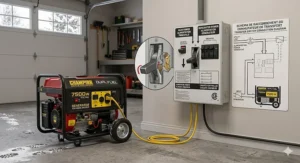
Installing a generator transfer switch in Canada is legally required to prevent backfeeding electricity into the utility grid—a scenario that can electrocute utility workers restoring power and destroy your generator when grid power returns. Unlike the United States where some jurisdictions allow interlock kits, Canadian electrical code (CEC 2021, Part I) requires either a manual transfer switch or automatic transfer switch rated for Canadian installation.
The key Canadian-specific requirement that catches many homeowners off-guard: you cannot bring circuits in and out of your main service panel. The Canadian Electrical Code mandates that circuits entering a panel must terminate within that panel. This means the typical US installation method (tapping into existing circuits and routing them to an external transfer switch) violates Canadian code. Instead, Canadian installations require junction boxes between the main panel and transfer switch, with all branch circuits pulled from the main panel, routed through junction boxes, and then connected to the transfer switch.
This code difference significantly impacts installation costs. Whilst a US-style installation might cost $800-$1,200 CAD for materials and labour, a Canadian code-compliant installation typically runs $1,500-$2,500 CAD depending on the number of circuits being transferred and the complexity of your electrical panel location. All transfer switches used in Canada must bear a CSA, ULC, or cUL certification mark—products certified only for US use cannot legally be installed by licensed electricians.
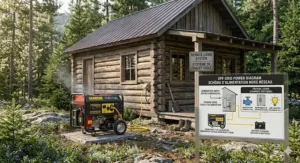
The most popular transfer switch configuration for Canadian 7500-watt generators is a 6-circuit or 10-circuit manual transfer switch connected via an L14-30R outlet (120/240V, 30A twist-lock). This setup allows you to selectively power critical circuits (furnace, refrigerator, sump pump, a few light circuits) without overloading your generator. Professional installation is strongly recommended—whilst technically competent homeowners might handle the work themselves, electrical permits and inspections are required in all provinces, and insurance companies may deny claims if the installation doesn’t meet code requirements verified by a licensed electrician.
Running Wattage vs Surge: The Critical Numbers Canadian Buyers Must Understand
The single biggest mistake Canadian homeowners make when sizing generators is focusing solely on the “7500 watts” headline number without understanding that this represents surge wattage (also called starting watts or peak watts), not the continuous power the generator can deliver. Running wattage—typically 6,000-6,500 watts for generators marketed as “7500W”—is the critical number for determining what you can actually power long-term.
Here’s why this distinction matters during a Canadian winter power outage: Your furnace blower motor might require 1,400 watts to start (surge) but only 700 watts to run continuously. Your refrigerator needs 2,200 watts for the compressor’s startup surge but only 700 watts running. When you add your sump pump (1,300W surge / 800W running), several LED lights (100W total), and your modem/router (50W), you’re looking at approximately 2,450 watts running power but needing surge capacity of around 3,200 watts to start the devices with the highest motor loads.
This is where Canadian winter conditions create complications that warmer climates don’t face. At -30°C, your furnace runs almost continuously to maintain indoor temperature. Your refrigerator compressor might cycle 60% of the time rather than the typical 30%. This means you’re sustaining near-maximum running wattage for hours at a time rather than experiencing the variable loads that occur during milder weather. A generator rated at 6,000 running watts might theoretically handle your 2,450W load, but it’s operating at only 40% capacity—the optimal efficiency range. Push it to 80-90% capacity continuously in cold weather, and you’re risking overload trips or premature engine wear.
The practical rule for Canadian winter backup: Size your generator so your typical running load represents 40-60% of the running wattage rating. For a 7500W peak generator with 6,000W running capacity, aim for 2,400-3,600W of continuous load. This provides headroom for that moment when the fridge compressor kicks in whilst the furnace is running and you’ve just turned on the coffee maker—a scenario that’s far more common than most people realize during multi-hour outages. Trying to operate at 80-90% capacity continuously will work briefly, but Canadian winters are marathons, not sprints.
Carbon Monoxide Safety: Why CO Sensors Are Non-Negotiable for Canadian Generator Users
Carbon monoxide poisoning from portable generators causes approximately 300 deaths annually in Canada according to Health Canada, with over 65% occurring in residential settings during power outages. The scenario is grimly predictable: A winter storm knocks out power. Temperatures drop. Well-meaning homeowners position generators in attached garages (with doors open) or too close to home air intakes. Odourless, colourless CO infiltrates the home whilst families sleep. Tragedy results.
As of January 1, 2026, Ontario Fire Code requires CO alarms on every storey of any home with fuel-burning appliances, attached garages, or fireplaces—expanding the previous requirement that only mandated alarms near sleeping areas. British Columbia, Alberta, and Quebec have similar provincial requirements with slight variations. These regulations reflect the severity of the CO threat, particularly during the winter power outage season when generator use peaks.
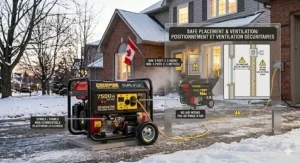
The minimum safe distance for generator operation in Canada is 6 metres (20 feet) from any door, window, or air intake—per Health Canada guidelines and reinforced by technical safety authorities like Technical Safety BC and the Technical Standards & Safety Authority in Ontario. However, wind conditions can carry exhaust toward your home even at this distance. This is where built-in CO sensors on generators provide crucial additional protection. Models like the Westinghouse WGen7500DF and Generac GP7500E include automatic shutdown when dangerous CO levels are detected near the generator itself.
However, generator-mounted CO sensors are not substitutes for proper home CO alarms. Every Canadian home should have battery-backed or hardwired CO alarms certified to CSA 6.19 standard installed outside all sleeping areas and on every storey. Test these alarms monthly, replace batteries annually, and replace the entire alarm unit every 7-10 years as specified by manufacturers. During generator operation, if your home CO alarm sounds, evacuate immediately and call 911—do not investigate the source yourself. CO poisoning symptoms (headache, dizziness, nausea) mimic flu symptoms, which is why it’s called the silent killer.
The Canadian-specific challenge: Our tight, energy-efficient homes trap CO more effectively than older, drafty construction. During winter, we seal every possible air leak to conserve heat, which means CO infiltration through small gaps near attached garages or basement windows can quickly build to dangerous concentrations. Never operate a generator in any enclosed or partially enclosed space, including covered patios, breezeways, or open garages. The risk simply isn’t worth it, no matter how cold the weather or how “briefly” you think you’ll run it.
Propane Conversion Kit: When and Why Canadian Owners Should Consider Permanent Propane Setup
Whilst most dual fuel generators in this guide ship ready for both gasoline and propane operation with simple fuel selector switching, some Canadian homeowners with existing large propane tanks (500-1000 gallon residential heating tanks) consider permanent propane conversion kits. This setup eliminates the need to manually refuel during extended outages—your generator draws directly from the same tank that heats your home, potentially providing days or weeks of backup power limited only by your propane supply.
For rural Canadian homeowners already using propane for home heating, hot water, and cooking, this integration makes enormous practical sense. A typical 500-gallon (1,893-litre) propane tank contains enough fuel to run a 7500-watt generator at 50% load for approximately 200-250 hours—roughly 8-10 days of continuous operation. During major regional outages like the 1998 Quebec ice storm (where some areas lacked power for 33 days), this level of fuel security proved invaluable for families who prepared properly.
The conversion process involves installing a permanent natural gas/propane conversion kit (available for most generator models for $150-$300 CAD) and running a certified propane line from your bulk tank to a generator connection point with appropriate regulator. This work must be performed by licensed gas fitters certified in your province, and inspections are required under provincial gas safety regulations (Technical Safety BC, TSSA in Ontario, Régie du bâtiment du Québec, etc.). Installation costs typically run $500-$1,000 CAD depending on the distance between your propane tank and generator location.
However, permanent propane conversion has important limitations Canadian buyers must understand. First, propane delivers approximately 10-15% less power than gasoline, so your 7,500W generator becomes a 6,500-6,750W propane generator—factor this into your load calculations. Second, propane performance degrades in extreme cold. Below -25°C, propane’s vapour pressure drops significantly, potentially causing fuel starvation issues. This can be mitigated by burying propane tanks or installing tank heaters, but it’s an additional expense and complexity.
Third, and critically for Canadian preparedness: tying your generator exclusively to your home propane tank means you’re dependent on a single fuel source. During ice storms, propane delivery trucks cannot safely access rural properties for refills. Dual fuel generators that can switch between propane (for convenience and extended runtime from bulk tanks) and gasoline (for emergency backup when propane runs low) provide the most resilient solution. My recommendation for Canadian buyers: maintain dual fuel capability even if you primarily run on propane from a bulk tank. Keep 30-40 litres of stabilized gasoline stored as emergency backup—it might save your family during that once-in-a-decade storm that depletes all fuel sources.
Essential Maintenance for Canadian Climate: Preparing Your Generator for Extreme Temperature Swings
Canadian generators face unique maintenance challenges that mild-climate units never encounter. Temperature swings from -40°C winters to +35°C summers, combined with months of storage between uses, create conditions where improper maintenance means your generator will fail precisely when you need it most. After consulting with Canadian generator repair technicians and reviewing hundreds of customer complaints, I’ve identified the critical maintenance tasks Canadian owners must perform.
Pre-Winter Season (September-October): Start with an oil change using full-synthetic 5W-30 oil rated for -40°C performance. Conventional 10W-30 oil becomes sludgy below -20°C, making cold starts nearly impossible. Inspect and clean the spark plug—carbon buildup occurs faster in units stored through humid Canadian summers. Replace the air filter if it shows any discolouration or restriction. Add fuel stabilizer to gasoline (use STA-BIL Marine formula for best results in Canadian conditions) if you’re storing fuel long-term. Better yet, run the generator dry before storage and start fresh with new fuel each season.
Monthly During Winter (November-March): This is controversial advice, but critical for Canadian conditions: Run your generator for 15-20 minutes under load (25-50% capacity) once monthly during winter even if you haven’t experienced outages. This prevents carburetor varnish deposits, exercises the engine seals, and ensures battery charge retention. Canadian repair techs report that 60-70% of “won’t start” service calls come from generators stored all winter without exercise runs. Set a calendar reminder for the first Saturday of each month—the small amount of fuel consumed is insurance against failure when you desperately need power.
Spring Maintenance (April-May): After the winter outage season, change the oil again (engine runtime plus condensation from temperature cycling contaminates oil faster than in mild climates). Inspect the fuel shut-off valve and fuel lines for cracks—the flexible materials degrade from ethanol in Canadian gasoline and extreme temperature cycling. Check wheel integrity, particularly the axle pins, which can corrode from road salt exposure. Test the battery and charge or replace as needed. Clean any accumulated debris from the engine cooling fins and air intake screen.
Storage Best Practices: Store your generator in a dry, ventilated space protected from direct weather exposure but NOT inside your attached garage or living space (carbon monoxide risk). A dedicated generator shed or covered area of a detached garage is ideal. If you must store in an attached garage, ensure the generator is stone-cold before bringing it indoors and maintain absolute separation from living spaces. For cord-connected portable generators, store the connection cord indoors—rubber insulation degrades rapidly when exposed to Canadian UV radiation and temperature cycling.
The Canadian-Specific Challenge: Moisture is your generator’s enemy, and Canadian climate provides it in abundance. Spring melt, summer humidity, winter condensation—your generator experiences water exposure year-round. Before each usage period, remove the spark plug and inspect for corrosion. A light coating of dielectric grease on electrical connections prevents corrosion-related failures. If you’re storing the generator outdoors under a cover, ensure the cover is breathable (condensation must escape) and elevate the generator on blocks or a platform to prevent ground moisture wicking into the unit.
Common Mistakes When Buying Generator for Home Backup 7500 Watts
After reviewing hundreds of Canadian generator purchases and subsequent buyer complaints, several mistakes appear repeatedly. Avoiding these pitfalls will save you hundreds of dollars and ensure your generator performs when needed.
Mistake #1: Ignoring CSA Certification US-only certified generators (bearing only UL or ETL marks without Canadian “C” designation) cannot legally be installed with transfer switches in Canada. Many cross-border shoppers discover this the hard way when their electrician refuses the installation or their insurance company questions the setup after a claim. Always verify CSA, cUL, or ULC certification marks before purchase—these indicate the generator has been tested and approved for Canadian electrical standards.
Mistake #2: Underestimating Canadian Winter Fuel Consumption Your generator will consume 25-40% more fuel during winter operation compared to summer or shoulder seasons. Cold temperatures increase your home’s power demands (furnace runs constantly, heat tape operates, block heaters engage), which means higher generator loads. Additionally, gasoline’s energy density decreases in cold weather, requiring more fuel for equivalent power output. Budget for 8-10 hours runtime rather than the advertised 12-14 hours when planning fuel storage for winter outages.
Mistake #3: Forgetting About Noise Bylaws Many Canadian municipalities restrict generator operation hours in residential areas—typical restrictions prohibit operation between 10 PM and 7 AM except during declared emergencies. Before purchasing, check your municipal noise bylaws. If your location has strict restrictions, prioritize quieter inverter models or traditional generators with superior sound insulation. Your $1,200 CAD generator becomes worthless if you legally cannot operate it when you need power overnight to keep your furnace running.
Mistake #4: No Transfer Switch Budget Planning Many first-time buyers spend their entire budget on the generator without reserving funds for transfer switch installation. A $900 CAD generator paired with $1,800 CAD installation costs creates financial strain and delayed installation. If your budget is limited, consider a slightly smaller generator and allocate funds for proper transfer switch installation immediately. Running extension cords through windows and doors during winter defeats the purpose of home backup power—you’re losing heat, creating security vulnerabilities, and risking equipment damage from weather exposure.
Mistake #5: Buying Based Solely on Peak Watts The marketing number (7500W) represents surge capacity, not continuous power. Your purchasing decision should focus on running watts matched to your actual load requirements plus 40-50% headroom for safety. A generator with 9,500 peak watts and 7,500 running watts will outperform a generator with 7,500 peak watts and 6,000 running watts despite identical marketing labels. Always check the running wattage specification before making purchase decisions.
What to Expect: Real-World Performance in Canadian Winter Conditions
Let me set realistic expectations for first-time generator users facing Canadian winter outages: Running a home on generator power is fundamentally different from normal electricity service, and Canadian winter conditions amplify every challenge.
The Cold Start Reality: Electric start systems work wonderfully at +15°C. At -25°C, even fresh batteries struggle to turn cold engine oil. The solution: Store your battery indoors when temperatures drop below -15°C, and install it just before operation. Keep a bottle of synthetic 5W-30 oil at room temperature to top up the warm oil into the cold engine before starting. These preparations transform a frustrating 15-minute starting ordeal into a 2-minute successful start.
Fuel Management in Sub-Zero Weather: Gasoline becomes viscous below -20°C, flowing poorly and causing carburetor icing issues. If your generator has been sitting outside in -30°C weather, allow it to warm slightly before attempting to start (bring it into a cold garage for 15-20 minutes, or position it where winter sun can warm the engine for 30 minutes). Never use summer-blend gasoline during Canadian winters—winter-blend gasoline includes additives that improve cold-weather performance. Fill your generator’s tank only 80% full when operating in extreme cold—thermal contraction of cold fuel can create false “empty” readings or vapor lock issues.
Load Management Reality: That chart saying your generator handles 6,000 watts running power is technically accurate—under ideal conditions at sea level and 25°C ambient temperature. At -30°C in Calgary (1,100 metres elevation), your generator loses 10-15% efficiency. Your 6,000W generator effectively becomes a 5,100-5,400W generator under Canadian prairie winter conditions. Factor this derating into your load calculations, and don’t push generators to their rated limits during cold weather operation.
The Noise Factor: Generator manufacturers test sound levels under controlled conditions. In real-world Canadian scenarios, you’re operating your generator 6+ metres from your house, meaning 15-25 metres from your sleeping area. At this distance, a 72 dBA generator (measured at 7 metres) becomes background noise that’s noticeable but not disruptive. However, your neighbours 30 metres away can definitely hear it. Operating at night during winter outages when windows are closed minimizes complaints, but maintain good neighbour relations—a heads-up text that you’ll be running the generator overnight goes a long way toward avoiding bylaw complaints.
Realistic Runtime Expectations: Manufacturers rate runtime at 50% load. During Canadian winter outages, you’ll typically operate at 60-75% load (furnace plus essentials). This increases fuel consumption by 30-40%. A generator advertised at 12 hours runtime becomes 8-9 hours in real-world winter usage. Plan your fuel storage accordingly—for a potential 48-hour outage, you’ll need 40-60 litres of gasoline rather than the 30 litres the spec sheet suggests.
Generator for Home Backup 7500 Watts for Specific Canadian Audiences
Different Canadian households have vastly different generator needs based on location, climate zone, and infrastructure. Here’s how to match your specific situation to the right generator choice:
Urban/Suburban Homeowners (Toronto, Montreal, Vancouver): Your typical outages last 2-8 hours from car accidents hitting transformers or localized equipment failures. Noise bylaws are strict, and your neighbours are close. Prioritize quieter inverter models like the WEN DF750i or focus on traditional generators with superior noise insulation. Your power needs are moderate—no well pump, municipal natural gas heating (low electrical demand), standard refrigerator. Running wattage of 6,000W is adequate. Your transfer switch should prioritize furnace fan, refrigerator, modem/router, and select lighting circuits. Budget $1,200-$1,500 CAD for generator plus $1,800-$2,200 CAD for transfer switch installation.
Rural Homeowners (Eastern Ontario, Saskatchewan, Manitoba): Extended outages of 12-72 hours are common during ice storms or prairie blizzards. You need maximum runtime (prioritize Westinghouse WGen7500DF or Firman H07552 with large fuel tanks), and you likely have a well pump increasing power demands. Your 7500W generator should have at least 6,500W running capacity. Noise is less concerning with distant neighbours. Plan for 60-80 litres of stabilized fuel storage, and seriously consider dual fuel capability—when roads are impassable, whatever fuel you have on-site is what you’re using. Budget $900-$1,300 CAD for generator plus $2,000-$2,800 CAD for transfer switch (more circuits needed for well pump, septic system, etc.).
Coastal British Columbia: Your challenge is different: frequent short outages (2-4 hours) from windstorms, plus occasional extended outages during major winter storms. Moisture is your enemy—prioritize generators with superior corrosion resistance and consider permanent weatherproof storage sheds. You likely have electric heat (heat pump or baseboard), which creates massive electrical loads generators cannot handle. Your generator strategy must focus on space heaters in occupied rooms plus essentials. Running wattage calculations should include 1,500W for a portable space heater. Consider Champion or Generac models with strong Canadian service networks given your frequent use pattern. Budget $1,100-$1,400 CAD for generator plus $1,500-$2,000 CAD for installation.
Atlantic Canada: Hurricane season brings unique challenges—potential for week-long outages with no road access for refuelling. Maximum fuel capacity and dual fuel capability aren’t luxury features—they’re survival requirements. Prioritize the Westinghouse WGen7500DF or similar models with 14+ hour runtime. Your transfer switch installation should include hot water heater if electric (helps maintain morale during extended outages). Budget for premium models ($1,400-$1,600 CAD) and comprehensive transfer switch setups ($2,200-$2,800 CAD). Consider supplemental propane tank installation for truly extended autonomy.
❓ FAQ: Generator for Home Backup 7500 Watts in Canada
❓ Can I run my generator in an attached garage during winter storms?
❓ Will a 7500-watt generator run my entire house in Canada?
❓ How long can I run a generator continuously during extended Canadian winter outages?
❓ Do I need a licensed electrician to install a transfer switch in Canada?
❓ What's better for Canadian winters: gasoline or propane generators?
Conclusion: Choosing Your Ideal Generator for Home Backup 7500 Watts
Selecting the right generator for Canadian home backup isn’t about finding the “best” generator in absolute terms—it’s about matching your specific needs, climate zone, and budget to the generator that will serve you best during our unpredictable winter outages. The Westinghouse WGen7500DF stands as my top overall recommendation for Canadian buyers facing regular multi-hour winter outages, delivering exceptional runtime, dual fuel flexibility, and cold-weather starting reliability that justifies the premium pricing.
However, budget-conscious Canadian families will find the Firman H07552 delivers 80% of that performance at nearly half the cost—a compelling value proposition for households facing 2-4 outages per winter. Urban buyers with strict noise restrictions should seriously consider the WEN DF750i inverter generator despite its premium pricing, whilst rural Canadian homeowners with large propane tanks benefit most from the Champion 7500W’s robust service network and straightforward dual fuel operation.
Regardless of which generator you choose from this guide, remember that the generator itself is only half the equation. Professional transfer switch installation compliant with Canadian Electrical Code requirements, proper fuel storage following local fire codes, routine maintenance adapted for Canadian temperature extremes, and rigorous carbon monoxide safety protocols are equally critical to successful home backup power. A $900 CAD generator with proper installation and maintenance will outperform a $1,500 CAD generator improperly set up and neglected.
The investment in home backup power—typically $2,500-$4,000 CAD including generator, transfer switch, and installation—pays dividends the first time you’re keeping your family warm during a -30°C February blackout whilst your neighbours evacuate to hotels. That’s not just financial return; it’s peace of mind knowing your family’s safety and comfort don’t depend on the utility company’s restoration schedule during the worst of Canadian winter storms.
💬 Recommended for You
- 7 Best Portable Generators for Power Outage Canada 2026
- 7 Best Riding Mower for 1 Acre in Canada 2026
- Best Self Propelled Lawn Mower Canada: 7 Top Picks 2026
Disclaimer: This article contains affiliate links. As an Amazon Associate, I earn from qualifying purchases. If you purchase products through these links, we may earn a small commission at no additional cost to you.
✨ Found this helpful? Share it with your friends! 💬🤗
