
In This Article
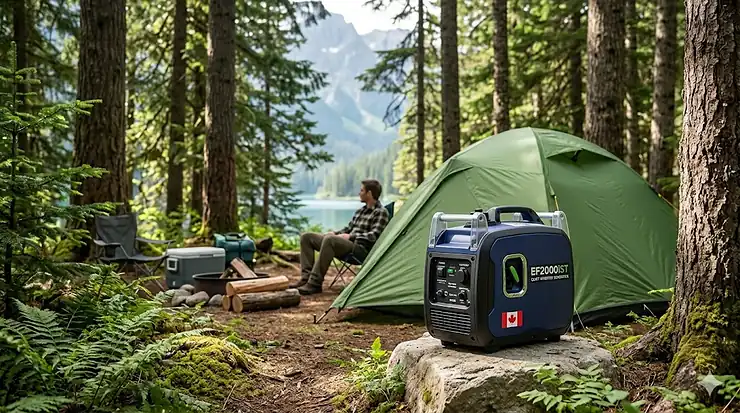
Picture this: you’re deep in Algonquin Park, the northern lights dancing overhead, and the only sound is… someone’s generator roaring like a chainsaw three sites over. Frustrating, right? That’s precisely why quiet inverter generator camping has become the gold standard for Canadian outdoor enthusiasts in 2026.
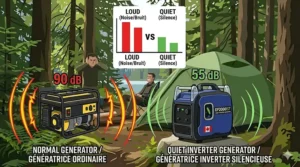
Traditional generators operate at a constant 70-90 decibels—roughly the volume of a busy Toronto street corner during rush hour. In contrast, modern inverter generators hum along at 48-62 dB, comparable to a normal conversation. This matters profoundly when you’re trying to enjoy the peace of BC’s backcountry or respect Parks Canada’s increasingly strict noise regulations.
What most Canadian buyers overlook is how inverter technology transforms your camping experience beyond just noise reduction. The variable engine speed adjusts automatically based on power demand, meaning these units sip fuel when you’re just charging phones, then ramp up when you fire up the coffee maker. In Canadian winters where battery efficiency drops 10-20% in sub-zero temperatures, this fuel economy becomes critical—especially when you’re three hours from the nearest petrol station in rural Manitoba.
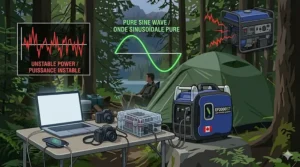
The inverter’s clean power output (less than 3% total harmonic distortion or THD) protects your expensive electronics like CPAP machines, laptops, and camera gear from voltage spikes that would destroy them with conventional generators. For Canadian campers who increasingly rely on technology for safety communications and navigation, this THD percentage rating isn’t just a spec—it’s insurance against a $2,000 CAD laptop replacement.
Quick Comparison: Top Quiet Inverter Generators for Canadian Camping
| Model | Noise Level | Running Watts | Runtime @ 25% | Weight | Price Range (CAD) | Best For |
|---|---|---|---|---|---|---|
| Honda EU2200i | 48-57 dB | 1800W | 8.1 hours | 21.5 kg (47 lbs) | $1,400-$1,700 | Premium reliability, extreme quiet |
| Champion 2500W Dual Fuel | 53 dB | 1850W (gas) | 11.5 hours | 17.7 kg (39 lbs) | $650-$850 | Best value, propane option |
| WEN 56380i | 57 dB | 3400W | 8.5 hours | 30 kg (66 lbs) | $800-$1,000 | Mid-size power needs |
| Westinghouse iGen2200 | 52 dB | 1800W | 12 hours | 21 kg (46 lbs) | $550-$750 | Budget-friendly quiet |
| WEN 56200i | 51 dB | 1600W | 6 hours | 17.7 kg (39 lbs) | $450-$600 | Ultra-portable, solo camping |
| Champion 3500W Inverter | 58 dB | 2300W | 10 hours | 34 kg (75 lbs) | $900-$1,150 | Families, extended trips |
| Westinghouse iGen4500DF | 52 dB | 3700W (gas) | 18 hours | 47.5 kg (105 lbs) | $1,200-$1,500 | RV-ready, dual fuel versatility |
Looking at this comparison, the Champion 2500W Dual Fuel emerges as the sweet spot for most Canadian campers—delivering Honda-level quietness at less than half the price, with the bonus of propane compatibility for winter storage. Budget buyers should note the WEN 56200i sacrifices runtime for portability, a trade-off that hits harder during Canadian winters when cold temperatures already reduce efficiency. For families needing extended power in remote locations, the Westinghouse iGen4500DF’s massive 18-hour runtime justifies the extra weight and cost—think of it as bringing three generators’ worth of fuel capacity in one unit.
💬 Just one click — help others make better buying decisions too! 😊
Top 7 Quiet Inverter Generators for Camping: Expert Analysis
1. Honda EU2200i — The Canadian Gold Standard
The Honda EU2200i remains the benchmark that every other manufacturer measures against, and for Canadian campers who refuse to compromise, it delivers
exceptional value despite the premium price tag.
At just 48 dB at quarter load—quieter than the hum of most modern refrigerators—this generator disappears into the background of your campsite. The 121cc Honda GXR120 commercial-grade engine produces 2,200 starting watts and 1,800 running watts, enough to simultaneously power a portable fridge, LED lighting, and charge multiple devices without breaking a sweat. What the spec sheet won’t tell you: this engine was originally engineered for heavy-duty construction equipment, which explains why Honda backs it with legendary reliability even in harsh Canadian conditions.
Canadian buyers particularly value the CO-MINDER carbon monoxide detection system, which automatically shuts down the unit before dangerous CO levels accumulate—critical for those late-fall camping trips when you might be tempted to run it near your enclosed trailer during an unexpected Alberta Clipper. The fuel shutoff valve lets you run the carburetor dry before storage, preventing the varnish buildup that kills generators left sitting through Canadian winters.
Customer feedback from Canadian reviewers: Consistently praised for starting reliably even after months of storage in unheated garages, with several Yukon users reporting flawless operation at -15°C. The most common complaint? Wishing they’d bought it sooner instead of fighting with cheaper alternatives.
Pros:
✅ Industry-leading 48-57 dB operation—neighbours won’t even know it’s running
✅ Parallel capability lets you connect two units for 4,400W when needed
✅ 8.1-hour runtime on 3.6 litres means fewer midnight fuel runs
Cons:
❌ Premium pricing (around $1,500-$1,700 CAD) puts it out of reach for casual campers
❌ No electric start—recoil only (though Honda’s compression release makes pulls effortless)
Price verdict: You’re paying $500-800 CAD more than alternatives, but Honda resale value remains strong (used units still fetch 60-70% of original price), making the true cost of ownership more reasonable than it appears.
2. Champion 2500W Dual Fuel Inverter — Best Value for Canadian Campers
The Champion 2500W Dual Fuel has earned its reputation as the thinking camper’s choice—delivering 90% of the Honda’s performance at 45% of the cost, with fuel flexibility that’s invaluable across Canada’s vast geography.
This ultralight 17.7 kg (39 lb) generator runs on either gasoline or propane with a simple dial switch, producing 2,500 starting watts and 1,850 running watts on gas (1,665W on propane). For Canadian buyers, this dual-fuel capability solves a critical problem: propane stores indefinitely without degrading, unlike gasoline which goes stale after 3-6 months. If you’re a weekend warrior who camps monthly from May to October then stores your gear all winter, you’ll never again dump out rancid fuel come spring.
The 53 dB noise rating puts it in whisper-quiet territory—about the same volume as a dishwasher running in the next room. Champion’s CO Shield technology monitors carbon monoxide accumulation and auto-shuts down the engine before dangerous levels build, meeting the same safety standards as premium units. The economy mode automatically throttles down when electrical demand drops, stretching that 1.05-gallon (4-litre) tank to 11.5 hours at 25% load on gasoline—or an impressive 34 hours on a 20-pound propane cylinder.
Canadian camper experiences: Quebec users particularly appreciate the parallel capability, connecting two units via the optional parallel kit ($100-150 CAD) to run a 30-amp RV air conditioner during humid summer camping. Several British Columbia reviewers note the unit handles elevation changes from sea level to mountain camping without performance loss.
Pros:
✅ Dual-fuel versatility eliminates fuel degradation concerns during Canadian winters
✅ At 17.7 kg, easily carried by one person from vehicle to campsite
✅ 3-year warranty with Canadian service network (Champion has facilities across Canada)
Cons:
❌ Propane mode produces 185W less power than gasoline—matters if you’re maxing out capacity
❌ Recoil start only (no electric start option)
Price verdict: In the $700-850 CAD range, this represents the best performance-per-dollar for Canadian buyers who camp regularly. The propane option alone saves enough on spoiled fuel over three seasons to justify the modest premium over gas-only alternatives.
3. WEN 56380i — The Mid-Size Powerhouse
The WEN 56380i fills the gap between portable 2,000W units and heavy RV generators, delivering 3,800 surge watts and 3,400 rated watts in a surprisingly manageable 30 kg (66 lb) package with built-in wheels.
This 212cc OHV engine produces enough clean power (under 1.2% THD at full load) to run a 13,500 BTU RV air conditioner or multiple heavy-draw appliances simultaneously—think portable fridge, LED string lights, coffee maker, and phone chargers all running at once during a family camping trip. The electric start with included battery means no more yanking starter cords on cold Muskoka mornings, and the fuel shutoff feature prevents carburetor gumming during winter storage.
What sets this apart for Canadian buyers is the included RV-ready TT-30R receptacle—no adapter needed to plug directly into your travel trailer. The digital display shows real-time fuel level, runtime remaining, and load percentage, letting you plan fuel stops intelligently rather than running dry 40 kilometres from the nearest gas station on Highway 17 through Northern Ontario.
Canadian user insights: Alberta families praise the 8.5-hour runtime at half-load, noting it easily powers an entire weekend at Jasper National Park campgrounds on two 7.2-litre (1.9 gal) tanks. The telescoping handle and wheels make moving it across gravel campsites far easier than carrying competitors’ models.
Pros:
✅ 3,400W running power handles serious electrical demands including AC units
✅ Electric start eliminates physical strain—critical for older campers or those with mobility issues
✅ Parallel-ready with optional kit to double power output to 6,800W
Cons:
❌ At 30 kg, requires two people to lift into truck beds or storage compartments
❌ Louder than smaller units at 57 dB (still campground-acceptable, but neighbours will hear it)
Price verdict: Around $850-1,000 CAD positions this as a premium mid-range option. If you genuinely need 3,400W of power (running AC, multiple appliances, or work equipment), the extra cost over 2,000W units delivers real capability. But weekend tent campers won’t use half this capacity—save money and weight with a smaller model.
4. Westinghouse iGen2200 — Budget-Friendly Quiet Performance
The Westinghouse iGen2200 proves you don’t need to spend Honda money to achieve whisper-quiet operation, delivering 52 dB performance and 2,200 peak watts for under $700 CAD.
Powered by a fuel-efficient 80cc Westinghouse 4-stroke OHV engine with automatic engine speed adjustment, this 21 kg (46 lb) generator produces 1,800 running watts of clean power (less than 3% THD). The economy mode extends the 1.14-gallon (4.3-litre) tank to 12 hours of runtime at 25% load—longer than any competitor in its price class, meaning you can run it overnight powering essential electronics without a 3 AM fuel refill.
For Canadian buyers operating in provincial parks with strict noise restrictions, the double-insulated acoustic enclosure with asymmetrical cooling fans keeps sound output as quiet as a normal conversation even under moderate load. The parallel capability (using Westinghouse’s optional 30A parallel cord sold separately for around $120 CAD) lets you connect another iGen2200 for doubled power output when requirements grow.
Canadian camper feedback: Saskatchewan users highlight the impressive 12-hour runtime, allowing them to power CPAP machines throughout entire nights during medical camping trips. Ontario reviewers note the low oil shutdown and overload protection prevented damage when they accidentally overloaded the circuit—features usually found on premium models.
Pros:
✅ Ultra-quiet 52 dB operation rivals units costing twice as much
✅ Exceptional 12-hour runtime stretches fuel budget on extended trips
✅ 3-year limited warranty backed by nationwide Westinghouse service network
Cons:
❌ No fuel shutoff valve—requires manual draining before winter storage
❌ Recoil start only (though Honda’s decompression system makes pulls relatively easy)
Price verdict: At $550-750 CAD, this delivers 85% of premium generator performance at 40% of the cost. Budget-conscious Canadian campers who prioritize quiet operation and runtime over premium features won’t find better value.
5. WEN 56200i — Ultra-Portable Solo Camping Champion
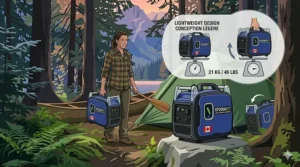
The WEN 56200i redefines “portable generator” for solo campers and backpack-style adventurers, weighing just 17.7 kg (39 lbs) while producing impressively clean and quiet power.
This compact unit generates 2,000 surge watts and 1,600 running watts from a fuel-sipping 79.7cc engine that operates at an ultra-quiet 51 dB—literally quieter than most refrigerators and barely louder than a whisper. At quarter load, you can hold a normal conversation standing right next to it. The pure sine wave output (less than 0.3% THD at no load) makes it safe for sensitive electronics including laptops, cameras, drones, and medical devices like CPAP machines that many Canadian campers rely on.
The 0.95-gallon (3.6-litre) fuel tank delivers 6 hours of runtime at 25% load—not marathon territory, but perfectly adequate for overnight charging sessions or powering a portable fridge during day trips. For Canadian buyers, the critical advantage is easy portability: one person can carry this from vehicle to campsite without assistance, toss it in a canoe for backcountry trips, or store it in a compact apartment without dedicating entire closets to generator storage.
Canadian user experiences: British Columbia kayak-campers praise the ability to pack this alongside camping gear without weight penalties, while Manitoba RVers use it as a lightweight backup to larger generators. The integrated carrying handle makes portability genuinely practical rather than theoretical.
Pros:
✅ Featherweight 17.7 kg enables true solo portability—easiest generator to transport in its class
✅ 51 dB operation disappears into background noise even in quiet wilderness settings
✅ Parallel capability with optional kit doubles power for growing needs
Cons:
❌ 6-hour runtime requires mid-trip refueling on extended camping weekends
❌ 1,600W running power limits you to smaller appliances (no air conditioners or high-draw tools)
Price verdict: Around $450-600 CAD makes this an entry-level option that doesn’t sacrifice quality. Solo campers and minimalists get everything they need without paying for capacity they’ll never use. However, families or groups should invest in more powerful alternatives.
6. Champion 3500W Inverter — Family Camping Powerhouse
The Champion 3500W Inverter delivers serious power for Canadian families who need to run multiple appliances simultaneously without the fuel consumption and noise of traditional open-frame generators.
This 122cc Champion engine produces 3,500 starting watts and 2,300 running watts of clean power (less than 3% THD), operating at 58 dB from 7 metres (23 feet)—about as loud as normal conversation. The key advantage for families: you can simultaneously run a portable fridge, LED lighting, charge multiple devices, operate a small microwave, and still have power headroom left over. The 1.2-gallon (4.5-litre) tank provides 10 hours runtime at 25% load, enough to get through entire overnight periods without refueling.
For Canadian buyers, Champion’s CO Shield carbon monoxide detection system provides critical safety when operating near enclosed trailers or during unexpected weather that forces you closer to shelter. The economy mode automatically reduces engine speed when electrical demand drops, cutting fuel consumption and noise levels even further during light-load periods like overnight CPAP operation or phone charging.
Canadian camper reviews: Alberta families appreciate the power capacity for running portable heaters during shoulder-season camping when temperatures drop unexpectedly. Quebec users note the parallel capability (using optional parallel kit) can connect to another Champion 2,800W+ inverter to power dual 15,000 BTU RV air conditioners during humid summer camping.
Pros:
✅ 2,300W running power handles family-sized electrical demands without strain
✅ CO Shield auto-shutdown provides safety peace of mind around children
✅ Parallel-ready for power expansion as needs grow
Cons:
❌ 34 kg (75 lbs) weight requires two-person lifting or hand truck for transport
❌ Slightly louder than smaller units at 58 dB (still campground-acceptable)
Price verdict: In the $900-1,150 CAD range, this occupies the premium mid-range segment. Families genuinely using this capacity will appreciate the capability, but casual campers should honestly assess whether they need this much power before paying the premium.
7. Westinghouse iGen4500DF Dual Fuel — Premium RV-Ready Power
The Westinghouse iGen4500DF represents the pinnacle of portable power for serious Canadian RVers and extended off-grid adventures, combining massive capacity with whisper-quiet operation and dual-fuel versatility.
This powerhouse produces 5,000 peak watts and 3,700 running watts on gasoline (4,200 running on propane), enough to simultaneously run two RV air conditioners, a microwave, portable fridge, and all your electronics without breaking a sweat. The 224cc engine achieves this while maintaining 52 dB operation at quarter load—quieter than most household conversations. The 3.4-gallon (12.9-litre) fuel tank delivers an astonishing 18 hours of runtime at 25% load on gasoline, or switch to propane for indefinite shelf-stable fuel storage between camping seasons.
The remote electric start with wireless key fob means you can fire up the generator from inside your RV during cold mornings—no more trekking outside in pyjamas during an Ontario ice storm. The LED data centre displays runtime remaining, fuel level, voltage output, and load percentage in real-time, eliminating guesswork about when to refuel or reduce electrical draw. Built-in wheels and telescoping handle make the 47.5 kg (105 lb) weight manageable despite the substantial capacity.
Canadian RVer feedback: British Columbia full-timers praise the ability to dry-camp comfortably for extended periods without generator anxiety, while Alberta snowbirds appreciate running propane all winter without fuel degradation concerns. The RV-ready TT-30R outlet eliminates adapters and simplifies setup.
Pros:
✅ Massive 18-hour runtime eliminates constant refueling on extended trips
✅ Dual-fuel capability provides fuel source flexibility across Canada’s varying availability
✅ Remote start delivers premium convenience in extreme weather
Cons:
❌ 47.5 kg weight requires proper loading equipment or two-person team
❌ Premium $1,200-1,500 CAD price point targets serious RVers, not casual campers
Price verdict: This investment makes sense for Canadians who spend weeks at remote campsites or full-time RV living. Weekend warriors should consider whether they’ll actually use this capacity before committing the budget.
Winterizing Your Quiet Inverter Generator: Canadian Climate Survival Guide
Canadian winters pose unique challenges that destroy unprepared generators. Follow this end-of-season protocol to ensure spring startup success:
Before first frost:
Run the fuel stabilizer through your tank if storing with fuel (STA-BIL or similar brands approved for ethanol fuels). Better yet, use the fuel shutoff valve if equipped, running the carburetor completely dry—this eliminates varnish deposits that gum up jets during six-month storage. Change the oil even if you haven’t hit the recommended hour interval; combustion byproducts accumulate over time and attack engine components during dormant periods.
During storage:
Store in a heated or insulated space if possible—unheated garages that cycle between -20°C and +5°C create condensation that corrodes electrical components and rusts fuel systems. If you must store in an unheated space, at minimum keep it elevated off concrete floors (condensation magnets) and cover with a breathable tarp that prevents moisture accumulation while allowing air circulation. Remove the battery if equipped with electric start, storing it on a trickle charger in a warmer location.
Spring resurrection:
Check oil level before first start—cold causes contraction that can drop levels below safe operating minimums. Inspect the air filter for mouse nests (they love the warm engine compartment). If you stored with fuel despite better judgment, add fresh gasoline to dilute any degraded fuel before starting. Run the generator under load for 30 minutes before your first camping trip to identify any issues while you’re still near parts suppliers rather than deep in Quetico Provincial Park.
Cold-weather operation tips:
Inverter generators start more reliably in cold than conventional models, but help them along: store fuel cans indoors overnight so you’re starting with warm fuel rather than -15°C gasoline. Let the generator warm up for 5 minutes before applying significant loads—cold oil flows poorly, and immediate high loads stress components. In extreme cold (below -20°C), consider building a simple insulated box with adequate ventilation to maintain operating temperatures, but never fully enclose a running generator due to carbon monoxide dangers.
Real-World Canadian Camping Scenarios: Which Generator Fits Your Style?
The Solo Backpacker (Lake Superior Provincial Park):
You paddle your canoe three hours into the backcountry, camping on remote islands. The WEN 56200i (17.7 kg / 39 lbs) fits in a dry bag alongside camping gear without sinking your vessel. Six-hour runtime powers your camp lights and charges camera batteries for wildlife photography, operating at 51 dB so you don’t scare off the moose you paddled here to photograph. Budget: $500-600 CAD.
The Weekend Warriors (Banff National Park):
Your young family camps monthly from May to September in established campgrounds with noise restrictions. The Champion 2500W Dual Fuel (17.7 kg) delivers Honda-level quietness at half the price, running your portable fridge, lights, and device chargers for 11.5 hours on a single tank. The propane option means you store it all winter without fuel degradation anxiety. Budget: $700-850 CAD.
The Extended Adventurers (Newfoundland Coastal Loop):
You’re touring Canada’s maritime provinces for three weeks, camping in remote areas far from services. The Westinghouse iGen2200’s 12-hour runtime means you refuel once daily rather than three times, and the 52 dB operation won’t alienate fellow campers at crowded coastal campgrounds. Parallel capability provides power expansion if you upgrade your camping setup later. Budget: $600-750 CAD.
The RV Family (Cross-Canada Summer Tour):
Six weeks traversing Canada from Victoria to Halifax with your 30-foot trailer requires serious power. The Westinghouse iGen4500DF runs dual air conditioners through Saskatchewan heat waves, operates silently enough for urban RV parks, and the 18-hour runtime means you rarely think about refueling. Dual-fuel versatility adapts to regional fuel availability differences. Budget: $1,300-1,500 CAD.
Parallel Capability Explained: When Two Generators Beat One
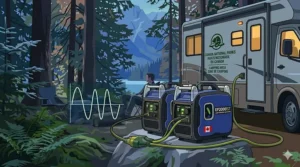
Parallel operation connects two identical or compatible inverters to combine power output, and understanding when this makes sense saves Canadian buyers from overspending on oversized single units.
The math: Two Champion 2500W units paralleled deliver 3,700-4,000W combined (not quite double due to connection losses), costing around $1,400-1,700 CAD total. One Champion 4000W costs similar money but weighs twice as much and can’t split into portable pieces for solo trips.
Real advantages for Canadians:
Transport flexibility matters when traveling in smaller vehicles—two 18 kg units fit in trunk corners versus one 40 kg unit blocking entire cargo areas. Power scalability means you run one generator for normal weekend camping, adding the second only when family visits expand your electrical needs. Redundancy provides backup if one unit fails during remote trips—you’re partially powered rather than completely dark.
Compatibility requirements:
Champion, WEN, and Westinghouse all require brand-specific parallel kits ($100-200 CAD) and matching wattage ranges. You can’t parallel a 2000W unit with a 4000W unit from the same manufacturer—wattages must be compatible per manufacturer specifications. Read your manual’s parallel section carefully before assuming compatibility.
When parallel makes sense: You regularly alternate between solo and group camping, need transport flexibility, or want power expansion capability without replacing equipment. When it doesn’t: You need maximum wattage at minimum cost (single larger units are cheaper per watt), have ample transport space, or rarely use full capacity.
Common Mistakes Canadian Buyers Make (And How to Avoid Them)
Mistake #1: Ignoring winter performance implications.
Summer campers forget that lithium batteries in portable fridges and electronics lose 10-20% capacity in cold temperatures, increasing electrical draw just when generators become harder to start.
Solution: Size your generator 20% larger than summer calculations suggest if you camp into October or start early spring.
Mistake #2: Assuming “quiet” means silent.
Even 48 dB generators are audible in wilderness settings—you’re not achieving generator-free tranquility.
Solution: Position generators 20+ metres downwind from your sleeping area, use longer extension cords (12-gauge minimum for safety), and shut down during evening quiet hours (10 PM – 7 AM in most provincial parks).
Mistake #3: Neglecting warranty coverage limitations.
Most manufacturers void warranties for commercial use, extreme temperature operation, or improper storage. Running your camping generator as a home backup during power outages often violates terms.
Solution: Read warranty fine print before purchase, register your unit immediately, and keep maintenance records including oil changes and storage procedures.
Mistake #4: Underestimating Canadian shipping realities.
Some “Amazon best-sellers” don’t ship to Canada or charge $200+ CAD extra for cross-border logistics.
Solution: Verify “ships to Canada” status and calculate total delivered cost before comparing prices. Sometimes slightly more expensive Canadian retailers offer better delivered value.
Mistake #5: Overbuying capacity you’ll never use.
Generators operate most efficiently at 25-50% load—a 4000W generator running 500W of electronics wastes fuel and money.
Solution: Calculate your actual power needs (add up wattage ratings of everything you’ll run simultaneously, plus 20% headroom), then buy the smallest generator that meets this requirement.
How to Choose a Quiet Inverter Generator in Canada: 5-Step Expert Framework
Step 1: Calculate your true power requirements
List every device you’ll run simultaneously, add their wattage ratings (check device labels or manuals), then add 20% headroom for surge protection. Example: portable fridge (60W running, 180W surge), LED lights (40W), laptop charging (65W), phone charging (20W) = 185W running, 305W surge. Even a small 2000W generator provides 6x your needs—don’t overbuy.
Step 2: Prioritize noise level based on camping style
Provincial parks typically require generators under 65 dB, but unwritten campground etiquette suggests staying under 60 dB. For wilderness camping where you’re seeking tranquility, target 52 dB or quieter—the difference between “barely noticeable” and “everyone knows you have a generator.”
Step 3: Assess runtime requirements vs. refueling tolerance
Multiply your typical usage hours per day by days between fuel access. Weekend campground trips tolerate 6-8 hour runtimes with daily refueling; remote week-long adventures need 10+ hours to minimize fuel transport weight. Cold weather camping requires larger tanks as battery inefficiency increases electrical demand.
Step 4: Evaluate weight vs. power tradeoffs
Solo operators should cap weight at 23 kg (50 lbs) maximum for safe handling; 18 kg (40 lbs) is ideal. Couples can manage 32-36 kg (70-80 lbs) with two-person lifting. RVers with permanent storage spaces can consider 45+ kg units that never need manual carrying. Consider whether you’re loading into trucks (weight matters less) or carrying across campsites (every kilogram counts).
Step 5: Factor Canadian climate durability
Look for CO shutdown sensors (safety requirement for enclosed-space proximity), fuel shutoff valves (winter storage essential), and low-temperature starting capabilities. Verify manufacturer warranty validity in Canada and service centre locations—being 800 km from the nearest authorized repair facility matters when equipment fails mid-season.
Understanding THD Percentage Rating: Why It Matters for Your Devices
Total harmonic distortion (THD) measures how “clean” the electrical output is compared to pure utility-grid power. Inverter generators produce under 3% THD; conventional generators often exceed 20% THD.
What this means practically: Sensitive electronics like laptops, CPAP machines, modern refrigerators with digital controls, and camera battery chargers contain microprocessors that malfunction or suffer damage from “dirty” power with high THD. Conventional generators produce voltage spikes and frequency variations that can instantly destroy a $2,000 CAD laptop or corrupt camera memory cards during transfers.
The Canadian winter factor: Cold temperatures increase electrical resistance in devices, making them more vulnerable to voltage irregularities. A CPAP machine that tolerates marginal power quality in summer may malfunction at -5°C when coupled with high-THD generator power. This is why medical equipment manufacturers specifically warn against non-inverter generators for CPAP use.
Inverter technology’s solution: The generator produces raw AC power, converts it to DC, then inverts it back to AC with precise digital control over voltage and frequency. This “double conversion” process filters out irregularities, producing clean sine wave power virtually identical to your home electrical panel.
Bottom line for Canadian buyers: If you’re only powering incandescent lights and basic tools, THD doesn’t matter much. The moment you plug in anything with a circuit board—phones, laptops, modern fridges, LED lights with drivers, medical devices—THD under 3% becomes essential rather than optional. This alone justifies inverter generator pricing over conventional units.
Eco Mode Fuel Efficiency: The Feature That Pays for Itself
Economy mode (Eco Mode) automatically adjusts engine speed to match electrical demand rather than running at constant maximum RPM. This single feature fundamentally changes fuel economics and noise levels.
Conventional generator: Runs at 3,600 RPM constantly whether you’re drawing 100W or 2000W, consuming fuel at maximum rate regardless of load. Think of driving your car at highway speed while sitting in a parking lot—technically functional but absurdly wasteful.
Inverter with Eco Mode: At light loads (phone charging, single LED light), engine drops to 1,800-2,400 RPM, sipping fuel and operating at 48-52 dB. When you fire up the coffee maker, engine automatically ramps to required speed, then drops back down when demand falls. It’s like cruise control for generators—maximum efficiency across varying conditions.
Real fuel savings for Canadian campers: A WEN 56380i running 500W steady load (portable fridge, lights, phone charging) operates 8.5 hours on 7.2 litres in Eco Mode versus approximately 4 hours at constant RPM without Eco Mode. At current Canadian fuel prices ($1.70-2.00/litre in remote areas), Eco Mode saves $12-15 CAD daily on extended trips. Over a summer camping season (10 weekends), that’s $120-150 CAD in your pocket rather than burned unnecessarily.
Noise reduction bonus: Lower RPMs directly translate to quieter operation. That 57 dB rating at rated load drops to 48-52 dB at quarter load with Eco Mode active—the difference between “noticeable generator” and “barely audible hum.” Your neighbours will thank you.
When to disable Eco Mode: Starting air conditioners, running power tools with surge demands, or any application where instant power response matters more than fuel economy. Most users leave Eco Mode enabled 90% of the time, manually overriding only for specific high-demand scenarios.
Canadian Regulations & Safety Standards You Need to Know
Parks Canada generator policies:
National parks permit generators during specified hours only (typically 9 AM – 11 AM and 6 PM – 8 PM), with some parks banning them entirely in designated quiet zones. Before planning your trip, check specific park regulations at the Parks Canada website—rules vary significantly between Banff (permissive) and Gros Morne (highly restrictive).
Provincial campground noise limits:
Most provincial parks set maximum 65 dB limits measured at adjacent campsites, though enforcement varies. Ontario Parks has increasingly strict interpretation, while British Columbia’s interior parks remain more permissive. The unwritten rule: if you can hold a conversation over your generator from 6 metres away, you’re probably fine. If you can’t, you’re annoying neighbours regardless of dB readings.
Carbon monoxide safety requirements:
According to Health Canada guidelines on indoor air safety, carbon monoxide is extremely toxic and exposure even at low levels causes headaches and fatigue. Installing carbon monoxide alarms certified by Standards Council of Canada-accredited bodies (look for CSA, UL, or Intertek ETL marks) is essential when operating generators near enclosed spaces. Never run generators inside tents, vehicles, or within 6 metres of windows or air intakes, even temporarily.
Fuel storage regulations:
Transport Canada limits portable fuel containers to 30 litres capacity for road transport, with specific container certification requirements. Most provinces restrict fuel storage in campgrounds to fuel currently in approved containers (not jerry cans stored under trailers between trips). British Columbia has particularly strict wildfire-season restrictions on fuel storage in forested campgrounds.
CSA certification for Canadian use:
While not legally mandatory for portable generators, CSA (Canadian Standards Association) certification ensures units meet Canadian electrical safety standards and operate correctly with Canadian voltage/frequency specifications. Most reputable manufacturers selling in Canada include CSA or equivalent certification—if the spec sheet doesn’t mention safety certifications, consider alternative products.
❓ FAQ: Quiet Inverter Generator Camping in Canada
❓ Can I use a quiet inverter generator in winter camping in Canada?
❓ How loud is 52 decibels compared to everyday Canadian sounds?
❓ Do I need special outlets or adapters for camping in Canadian provincial parks?
❓ How much does it cost to run a quiet inverter generator for a weekend camping trip in Canada?
❓ Can I run my CPAP machine off a quiet inverter generator while camping in Canada?
Conclusion: Finding Your Perfect Quiet Inverter Generator for Canadian Camping
The Canadian camping landscape has fundamentally shifted toward quiet, efficient, eco-conscious recreation—and inverter generators represent that evolution perfectly. Whether you’re a solo paddler exploring Northern Ontario’s backcountry, a family establishing summer traditions in Maritime parks, or full-time RVers circling Canada’s Trans-Canada Highway, the right quiet inverter generator transforms camping from make-do survival to comfortable adventure.
For most Canadian weekend warriors, the Champion 2500W Dual Fuel delivers unbeatable value at $700-850 CAD—combining Honda-level quietness with propane versatility that eliminates winter storage headaches. Budget-focused buyers seeking maximum quiet should grab the Westinghouse iGen2200 ($550-750 CAD) with its exceptional 12-hour runtime. Solo adventurers need the WEN 56200i ($450-600 CAD) for genuine portability without capability compromise. Families running serious electrical loads justify the Champion 3500W ($900-1,150 CAD) for power headroom that eliminates generator anxiety. And RVers chasing ultimate convenience will appreciate the Westinghouse iGen4500DF ($1,300-1,500 CAD) with remote start and 18-hour runtime.
The premium Honda EU2200i ($1,400-1,700 CAD) remains the gold standard for those who refuse compromises on reliability, quietness, and longevity—particularly valuable when camping in remote regions where equipment failure means genuine hardship rather than mere inconvenience.
Remember: generators are long-term investments that should serve 10-15 years with proper maintenance. Spending an extra $200-300 CAD for features you’ll use weekly (dual fuel, extended runtime, premium quiet operation) pays dividends over hundreds of camping trips. Conversely, overpaying for capacity you’ll never use just increases weight you’ll curse every time you load your vehicle.
Calculate your actual needs honestly, prioritize the features that match your specific camping style, and invest in quality that handles Canadian climate extremes. Your future self—camped beside a tranquil Quetico lake with only whisper-quiet power humming in the background—will thank you for choosing wisely.
✨ Recommended for You
- 7 Best Champion Generator Cold Weather Starting Tips Canada 2026
- Best 7500W Generator for Home Backup Canada 2026
- 7 Best Portable Generators for Power Outage Canada 2026
Disclaimer: This article contains affiliate links. As an Amazon Associate, I earn from qualifying purchases. If you purchase products through these links, we may earn a small commission at no additional cost to you.
✨ Found this helpful? Share it with your friends! 💬🤗
