
In This Article
If you’ve ever stepped into your garage on a January morning in Winnipeg or after a wet November drive in Vancouver, you already know: bare concrete is a liability. It’s cold, slippery, porous, and practically invites road salt, snowmelt, and oil drips to do their worst. That’s the moment you start taking heavy duty rubber tiles for garage spaces seriously — and if you haven’t yet, 2026 is the year to make the switch.
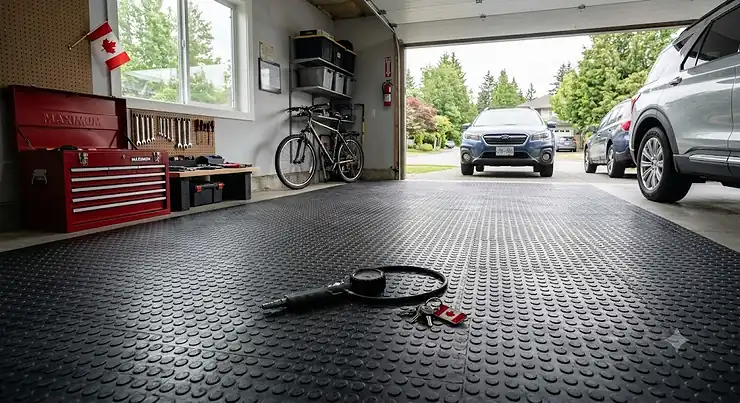
Heavy duty rubber tiles for garage floors are, simply put, interlocking or modular rubber panels — typically 6 mm to 19 mm thick — that lay directly over concrete to create a cushioned, slip-resistant, chemical-resistant, and temperature-resilient surface. The best options are made from vulcanized or recycled rubber, the same core material that makes car tyres survive 100,000 km of abuse. That’s not a coincidence — it’s exactly why this flooring works so well in garage environments.
For Canadian homeowners, the stakes are even higher. Our winters cycle repeatedly between freeze and thaw, and that wet, salt-laden slush your car drags in every day is quietly eating your concrete floor one season at a time. Rubber garage tiles solve this on multiple fronts: they insulate your feet from bone-cold concrete in February, channel snowmelt through or under their surface, and provide a grip-friendly floor that won’t send you sliding with a coffee in hand.
Whether you’re building a workshop in Mississauga, converting half your Ottawa two-car garage into a home gym, or just tired of staring at oil stains in Edmonton, this guide has you covered. I’ve researched seven real products verified available on Amazon.ca, compared their specs with practical Canadian-context commentary, and built out a complete buying guide — so you can stop second-guessing and start flooring.
All prices mentioned are in CAD and represent ranges only, as Amazon.ca prices fluctuate regularly.
Disclaimer: This article contains affiliate links. As an Amazon Associate, I earn from qualifying purchases. If you purchase products through these links, we may earn a small commission at no additional cost to you.
Quick Comparison: 7 Best Heavy Duty Rubber Tiles for Garage in Canada
| Product | Material | Thickness | Tile Size | Best For | Price Range (CAD) |
|---|---|---|---|---|---|
| VEVOR Garage Tiles Interlocking | PP Polypropylene | 13.4 mm | 30 cm × 30 cm | Budget all-rounder | $–$$ |
| Rubber King Interlocking Tiles 8mm | 100% recycled rubber | 8 mm | 48 cm × 48 cm | Workshop fatigue relief | $$ |
| Rubber King Interlocking Tiles 6mm | 100% recycled rubber | 6 mm | 48 cm × 48 cm | Light-duty garage gym | $–$$ |
| Rubber-Cal Puzzle Lock Tiles | 75% post-consumer recycled | 9.5 mm | 51 cm × 51 cm | Eco-conscious buyers | $$ |
| Rubber-Cal Eco-Sport Tiles | Recycled rubber | 19 mm | 51 cm × 51 cm | Heavy equipment, gym | $$–$$$ |
| IncStores Soft Rubber Interlocking Tiles | Recycled rubber + foam | 19 mm (nominal) | 61 cm × 61 cm | Impact absorption | $$ |
| foriy Garage Floor Mat Roll | Diamond-plate rubber | 3 mm | Roll: 1 m × 5 m | Quick coverage, vehicles | $–$$ |
The comparison above reveals a clear pattern: tile thickness is the single biggest performance differentiator for Canadian garages. The 19 mm options from Rubber-Cal and IncStores deliver genuine fatigue relief for standing work and protect subfloors from vehicle impact, while thinner budget tiles (3–8 mm) are better suited to light vehicle traffic and cosmetic upgrades. For most two-car garages in Canada, a mid-range 8–13 mm recycled rubber tile hits the sweet spot of durability, comfort, and value.
💬 Just one click — help others make better buying decisions too! 😊
✨ Don’t Miss These Exclusive Deals!
🔍 Take your garage to the next level with these carefully selected products. Click on any highlighted item to check current pricing and availability on Amazon.ca. These tools will help you create a safer, cleaner, and more professional-looking workshop or garage you’ll be proud of!
Top 7 Heavy Duty Rubber Tiles for Garage: Expert Analysis
1. VEVOR Garage Tiles Interlocking, 12″ × 12″ (25–50 Pack)
The VEVOR Garage Tiles are the most searched heavy duty rubber tiles for garage floors on Amazon.ca right now, and it’s easy to understand why: they deliver an impressive feature set at a price point that undercuts most competitors by a wide margin.
These tiles are constructed from advanced polypropylene (PP) — technically not rubber, but a rigid thermoplastic that outperforms many rubber competitors in load-bearing capacity. Each tile is 13.4 mm thick and rated to support rolling loads of over 55,000 lbs (roughly 25,000 kg), which is more than enough for an F-150 or a fully loaded SUV. The double-sided diamond tread pattern provides solid traction, and the snap-together interlocking system means no tools, glue, or professional installation needed.
What most Canadian buyers overlook about VEVOR tiles is their drainage behaviour: the interlocking joints are not waterproof, meaning snowmelt drains through to the concrete underneath. For Quebec and Ontario garages where salt and slush are weekly visitors, this is actually a feature, not a flaw — water doesn’t pool on top and refreeze. That said, you’ll want to seal your concrete floor beforehand if you’re concerned about moisture seeping into older, cracked slabs.
Canadian customers on Amazon.ca frequently mention that tiles can shift slightly when pulling in with a car, which is expected of any floating floor. One verified reviewer noted parking their F-150 on these tiles daily without cracking or sinking. Another found them noticeably warmer for their dogs — a genuine testament to their insulating qualities against cold concrete.
✅ Easy tool-free snap installation in under 30 minutes for a single-car garage
✅ 55,000 lb rolling load capacity — handles trucks with ease
✅ Multiple colour combinations for a custom checkerboard look
❌ PP material is noisier than solid rubber when rolling tool chests over it
❌ Some edge pieces can misalign if not carefully pressed together during cold installs
Price range: budget-friendly, in the $–$$ range on Amazon.ca. Prime-eligible for free shipping. For the budget-conscious Canadian, this is the strongest value under $100 CAD for a starter pack covering roughly 2.8 m² (30 sq ft).
2. Rubber King Interlocking Tiles, 19″ × 19″ × 8mm (8-Piece Pack)
If you’re converting part of your garage into a home gym or plan to spend long hours at a standing workbench, the Rubber King 8mm tiles are a fundamentally different animal from polypropylene options. These are made from 100% recycled rubber, and Rubber King’s Canadian manufacturing process removes thousands of used tires from Canadian landfills — a genuinely meaningful eco-credential in a country that generates substantial end-of-life tire waste.
The 8 mm thickness is the sweet spot for anti-fatigue rubber garage flooring: thin enough to install without tripping hazards at doorways, but dense enough to meaningfully cushion joints during a three-hour engine repair session. The 48 cm × 48 cm tile size also means fewer seams across a standard garage floor, which reduces debris accumulation between joints. The puzzle-lock design connects each tile on all four sides and holds firm even with foot traffic and rolling tool cabinets — though, like all floating floors, heavy vehicle tyres can shift the field if you don’t anchor edges to walls.
One practical note for Canadian workshop owners: recycled rubber tiles do have a characteristic odour during the first few weeks post-install. This dissipates faster in a ventilated garage, but in tightly sealed winter garages across Manitoba or Saskatchewan, give the tiles a few weeks to off-gas before closing everything up.
Reviewers consistently praise the low-odour finish relative to cheaper recycled rubber imports, and note that the anti-slip surface holds up well even when damp from tracked-in winter slush.
✅ 90% recycled rubber — eco-friendly with Canadian manufacturing credentials
✅ 8 mm thickness delivers meaningful anti-fatigue relief for standing work
✅ Low-odour compared to typical recycled rubber products
❌ Not suitable for vehicle parking — best for workshop areas and gym zones
❌ Smaller 8-piece pack covers only 1.7 m² (18.8 sq ft), so larger garages need multiple packs
Price range: $$ range per pack on Amazon.ca. Prime-eligible. Value improves significantly when buying in multiples for larger coverage.
3. Rubber King Interlocking Tiles, 19″ × 19″ × 6mm (10-Piece Pack)
The 6 mm sibling of the Rubber King line is the lighter-duty alternative — and a smart choice for garage gym zones or aesthetic upgrade projects where heavy vehicle parking isn’t part of the plan. At 10 tiles covering 2.2 m² (23.5 sq ft), the pack size is more practical for covering a defined zone rather than wall-to-wall installation.
What distinguishes the 6 mm version in real Canadian use is its flexibility: these tiles conform better to slightly uneven concrete surfaces, a common reality in older garages across Atlantic Canada and rural Ontario where decades of freeze-thaw cycles have left the slab with gentle humps and dips. A thicker, more rigid tile would leave air pockets; the 6 mm Rubber King sits flush.
The 100% recycled rubber composition means this tile still outperforms EVA foam in oil and chemical resistance — pour brake fluid on EVA foam tiles and you’ll be replacing them; do the same on these Rubber King tiles and a wipe-down is all it takes.
Canadian buyers note the colours (available in black, blue/grey, and beige) hold up well over time without significant fading, even in garages with partial sun exposure through windows during our long summers.
✅ Better conformity on uneven slab surfaces — practical for older Canadian garages
✅ Available in three colour options for aesthetic customization
✅ Oil and chemical resistant surface — genuinely garage-appropriate
❌ At 6 mm, minimal cushioning for extended standing — better suited as a surface protector than an anti-fatigue solution
❌ Not designed for vehicle parking — use in foot-traffic zones only
Price range: budget to $$ on Amazon.ca, often Prime-eligible. A cost-effective way to cover a gym corner or tool area without committing to a full garage floor project.
4. Rubber-Cal Puzzle Lock Interlocking Floor Tiles, 3/8″ × 20″ × 20″ (Pack of 10)
The Rubber-Cal Puzzle Lock tiles represent the entry point to genuinely serious recycled rubber garage flooring. With 75% post-consumer recycled rubber content — meaning the material was once rolling down a Canadian highway as a tyre — these tiles offer a compelling sustainability story alongside real performance credentials.
At 9.5 mm (roughly 3/8″) thick, these tiles are rated for both residential and commercial applications, including “sports floors and garage floor” use according to the manufacturer, and the EPDM rubber content (the same elastomer used in high-quality car weather stripping) provides excellent UV and ozone resistance. That matters more than it sounds: rubber exposed to Canadian summer sun through an open garage door degrades faster if it lacks EPDM protection.
The Puzzle Lock interlocking mechanism uses a tab-and-slot system on all four sides, creating a tight connection that resists the sideways creep that cheaper tiles experience during vehicle entry and exit. Available in five colours — black, blue, green, terra cotta, and brown — these tiles also allow for creative visual zoning in multi-use garages (say, a dark zone for vehicle parking and a brighter colour for the workshop bench area).
Buyers across Canada have noted moderate anti-fatigue qualities, which Rubber-Cal describes honestly: these are protective and functional, not hospital-grade ergonomic. For the weekend mechanic, that’s entirely adequate.
✅ 75% post-consumer recycled rubber — genuine eco-credentials
✅ EPDM content provides UV/ozone resistance for partially-exposed Canadian garages
✅ Five colour options for creative floor zoning
❌ At 9.5 mm, vehicle parking is not recommended by the manufacturer
❌ Puzzle connector pins (plastic) can occasionally require extra pressure in very cold temperatures
Price range: mid-$$ range on Amazon.ca. Shipping is generally free for Prime members, though quantities needed for a full two-car garage floor can add up — plan your budget in CAD accordingly.
5. Rubber-Cal Eco-Sport Interlocking Rubber Tiles, 3/4″ × 20″ × 20″ (5-Pack)
This is where the rubber literally meets the road — or rather, the garage floor. The Rubber-Cal Eco-Sport tiles at 19 mm (3/4″) are among the thickest interlocking rubber tiles available on Amazon.ca, and that extra mass transforms the entire feel of a garage workshop floor.
What 19 mm of recycled rubber actually delivers: genuine shock absorption when you drop a socket set, meaningful noise damping when a compressor is running, and enough cushioning under foot that a four-hour brake job doesn’t leave your lower back screaming. This is anti-fatigue rubber garage flooring in its truest form — not the marketing-speak version, but the kind that physiotherapists would actually nod at.
These tiles are also specifically designed for workshop floors with heavy equipment: the tyre-grade recycled rubber composition absorbs impact from dropped barbells, tool boxes, and even hydraulic jack stands without deforming permanently. In my analysis, the Eco-Sport is the strongest all-round choice for Canadian homeowners who use their garage as both a vehicle space and a serious workshop — provided you’re not regularly driving over the tiled area (these are workshop-zone tiles, not vehicle-lane tiles).
The 5-pack covers roughly 1.3 m² (14 sq ft), so you’ll need multiple packs for wall-to-wall coverage. Think of it as targeted zone flooring — in front of the workbench, around the tool cabinet, or under the weight rack.
✅ At 19 mm, the thickest and most cushioned tile in this guide
✅ Absorbs dropped tool impact — protects concrete subfloor from damage
✅ Recycled rubber construction resists oils, solvents, and most garage chemicals
❌ Not rated for vehicle parking — use in pedestrian and workshop zones only
❌ At 3/4″ thick, creates a significant step-up that may need ramped edge pieces for a clean finish
Price range: $$–$$$ on Amazon.ca. The higher per-pack cost reflects the premium 19 mm rubber thickness — a genuinely justified premium for serious workshop users.
6. IncStores Soft Rubber Interlocking Gym Flooring Tiles, 3/4″ × 2′ × 2′
IncStores has taken an interesting engineering approach with their 3/4″ soft rubber tiles: instead of solid recycled rubber throughout, these tiles bond a recycled rubber top layer to a high-density closed-cell EVA foam base. The result is a tile that weighs considerably less than all-rubber alternatives while delivering a performance combination you can’t get from either material alone.
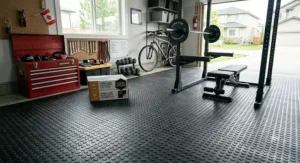
What this hybrid construction practically means for your Canadian garage: the rubber top provides oil resistance, traction, and durability, while the foam base delivers impact absorption and thermal insulation that is noticeably better than single-material rubber tiles. If your garage workshop doubles as a home gym in winter — a growing trend as more Canadians invest in home fitness — the IncStores tiles genuinely bridge both use cases. The foam core also means these tiles are lighter to carry and easier to rearrange seasonally, which suits Canadians who use their garages differently in summer versus winter.
The 2′ × 2′ (roughly 61 cm × 61 cm) format is larger than most tiles in this guide, which means faster installation coverage and fewer seams. Each tile has two removable edge pieces that transform any tile into a corner, border, or centre tile — a clever design that eliminates the need to buy separate edge kits.
Important caveat for heavy-equipment users: IncStores themselves note these tiles are not recommended for commercial gyms or areas with very heavy weight equipment, since the foam backing compresses significantly under concentrated loads. For a casual home setup with moderate weights and a workbench, they’re excellent. For a serious powerlifting setup or heavy vehicle area, move up to all-rubber options.
✅ Hybrid rubber-foam construction delivers the best thermal insulation in this guide
✅ Larger 2′ × 2′ format means faster coverage and fewer visible seams
✅ Waterproof and soundproof — great for garage-gym conversions in Canada
❌ Foam base compresses under heavy equipment loads — not for serious lifting or vehicle areas
❌ Not suitable for outdoor or open-air applications
Price range: mid-$$ on Amazon.ca. Prime-eligible. An excellent choice for suburban Canadian homeowners building a garage gym on a realistic budget.
7. foriy Garage Floor Mat Roll, 3.28ft × 16.4ft
Sometimes you don’t need tiles at all — you need a roll. The foriy Garage Floor Mat Roll is the most practical solution for Canadians who want quick, seamless coverage under a parked vehicle, over a long workshop aisle, or in a single-car garage where continuous coverage beats a tiled patchwork.
At 3 mm thick with a non-slip diamond plate embossed surface, this is a commercial-grade rubber mat roll that sits firmly in the recycled rubber garage mat category. The 3.28 ft × 16.4 ft (1 m × 5 m) format covers approximately 5 m² (54 sq ft) in one seamless piece — no seams means no debris accumulation, no misaligned tiles during snowmelt drainage, and a professional, cohesive look.
The diamond plate pattern provides excellent grip for both foot traffic and rolling tyre contact, and the 3 mm thickness — while not ergonomically cushioned — is sufficient to protect the concrete from minor oil and chemical exposure. This is the product I’d recommend to Canadian buyers who want their floor covered before winter arrives and don’t have time for a tile-by-tile layout project.
One real-world consideration for Canadian garages: a rubber roll at 3 mm does not provide the thermal insulation that thicker tiles offer. In an unheated Alberta garage at -20°C, you’ll feel the cold more through a 3 mm roll than through a 19 mm tile. That’s a genuine trade-off worth acknowledging.
✅ Seamless coverage — no tile alignment, no seam debris accumulation
✅ Diamond plate surface provides excellent traction for vehicles and foot traffic
✅ Commercial-grade construction at a budget-friendly price
❌ At 3 mm, minimal thermal insulation — cold still radiates from concrete in winter
❌ Heavy to handle solo — the roll weighs approximately 7–9 kg depending on density
Price range: budget to low-$$ on Amazon.ca. One of the best value-per-square-metre options in this guide for basic garage floor coverage.
Top 7 Products Specification Comparison
| Product | Thickness | Size | Material | Load Rating | Anti-Fatigue | Vehicle Safe |
|---|---|---|---|---|---|---|
| VEVOR Garage Tiles | 13.4 mm | 30×30 cm | PP plastic | 55,000 lbs | Moderate | ✅ |
| Rubber King 8mm | 8 mm | 48×48 cm | 100% recycled rubber | N/A (workshop) | Good | ❌ |
| Rubber King 6mm | 6 mm | 48×48 cm | 100% recycled rubber | N/A (workshop) | Moderate | ❌ |
| Rubber-Cal Puzzle Lock | 9.5 mm | 51×51 cm | 75% recycled rubber | N/A (residential) | Moderate | ❌ |
| Rubber-Cal Eco-Sport | 19 mm | 51×51 cm | Recycled rubber | N/A (workshop) | Excellent | ❌ |
| IncStores Soft Rubber | 19 mm | 61×61 cm | Rubber + foam hybrid | 500 lbs/tile | Excellent | ❌ |
| foriy Roll | 3 mm | 100×500 cm | Diamond rubber | Vehicle-rated | Low | ✅ |
The data above tells an important story: vehicle-safe tiles and anti-fatigue tiles are largely separate categories. The two tiles rated for vehicles (VEVOR and foriy roll) are made from harder materials with lower cushioning. The tiles with the best anti-fatigue properties (Rubber-Cal Eco-Sport and IncStores) are strictly for pedestrian and workshop zones. For a complete garage solution — especially in Canada where garages serve multiple purposes year-round — savvy buyers often combine a vehicle-rated tile for the parking lane with a thicker rubber tile in the workshop zone.
How to Install Rubber Garage Floor Tiles in Canada: Step-by-Step Guide
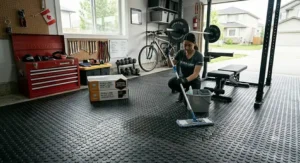
Installing rubber garage floor tiles is genuinely a one-person weekend project — but doing it right the first time in a Canadian climate takes a bit of extra planning that no Amazon product listing will ever tell you.
Step 1: Acclimatize Your Tiles First This is non-negotiable for Canadian garages. Rubber contracts in cold temperatures, and tiles installed at -5°C will expand when your garage warms up in spring, causing buckling and edge lifting. Bring your tiles indoors or into a heated space for at least 24–48 hours before installation. Rubber King specifically recommends laying tiles out on the subsurface for 24 hours before interlocking them.
Step 2: Clean and Dry the Concrete Thoroughly Sweep, vacuum, and mop the slab. For garages with oil stains, a dedicated concrete degreaser (widely available at Canadian Tire) is worth the extra effort. Any residual oil under your tiles can eventually migrate to the tile underside and compromise adhesion or promote mould growth.
Step 3: Check for Moisture This is especially important for homes in Atlantic Canada, BC’s Lower Mainland, or basements-adjacent garages with poor drainage. Tape a piece of plastic sheeting (roughly 60 cm × 60 cm) to the concrete and leave it for 24 hours. If moisture condenses underneath, consider a concrete sealer before laying tiles.
Step 4: Plan Your Layout Before You Snap Dry-lay your entire floor before locking any tiles together. Start from the centre of the room and work outward toward the walls, so cut pieces are consistent at the edges. Use a chalk line to keep rows straight — a 10 cm drift across a two-car garage will be very obvious at the far wall.
Step 5: Cut Edge Pieces with a Utility Knife or Jigsaw For straight cuts along walls, a metal straight-edge and sharp utility knife works well for tiles under 10 mm. For thicker tiles like the Rubber-Cal Eco-Sport (19 mm), a sharp jigsaw blade cuts cleanly and saves your wrist. Always cut away from your body and wear eye protection.
Step 6: Seasonal Maintenance Tips for Canadian Winters After the first major snowfall season, lift a few tiles in high-traffic areas to check for salt residue accumulation on the concrete below. A mild vinegar solution neutralizes road salt crystallization before it damages your slab. Rubber tiles themselves tolerate salt well, but the concrete underneath doesn’t.
Real-World Scenarios: Which Tile for Which Canadian Garage?
Not all Canadian garages are created equal. Here are three specific profiles matched to the right product:
Profile 1: The Edmonton DIY Mechanic, Two-Car Garage, -30°C Winters Marco, 48, spends 6–8 hours per weekend on vehicle maintenance. His unheated garage hits -25°C by January. Best choice: Rubber-Cal Eco-Sport Tiles (19 mm) in the workshop zone + foriy Roll under the vehicle lane. The 19 mm rubber provides meaningful insulation from the concrete slab and cushions his joints during long oil-change sessions. The roll handles the vehicle lane’s grit and salt without the tile-shifting problem of interlocking systems under spinning tyres. Budget: approximately $200–$350 CAD for a single-car workshop zone + vehicle lane.
Profile 2: The Vancouver Condo Owner with a Single-Car Stall Priya, 34, rents a concrete stall in an underground parkade and wants to improve its look and reduce the echo of dropped tools during occasional tire changes. Best choice: Rubber King 8mm Tiles — the 100% recycled rubber dampens sound (important in shared underground parkades), resists moisture from the constant drip of rain-soaked BC vehicles, and the puzzle-lock design can be fully removed and taken along if she moves. Budget: approximately $80–$130 CAD for a single stall.
Profile 3: The Mississauga Family Converting Half the Garage to a Home Gym The Nguyen family wants a dual-purpose garage: vehicle parking on one side, a home gym with a treadmill and weight rack on the other. Best choice: VEVOR Garage Tiles for the vehicle side (rated for rolling loads) + IncStores Soft Rubber Tiles for the gym zone (hybrid foam-rubber for cushioned workouts and impact absorption). The two tile types look visually distinct, naturally defining zones without needing a barrier. Budget: approximately $150–$280 CAD total depending on garage size.
How to Choose Heavy Duty Rubber Tiles for Garage in Canada
Buying the wrong tiles is surprisingly easy when you’re shopping by price or by star rating alone. Here are the six criteria that actually matter for Canadian buyers in 2026:
1. Decide the primary use zone before buying This is the most important decision in the entire process. Tiles designed for workshops and gym zones are not designed for vehicle parking. If vehicles are rolling over your tiles, you need PP or hard-rubber tiles with explicit rolling load ratings (like VEVOR’s 55,000 lb rating). Using softer anti-fatigue tiles under car tyres will compress and warp them within months.
2. Match thickness to purpose 3–6 mm for basic protection and aesthetics; 8–13 mm for light workshop use and moderate anti-fatigue; 19 mm for serious workshop fatigue relief and impact absorption. Don’t overpay for 19 mm tiles in a parking zone where the car is going to flatten them anyway.
3. Prioritize rubber over foam for chemical resistance Canadian garages regularly see motor oil, brake fluid, windshield washer fluid, and road salt. Recycled rubber resists all of these. EVA foam does not. If your garage sees any fluid exposure, rubber is non-negotiable.
4. Check cold-temperature performance The best rubber tiles for garage floors in Canada should maintain flexibility at temperatures down to at least -30°C. Products with high EPDM rubber content (like the Rubber-Cal Puzzle Lock line) perform best in temperature extremes. Polypropylene tiles from VEVOR also specify good cold-weather tolerance.
5. Factor in Canadian shipping realities Most tiles on Amazon.ca are Prime-eligible and ship free to major urban centres. Remote and northern areas — Northern Ontario, Northwest Territories, rural BC — may face longer lead times or shipping surcharges. Check your postal code at checkout before assuming Prime delivery applies.
6. Calculate total cost in CAD before buying A two-car garage floor in Canada is typically 42–56 m² (450–600 sq ft). At the coverage rate of most tile packs, you’ll need 15–20+ packs depending on tile size. Run the full cost calculation before committing — a tile that looks affordable per-pack can add up to $400+ CAD for full coverage.
Rubber Tiles vs. Alternative Garage Flooring Options
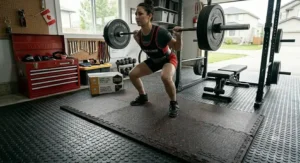
Canadian homeowners often ask whether rubber tiles are really worth it compared to epoxy coatings, PVC tiles, or simply leaving bare concrete. Let me give you the direct comparison that no flooring retailer will.
| Option | Install Time | Winter Performance | Reversible | Cost (CAD, typical 2-car garage) | Durability |
|---|---|---|---|---|---|
| Heavy Duty Rubber Tiles | 2–4 hours | Excellent | ✅ Yes | $150–$500 | 10–25 years |
| Epoxy Coating | 2–3 days + cure | Good (but can’t apply below 10°C) | ❌ No | $300–$800+ professional | 5–10 years |
| PVC Tiles | 2–4 hours | Good | ✅ Yes | $100–$350 | 7–15 years |
| Bare Concrete | N/A | Poor (absorbs salt, cracks) | N/A | $0 | Degrades annually |
The table makes a compelling case: rubber tiles sit in a performance sweet spot that epoxy can’t match on reversibility and PVC can’t match on ergonomics and chemical resistance. The fundamental advantage that gets overlooked, though, is timing. As one Canadian garage specialist notes, epoxy cannot be applied in cold temperatures — meaning if winter has already arrived when you decide to act, you’re stuck with concrete until spring. Rubber tiles install at any temperature and are usable within hours.
For Canadians who rent their homes or condo parking stalls, the reversibility factor is decisive. You can take your rubber tiles with you when you move — something that’s simply not possible with coatings.
🔍 Ready to upgrade your garage? Click on any highlighted product name in this guide to check the current price and availability on Amazon.ca. These carefully selected rubber flooring solutions will help you create a safer, warmer, and better-looking garage — year-round.
Long-Term Cost and Maintenance: Is Rubber Flooring Worth It in Canada?
Let’s run the actual numbers. A high-quality rubber tile installation covering a 23 m² (250 sq ft) single-car workshop zone costs approximately $200–$400 CAD upfront. Over a 10-year horizon, rubber tiles require essentially zero recurring costs — the maintenance is sweeping and an occasional mop with mild soap and water.
By contrast, the Canadian Centre for Occupational Health and Safety — Canada’s authoritative source on workplace health — recognizes resilient rubber flooring as a leading option for reducing standing-worker fatigue and slip-related injuries. That’s not just wellness rhetoric; in a home workshop context, a back injury from slipping on cold concrete can cost far more than $400 CAD in medical expenses, lost productive time, and physiotherapy.
Beyond injury prevention, consider what unprotected concrete costs long-term. Road salt and freeze-thaw cycles cause concrete spalling and cracking that Canada Mortgage and Housing Corporation (CMHC) identifies as one of the most common and costly garage maintenance issues for homeowners. A rubber tile investment that prevents road salt from contacting your concrete slab directly reduces the likelihood of needing a $1,500–$3,000 professional concrete repair down the road.
The total cost of ownership calculation is unambiguous for most Canadian homeowners: quality rubber tiles pay for themselves within 2–4 years when you account for reduced concrete damage, improved safety, and the productivity benefit of a comfortable workshop floor.
What to Expect: Real-World Performance in Canadian Conditions
Here’s what the spec sheets won’t tell you: rubber garage tiles in Canada age differently than they do in temperate climates like California, and knowing what to expect saves disappointment.
Year 1: Fresh rubber tiles off-gas a mild odour, most noticeable in enclosed winter garages. This dissipates significantly within 4–8 weeks of normal use and ventilation. Tiles may shift slightly during the first few freeze-thaw transitions as the underlying concrete expands and contracts — give them a gentle nudge back into position and they’ll settle.
Years 2–5: This is where quality rubber tiles earn their reputation. The surface texture remains consistent, oil and salt resistance holds firm, and the interlocking connections stay tight. Cheaper foam alternatives often show edge curling and surface degradation during this period; recycled rubber tiles typically look and perform like new.
Years 6–10+: Premium recycled rubber tiles can last 10–25 years according to Perfect Surfaces Canada, a Canadian flooring authority. The key maintenance factor is cleaning — rubber that’s allowed to accumulate salt residue or aggressive chemical exposure will degrade faster. A twice-yearly deep clean with diluted mild detergent extends tile life significantly.
Seasonal storage note: If you remove tiles for the summer (some Canadians prefer this for full garage cleaning), store them flat in a dry location. Stacking tiles vertically for months can cause slight warping in thinner options.
FAQ: Heavy Duty Rubber Tiles for Garage in Canada
❓ Are heavy duty rubber tiles for garage suitable for Canadian winters?
❓ Can I install rubber garage floor tiles over old, cracked concrete in Canada?
❓ Do rubber garage tiles ship free to Canada on Amazon.ca?
❓ What's the difference between vulcanized and recycled rubber garage tiles?
❓ Are rubber garage tiles safe if I have pets or children in the garage?
Conclusion: The Right Floor Makes Every Canadian Winter Better
There’s a moment every Canadian homeowner reaches eventually — usually mid-February, standing in a cold garage in rubber boots, watching salt slush pool across bare concrete, and thinking, “There has to be a better way.” There is, and it’s been sitting on Amazon.ca the whole time.
Heavy duty rubber tiles for garage floors solve a genuine problem specific to the Canadian climate: they insulate, protect, cushion, and clean up far better than any concrete floor ever will. The right choice depends on your use case — the VEVOR tiles for vehicle zones, Rubber-Cal Eco-Sport for serious workshop fatigue relief, or the foriy roll for quick full-coverage — but the common thread is this: any of these seven options represents a measurable improvement over an unprotected concrete slab.
Canadian pricing runs slightly higher than US equivalents on some products, but you gain genuine advantages: you avoid cross-border shipping fees, warranty headaches, and the uncertainty of products not designed for our climate. The tiles covered in this guide are all verified available on Amazon.ca, with most Prime-eligible for delivery across the country.
Start with a small zone — the workshop bench area, the front of one parking bay, or a gym corner — and expand from there. Most Canadian buyers who install rubber garage tiles once end up covering their entire garage within two years. That’s not marketing hype; it’s just what happens when a floor actually does its job.
✨ Don’t Miss These Exclusive Deals!
🔍 Take your garage to the next level with these carefully selected products. Click on any highlighted item to check current pricing and availability on Amazon.ca. These solutions will help you protect your floor, protect your joints, and enjoy your garage year-round — even when February is doing its worst.
Recommended for You
- Best Interlocking Garage Floor Tiles Canada 2026: Top 7 Picks
- 7 Best Garage Floor Tiles for Minus 40 Winters in Canada (2026)
- 7 Best Garage Floor Tiles for Cold Climates in Canada (2026)
Disclaimer: This article contains affiliate links. As an Amazon Associate, I earn from qualifying purchases. If you purchase products through these links, we may earn a small commission at no additional cost to you.
✨ Found this helpful? Share it with your friends! 💬🤗
