
In This Article
Have you ever wondered why your mechanic insists on using a torque wrench for your lug nuts instead of just tightening them “really hard”? Here’s the thing: over-torquing can warp brake rotors or snap wheel studs, while under-torquing might leave your wheel wobbling down Highway 401. When you’re dealing with Canadian winters where road salt accelerates corrosion and temperature swings affect metal expansion, precise torque becomes even more critical.
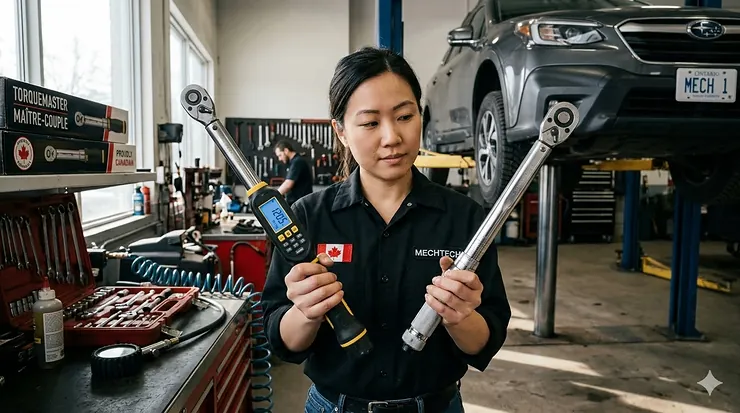
The debate between digital and click type torque wrenches has intensified in 2026, especially as Canadian automotive standards evolve and more DIY enthusiasts tackle their own maintenance. Digital models offer precision readouts and data logging, while traditional click-type wrenches provide reliable mechanical feedback without batteries dying in your cold garage.
Whether you’re torquing lug nuts on your truck before a trip through the Rockies or assembling precision bicycle components, understanding which torque wrench suits your needs can save you from costly repairs and safety hazards. This comprehensive guide examines real products available on Amazon.ca, compares their specifications, and helps you make an informed decision based on your specific requirements and budget.
Quick Comparison Table
| Feature | Digital Torque Wrench | Click Type Torque Wrench |
|---|---|---|
| Accuracy | ±1-2% (±2% typical) | ±3-4% (±4% typical) |
| Price Range (CAD) | $85-$280 | $45-$175 |
| Power Source | AAA batteries (2-4) | Mechanical spring mechanism |
| Feedback Type | LED, buzzer, vibration, screen | Audible/tactile click |
| Calibration Frequency | 12 months or 5,000 cycles | 12 months or 5,000 cycles |
| Best For | Precision work, data logging, multiple units | Heavy-duty use, cold environments, reliability |
| Storage Requirements | Any setting | Must be at lowest setting |
| Canadian Winter Reliability | Battery performance drops below -10°C | Fully mechanical, works in all temps |
💬 Just one click – help others make better buying decisions too!😊
Top 7 Torque Wrenches Available in Canada: Expert Analysis
1. ACDelco ARM601-4 Digital Torque Wrench
The ACDelco ARM601-4 represents professional-grade digital torque measurement for Canadian mechanics and serious DIY enthusiasts. This 1/2-inch drive model covers 4-99 foot-pounds (5-135 Newton-meters), making it ideal for automotive applications including brake assemblies, suspension components, and engine work.
Key Specifications:
- Torque range: 4-99 ft-lbs / 5-135 Nm
- Accuracy: ±2% (from 20-100% of range)
- Drive size: 1/2 inch
- Peak and Track modes for different applications
Price: Approximately $110-$145 CAD on Amazon.ca
The digital display eliminates guesswork with clear LED backlighting visible even in dimly lit garages common during Canadian winter months. Canadian buyers appreciate the dual-direction measurement capability, allowing torque verification for both tightening and loosening operations. The tool features both Peak mode for final torque confirmation and Track mode for continuous monitoring during tightening.
✅ Pros:
- Professional-grade accuracy suitable for critical fasteners
- Backlit display readable in low-light conditions
- Dual measurement modes provide flexibility
- Comprehensive units conversion (ft-lbs, Nm, in-lbs, kg-cm)
❌ Cons:
- Requires 4 AAA batteries (not included)
- Higher price point than mechanical alternatives
- Battery performance diminishes in extreme cold
Canadian customer feedback highlights the wrench’s reliability for seasonal tire changes and brake work, with users noting the clear display helps avoid costly over-torquing mistakes on alloy wheels.
2. CRAFTSMAN CMMT99436 Digital Torque Wrench
The CRAFTSMAN CMMT99436 brings American tool heritage to Canadian workshops with its 1/2-inch drive digital design. This model bridges the gap between budget and professional tools, offering electronic precision at a mid-range price point accessible to Canadian home mechanics.
Key Specifications:
- One-button unit conversion (ft-lbs, in-lbs, Nm)
- LED backlit screen for visibility
- 1/2-inch drive suitable for automotive work
- Calibrated accuracy within industry standards
Price: Approximately $95-$135 CAD on Amazon.ca
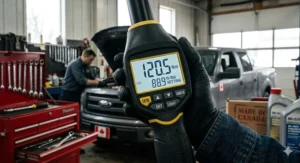
What sets this wrench apart for Canadian users is the simplified interface requiring minimal training. The single-button conversion between foot-pounds, inch-pounds, and Newton-meters accommodates both Imperial and metric specifications common in Canadian automotive manuals. The LED screen remains visible even in unheated garages during winter maintenance sessions.
✅ Pros:
- Intuitive single-button operation
- Trusted CRAFTSMAN brand with Canadian warranty support
- Affordable entry into digital torque tools
- Ships calibrated and ready for immediate use
❌ Cons:
- Basic feature set compared to premium digitals
- No data logging or advanced modes
- Plastic housing less durable than all-steel construction
Canadian purchasers frequently use this for general automotive maintenance, with particularly positive feedback for lug nut torquing where the 80-100 ft-lb range sees frequent use on cars and light trucks.
3. VANPO 1/2-Inch Drive Digital Torque Wrench
The VANPO 1/2-inch delivers impressive torque range coverage from 12.5 to 250.8 foot-pounds (17-340 Newton-meters), making it versatile enough for everything from motorcycle maintenance to heavy truck work. This represents excellent value for Canadians needing one tool for multiple vehicle types.
Key Specifications:
- Extended range: 12.5-250.8 ft-lbs / 17-340 Nm
- Accuracy: ±2% across operating range
- Preset torque values with alerts
- Buzzer and LED notification system
Price: Approximately $85-$120 CAD on Amazon.ca
The preset capability proves invaluable for repetitive tasks like wheel installations. Set your target torque once, and the wrench alerts you with combined buzzer sound, LED flash, and handle vibration when you’ve reached the specification. This triple-alert system works brilliantly in noisy garage environments.
✅ Pros:
- Wide torque range eliminates need for multiple wrenches
- Triple alert system (buzzer, LED, vibration)
- Preset memory for common torque values
- Excellent value proposition for Canadian buyers
❌ Cons:
- Build quality lighter than premium brands
- Battery cover can be fragile in cold weather
- Limited brand recognition compared to established names
Canadian customers report using this successfully for everything from snowmobile maintenance to automotive suspension work, with the wide range proving especially useful for those working on multiple vehicle types throughout the year.
4. TEKTON 24335 Click Type Torque Wrench
The TEKTON 24335 represents the gold standard in mechanical click-type torque wrenches for Canadian DIY mechanics. This 1/2-inch drive model covering 10-150 foot-pounds has earned legendary status in Canadian online forums for its reliability, accuracy, and value proposition.
Key Specifications:
- Torque range: 10-150 ft-lbs / 13.6-203.5 Nm
- Accuracy: ±4% (pre-calibrated)
- All-steel construction with no plastic parts
- Reversible ratchet head
Price: Approximately $50-$70 CAD on Amazon.ca (frequently on sale)
This wrench has become the benchmark recommendation across Canadian automotive communities, frequently appearing in RedFlagDeals threads and praised by Princess Auto shoppers. The all-steel construction means no concerns about plastic components cracking during cold Saskatchewan winters or humid Vancouver storage.
The dual-range scale marked in both foot-pounds and Newton-meters accommodates Canadian mechanics working with imported vehicles or following manufacturer specifications in either measurement system. The click mechanism delivers unmistakable tactile and audible feedback even through heavy work gloves.
✅ Pros:
- Exceptional value for accuracy and build quality
- All-steel construction survives Canadian climate extremes
- No batteries required – purely mechanical operation
- Ships pre-calibrated from factory
- Strong warranty backing from TEKTON
❌ Cons:
- Must be stored at lowest setting to maintain calibration
- No digital readout for precision-obsessed users
- Requires manual adjustment between torque values
Canadian purchasers consistently praise this wrench for tire changes, with many reporting years of reliable service for seasonal wheel swaps and general automotive maintenance. The 10-150 ft-lb range perfectly suits passenger vehicles and light trucks common on Canadian roads.
5. EPAuto 1/2-Inch Drive Click Torque Wrench
The EPAuto 1/2-inch offers Canadian budget-conscious mechanics a reliable entry point into proper torque tool usage. Covering 10-150 foot-pounds (13.6-203.5 Newton-meters), this wrench punches above its weight class in accuracy and features while maintaining an accessible price point.
Key Specifications:
- Range: 10-150 ft-lbs / 13.6-203.5 Nm
- Click-type mechanism with dual-scale markings
- Chrome vanadium steel construction
- Comes with protective storage case
Price: Approximately $45-$65 CAD on Amazon.ca
What makes this wrench particularly appealing for Canadian buyers is the included hard storage case, protecting the calibrated mechanism from garage clutter and temperature fluctuations. The case proves especially valuable for mobile mechanics or those storing tools in unheated sheds through winter months.
The wrench features clear, easy-to-read dual scales that don’t fade or become obscured with regular use. Canadian mechanics appreciate the straightforward adjustment mechanism requiring no special tools or complicated procedures.
✅ Pros:
- Outstanding value proposition for occasional users
- Protective case included in purchase price
- Simple, reliable click mechanism
- Suitable for most passenger vehicle applications
❌ Cons:
- Build quality not comparable to premium brands
- Some users report needing recalibration sooner than premium models
- Handle grip less ergonomic for extended use
Canadian customer reviews frequently mention using this for seasonal tire changes and basic brake work, with many noting it provides everything needed for responsible DIY automotive maintenance without premium pricing.

6. Park Tool TW-5.2 Click Type Torque Wrench
The Park Tool TW-5.2 serves a specialized niche for Canadian cyclists and precision mechanics working with carbon fibre components and delicate assemblies. This 1/4-inch drive model covers 2-14 Newton-meters, the critical range for bicycle components where over-torquing can crack expensive carbon handlebars or seatposts.
Key Specifications:
- Range: 2-14 Nm (177-124 in-lbs)
- Designed specifically for bicycle applications
- Ratcheting click-type mechanism
- 72-tooth gear for fine adjustment
- Includes protective storage case
Price: Approximately $75-$95 CAD on Amazon.ca
With Canada’s growing cycling culture and the prevalence of high-end mountain bikes in British Columbia and road bikes in Ontario, this wrench addresses a specific market need. Carbon fibre components dominate modern bicycles, and these materials require precise torque to avoid structural damage.
The wrench’s design reflects Park Tool’s five decades of bicycle tool expertise. The low torque range prevents the catastrophic failures that occur when bicycle mechanics use automotive torque wrenches or guesswork on delicate components.
✅ Pros:
- Purpose-built for bicycle component specifications
- Prevents carbon fibre component damage
- Trusted Park Tool brand with excellent support
- Fine adjustment increments for precision work
❌ Cons:
- Single-purpose tool not suitable for automotive work
- Higher cost per torque range compared to general wrenches
- Some users report difficulty feeling click at very low torques (2-3 Nm)
Canadian cycling enthusiasts and bike shop mechanics consider this an essential tool, particularly for maintaining high-value mountain bikes and road bikes where component replacement costs justify the wrench investment.
7. Amazon Basics 1/4-Inch Drive Click Torque Wrench
The Amazon Basics torque wrench represents the absolute entry point for Canadians wanting to move beyond guesswork without significant investment. This 1/4-inch drive model covers 20-150 inch-pounds (2.5-15 Newton-meters), suitable for light automotive work, small engine maintenance, and general fastener applications.
Key Specifications:
- Range: 20-150 in-lbs / 2.5-15 Nm
- Click-type mechanism
- Compact size for tight spaces
- Amazon’s satisfaction guarantee
Price: Approximately $35-$50 CAD on Amazon.ca
This wrench fills an important role for Canadian households needing occasional torque capability without professional-grade investment. The 1/4-inch drive suits smaller fasteners found on motorcycles, ATVs, snowmobiles, and small engines common in Canadian garages.
The Amazon Basics guarantee provides reassurance for first-time torque wrench buyers uncertain about the technology. Canadian Prime members benefit from fast shipping and easy returns, reducing purchase risk for those testing whether torque tools suit their maintenance habits.
✅ Pros:
- Lowest price point for click-type torque measurement
- Amazon’s customer service and return policy
- Adequate for light-duty applications
- Good introduction to torque wrench usage
❌ Cons:
- Limited torque range excludes many automotive applications
- Basic construction and finish
- No protective case included
- May require more frequent recalibration
Canadian purchasers frequently use this for electronics assembly, small engine work, and as a learning tool before investing in professional-grade equipment. The low price makes it acceptable as a gateway tool even if upgraded later.
✨ Don’t Miss These Exclusive Deals!
🔍 Take your automotive maintenance to the next level with these carefully selected torque wrenches available in Canada. Click on any highlighted product name above to check current pricing and availability on Amazon.ca. These tools will help you create professional-quality repairs your family can trust!
Understanding Torque Wrench Fundamentals
Torque represents rotational force measured in foot-pounds, inch-pounds, or Newton-meters. When you tighten a fastener, you’re creating clamping force between components. Too little torque leaves assemblies loose and prone to vibration failure. Excessive torque can strip threads, crack components, or create stress concentrations that fail under load.
The International Organization for Standardization maintains ISO 6789 standards governing torque wrench design, calibration, and accuracy requirements. In Canada, the National Research Council oversees calibration laboratory accreditation, ensuring measurement traceability to international standards. Professional-grade torque wrenches must meet accuracy specifications within plus or minus 4 percent for mechanical models and plus or minus 2 percent for digital versions.
How Digital Torque Wrenches Work
Digital torque wrenches employ strain gauge technology to measure deflection in the wrench body under load. As you apply torque, microscopic deformation occurs in the tool’s metal structure. Precision sensors detect this deflection and convert it to electrical signals. A microprocessor interprets these signals, calculates the applied torque, and displays the result on an LCD or LED screen.
The advantages become apparent in professional applications. Digital models can store preset torque values, log measurement data, and provide visual plus audible alerts when target torque is achieved. Many Canadian industrial users appreciate the ability to switch between measurement units instantly, accommodating both domestic and imported equipment specifications without mental calculations.
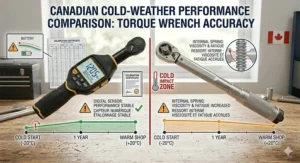
Battery dependency represents the primary limitation for Canadian users. Cold garage temperatures below minus ten degrees Celsius significantly reduce battery capacity. Some mechanics report digital wrenches becoming sluggish or providing unreliable readings when batteries approach end-of-life. Keeping spare AAA batteries in your toolbox becomes mandatory for year-round reliability.
How Click Type Torque Wrenches Work
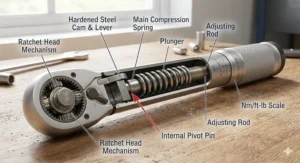
Click-type torque wrenches use a calibrated spring mechanism and cam arrangement to produce an audible and tactile “click” when preset torque is reached. You adjust the handle to your desired torque setting, which compresses or releases the internal spring. As you tighten a fastener, force builds in the wrench mechanism. At the preset torque value, the cam slips past a pivot point, creating the distinctive click sensation and sound.
This mechanical approach offers significant advantages for Canadian workshops. The wrench functions identically at minus forty degrees or plus thirty degrees Celsius. No batteries die at inconvenient moments. The click feedback penetrates through heavy work gloves and noisy shop environments. Durability often exceeds digital models because there are no electronic components to fail from moisture, impact, or electrical issues.
The primary maintenance requirement involves storage at the lowest torque setting when not in use. Leaving the spring compressed for months can cause calibration drift. Canadian mechanics who perform seasonal work should verify calibration at the beginning of each active season, particularly before trusting the wrench with critical fasteners.
Digital vs Click Type: Detailed Feature Comparison
Accuracy and Precision Differences
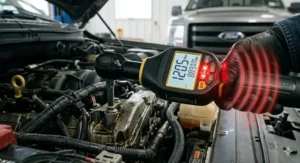
Digital torque wrenches typically achieve plus or minus two percent accuracy across their operating range, while click-type mechanical models usually specify plus or minus four percent. This difference matters primarily in critical applications like aerospace fasteners, medical equipment assembly, or racing engine builds where marginal torque variations affect performance or safety.
For typical Canadian automotive work, both accuracy levels prove adequate. Consider that lug nut torque specifications often range from 80 to 100 foot-pounds with a 20 foot-pound tolerance window. Even a four percent accuracy variation on a click-type wrench falls well within acceptable limits. The human element of applying force consistently often introduces more variation than the tool’s inherent accuracy rating.
Temperature affects both wrench types differently. Digital models can experience accuracy drift as battery voltage drops in cold conditions. The electronic components may also require temperature compensation algorithms that don’t always work perfectly across Canada’s extreme seasonal ranges. Click-type wrenches maintain consistent calibration across temperature variations because the spring characteristics remain stable within normal automotive service temperature ranges.
User Experience and Learning Curve
Digital wrenches present a shallower learning curve for newcomers to torque tools. The numeric display removes interpretation ambiguity, preset memory eliminates repeated adjustments, and multi-modal alerts (buzzer plus LED plus vibration) provide unmistakable feedback when target torque is reached. First-time users appreciate seeing exact applied torque values, building confidence that fasteners receive proper tightening.
Click-type wrenches demand slightly more technique mastery. Users must learn to recognize the click sensation, understand that continued force after the click over-torques the fastener, and develop consistent pulling technique to achieve repeatable results. Canadian mechanics teaching apprentices often note that some individuals struggle to feel or hear the click initially, particularly when wearing thick winter gloves or working in noisy environments.
However, click-type simplicity offers long-term advantages. There’s nothing to configure, no menu navigation, no unit selection confusion. Adjust the handle to your desired torque value, tighten until it clicks, and you’re done. This straightforward operation proves valuable when working quickly or when multiple users share tools without extensive training.
Benefits vs Traditional Fastening Methods
| Method | Precision | Repeatability | Skill Required | Cost | Best Use Case |
|---|---|---|---|---|---|
| Digital Torque Wrench | Excellent (±2%) | Very High | Low-Medium | $85-$280 | Critical fasteners, data logging |
| Click Type Torque Wrench | Good (±4%) | High | Medium | $45-$175 | General automotive, reliability |
| Beam Torque Wrench | Good (±3%) | High | Medium-High | $30-$80 | Reference/calibration checks |
| Impact Gun | Poor (±20%+) | Low | Low | $80-$400 | Initial tightening only |
| Hand Tightening | Very Poor | Very Low | Very High | Free | Emergency/temporary only |
Durability and Maintenance Requirements
All-steel click-type torque wrenches demonstrate exceptional durability in Canadian workshop environments. Drop one from a workbench and you’ll likely only scratch the finish. The mechanical mechanism tolerates reasonable abuse, moisture exposure, and temperature cycling without catastrophic failure. Many Canadian mechanics report using the same click-type wrench for ten or fifteen years with only periodic recalibration.
Digital models require more careful handling. The electronic display, circuit boards, and sensors can fail from impact damage. Moisture ingress through battery compartments or button seals causes corrosion failures. Some Canadian users report digital wrenches failing after garage humidity exposure during spring thaw cycles. The added complexity introduces additional failure modes beyond pure mechanical wear.
Both wrench types require calibration verification according to ISO 6789 standards. The guideline specifies recalibration every 5,000 cycles or twelve months, whichever comes first. Canadian industrial users typically send wrenches to accredited calibration laboratories annually. DIY mechanics can verify calibration using beam-style reference wrenches or by sending tools to facilities offering calibration services with certificates traceable to National Research Council standards.
Best Torque Wrench for Lug Nuts: Canadian Considerations
Proper wheel installation represents one of the most common torque wrench applications for Canadian vehicle owners. Seasonal tire changes, brake service, and wheel bearing maintenance all require specific torque values to ensure safe operation.
Torque Specifications for Canadian Vehicles
Most passenger cars require lug nut torque between 80 and 100 foot-pounds. Light trucks and SUVs often specify 100 to 140 foot-pounds. Heavy-duty trucks may require 150 to 200 foot-pounds or higher. These specifications appear in your vehicle’s owner manual, typically in both foot-pounds and Newton-meters to accommodate different measurement preferences.
Canadian vehicle owners should verify specifications for their specific make and model rather than relying on generic values. Aluminum wheels often require different torque than steel wheels due to thermal expansion characteristics. Aftermarket wheels may have unique requirements based on their design and material composition.
Temperature cycling affects wheel installations significantly in Canadian climates. A wheel torqued to specification in a heated garage may experience different clamping force after sitting outside overnight at minus twenty degrees Celsius. Many professional shops recommend retorquing lug nuts after the first 50 to 100 kilometres of driving, allowing thermal cycling and vibration to stabilize the installation.
Recommended Wrench Range for Wheels
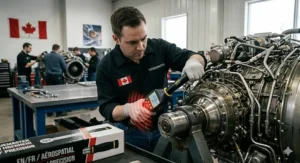
For Canadian passenger vehicle owners, a 1/2-inch drive torque wrench covering 10 to 150 foot-pounds handles virtually all wheel installation requirements. This range accommodates sedans, crossovers, minivans, and light trucks. The TEKTON 24335 and EPAuto models reviewed earlier both fit these specifications perfectly.
Owners of heavy-duty trucks, commercial vehicles, or RVs need wrenches extending to 250 foot-pounds or higher. The VANPO digital wrench reaching 250.8 foot-pounds serves this market well. Some large truck applications require even higher torque values, necessitating specialized heavy-duty wrenches or torque multipliers.
Motorcycle and sports car owners working with lightweight wheels may benefit from lower-range wrenches like the 3/8-inch drive models covering 10 to 80 foot-pounds. These provide finer adjustment resolution in the 60 to 80 foot-pound range common for performance vehicle applications.
Torque Wrench Calibration Guide for Canadian Users
Maintaining calibration ensures your torque measurements remain accurate and reliable. Without proper calibration verification, you’re essentially guessing at applied torque values, defeating the purpose of using a precision tool.
Understanding ISO 6789 Calibration Standards
The ISO 6789 standard establishes international requirements for torque wrench design, testing, and calibration. The 2017 revision split the standard into two parts. ISO 6789-1 specifies design requirements and minimum performance specifications. ISO 6789-2 defines calibration procedures and uncertainty calculations.
Under ISO 6789, torque wrenches must demonstrate accuracy within specified tolerances across their full operating range. Testing occurs at the minimum value of the indicated range, at 60 percent of capacity, and at 100 percent of capacity. Each test point requires loading in both clockwise and counterclockwise directions where applicable. The wrench must meet accuracy specifications at all test points to pass calibration.
Canadian calibration laboratories accredited by the National Research Council CLAS program follow these international standards. Accreditation ensures measurement traceability through an unbroken chain to Canadian national measurement standards, ultimately linking to international SI units.
DIY Calibration Verification Methods
While professional calibration requires specialized equipment, Canadian mechanics can perform basic verification checks to identify obviously out-of-calibration tools before sending them for formal testing.
The simplest method involves using a beam-style torque wrench as a reference standard. Beam wrenches maintain calibration extremely well because they have no mechanical or electronic components to drift. Apply torque to a secure fastener using your click-type or digital wrench set to a specific value. While maintaining that position, verify the reading on a beam wrench attached to the same fastener. Significant discrepancies indicate calibration drift requiring professional attention.
Some Canadian tool rental shops and automotive schools offer calibration verification services for reasonable fees. These facilities use torque testers or transducers to measure actual applied torque and compare it against the wrench’s indicated value. Results identify whether calibration falls within acceptable tolerances or requires adjustment.
For those wanting to invest in their own verification capability, digital torque testers are available through industrial suppliers. These devices provide traceable measurements allowing you to verify your working wrenches against a calibrated standard. Initial costs run several hundred dollars, justifiable for professional mechanics or serious enthusiasts maintaining multiple torque tools.
When to Recalibrate Your Wrench
Follow the ISO 6789 guideline of recalibration every 5,000 cycles or twelve months, whichever occurs first. Professional mechanics working daily should track cycle counts and schedule calibration accordingly. DIY users working on personal vehicles probably won’t reach 5,000 cycles in a year, making annual recalibration the appropriate schedule.
Immediate recalibration becomes necessary after certain events. Dropping a torque wrench from any significant height can shift calibration even without visible damage. Over-torquing beyond the wrench’s maximum rated capacity can damage internal components. Exposure to extreme impacts, like being run over by a vehicle, almost certainly requires recalibration before the tool can be trusted again.
Canadian mechanics working in mobile service environments face additional calibration challenges. Tools transported between job sites experience more vibration and impact than stationary shop tools. Some mobile mechanics verify calibration quarterly rather than annually to ensure reliability when working on customer vehicles.
✨ Upgrade Your Tool Kit Today!
🛠️ Ready to achieve professional-level precision in your automotive work? The torque wrenches featured in this guide represent the best options available on Amazon.ca for Canadian mechanics. Click on the product names to explore detailed specifications, read Canadian customer reviews, and take advantage of current promotions. Your wheels, engine, and suspension components deserve proper torque!
1/2 Inch Drive Torque Wrench Range Explained
The 1/2-inch drive size represents the standard for automotive torque wrenches in Canadian workshops. This drive accepts standard 1/2-inch square sockets, matching the common socket sets used for vehicle maintenance and repair.
Why 1/2-Inch Became the Automotive Standard
The 1/2-inch drive balances several competing requirements. It’s large enough to handle automotive torque loads without adapter failures. The socket selection in 1/2-inch drive surpasses smaller sizes, providing access to virtually any automotive fastener size. The drive squares tolerate repeated high-torque cycles without rounding off or wearing excessively.
Smaller 3/8-inch and 1/4-inch drives suit lower torque applications. Mechanics use 3/8-inch drives for engine accessories, transmission pans, differential covers, and similar components typically torqued below 80 foot-pounds. The 1/4-inch drive serves precision work on bicycles, electronics, and small engines where torque values rarely exceed 20 foot-pounds.
Larger 3/4-inch and one-inch drives address heavy industrial applications beyond typical automotive work. These massive wrenches torque axle nuts, driveline components, and heavy equipment fasteners requiring 300 foot-pounds or more. Most Canadian DIY mechanics will never need drives larger than 1/2-inch unless working on commercial vehicles or industrial equipment.
Typical Torque Ranges for Different Applications
Automotive applications distribute across surprisingly wide torque ranges. Engine oil drain plugs typically require 20 to 30 foot-pounds. Spark plugs need 15 to 25 foot-pounds depending on thread size and material. Cylinder head bolts can demand 60 to 100 foot-pounds or more, often with specific torque-plus-angle procedures.
Wheel lug nuts consume most torque wrench usage for Canadian vehicle owners. The 80 to 140 foot-pound range covers nearly all passenger vehicles and light trucks. This explains why 1/2-inch drive wrenches covering 10 to 150 or 25 to 250 foot-pounds dominate the market.
Suspension components require careful torque control. Ball joints, control arm bushings, sway bar links, and shock mounts all have specific torque values preventing looseness while avoiding component damage. These fasteners typically fall in the 40 to 100 foot-pound range, well within 1/2-inch drive wrench capabilities.
Canadian Price Range and Value Analysis
| Price Range (CAD) | Wrench Type | Expected Features | Target User | Value Rating |
|---|---|---|---|---|
| $35-$60 | Click Type | Basic mechanism, minimal case, ±4% accuracy | DIY beginners, occasional use | ⭐⭐⭐⭐ |
| $60-$100 | Click/Digital | Quality build, protective case, reliable calibration | Home mechanics, regular use | ⭐⭐⭐⭐⭐ |
| $100-$150 | Digital | Advanced features, multiple modes, ±2% accuracy | Enthusiasts, semi-professional | ⭐⭐⭐⭐ |
| $150-$280 | Premium Digital | Professional grade, data logging, certification | Professional mechanics, critical work | ⭐⭐⭐⭐ |
| $280+ | Industrial | Extreme accuracy, specialty features, full certification | Industrial, aerospace, medical | ⭐⭐⭐ |
Value ratings based on feature-to-price ratio for typical Canadian automotive applications
Foot-Pounds vs Newton-Meters: Canadian Perspective
Canadian mechanics navigate both Imperial and metric measurement systems daily. Domestic vehicle manufacturers traditionally specified torque in foot-pounds, while European and Asian imports used Newton-meters. Modern service information often lists both units, but understanding conversion helps verify specifications and catch documentation errors.
Understanding Measurement Units
A foot-pound represents the torque created by one pound of force applied perpendicular to a wrench one foot from the center of rotation. If you hang a one-pound weight from a twelve-inch wrench handle and let gravity pull straight down, you’re applying one foot-pound of torque to the fastener.
A Newton-meter quantifies torque using metric units. One Newton equals the force required to accelerate one kilogram at one meter per second squared. Apply one Newton of force perpendicular to a wrench one meter from rotation center, and you generate one Newton-meter of torque.
The conversion factor between these units is approximately 1.356. One foot-pound equals 1.356 Newton-meters. Conversely, one Newton-meter equals 0.7376 foot-pounds. Most torque wrenches display both scales, eliminating mental math during service procedures.
Why Canada Uses Both Systems
Canada officially adopted the metric system in the 1970s, but complete conversion never occurred in all industries. Automotive service represents a particularly mixed environment. Canadian-market vehicles from American manufacturers often retained Imperial fasteners and torque specifications. European and Japanese imports brought metric measurements.
This dual system persists in 2026. Mechanics working on Ford trucks use foot-pounds. Technicians servicing BMW sedans reference Newton-meters. Multi-brand shops require fluency in both systems. Many Canadian mechanics develop intuitive feel for common torque values in both units through repeated application.
Digital torque wrenches simplify this situation by offering instant conversion between units. Press a button and the display switches from 90 foot-pounds to 122 Newton-meters or vice versa. Click-type wrenches address the issue with dual-scale markings, though reading the correct scale requires attention to avoid errors.
Practical Conversion Tips
For quick mental approximations, remember that Newton-meters are about three-quarters the numeric value of foot-pounds. A specification of 100 foot-pounds translates to roughly 75 Newton-meters (actual value 73.8). A requirement for 90 Newton-meters approximates 120 foot-pounds (actual value 122).
Canadian mechanics often round torque values to convenient increments matching wrench graduations. If a specification calls for 87 Newton-meters and your wrench marks in 5-unit increments, setting to 85 or 90 Newton-meters typically falls within acceptable tolerance. Verify that the specification’s tolerance range accommodates this rounding before approximating.
Some Canadian service facilities maintain conversion charts posted in work areas. These references prevent errors and speed up service procedures when technicians encounter unfamiliar measurement units. Smartphone calculator apps with torque conversion features serve the same purpose for mobile mechanics or those working outside dedicated shop environments.
Accuracy Tolerance Percentage: What You Need to Know
Torque wrench accuracy specifications describe how closely applied torque matches the indicated value. Understanding these tolerances helps you select appropriate tools and interpret calibration certificates.
Decoding Accuracy Specifications
When a manufacturer states plus or minus 4 percent accuracy, they’re describing the maximum deviation between indicated and actual torque. A wrench set to 100 foot-pounds with plus or minus 4 percent accuracy might apply anywhere from 96 to 104 foot-pounds in real-world use. This variation occurs due to mechanical tolerances, friction, temperature effects, and measurement uncertainty.
The accuracy specification typically applies across a portion of the wrench’s range rather than from zero to maximum. Most torque wrenches specify accuracy from 20 percent to 100 percent of full scale. A wrench rated for 10 to 150 foot-pounds maintains its accuracy specification from 30 to 150 foot-pounds. Below 30 foot-pounds, accuracy may degrade significantly.
Professional-grade digital wrenches achieve plus or minus 2 percent or better accuracy across their operating range. This tighter tolerance suits critical applications but costs significantly more than mechanical click-type wrenches. Canadian aerospace shops, pharmaceutical manufacturers, and precision engineering facilities justify the premium for applications where torque variations affect safety or product quality.
How Accuracy Affects Your Work
For most Canadian automotive applications, plus or minus 4 percent accuracy proves entirely adequate. Consider lug nuts torqued to 100 foot-pounds with a 4 percent accuracy wrench. The actual applied torque might range from 96 to 104 foot-pounds. Vehicle manufacturers design fastener systems with safety factors accommodating this variation and more.
Critical fasteners demand tighter tolerance. Engine connecting rod bolts, cylinder head fasteners, and main bearing caps often specify torque-plus-angle tightening procedures requiring precise initial torque before angle measurement. These applications benefit from plus or minus 2 percent digital wrenches ensuring accurate baseline torque before angular rotation.
Temperature effects can exceed the wrench’s inherent accuracy specification. A fastener torqued in a heated garage will experience different clamping force after temperature stabilization outdoors. Canadian mechanics working across extreme temperature ranges should consider these thermal expansion effects alongside wrench accuracy when evaluating critical assemblies.
Maintaining Accuracy Over Time
All torque wrenches experience calibration drift with use. Mechanical wear, spring fatigue, and accumulated stress gradually shift the relationship between indicated and actual torque. Regular calibration verification identifies this drift before it produces service failures or safety issues.
Proper storage practices slow calibration drift. Click-type wrenches should always be stored at their lowest torque setting, releasing spring tension. Digital wrenches should have batteries removed for long-term storage, preventing corrosion from battery leakage. Both types benefit from protective cases preventing impacts and contamination exposure.
Canadian mechanics who drop tools, over-torque beyond maximum ratings, or expose wrenches to impacts should verify calibration more frequently than the standard twelve-month interval. A single significant impact can shift calibration outside acceptable tolerance even without visible damage to the tool.
Storage Case Included: Why This Matters in Canada
Torque wrench storage protection proves particularly important in Canadian climate conditions. Temperature cycling, humidity variations, and workshop clutter all threaten calibration stability and tool longevity.
Protection from Temperature Extremes
Canadian workshops experience dramatic temperature variations. A garage in Winnipeg might sit at minus thirty degrees Celsius overnight, then reach plus twenty degrees during the workday as heating systems engage. These temperature swings cause expansion and contraction cycles potentially affecting calibrated mechanisms.
Hard storage cases provide thermal mass buffering these rapid changes. A wrench stored in a protective case warms and cools more slowly than one left exposed on a shelf. This gentler temperature transition reduces thermal stress on springs, electronics, and mechanical components.
Foam-lined cases also provide moisture protection during shoulder seasons when condensation forms on cold tools brought into warm environments. Spring thaw periods prove particularly troublesome as ice-cold tools from unheated garages immediately condensate when exposed to humid indoor air. The protective case prevents this moisture from directly contacting the wrench mechanism.
Preventing Calibration Damage from Impacts
Even expensive professional-grade torque wrenches can fail from a single drop onto concrete floors. The impact transmits shock waves through the wrench body, potentially jarring calibrated springs or damaging electronic components. Drops from waist height or above frequently shift calibration outside acceptable tolerances.
Storage cases prevent most accidental drops. When you finish using the wrench, it goes back in its case rather than being set on a crowded workbench where it might fall. The case also protects against items dropped onto the wrench or tools rolled across it by other workers sharing the space.
Canadian mobile mechanics transporting tools between job sites benefit especially from protective cases. Vibration during transport can gradually shift mechanical adjustments or fatigue electronic connections. The foam cushioning inside quality storage cases absorbs these vibrations, extending calibration intervals and tool service life.
Keeping Track of Multiple Tools
Professional mechanics accumulate multiple torque wrenches covering different ranges and drive sizes. Protective cases with label areas help organize this collection. You can quickly identify your 1/4-inch low-range wrench versus the 1/2-inch automotive model without handling each tool.
Some Canadian shops implement tool control programs tracking calibration dates, cycle counts, and service history. Serialized wrenches in identified cases simplify these systems. The case becomes the permanent home for calibration certificates, usage logs, and maintenance records.
Cases also prevent mix-ups between personal and shop-owned tools. In collaborative work environments where multiple technicians share equipment, clearly labeled cases reduce confusion about tool ownership and maintenance responsibility.
Frequently Asked Questions
❓ What is the average lifespan of a torque wrench in Canadian workshop conditions?
❓ Can I use a torque wrench as a regular ratchet for loosening fasteners?
❓ How often should I recalibrate my torque wrench under Canadian climate conditions?
❓ What torque wrench range covers most automotive work on Canadian vehicles?
❓ Are digital torque wrenches reliable in cold Canadian winter temperatures?
Conclusion: Making Your Decision for Canadian Conditions
The choice between digital and click type torque wrenches ultimately depends on your specific needs, working environment, and budget constraints. Canadian mechanics face unique considerations including extreme temperature ranges, mixed measurement systems, and diverse vehicle populations requiring flexible tool capabilities.
For general automotive work, the TEKTON 24335 click type wrench represents outstanding value, combining reliability with affordability in a package suited to Canadian climate extremes. Its all-steel construction survives temperature cycling, the mechanical design eliminates battery concerns, and the 10-150 foot-pound range covers most passenger vehicle applications perfectly.
Professional mechanics and enthusiasts seeking maximum accuracy should consider digital models like the ACDelco ARM601-4 or CRAFTSMAN CMMT99436. These tools provide precision measurement, data logging capabilities, and convenient unit conversion supporting efficient service procedures. Just remember to account for battery performance in cold conditions and implement appropriate storage practices.
Regardless which type you choose, commit to proper maintenance including storage at minimum torque settings for click wrenches, annual calibration verification, and protective case usage. The most accurate torque wrench delivers no value if calibration drift goes undetected for years. Canadian professionals and serious DIYers should establish relationships with accredited calibration laboratories or invest in verification equipment ensuring tools remain trustworthy.
Remember that any torque wrench vastly improves upon guesswork. Even a budget click-type wrench provides more reliable results than impact guns or muscle memory alone. Your investment protects expensive components, prevents safety failures, and demonstrates professional approach to mechanical work.
Recommended for You
- 7 Best Torque Wrenches for Winter Tire Changes Canada 2026
- 7 Best Screwdriver Sets for Electronics Canada 2026
- Ratcheting Wrench vs Standard Wrench: 7 Key Differences (2026 Canada)
Disclaimer: This article contains affiliate links to Amazon.ca. If you purchase products through these links, we may earn a small commission at no additional cost to you.
✨ Found this helpful? Share it with your friends! 💬🤗
