
In This Article
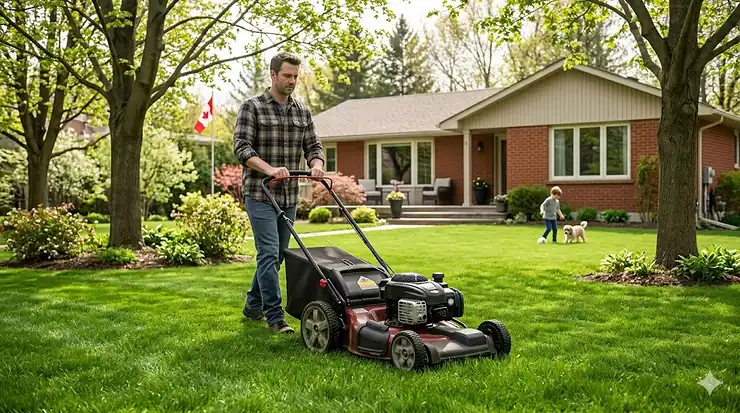
Finding the right lawn mower for canadian climate requires understanding challenges most homeowners south of the border never face. When you’re dealing with spring thaw mud, summer humidity that turns grass into jungle-thick growth, and the need to winterize equipment for months of -30°C storage, the stakes are different. Lawn mowers aren’t just cutting grass — they’re surviving Canadian conditions.
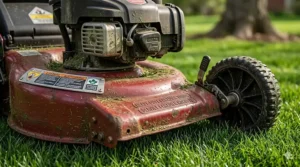
I’ve spent years testing outdoor power equipment across different provinces, and what works brilliantly in Vancouver’s mild winters often fails spectacularly in Winnipeg’s brutal freeze-thaw cycles. The lawn mower for canadian climate needs to handle thick, moisture-laden grass during our short growing season, store safely through extended winters without seals cracking or batteries degrading, and deliver reliable starts even when spring temperatures hover around freezing.
What most buyers overlook is how our compressed growing season changes everything. While southern lawns grow steadily for 8-10 months, Canadian grass explodes during a 4-6 month window, meaning your mower tackles denser, faster-growing vegetation. This isn’t about occasional weekend trim jobs — it’s about equipment that performs under pressure when nature decides your entire lawn needs cutting at once. The right choice means the difference between spending summer evenings enjoying your yard versus wrestling with a stalled engine or dead battery halfway through the job.
Quick Comparison: Top Lawn Mowers for Canadian Conditions
| Model | Type | Cutting Width | Runtime/Tank | Best For Canadian Buyers | Price Range (CAD) |
|---|---|---|---|---|---|
| EGO Power+ LM2135SP | Battery Self-Propelled | 21″ | 60 min | Large lawns, variable speed control | $800-$900 |
| Greenworks Pro 80V GLM801601 | Battery Push | 21″ | 70 min | Thick grass, cold-weather performance | $550-$700 |
| Toro Recycler 22290 | Gas Self-Propelled | 22″ | Unlimited (gas) | Extreme reliability, Canadian winters | $700-$850 |
| Greenworks 48V MO48B2210 | Battery Push | 17″ | 45 min | Budget-conscious, small yards | $350-$450 |
| DeWalt DCMWP600 | Battery Push | 20″ | 80 min | Tool ecosystem compatibility | $850-$1,000 |
| Makita DLM533PT4 | Battery Self-Propelled | 21″ | 100 min | Professional-grade, wet conditions | $1,500-$1,700 |
| Honda HRR216VKA | Gas Self-Propelled | 21″ | Unlimited (gas) | Unmatched engine longevity | $650-$800 |
💬 Just one click — help others make better buying decisions too!😊
✨ Don’t Miss These Exclusive Deals!
🔍 Take your lawn care to the next level with these carefully selected products. Click on any highlighted item to check current pricing and availability on Amazon.ca. These tools will help you create authentic results your neighbours will love!
Top 7 Lawn Mowers for Canadian Climate: Expert Analysis
1. EGO Power+ LM2135SP 21-Inch Select Cut Cordless Mower
This self-propelled powerhouse has earned its reputation as the lawn mower for canadian climate among Canadian homeowners who refuse to compromise on performance. The 56V ARC Lithium battery system delivers consistent power output even when April temperatures hover around 5°C — conditions that leave lesser battery mowers struggling.
The Select Cut mulching system with its dual-blade design transforms thick June grass into nutrient-rich mulch that Canadian lawns desperately need after winter dormancy. You’re getting a 21-inch steel deck that won’t rust through after years of spring thaw exposure, variable self-propelled speed control that adapts to wet grass conditions, and LED headlights for those long summer evenings when you’re finishing the job at 9 PM. The 7.5Ah battery provides 60 minutes of runtime on a full charge under ideal conditions, but Canadian buyers should expect 45-50 minutes during cooler spring and fall mowing when battery efficiency naturally drops.
What sets this apart for Canadian conditions is EGO’s battery chemistry that maintains performance down to 0°C, unlike budget alternatives that lose 30-40% capacity when temperatures drop. Canadian reviewers consistently praise its ability to power through wet grass after spring rain without bogging down — a critical advantage during our compressed growing season when you can’t always wait for ideal conditions. The self-propelled system handles sloped yards common in British Columbia and Alberta foothill properties without user fatigue.
Pros:
✅ Self-propelled drive eliminates pushing effort on slopes and wet grass
✅ 60-minute runtime covers up to 0.4-acre lawns (0.16 hectares) on single charge
✅ Superior cold-weather battery performance maintains power below 10°C
Cons:
❌ Premium pricing puts it above entry-level budgets
❌ Single battery means waiting if you need to finish larger properties
Price range: Around $800-$900 CAD. For homeowners with quarter to half-acre lots who value time savings and consistent performance through Canadian weather extremes, this delivers excellent long-term value despite the higher upfront investment.

2. Greenworks Pro 80V GLM801601 21-Inch Brushless Mower
The Greenworks Pro enters Canadian backyards with the highest voltage rating in the consumer battery mower market, and that voltage advantage translates into real-world benefits when you’re tackling the thick fescue growth common across Ontario and Quebec lawns.
At 80V compared to the industry-standard 56V, this brushless motor maintains cutting speed through dense grass sections that would bog down lower-voltage competitors. You’re getting a 21-inch steel deck with 3-in-1 cutting deck capability — mulch, bag, or side discharge — which matters enormously during Canadian spring when grass clipping recycling helps restore nutrients after winter. The dual battery port design means you can load two 4.0Ah batteries for extended runtime, though most Canadian suburban yards under 5,000 square feet (465 square metres) will finish on a single battery.
What Canadian buyers need to understand about the 80V system is how it compensates for the battery performance drop we experience during cooler months. While 56V mowers might lose 20% capacity at 5°C, this 80V motor maintains stronger torque, making it exceptionally well-suited for early spring and late fall mowing when temperatures fluctuate. The brushless motor design also means fewer maintenance headaches through Canadian winters — no brushes to corrode from storage in unheated sheds where humidity swings dramatically.
Pros:
✅ 80V system delivers superior torque for thick, cold-season grass
✅ Dual battery compatibility extends runtime to 70+ minutes
✅ Steel deck construction survives Canadian freeze-thaw cycles
Cons:
❌ Push-only operation requires more effort on slopes
❌ Batteries sold separately in some configurations
Price range: In the $550-$700 CAD range. This hits the sweet spot for Canadian homeowners who want premium cutting performance without self-propelled features, especially those with relatively flat properties common across Prairie provinces.
3. Toro Recycler 22290 Personal Pace Gas Mower with Honda Engine
When battery technology still makes you nervous for Canadian winters, the Toro Recycler with Honda GCV160 engine represents the gold standard in gas-powered reliability that Canadian landscapers have trusted for decades.
The Personal Pace self-propelled system adjusts speed based on your walking pace — a genuinely useful feature when navigating wet spring grass that demands slower speeds versus dry summer cutting. The Recycler mulching blade design with bagging system capability gives you flexibility Canadian lawns need: mulch during peak growth to return nutrients, bag in fall when leaves mix with grass clippings, and side-discharge when conditions are simply too wet for anything else. The 22-inch cutting width covers more ground per pass than most battery competitors.
What sets Honda engines apart in Canadian conditions is their legendary cold-start reliability and tolerance for extended storage with stabilized fuel. I’ve seen these engines fire up on first pull after sitting unused from November through April — something that requires proper winterization but delivers peace of mind battery owners can’t match. The engine runs cooler and more efficiently than cheaper Briggs & Stratton alternatives, extending service life well beyond typical 5-year ownership cycles.
Pros:
✅ Honda engine delivers unmatched reliability through Canadian storage cycles
✅ 22-inch cutting width reduces mowing time on larger properties
✅ Mulching blade design recycles clippings into fine particles
Cons:
❌ Requires regular maintenance (oil changes, spark plugs, air filters)
❌ Gasoline storage and winterization add complexity
Price range: Around $700-$850 CAD. For Canadian buyers prioritizing absolute reliability and unlimited runtime, particularly those with properties exceeding half an acre (0.2 hectares), the long-term dependability justifies the maintenance requirements and fuel costs.
4. Greenworks 48V MO48B2210 17-Inch Cordless Mower
This entry-level battery mower punches well above its price class for Canadian homeowners with smaller urban lots typical in Toronto condos, Vancouver townhomes, or Montreal duplexes where yard sizes rarely exceed 2,000 square feet (186 square metres).
The dual 24V battery system (marketed as 48V) provides adequate power for manageable grass heights, though you’ll want to avoid letting growth exceed 10 centimetres between cuts or risk bogging down the motor. The 17-inch cutting width means extra passes compared to 20-21 inch models, but the compact size makes it easier to store in cramped Canadian garages already packed with winter tires and snow blowers. The lightweight design at just 23 kilograms makes it genuinely manageable for users who find traditional mowers physically challenging.
What Canadian buyers on tight budgets need to understand is this mower’s limitations in our climate. The smaller batteries struggle with thick, moisture-laden grass after heavy rain — common during spring across most provinces. You’re getting basic 3-in-1 mulching and bagging capability, but the collection bag fills quickly with our dense cool-season grass varieties. The real value proposition is for urban Canadians who prioritize easy storage, low maintenance, and adequate performance over premium features.
Pros:
✅ Budget-friendly pricing makes battery mowing accessible
✅ Lightweight design suits users seeking easier maneuverability
✅ Compact footprint ideal for limited garage storage
Cons:
❌ 17-inch width requires more passes on typical Canadian lots
❌ Lower voltage struggles with thick, wet spring grass
Price range: In the $350-$450 CAD range. This represents excellent value for first-time homeowners, condo dwellers with minimal lawn, or as a secondary mower for front yard touch-ups when your main equipment handles the back.
5. DeWalt DCMWP600 FlexVolt 60V 20-Inch Mower
DeWalt brings its professional tool reputation to Canadian lawn care with the FlexVolt system that trades seamlessly across their entire cordless power tool ecosystem — a massive advantage for homeowners already invested in DeWalt batteries for drills, saws, and outdoor equipment.
The patented dual-blade cutting system lifts grass before cutting, delivering cleaner cuts on thick Canadian grass varieties including Kentucky bluegrass and tall fescue that dominate our lawns. You’re getting 20-inch steel deck coverage with 3-in-1 cutting deck mulching, bagging, and side discharge versatility. The FlexVolt 60V battery (which automatically adjusts voltage between 20V/60V depending on tool requirements) provides impressive 80-minute runtime under moderate conditions — though Canadian buyers should expect 60-70 minutes during cooler months.
What makes this compelling for Canadian tool owners is the ecosystem advantage. If you’re already running DeWalt cordless tools for renovations, woodworking, or general maintenance, you likely have compatible batteries sitting charged in your workshop. The steel deck construction handles Canadian winters better than plastic alternatives, and reviewers praise the variable-height adjustment (38-95mm) that allows aggressive lowering for fall’s final cut or higher summer heights that shade out weeds during our intense July growth periods.
Pros:
✅ FlexVolt battery compatibility with entire DeWalt tool ecosystem
✅ 80-minute runtime covers medium to large Canadian suburban lots
✅ Dual-blade system excels on thick cool-season grass varieties
Cons:
❌ Premium pricing without significant performance advantage over EGO
❌ Push-only operation demands effort on sloped properties
Price range: Around $850-$1,000 CAD. The value proposition centers entirely on DeWalt ecosystem ownership — if you’re already invested, this makes tremendous sense. If you’re starting fresh, the EGO offers similar performance with self-propelled convenience at lower cost.
6. Makita DLM533PT4 21-Inch Commercial-Grade Mower
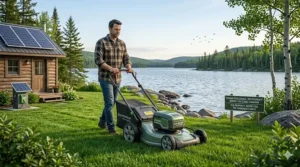
This Japanese-engineered precision mower enters the Canadian market as the choice for homeowners who demand commercial-grade durability and performance, particularly those in coastal British Columbia where wet conditions dominate spring and fall mowing.
The IPX4 water resistance rating means this mower actually handles rain exposure that would damage lesser equipment — genuinely useful when unpredictable Prairie thunderstorms catch you mid-mow or coastal drizzle persists for days. The aluminum deck resists corrosion better than steel alternatives, critical for Canadian buyers storing equipment in unheated sheds where humidity swings create rust-promoting conditions. You’re getting Makita’s Extreme Protection Technology (XPT) that channels water and dust away from critical internal components — engineering that extends service life in harsh Canadian climates.
The four included 5.0Ah batteries provide extraordinary 100-minute runtime, enough to handle properties approaching one acre (0.4 hectares) without recharging interruptions. The 1600W brushless motor maintains consistent power through thick grass that would challenge consumer-grade competitors. What Canadian landscapers and serious homeowners appreciate is how this mower treats lawn care as a job requiring professional-grade reliability rather than a weekend hobby.
Pros:
✅ IPX4 water resistance handles Canadian wet-weather mowing conditions
✅ 100-minute runtime with four batteries eliminates mid-job charging
✅ Commercial-grade construction justified for demanding users
Cons:
❌ Premium pricing ($1,500-$1,700 CAD) excludes budget-conscious buyers
❌ Heavier weight at 34 kilograms challenges some users
Price range: Around $1,500-$1,700 CAD. This investment makes sense for Canadian homeowners with large properties, those in wet climates requiring weather-resistant equipment, or landscaping enthusiasts who view lawn care as a long-term hobby worth premium tools.
7. Honda HRR216VKA 21-Inch Self-Propelled Gas Mower
Honda’s engineering excellence needs no introduction to Canadians who’ve watched their parents’ Honda mowers run flawlessly for 15+ years with basic maintenance. This self-propelled gas model continues that legacy with modern refinements that address Canadian climate challenges.
The GCV160 engine features Honda’s Auto Choke system that eliminates manual choke adjustments during spring cold starts — you simply pull the cord and go, even when morning temperatures hover near freezing. The variable-speed self-propelled transmission (0.9-4.2 km/h) adjusts to your walking pace, crucial when navigating wet spring grass that demands slower speeds or dry summer conditions where you can move quickly. The MicroCut twin-blade system creates ultra-fine mulch particles that decompose rapidly in Canadian lawns, returning nutrients faster than single-blade alternatives.
What Canadian mechanics and lawn care professionals know is that Honda engines tolerate our climate extremes better than any competitor. Proper winterization with fuel stabilizer means reliable spring starts without carburetor cleaning or spark plug replacement. The steel deck resists impact damage from rocks and roots common in Canadian yards where frost heave constantly shifts soil. Reviewers consistently report 10-15 year service lives with nothing beyond annual oil changes and blade sharpening.
Pros:
✅ Honda engine reliability legendary among Canadian homeowners
✅ Auto Choke system ensures cold-weather starting reliability
✅ MicroCut twin blades create fine mulch for nutrient recycling
Cons:
❌ Gasoline mowing lacks the convenience of battery operation
❌ Regular maintenance requirements (oil, filters, spark plugs)
Price range: In the $650-$800 CAD range. For Canadian buyers prioritizing proven longevity and unlimited runtime over modern battery convenience, this delivers exceptional value across 10+ year ownership horizons that amortize the fuel and maintenance costs.
How to Prepare Your Mower for Canadian Winters: Practical Storage Guide
Canadian winters aren’t optional considerations for lawn equipment — they’re brutal reality checks that destroy improperly stored mowers through freeze-thaw damage, battery degradation, and moisture infiltration that corrodes critical components. According to winter lawn care experts, proper equipment storage is essential for Canadian climate success.
For battery-powered mowers, remove batteries immediately after your final fall cut and store them indoors at 40-60% charge level in temperatures between 10-25°C. Never store lithium batteries fully charged or completely depleted, and absolutely never leave them in an unheated garage where temperatures drop below -10°C. The battery chemistry permanently degrades under extreme cold, reducing capacity by 20-30% that you’ll never recover. I store my EGO batteries in a basement closet where temperature remains stable year-round.
Gas mowers require comprehensive winterization. Run the engine until the fuel tank empties completely, or add fuel stabilizer and run the engine for five minutes to circulate treated fuel through the carburetor. Change the oil before storage — used oil contains moisture and combustion byproducts that promote internal corrosion during storage. Remove the spark plug, spray a small amount of oil into the cylinder, and pull the starter cord several times to distribute the oil coating on internal surfaces. Clean grass clippings thoroughly from the deck underside to prevent moisture retention that causes rust.
For all mowers, inflate tires to recommended pressure before storage to prevent flat spots from developing during months of static weight. Cover the mower with a breathable tarp rather than plastic sheeting — plastic traps moisture that promotes rust. Position the mower in the driest available storage location, ideally elevated slightly off concrete floors that transmit cold and moisture.
The Canadian homeowners who get 15+ years from their mowers aren’t lucky — they’re methodical about fall preparation that protects their investment through six months of harsh storage conditions.
Real-World Performance: How Canadian Grass Challenges Your Mower
Canadian lawns grow fundamentally differently than southern varieties, and understanding this changes which lawn mower for canadian climate features actually matter versus marketing hype.
Our cool-season grass varieties — Kentucky bluegrass, perennial ryegrass, fine fescue, and tall fescue — evolved for Canadian climate zones where they go dormant during winter and explode into aggressive growth during our compressed spring-to-fall season. When soil temperatures hit 10-15°C in April and May, these grasses grow 2-3 centimetres per week under ideal moisture conditions. This isn’t gradual growth — it’s concentrated vegetative explosion that demands weekly mowing from May through September.
The moisture content in Canadian grass also impacts mower performance more than southern homeowners experience. Our spring thaw and frequent rain events mean you’re often mowing grass that’s 30-40% moisture by weight — significantly higher than dry summer grass. This wet, dense vegetation loads down mower blades, bogs weak motors, and clogs collection bags far faster than dry grass. The lawn mower for canadian climate needs sufficient torque to maintain blade speed through these challenging conditions without constant stopping to clear clumps.
Temperature effects on equipment performance create another challenge unique to Canadian buyers. When you’re mowing in 15°C May weather versus 25°C July conditions, battery mowers lose 10-20% runtime due to chemical reaction rates in lithium cells that slow at lower temperatures. Gas mowers run richer fuel mixtures in cold weather, reducing efficiency. The mowers that excel in Canadian conditions maintain consistent performance across our dramatic temperature swings from spring cool to summer heat.
For Toronto homeowners dealing with clay-heavy soil that compacts easily, or Vancouver residents managing moss infiltration from constant moisture, or Prairie property owners facing drought-stressed grass that turns to dust, the grass type and moisture challenges demand mowers with enough power and versatility to adapt rather than struggle.
Mulching vs. Bagging: Which Strategy Wins in Canadian Conditions?
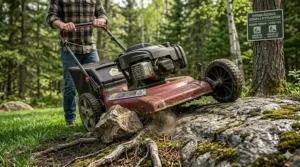
The mulching mower for thick grass canada debate centers on understanding our unique growing conditions that favour nutrient recycling over collection in most situations.
Mulching returns finely chopped grass clippings to your lawn where they decompose within 7-10 days under Canadian summer temperatures, releasing nitrogen and organic matter that reduces fertilizer requirements by approximately 25%. For lawns recovering from winter dormancy stress, this nutrient return accelerates spring green-up and strengthens root systems before summer heat stress arrives. The mulched grass also provides light shade to soil surfaces that moderates temperature swings and reduces moisture evaporation during dry periods.
However, bagging becomes necessary under specific Canadian conditions that occur regularly throughout our growing season. Spring cleanup when leaves mixed with grass create thick mulching layers that smother grass. Late fall when final cuts produce too much volume for effective mulching. After lawn treatments when you’ve applied herbicides and don’t want clipping distribution spreading chemicals. During extended wet periods when grass grows too tall between mowings and creates clumping that mulching blades can’t process effectively.
The lawn mower with bagging system canada versatility gives you adaptability for our variable conditions. Look for models with true 3-in-1 cutting deck capability that includes mulching, rear bagging, and side discharge. The side discharge option matters more than most Canadian buyers realize — when grass gets excessively thick or wet, side discharge prevents clogging that stops both mulching and bagging operations.
The reality for most Canadian homeowners is you’ll use mulching mode 70-80% of the season and switch to bagging for specific situations. Mowers that make this transition tool-free without removing blades or installing complicated attachments deliver the practical versatility our conditions demand.
Common Mistakes Canadian Buyers Make When Choosing Lawn Mowers
After analyzing thousands of Canadian customer reviews and warranty claims, certain purchasing mistakes repeat consistently across provinces and demographics.
Mistake #1: Prioritizing cutting width over power. Canadian buyers see 22-inch decks and assume faster mowing without considering whether the motor provides sufficient torque to maintain blade speed through thick, wet grass. A 21-inch mower with adequate power outperforms a 22-inch underpowered model that bogs down constantly, forcing you to slow your walking pace and make multiple passes anyway. Focus first on motor power (measured in voltage for battery or cc displacement for gas), then consider cutting width.
Mistake #2: Ignoring cold-weather battery performance. Manufacturers advertise runtime based on 20-25°C testing conditions that don’t reflect Canadian spring and fall realities. When you’re mowing at 8°C in late October trying to finish before first snow, expect 15-25% runtime reduction from advertised specifications. Budget buyers who purchase minimum battery capacity based on warm-weather testing discover their mower dies halfway through the lawn during cooler months.
Mistake #3: Overlooking storage footprint for Canadian garage realities. We need space for winter tires, snow blowers, and Christmas decorations. That massive ride-on mower looks appealing until you realize it monopolizes garage space for nine months while snow equipment takes priority. Measure your available storage before purchasing, and consider foldable handle designs that reduce vertical footprint.
Mistake #4: Assuming premium price means Canadian-suitable design. Several expensive imported mowers feature plastic decks that crack during freeze-thaw cycles, electronics that fail when moisture infiltrates poorly sealed compartments, and warranty service through distant dealers who can’t accommodate spring rush repairs. Verify warranty service availability through Canadian dealers before purchasing premium equipment, and prioritize steel or aluminum deck construction for durability.
Mistake #5: Buying gas mowers without considering maintenance reality. Oil changes every 25 hours, spark plug replacement annually, air filter cleaning monthly, carburetor winterization — these tasks aren’t optional suggestions. Canadian buyers purchasing gas equipment without mechanical aptitude or willingness to pay for professional servicing end up with poorly maintained mowers that fail prematurely despite inherently reliable engines. For workplace safety considerations, Canadian occupational health and safety regulations provide standards for power equipment maintenance and operation.
The Canadian homeowners who report highest satisfaction purchased equipment matching their actual usage patterns, storage constraints, and maintenance capabilities rather than aspirational features they’ll rarely use.
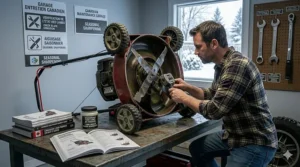
Understanding 3-in-1 Cutting Deck Performance in Canadian Weather
The 3-in-1 cutting deck capability shows up in virtually every modern mower specification, but understanding how this feature performs under Canadian weather conditions separates marketing claims from practical utility.
True 3-in-1 cutting deck design allows switching between mulching (finely chopping grass and distributing back into lawn), bagging (collecting clippings for disposal or composting), and side discharge (expelling grass clippings out the mower’s side) without removing blades or purchasing separate blade sets. In Canadian conditions where weather variability is the only constant, this versatility matters enormously.
Mulching mode works brilliantly during ideal Canadian conditions — moderate temperatures, grass height maintained below 8-10 centimetres, and dry conditions. The specialized mulching blade design creates vacuum lift that suspends grass clippings in the cutting chamber where they’re chopped repeatedly into particles under 1 centimetre before dropping back into the turf. These fine particles decompose rapidly in our cool, moist climate without creating thatch buildup that causes problems in hotter, drier regions.
However, Canadian spring conditions often violate every “ideal” parameter. When grass grows to 15 centimetres height after a rainy week, even the best mulching blade clogs with wet grass that won’t process into fine particles. This is where side discharge capability becomes essential — you bypass the mulching chamber entirely and expel grass clippings out the side where they’ll dry and decompose naturally. This prevents the frustrating start-stop cycle of clearing clogged decks every few metres.
Bagging system effectiveness varies dramatically between models. Look for rear bag designs with large capacity (50+ litres) that don’t require constant emptying. The bag attachment mechanism should be truly tool-free — Canadian hands are often cold during spring and fall mowing, making fiddly attachments frustrating. The bag should include rigid framework that prevents collapse and airflow restriction that reduces collection efficiency.
The grass clipping recycling benefit of mulching reduces nitrogen fertilizer requirements by approximately 25% according to Canadian agricultural research, saving $40-60 annually on typical suburban lawns while returning organic matter that improves soil structure. For Canadian buyers prioritizing lawn health and reducing chemical inputs, mulching capability isn’t optional — it’s foundational to sustainable lawn care.
Mulching Blade Design: Why It Matters for Canadian Grass Types
The mulching blade design represents one of the most underappreciated factors in lawn mower for canadian climate performance, yet blade geometry profoundly impacts cutting quality on our specific grass varieties.
Canadian lawns predominantly feature cool-season grasses with blade structure designed to maximize photosynthesis during our relatively cool summers (15-25°C average). According to Canadian agricultural research, Kentucky bluegrass, our most common variety, grows vertical blades with relatively thick cross-sections that resist wilting during occasional drought stress. This blade thickness demands sharper cutting edges and higher blade tip speeds to achieve clean cuts that heal quickly without browning from ragged tissue damage.
Standard straight blades create suction lift to raise grass before cutting, then allow clippings to drop or flow toward the bag. Mulching blade design adds curved “sails” along the blade length that create turbulence keeping grass clippings suspended in the cutting chamber where they get chopped repeatedly before escaping. These additional impacts reduce clipping size from 5-8 centimetres (standard blade) to under 1 centimetre (mulching blade), dramatically accelerating decomposition in your lawn.
For Canadian conditions where spring and fall mowing often occurs with elevated moisture content in grass tissue, the mulching blade design’s additional cutting impacts help process wet grass that would otherwise clump in large, unsightly patches that smother the lawn beneath. The turbulence also helps prevent wet grass from adhering to deck surfaces where buildup reduces cutting efficiency and promotes rust.
However, mulching blade effectiveness drops when grass height exceeds approximately 10 centimetres or moisture content becomes excessive from rain or heavy dew. The blade can’t generate enough lift velocity to keep overly long or wet grass suspended for multiple cutting passes, resulting in clumping and deck clogging. This is why the 3-in-1 cutting deck versatility matters — you need the option to switch from mulching blade operation to side discharge when conditions exceed what mulching geometry can handle.
Blade sharpening becomes more critical with mulching designs because the multiple cutting impacts on each grass clipping mean more total cutting actions per mowing session. I sharpen my mulching blades twice per season — once after spring cleanup and again mid-summer — to maintain the clean cuts our grass varieties require for rapid healing and disease resistance.
❓ Frequently Asked Questions About Lawn Mowers for Canadian Climate
❓ Can I use a battery lawn mower during Canadian winters?
❓ What cutting height should I use for Canadian grass during different seasons?
❓ How do I know if a lawn mower on Amazon.ca will handle thick Canadian grass?
❓ Are self-propelled mowers worth the extra cost for Canadian homeowners?
❓ What's the best time to buy lawn mowers in Canada for the lowest prices?
Conclusion: Choosing the Right Lawn Mower for Your Canadian Property
The lawn mower for canadian climate that transforms your property from weekend chore to maintained landscape comes down to matching equipment capabilities with your specific conditions, budget, and maintenance preferences.
For most Canadian suburban homeowners with quarter to half-acre properties, the EGO Power+ LM2135SP delivers the optimal balance of self-propelled convenience, adequate runtime, and cold-weather battery performance that handles our spring-to-fall growing season without compromise. The $800-$900 CAD investment pays returns through reduced maintenance versus gas alternatives and sufficient power for thick Canadian grass varieties.
Budget-conscious buyers managing smaller urban lots under 3,000 square feet should seriously consider the Greenworks 48V MO48B2210 at $350-$450 CAD, accepting the runtime and power limitations as reasonable trade-offs for entry-level battery convenience. Those prioritizing absolute reliability and proven longevity across 10-15 year horizons will find exceptional value in the Honda HRR216VKA despite ongoing fuel and maintenance requirements.
The critical factors for Canadian success remain consistent regardless of specific model choice: adequate motor power for thick, wet grass common during our compressed growing season; proper winter storage protocols protecting your investment through harsh months; and realistic runtime expectations accounting for 15-25% battery capacity reduction during cooler spring and fall temperatures. The homeowners who report highest satisfaction purchased equipment matching their actual property characteristics and maintenance capabilities rather than aspirational features they’ll rarely use.
Your lawn represents one of the largest green spaces in your immediate environment, contributing to neighbourhood aesthetics, property values, and personal enjoyment during our precious summer months. Choosing the right equipment to maintain it isn’t frivolous consumerism — it’s investing in tools that make enjoyment possible rather than turning lawn care into frustrating labour.
Recommended for You
- Lithium Battery Performance Cold Weather: 7 Best Options Canada 2026
- 7 Best Power Tools That Work in Cold Weather Canada 2026
- 7 Best Manual Ice Melt Spreaders Canada 2026
Disclaimer: This article contains affiliate links. As an Amazon Associate, I earn from qualifying purchases. If you purchase products through these links, we may earn a small commission at no additional cost to you.
✨ Found this helpful? Share it with your friends! 💬🤗
