
In This Article
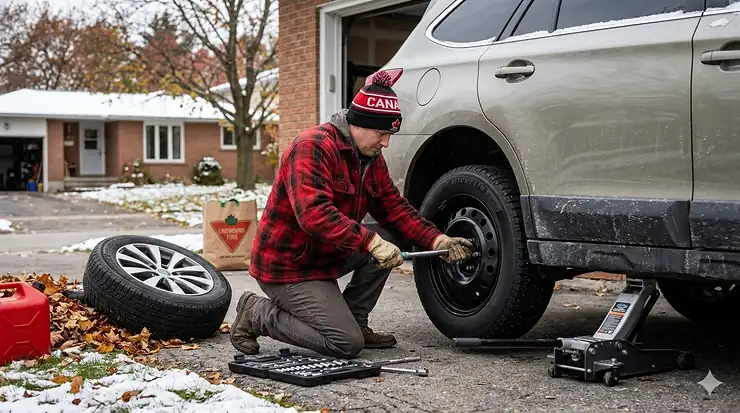
Picture this: you’re changing your winter tires in your driveway on a chilly October morning, trying to beat the first snowfall. You tighten those lug nuts with all your might, thinking “tighter is better,” right? Wrong. Fast forward to spring, and you’re stuck on Highway 401 with a stripped stud or worse—a wheel that’s worked itself loose.
Here’s the thing about Canadian winters—they’re not just cold, they’re ruthless on our vehicles. With temperatures swinging from +5°C to -30°C, metal expands and contracts, and improperly torqued lug nuts can spell disaster. According to Transport Canada, proper wheel installation is critical for vehicle safety, and that’s exactly where a torque wrench for winter tire changes becomes your best friend.
Whether you’re swapping between winter and all-season tires twice a year (like most Canadians do) or simply maintaining your vehicle, understanding proper torque specs for winter tires isn’t just mechanical knowledge—it’s a safety essential. The difference between 80 ft-lb and 100 ft-lb might seem insignificant, but it’s actually the line between secure wheels and potential catastrophe. In this comprehensive guide, I’ll walk you through everything you need to know about torque wrenches for seasonal tire swaps, from budget-friendly options to professional-grade tools available on Amazon.ca.
Quick Comparison Table
| Torque Wrench Model | Torque Range | Price (CAD) | Best For | Rating |
|---|---|---|---|---|
| EBOKA 1/2″ Drive Wrench | 10-150 ft-lb | $65-$75 | Budget DIYers | 4.5/5 |
| DEWALT DWMT45012 Kit | 50-250 ft-lb | $130-$230 | Complete solutions | 4.7/5 |
| EPAuto 1/2″ Drive | 10-150 ft-lb | $48-$60 | Value seekers | 4.6/5 |
| MAXIMUM Tire Change Kit | 50-250 ft-lb | $80-$120 | Canadian Tire shoppers | 4.3/5 |
| YIYEIE Digital Wrench | 10-160 ft-lb | $52-$85 | Tech enthusiasts | 4.5/5 |
| Lytool Click Wrench Set | 10-150 ft-lb | $45-$65 | Compact storage | 4.4/5 |
| ATsafepro Dual Scale | 10-160 ft-lb | $55-$70 | Precision needs | 4.5/5 |
💬 Just one click – help others make better buying decisions too!😊
Top 7 Torque Wrenches for Winter Tire Changes: Expert Analysis
1. EBOKA 1/2″ Drive Torque Wrench with Socket Kit
The EBOKA Torque Wrench stands out as a comprehensive solution for Canadian DIYers tackling seasonal tire swaps. Made in Taiwan with hardened Chrome Vanadium steel alloy, this 17-inch wrench delivers reliability when you need it most—during those frantic November tire changes before the first major snowfall hits.
Key Specifications:
- Torque range: 10-150 ft-lb (1.4-20.7 m/kg)
- Includes CR-MO protective wheel deep socket set (17mm, 19mm, 21mm)
- 1/2″ drive with extension bar for tight wheel wells
Canadian Price: $65-$75 CAD
Canadian buyers particularly appreciate the included socket set, which covers most passenger vehicles on Canadian roads. One Toronto reviewer mentioned using it for their Honda CR-V winter tire changes for three seasons without recalibration issues. The audible “click” when preset torque is reached gives you confidence you’re hitting those critical lug nut torque specifications.
✅ Pros:
- Complete kit eliminates need for separate socket purchases
- Satin finish provides corrosion resistance (crucial for Canadian winters)
- Simple clutch mechanism requires minimal maintenance
❌ Cons:
- 21mm socket may show cosmetic scratches (doesn’t affect performance)
- Not designed for removal—requires separate breaker bar
2. DEWALT Torque Wrench Tool Set DWMT45012
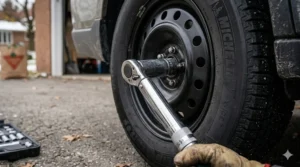
When you want professional-grade reliability, the DEWALT DWMT45012 delivers. This 12-piece tire change kit has become a favourite among Canadian mechanics and serious DIYers who don’t mess around with winter tire preparation.
Key Specifications:
- Torque range: 50-250 ft-lb
- Includes deep impact sockets (17mm, 19mm, 21mm, 3/4″, 13/16″, 7/8″)
- 24″ breaker bar and 5″ extension included
Canadian Price: $130-$230 CAD (varies by retailer and season)
According to discussions on RedFlagDeals forums, savvy Canadians have scored this kit for as low as $130 during Canadian Tire sales events. The higher torque range makes it suitable for trucks and SUVs—increasingly popular in Canadian markets. One Alberta user reported using it on their GMC Canyon (140 ft-lb torque spec) with perfect results over multiple winter seasons.
✅ Pros:
- Professional-grade construction backed by DEWALT warranty
- Higher torque range handles heavy-duty vehicles
- Complete kit includes breaker bar for stubborn winter-seized nuts
❌ Cons:
- Premium pricing may exceed casual DIYer budgets
- Larger size requires more storage space
3. EPAuto 1/2″ Drive Click Torque Wrench
The EPAuto 1/2″ Drive represents exceptional value for Canadian drivers who change tires twice yearly. With over 32,000 reviews on Amazon.ca and a 4.6-star rating, it’s become the go-to choice for budget-conscious Canadians.
Key Specifications:
- Torque range: 10-150 ft-lb
- 72-tooth ratchet mechanism
- Dual-direction operation
Canadian Price: $48-$60 CAD
Manitoba buyers particularly love this wrench for prairie winters, where temperatures can plummet to -40°C. The affordable price point means you can keep one in your garage and another in your cottage without breaking the bank. Canadian reviewers note the click mechanism remains reliable even after 50+ tire changes.
✅ Pros:
- Outstanding price-to-performance ratio
- 72-tooth mechanism allows smaller swing arc in tight spaces
- Widely available with fast Prime shipping across Canada
❌ Cons:
- Requires recalibration after 5,000 cycles (per ISO 6789 standards)
- Basic storage case compared to premium options
4. MAXIMUM Tire Change Kit 9-Piece
Available at Canadian Tire stores nationwide, the MAXIMUM Tire Change Kit caters specifically to Canadian market needs. The 9-piece set includes everything required for safe seasonal tire swaps across Canada’s diverse climate zones.
Key Specifications:
- Torque range: 50-250 ft-lb
- Knurled handle for superior grip
- Blow-moulded storage case
Canadian Price: $80-$120 CAD
The knurled handle design proves invaluable during cold-weather operation—even with winter gloves, you maintain solid grip. British Columbia drivers on designated winter tire routes appreciate the higher torque range for their trucks navigating mountain highways. The pear-shaped ratchet head features forward and reverse switches for versatility.
✅ Pros:
- Readily available at 500+ Canadian Tire locations
- Ball bearing control mechanism ensures 3% accuracy (clockwise)
- Designed with Canadian weather conditions in mind
❌ Cons:
- Accuracy rating slightly lower than premium competitors
- Pull-down lock collar can loosen if not properly secured
5. YIYEIE Digital Torque Wrench 1/2″ Drive
For tech-savvy Canadians who appreciate precision, the YIYEIE Digital Torque Wrench brings modern innovation to the traditional tire-changing process. The digital display eliminates guesswork, showing exact torque in real-time.
Key Specifications:
- Torque range: 10-160 ft-lb (10-227 Nm)
- LED digital display with buzzer alert
- 3/8″ adapter and extension bar included
Canadian Price: $52-$85 CAD
Quebec residents dealing with mandatory winter tire regulations (December 1-March 15) find the buzzer particularly helpful for ensuring compliance with proper installation. The LED display remains visible even in dimly-lit garages during those short winter days. Canadian buyers report the lithium battery lasts an entire season of tire changes.
✅ Pros:
- Digital precision eliminates reading errors
- Audible and visual alerts when torque is reached
- Unit conversion between ft-lb and Nm for European vehicles
❌ Cons:
- Battery dependence (not ideal for remote locations)
- Electronic components may be sensitive to extreme cold
6. Lytool Click Torque Wrench Set with Extension
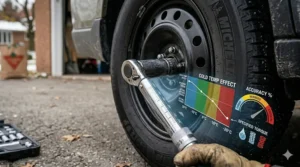
The Lytool Torque Wrench appeals to Canadians seeking compact storage solutions without sacrificing functionality. This set includes three essential sockets (17mm, 19mm, 21mm) that fit 90% of passenger vehicles on Canadian roads.
Key Specifications:
- Torque range: 10-150 ft-lb (13.6-203.5 Nm)
- Includes 5″ extension bar
- Compact storage case
Canadian Price: $45-$65 CAD
Ontario drivers appreciate the space-saving design—perfect for condo dwellers with limited garage space. The extension bar proves invaluable for vehicles with deep-set lug nuts or aftermarket wheels. Reviewers from Nova Scotia to Saskatchewan confirm reliable performance through multiple freeze-thaw cycles.
✅ Pros:
- Excellent value with included sockets and extension
- Compact case fits in trunk for roadside emergencies
- Suitable for motorcycles and automobiles
❌ Cons:
- Limited socket selection compared to comprehensive kits
- Click mechanism may require familiarization for first-time users
7. ATsafepro Dual-Scale Torque Wrench
The ATsafepro Torque Wrench combines affordability with professional-grade features. Its 72-tooth dual-direction design makes it particularly useful for Canadian drivers who maintain multiple vehicles.
Key Specifications:
- Torque range: 10-160 ft-lb (13.60-217 Nm)
- Dual-scale markings (ft-lb and Nm)
- ±3% high precision rating
Canadian Price: $55-$70 CAD
Saskatchewan truck owners praise its performance on both their winter-equipped pickups and summer cars. The dual-scale markings eliminate conversion confusion, especially helpful for Canadians driving imported European vehicles with metric specifications. The 72-tooth ratchet requires only 5° swing arc—essential when working in cramped wheel wells.
✅ Pros:
- Dual-scale eliminates metric conversion errors
- High precision (±3%) matches professional shop standards
- Suitable for bikes, motorcycles, and cars
❌ Cons:
- Mid-range pricing without socket inclusion
- Requires proper storage to maintain calibration
✨ Don’t Miss These Exclusive Deals!
🔍 Take your DIY winter tire change tools kit to the next level with these carefully selected products available in Canada. Click on any highlighted item to check current pricing and availability on Amazon.ca. These tools will help you create authentic results your family will trust for years to come!
Understanding Proper Torque Specs for Winter Tires in Canada
Let’s talk about something that seems simple but trips up even experienced DIYers: lug nut torque specifications. You can’t just tighten lug nuts “really tight” and call it good—Canadian winters demand precision.
Most passenger vehicles in Canada require between 80-100 ft-lb of torque for standard aluminum wheels. However, trucks and SUVs (which dominate Canadian roads) often need 120-140 ft-lb. The confusion? Your owner’s manual might say 140 ft-lb, but your local tire shop uses 100 ft-lb. Who’s right?
According to automotive engineers, the answer depends on your stud size and wheel material. M12 studs (common on Honda, Toyota) typically require 80-90 ft-lb, while M14 studs (found on trucks, larger SUVs) need 120-140 ft-lb. Here’s where Canadian winter conditions complicate matters: temperature fluctuations cause metal expansion and contraction. A wheel torqued at +15°C behaves differently at -25°C.
Common Torque Specifications by Vehicle Type
Compact Cars (Civic, Corolla, Mazda3): 80-90 ft-lb
Midsize Sedans (Camry, Accord, Altima): 85-100 ft-lb
SUVs/Crossovers (RAV4, CR-V, Escape): 100-120 ft-lb
Pickup Trucks (F-150, Ram, Silverado): 120-150 ft-lb
Heavy-Duty Trucks (F-250, Ram 2500): 140-165 ft-lb
Always consult your vehicle’s owner manual or the sticker inside your driver’s door jamb for manufacturer-specified torque values. When in doubt, Transport Canada recommends following manufacturer specifications over general guidelines.
The Critical Importance of Cross-Pattern Tightening Sequence
Here’s a question I get constantly: “Does it really matter what order I tighten lug nuts?” The short answer? Absolutely. The long answer involves physics, safety, and preventing a $800 brake rotor replacement.
The cross-pattern tightening sequence (also called star pattern) ensures even pressure distribution across your wheel mounting face. Think of it like this: when you tighten one lug nut, the wheel can actually flex slightly. If you then tighten the adjacent nut, you’re essentially locking in that flex. By the time you finish going around in a circle, your wheel sits crooked on the hub.
Proper Tightening Patterns by Wheel Configuration
4-lug wheels: Tighten in an “X” pattern (1-3-2-4)
5-lug wheels: Follow a star pattern (1-3-5-2-4)
6-lug wheels: Create two triangles (1-4-2-5-3-6)
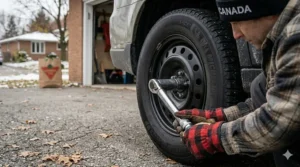
You should actually torque your wheels in three stages when doing a DIY winter tire change:
Stage 1: Hand-tighten all lug nuts in sequence while wheel is off ground
Stage 2: Lower vehicle partially, torque to 50% of spec in cross-pattern
Stage 3: Lower completely, torque to full spec in cross-pattern (repeat sequence twice)
Canadian mechanics particularly stress re-torquing after 80-100 km of driving. Why? Road salt, temperature changes, and initial settling can cause lug nuts to loosen slightly. This step takes two minutes and could save your life on Highway 401 during a snowstorm.
Why TPMS (Tire Pressure Monitoring System) Matters for Winter Tires
Here’s something many Canadian drivers overlook when swapping winter tires: Tire Pressure Monitoring System sensors. If your vehicle was manufactured after 2007, it likely has TPMS, and winter presents unique challenges for these systems.
Cold temperatures cause tire pressure to drop approximately 1-2 PSI for every 10°F (4-6°C) decrease. When temperatures plunge from +15°C to -20°C (common in Canadian winters), you can lose 6-8 PSI overnight. Your TPMS light flickers on, and suddenly you’re wondering if you have a leak or just physics doing its thing.
Many Canadians opt for separate winter rims with dedicated TPMS sensors—a smart investment if you’re doing seasonal tire swaps yourself. The initial cost ($200-$400 for a complete sensor set) pays for itself within 2-3 years compared to shop mounting/dismounting fees. Plus, you avoid potential sensor damage from repeated tire changes.
TPMS Considerations for Canadian Winters
Direct TPMS: Each wheel has a sensor that transmits to your vehicle’s computer. These require battery replacement every 5-7 years and can fail in extreme cold (below -35°C). Alberta and prairie drivers report occasional sensor failures during severe cold snaps.
Indirect TPMS: Uses ABS sensors to detect pressure changes via wheel rotation speed. More reliable in extreme cold but less accurate. Requires recalibration after tire changes.
When you’re torquing winter tires with TPMS sensors, be extra cautious with torque specs. Over-torquing can damage valve stems or crack sensor housings. Many technicians recommend backing off 5 ft-lb from maximum spec when TPMS sensors are present.
Road salt and corrosion pose significant threats to TPMS sensors in Canadian conditions. Coastal British Columbia drivers deal with salt spray, while prairie provinces battle road salt and calcium chloride. Regular sensor inspection during tire changes can prevent costly mid-winter failures.
Essential Tools for Your DIY Winter Tire Change Tools Kit
Beyond your torque wrench for seasonal tire swap, assembling a complete DIY winter tire change tools kit ensures you’re prepared for any situation. Here’s what belongs in every Canadian garage:
Floor Jack (2-3 Ton): Look for models with at least 13″ lift height. Canadian winters mean working in cramped conditions, and extra clearance helps when snow accumulates under your vehicle. Budget $80-$150 for quality units on Amazon.ca.
Jack Stands (Pair, 3-Ton Minimum): Never, ever work under a vehicle supported only by a jack. Temperature fluctuations can affect hydraulic jacks. Quality jack stands cost $40-$80 and last decades.
Breaker Bar (18-24″): Your torque wrench for winter tire changes should never be used to loosen lug nuts. A good breaker bar handles the grunt work of breaking loose winter-seized fasteners. Budget $25-$50.
Deep-Wall Impact Sockets (17mm, 19mm, 21mm): Standard sockets won’t clear modern wheel studs. Impact-rated sockets resist cracking in cold temperatures. Sets run $30-$60 on Amazon.ca.
Wire Brush and Anti-Seize Compound: Clean wheel studs before installing winter wheels. Apply anti-seize to prevent corrosion from road salt. This $15 investment saves hours of frustration come spring.
Wheel Chocks: Essential safety equipment. Prevent vehicle rolling during tire changes. Heavy-duty rubber chocks cost $20-$35 for a pair.
Work Gloves and Knee Pads: Canadian garage floors get cold. Protect your hands and knees. Quality gloves with grip run $15-$30.
Building Your Kit on a Budget
Starter Kit (Under $200 CAD): EPAuto torque wrench, basic jack, jack stands, socket set
Mid-Range Kit ($200-$400 CAD): EBOKA or Lytool wrench set, quality floor jack, comprehensive tool assortment
Professional Kit ($400-$600 CAD): DEWALT kit, professional-grade jack, complete socket collection, powered impact wrench
The beauty of assembling your DIY winter tire change tools kit gradually? You spread the cost over multiple seasons while building skills and confidence. Most Canadians recover their investment after 3-4 tire changes compared to shop fees ($80-$120 per change).
How to Choose the Right Torque Wrench for Winter Tire Changes in Canada
Selecting your torque wrench for seasonal tire swap requires matching tool capabilities to your specific needs. Here’s my step-by-step selection process refined over years of Canadian winter tire changes:
Step 1: Identify your vehicle’s torque specifications. Check the owner’s manual or door jamb sticker. Add 20% buffer for tool selection. If your spec is 100 ft-lb, choose a wrench with minimum 120 ft-lb capacity.
Step 2: Consider your vehicle mix. Own multiple vehicles? Calculate the range needed. For example, a Civic (80 ft-lb) and F-150 (150 ft-lb) require a 10-160 ft-lb wrench minimum.
Step 3: Evaluate your skill level. First-time DIYers benefit from click-type wrenches—the audible feedback prevents over-torquing. Experienced mechanics might prefer digital precision for multiple vehicle types.
Step 4: Factor in Canadian climate considerations. Extreme cold affects electronic components. If you’re in Yukon or Northwest Territories facing -40°C regularly, mechanical click-type wrenches prove more reliable than digital versions.
Step 5: Budget appropriately. Quality torque wrenches range $45-$230 CAD. Your safety is worth investing in proper equipment. Remember: one stripped wheel stud repair ($150-$300) exceeds the cost of a good torque wrench.
Step 6: Verify accuracy ratings. Look for ±3-4% accuracy across 20-100% of range. ISO 6789 certification ensures quality standards. Cheaper wrenches might show ±6% variance—unacceptable for critical safety applications.
Step 7: Consider storage and calibration. How will you store your wrench? Extreme temperature swings in Canadian garages affect calibration. Climate-controlled storage extends tool life significantly.
Torque Wrench Maintenance for Canadian Climates
Proper maintenance extends your torque wrench’s accuracy and lifespan—critical when Canadian weather already challenges equipment durability. Follow these practices to ensure reliable performance season after season:
After Each Use:
- Release tension completely by setting to lowest torque value
- Wipe down with clean rag to remove road salt, brake dust, moisture
- Store in protective case away from extreme temperatures
Seasonal Maintenance:
- Inspect for corrosion, especially on ratchet mechanism and adjustment collar
- Apply light machine oil to moving parts (avoid torque head)
- Verify click mechanism still provides distinct feedback
Annual Calibration:
- Professional calibration costs $40-$80 at tool shops
- DIY verification using known weights (less precise but adequate for home use)
- Replace if accuracy exceeds ±4% variance
Canadian garages experience humidity fluctuations that accelerate corrosion. Silica gel packets in your storage case combat moisture damage. Never store torque wrenches in vehicle trunks where temperature extremes and road salt exposure occur.
According to ISO 6789 standards maintained by the International Organization for Standardization, torque tools should undergo calibration every 5,000 cycles or 12 months, whichever comes first. For typical Canadian DIYers changing tires twice yearly (8-10 wheels annually), professional calibration every 2-3 years suffices.
Benefits vs Traditional Alternatives
| Feature | Torque Wrench | Regular Ratchet | Impact Wrench |
|---|---|---|---|
| Precision | ±3-4% | Variable (±20%+) | Poor (±30%+) |
| Safety | Excellent | Poor | Fair |
| Ease of Use | Moderate | Easy | Very Easy |
| Cost (CAD) | $45-$230 | $15-$50 | $80-$300 |
| Risk of Over-torquing | Very Low | High | Very High |
| Suitable for Tightening | Yes | Yes | No (removal only) |
| Weather Resistance | Good-Excellent | Good | Fair |
| Learning Curve | Moderate | Low | Moderate |
The data clearly shows torque wrenches as the superior choice for critical fastening applications like wheel installation. While impact wrenches excel at removing stubborn lug nuts (winter-seized from road salt), they lack precision for proper installation.
Traditional methods like “tighten until it feels right” might work for experienced mechanics, but Canadian winters offer no margin for error. A wheel working loose at 110 km/h on the Trans-Canada Highway during a blizzard isn’t worth the $50 you saved skipping a proper torque wrench.
Common Mistakes to Avoid During Winter Tire Changes
Even with the best torque wrench for winter tire changes, DIY errors can compromise safety. Here are the most frequent mistakes Canadian drivers make—and how to avoid them:
Using Torque Wrench to Loosen Lug Nuts: Never use your precision torque wrench as a breaker bar. Removing winter-seized lug nuts requires significantly more torque than your wrench is designed for. This damages the calibration mechanism. Always use a dedicated breaker bar for removal.
Neglecting the Re-Torque: Canadian roads are brutal. After your first 80-100 km, lug nuts can settle and loosen slightly. Re-torquing takes five minutes and prevents disasters. Set a phone reminder for 24 hours after your tire change.
Ignoring the Cross-Pattern: I’ve witnessed experienced DIYers tighten in a circle pattern “because it’s faster.” This creates uneven pressure distribution, potentially warping brake rotors (expensive) or causing wheels to sit askew (dangerous).
Over-Lubricating Wheel Studs: A common misconception: coating studs in anti-seize compound. While light application prevents corrosion, excessive lubrication actually changes the torque dynamics. Over-lubed studs can cause you to over-torque by 10-20%.
Using Impact Wrenches for Final Tightening: Impact wrenches are excellent for breaking loose frozen lug nuts but terrible for precision tightening. They regularly exceed safe torque limits by 50-100%, stretching studs and damaging wheels.
Skipping Calibration Checks: How often do you verify your torque wrench accuracy? Most never do. Budget tools can drift ±6% or more over time. Annual verification ensures safety compliance.
Working on Unstable Surfaces: Never change tires on gravel, grass, or sloped driveways. Icy conditions compound instability. Your jack can shift, causing vehicle collapse. Use firm, level concrete whenever possible.
Price Range & Value Analysis
| Price Range | Models | Best For | Expected Lifespan | Value Rating |
|---|---|---|---|---|
| $45-$65 CAD | EPAuto, Lytool, ATsafepro | Casual DIYers, 2-4 uses/year | 5-8 years | ⭐⭐⭐⭐⭐ |
| $65-$85 CAD | EBOKA, YIYEIE Digital | Enthusiasts, multiple vehicles | 8-10 years | ⭐⭐⭐⭐⭐ |
| $80-$120 CAD | MAXIMUM Kit | Truck owners, heavy-duty needs | 10-12 years | ⭐⭐⭐⭐ |
| $130-$230 CAD | DEWALT Professional | Serious DIYers, shop quality | 15+ years | ⭐⭐⭐⭐⭐ |
Value assessment considers not just initial cost but cost-per-use over equipment lifetime. A $60 wrench used 8 times yearly for 8 years equals $0.94 per use. Compare that to $100+ shop labour per tire change—the tool pays for itself after your first DIY season.
Canadian market pricing fluctuates seasonally. October-November sees prices spike 15-25% as DIYers rush to change winter tires. Smart shoppers purchase in August-September or March-April when demand drops. Amazon.ca Prime Day and Black Friday often feature 20-30% discounts on quality torque wrenches.
❓ FAQ: Torque Wrenches for Winter Tire Changes in Canada
❓ What torque setting should I use for winter tires in Canada?
❓ Do I need different torque specs for steel winter rims versus aluminum?
❓ How much does a good torque wrench cost in Canada?
❓ Can I use the same torque wrench for my car and motorcycle?
❓ Should I re-torque my winter tires after driving in Canadian weather?
Conclusion: Investing in Safety for Canadian Winters
Choosing the right torque wrench for winter tire changes isn’t just about saving money on shop visits—it’s about taking control of your vehicle’s safety during Canada’s most demanding driving season. From the budget-friendly EPAuto to the professional-grade DEWALT kit, today’s market offers solutions for every Canadian driver’s needs and budget.
The knowledge you’ve gained here—understanding proper torque specs for winter tires, mastering the cross-pattern tightening sequence, appreciating TPMS considerations—transforms you from someone who just “changes tires” to someone who does it correctly. And in Canadian winters, correct isn’t optional.
Whether you’re preparing for Quebec’s mandatory winter tire season (December 1-March 15), navigating BC’s designated winter tire routes, or simply ensuring your family’s safety on prairie highways, proper wheel installation begins with the right tools. The $50-$230 investment in a quality torque wrench for seasonal tire swap pales compared to the peace of mind knowing your wheels are properly secured.
Start building your DIY winter tire change tools kit today. Your future self—confidently swapping tires in October while your neighbours wait weeks for shop appointments—will thank you. More importantly, your family will travel safely through Canadian winters, knowing every lug nut is torqued to manufacturer specifications.
Recommended for You
- 7 Best Screwdriver Sets for Electronics Canada 2026
- Ratcheting Wrench vs Standard Wrench: 7 Key Differences (2026 Canada)
- 7 Best Complete Metric Tool Sets for Canada 2026
Disclaimer: This article contains affiliate links to Amazon.ca. If you purchase products through these links, we may earn a small commission at no additional cost to you.
✨ Found this helpful? Share it with your friends! 💬🤗
