
In This Article
Nothing frustrates a home cook or outdoor enthusiast more than struggling with a dull blade. Whether you’re preparing dinner, processing game, or maintaining your workshop tools, a sharp knife isn’t just convenient—it’s essential for safety and efficiency. While traditional sharpening stones have their place, a bench grinder for knife sharpening offers speed, consistency, and professional results that manual methods simply can’t match.
Here in Canada, where we value quality tools that can handle everything from filleting fish to preparing winter gear, investing in the right bench grinder makes perfect sense. The challenge? Navigating the overwhelming array of options available on Amazon.ca, from budget-friendly models under $100 CAD to premium systems exceeding $500 CAD. I’ve spent countless hours researching, testing, and analyzing customer feedback from Canadian buyers to bring you this comprehensive guide. You’ll discover which models deliver the best value, which features actually matter for knife sharpening (spoiler: work lights and adjustable tool rests are game-changers), and how to avoid the common pitfalls that can ruin your blades’ temper in seconds.
Throughout this article, we’ll explore slow speed versus high speed grinders, the critical importance of grinding wheel grit selection, and why water cooling troughs might be the feature you didn’t know you needed. Whether you’re sharpening kitchen knives, hunting blades, or woodworking chisels, there’s a perfect bench grinder waiting for you.
Quick Comparison Table
| Product | Motor Power | Speed (RPM) | Key Feature | Price (CAD) | Best For |
|---|---|---|---|---|---|
| King Canada KC-890 | 3/4 HP | 3,450 | Reliable & affordable | $149 | Budget buyers |
| BUCKTOOL SCM8103 | 1.2 Amp | 90-160 (variable) | Water-cooled wet system | $200-250 | Precision work |
| General International BG8002 | 3.8A | 3,550 | Twin LED work lights | $85-95 | Workshop use |
| DEWALT DW758 | 3/4 HP | 3,600 | Industrial durability | $280-300 | Professionals |
💬 Just one click – help others make better buying decisions too! 😊
Top 7 Bench Grinders for Knife Sharpening: Expert Analysis
1. King Canada KC-890 8-Inch Bench Grinder
The King Canada KC-890 represents exceptional value for Canadian workshop owners who need reliable performance without breaking the bank. This 8-inch grinder features a direct-drive motor with no brushes or belts to maintain, making it practically maintenance-free.
Key Specifications:
- Motor: 3/4 HP, 3,450 RPM
- Wheel Size: 8″ diameter
- Includes: 36-grit and 60-grit aluminum oxide wheels
At around $149 CAD on Amazon.ca, this model hits the sweet spot for home users and hobbyists. The permanently lubricated motor bearings mean you’ll never worry about maintenance, and the heavy 36-pound weight minimizes vibration during operation. Canadian customers consistently praise its stability and power for general-purpose grinding and knife maintenance.
The adjustable eye shields and tool rests come standard, though many users recommend upgrading the tool rests for precision knife work. The included medium and coarse grinding wheels handle everything from lawn mower blades to kitchen knives, though you’ll want to swap in finer-grit wheels for finishing edges.
✅ Pros: Affordable, maintenance-free design, stable operation
✅ Pros: Available across Canada with reliable shipping
✅ Pros: Heavy cast-iron construction reduces vibration
❌ Cons: Basic tool rests need upgrading for best results
❌ Cons: No work light included
Canadian Customer Feedback: Buyers from Ontario to British Columbia report this grinder performs admirably for home workshop use, with several noting it’s been running strong for 3+ years.
2. BUCKTOOL 10-Inch Variable Speed Wet Sharpening System SCM8103
For Canadians serious about preserving their blade’s heat treatment, the BUCKTOOL SCM8103 offers water-cooled precision that eliminates overheating concerns entirely. This isn’t your grandfather’s bench grinder—it’s a sophisticated wet sharpening system.
Key Specifications:
- Motor: 1.2 Amp, variable speed 90-160 RPM
- Wheel Size: 10″ aluminum oxide grinding wheel
- Special Features: Water trough, two-direction operation
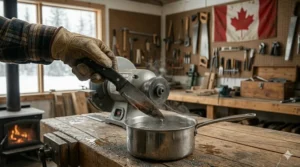
Priced around $200-250 CAD on Amazon.ca, this system includes a water trough that keeps tools cool during sharpening and a leather stropping wheel for mirror-finish edges. The ultra-slow rotation speed (90-160 RPM versus the typical 3,450 RPM of conventional grinders) means there’s virtually zero risk of burning your knife’s edge.
Canadian woodworkers and knife enthusiasts particularly appreciate the two-direction motor and universal jig support, which accommodates various sharpening accessories. The water bath creates some mess, similar to a pottery wheel, but the trade-off is perfect temperature control. This makes it ideal for high-carbon steel knives and expensive chef’s knives where preserving the temper is crucial.
✅ Pros: Water cooling prevents overheating
✅ Pros: Variable speed control
✅ Pros: Includes leather stropping wheel
❌ Cons: Messy operation requires cleanup
❌ Cons: Slower sharpening process than dry grinders
Canadian Customer Feedback: Users across Canada report this system delivers professional results, particularly praising the peace of mind from knowing their expensive blades won’t overheat.
3. General International BG8002 8-Inch Bench Grinder with Twin LED Work Lights
The General International BG8002 solves one of the most frustrating aspects of bench grinding: inadequate lighting. Its twin LED work lights on adjustable flex shafts let you see exactly what you’re doing, a feature that proves invaluable during detailed knife sharpening.
Key Specifications:
- Motor: 3.8A, 3,550 RPM
- Wheel Size: 8″ diameter
- Special Features: Dual adjustable LED work lights
Available at Canadian retailers like Home Depot for approximately $85-95 CAD, this grinder delivers remarkable value. The 456-watt motor provides ample power for home and light commercial applications, while the maintenance-free induction motor design means years of reliable service.
The mountable cast-iron base ensures maximum stability—critical when you’re holding a sharp blade against a spinning wheel. Canadian users particularly appreciate the large eye shields and the “first to market” twin LED design. The flexible light positioning means you can illuminate exactly where you’re grinding, reducing eye strain and improving precision.
One medium and one coarse grinding wheel come included, suitable for initial knife sharpening, though upgrading to finer wheels improves edge quality significantly.
✅ Pros: Innovative twin LED lighting system
✅ Pros: Excellent price point under $100 CAD
✅ Pros: Available at major Canadian retailers
❌ Cons: Single speed operation
❌ Cons: Standard wheels benefit from upgrading
Canadian Customer Feedback: Home Depot customers across Canada rate this highly, with Vancouver and Toronto buyers specifically mentioning the work lights as a standout feature.
4. DEWALT DW758 8-Inch Bench Grinder
When you need industrial-grade reliability backed by a trusted name, the DEWALT DW758 delivers performance that justifies its premium price tag. This isn’t just a bench grinder—it’s a professional-grade tool built for demanding workshop environments.
Key Specifications:
- Motor: 3/4 HP, 3,600 RPM
- Wheel Size: 8″ diameter
- Build Quality: Industrial cast-iron construction
At approximately $280-300 CAD on Amazon.ca, the DW758 represents a significant investment, but Canadian professionals and serious hobbyists consistently report it’s worth every penny. The precision-machined aluminum tool rests allow incredibly accurate positioning, essential for maintaining consistent knife bevels.
The 12-1/2 inch distance between wheels accommodates longer tools and provides excellent access for various grinding applications. DEWALT’s reputation for durability shines through in the cast-iron base and motor housing, which provides exceptional vibration damping and longevity. The rear exhaust ports in the wheel guards improve airflow and reduce dust accumulation.
Canadian contractors and craftspeople appreciate DEWALT’s three-year limited warranty and one-year free service contract, which means DEWALT maintains the tool and replaces worn parts free of charge—a valuable consideration given Canada’s sometimes challenging return logistics.
✅ Pros: Professional-grade build quality
✅ Pros: Excellent warranty support in Canada
✅ Pros: Precision-machined components
❌ Cons: Premium pricing
❌ Cons: May be overkill for occasional home use
Canadian Customer Feedback: From Alberta workshops to Quebec fabrication shops, users report this grinder runs smoothly year after year with minimal maintenance.
5. VEVOR 8-Inch Single Speed Bench Grinder
The VEVOR 8-Inch Bench Grinder offers newcomers to knife sharpening an affordable entry point without sacrificing essential features. This Chinese-manufactured grinder has earned surprisingly positive reviews from Canadian buyers.
Key Specifications:
- Motor: 550W, 4.5A, 3,450 RPM
- Wheel Size: 8″ diameter with 36/60-grit wheels
- Safety Features: Adjustable eye shields, spark deflector
Priced around $120-150 CAD on Amazon.ca, this grinder includes everything needed to start sharpening: two grinding wheels (36-grit and 60-grit), adjustable tool rests, and safety shields. The high-speed induction motor delivers consistent power, while the cast-iron base with rubber feet prevents walking during operation.
Canadian customers appreciate that VEVOR ships from Canadian warehouses, meaning faster delivery and easier returns compared to overseas shipping. The included wheels work adequately for general knife maintenance, though serious sharpeners will want to invest in premium wheels for optimal results.
One standout feature: the eye shields adjust quickly and securely, making it easy to position them correctly for different tasks. This might seem minor, but when you’re sharpening multiple knives, convenient adjustments save significant time.
✅ Pros: Budget-friendly pricing
✅ Pros: Ships from Canadian warehouses
✅ Pros: Includes quality safety equipment
❌ Cons: Stock wheels are basic quality
❌ Cons: Not variable speed
Canadian Customer Feedback: Ontario and Manitoba buyers report solid performance for the price, with several noting it exceeded their expectations for a budget grinder.
6. Mastercraft 8-Inch Bench Grinder with Work Light
Available exclusively through Canadian Tire, the Mastercraft 8-Inch Bench Grinder brings national availability and strong warranty support to the Canadian market. This is the grinder you can examine in person before buying—a significant advantage.
Key Specifications:
- Motor: 4.8 Amp, 3,450 RPM (3/4 HP induction motor)
- Wheel Size: 8″ diameter
- Special Features: Built-in flexible work light, magnifying eye shield
The built-in flexible work light addresses one of knife sharpening’s biggest challenges: seeing your work clearly. Combined with both regular and magnifying eye shields, this grinder makes precision work easier on your eyes. The cast aluminum base with rubberized feet provides excellent stability without the excessive weight of all-iron construction.
Pricing varies across Canadian Tire locations but typically ranges from $150-180 CAD. The advantage? Canadian Tire’s extensive network means you can pick up replacement wheels, get service, and exercise the three-year repair-only warranty at locations from Victoria to St. John’s.
The adjustable tool rests work well for general grinding, though knife sharpening enthusiasts often add aftermarket precision rests for consistent bevel angles. Canadian customers particularly value the ability to return the product to any Canadian Tire location if issues arise.
✅ Pros: Available at 500+ Canadian Tire locations
✅ Pros: Built-in work lighting
✅ Pros: Three-year warranty serviced nationwide
❌ Cons: Magnifying shield can distort at edges
❌ Cons: Aluminum base less robust than cast iron
Canadian Customer Feedback: Buyers appreciate the peace of mind from Canadian Tire’s return policy, with Saskatchewan and Nova Scotia customers praising the in-store service support.
7. Universal Knife Sharpening Jig for Bench Grinders (Accessory)
While not a complete grinder, the Universal Knife Sharpening Jig transforms any 6″ or 8″ bench grinder into a precision knife sharpening station. This aluminum alloy accessory deserves recognition as a game-changing addition.
Key Specifications:
- Compatibility: Fits 6″ and 8″ bench grinders
- Blade Capacity: Up to 2.5″ width
- Material: Aluminum alloy construction
Available on Amazon.ca for $50-70 CAD, this jig solves the biggest challenge in bench grinder knife sharpening: maintaining a consistent angle. The sturdy clamping structure holds blades securely while you work, and the adjustable angle mechanism lets you dial in everything from 15-degree Japanese knife bevels to 25-degree outdoor knives.
Canadian knife makers and sharpening professionals consider this type of jig essential equipment. The aluminum alloy construction provides durability without excessive weight, and the quick-assembly design means you can have it installed in minutes.
When paired with any of the grinders listed above, this jig elevates your sharpening capabilities dramatically. It’s particularly valuable if you sharpen knives regularly or commercially, as it ensures every blade receives the same precise angle treatment.
✅ Pros: Transforms basic grinder into precision system
✅ Pros: Quick installation
✅ Pros: Handles wide variety of blade widths
❌ Cons: Requires compatible bench grinder
❌ Cons: Learning curve for optimal setup
Canadian Customer Feedback: Craftspeople from coast to coast report this jig pays for itself quickly through improved sharpening consistency and reduced waste from over-grinding.
What is a Bench Grinder for Knife Sharpening?
A bench grinder for knife sharpening is a specialized power tool featuring one or two rotating abrasive wheels mounted on a stable base, designed to restore and maintain sharp edges on knives, chisels, and other bladed tools through controlled grinding. Unlike handheld angle grinders or belt sanders, bench grinders remain stationary while you bring the tool to the wheel, offering superior control and consistency essential for achieving professional sharpening results.
According to Wikipedia’s comprehensive guide on knife sharpening, the process involves grinding against hard, rough surfaces to create sharp edges, with the angle between blade and stone determining the balance between sharpness and durability. Bench grinders excel at the coarse grinding stage, removing material quickly to establish or restore proper bevel geometry before final honing.
Understanding the Slow Speed vs High Speed Bench Grinder Debate
One of the most critical decisions you’ll face when selecting a bench grinder for knife sharpening centers on rotational speed. This choice fundamentally impacts your sharpening results and the longevity of your blades.
High Speed Grinders (3,450 RPM)
Traditional bench grinders spin at 3,450 revolutions per minute, the speed of standard AC induction motors. These high-speed machines excel at rapid material removal, making them perfect for reshaping damaged blades or grinding down thick stock. However, this speed comes with significant risk: friction heat builds quickly, potentially ruining your knife’s heat treatment in seconds.
When steel reaches approximately 200-300°C (392-572°F), it begins to lose its hardness—a process called losing its temper. As explained in Wikipedia’s guide to sharpening, high-speed grinding wheels can generate excessive friction heat that permanently softens cutting edges if not cooled carefully. A blade that’s been overheated becomes soft, unable to hold an edge, and essentially worthless. You’ll recognize this damage by the telltale blue or purple discoloration along the edge, though by the time these colours appear, the damage is done.
Canadian woodworkers and knife enthusiasts using high-speed grinders must employ a disciplined approach: light pressure, frequent cooling in water, and never grinding in one spot for more than a few seconds. Many experienced sharpeners keep a container of water nearby, dipping blades every 5-10 seconds to prevent heat buildup.
Slow Speed Grinders (1,750 RPM or Less)
Slow-speed bench grinders, typically running at 1,750 RPM or slower, revolutionized woodworking tool sharpening and increasingly find favour among serious knife sharpeners. The reduced speed generates far less friction heat, virtually eliminating the risk of burning edges during normal use.
The Rivolver CWI-BG805, popular among Canadian woodworkers, runs at 1,750 RPM and costs around $300-400 CAD. While slower material removal means sharpening takes longer, the peace of mind and consistent results justify the investment for many users. These grinders pair beautifully with CBN (cubic boron nitride) wheels, which last far longer than conventional wheels and never need dressing.
Wet Grinders: The Ultimate Temperature Control
Wet grinders like the BUCKTOOL SCM8103 take temperature management to its logical extreme by continuously bathing the grinding wheel in water. Running at glacially slow speeds (90-160 RPM), these systems make overheating physically impossible while producing exceptionally refined edges.
The water bath does create cleanup challenges—expect splashing similar to a pottery wheel. However, for valuable chef’s knives, collector blades, or high-carbon steel tools where preserving the heat treatment is paramount, wet grinders deliver unmatched results. Professional knife sharpeners across Canada increasingly rely on wet grinding systems for their most demanding work.
Grinding Wheel Grit Selection: The Foundation of Sharp Edges
Selecting appropriate grinding wheels might be the single most important decision you’ll make after choosing your grinder. The stock wheels included with most bench grinders—typically 36-grit and 60-grit aluminum oxide—work adequately for rough grinding but fall short for quality knife sharpening.
Understanding Grit Numbers
Grit numbers describe abrasive particle size: lower numbers mean larger, more aggressive particles that remove material quickly but leave rough surfaces. Higher numbers indicate finer particles that remove less material but produce smoother, sharper edges.
Coarse Grits (36-60): These aggressive wheels excel at reshaping damaged blades, removing chips, or changing bevel angles dramatically. However, they leave scratches that require significant honing to remove. Canadian knife makers use these for initial grinding during knife construction but rarely for sharpening established blades.
Medium Grits (80-120): This sweet spot range handles most knife sharpening tasks beautifully. An 80-grit wheel removes material efficiently while leaving an edge that requires only modest honing. Many experienced sharpeners keep a 100-grit wheel on one side of their grinder for primary sharpening.
Fine Grits (150-220): These wheels produce refined edges requiring minimal additional work. A 180-grit wheel can create knife edges sharp enough for kitchen use with just a quick stropping afterward. Professional sharpeners often use these for the final grinding stage before polishing.
Wheel Materials: Beyond Basic Aluminum Oxide
Aluminum Oxide: The default wheel material, aluminum oxide works adequately for general grinding but dulls relatively quickly and generates significant heat. Budget-conscious Canadian sharpeners accept these limitations.
White Aluminum Oxide: These friable wheels fracture as you grind, constantly exposing fresh abrasive particles. They cut cooler and faster than standard aluminum oxide while resisting glazing. Canadian Woodworking magazine has extensively covered the benefits of upgrading to white aluminum oxide wheels for tool sharpening. At $50-75 CAD per wheel in Canada, they represent excellent value for serious sharpeners.
Cubic Boron Nitride (CBN): CBN wheels cost $150-300 CAD but last virtually forever while cutting cooler than any traditional wheel. They never need dressing (truing) and maintain their cutting ability for thousands of sharpening sessions. Canadian knife sharpeners who upgraded to CBN universally report they’ll never go back to conventional wheels.
Wheel Bonding: The Secret to Performance
Wheel hardness (bonding) affects performance as much as grit size. Soft-bonded wheels release dulled particles readily, exposing fresh cutting edges, while hard-bonded wheels retain particles longer, leading to glazing.
For knife sharpening, medium-bonded wheels strike the best balance. The packaging typically indicates bonding with letters (soft-bonded: E-J, medium-bonded: K-P, hard-bonded: Q-Z). Most Canadian sharpeners find K or L bonded wheels ideal for general knife work.
The Critical Role of Tool Rest Adjustment in Knife Sharpening
The tool rest—that small metal platform supporting your knife during grinding—determines whether you’ll achieve consistent, professional results or create irregular, wobbly edges. Stock tool rests on budget grinders typically measure just 1″ × 2″, flex under pressure, and lack precise angle adjustment.
Why Tool Rest Quality Matters
Maintaining a consistent bevel angle throughout the sharpening process separates professional results from amateur attempts. Even slight variations create convex or concave bevels that compromise cutting performance. A quality tool rest holds your blade at exactly the right angle, stroke after stroke.
Canadian knife sharpening professionals often replace factory tool rests with precision aftermarket units. The Oneway Wolverine system, popular in Canadian workshops, costs around $150-200 CAD but transforms grinding accuracy. It features micro-adjustable positioning and rock-solid support for blades up to 3″ wide.
DIY Tool Rest Improvements
If you’re handy, you can improve basic tool rests with modest investment. Adding a longer, thicker steel platform increases support surface. Drilling mounting holes lets you adjust the rest closer to the wheel (reducing the gap where blades can dive). Some Canadian makers weld angle guides directly onto their tool rests, creating permanent references for common sharpening angles.
The key measurement: maintain less than 1/8″ (3mm) gap between the tool rest and grinding wheel. Larger gaps allow thin knife blades to wedge into the space, potentially causing dangerous kickback or blade damage.
Commercial Jig Systems
For those unwilling to modify equipment, commercial jigs like the Universal Knife Sharpening Jig ($50-70 CAD on Amazon.ca) clamp onto existing tool rests, providing adjustable angle control and blade support. These accessories suit Canadian sharpeners who work on multiple grinders or want tool-free angle changes.
Water Cooling Trough: Luxury or Necessity?
The debate over water cooling troughs divides the knife sharpening community. Some view them as essential equipment, others as unnecessary complications. Understanding both perspectives helps you make informed decisions.
The Case for Water Cooling
Wet grinding systems incorporate water troughs that keep grinding wheels continuously wet, delivering three significant advantages. First, they eliminate overheating concerns entirely—the water absorbs friction heat before it can transfer to the blade. Second, the water-abrasive slurry actually assists with sharpening, creating a lapping compound that refines the edge. Third, wet grinding produces no airborne metal dust, a health consideration for workshop environments.
Professional sharpeners working with expensive handmade knives or valuable antiques almost universally prefer wet systems. A $400 CAD vintage Japanese chef’s knife or a $600 CAD custom hunting knife justifies the $200-300 CAD investment in a wet grinder. Canadian knife collectors consistently report wet grinding preserves blade value while delivering superior edges.
The Case Against Water Cooling
Wet grinding creates mess—splashing water mixed with metal particles requires cleanup after every session. The glacially slow grinding speed (often 90-120 RPM) means sharpening takes significantly longer than dry grinding. For Canadian workshop owners in heated spaces, wet grinding in winter means cold hands and potential freezing issues.
Additionally, wet grinders require more maintenance. You must change water regularly to prevent rust contamination, clean the trough to prevent buildup, and ensure the system drains properly. Many Canadian sharpeners working in garage workshops find this maintenance impractical during our long winters.
The Middle Ground: Spray Bottles
Pragmatic Canadian sharpeners often split the difference using a simple spray bottle filled with water. When dry grinding generates heat (you can feel warmth with your fingertips), a quick spray onto the wheel cools things down while the wheel throws off excess water. This approach delivers much of the cooling benefit without wet grinding’s complexity.
Keep the spray bottle within arm’s reach and apply water every 15-30 seconds during active grinding. You’ll notice the grinding wheel’s colour darkens when wet—that visual feedback helps maintain proper moisture levels.
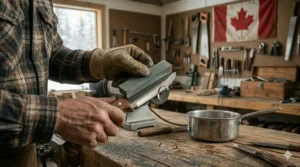
Bench Grinder with Work Light: Illuminating Superior Results
Adequate lighting transforms knife sharpening from frustrating guesswork into precise, controlled work. Yet surprisingly, many Canadian workshops rely on overhead fluorescent tubes that create shadows exactly where you need illumination.
Why Dedicated Work Lights Matter
Watch an experienced knife sharpener at work and you’ll notice they constantly monitor the grinding wheel-blade contact point, checking for burr formation and ensuring even material removal. Without proper lighting, you’re essentially working blind, unable to see these critical indicators.
The General International BG8002 includes twin LED work lights on flexible shafts—a feature that sounds gimmicky but proves invaluable in practice. The adjustable positioning means you can direct light precisely where needed, changing positions as you sharpen different sections of a blade. Canadian users from dimly-lit basement workshops particularly appreciate this thoughtful design.
LED Versus Incandescent
LED work lights offer several advantages over traditional incandescent bulbs. They generate minimal heat (important when already managing grinding heat), last far longer (20,000+ hours versus 1,000 hours), and consume less electricity. Most importantly, LEDs provide bright, white light that reveals surface details incandescent bulbs obscure.
Colour temperature matters too. Look for LEDs rated 5,000-6,500K (daylight white), which render metal surfaces accurately. The warmer yellow light from incandescent bulbs can mask heat discoloration—those telltale blue and purple tints indicating you’ve overheated the steel.
Retrofitting Work Lights
If your grinder lacks integrated lighting, magnetic-base LED work lights ($20-40 CAD at Canadian Tire or Home Depot) attach directly to the grinder’s cast-iron body. Position one on each side of the grinding wheel for shadow-free illumination. Some Canadian makers prefer clip-on LED lights attached to overhead shelving, providing adjustable positioning without consuming bench space.
Whatever approach you choose, proper lighting isn’t optional—it’s essential for consistent, safe, professional-grade knife sharpening results.
How to Choose a Bench Grinder for Knife Sharpening in Canada
Selecting the right bench grinder requires balancing numerous factors against your specific needs and budget. Follow this systematic approach to identify your ideal machine.
Step 1: Assess Your Sharpening Volume and Blade Types
Start by honestly evaluating how much sharpening you’ll actually do. Occasional kitchen knife maintenance suggests different requirements than a small sharpening business or active knife making hobby. Canadian hunters preparing for fall season need different capabilities than chefs maintaining restaurant knife sets.
Consider blade types too. Thin, delicate kitchen knives demand gentler treatment than thick hunting knives or woodworking chisels. High-carbon steel blades require cooler grinding than stainless steel. Japanese knives with acute 15-degree bevels need different equipment than 25-degree Western knives.
Step 2: Determine Your Speed Requirements
Based on blade types and volumes, decide between high-speed, slow-speed, or wet grinding. High-speed grinders ($100-300 CAD) work for occasional use with careful technique. Slow-speed grinders ($250-400 CAD) suit frequent users wanting safety margins. Wet grinders ($200-350 CAD) serve professionals and collectors protecting valuable blades.
Many Canadian sharpeners start with high-speed grinders, upgrading to slow or wet systems as skills and blade collections grow. There’s no shame in this progression—it actually makes economic sense to learn fundamentals on affordable equipment before investing in premium systems.
Step 3: Set Your Budget Including Accessories
Remember the grinder purchase represents just the foundation. Quality grinding wheels add $50-150 CAD, improved tool rests another $50-200 CAD, and safety equipment (face shields, dust collection) potentially $50-100 CAD more. A $150 CAD grinder can easily become a $400 CAD system once properly equipped.
Canadian buyers should budget approximately 150-200% of the grinder’s base price for a complete, properly equipped sharpening station. This realistic approach prevents disappointment when you discover the stock wheels don’t meet your expectations.
Step 4: Verify Canadian Availability and Support
Prioritize grinders available through Canadian retailers or Amazon.ca’s Canadian warehouses. Cross-border shipping adds costs, delays, and potential customs complications. Moreover, warranty service through Canadian channels simplifies repairs if needed.
Brands like King Canada, Mastercraft, DEWALT, and General International maintain strong Canadian presence with readily available parts and service. This matters when you need replacement parts in February and don’t want to wait for international shipping.
Step 5: Read Canadian Customer Reviews
Pay particular attention to reviews from Canadian buyers, who face our unique workshop conditions. Winter workshop temperatures, potential humidity issues, and Canadian electrical standards (which should match but occasionally create quirks) all influence grinder performance.
Look for reviews mentioning specific Canadian locations—”works great in my Calgary garage shop” or “no issues through two Nova Scotia winters” provide valuable real-world confirmation.
Essential Safety Practices for Bench Grinder Knife Sharpening
Bench grinders demand respect. Those spinning wheels remove material aggressively and can cause serious injury if you don’t follow proper safety protocols. Canadian workshop safety standards emphasize these critical practices.
Personal Protective Equipment
Safety Glasses: Non-negotiable. Metal particles fly off grinding wheels at high velocity, potentially causing permanent eye damage. Canadian safety standards (CSA Z94.3) require impact-resistant eyewear whenever operating grinding equipment. Regular prescription glasses don’t provide adequate protection—invest in proper safety glasses or a full face shield ($15-50 CAD at Canadian Tire or Home Depot).
Hearing Protection: Bench grinders generate 85-95 decibels, above the 85dB threshold where hearing damage begins. Canadian occupational health guidelines recommend hearing protection for sustained exposure. Foam earplugs (rated NRR 29-33) or ear muffs work well.
Respiratory Protection: Dry grinding creates metal dust and wheel particles that shouldn’t be inhaled. While not required for occasional use, frequent sharpeners should wear N95 or P100 respirators. Better yet, connect dust collection to your grinder—several Canadian suppliers offer collection hoods designed for bench grinders.
Grinding Wheel Inspection
Before each use, inspect grinding wheels for cracks, chips, or damage. A damaged wheel can explode at operating speed, throwing fragments with deadly force. Tap the wheel gently with a wooden handle—it should ring clearly. A dull thud indicates cracks requiring immediate wheel replacement.
Check wheel guards too, ensuring they’re properly positioned and secure. Canadian safety regulations require guards covering at least 180 degrees of the wheel’s circumference. The Canadian Centre for Occupational Health and Safety (CCOHS) provides detailed guidelines on bench grinder safety that every operator should review. Never operate a grinder with guards removed or loose.
Proper Grinding Technique
Always grind on the wheel’s face (the flat circular surface), never the side, unless the wheel is specifically designed for side grinding. Position yourself slightly to one side, not directly in front, so if something breaks, fragments won’t hit you directly.
Maintain light, consistent pressure. Forcing the blade against the wheel generates excessive heat and risks damaging both blade and wheel. Let the grinding wheel do the work—your job is guiding the blade, not powering the cut.
Keep a water container nearby and cool blades frequently. If the blade becomes too hot to hold comfortably with bare fingers, it’s too hot for the steel. Dip it immediately and wait for it to cool completely before continuing.
Maintaining Your Bench Grinder for Optimal Knife Sharpening Performance
Like any precision tool, bench grinders require regular maintenance to deliver consistent results. These simple practices extend equipment life while ensuring optimal sharpening performance.
Wheel Dressing and Truing
Grinding wheels inevitably load with metal particles and glaze over time, reducing cutting efficiency and generating excessive heat. Dressing (cleaning) and truing (reshaping) wheels restores performance. Canadian sharpeners should dress wheels whenever grinding becomes noticeably less efficient.
Diamond wheel dressers ($20-40 CAD) feature industrial diamonds mounted in a steel holder. Run the dresser across the spinning wheel’s face, removing the contaminated layer and exposing fresh abrasive. This simple 30-second procedure dramatically improves grinding efficiency.
Truing involves reshaping wheels that have worn unevenly, creating wobbles or grooves. Commercial truing tools ($50-150 CAD) attach to the tool rest, precisely machining the wheel face flat and concentric. While optional for casual users, serious sharpeners find trued wheels deliver noticeably smoother, more consistent results.
Bearing Lubrication
Most modern grinders feature permanently lubricated ball bearings requiring no maintenance. However, older grinders or budget models may need occasional lubrication. Check your owner’s manual—if bearings require greasing, do so annually using high-temperature bearing grease available at Canadian Tire or automotive suppliers.
Listen for grinding noise changes indicating bearing wear. Grinding wheels should run smoothly with a steady hum. Rumbling, squeaking, or grinding sounds suggest bearing problems requiring attention before failure occurs.
Electrical Component Checks
Inspect power cords regularly for damage, particularly where the cord enters the grinder body—a common wear point. Canadian electrical codes require proper grounding for power tools, so verify the ground pin remains intact on three-prong plugs.
If your grinder has a switch that feels loose or sticky, address it immediately. Failed switches can create dangerous startup situations where the grinder activates unexpectedly. Canadian electrical supply houses stock replacement switches for most major grinder brands.
Storage and Environmental Protection
Canadian workshops experience significant humidity and temperature swings, particularly in unheated garages or sheds. While grinding wheels can tolerate these conditions, rust threatens metal components. Apply a light coat of oil to exposed metal surfaces before extended storage periods, wiping it off before next use.
Consider covering your grinder when not in use, protecting it from dust and moisture. A simple canvas or vinyl cover ($15-30 CAD) prevents rust while keeping grinding wheels cleaner between uses. Just ensure the grinder cools completely before covering to prevent condensation.
Advanced Bench Grinder Knife Sharpening Techniques
Once you’ve mastered basic sharpening, these advanced techniques deliver professional-level results that transform good edges into exceptional ones.
Creating Convex Edges
Most knife sharpeners create either flat or hollow-ground bevels, but convex edges offer superior strength and cutting performance. To create convex edges on a bench grinder, slightly rock the blade as you grind, creating a subtle curve rather than a flat bevel.
This technique requires practice and excellent tool control. Start with inexpensive knives until you develop the muscle memory. Canadian knife makers who’ve mastered convex grinding report these edges excel for heavy cutting tasks like processing game or splitting kindling.
Micro-Bevel Finishing
After grinding the primary bevel (typically 15-25 degrees), add a tiny micro-bevel at a slightly steeper angle (2-3 degrees more). This micro-bevel strengthens the edge while requiring minimal metal removal during resharpening. Switch to your finest grinding wheel and make 1-2 light passes at the increased angle.
Professional sharpeners across Canada use micro-bevels to extend edge retention significantly. Kitchen knives with micro-bevels stay sharp through 2-3 times more cutting before requiring touch-ups.
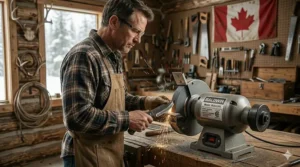
Progressive Grit Grinding
Rather than jumping from coarse to fine wheels, progress through intermediate grits for optimal results. Start with 80-grit for shaping, move to 120-grit for refining, then 180-grit for finishing. Each step removes the scratches from the previous grit, ultimately producing nearly polished edges.
While this approach requires more wheels and time, the results justify the effort for premium knives. Many Canadian sharpeners maintain three grinders: one for coarse work, one for medium grits, and one for fine finishing—eliminating wheel changes and streamlining workflow.
Compound Grinding for Specialized Edges
Different blade sections sometimes benefit from different grit sequences. The heel of a chef’s knife (near the handle) experiences different forces than the tip. Some professional sharpeners grind the heel with coarser wheels for durability while using finer wheels on the tip for precision work.
This advanced technique requires intimate understanding of blade geometry and usage patterns, but it maximizes each knife section’s performance for its specific purpose.
Troubleshooting Common Bench Grinder Knife Sharpening Problems
Even experienced sharpeners encounter issues. Understanding common problems and their solutions prevents frustration and damaged blades.
Problem: Blue or Purple Discoloration on Blade Edge
Cause: Overheating during grinding has drawn the temper from the steel, softening it.
Solution: Grind away the discoloured section completely—that steel is ruined. Prevent recurrence by reducing grinding pressure, cooling more frequently, and potentially switching to slower-speed grinding or finer-grit wheels that cut cooler.
Canadian climate note: In winter workshops, blades reach room temperature (often below 15°C), providing more heat capacity before reaching dangerous temperatures. Summer workshops require more aggressive cooling.
Problem: Uneven or Wavy Edge
Cause: Inconsistent angle during grinding, often from inadequate tool rest support or unstable hand positioning.
Solution: Improve tool rest quality or add a jig system. Practice maintaining consistent pressure and angle. Some Canadian sharpeners mark desired angles on the grinder housing with permanent marker as visual references.
Problem: Grinding Wheels Loading Quickly
Cause: Wheels glazing with metal particles, reducing cutting efficiency.
Solution: Dress wheels more frequently. Consider switching to softer-bonded or white aluminum oxide wheels that shed particles more readily. For persistent problems, CBN wheels (which don’t load) might justify their higher cost.
Problem: Excessive Vibration
Cause: Wheels out of balance or grinder mounting loose.
Solution: Balance grinding wheels using balancing washers or systems like the Oneway Precision Balancing System ($75-100 CAD). Verify all mounting bolts are tight and the grinder sits securely on its base. Rubberized feet reduce vibration transmission to workbenches.
Problem: Chattering or Rough Grinding
Cause: Wheel surface uneven or contaminated, or grinding too aggressively.
Solution: Dress and true wheels. Reduce grinding pressure. Check that the wheel matches your grinder’s rated RPM—using wheels rated for lower speeds on high-speed grinders creates dangerous conditions.
Frequently Asked Questions
❓ How much should I expect to spend on a quality bench grinder for knife sharpening in Canada?
❓ Can I sharpen kitchen knives safely on a bench grinder without ruining them?
❓ What's the difference between wet grinders and dry grinders for knife sharpening?
❓ Do I need a slow-speed grinder or will a standard high-speed grinder work for knife sharpening?
❓ What grit grinding wheel should I use for knife sharpening in Canada?
Conclusion: Selecting Your Perfect Bench Grinder for Knife Sharpening
Choosing the right bench grinder for knife sharpening transforms frustrating, inconsistent results into professional-grade edges you’ll take pride in. Whether you’re a Canadian hunter maintaining field knives, a chef keeping kitchen blades razor-sharp, or a hobbyist exploring the satisfying craft of knife sharpening, the right equipment makes all the difference.
Throughout this comprehensive guide, we’ve explored bench grinders spanning the full spectrum from budget-friendly options like the $149 CAD King Canada KC-890 to professional-grade systems like the BUCKTOOL wet grinder. We’ve examined critical features including grinding wheel grit selection (100-180 grit sweet spot for most knife work), the slow speed versus high speed debate (slower is safer but more expensive), tool rest adjustment capabilities (essential for consistent angles), and the benefits of water cooling troughs (messy but foolproof temperature control).
Remember that the “best” bench grinder depends entirely on your specific needs, budget, and blade types. Occasional home users sharpening kitchen knives succeed beautifully with the General International BG8002 ($85 CAD) or Mastercraft model ($150-180 CAD), while serious knife collectors and professionals justify investing in the DEWALT DW758 ($280-300 CAD) or BUCKTOOL wet system ($200-250 CAD). The most important factors? Choosing appropriate grinding wheels (don’t settle for stock wheels), implementing proper safety practices (eye protection is non-negotiable), and developing disciplined technique through practice on inexpensive blades first.
Canadian buyers enjoy excellent access to quality bench grinders through Amazon.ca, Canadian Tire, Home Depot, and specialized woodworking retailers. Take advantage of our strong warranty support infrastructure and brick-and-mortar presence—buying equipment you can examine locally and return easily provides peace of mind worth paying slightly more for.
Start with clear goals, honest budget assessment, and realistic expectations. A well-chosen bench grinder, properly equipped and skillfully operated, will serve your knife sharpening needs for decades while delivering professional results that rival expensive commercial sharpening services.
✨ Don’t Miss These Exclusive Deals!
🔍 Take your knife sharpening to the next level with these carefully selected products available in Canada. Click on any highlighted item to check current pricing and availability on Amazon.ca. These tools will help you create razor-sharp edges your family will appreciate!
Recommended for You
- 7 Best Digital vs Click Type Torque Wrench Canada 2026
- 7 Best Torque Wrenches for Winter Tire Changes Canada 2026
- 7 Best Screwdriver Sets for Electronics Canada 2026
Disclaimer: This article contains affiliate links to Amazon.ca. If you purchase products through these links, we may earn a small commission at no additional cost to you.
✨ Found this helpful? Share it with your friends! 💬🤗
