
In This Article
Picture this: it’s -28°C outside Winnipeg, you’ve drifted off a snow-packed highway, and your phone is at 4% battery. Now ask yourself — is your car ready for this?
For most Canadians, the honest answer is: probably not quite.
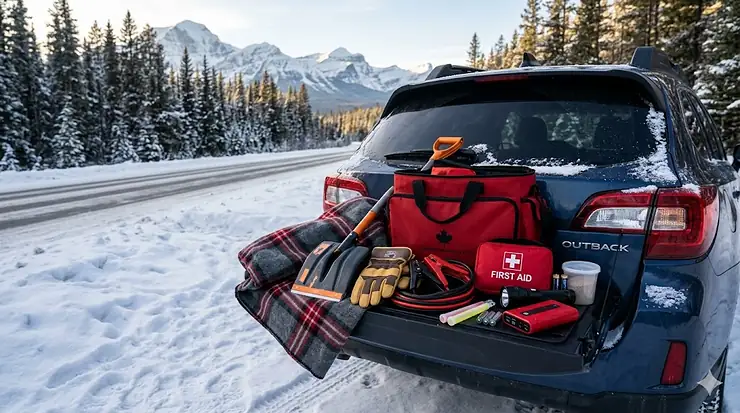
A proper winter emergency supplies checklist isn’t just a precaution. According to the Government of Canada’s emergency preparedness guidelines, every vehicle should carry a stocked emergency kit before winter conditions arrive — and the spec sheet goes well beyond a dusty first-aid kit from 2018.
What is a winter emergency supplies checklist? It’s a curated collection of survival tools, warmth items, roadside safety gear, and power solutions kept in your vehicle so that if you’re stranded in sub-zero Canadian temperatures, you can stay warm, signal for help, and manage the situation until rescue arrives — ideally for at least 72 hours.
The stakes here are serious. Environment Canada notes that exposed skin can develop frostbite in as little as 10 minutes at -28°C with even a slight wind. A few degrees of additional warmth inside your vehicle, or the ability to restart a dead battery independently, can be the difference between a minor inconvenience and a life-threatening emergency.
In this guide, I’ve researched 7 real products available on Amazon.ca and built out an expert-level checklist so you can outfit your vehicle before the next snowstorm hits. All prices are in CAD. Let’s get into it. 🇨🇦
Quick Comparison: Top 7 Winter Emergency Supplies at a Glance
| Product | Category | Best For | Price Range (CAD) | Amazon.ca? |
|---|---|---|---|---|
| NOCO Boost GB40 1000A | Jump Starter | Cars, SUVs up to 6.0L gas | $100–$135 | ✅ Prime eligible |
| HotHands Hand Warmers 40-Pair | Warmth | Long waits in extreme cold | Under $45 | ✅ Prime eligible |
| S.O.L. Survive Outdoors Longer Blanket | Emergency Blanket | Single-person heat retention | Under $25 | ✅ Ships to all provinces |
| Lifeline AAA 4330AAA 42-Piece Road Kit | All-in-One Kit | Budget-conscious drivers | $50–$70 | ✅ Prime eligible |
| Lifeline AAA 4390 66-Piece Severe Weather Kit | Winter All-in-One Kit | Families, harsh-winter provinces | $65–$90 | ✅ Limited availability |
| Ready First Aid 107-Piece First Aid Kit | First Aid | All drivers | $35–$55 | ✅ Ships from Amazon.ca |
| NOCO Boost GB50 1500A | Jump Starter | Trucks, diesel, large SUVs | $150–$185 | ✅ Prime eligible |
The table above reveals something important: there’s no single “perfect kit.” A Corolla driver commuting in Ottawa has different needs than someone hauling a diesel truck across the Prairies. The GB40 handles most cars comfortably, but if you drive a 3/4-ton or a diesel pickup, the GB50’s 1500A output and 4.5L diesel rating make it the smarter investment. Budget buyers should note that the Lifeline 42-Piece kit is a solid starter — but it lacks the winter-specific extras (shovel, fire starter, fleece set) found in the 66-piece Severe Weather edition.
💬 Just one click — help others make better buying decisions too! 😊
✨ Don’t Miss These Exclusive Deals!
🔍 Take your winter preparedness to the next level with these carefully selected products. Click on any highlighted item to check current pricing and availability on Amazon.ca. These tools could be the difference between a close call and a real emergency this Canadian winter!
Top 7 Winter Emergency Supplies: Expert Analysis 🛡️
1. NOCO Boost GB40 1000A UltraSafe Jump Starter
The NOCO Boost GB40 is, in my opinion, the single most important item on any winter emergency supplies checklist for a Canadian driver — and it’s not even close.
Here’s the thing most people overlook: at -20°C, a standard car battery loses up to 60% of its cranking power. Simultaneously, your engine oil thickens and demands more energy to turn over. This “double threat” is why dead batteries are the number one cause of winter roadside calls to CAA across Canada every season. The GB40 delivers 1,000 amps of lithium starting power — enough for gas engines up to 6.0 litres and diesel up to 3.0 litres — and unlike jumper cables, you don’t need a second vehicle. You’re self-sufficient. That matters enormously when you’re stranded at 2 a.m. on a deserted Trans-Canada highway stretch.
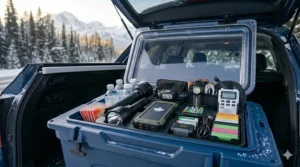
Beyond jump-starting, it doubles as a USB-C power bank (critical for keeping your phone alive) and includes a 100-lumen LED flashlight with 7 modes including SOS strobe. The IP65-rated enclosure shrugs off water and dust. One important caveat that Canadian reviewers frequently raise: lithium batteries lose charge faster in extreme cold when stored inside the car. The fix? Keep the GB40 charged (it holds a charge for up to a year at room temperature) and if it’s been sitting in a -30°C trunk, warm it up slightly before use. NOCO’s UltraSafe spark-proof technology and reverse polarity protection mean even a panicking first-timer can connect it correctly.
✅ Pros: Up to 20 jump starts per charge; spark-proof and mistake-proof; USB-C power bank built in
✅ Pros: 100-lumen SOS flashlight; IP65 water/dust resistance
✅ Pros: Compact enough to fit in a glove box
❌ Con: Lithium performance degrades in extreme cold — keep charged and warm before use
❌ Con: Not rated for diesel engines above 3.0L (see GB50 for larger trucks)
Check current price on Amazon.ca — around the $100–$135 CAD range. Worth every dollar.
2. HotHands Hand Warmers 40-Pair Bulk Pack
If the NOCO GB40 is your mechanical lifeline, HotHands are your human lifeline — the item you’ll reach for the moment you step outside to attach those jumper cables in -25°C wind chill.
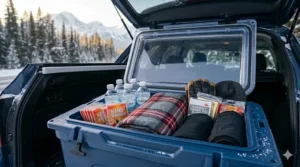
HotHands use an iron powder oxidation reaction triggered by air exposure. Shake the packet, slip it into your glove or pocket, and within 15–30 minutes it reaches an average temperature of around 57°C (135°F), sustaining warmth for up to 10 hours. No batteries, no charging, no moving parts. A 40-pair bulk pack gives you 80 individual warmers — enough to stock your car all season long and still have extras for your kids’ hockey practices. 🏒
What most Canadian buyers overlook about these: the 3–4 year shelf life means you can toss a pack in your kit and not think about it until you actually need it. They’re Health Canada-recognized as safe (iron powder, water, salt, activated charcoal, wood fibre — nothing toxic), and they’re odourless, which matters in an enclosed car cabin. Canadian reviewers consistently rate these among their top winter car essentials, calling them “a winter necessity” for good reason.
My advice: don’t just pack hand warmers. Tuck two pair into the kit and keep four pairs accessible in the back seat or door pocket. In a genuine emergency, you want warmth immediately, not after rummaging through a packed trunk.
✅ Pros: Up to 10 hours of sustained heat; no activation needed beyond opening
✅ Pros: 3–4 year shelf life; safe, odourless chemistry
✅ Pros: Bulk 40-pair pack offers excellent value for full-season coverage
❌ Con: Single-use only — not rechargeable
❌ Con: Heat activation takes 15–30 minutes; not instant
Under $45 CAD for 40 pairs on Amazon.ca. Prime-eligible for fast delivery.
3. S.O.L. Survive Outdoors Longer 90% Heat Reflective Emergency Blanket
Here’s a product where the spec sheet actually undersells the real-world performance — and that’s rare.
The S.O.L. Emergency Blanket is made from vacuum-metalized polyethylene, not the crinkly Mylar you’ve probably encountered in cheap kits. The difference? This one won’t shred if nicked, won’t crinkle loudly in high winds, and if punctured, it can be repaired. It reflects 90% of body heat back to you, creating a pocket of warmth that can be genuinely life-saving when your car heater fails in a Canadian blizzard. The high-visibility orange exterior helps rescuers spot you — a critical detail if you’re stranded off-road or in a ditch covered by blowing snow.
I keep one in every vehicle I own, and here’s why: it weighs almost nothing and folds to the size of a deck of cards. There is zero reason not to have this in your kit. Survival tips are printed directly on the blanket, which is useful if you’re operating under stress and can’t think clearly.
On Amazon.ca, this ships from Amazon directly to all provinces, including remote northern areas (though delivery timelines can extend for communities above 60°N). Canadian reviewers praise its durability compared to standard foil blankets, noting it survives multiple seasons without degrading.
✅ Pros: Reflects 90% of body heat; tear-resistant and repairable
✅ Pros: High-visibility orange for rescue signaling; survival tips printed on blanket
✅ Pros: Ultra-compact and lightweight — no excuse not to carry one
❌ Con: Single-person coverage only (the XL version accommodates two people)
❌ Con: Not a replacement for a proper sleeping bag in overnight survival scenarios
Under $25 CAD on Amazon.ca. One of the best value-per-gram purchases in any winter emergency supplies checklist.
4. Lifeline AAA 4330AAA 42-Piece Premium Road Kit
For drivers who want a foundational kit that covers the essentials without overwhelming complexity, the Lifeline AAA 4330AAA is a reliable starting point — with a few important caveats for Canadian winter use.
This AAA-branded kit packs 42 components into a compact storage bag: 8-gauge, 8-foot booster cables, a 9-LED flashlight with batteries, an emergency poncho, a safety vest, duct tape, a 2-in-1 screwdriver, assorted fuses, cable ties, and 19 first aid pieces. Everything is organized in a zippered carry bag that fits neatly in most trunk spaces. AAA engineering standards require all components to pass quality and safety testing, which means the jumper cables and flashlight are meaningfully better than what you’d find in generic off-brand kits at the same price point.
Here’s the honest Canadian perspective: this is a general roadside kit, not a winter survival kit. It doesn’t include a shovel, hand warmers, extra blankets, or a fire starter — all items Transport Canada’s winter driving guidelines specifically recommend. Think of the 4330AAA as your mechanical baseline. You’ll want to supplement it with hand warmers, an emergency blanket, and ideally a collapsible shovel for a truly winter-ready setup. For drivers in BC, Alberta, Manitoba, or Quebec — where winters regularly hit -25°C or colder — this kit alone isn’t sufficient.
✅ Pros: AAA-quality components with real engineering standards
✅ Pros: Compact, organized carry bag fits easily in most trunks
✅ Pros: Good value at the $50–$70 CAD price point
❌ Con: No winter-specific gear (shovel, warmers, fire starter)
❌ Con: 8-foot booster cables are shorter than ideal for some vehicle configurations
Around $50–$70 CAD on Amazon.ca. Prime-eligible.
5. Lifeline AAA 4390 66-Piece Severe Weather Emergency Road Safety Kit
Think of the 4390 as the 4330AAA’s older sibling who actually knows how to survive a Canadian winter.
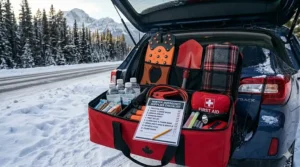
The 66-piece Severe Weather Kit adds the cold-weather essentials that the basic kit leaves out: an emergency folding shovel, a fleece hat/gloves/scarf set, a fire starter (quick-spark igniter), a survival candle (critical for warming your hands without draining your car battery or fuel), hand warmers, and an aluminum flashlight with additional features. These extras address the precise failure points that leave Canadians in genuine peril — being trapped in a snowbank with no way to dig out, or having no heat source if your car runs out of fuel while waiting for help.
One note of transparency: the 4390’s availability on Amazon.ca can be inconsistent — stock fluctuates seasonally, and it’s not always Prime-eligible. If you find it in stock in October before the season starts, buy it immediately. If it’s unavailable, the strategy I’d recommend is purchasing the 4330AAA and individually adding a quality folding shovel, hand warmers, and an emergency candle. The DIY approach costs slightly more but lets you choose better-quality individual components.
Canadian reviewers note that the included shovel is compact — useful for clearing a tailpipe or digging out a tire, but not a replacement for a full-size snow shovel if you’re regularly driving remote gravel roads in northern Ontario or Saskatchewan.
✅ Pros: Winter-specific additions (shovel, candles, fire starter, fleece set)
✅ Pros: More complete cold-weather coverage than the 42-piece kit
✅ Pros: AAA quality standards applied across all 66 components
❌ Con: Stock on Amazon.ca can be limited — check availability early in the season
❌ Con: Shovel is functional but small; not suitable for heavy snowbank clearing
Around $65–$90 CAD on Amazon.ca when available. Worth monitoring for stock.
6. Ready First Aid 107-Piece First Aid Kit
Here’s something I see people get wrong constantly: they assume the first aid kit inside their all-in-one emergency kit is “good enough.” It usually isn’t — particularly in a Canadian winter context where cold temperatures can mask symptoms of shock, frostbite, and hypothermia, making proper wound assessment and treatment even more critical.
The Ready First Aid 107-Piece Kit, sold through Amazon.ca by 72Hours Survival & First Aid, is a Canadian-market product specifically organized for roadside and emergency use. The 107 components include an appropriate range of bandages, gauze pads, adhesive tape, antiseptic wipes, vinyl examination gloves, and a first aid guide. The clamshell carry case keeps everything organized and visible — important when you’re cold, stressed, and need to find a specific item quickly.
What sets this apart from the first aid pouches included in all-in-one kits is sheer volume and quality. The 72Hours brand is a Canadian preparedness retailer, meaning the kit is assembled with Canadian standards and climate in mind (durable materials that don’t become brittle at -20°C, for example). For families with young children, or anyone driving long distances on remote Canadian highways, a dedicated first aid kit is non-negotiable.
✅ Pros: 107 pieces provides meaningful coverage for real injuries
✅ Pros: Canadian supplier with cold-climate material standards
✅ Pros: Clamshell case keeps everything visible and organized
❌ Con: Bulkier than the first aid pouches in all-in-one kits
❌ Con: No advanced trauma items (tourniquet, CPR mask) — consider adding separately
Around $35–$55 CAD on Amazon.ca. Pairs perfectly with any of the Lifeline all-in-one kits above.
7. NOCO Boost GB50 1500A UltraSafe Jump Starter
Everything I said about the GB40 applies here — except the GB50 is built for Canadians who drive something bigger.
The GB50 delivers 1,500 amps of starting power, rated for gas engines up to 7.0 litres and diesel engines up to 4.5 litres. If you drive a Ram 1500, F-150, Chevy Silverado, or any diesel-powered truck — and millions of Canadians do — the GB40’s 3.0L diesel ceiling simply won’t cut it. The GB50 fills that gap without jumping to the industrial-scale GB70, keeping the form factor manageable for glove box or centre console storage.
The same UltraSafe technology applies: spark-proof connections, reverse polarity protection, an IP65-rated enclosure, and a built-in 100-lumen SOS-capable flashlight. It holds a charge for up to a year in storage, making it genuinely useful as a “set it and check it twice a year” type of emergency tool. Canadian truck drivers and tradespeople who reviewed this product on Amazon.ca note it’s reliable in cold-starts at temperatures down to -20°C — provided it hasn’t been sitting discharged in a frozen truck bed for weeks.
My recommendation: GB40 for cars and compact SUVs; GB50 for trucks, large SUVs, and anyone with a diesel engine. Don’t try to save $40 by buying the smaller unit if you drive a larger vehicle — you’ll regret it on the one morning it can’t crank your engine.
✅ Pros: 1,500A handles trucks, large SUVs, and diesel up to 4.5L
✅ Pros: Same UltraSafe spark-proof system as the GB40
✅ Pros: USB-C power bank + SOS flashlight built in
❌ Con: Higher price point — not necessary for compact car owners
❌ Con: Like all lithium starters, performance dips in extreme cold; keep charged year-round
Around $150–$185 CAD on Amazon.ca. Prime-eligible for most Canadian provinces.
How to Assemble Your Winter Emergency Kit: A Practical Setup Guide 🔧
Buying the right products is step one. But how you organize your winter emergency supplies checklist is just as important as what’s in it.
Step 1 — Choose the right container. A waterproof duffel or a hard-shell case works best. Avoid cardboard boxes (they collapse in wet trunks) and flimsy tote bags. Your kit needs to survive a season of being bumped around.
Step 2 — Divide into layers. Place heavy items (jump starter, tools) at the bottom. Emergency blanket, hand warmers, and first aid kit go on top — these are the items you’ll reach for first under stress.
Step 3 — Store the jump starter in the cabin, not the trunk. Lithium batteries are more accessible and perform better when not exposed to extreme trunk temperatures. The centre console or rear seat footwell is ideal.
Step 4 — Add Canadian-specific supplements. Transport Canada recommends keeping windshield wiper fluid rated to at least -40°C, fuel line antifreeze, and a candle or matches for hand-warming without draining your battery. These small items cost under $10 CAD each and are often overlooked.
Step 5 — Review your kit at each time change. Use the spring-forward and fall-back daylight saving switch as your reminder. Check hand warmer expiry dates (3–4 years for HotHands), replace any used first aid supplies, and top up the jump starter charge.
Real-World Canadian Winter Scenarios: Who Should Buy What? 🗺️
Not every Canadian driver faces the same risks. Here’s how the products above map to three real-world user profiles:
The Urban Commuter (Toronto, Vancouver, Calgary): You’re driving 15–25 km (9–15 miles) to work in a sedan or compact SUV. Your biggest risks are dead batteries in a cold parking garage and slow-moving highway shutdowns in a blizzard. Your priority kit: GB40 jump starter + HotHands 40-pair + SOL emergency blanket + Lifeline 42-Piece road kit + Ready First Aid kit. Budget: $250–$320 CAD total. This setup covers 90% of urban winter emergencies.
The Rural or Highway Driver (Northern Ontario, Saskatchewan, Prairies): You’re covering 60–150 km (37–93 miles) between towns on highways with no cell service. You need more than a mechanical fix — you need genuine survival capability. Add the Lifeline 66-Piece Severe Weather kit, upgrade to the GB50 if driving a truck or diesel, and supplement with a full-size collapsible snow shovel and at least 2,000 calories of non-perishable food. Budget: $350–$500 CAD.
The Family with Young Children: Hypothermia risk is higher for children, and a panicked parent handling an emergency is more likely to make mistakes. Prioritize the Ready First Aid 107-Piece kit, the SOL XL blanket (2-person size), a complete HotHands variety pack (hands, toes, and body warmers), and a crank-powered flashlight that doesn’t rely on batteries. Budget: $280–$380 CAD.
How to Choose Winter Emergency Supplies in Canada: 6 Expert Criteria 📋
- Match your vehicle type first. A GB40 is fine for your Civic but won’t reliably crank a 6.6L diesel Duramax. Know your engine specs before buying a jump starter.
- Prioritize warmth over tools. Most Canadian winter emergencies are about staying warm while waiting for help — not performing roadside repairs. Weight your kit towards warmth (blankets, warmers, candles) before adding tools.
- Verify Amazon.ca availability before assuming. Some products visible in Canadian search results are fulfilled from the US and may have extended delivery windows, higher shipping costs, or limited warranty support in Canada. Always check the “Sold by” and “Ships from” details.
- Check for CSA or Canadian safety certification on electrical items. Jump starters and power banks should meet Canadian electrical standards. NOCO products meet these standards; always verify for lesser-known brands.
- Think about shelf life for consumables. Emergency food bars, hand warmers, and candles all have expiry dates. HotHands last 3–4 years. Build a replacement schedule into your calendar.
- Account for remote delivery if you’re in northern Canada. Amazon.ca ships to most of Canada, but remote communities in Nunavut, NWT, and northern Quebec may experience significantly longer delivery times. Order your winter emergency supplies checklist items before October. 🇨🇦
Common Mistakes When Building a Winter Car Kit ⚠️
Mistake 1: Relying solely on roadside assistance membership. CAA is excellent — but response times during major Prairie blizzards or multi-vehicle highway shutdowns can stretch to several hours. Your kit bridges the gap.
Mistake 2: Buying a kit, never opening it. Products expire, batteries die, and hand warmers past their date won’t activate reliably. Open your kit every fall and spring. Replace what’s expired.
Mistake 3: Storing the jump starter in the trunk all winter. Lithium batteries discharge faster in cold environments and perform worse when frozen. Keep yours in the cabin where it’s slightly warmer.
Mistake 4: Ignoring the tail pipe. If you’re running your engine for heat while stranded in a snowbank, ensure the tail pipe is clear of snow accumulation. A blocked pipe can cause carbon monoxide to build up inside the cabin — a silent and deadly risk. This is a specific hazard that Canada.ca’s extreme cold guidance explicitly warns about.
Mistake 5: Packing tools but no warmth. Many commercial roadside kits prioritize jumper cables and fuses over blankets and heat packs. In a Canadian winter, hypothermia is a realistic risk within 30 minutes of exposure. Warmth items are not optional additions — they belong at the top of your kit.
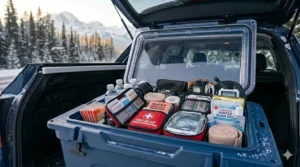
Winter Emergency Supplies vs. Basic Roadside Kits: What’s the Difference?
| Feature | Basic Roadside Kit | Winter Emergency Supplies Kit |
|---|---|---|
| Jumper cables | ✅ Yes | ✅ Yes (or portable jump starter) |
| First aid | ✅ Basic | ✅ Comprehensive |
| Emergency blanket | ❌ Rarely | ✅ Essential |
| Hand warmers | ❌ No | ✅ Essential |
| Snow shovel | ❌ No | ✅ Recommended |
| Fire starter/candle | ❌ No | ✅ Recommended |
| Emergency food/water | ❌ No | ✅ For remote driving |
| Reflective triangles | Sometimes | ✅ Yes |
| Cold-rated materials | ❌ Not specified | ✅ Designed for sub-zero use |
The comparison above makes the gap obvious. A basic roadside kit gets you through a flat tyre or dead battery in mild weather. A properly assembled winter emergency supplies checklist gets you through a -30°C blizzard breakdown 100 km from the nearest town. The difference in cost is often under $100 CAD — but the difference in outcome can be everything. Learn more about what Wikipedia describes as the physiological risks of hypothermia to understand why warmth tools aren’t optional in Canadian winters.
✨ Don’t Miss These Exclusive Deals!
🔍 Ready to build your kit? Click any highlighted product to check current pricing and availability on Amazon.ca. Your safest winter season starts with one purchase at a time — and Prime members get free shipping on eligible orders!
FAQ: Winter Emergency Supplies Checklist in Canada ❓
❓ What should I keep in my car for winter emergencies in Canada?
❓ How long should my winter emergency car kit last me?
❓ Can I order winter emergency supplies on Amazon.ca with fast delivery across Canada?
❓ What emergency candle is best for car heat in a Canadian winter?
❓ Do hand warmer packets really work in -30°C Canadian winters?
Conclusion: Build Your Winter Emergency Supplies Checklist Before the First Snowfall ❄️
Canadian winters are not for the under-prepared. Between Newfoundland’s freezing rain, the Prairies’ ground blizzards, and BC’s mountain passes, no province is immune to the kind of weather that can strand a driver in genuinely dangerous conditions within minutes.
The winter emergency supplies checklist I’ve built in this guide covers the full spectrum: power (NOCO GB40/GB50), warmth (HotHands, SOL Emergency Blanket), medical (Ready First Aid 107-Piece), and all-in-one readiness (Lifeline 42-Piece and 66-Piece kits). All are available on Amazon.ca, and all have been chosen based on real product specs, Canadian reviewer feedback, and alignment with Transport Canada and Government of Canada emergency preparedness standards.
Start with the items that address your biggest vulnerability. If your car battery is aging, the GB40 is your first purchase. If you drive rural highways in Manitoba or northern Ontario, the SOL Emergency Blanket and a 40-pack of HotHands should be in your trunk today.
Don’t wait for a cold snap to remind you. Build your kit this week. 🇨🇦
Recommended for You 📖
- 7 Best Winter Car Emergency Kits Canada 2026
- 7 Best Block Heater Extension Cord Outdoor Rated Canada 2026
- 7 Best Block Heaters for Canadian Winter That Actually Work 2026
Disclaimer: This article contains affiliate links. As an Amazon Associate, I earn from qualifying purchases. If you purchase products through these links, we may earn a small commission at no additional cost to you.
✨ Found this helpful? Share it with your friends! 💬🤗
