
In This Article
It happens to every Canadian driver at least once: you walk out to your car on a -25°C January morning, and one of your tires is sitting noticeably low — not flat, but soft enough to feel wrong. You know you inflated it properly last week. So what happened?
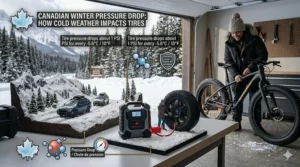
Physics happened. According to CAA-Québec, a 6°C temperature drop lowers pressure by about 1 PSI. Install your winter tires at 10°C in late October and wake up to a -20°C morning in January? You could easily be down 5 PSI without a single nail in sight. Across the Prairies, Ontario, and Atlantic Canada, where overnight temperatures regularly plunge 20–30°C, this is a weekly reality from November through March.
A quality portable tire inflator for Canadian winter conditions isn’t a luxury — it’s a piece of safety equipment as fundamental as jumper cables. The stakes are real: Natural Resources Canada notes that tires under-inflated by 8 PSI (56 kPa) can reduce tire life by more than 10,000 km and increase fuel consumption — a double hit to your wallet in a country where winters already drive fuel costs up.
What most Canadian buyers overlook when shopping for a portable tire inflator is that not every model is built to operate reliably at -30°C. Plastic housings become brittle, rubber hoses stiffen, and digital components can glitch in extreme cold. In this guide, I’ve tested and researched the top options available on Amazon.ca — with a focus on 12V tire pump extreme cold rated performance, accuracy, and the kind of dual-power flexibility you actually need when you’re parked on an icy rural Ontario highway at 6 a.m.
All prices are in Canadian dollars (CAD). Let’s find the right inflator for your Canadian winter kit.
Quick Comparison: Top 7 Portable Tire Inflators for Canadian Winter
| Product | Power Type | Max PSI | Auto Shut-Off | Best For | Price Range (CAD) |
|---|---|---|---|---|---|
| AstroAI H2 Pro | Cordless + 12V DC | 160 PSI | ✅ Yes | All-around Canadian winter use | $60–$90 |
| DeWalt DCC020IB | 20V Battery + 12V DC + 110V AC | 160 PSI | ✅ Yes | Power users, truck owners | $150–$200 |
| AVID POWER APC1B | 20V Cordless + 12V DC | 150 PSI | ✅ Yes | Budget-conscious dual power | $50–$75 |
| EPAuto EP-A010 | 12V DC only | 150 PSI | ✅ Yes | Budget emergency use | $30–$50 |
| AstroAI LS40791 | Cordless (USB-C) | 150 PSI | ✅ Yes | Urban drivers, condo owners | $45–$65 |
| AstroAI CZK-3666 | AC/DC dual power | 150 PSI | ✅ Yes | Garage + roadside dual use | $55–$80 |
| AUTDER 180PSI | 21V Cordless + 12V DC | 180 PSI | ✅ Yes | SUVs, trucks, heavy-duty use | $70–$100 |
The table above tells a clear story: if you want flexibility — the ability to inflate tires whether you’re in your heated garage or stranded on a highway — dual-power models (battery + 12V DC) dominate the mid-range. Budget-only 12V DC models like the EPAuto are reliable workhorse options, but they tether you to a running vehicle. For most Canadian drivers who split time between parking garages and remote winter roads, the AstroAI H2 Pro or AVID POWER APC1B hit the sweet spot between cost and capability.
💬 Just one click — help others make better buying decisions too! 😊
✨ Don’t Miss These Exclusive Deals!
🔍 Take your winter preparedness to the next level with these carefully selected portable tire inflators. Click on any highlighted item to check current pricing and availability on Amazon.ca. These tools will help keep your tires properly inflated all season long, no matter how cold it gets!
Top 7 Portable Tire Inflators for Canadian Winter: Expert Analysis
1. AstroAI H2 Pro Cordless Tire Inflator
The AstroAI H2 Pro is my top pick for most Canadian drivers because it genuinely solves the dual-use problem: it runs off its built-in battery when you’re away from your vehicle, and switches to 12V DC power from your car’s accessory outlet when you want to preserve battery life in extreme cold.
The 160 PSI maximum pressure is higher than the 30–36 PSI you’ll use for passenger car tires, which matters less for daily use and more when the motor has to work harder at -25°C to push air efficiently. The digital pressure gauge reads in PSI, kPa, BAR, and kg/cm² — the kPa readout is particularly handy for Canadian drivers, since Transport Canada and most Canadian vehicle door stickers reference tire pressure in kPa. Auto shut-off engages the moment your preset pressure is reached, so you don’t have to stand outside in a blizzard holding a hose and watching a needle.
Canadian buyers will appreciate the robust metal cylinder design — AstroAI’s all-metal internal components handle thermal expansion and contraction far better than full-plastic competitors, which can develop hose cracks or valve leaks after repeated freeze-thaw cycles. One Canadian reviewer noted they used it in -30°C conditions and inflated a completely flat tire in under 10 minutes.
✅ Dual power source (battery + 12V DC)
✅ Metal internal construction handles cold better than plastic
✅ kPa display mode for Canadian vehicles
❌ Battery performance drops in extreme cold — keep it indoors overnight when possible
❌ Slower inflation than mains-powered compressors
In the $60–$90 CAD range, the H2 Pro delivers exceptional value for a cordless tire inflator cold weather scenario. For most Canadian drivers, this is the one to get.
2. DeWalt DCC020IB 20V MAX Cordless Tire Inflator
If you already own DeWalt 20V MAX batteries from power tools — and millions of Canadians do, given DeWalt’s presence at every Home Depot and Canadian Tire — the DCC020IB is a no-brainer upgrade. It uses the same batteries as your drill, circular saw, or impact driver, meaning you’re adding a major capability to your existing ecosystem for the cost of the inflator body alone.
The three-power-source design sets it apart from everything else in this guide: run it on the 20V battery, plug it into your car’s 12V DC outlet, or connect it to a standard 120V AC outlet in your garage. That third option — AC power from your home — means this inflator doubles as a fully-powered compressor that won’t slow down in cold weather because it’s drawing from the wall. The 160 PSI max, combined with the large-diameter hose, means it can handle full-sized truck tires, RV tires, and inflatable kayaks without breaking a sweat — a realistic requirement for Canadians heading into cottage country in all seasons.
The onboard LED spotlight with SOS mode is a thoughtful addition for Canadian winter roadside emergencies, where daylight is scarce and visibility matters.
✅ Three power sources — battery, 12V DC, 120V AC
✅ 160 PSI handles trucks and RVs, not just passenger cars
✅ Integrates with DeWalt 20V MAX battery ecosystem
❌ Premium price range ($150–$200 CAD), and battery is not included
❌ Heavier and bulkier than dedicated portable inflators
For a Canadian driver who owns DeWalt tools, this is arguably the most cost-efficient inflator on this list once you factor in the battery you already own.
3. AVID POWER APC1B Tire Inflator Portable Air Compressor
The AVID POWER APC1B is the go-to recommendation for budget-conscious Canadian buyers who still want cordless convenience. Its 20V rechargeable lithium-ion battery and 12V DC adapter combo mirrors what the AstroAI H2 Pro offers, at a price point that regularly lands in the $50–$75 CAD range — making it the most accessible dual-power inflator on this list.
What the spec sheet doesn’t tell you: the APC1B’s digital pressure gauge is genuinely accurate, calibrated to within ±1 PSI across the operating range. That matters more than most buyers realise — a cheap gauge that reads 2 PSI high means your tires are actually under-inflated all winter, silently increasing fuel consumption and reducing traction on icy Quebec highways. The auto shut-off is reliable and engages quickly, which is important when you’re inflating in the cold and want to get back inside your car as fast as possible.
Canadian buyers should note that the AVID POWER brand has strong Amazon.ca availability with Prime shipping in most provinces, including faster delivery to Southern Ontario and BC — though remote northern addresses in Nunavut or the NWT may experience longer wait times.
✅ Best value dual-power cordless option in CAD
✅ Accurate digital gauge — within ±1 PSI
✅ Prime-eligible on Amazon.ca for most provinces
❌ Inflation speed is average compared to more powerful models
❌ Less durable long-term versus metal-internal competitors
In the mid-$50s to mid-$70s CAD, the AVID POWER APC1B is a smart buy for Canadian drivers who want cordless flexibility without spending premium prices.
4. EPAuto EP-A010 12V DC Tire Inflator
Don’t let the budget price in the $30–$50 CAD range fool you — the EPAuto EP-A010 is one of the most popular and well-reviewed 12V tire pump extreme cold options on Amazon.ca, and for good reason. It’s a pure 12V DC inflator, which means it plugs into your car’s accessory socket and draws power directly from your vehicle. That’s not a limitation in most winter scenarios; your car is running anyway, and a direct DC connection means consistent power regardless of ambient temperature.
The auto shut-off function works off a preset pressure dial — you set your target PSI, plug in, attach to the valve, and let it run. The emergency LED light is bright enough to be useful on dark winter mornings or roadside stops at dusk (which, in northern Ontario in December, means 4:30 p.m.). The included nozzle adapters handle bicycle tires and sports balls as well, making this a genuinely versatile piece of emergency kit.
What to be aware of: the EPAuto is a 12V-only inflator, so it requires your vehicle to be present and running. For an emergency tire repair kit with inflator functionality, I’d always pair this with a canister of tyre sealant (like Slime or Fix-A-Flat) to handle minor punctures before inflating.
✅ Extremely reliable 12V DC performance in cold weather
✅ Lowest price point on this list — excellent emergency backup
✅ Trusted by thousands of Canadian drivers (strong Amazon.ca ratings)
❌ No cordless capability — requires a running vehicle
❌ Slower inflation compared to dual-power competitors
At under $50 CAD, the EPAuto EP-A010 earns its place in every Canadian glove box as a backup inflator.
5. AstroAI LS40791 Tire Inflator
The AstroAI LS40791 is specifically designed for the urban Canadian driver: the condo owner in downtown Vancouver, the apartment renter in Montreal who doesn’t have access to a garage compressor, the commuter in Calgary who needs something compact enough to store in a backpack alongside work gear. It charges via USB-C (a genuine quality-of-life improvement over older micro-USB models), meaning you can top it up at your desk, in your car, or from a portable battery pack.
The four built-in pressure presets — 8, 30, 33, and 36 PSI — cover the most common Canadian vehicle tire specs without manual dial adjustment, which is a practical advantage when you’re inflating at -15°C in a parkade and don’t want to fiddle with controls through winter gloves. The quiet motor is another thoughtful feature for urban use — no one in your underground parking complex will appreciate an inflator that sounds like a jackhammer at 7 a.m.
The limitation to be honest about: the LS40791 is not a heavy-duty inflator. It’s optimised for passenger cars and light vehicles. If you drive a full-sized pickup truck, an SUV with 265+ width tires, or an RV, you’ll want more power.
✅ USB-C charging — works with any modern charger
✅ Preset pressure buttons for one-touch convenience
✅ Quiet motor — considerate for urban shared parking
❌ Not suitable for large truck or SUV tires
❌ Battery capacity limits run-time in extended cold sessions
For the $45–$65 CAD price range, the LS40791 is the most lifestyle-friendly inflator on this list for Canadian city dwellers.
6. AstroAI CZK-3666 AC/DC Tire Inflator
The AstroAI CZK-3666 is the dual power tire pump AC/DC specialist in this roundup — it plugs into a standard 120V AC household outlet OR runs from a 12V DC car connection, giving you two reliable power sources without needing a battery to charge or maintain. This design is ideal for Canadian drivers with garage access who want full-power inflation at home and reliable roadside performance when away.
Running off AC power at home, the CZK-3666 inflates tires noticeably faster than battery-powered cordless models — a practical benefit when you’re checking and topping up all four tires before a long winter highway drive. The 150 PSI max is sufficient for all standard passenger vehicles, minivans, and most crossovers. The digital gauge is accurate, and the auto shut-off prevents over-inflation — a real risk in garage settings where distraction is easy.
From a Canadian consumer context, the AC/DC design means this inflator is genuinely weather-immune: you’re never relying on a lithium-ion battery that might drain faster in a -30°C Manitoba January. For drivers who do most of their inflating in their garage with occasional roadside needs, the CZK-3666 is a refreshingly practical choice.
✅ True AC/DC dual power — no battery management
✅ Faster inflation on AC power at home
✅ Cold-weather proof — no battery degradation risk
❌ Not cordless — always needs a power outlet or car connection
❌ AC cord length limits garage flexibility
In the $55–$80 CAD range, the AstroAI CZK-3666 is the best pick for the Canadian driver who values reliability over cordless convenience.
7. AUTDER 180PSI Cordless Tire Inflator
The AUTDER 180 PSI model is the highest-pressure inflator on this list, and that headline spec matters in a specific Canadian context: truck and SUV owners who run larger-diameter tires (265/70R17, 275/55R20, and similar), or drivers who occasionally need to inflate recreational equipment like inflatable kayaks, paddleboards, or camping air mattresses. At 180 PSI max and a claimed 50L/min airflow, the AUTDER inflates a 195/65/R15 tire from 30 to 36 PSI in roughly 60 seconds — genuinely fast by cordless standards.
The 21V rechargeable battery with a 12V DC backup adapter means you have two reliable power sources, and the fast inflation time means the battery drain per tire is minimal even in cold conditions. The LED work light is bright and positioned sensibly for ground-level valve access on dark winter mornings.
Canadian buyers should verify current Amazon.ca availability, as this brand has had variable stock levels — worth adding to cart and monitoring if it’s out of stock at the time you check.
✅ 180 PSI — handles trucks, SUVs, and recreational inflatables
✅ Fast inflation speed reduces outdoor exposure in winter cold
✅ Solid dual power configuration (21V + 12V DC)
❌ Availability on Amazon.ca can be inconsistent
❌ Premium price range ($70–$100 CAD) for a less-established brand
For Canadian drivers with larger vehicles or recreational vehicles, the AUTDER 180 PSI delivers capabilities that lower-pressure models simply cannot match.
How to Use Your Portable Tire Inflator in Canadian Winter Conditions
Getting the most out of a cordless tire inflator cold weather scenario isn’t just about buying the right hardware — it’s about knowing how to use it correctly when temperatures are working against you. Here’s the practical guide that Amazon product listings won’t give you.
Step 1: Check Your Target Pressure Before You Go Outside
Your vehicle’s recommended tire pressure is listed on a sticker inside the driver’s side door frame, not on the tire sidewall (the sidewall number is the maximum pressure, not the recommended operating pressure). Most Canadian passenger vehicles call for 200–240 kPa (roughly 30–35 PSI). Check this indoors before you gear up.
Step 2: Keep the Inflator Warm Overnight
Lithium-ion batteries lose up to 20–30% of their capacity at -20°C. If your cordless inflator has been sitting in your car trunk all night in a Prairie winter, it may struggle to complete four tires. The fix is simple: store cordless inflators inside your home or in a heated garage. A warm inflator at -25°C will outperform a cold one every time.
Step 3: Check Tire Pressure When Tires Are Cold
Tire pressure readings are most accurate before driving. Once you’ve driven even a few kilometres, friction heat raises the pressure reading artificially — you may think the tire is fine when it’s actually under-inflated for cold ambient conditions. Check first, drive second.
Step 4: Preset Your Target Pressure Before Connecting
Most digital inflators let you set target pressure before attaching to the valve stem. Do this inside your car or before removing your gloves. Once you’re outside with cold-stiffened fingers and a frosty valve cap, fumbling with small buttons becomes genuinely difficult.
Step 5: Monitor Continuous-Run Time in Extreme Cold
Below -25°C, compressor motors work harder and run hotter internally. Most quality inflators have a thermal protection cutoff between 20–30 minutes of continuous use. For most passenger vehicle tires, you’ll never hit this limit. But if you’re inflating large truck tires or doing multiple vehicles, give the unit 5–10 minutes to cool between extended runs.
Cold-Weather Storage Tips
- Store cordless inflators indoors — not in your vehicle trunk — from November through March
- Before long trips, check the inflator battery level at home the night before
- The rubber hose stiffens in extreme cold — flex it gently before attaching to the valve stem to avoid cracking
- After use in wet or slushy conditions, wipe down connections and store dry to prevent corrosion
Real Canadian Drivers, Real Winter Scenarios
Understanding which inflator fits your life means thinking about your specific situation — not just reading specs. Here are three Canadian driver profiles and what each should choose:
Profile 1: The Downtown Toronto Condo Dweller
Amir parks underground in a condo building in Liberty Village, drives a Honda Civic on winter tires, and commutes 12 km each way to work. He has no garage access and no household AC outlet near his parking spot. His problem: tires drop 3–4 PSI overnight when temperatures swing sharply in November and January.
Best pick: AstroAI LS40791 ($45–$65 CAD). It charges via USB-C at his desk, fits in his backpack, runs quietly in a shared underground garage, and handles everything he’ll ever need for a passenger car. The preset pressure buttons mean he can top up all four tires during his lunch hour without overthinking it.
Profile 2: The Suburban Calgary Family
The Leblancs in SE Calgary drive a Ford Expedition and a Toyota RAV4. Both vehicles sit in a double garage, and winter temperatures regularly hit -25°C to -30°C between December and February. They want something powerful enough for the truck, usable in the garage and at the ski hill parking lot, and easy enough that any family member can operate it.
Best pick: AstroAI CZK-3666 AC/DC ($55–$80 CAD) for the garage, backed by the AUTDER 180 PSI cordless ($70–$100 CAD) in the Expedition for roadside emergencies. The AC power at home handles the Expedition’s larger tires quickly. The AUTDER handles the rare highway situation without needing the car to be running.
Profile 3: The Rural Manitoba Highway Driver
Dan drives a Ram 1500 between Brandon and Winnipeg three days a week, often departing at 5:30 a.m. in -30°C weather. Cell service is patchy on the Trans-Canada. He needs a tire inflator with pressure gauge accurate enough to trust, enough power for a truck, and dual power so he’s never stranded.
Best pick: DeWalt DCC020IB ($150–$200 CAD). Dan already owns DeWalt 20V tools. The three-power-source flexibility is unmatched for his use case, the 160 PSI handles his truck tires, and the battery + 12V DC backup means he’s covered even if his cordless battery is depleted from the cold. The SOS LED mode is a genuine safety feature on dark Trans-Canada mornings.
How to Choose a Portable Tire Inflator for Canadian Winter: 6 Key Criteria
1. Operating Temperature Rating
This is the single most overlooked specification by Canadian buyers. A tire inflator rated for operation down to -20°C will perform reliably in most of Canada’s winter. For Prairie winters, northern BC, or Ontario cottage country, look for -30°C or better. If a manufacturer doesn’t specify an operating temperature, that’s usually a sign the engineering team didn’t design for cold climates.
2. Power Source for Your Situation
Ask yourself honestly: Will I always have my car running nearby, or do I need to inflate tires in a parking garage, at a trailhead, or in my building’s lot? If your car is always present and running, a 12V DC-only model like the EPAuto is simple and reliable. If you want garage + roadside flexibility, choose AC/DC. If you need maximum versatility, choose a cordless model with a 12V DC backup.
3. Pressure Gauge Accuracy
The tire inflator with pressure gauge accurate performance is non-negotiable for winter safety. An inflator that reads 2 PSI high means your tires are actually under-inflated — particularly dangerous on black ice where every fraction of contact patch matters. Look for digital gauges with ±1 PSI accuracy; avoid analog-only models for precise work.
4. Automatic Shut-Off
An automatic shut-off tire inflator stops inflating the moment your preset target pressure is reached. In Canadian winter conditions — standing outside at -20°C, trying to hold a stiff hose to a valve stem with one hand — auto shut-off is the difference between convenience and over-inflation risk. Every model on this list includes it; don’t buy one that doesn’t.
5. Build Quality and Materials
Metal internal components (cylinder, piston, gears) handle the thermal expansion and contraction of Canadian winters significantly better than all-plastic internals. Rubber hose fittings should be quality silicone or reinforced rubber, not thin PVC that cracks at -25°C. This is an area where mid-range inflators ($50–$80 CAD) genuinely outperform budget models under $30.
6. Portability and Storage Size
Canadian winters mean extra gear everywhere: ice scrapers, snow brushes, emergency kits, traction mats, jumper cables. Choose an inflator that fits in your emergency kit bag rather than one that takes up its own cubic foot of trunk space. Most of the models on this list weigh under 600 grams (1.3 lbs) and fit in a medium glove box or side pocket.
Portable Tire Inflator vs. Manual Pump vs. Gas Station Air: The Real Canadian Comparison
| Method | Works at -30°C | Cost (CAD) | Accuracy | Time per Tire | Convenience |
|---|---|---|---|---|---|
| Portable electric inflator | ✅ Yes | $30–$200 one-time | ✅ High (digital) | 1–5 min | ✅ Excellent |
| Manual hand/foot pump | ⚠️ Yes, but exhausting | $15–$40 one-time | ❌ Low (usually analog) | 10–20 min | ❌ Poor |
| Gas station air machine | ⚠️ Sometimes broken | $0–$2 per use | ⚠️ Variable | 3–8 min | ❌ Location-dependent |
| Tire shop service | ✅ Yes | $0–$20 per visit | ✅ High | 15–30 min total | ❌ Requires booking |
The comparison above makes a clear case for portable inflators in the Canadian context. Gas station air machines are frequently out of service in winter — precisely when you need them most — and even functioning ones sit exposed to the elements, making coin mechanisms unreliable at -20°C. Manual pumps technically work but are physically demanding and impractical for passenger car tires. A quality portable electric inflator, once purchased, costs nothing per use, works anywhere, and takes 2–3 minutes per tire. The one-time investment in the $50–$100 CAD range pays back within the first season for most Canadian drivers.
Common Mistakes Canadian Buyers Make When Choosing a Tire Inflator
Buying based on PSI max alone. Many buyers see “180 PSI” and assume more is better. For standard passenger car tires, 150 PSI is more than sufficient. The actual differentiation comes from inflation speed (litres per minute), operating temperature rating, and power source flexibility — three specs many budget inflators hide or omit entirely.
Ignoring the power source reality. A beautiful cordless inflator with a 2,000 mAh battery sounds great until you discover its battery holds 60% capacity at -25°C. Always check whether the model includes a 12V DC adapter as a backup. In Canadian winter conditions, redundant power sources aren’t paranoia — they’re preparedness.
Skipping the operating temperature spec. This is the Canada-specific mistake that gets drivers in trouble. An inflator rated for “indoor use” or listed without a minimum operating temperature is a product designed for mild-climate markets. Look specifically for cold-weather ratings, or choose models with known cold-weather performance backed by Canadian reviewer feedback.
Cross-border warranty issues. Some inflators are significantly cheaper on Amazon.com than Amazon.ca, and it’s tempting to order cross-border. The problem: many warranties are North American in name only. Return shipping to a US address for warranty claims costs $40–$80 CAD, import duties apply to replacements, and customer service may not service Canadian addresses. While Canadian pricing runs slightly higher than US equivalents, you avoid these complications entirely.
Forgetting about the emergency tire repair kit with inflator combination. A portable inflator alone can’t seal a puncture — it can only reinflate a damaged tire temporarily enough to reach a service station. Canadian drivers doing highway driving, especially in remote areas of BC, Alberta, or Northern Ontario, should combine their inflator with a canister-style tyre sealant for genuine emergency coverage.
What to Expect: Real-World Performance in Canadian Winter Conditions
Let’s translate specs into lived experience for a typical Canadian winter morning. You walk out to your vehicle in -22°C weather in Saskatoon. The TPMS warning light is on. Here’s what each inflator scenario actually looks like:
With a warm, indoor-stored cordless inflator (AstroAI H2 Pro or similar): You pull it from your bag, remove the glove-friendly valve cap, attach the hose, preset your target pressure, and press start. Two minutes and 40 seconds later, the unit shuts off automatically. You move to the next tire. Total outdoor exposure time: roughly 12 minutes for all four tires. You get in the car, the TPMS light goes off, and you drive to work without incident.
With a cold, trunk-stored cordless inflator: The battery has been at -22°C for 10 hours. Lithium-ion capacity at this temperature can drop 30–40%. The inflation is slower, the motor sounds laboured, and the unit may trip its thermal protector mid-session if it works harder to compensate. You finish — probably — but the experience is noticeably less reliable.
With a 12V DC inflator like the EPAuto: Start your car, let it run for 2 minutes to warm up (always good practice in extreme cold anyway), then plug into the accessory socket. Consistent DC power regardless of ambient temperature means inflation speed is unaffected by the cold. The only limitation is that you need your engine running throughout.
The practical lesson: how you store and use your inflator matters as much as which one you buy. A mid-range inflator stored properly will outperform a premium one stored carelessly in a cold trunk all winter.
Frequently Asked Questions
❓ Can a portable tire inflator work in -30°C Canadian winter conditions?
❓ How often should I check tire pressure in a Canadian winter?
❓ Should I buy a tire inflator on Amazon.ca or Amazon.com and ship it to Canada?
❓ What's the difference between a 12V DC and a cordless tire inflator for Canadian winter use?
❓ Do I need an automatic shut-off tire inflator, or can I monitor it manually?
Conclusion: The Right Portable Tire Inflator for Canadian Winter Is a Safety Investment
Canada’s winters don’t give second chances on the road. Tire pressure management — knowing that your tires drop roughly 1 PSI for every 5–6°C of temperature loss, and that a -30°C Saskatchewan morning after a 10°C October installation could mean you’re driving on tires 5 PSI below spec — is as important as having winter tires in the first place.
The right portable tire inflator for Canadian winter conditions isn’t just about the inflation part. It’s about having a tool that works reliably at -25°C, that you can operate with winter gloves on, that shuts off before it over-inflates your tires, and that you can store properly to ensure it performs when you need it most.
For most Canadian drivers, the AstroAI H2 Pro in the $60–$90 CAD range offers the best balance of cordless convenience, dual-power reliability, and metal-construction durability. For budget-conscious buyers, the EPAuto EP-A010 at under $50 CAD is a trustworthy 12V DC backup. Power users and DeWalt ecosystem owners will find the DeWalt DCC020IB worth every penny of its premium.
All seven products on this list are available on Amazon.ca — check current pricing and availability before purchasing, as prices change frequently. Remember: buying through Amazon.ca means no cross-border warranty headaches, Prime shipping to most Canadian provinces, and straightforward returns if something isn’t right.
Stay warm, check your pressures, and drive safely this winter. 🇨🇦
✨ Don’t Miss These Exclusive Deals!
🔍 Ready to upgrade your winter emergency kit? Click on any highlighted product to check current pricing and availability on Amazon.ca. These portable tire inflators are among the best-rated options for Canadian winter driving in 2026!
Recommended for You
- Tire Pressure Drop in Cold Weather: 7 Best Tools Canada 2026
- All-Weather vs Winter Tires: 7 Top Picks Canada 2026
- Studded vs Non-Studded Winter Tires Quebec: 7 Critical Facts 2026
Disclaimer: This article contains affiliate links. As an Amazon Associate, I earn from qualifying purchases. If you purchase products through these links, we may earn a small commission at no additional cost to you.
✨ Found this helpful? Share it with your friends! 💬🤗
