
In This Article
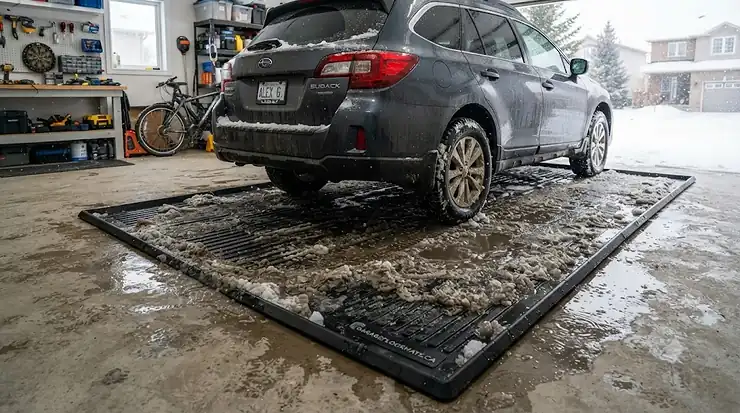
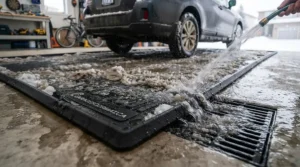
Every Canadian who parks indoors from November through March knows the ritual: you pull in, kill the engine, and watch a small glacier start forming under your bumper. A slush mat for garage floors is simply a waterproof, raised-edge barrier — usually vinyl, rubber, or a heavy absorbent fabric — that you park on top of to catch the meltwater, road salt, and grit your tires and boots drag in. Instead of that mess soaking into your concrete or, worse, migrating toward the door into your mudroom, it stays contained on a mat you can hose off or wring out once spring finally shows up.

I’m not going to pretend a floor mat is glamorous. But if you’ve ever scraped white salt bloom off a garage slab, or watched a puddle creep toward your tool chest, you already understand why this is one of the cheapest insurance policies a Canadian homeowner can buy. Here’s what to weigh: your vehicle size, your garage layout, how much wet-boot traffic you get, and whether you’re dealing with a compact hatchback or a full-size SUV that tracks in a small snowbank on its own. We researched real, currently available products — from Canadian-made canvas mats to heavy-duty containment systems — and broke down what the spec sheets actually mean once winter hits. A quick note before we dive in: Transport Canada’s own winter driving safety guidance is a good reminder of just how much slush, salt brine, and grit gets flung onto your vehicle before it even reaches your garage door.
Quick Comparison Table
| Product | Best For | Price Range (CAD) | Rating Snapshot |
|---|---|---|---|
| Drymate Max Absorbent Garage Mat | Budget buyers, single compact car | C$80-C$130 | Strong for absorption, weaker on edge containment |
| Winkler Canvas Floor Guard | Canadian-made durability | C$150-C$230 | Consistently praised for build quality |
| WeatherTech BootTray | Wet snow boots, mudroom entry | C$40-C$70 | Very high satisfaction, small footprint only |
| GorillaCONTAIN Containment Mat | Non-slip winter mat for extreme cold | C$180-C$270 | Praised for cold-weather flexibility |
| Park Smart Clean Park | Mid-range vinyl with snap edges | C$200-C$290 | Reliable, some assembly required |
| TruContain HD Containment Mat | Full-size SUV, heavy vehicle floor mat | C$230-C$340 | Heaviest fabric in this lineup |
| WeatherTech GarageMat | Premium rigid protection | C$260-C$380 | Top-tier reviews, higher investment |
Looking at this table, the split is pretty clean: if you drive a sedan or small crossover and mostly want to stop puddles, the Drymate Max Absorbent Garage Mat or WeatherTech BootTray cover you without much outlay. If you’re parking a heavy vehicle — a three-row SUV, a crew-cab truck, or anything that spends real time on gravel or rural roads — the TruContain HD Containment Mat and WeatherTech GarageMat are built with thicker fabric specifically because lighter mats tend to crease, curl, or wear through faster under that weight. The middle tier, Winkler Canvas, GorillaCONTAIN, and Park Smart Clean Park, is where most Canadian households actually land, balancing containment capacity against cost.
💬 Just one click — help others make better buying decisions too!😊
Top 7 Slush Mats for Garage Use in Canada: Expert Analysis
1. Drymate Max Absorbent Garage Mat — best budget pick for a single car
The Drymate Max leans into a different philosophy than the rigid vinyl mats on this list: instead of just channeling liquid to the edges, its bonded fabric top actually soaks it up. That matters more than it sounds like it should.
Specs-wise, you’re looking at a fiber-and-poly-backed mat, typically sold in a roughly 7-foot-4-inch by 17-foot format, with a waterproof bonded underside that stops moisture from reaching the concrete below. In practice, that width comfortably swallows a sedan or compact crossover, though it starts to feel tight under a longer SUV. The fabric top means it also functions as a bit of a boot-scraper zone near the door, which the rigid vinyl mats can’t really do.
Based on the spec comparison, this is the pick for someone who wants a “set it and forget it” mat for a single daily driver and doesn’t want to deal with rigid edges or snap-together assembly. It’s not the mat for a truck that tracks in gravel and heavy road grime, since the absorbent fibre isn’t designed to contain a large standing puddle the way a raised-edge vinyl mat is.
Reviewers consistently report that the mat lies flat quickly after unboxing and doesn’t develop a lingering plastic smell, which is a common complaint with cheaper PVC alternatives. A recurring theme in aggregated feedback is that owners wish the corners had some added weight, since a gust through an open garage door can fold a corner over.
Pros:
- ✅ Genuinely absorbs standing water instead of just channeling it
- ✅ Lies flat within days with no lingering odour
- ✅ Machine-washable-style cleaning with soap and a hose
Cons:
- ❌ Corners can lift in a windy, open-door garage
- ❌ Less containment capacity than raised-edge vinyl mats
At around C$80-C$130 depending on size, the Drymate Max is priced for a single-car household that wants meaningful protection without committing to a heavier system — solid value if your garage isn’t a wind tunnel every time the door opens.
2. Winkler Canvas Floor Guard Garage Mat — best Canadian-made durability
Winkler Canvas builds this mat in Manitoba, specifically for the freeze-thaw cycle Canadian garages actually experience, and that regional focus shows up in the details.
The mat uses a heavier canvas-style material that’s UV and mold/mildew treated, with an antiskid coating meant to face up. Winkler recommends sizing the mat at least 6 inches larger than your vehicle on all sides, which in practice means most owners end up custom-ordering rather than grabbing an off-the-shelf size — a small extra step, but one that pays off in fit. What most buyers overlook about this model is that it’s explicitly rated for ATVs, snowmobiles, and lawn tractors too, so if your garage does double duty as storage for winter toys, one mat design covers the whole rotation.
This is the mat for someone who values buying Canadian and wants a product engineered around Prairie and rural winters rather than a generic import. It’s a poor match if you run studded tires, since the manufacturer is explicit that studs can puncture the fabric and leak the mat’s contents onto the floor beneath.
Aggregated customer sentiment is notably warm here: buyers repeatedly mention quick shipping and describe being satisfied enough to purchase a second mat for a different vehicle. A common thread in reviews is that factory-fold creases take a few days of being unrolled flat before they fully disappear — not a defect, just something to expect on arrival.
Pros:
- ✅ Purpose-built for Canadian freeze-thaw conditions
- ✅ Doubles for ATVs, snowmobiles, and garden equipment
- ✅ Custom sizing available to match your vehicle exactly
Cons:
- ❌ Not compatible with studded tires
- ❌ Custom orders mean a few extra days of production time
Priced in the C$150-C$230 range depending on the custom dimensions you choose, this is a strong mid-tier value pick, especially if supporting a domestic manufacturer matters to you as much as the mat itself.
3. WeatherTech BootTray — best garage mat for wet snow boots
Not every household problem is under the car — plenty of it is under your feet. The WeatherTech BootTray is a rigid, raised-edge tray rather than a roll-out mat, and it’s specifically sized for the door zone where boots pile up.
At roughly 16 by 36 inches (about 40 by 91 cm), it’s built with drainage channels and raised edges rather than absorbent fabric, meaning slush and snowmelt pool inside the tray instead of soaking into anything. Amazon.ca listings note it holds up to four pairs of boots comfortably, which covers most families without eating a huge footprint near the entry door. The rigid polymer construction means there’s no fabric to saturate or mildew over a long winter — you just tip it out and wipe it down.
Here’s what to weigh: this isn’t a vehicle mat at all, so it solves a different, narrower problem — specifically the “why is there a puddle by the door every time someone comes inside” issue that a car-sized mat doesn’t touch. For a garage that doubles as the main household entry point, pairing this with a larger vehicle mat covers both problem zones instead of leaving one uncontained.
Reviewers consistently praise the rigid edges for actually holding standing water rather than letting it seep out over time, which is the most common complaint lodged against cheaper flexible boot trays.
Pros:
- ✅ Rigid edges genuinely contain standing meltwater
- ✅ Compact footprint fits tight entryway zones
- ✅ Wipes clean in seconds, no fabric to saturate
Cons:
- ❌ Not sized for vehicles — boots and small gear only
- ❌ Rigid plastic can feel less premium underfoot than fabric options
At an approachable C$40-C$70, this is one of the easiest upgrades on the list, and honestly it’s the piece most Canadian garages are missing while they focus all their attention on the vehicle mat.
4. GorillaCONTAIN Containment Mat — best non-slip winter mat for extreme cold
If your garage regularly sees temperatures well below freezing, material flexibility becomes a real engineering question, not just a marketing line. GorillaCONTAIN is rated for a -40°C to +40°C operating range, and that number isn’t decorative — plenty of vinyl mats turn stiff and crack-prone once the mercury really drops.
Built from a waterproof tarpaulin material with a raised rubber-rope edge barrier, the design goal here is a firmer, less “squishy” containment lip that holds its shape through repeated freeze-thaw cycling rather than compressing flat after a season. On paper this means the raised edge stays functional in January the same way it did in November, which is where cheaper foam-edged competitors tend to soften and lose their containment height.
Based on the spec comparison, this is the mat for anyone in a genuinely cold climate zone — the Prairies, Northern Ontario, most of Quebec outside the coastal pockets — where a mat rated for generic “cold weather” simply hasn’t been tested at the temperatures your garage actually reaches. It’s overkill if you’re in a milder coastal climate that rarely dips far below zero.
Aggregated reviews frequently cite the neutral grey colour blending well with typical garage flooring, and note that the one-piece, heat-sealed construction avoids the seam-leak issues some multi-panel containment mats develop over a season of heavy use.
Pros:
- ✅ Rated to -40°C without the edge going soft or brittle
- ✅ Heat-sealed one-piece build avoids seam leaks
- ✅ Neutral grey blends into most garage floor colours
Cons:
- ❌ Premium pricing versus basic containment mats
- ❌ Not rated for studded tire use
Expect a C$180-C$270 range depending on size, which is a reasonable premium to pay if your winters genuinely test equipment at the extremes.
5. Park Smart Clean Park — best snap-edge vinyl system
The Clean Park takes a modular approach: rather than a single molded piece, it ships with separate snap-on side and end pieces that click onto a 20-mil heavy-duty vinyl base.
That 20-mil thickness is worth pausing on — it’s noticeably heavier gauge than the thin vinyl sheeting used in some bargain mats, and paired with the raised plastic edges, it’s designed to hold standing liquid rather than let it creep over the lip during a fast thaw. The snap-on assembly means initial setup takes longer than a roll-and-done mat, but it also means damaged edge pieces can theoretically be replaced individually rather than forcing you to buy an entirely new mat.
What most buyers overlook about this model is that the modular edges make it more forgiving for irregular garage shapes — you can configure the perimeter pieces around support posts or storage shelving in ways a fixed one-piece mat can’t accommodate. It’s a poor fit if you want zero-assembly, unbox-and-done simplicity, since those snap pieces do take real time to click into place correctly.
Reviewers highlight the one-year limited warranty as a meaningful trust signal compared to unbranded imports, and a common theme in feedback is that the vinyl holds its shape well without the corner-curling some cheaper mats develop.
Pros:
- ✅ 20-mil vinyl holds standing liquid without seeping
- ✅ Modular snap edges adapt to irregular garage layouts
- ✅ Backed by a one-year limited warranty
Cons:
- ❌ Assembly takes noticeably longer than roll-out mats
- ❌ Individual snap pieces can loosen with very frequent handling
Priced around C$200-C$290, this sits solidly in the mid-to-upper range, justified by the modular design and the warranty backing.
6. TruContain HD Containment Mat — best heavy vehicle floor mat
TruContain’s standard mats already have a reputation as one of the best-selling containment options around, but the HD version is the one worth focusing on if you’re parking anything larger than a compact car.
The headline spec is raw fabric weight: TruContain’s HD line runs roughly a third heavier than its own standard mats, and the manufacturer is candid that competitor “heavy duty” naming doesn’t always reflect an actual material upgrade. Combined with 1.18-inch raised edges made from a semi-rigid foam rather than a soft, squishy foam core, the edge is engineered to hold its containment height under the extra weight and traffic a bigger vehicle brings. Reviewers consistently note gravel-road driving as the scenario where this heavier fabric earns its keep — thinner mats show wear and puncture risk faster under that kind of grit.
Based on the spec comparison, this is squarely the pick for a full-size SUV, a crew-cab truck, or a household on a gravel or rural road where standard-weight mats wear out within a season or two. It’s genuinely excessive for a small hatchback that rarely leaves paved streets — you’d be paying for durability margin you don’t need.
Aggregated sentiment repeatedly flags the sizing guidance as genuinely useful: the manufacturer recommends the mat run about two feet longer than the vehicle, with a one-foot minimum, which is more specific guidance than most competitors publish.
Pros:
- ✅ Roughly a third heavier fabric than standard containment mats
- ✅ Semi-rigid foam edge holds height under heavier vehicle weight
- ✅ Clear, vehicle-specific sizing guidance from the manufacturer
Cons:
- ❌ Overbuilt (and overpriced) for compact cars on paved roads only
- ❌ Not intended for studded tires
Expect C$230-C$340 for HD sizing appropriate to a full-size SUV or truck — a fair price given how directly the spec sheet ties to real-world heavy-vehicle durability.
7. WeatherTech GarageMat — best premium, rigid protection
WeatherTech built its automotive reputation on precision-fit rigid products, and the GarageMat brings that same philosophy to the garage floor instead of the vehicle interior.
Rather than flexible vinyl or fabric, this is a firmer, more rigid mat construction, which reviewers frequently describe as feeling closer to a permanent flooring upgrade than a seasonal roll-out accessory. That rigidity means less curling at the corners over time and a surface that stays flatter under repeated vehicle weight, though it also means the mat is less forgiving to trim or reshape around obstacles than a soft vinyl alternative. WeatherTech’s broader garage line, including entryway boot trays and outdoor mats, uses the same design language, so households already invested in WeatherTech’s automotive floor liners get a visually consistent setup.
Here’s what to weigh: this is the premium end of the spectrum, and the price reflects brand positioning as much as raw material cost — the actual containment performance is excellent, but budget-focused buyers will find comparable functional containment at a lower price point elsewhere on this list. It’s the right call if you want a long-term, low-maintenance solution and don’t mind paying for the brand’s fit-and-finish reputation.
Reviewers consistently praise the rating consistency across WeatherTech’s garage lineup, with several product lines maintaining ratings above 4.7 out of 5 stars across hundreds of verified purchases — a level of consistency that’s harder to find among the smaller containment-mat brands.
Pros:
- ✅ Rigid build resists long-term corner curling
- ✅ Matches WeatherTech’s broader garage and automotive product line
- ✅ Consistently high verified-purchase ratings across the brand
Cons:
- ❌ Priciest option in this roundup
- ❌ Less flexible to trim or reshape than fabric-based mats
At roughly C$260-C$380, the WeatherTech GarageMat is an investment purchase — one that makes the most sense for buyers prioritizing longevity and brand consistency over upfront cost.
Practical Usage Guide: Setting Up Your Garage Mat for Winter
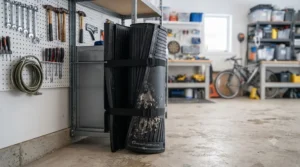
Getting a new mat home is only step one. Unroll it in the garage at least 48 hours before you actually need it, ideally somewhere with mild heat, since cold vinyl and canvas resist flattening and will fight you if you try to force them down immediately. Position it with the rough or antiskid side facing up — a surprisingly common first-time mistake, since a few brands ship with the smoother finished side visible on top of the roll.
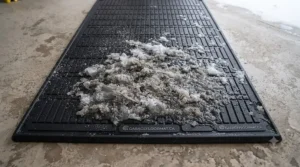
Once it’s down, drive in slowly the first time and check that the front and rear clearance matches what the manufacturer recommended, generally at least a foot of margin beyond your bumper and tailgate. For the raised-edge containment mats, resist the urge to shove heavy shelving right up against the lip; give it breathing room so meltwater has somewhere to actually pool. A monthly maintenance habit works well for most households: shop-vac loose grit weekly, then do a full soap-and-hose rinse once a month through the worst of the season, followed by a squeegee pass to speed drying. Common first-30-day mistakes include letting salt-crusted puddles sit for days (it accelerates the white bloom staining underneath if any seeps past the edge) and forgetting to check for wind-lifted corners near an open garage door, which is exactly the failure point several reviewers flagged on the lighter fabric mats above.
Real-World Scenario: Matching the Mat to Your Household
Picture a downtown condo owner with a single underground parking stall and a compact hatchback — for that household, something like the Drymate Max Absorbent Garage Mat or a modestly sized WeatherTech BootTray by the door covers the actual footprint of the problem without wasting money on a system built for a truck.
Now picture a family in rural Alberta running a three-row SUV down a gravel road every day through a brutal Prairie winter. That’s the TruContain HD Containment Mat scenario almost exactly — the heavier fabric and taller semi-rigid edge exist specifically for gravel grit and sustained sub-zero temperatures, and a lighter mat would likely show puncture wear within a season.
Finally, consider a suburban household with two vehicles and a finished, epoxy-coated garage floor they’re protective of. Here, the modular Park Smart Clean Park or the rigid WeatherTech GarageMat make sense, since both are engineered to avoid the kind of moisture bleed-through that can stain or lift a coated floor over a full winter season.
How to Choose a Slush Mat for Your Garage
- Measure your vehicle first, not the garage. Add roughly one to two feet of margin on every side, per the sizing logic most manufacturers, including TruContain and Winkler Canvas, publish directly.
- Match fabric weight to your road conditions. Paved city streets are gentler on a mat than gravel or heavily sanded rural roads, which chew through lighter fabrics faster.
- Check the temperature rating, not just the “winter-ready” label. A mat rated to -40°C, like GorillaCONTAIN, behaves very differently in January than one only tested to more modest cold.
- Decide between absorbent and containment styles. Absorbent fabric mats like the Drymate Max soak liquid in; raised-edge vinyl mats channel and pool it — pick based on whether you’d rather squeegee a puddle or wring out a mat.
- Factor in assembly tolerance. Snap-edge systems like Park Smart trade a longer setup for modular repairability; one-piece roll-out mats trade that flexibility for speed.
- Don’t ignore the entryway. A boot tray solves a genuinely different problem than a vehicle mat, and skipping it is one of the most common gaps in an otherwise well-planned garage setup.
- Confirm tire compatibility. Nearly every mat on this list explicitly warns against studded tires, so check your own tire setup before ordering.
Common Mistakes When Buying a Garage Slush Mat
The single most common mistake is buying to fit the vehicle’s exact footprint rather than adding margin — most owners end up stepping directly into accumulated slush at the edges within the first storm. A close second is ignoring temperature ratings entirely and assuming any “winter” mat performs the same at -30°C as it does at -5°C, which the material science genuinely doesn’t support. Buyers also frequently underestimate how much a boot-tray gap near the entry door undermines an otherwise solid vehicle mat purchase, since foot traffic tracks moisture past the car entirely. Finally, plenty of shoppers skip reading the studded-tire warnings that show up across nearly every product in this category, only to discover punctures partway through the season.
Slush Mats vs. Bare Concrete: What Changes
The written comparison here matters more than a spec table can capture. Bare concrete is porous, and road salt brine seeps into that porosity, undergoing repeated freeze-thaw expansion that leads to the flaking and pitting known as spalling. A quality containment mat interrupts that cycle entirely by keeping the brine off the slab surface in the first place, which is a meaningfully different (and cheaper) intervention than resurfacing or resealing concrete after the damage is already visible. The trade-off is upkeep: a mat needs periodic rinsing and drying, whereas bare concrete needs nothing until the damage shows up — at which point the fix is considerably more expensive than any mat on this list.
Long-Term Cost & Maintenance: Is a Garage Mat Worth It?
Run the numbers honestly and the math favours the mat almost every time. A mid-range mat in the C$150-C$270 bracket, used for five or six winters before it needs replacing, works out to roughly C$25-C$50 per season of protection. Compare that to concrete resurfacing after salt damage sets in, which industry sources peg at several dollars per square foot for professional repair — a single-car garage floor repair can run into the thousands. Add the labour of scraping and re-sealing a damaged slab, and a C$200 mat that gets rinsed monthly through winter starts to look less like a purchase and more like a maintenance line item that pays for itself several times over.
Safety and Regulations: What Canadian Homeowners Should Know
None of these mats are regulated products in the way, say, child car seats are, but a few practical safety notes matter. Every manufacturer in this roundup explicitly warns against studded tires, since the metal studs can puncture vinyl and fabric alike, leaking contained liquid back onto the floor and creating exactly the slip hazard the mat was meant to prevent. Speaking of slip hazards, the antiskid or textured top surface featured on most of these mats isn’t cosmetic — the Canadian Centre for Occupational Health and Safety notes that winter slip-and-fall injuries spike specifically around entryways and transition zones where wet footwear meets a hard surface, which is precisely the zone a boot tray or antiskid mat is designed to neutralize. If your municipality has bylaws around wastewater disposal, note that some containment mats can hold several dozen gallons of meltwater, road salt, and grime, which should be disposed of thoughtfully rather than dumped directly into a storm drain.
✨ Don’t Miss These Exclusive Deals!
🔍 Take your garage protection to the next level with these carefully selected mats. Click on any highlighted product to check current pricing and availability. A properly sized mat is one of the easiest wins for keeping your Canadian garage clean and salt-stain-free this winter!
Slush Mats for Different Canadian Households
A young couple in a Toronto suburb with a single compact SUV in an attached garage has fairly modest needs — moderate salt exposure, mostly paved roads, and limited storage space to work around. A retired couple in rural Saskatchewan running a full-size truck down a gravel driveway daily faces a completely different load: heavier fabric wear, more grit, and colder sustained temperatures that test edge flexibility. And a growing family in Montreal juggling two vehicles and a mudroom’s worth of kids’ snow boots needs to think about the entryway as much as the parking spot itself. Matching the product to the actual household pattern, not just the price tag, is what separates a mat that lasts one season from one that lasts five.
What to Expect: Real-World Performance Through a Full Winter
On paper, every mat in this category claims to keep your floor “clean and dry.” In practice, expect a gradual accumulation of white salt residue on the mat’s surface by mid-January even with regular rinsing — that’s normal and easily managed with a warm water and mild dish soap wipe-down, never bleach, which several manufacturers explicitly warn can degrade the coating. Expect some crease lines for the first week or two after unboxing a roll-out mat; they flatten with time and ambient warmth, not with force. And expect that no mat, however well-rated, replaces basic vigilance: wiping up an unusually large puddle sooner rather than later still matters, since standing liquid near cold concrete edges can occasionally seep past even a well-designed containment lip during a fast, heavy thaw.
Frequently Asked Questions
❓ What size garage mat do I need for an SUV?
❓ Can I use a garage mat with studded winter tires?
❓ Do garage slush mats actually stop concrete staining?
❓ How often should I clean a garage floor mat in winter?
❓ Are absorbent mats or raised-edge containment mats better for a garage?
Conclusion
Winter in Canada isn’t optional, and neither is the mess it drags into your garage. What changes is how much of that mess ends up permanently etched into your concrete versus contained on a mat you can rinse off come April. Whether you land on the budget-friendly Drymate Max Absorbent Garage Mat, the Canadian-made Winkler Canvas Floor Guard, or the heavy-duty TruContain HD Containment Mat built for full-size trucks and SUVs, the right choice comes down to matching fabric weight, temperature rating, and containment style to your actual driveway and driving conditions — not just grabbing whatever’s cheapest or most heavily advertised. Pair your vehicle mat with a dedicated boot tray like the WeatherTech BootTray, and you’ve covered both major entry points where winter tries to sneak into your home. Do the small maintenance — a weekly vacuum, a monthly rinse — and any mat on this list should carry you comfortably through several Canadian winters.
Recommended for You
- Garage Mats for Snow Melt: 7 Proven Picks for Canadian Winters (2026)
- Garage Floor Sealer Salt Resistant Canada: 7 Tough Picks (2026)
- Salt Resistant Garage Floor Coating: 7 Top Picks for 2026
Disclaimer: This article contains affiliate links. As an Amazon Associate, I earn from qualifying purchases. If you purchase products through these links, we may earn a small commission at no additional cost to you.
✨ Found this helpful? Share it with your friends! 💬🤗
