
In This Article
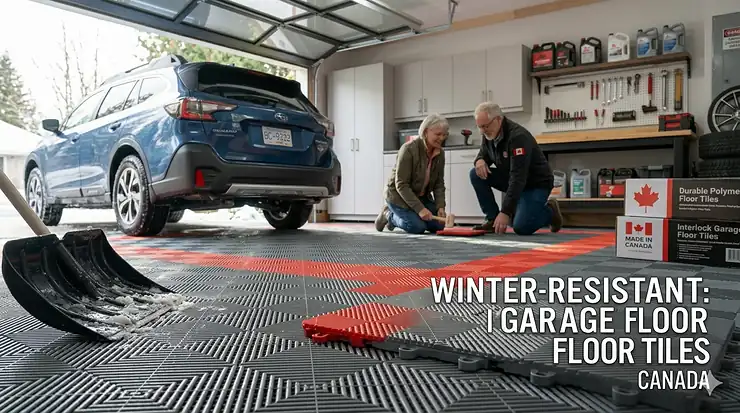
If you’ve ever walked into your garage on a February morning — heels of your boots crunching on old rock salt, concrete stained with antifreeze and motor oil — you already know the problem. Bare concrete was never designed to look good or keep you safe. It’s porous, cold, brutally unforgiving on your back when you’re lying underneath a car, and practically impossible to keep clean through a Canadian winter. That’s where interlocking garage floor tiles Canada solutions come in, and they’ve changed the game completely.
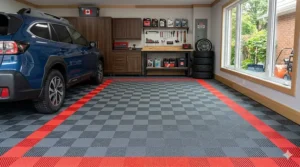
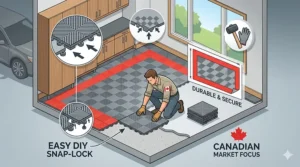
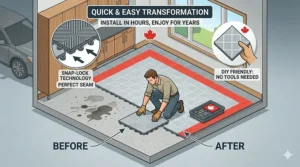
What exactly are they? Interlocking garage floor tiles are modular, snap-together panels — typically made from polypropylene, PVC, or rubber — that lock edge-to-edge to create a seamless, protective floor covering. No glue, no grout, no contractor required. Most Canadian homeowners can tile a two-car garage in an afternoon using nothing more than a utility knife and a rubber mallet.
The Canadian market has matured significantly in 2026. You’ll find everything from budget-friendly $1-per-square-foot drainage tiles to premium raised-base systems engineered to handle the freeze-thaw cycles that wreak havoc on unprotected concrete across Ontario, Alberta, and beyond. Whether you’re in a condo-sized single-car garage in Vancouver or a sprawling triple-car bay on an acreage outside Winnipeg, there’s a tile system designed for your space and your climate.
In this guide, I’ve researched and compared 7 real products available on Amazon.ca, priced in CAD, with honest commentary on how each one performs under real Canadian conditions. I’ll also walk you through installation tips, common buying mistakes, and a practical decision framework so you can stop second-guessing and start building the garage floor you actually want.
Quick Comparison: Top 7 Interlocking Garage Floor Tiles at a Glance
| Product | Material | Tile Size | Drainage | Price Range (CAD) | Best For |
|---|---|---|---|---|---|
| GarageTrac Diamond G900 | Polypropylene | 30 × 30 cm (12″×12″) | Raised base | $$ (mid-range) | Weekend DIYers, all climates |
| RaceDeck Diamond Plate | Polypropylene | 30 × 30 cm (12″×12″) | Solid/vented | $$$ (premium) | Enthusiasts, showroom look |
| Swisstrax Ribtrax | Polypropylene | 40 × 40 cm (15.75″×15.75″) | Excellent vented | $$$$ (ultra-premium) | Wet garages, car shows |
| Norsk Duräflex Pro PVC | PVC Co-Polymer | 46 × 46 cm (18.3″×18.3″) | Air-Dry design | $$ (mid-range) | Budget-minded, uneven floors |
| VEVOR Drainage Interlocking | Soft PVC | 30 × 30 cm (12″×12″) | Full drainage holes | $ (budget) | Wash bays, damp garages |
| TrueLock HD Diamond | Polypropylene | 30 × 30 cm (12″×12″) | Raised base | $$ (mid-range) | Value buyers, 6-lock grip |
| Speedway Interlocking Tile | Polypropylene | 30 × 30 cm (12″×12″) | Raised base | $$ (mid-range) | Versatile DIY install |
Table Analysis: What jumps out here is the clear split between the polypropylene rigids (GarageTrac, RaceDeck, Swisstrax, TrueLock, Speedway) and the flexible PVC options (Norsk, VEVOR). For most Canadian garages dealing with temperature swings of -30°C in January to +35°C in July, high-quality polypropylene handles thermal expansion and contraction far better than standard PVC — so it earns the top recommendations for year-round use. The Swisstrax is the clear drainage champion, while the VEVOR and Norsk earn their place for buyers on tighter budgets or dealing with chronically damp concrete.
💬 Just one click — help others make better buying decisions too!😊
✨ Don’t Miss These Exclusive Deals!
🔍 Take your garage to the next level with these carefully selected products. Click on any highlighted item to check current pricing and availability on Amazon.ca. These tiles will help you transform your garage into a space your whole family will actually enjoy!
Top 7 Interlocking Garage Floor Tiles Canada: Expert Analysis
1. GarageTrac Diamond G900 Interlocking Modular Floor Tile
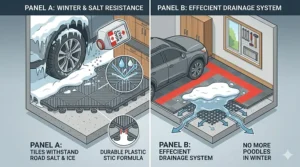
The GarageTrac Diamond G900 is the tile that most Canadian first-timers land on, and honestly, it deserves that popularity. It features a classic diamond-plate surface pattern in a 30 × 30 cm (12″×12″) format, manufactured from high-impact copolymer polypropylene — the same durable thermoplastic used in everything from automotive parts to storage containers. The raised-base design lifts the tile roughly 12 mm off the concrete, creating an air gap that promotes drainage and discourages moisture retention under the floor. That matters enormously in Canada, where melting snow off your tires can pool on a flat surface and freeze overnight.
The G900 carries a rolling weight rating of over 36,000 kg (80,000 lbs), which means your full-size pickup or SUV isn’t going to stress this floor in the slightest. Ten colour options let you design something that actually looks intentional — graphite and jet black are consistently popular for that clean, modern garage aesthetic.
In my view, this is the ideal tile for the Canadian homeowner who wants a serious upgrade without the learning curve of premium systems. It’s not the thinnest tile on the market, and the four-peg-per-side locking system is slightly less secure than a six-lock system in heavy-traffic areas — but for a typical residential garage, you’ll never notice the difference.
Canadian reviewers on Amazon.ca regularly note that the tiles stayed locked and level through full winter cycles without warping or separating, which is the real test in this climate.
✅ Proven durability in Canadian freeze-thaw cycles
✅ 10 colour options, compatible with RaceDeck edges
✅ No tools required — snap together in minutes
❌ 4-lock system less secure than 6-lock competitors
❌ Solid surface traps liquid underneath if drainage gap is compromised
Price range: Mid-range in CAD — check current pricing on Amazon.ca. Solid value for the quality.
2. RaceDeck Diamond Plate Interlocking Garage Floor Tile
RaceDeck is the name that gets thrown around at Barrett-Jackson auctions and in automotive TV shows for a reason. This is premium polypropylene tile — 30 × 30 cm (12″×12″) by 12.7 mm (½”) thick — manufactured in the USA by SnapLock Industries, with a 20-year limited warranty and a rolling weight rating of 36,000 kg (80,000 lbs). The tile’s surface features a refined diamond plate pattern with a satin finish that genuinely looks like a showroom floor rather than a DIY project.
What separates RaceDeck from the budget crowd isn’t just cosmetics. The polypropylene compound is formulated to resist UV degradation, petroleum products, antifreeze, and road-salt residue — the last point being critically important for Canadian garages where road salt from snowy driveways gets tracked in constantly from October through April. Interchangeable with RaceDeck’s FreeFlow vented tile, you can mix drainage and solid tiles in the same layout — solid under the car, vented near the door where meltwater pools.
This is the tile for the Canadian who treats the garage as a second living room — a dedicated workspace where appearance and performance both matter. The price is higher than most competitors, but the 20-year warranty makes the total cost of ownership argument surprisingly competitive.
Prime-eligible on Amazon.ca, though Canadian pricing typically runs 10–15% higher than the US equivalent due to exchange rates — completely worth it to avoid cross-border customs headaches and warranty complications.
✅ Premium satin finish, showroom-quality look
✅ 20-year warranty — best in class
✅ Interchangeable with FreeFlow drainage tile
❌ Premium price point — higher CAD investment upfront
❌ 4-lock system (versus 6-lock on some competitors)
Price range: Premium-tier in CAD — check current pricing on Amazon.ca. Worth every dollar for the long haul.
3. Swisstrax Ribtrax Modular Garage Floor Tile
If your garage floor sees serious moisture — meltwater from vehicles, wash-bay runoff, or spring flooding from the garage entrance — the Swisstrax Ribtrax is the tile you want. It’s an open-grid, self-draining design: liquid passes straight through the surface and drains away from the concrete underneath, rather than pooling between tile and floor. This is a fundamentally different approach from raised-base solid tiles, and for wet-climate applications, it wins every time.
Each Ribtrax tile measures approximately 40 × 40 cm (15.75″×15.75″) by 19 mm (¾”) thick, with six locks per side — that’s 50% more connection points than a standard four-lock tile, which means the floor stays locked even under heavy rolling loads or during aggressive prying with a floor jack. Available in 18 colours, with a premium-tier 60,000 lbs rolling weight rating and a lifetime limited warranty on the premium version.
The slatted surface also dramatically reduces noise — a complaint you’ll hear constantly about solid polypropylene tiles. Park a car on them, open the door, and the hollow click you’d get from cheaper tiles simply isn’t there.
This is the tile I’d recommend to someone in coastal BC or the Great Lakes region where humidity and moisture are persistent challenges year-round. It’s also the top pick for the Canadian automotive enthusiast who wants their garage to look as good as the cars inside it.
✅ Superior drainage — liquid passes through, not around
✅ Quieter than solid polypropylene tiles
✅ 6-lock system for maximum stability
❌ Highest price point — significant CAD investment
❌ Open grid means small dropped items (fasteners, washers) fall through
Price range: Ultra-premium in CAD — check current pricing on Amazon.ca. Unmatched for wet-garage applications.
4. Norsk Duräflex Pro PVC Interlocking Floor Tile
The Norsk Duräflex Pro is a different animal from the polypropylene tiles above. Made from a flexible PVC co-polymer blend, each tile measures 46 × 46 cm (18.3″×18.3″) by 6.5 mm (¼”) thick — bigger tiles means fewer seams, faster installation. The standout engineering feature is Norsk’s patented Air-Dry design: micro-channels underneath the tile allow moisture to evaporate rather than pool under the floor, which is a significant advantage over PVC tiles that simply sit flat on concrete.
Where this tile earns its spot is in garages with slightly uneven concrete — and if you’ve ever looked at a 20-year-old residential concrete slab, you know perfectly well that “uneven” is the norm, not the exception. Because PVC is naturally flexible, the Duräflex Pro conforms to minor surface variations that would cause a rigid polypropylene tile to rock or click underfoot.
The trade-off is temperature performance. PVC becomes brittle at extreme cold and soft at high heat. In a garage that dips to -20°C or colder during a Canadian winter, this tile can crack if it takes a heavy impact while frozen. For unheated garages in Manitoba, Saskatchewan, or Northern Ontario, I’d recommend the polypropylene options above. For a heated attached garage in the GTA or lower mainland BC, the Norsk Duräflex Pro is a genuinely excellent mid-range choice.
Ships to Canada on Amazon.ca; free shipping for Prime members.
✅ Flexible — tolerates uneven concrete better than rigid tiles
✅ Patented Air-Dry moisture management
✅ Larger tile size = faster installation
❌ Not recommended for unheated garages in extreme Canadian cold
❌ Thinner than polypropylene competitors at 6.5 mm
Price range: Mid-range in CAD per box — check current pricing on Amazon.ca. Best value for heated garages with imperfect floors.
5. VEVOR Interlocking Drainage Floor Tiles
VEVOR has become the brand Canadians reach for when they need functional flooring fast and on a tight budget. These 30 × 30 cm (12″×12″) soft PVC tiles are perforated with drainage holes throughout the surface, making them ideal for any area of the garage where water accumulates: near the entrance, under a wash bay setup, or over a floor drain. The snap-together interlocking system requires no tools and no adhesive — you can cover a 4.5 sq m (50 sq ft) area in under 30 minutes.
What most buyers overlook about these tiles is their load-bearing limit. At around 2,500 kg (5,500 lbs) per tile depending on the model, they’re fine for foot traffic, tool trolleys, and motorcycles — but parking a full-size truck or SUV on them repeatedly will compress and crack the soft PVC over time. Use them strategically: install them in the workshop area, along the walls, or near entryways, not under your vehicle’s tyres.
For Canadian buyers, the key advantage is price. You can cover a significant surface area in the budget-friendly range, which makes VEVOR drainage tiles a practical choice for a first-time garage makeover where you’re not sure how committed you are to the project yet.
✅ Excellent drainage through perforated surface
✅ Budget-friendly in CAD — great for large areas
✅ Easy to replace individual tiles if damaged
❌ Not rated for heavy vehicle parking loads
❌ Soft PVC can crack in unheated garages at extreme cold
Price range: Budget-tier in CAD — check current pricing on Amazon.ca. Best bang-for-your-buck for drainage-focused zones.
6. TrueLock HD Diamond Interlocking Polypropylene Tile
TrueLock HD Diamond is the tile that quietly outperforms its price tag. Manufactured from high-impact polypropylene in a 30 × 30 cm (12″×12″) format, the HD Diamond version features six interlocking points per side — the same lock count as the Swisstrax Ribtrax — which gives it substantially better lateral stability than four-lock competitors at a fraction of the premium tile cost. This six-lock system is the spec that most buyers gloss over, but it’s the reason the floor stays solid when you drag a heavy tool chest across it rather than having tiles peel up at the edges.
The diamond plate surface is genuinely attractive: TrueLock’s finish has a polished quality that elevates it visually above the flat matte look of budget polypropylene tiles. The raised-base structure provides that critical air gap for drainage and moisture management — essential in Canadian garages during spring thaw when concrete can weep moisture up from below.
Available in multiple colours on Amazon.ca, with a rolling weight rating that handles standard passenger vehicles and light trucks comfortably. This is the tile I’d put in my own garage if I was balancing quality against budget — it’s the sweet spot between the basic GarageTrac and the premium RaceDeck without compromising the features that actually matter in Canadian conditions.
✅ Six-lock system — superior lateral stability
✅ Polished diamond finish — premium look at mid-range price
✅ Raised-base design manages moisture in spring thaw
❌ Not interchangeable with all competitor systems
❌ Colour selection smaller than RaceDeck/Swisstrax
Price range: Mid-range in CAD — check current pricing on Amazon.ca. Outstanding value for a 6-lock polypropylene tile.
7. Speedway Interlocking Polypropylene Garage Tile
Speedway rounds out the list as one of the most versatile and well-rounded mid-tier tiles available to Canadian buyers. Made from high-impact polypropylene in the standard 30 × 30 cm (12″×12″) format, Speedway tiles feature more connector points per side than basic four-lock competitors, a coin-pattern surface option that provides exceptional rolling performance for tool carts and floor jacks, and compatible edge ramps and corner pieces in multiple colours — a detail that sounds minor until you’re trying to source matching trim and discovering half the market doesn’t stock it.
The raised base design channels moisture away from the concrete, and the coin surface is one of the smoothest rolling textures available in polypropylene tile — particularly relevant if you’re constantly moving wheeled equipment around a workshop. Canadian buyers on Amazon.ca note that the tiles ship well-packaged and arrive without the corner damage that plagues some budget alternatives.
At a competitive CAD price point with readily available edge and corner accessories, Speedway is an excellent choice for the practical Canadian buyer who wants a complete, finished floor — edges, ramps, and all — without hunting down compatible trim from a different manufacturer.
✅ Compatible edge ramps easily available
✅ Coin surface — smooth rolling for carts and jacks
✅ More connectors per side than basic 4-lock tiles
❌ Not as visually premium as RaceDeck or TrueLock HD
❌ Fewer colour options compared to Swisstrax
Price range: Mid-range in CAD — check current pricing on Amazon.ca. Ideal for a complete, edge-to-edge garage floor solution.
How to Install Interlocking Garage Floor Tiles in Canada: A Practical Guide
This is where Amazon product listings fail you completely — they’ll tell you the tile snaps together, but they won’t tell you what happens when you’re installing at -5°C in an unheated garage in March. So here’s the real-world Canadian installation guide.
Step 1: Prepare the concrete. Sweep thoroughly and patch any cracks wider than 6 mm with a concrete filler product. Road salt and grit trapped under tiles accelerates concrete corrosion over time. If you suspect moisture migrating up from below — common in older Canadian slab-on-grade construction — apply a concrete sealer before tiling. The National Research Council of Canada recommends addressing moisture migration at the source before any floor covering installation.
Step 2: Acclimatize the tiles first. This is the step most Canadians skip and regret. Polypropylene tiles expand and contract with temperature changes. If you’ve ordered tiles that were stored in a cold warehouse and install them immediately in a cold garage, they’ll expand as the garage warms up — and the joints will buckle. Bring the tiles inside your heated home for 24 hours before installation if ambient temperature is below 10°C.
Step 3: Plan your layout before you snap a single tile. Start from the centre of the garage and work outward, or from a visible wall inward — never from a corner. Measure the space and do a dry run before committing. Most Canadian two-car garages run roughly 5.5 × 6 m (18″×20″) — plan for perimeter cuts using a circular saw or jigsaw with a fine-tooth blade.
Step 4: Snap and walk. Lay tiles in a running bond or brick pattern for maximum lateral stability. Press or tap seams with a rubber mallet. Work in rows rather than quadrants — it’s faster and keeps joints aligned.
Step 5: Fit edge ramps. These are non-negotiable. Without edge ramps, the floor’s perimeter edge becomes a trip hazard and tiles peel up at the edges when driven over. Install ramps along all vehicle entry points.
Seasonal maintenance tip: After winter, pull up and rinse a section near the entrance where road-salt accumulation is heaviest. Salt crystals that penetrate the raised-base gap can accelerate concrete pitting. A garden hose and 15 minutes twice a year keeps the sub-floor in excellent condition.
Real Canadian Garages: Which Tile Fits Your Situation?
Here’s something Amazon’s product pages will never give you: a clear match between specific Canadian life situations and the right tile. Let me break it down.
Profile 1 — The GTA Homeowner with an Attached Garage Mark lives in Mississauga in a detached home with a heated two-car attached garage. His floor is in reasonable condition but stained with years of oil and road salt. His budget is flexible, but he wants something that looks sharp when the neighbours come over. Best pick: RaceDeck Diamond Plate. The showroom finish justifies the premium CAD investment, the 20-year warranty gives him peace of mind, and a heated attached garage means he’ll never deal with extreme-cold brittleness.
Profile 2 — The Alberta DIYer with an Unheated Detached Shop Sandra in Red Deer has a three-car detached shop that sees -35°C winters. She’s doing most mechanical work out there and needs a floor that handles oil, coolant, dropped tools, and brutal cold. Best pick: GarageTrac Diamond G900 or TrueLock HD Diamond. High-impact polypropylene rated well below freezing, raised-base drainage for the inevitable oil drips, and a mid-range CAD investment that doesn’t sting if a tile gets cracked by a dropped axle.
Profile 3 — The BC Coast Homeowner with Chronic Dampness James in Coquitlam has a garage where the concrete floor weeps moisture from October through April. Every floor covering he’s tried grows mould underneath. Best pick: Swisstrax Ribtrax. The open-grid design means moisture passes through rather than pooling, eliminating the damp-trap problem entirely. The lifetime warranty on the premium version is a bonus.
Profile 4 — The Condo Owner with a Small Single Parking Space Priya in Calgary has a 3 × 6 m (10″×20″) indoor underground parking stall with a concrete floor she’s allowed to tile per strata rules. She wants drainage and a quick, clean install. Best pick: VEVOR Drainage Tiles or Norsk Duräflex Pro. The underground parkade stays temperature-regulated, so PVC brittleness isn’t a concern, and the budget price point keeps the project proportionate to the space.
How to Choose Interlocking Garage Floor Tiles in Canada: 6 Expert Criteria
1. Material first, aesthetics second. Polypropylene for unheated or cold-climate garages. Flexible PVC only for heated spaces. Rubber tiles for anti-fatigue workshop areas where vehicles won’t park directly.
2. Lock count matters. Four locks per side is fine for light residential use. Six locks per side if you’re moving heavy equipment frequently or sharing the garage with multiple vehicles. Check the spec — some budget tiles advertise “interlocking” with only two pegs per side.
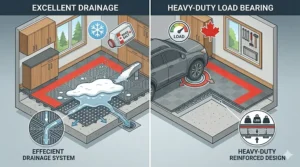
3. Drainage design matches your reality. If your floor is dry year-round, a raised-base solid tile is fine. If you see moisture seasonally — which describes most Canadian garages — a vented or perforated tile prevents mould and extends concrete life.
4. Temperature rating, not just “weather-resistant.” Look for products explicitly rated to at least -30°C for unheated Canadian garages. Some products on Amazon.ca carry vague cold-resistance claims without specific temperature ratings — avoid them. Products like the SnapGRID SS, marketed specifically to the Canadian market, cite -40°C to +70°C operating ranges — that’s the standard to aim for.
5. Vehicle weight rating vs. rolling vs. static load. Most tiles quote rolling weight limits, which is the force of a moving vehicle’s tyres. Static load — the weight of a parked car — is typically lower and relevant for long-term parking. Confirm the spec matches your intended use.
6. Edge trim availability. A tile without available matching edges looks unfinished and creates a tripping hazard. Confirm before you buy that edge ramps, corner pieces, and straight edges are in stock at a compatible CAD price.
Common Mistakes Canadian Buyers Make When Buying Garage Floor Tiles
Mistake 1: Skipping concrete prep because “the tiles will cover it.” They will cover it — and trap moisture underneath it, which accelerates concrete deterioration. Patch cracks and seal moisture-prone areas first. This applies especially to Canadian slab-on-grade construction where hydrostatic pressure from spring snowmelt is a genuine concern.
Mistake 2: Buying PVC tiles for an unheated garage. I see this constantly in Canadian DIY forums. The buyer orders a budget PVC tile, installs it in September when the garage is still warm, and by January the tiles are cracking at the seams because PVC becomes brittle below approximately -10°C. Polypropylene handles Canadian winters. PVC generally does not — unless it’s a premium co-polymer formulation in a heated space.
Mistake 3: Not accounting for thermal expansion. Polypropylene expands in heat and contracts in cold. In a Canadian garage swinging between -30°C in January and +40°C in July, a 5 × 6 m tile floor can expand or contract by several centimetres. Always leave a small gap at walls, and don’t force tiles tight against immovable obstacles. Most manufacturers recommend a 6–12 mm expansion gap.
Mistake 4: Ignoring edge ramps in the budget. Edge ramps on Amazon.ca add to the overall project cost, but they’re not optional — they prevent tile peeling at the entrance and eliminate a genuine tripping hazard. Factor them into your CAD budget from the start.
Mistake 5: Assuming Amazon.com pricing applies to Amazon.ca. It doesn’t. Canadian prices are consistently higher due to import duties, exchange rates, and smaller market volumes. Use Amazon.ca pricing as your baseline, and if the per-tile cost seems unexpectedly low, double-check the shipping origin — some sellers ship from US warehouses with significant cross-border duties that appear only at checkout.
Polypropylene vs. PVC vs. Rubber: Which Wins in Canadian Conditions?
| Feature | Polypropylene | PVC | Rubber |
|---|---|---|---|
| Cold-weather performance | Excellent (to -40°C+) | Fair (heated spaces only) | Good (to -20°C typically) |
| Chemical resistance | Excellent | Good | Good |
| Load capacity | Very high | Moderate | Moderate |
| Flexibility on uneven floor | Poor–Fair | Good | Good |
| Drainage options | Good (vented designs) | Fair (Air-Dry designs) | Poor (solid surface) |
| Price range (CAD) | $$ to $$$$ | $ to $$ | $$ to $$$ |
| Recommended for | All Canadian climates | Heated garages only | Workshop fatigue areas |
Table Analysis: This comparison makes the decision straightforward for most Canadians. Polypropylene’s cold-weather performance advantage is decisive for any garage without reliable heating through a Canadian winter. PVC earns its place for heated urban garages where its flexibility and lower cost make sense. Rubber tiles occupy a niche role — they’re excellent underfoot for long workshop sessions but don’t serve as primary garage floor tiles in the same way.
Long-Term Cost & Maintenance: Is It Worth It in Canada?
Let’s run the numbers honestly. A mid-tier polypropylene tile floor for a standard two-car garage of roughly 33 sq m (355 sq ft) will cost somewhere in the $500–$1,200 CAD range depending on the brand and coverage per box. That sounds like a significant investment against bare concrete — and it is. But compare it to alternatives:
Epoxy floor coating: A professional epoxy job in Canada runs $2,000–$4,500 CAD installed, according to Canadian contractor quotes. Once it chips or peels — which happens faster in climates with road salt and freeze-thaw cycling — you’re grinding it off and starting over. There’s no repair; it’s a full redo.
Interlocking tiles: A cracked or stained tile is replaced individually in minutes, at the cost of one tile. The floor is serviceable for 15–20 years with basic maintenance. When you move, you take the floor with you — something you absolutely cannot do with epoxy.
Maintenance in Canada: Sweep weekly during winter months when salt and grit accumulate. Rinse the raised-base area near the entrance twice per year with a garden hose. Wipe oil spills immediately — polypropylene resists oil staining but doesn’t benefit from prolonged exposure. In spring, lift a few tiles near the drain and inspect the concrete underneath for moisture-related issues.
Canada’s Competition Bureau guidelines require that any cost savings or value claims in advertising be substantiated and clear — this analysis is based on publicly available contractor pricing data, not manufacturer marketing. You can verify Canadian flooring contractor rates through resources like the Government of Canada’s consumer information portal at canada.ca.
✨ Don’t Miss These Exclusive Deals!
🔍 Compare prices and availability on all 7 tile systems reviewed above. Click any highlighted product to check current pricing on Amazon.ca. Canadian Prime members enjoy free shipping on most eligible tile orders — check your membership benefits before buying!
FAQ: Interlocking Garage Floor Tiles Canada
❓ Are interlocking garage floor tiles available with free shipping on Amazon.ca?
❓ Do polypropylene interlocking tiles crack in a Canadian winter?
❓ How many interlocking garage floor tiles do I need for a standard Canadian two-car garage?
❓ Can I install snap-together floor tiles over cracked concrete?
❓ Are DIY interlocking garage tiles removable if I rent or move?
Conclusion: The Right Tile Makes a Real Difference in Canadian Garages
After walking through seven real products and the Canadian-specific factors that matter — freeze-thaw cycles, road salt, spring meltwater, unheated garages, and metric-sized spaces — the takeaway is clear: interlocking garage floor tiles Canada options have never been better, and the right choice depends almost entirely on your garage’s climate and how you use the space.
For most Canadians, the GarageTrac Diamond G900 or TrueLock HD Diamond represent the ideal balance of durability, aesthetics, and value in the mid-range CAD price tier. If moisture is a chronic problem, the Swisstrax Ribtrax’s drainage performance justifies the premium investment. Budget-conscious buyers covering a large area quickly will find the VEVOR drainage tiles genuinely adequate for non-vehicle zones.
Whatever you choose, install it correctly — prep the concrete, acclimatize the tiles, leave the expansion gap, and fit those edge ramps. Done right, a polypropylene interlocking floor in a Canadian garage should last you 15 to 20 years with minimal effort. That’s a return on investment that bare concrete simply can’t compete with.
✨ Don’t Miss These Exclusive Deals!
🔍 Ready to build the garage floor you’ve always wanted? Click any highlighted product in this review to check current pricing and availability on Amazon.ca. Start with a single box to test the colour and fit — most tile systems are fully expandable later.
Recommended for You
- 7 Best Garage Floor Tiles for Minus 40 Winters in Canada (2026)
- 7 Best Garage Floor Tiles for Cold Climates in Canada (2026)
- 7 Best Battery Chargers for Canadian Winter 2026 (Tested Picks)
Disclaimer: This article contains affiliate links. As an Amazon Associate, I earn from qualifying purchases. If you purchase products through these links, we may earn a small commission at no additional cost to you.
✨ Found this helpful? Share it with your friends! 💬🤗
