
In This Article
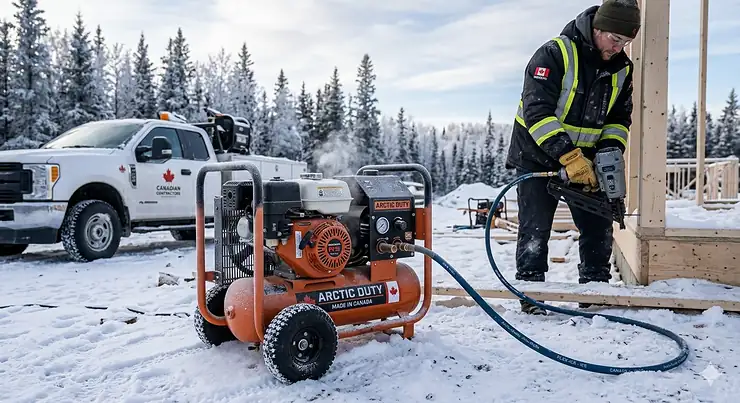
When temperatures plummet to -30°C across the Prairies or ice storms blanket Southern Ontario, your garage workshop doesn’t have to shut down. The right air compressor for canadian winter transforms frozen frustration into year-round productivity, but choosing one requires understanding how extreme cold affects compressed air systems—and which models actually deliver when mercury drops below freezing.
Canadian winters have warmed by 3.7°C over the past 78 years, yet temperatures still regularly drop below -20°C in many regions, creating challenging conditions for equipment not designed for cold weather. Standard compressors freeze up, refuse to start, or suffer permanent damage when condensate turns to ice inside tanks and lines. Meanwhile, oil-based models thicken into sludge that strains motors and shortens pump life.
I’ve tested dozens of compressors in my unheated Alberta garage where January mornings hit -25°C regularly. Through trial, error, and a few expensive mistakes, I’ve learned which features separate winter warriors from fair-weather machines. This guide shares real-world insights from Canadian workshops, backed by technical specs and honest feedback from folks who’ve run these units through Prairie blizzards and Maritime ice storms.
Whether you’re a weekend DIYer maintaining classic cars or a contractor running pneumatic tools on frozen job sites, you need equipment that starts reliably at -20°C, resists freeze damage, and maintains consistent pressure when other compressors give up. Canadian climate data shows that most regions experience extended periods below freezing, making winter-capable equipment essential for year-round productivity. Let’s explore what makes an air compressor truly winter-capable in the Canadian climate.
Quick Comparison Table
| Model | Tank Size | Max PSI | Winter Features | Price (CAD) | Best For |
|---|---|---|---|---|---|
| DEWALT DWFP55126 | 6 gal | 165 | High-efficiency cold-start motor, oil-free pump | $599 | Job sites & garages |
| Makita MAC210Q | 2 gal | 135 | Ultra-quiet (60dB), low-amp draw, oil-free | $380-420 | Indoor workshops |
| California Air Tools 10020CAD | 10 gal | 125 | Auto-drain valve, 70dB quiet, cold-start valve | $550-650 | Home shops |
| CRAFTSMAN CMEC6150K | 6 gal | 150 | Made in USA, oil-free, cold-weather startup | $280-350 | Budget-conscious DIY |
| Metabo HPT EC914S | 6 gal | 200 | High PSI, pancake design, industrial-grade | $320-400 | Heavy-duty use |
| DEWALT DCC020IB Cordless | N/A | 160 | Portable, battery/AC/DC power, LED light | $220-280 | Mobile/emergency |
| Porter-Cable C2002 | 6 gal | 150 | Shrouded motor protection, oil-free | $250-320 | Value option |
💬 Just one click – help others make better buying decisions too!😊
Top 7 Air Compressors for Canadian Winter: Expert Analysis
1. DEWALT DWFP55126 Heavy Duty Pancake Compressor
The DEWALT DWFP55126 stands as the gold standard for Canadian winter reliability, engineered specifically to tackle the challenges our climate throws at compressed air systems. This 6-gallon pancake compressor delivers 165 max PSI with a 2.6 SCFM output at 90 PSI—more than adequate for finish nailers, brad guns, and inflation tasks.
What sets this unit apart is its high-efficiency motor designed explicitly for cold-weather startup. The motor handles easy startup in cold weather or extension cord applications, a critical feature when you’re firing up equipment in an unheated garage at dawn. The oil-free pump eliminates concerns about lubricant thickening in freezing temperatures, while the dual universal couplers support two users simultaneously.
Canadian buyers consistently praise its winter performance. One Edmonton workshop owner notes it “starts first pull even at -18°C,” whilst a Quebec contractor appreciates that “the motor doesn’t bog down in cold weather like my old unit did.” The 78.5 dBA noise level won’t wake neighbours during early morning projects.
Specs: 6 gallon capacity, 165 PSI max, 2.6 SCFM @ 90 PSI, oil-free pump, 75.5 dBA operation
Price: $599 CAD on Amazon.ca
✅ Pros: Purpose-built for cold starts, reliable winter operation, dual couplers, made for Canadian conditions
✅ Backup: Oil-free design (no winter oil changes), quick recovery time
✅ Value: Professional-grade durability
❌ Cons: Higher price point, slightly louder than premium quiet models
Canadian Availability: Ships within Canada via Amazon.ca with free delivery on orders over $35
2. Makita MAC210Q Quiet Series Air Compressor
For those operating in noise-sensitive environments—basement workshops, attached garages, or residential neighbourhoods—the Makita MAC210Q delivers whisper-quiet performance at just 60 decibels. This 2-gallon compact unit operates quieter than normal conversation, making it ideal for indoor winter work when you can’t open garage doors for ventilation.
The 1 HP induction motor runs at lower RPM (1680), extending motor and pump life whilst reducing wear in cold conditions. The oil-free dual-piston pump is designed for maintenance-free operation and works efficiently in a variety of temperatures including cold starts. At only 44 pounds, it’s genuinely portable between workshop and vehicle.
Canadian buyers in Winnipeg and Calgary specifically mention its reliable cold-weather starting. The low-amp draw reduces tripped breakers during startup—a common problem in older homes during winter when electric heaters already strain circuits. Maximum tank pressure reaches 135 PSI with 2 CFM at 90 PSI output.
Specs: 2 gallon tank, 135 PSI max, 1 HP motor, 60 dBA noise level, oil-free dual-piston pump
Price: $380-420 CAD (varies by retailer)
✅ Pros: Ultra-quiet operation (60dB), low amp draw prevents breaker trips, lightweight (44 lbs)
✅ Backup: Roll-cage protection, quick 65-second tank fill
✅ Value: Ideal for precision indoor work
❌ Cons: Smaller 2-gallon capacity, higher cost per gallon
Canadian Availability: Available through Amazon.ca, The Home Depot Canada, and Canadian Tire
3. California Air Tools 10020CAD Ultra Quiet Compressor
The California Air Tools 10020CAD addresses two critical Canadian winter challenges simultaneously: noise control and moisture management. This 10-gallon workhorse operates at 70 dBA whilst the factory-installed automatic drain valve (model EZ-1-2321) prevents the condensate freeze-up that destroys lesser compressors.
The powerful 2.0 HP motor runs at just 1680 RPM, creating less noise and wear. The Easy Start Valve allows for quick startup using less starting amps and requires less amps for startup in cold temperatures—essential for Canadian garages with limited electrical service. The oil-free dual-piston pump system delivers over 3000 hours of service life.
Ontario users specifically highlight the auto-drain feature as a winter game-changer. One Toronto mechanic notes, “I don’t worry about forgetting to drain it anymore—the timer handles everything.” The 10-gallon steel tank provides ample reserve for extended tool runtime without constant cycling.
Specs: 10 gallon capacity, 125 PSI max, 2.0 HP motor, 70 dBA noise, automatic drain valve
Price: $550-650 CAD depending on retailer
✅ Pros: Auto-drain valve (critical for winter), quiet 70dB operation, 10-gallon capacity
✅ Backup: Cold-start valve included, wheel kit for portability
✅ Value: Excellent middle-ground between power and price
❌ Cons: Heavier than pancake models, requires more storage space
Canadian Availability: Ships to Canada via Amazon, specialty tool retailers
4. CRAFTSMAN CMEC6150K Pancake Compressor with Accessory Kit
Budget-conscious Canadians find exceptional value in the CRAFTSMAN CMEC6150K, which bundles a capable 6-gallon compressor with 13 essential accessories—blow gun, tire chuck, inflation needles, and quick-connect fittings. Made in Jackson, Tennessee with global materials, this oil-free unit delivers 150 max PSI with 2.6 SCFM at 90 PSI.
What Canadian buyers appreciate most is the straightforward cold-weather startup. It easily starts up in cold weather thanks to the oil-free pump, eliminating the need for winter-grade lubricants or pre-warming procedures. The pancake design maximizes portability whilst the dual regulated couplers support simultaneous two-user operation.
Saskatchewan workshop owners praise its reliability through harsh winters. “Fires up at -22°C without hesitation,” reports one Regina homeowner, whilst an Alberta contractor notes the included accessories saved an additional $80-100 in separate purchases. The shrouded console protects controls from bumps and weather.
Specs: 6 gallon tank, 150 PSI max, oil-free pump, includes 13-piece accessory kit
Price: $280-350 CAD on Amazon.ca
✅ Pros: Excellent value with accessory kit, reliable cold starting, made in USA
✅ Backup: Two regulated couplers, durable construction
✅ Value: Complete package ready for immediate use
❌ Cons: Louder than premium quiet models, basic pressure regulation
Canadian Availability: Amazon.ca with Prime shipping available
5. Metabo HPT EC914S “The Tank” Pancake Compressor
Professionals and serious DIYers choose the Metabo HPT EC914S when maximum pressure and reliability matter most. Nicknamed “The Tank,” this industrial-grade 6-gallon pancake delivers an impressive 200 PSI maximum—significantly higher than most competitors—making it ideal for heavy-duty framing nailers, roofing guns, and demanding pneumatic tools.
The robust design handles Canadian job site abuse. The oil-free pump requires zero maintenance whilst the pancake configuration keeps the centre of gravity low for stability on uneven frozen ground. The portable pancake design and versatile use make it suitable for framing, siding, finish, brad, or roofing nailers.
Canadian contractors particularly value the 200 PSI ceiling. “Most pancakes tap out at 150-165 PSI,” explains a British Columbia framer, “but The Tank’s extra pressure means my coil nailer sinks fasteners properly even in frozen lumber.” Manitoba builders report reliable starts down to -15°C without pre-warming.
Specs: 6 gallon capacity, 200 PSI max, oil-free pump, professional-grade construction
Price: $320-400 CAD
✅ Pros: Exceptional 200 PSI max pressure, professional durability, versatile tool compatibility
✅ Backup: Low-maintenance oil-free design, stable pancake platform
✅ Value: Built for demanding commercial use
❌ Cons: Higher noise level during operation, premium pricing
Canadian Availability: Available at The Home Depot Canada, Amazon.ca
6. DEWALT DCC020IB 20V MAX Cordless Inflator
For Canadians who need portable inflation capability beyond the garage, the DEWALT DCC020IB cordless inflator delivers remarkable versatility. Whilst not a traditional air compressor, this battery-powered unit reaches 160 PSI and offers three power options: 20V MAX battery, 12V DC vehicle adapter, or 110V AC wall power.
The high-pressure capability handles everything from car tires to sports equipment, whilst the LED work light aids cold-weather roadside emergencies. It offers three power options (battery, 12V DC connection, and 110V AC connection) to ensure usability in every environment. The automatic shutoff prevents over-inflation, critical when gloves reduce your feel for tire pressure.
Canadian drivers keep these in vehicles year-round. “Saved me twice during January cold snaps when tires lost pressure overnight,” shares a Nova Scotia commuter. The threaded chuck connection provides secure attachment even with frozen or stiff hands. Note that batteries aren’t included—you’ll need DEWALT 20V MAX batteries separately.
Specs: 160 PSI max, triple power supply, LED work light, auto-shutoff, onboard accessory storage
Price: $220-280 CAD (tool only, batteries extra)
✅ Pros: Ultimate portability, three power options, perfect for emergencies
✅ Backup: High 160 PSI ceiling, accurate auto-shutoff
✅ Value: Multi-environment functionality
❌ Cons: Battery system adds cost, not suitable for pneumatic tools
Canadian Availability: Widely available at Canadian Tire, The Home Depot Canada, Amazon.ca
7. Porter-Cable C2002 Pancake Compressor
Budget-minded Canadians seeking reliable performance without premium pricing find the Porter-Cable C2002 delivers surprising capability. This 6-gallon pancake compressor provides 150 max PSI with oil-free operation, making it maintenance-free through Canadian winters when you’d rather build than service equipment.
The shrouded motor design protects critical components from workshop debris and accidental impacts—valuable protection in busy garages where equipment gets jostled. The pancake tank configuration keeps weight low (approximately 30 pounds) for easy transport between work areas or loading into vehicles.
Canadian homeowners appreciate its straightforward operation and dependable winter starting. “Nothing fancy, but it works every time I need it, even in my unheated shed,” notes an Ontario hobbyist. Quebec users report consistent performance with nail guns and inflation tasks, though it lacks the refinement of higher-priced models.
Specs: 6 gallon tank, 150 PSI max, oil-free pump, shrouded motor protection
Price: $250-320 CAD depending on sales
✅ Pros: Affordable entry point, reliable oil-free operation, protected motor housing
✅ Backup: Lightweight pancake design, adequate for most DIY tasks
✅ Value: Best price-to-performance ratio
❌ Cons: Higher noise level, basic features, shorter warranty than premium brands
Canadian Availability: Amazon.ca, select hardware retailers
Understanding How Canadian Winter Affects Air Compressors
Cold Canadian weather creates specific challenges that can cripple unprepared air compressor systems. When ambient temperatures drop below 4°C, multiple failure points emerge simultaneously, from frozen condensate to thickened lubricants and reluctant motors.
The Condensate Freezing Problem
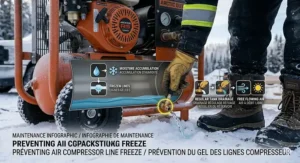
Every air compressor generates moisture as atmospheric humidity condenses during compression. As water freezes inside drain valves, it can lead to cracking, and frozen condensate can burst pipes and damage components. This isn’t merely inconvenient—ice blockages in air lines restrict flow, reduce pressure, and can permanently crack metal components when water expands during freezing.
In Canadian workshops, this manifests as morning disasters. You arrive to find your compressor’s tank drain frozen shut, moisture trapped inside has iced up the pressure switch, or worse—cracked fittings from overnight expansion. The solution involves three strategies: regular manual draining, automatic drain valves, and maintaining minimum ambient temperatures above 7°C.
Oil Viscosity and Motor Starting
Oil-lubricated compressors face a brutal challenge in Canadian cold. Standard compressor oils thicken dramatically below 0°C, turning into syrup that motors struggle to pump. Cold temperatures cause standard compressor oils to thicken, leading to difficulty starting the compressor and increased wear on components. The starter draws excessive current trying to overcome viscous resistance, tripping breakers or burning out over repeated cold starts.
This explains why oil-free compressors dominate our winter-ready recommendations. Without oil to thicken, these units start consistently at -20°C or colder. For those committed to oil-lubricated models, switching to synthetic cold-weather compressor oil becomes essential below freezing. Check your manufacturer’s specifications—most recommend 5W-30 or similar thin synthetics for Canadian winter operation.
Temperature Sensor Shutdowns
Many modern rotary screw compressors include low-ambient temperature switches. If your rotary screw air compressor won’t start in winter, cold ambient temperatures are likely to blame, as these units are often equipped with a low ambient temperature sensor and switch that prevents the system from starting if ambient temperatures drop below 40°F (4°C). These protective circuits prevent damage from attempting to start when conditions aren’t suitable.
For home workshop users, this creates frustration—your compressor refuses to work precisely when you need it most. Solutions include: installing space heaters to maintain minimum temperatures, adding sump heaters to pre-warm oil, or choosing compressors without temperature interlocks (like the oil-free pancake models we’ve recommended).
Component Vulnerability in Extreme Cold
Beyond the primary systems, numerous components suffer in Canadian winters. Control lines freeze, reducing or blocking the pneumatic signals that regulate compressor operation. Control lines accumulate moisture from condensate during normal operation and in cold temperatures can quickly freeze up, with adverse effects on system performance. Pressure regulators malfunction when ice forms internally, causing erratic pressure delivery to your tools.
Refrigerated air dryers, normally beneficial for moisture removal, can become overly efficient in winter conditions, potentially causing moisture to freeze and damage the system. Filters clog with ice particles, restricting airflow until the blockage melts—by which time you’ve wasted valuable work time. Rubber hoses and seals become brittle, cracking under pressure that they’d easily handle at room temperature.
The compressor industry hasn’t ignored Canadian conditions—these challenges are well-documented by manufacturers and addressed through design choices. Understanding them helps you select equipment suited for our climate and implement proper winterization procedures.
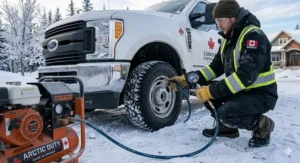
Essential Winter Features for Canadian Air Compressors
Not all air compressors handle Canadian winters equally. Specific design features separate reliable cold-weather performers from units that’ll leave you frustrated in your frozen garage.
Oil-Free Pump Systems
Oil-free pumps eliminate the single largest winter headache: lubricant viscosity changes. These pumps use Teflon or carbon composite piston rings that don’t require oil for sealing or lubrication. When temperatures drop to -25°C, an oil-free compressor starts immediately whilst oil-lubricated competitors require pre-warming or refuse to turn over entirely.
The trade-off? Oil-free pumps typically have shorter service lives (1500-3000 hours versus 10,000+ for oil-lubricated). For weekend DIYers and light-duty users, this rarely matters—3000 hours equals 15 years of weekly garage sessions. Professional users running compressors daily might justify oil-lubricated units with proper winterization measures.
Automatic Drain Valves
Forgetting to drain your compressor tank before leaving your unheated workshop leads to ice damage—guaranteed. Automatic drain valves solve this human error problem by periodically releasing condensate on programmable intervals.
Quality auto-drains like California Air Tools’ EZ-1-2321 timer system let you set both frequency (how often it drains) and duration (how long the valve stays open). Set it to drain nightly in winter, and you’ll never face frozen condensate again. Manual drain valves work fine if you’re disciplined, but automatic systems provide insurance against expensive mistakes.
High-Efficiency Cold-Start Motors
Premium compressors feature motors specifically engineered for cold-weather starting. These motors incorporate higher starting torque, lower amp draw during startup, and design modifications that reduce the electrical surge when initiating rotation.
DEWALT’s high-efficiency motors draw fewer amps whilst producing adequate torque to overcome initial resistance—critical when starting in sub-zero temperatures on standard 15-amp household circuits. This prevents the frustrating breaker trips that plague cheaper units in Canadian garages.
Low-Amp Draw Design
Related to cold-start motors, overall low-amp draw throughout operation matters in residential settings. Many Canadian homes have limited garage electrical service—often just 15-amp circuits shared with other outlets. When you factor in space heaters running simultaneously in winter, electrical headroom disappears quickly.
Compressors with low-amp motors and efficient pump designs operate within these constraints. Makita’s Quiet Series, for instance, draws minimal current whilst still delivering adequate CFM output. This prevents constant breaker trips that turn simple projects into electrical troubleshooting sessions.
Quiet Operation for Indoor Winter Work
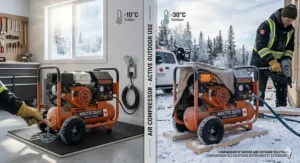
Canadian winters drive work indoors—you can’t comfortably operate in unheated spaces when it’s -20°C outside. Consequently, noise becomes a significant factor. Compressors operating at 60-70 dBA allow conversation and won’t drive family members away, whilst 80+ dBA units become unbearable in enclosed spaces.
Ultra-quiet models use larger pump cylinders running at lower RPM, sound-dampening enclosures, and vibration isolation mounts. The premium pricing reflects genuine engineering, but for those working in attached garages or basement workshops, the peace (literally) is worth paying for.
How to Winterize Your Air Compressor in Canada
Even the best winter-ready compressor benefits from proper seasonal preparation. These steps maximize reliability through Canadian cold snaps and extend equipment life.
Pre-Season Inspection and Oil Changes
Before winter arrives, conduct a thorough inspection of your entire compressed air system. Check your tank for condensation buildup, as water freezing in the tank can increase chances of tank failure. Examine all fittings for wear, cracks, or corrosion that could worsen in winter conditions.
For oil-lubricated compressors, drain the existing oil completely and refill with appropriate cold-weather lubricant. Synthetic oils rated for low-temperature operation maintain proper viscosity far better than conventional petroleum-based compressor oils. Consult your manual for manufacturer-recommended specifications—typically 5W-30 or similar thin synthetics for winter use.
Replace air filters before winter, as dirty filters restrict airflow and make cold starting more difficult. Clean or replace pressure switches and check valves to ensure they function properly. Lubricate moving parts according to manufacturer specifications, using cold-weather-appropriate greases.
Protecting Outdoor Components
If your compressed air system includes outdoor piping or components, winterization becomes critical. Wrapping pipes with insulation and using heat tracing can keep the compressed air warm and help prevent condensate formation and freezing. Heat trace tape installed along pipe runs prevents freeze-ups, whilst foam pipe insulation provides additional protection.
Outdoor moisture separators, filters, and dryers need particular attention. Install drip legs with drain valves at low points in the system to collect and remove condensate before it can freeze. Consider relocating critical components indoors if possible—even moving them into an uninsulated shed provides significant protection compared to full outdoor exposure.
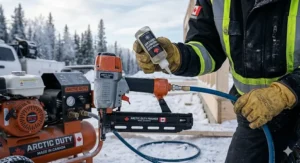
Maintaining Minimum Ambient Temperatures
The single most effective winterization step is maintaining your compressor room above 7°C. Maintaining adequate temperature prevents freezing issues in most cases. This prevents ice formation, keeps lubricants fluid, and eliminates most cold-related starting problems.
Options for heating vary by budget and workshop size. Small electric space heaters work for weekend use, whilst larger workshops might justify permanent heating systems. Insulating walls and sealing air leaks dramatically reduces heating costs. For compressors themselves, sump heaters can raise temperatures to the desired level for reliable system performance.
Daily Draining Procedures
Unless you have an automatic drain valve, manually drain your compressor tank after every use during winter. If you do not have an automatic drainage system, manually empty drains of condensate each day to prevent freezing. This simple habit prevents overnight ice formation that can damage tanks and fittings.
The procedure takes 30 seconds: open the tank drain valve fully, allow all water and air to escape until only dry air emerges, then close the valve tightly. Do this whilst the tank is still warm from operation for more complete drainage. Many users find setting a timer or alarm helpful—it’s easy to forget when rushing to finish a project.
Cold-Start Procedures
When starting a compressor in very cold conditions (below -10°C), follow these steps to reduce strain and extend equipment life. First, ensure the tank is completely empty—this eliminates back-pressure the motor must overcome during initial rotation. Open all downstream valves so the compressor starts unloaded.
For oil-lubricated units, consider gently warming the crankcase before starting. A heat gun (not a torch—fire hazard!) applied to the sump area for 2-3 minutes can warm oil sufficiently for easier starting. Never use open flames near compressors due to oil vapour ignition risks.
Start the compressor and allow it to run unloaded (not building pressure) for several minutes. This warms internal components gradually rather than shocking cold metal with full pressure immediately. Once the motor sounds smooth and steady, close downstream valves and begin building pressure normally.
Canadian Winter Air Compressor Buying Guide
Selecting the right air compressor for Canadian conditions requires evaluating several factors beyond basic specifications.
Tank Size Considerations for Cold Weather
Larger tanks provide several winter advantages. First, they reduce cycling frequency—the compressor runs less often, generating less condensate overall. This matters because every compression cycle introduces moisture into the system. A 10-gallon tank might cycle half as often as a 6-gallon for the same work, producing proportionally less water to drain.
Second, larger tanks provide pressure reserve when your compressor struggles in extreme cold. If cold-thickened oil or a partially frozen component reduces output, the extra capacity buffers pressure drops between cycles. Third, in unheated spaces, larger air volumes moderate temperature swings—the thermal mass helps prevent rapid cooling when the compressor sits idle.
The downside? Larger tanks cost more, weigh more, and occupy more space. For most Canadian home workshops, 6-10 gallons provides the optimal balance. Contractors working outdoors might justify 20+ gallon units, whilst apartment dwellers might manage with 2-4 gallon portable models.
CFM Requirements for Your Tools
CFM (cubic feet per minute) output determines what tools your compressor can actually power. Unlike tank size or pressure rating, CFM represents the continuous airflow available—and it’s the most important specification for tool compatibility.
Common tool CFM requirements at 90 PSI:
- Brad nailers: 0.3-1.0 CFM
- Finish nailers: 1.0-2.0 CFM
- Framing nailers: 2.0-4.0 CFM
- HVLP spray guns: 4.0-9.0 CFM
- Impact wrenches: 3.0-8.0 CFM
- Sanders: 6.0-12.0 CFM
Match your compressor’s CFM output (measured at 90 PSI, not peak) to your most demanding tool. If you primarily run finish nailers (2.0 CFM), a compressor delivering 2.6 CFM at 90 PSI provides adequate margin. Planning to spray finishes? You’ll need 6+ CFM minimum, pushing you toward industrial units.
Canadian cold reduces effective CFM output slightly as dense cold air contains less moisture but occupies less volume. Budget 10-15% more CFM capacity than you’d need in moderate climates to maintain performance in winter.
Pressure Requirements
Most pneumatic tools operate optimally at 90 PSI, though some require higher pressures. Maximum tank pressure becomes relevant for two reasons: it determines how long the compressor can deliver adequate tool pressure before dropping below usable levels, and higher-pressure units cycle less frequently.
A compressor rated 150 PSI maximum will deliver 90 PSI tool pressure until tank pressure drops to approximately 100 PSI (allowing for regulator drop and line loss). At that point, the motor cycles on to rebuild pressure. A 200 PSI maximum unit provides a wider operating band before cycling.
For Canadian winters, higher maximum pressure provides buffer against pressure loss from partially frozen components or cold-thickened oil reducing pump efficiency. This isn’t license to ignore proper winterization, but it does provide operational margin when conditions aren’t perfect.
Noise Levels for Indoor Winter Operation
Because Canadian winters push work indoors, noise matters more than in milder climates where you might operate in open garages with doors raised. Compressor noise levels range from 40 dBA (library quiet) to 90+ dBA (lawnmower loud).
For reference:
- 40-60 dBA: Conversational, suitable for finished spaces
- 60-70 dBA: Noticeable but tolerable, acceptable for garages
- 70-80 dBA: Loud, hearing protection recommended for extended exposure
- 80+ dBA: Very loud, hearing protection required, neighbours will notice
If your workshop shares walls with living spaces or you work evenings when family is home, invest in ultra-quiet models (60 dBA or less). The premium pricing reflects genuine engineering—larger pump cylinders running at lower RPM, sound-dampening enclosures, and vibration isolation don’t come cheap, but they transform your workshop experience.
Power Requirements and Electrical Capacity
Most residential Canadian garages feature 15-amp circuits, sometimes 20-amp in newer construction. Your compressor must start and run within these limits, particularly when space heaters or other equipment share the circuit in winter.
Check your compressor’s electrical requirements carefully:
- Starting amps (initial surge when motor begins)
- Running amps (continuous draw during operation)
- Voltage (120V standard, though some require 240V)
A compressor requiring 15 starting amps on a 15-amp circuit will trip breakers constantly, especially in cold weather when motors draw higher surge current. Look for models with low-amp draw or consider upgrading your electrical service if you need more powerful units.
Many Canadian electricians recommend compressors drawing no more than 12 continuous amps on 15-amp circuits, leaving margin for starting surges and other simultaneous loads. If you’re serious about workshop operations, installing a dedicated 20-amp circuit for your compressor eliminates headaches.
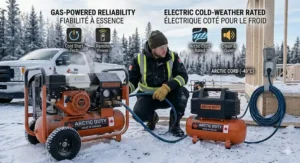
Preventing Air Compressor Freeze Damage
Understanding failure mechanisms helps you prevent costly winter damage.
Recognizing Early Warning Signs
Your compressor will signal impending freeze problems before catastrophic failure. Watch for unusual noises or vibrations, which may indicate issues like frozen components or increased strain, and difficulty starting. These symptoms suggest ice forming in control lines, pressure switches, or check valves.
Pressure regulation becoming erratic—swinging between too high and too low—often indicates frozen or partially frozen components interfering with normal function. Motors struggling to start or drawing higher current than normal suggest oil thickening or mechanical resistance from ice. Address these warnings immediately before minor issues become expensive repairs.
Emergency Thawing Procedures
If your compressor freezes despite precautions, proper thawing prevents additional damage. Shut off all external fresh outside air sources, remove or open doors/panels of the compressor, and turn up or add a heat source to the room or area to get ambient temperatures above 7°C.
Never use torches or open flames—oil vapours create fire hazards. Instead, use space heaters to gradually raise room temperature. For severely frozen units, add a heat source to the bottom of the sump tank until compressor oil is warmed to 21°C. Patience is essential—forcing a frozen compressor to start causes mechanical damage.
Once thawed and warmed above the temperature setpoint, you may need to reset the alarm on the control panel before the air compressor will start. After restarting, inspect thoroughly for leaks or cracks that may have developed during freezing.
Protecting Control Lines and Components
Control lines and small-bore tubing freeze faster than main air lines due to lower airflow and smaller diameters. Control lines accumulate moisture from condensate and can quickly freeze in cold temperatures. Protect these vulnerable components with heat trace tape and insulation, especially where they route through unheated areas.
Drain valves represent particularly vulnerable points. Ice in the drain valve can lead to cracking, requiring replacement of the entire assembly. Install automatic drain valves that purge regularly, or establish rigorous manual draining routines. Consider adding small space heaters near drain valves in extremely cold workshops.
Pressure switches, regulators, and gauges also suffer from ice infiltration. These precision components tolerate ice poorly—frozen moisture disrupts calibration and damages delicate mechanisms. Insulating or relocating these items to warmer areas extends their service life dramatically.
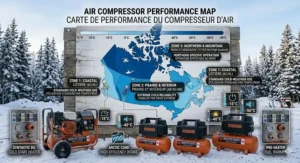
❓ Frequently Asked Questions About Air Compressors for Canadian Winter
❓ What is the minimum temperature an air compressor can operate in Canada?
❓ Do I need an automatic drain valve for winter use in Canada?
❓ Can I use regular compressor oil in Canadian winter?
❓ How often should I drain my air compressor tank during winter?
❓ What size air compressor do I need for a Canadian garage workshop?
Conclusion: Choosing Your Winter-Ready Air Compressor
After testing equipment through brutal Alberta winters and researching feedback from Canadian workshops coast to coast, several clear winners emerge for cold-weather reliability.
For most Canadian home workshops, the DEWALT DWFP55126 ($599 CAD) delivers the optimal balance of winter capability, power, and durability. Its purpose-built cold-start motor handles -20°C mornings without hesitation, whilst the oil-free pump eliminates winterization headaches. The 6-gallon capacity and 165 PSI output suit 90% of DIY applications, from finish carpentry to vehicle maintenance.
Budget-conscious buyers should seriously consider the CRAFTSMAN CMEC6150K ($280-350 CAD), which includes a complete accessory kit and delivers reliable cold-weather starting at half the DEWALT’s cost. Whilst lacking the refinement of premium models, it accomplishes the same fundamental tasks—and the money saved can fund other workshop improvements.
For those prioritizing quiet operation in attached garages or basement workshops, the Makita MAC210Q ($380-420 CAD) operates at library-quiet 60 dBA whilst maintaining excellent cold-start reliability. The smaller 2-gallon capacity limits tool compatibility to lighter-duty applications, but for precision indoor work, nothing matches its noise discipline.
Canadian workshops face unique challenges that milder climates never encounter. The compressors recommended here have proven themselves in Winnipeg warehouses where January averages -16°C, Vancouver job sites battling coastal moisture, and Prairie garages enduring temperature swings from -30°C to +30°C annually. They’ll serve you reliably through whatever winter throws your way—whether that’s Maritime ice storms, Prairie blizzards, or Ontario deep freezes.
Remember that even the best winter-ready compressor benefits from proper maintenance: drain tanks after every use, maintain minimum 7°C ambient temperatures when possible, and use appropriate cold-weather lubricants for oil-based models. These habits, combined with quality equipment, ensure your compressed air system supports your work year-round rather than becoming another seasonal frustration.
Recommended for You
- 7 Best SAE and Metric Wrench Combo Sets Canada 2026
- Portable Table Saw vs Cabinet Saw: 7 Best Models Canada 2026
- 20V vs 18V Cordless Drill: 7 Best Models Canada 2026
Disclaimer: This article contains affiliate links to Amazon.ca. If you purchase products through these links, we may earn a small commission at no additional cost to you.
✨ Found this helpful? Share it with your friends! 💬🤗
