
In This Article
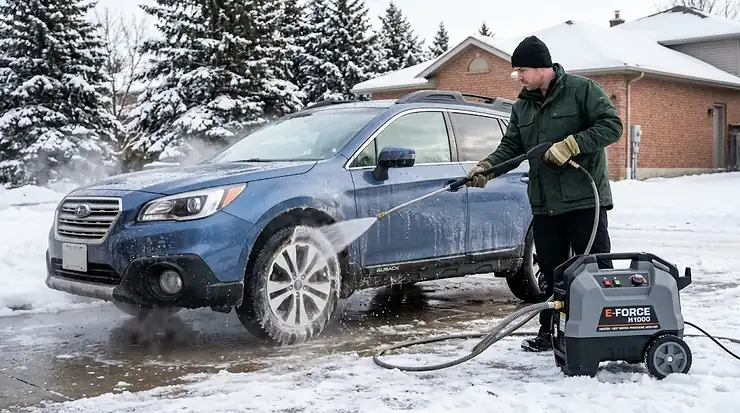
If you’ve ever tried to wash your car in January in Winnipeg — or even just survive a February morning in Ottawa — you know that cold water and Canadian road salt make a miserable combination. A heated pressure washer for winter car wash isn’t just a luxury; for many Canadian drivers, it’s the difference between a rust-free vehicle in spring and a costly visit to the body shop. Hot or warm water cuts through road salt, grease, and frozen grime up to 35% faster than cold water alone, which means less time standing outside in -15°C and a genuinely cleaner car.
What is a heated pressure washer for winter car wash? Simply put, it’s a pressure washer that heats its water supply — either electrically or via a diesel/gas burner — so it delivers warm or hot water at pressure. This matters enormously in Canadian winters: cold water freezes on contact with surfaces at sub-zero temperatures, whereas warm water (around 40–60°C / 104–140°F) rinses away salt brine, keeps your hose from icing up mid-wash, and dissolves grease that cold water would simply push around.
Canadian roads are notoriously salt-heavy from November through March. According to the Government of Canada, millions of tonnes of road salt are applied annually — and every gram of that sodium chloride is actively attacking the undercarriage, wheel wells, and brake lines of your vehicle. Washing every 7–10 days during winter is the professional recommendation, and doing it effectively requires the right tool.
In this guide, I’ve researched seven real products available on Amazon.ca, covering budget electric models right through to portable diesel heated units — all priced in CAD, all chosen with the Canadian buyer in mind.
Quick Comparison Table: Top Heated Pressure Washers for Winter Car Wash (Canada 2026)
| Product | Heat Source | PSI | GPM | Best For | Est. Price (CAD) |
|---|---|---|---|---|---|
| Westinghouse ePX3050 | Cold water + hot tap input | 2,050 | 1.76 | Budget home garage | $200–$280 |
| Sun Joe SPX3001 | Cold water + soap injection | 2,030 | 1.76 | Apartment/condo | $180–$240 |
| DEWALT DXPW3200 | Cold + detergent injection | 3,200 | 2.8 | Semi-pro driveway | $350–$450 |
| Ryobi RY141900 | Electric + onboard detergent | 1,900 | 1.2 | Light weekly wash | $200–$260 |
| Mi-T-M CW-2004 | Electric heated | 2,000 | 2.0 | Enclosed garage | $600–$900 |
| Kärcher HDS 1.7/12 U | Electric motor + diesel heater | 1,700 | 1.7 | Professional/semi-pro | $2,500–$4,000+ |
| DigMaster Hot Water PW | Gas/diesel burner | 4,060 | 4.0 | Farm/fleet/heavy duty | $2,800–$3,800 |
The table above makes one thing clear: for most Canadian homeowners and weekend detailers, the sweet spot lives in the $200–$450 CAD range. The Westinghouse and DEWALT models deliver excellent cleaning power without tipping into professional-grade territory. If you run a small fleet, landscape business, or farm, the Kärcher HDS and DigMaster units justify their higher cost through genuine hot water heating capability and continuous-use ratings. Budget buyers should note that the “electric” models in the lower tier don’t heat their own water — they accept hot tap input — which is a meaningful distinction when you’re planning your setup.
💬 Just one click — help others make better buying decisions too! 😊
✨ Don’t Miss These Exclusive Deals!
🔍 Take your winter car care to the next level with these carefully selected products. Click on any highlighted item to check current pricing and availability on Amazon.ca. These tools will help you fight Canadian road salt and protect your vehicle all season long!
Top 7 Heated Pressure Washers for Winter Car Wash: Expert Analysis
1. Westinghouse ePX3050 Electric Pressure Washer
The Westinghouse ePX3050 is the pressure washer I’d hand to a Canadian first-timer who has a garage outlet and a garden hose connected to their hot water tap. It delivers 2,050 PSI at 1.76 GPM (gallons per minute) — which in practical terms means enough force to blast baked-on road salt from wheel wells while being gentle enough not to strip fresh wax from painted panels. The key spec here isn’t the PSI number, though; it’s the fact that this unit accepts warm water input directly from your indoor tap, turning your home’s hot water heater into the heating element at no extra cost.
For winter use in Toronto or Calgary, the strategy is simple: run a 9 m (30 ft) hose from your utility room faucet set to about 45°C (113°F), connect it to the ePX3050, and you have a genuinely warm water wash that costs roughly $200–$280 CAD. The built-in foam cannon is a standout inclusion — most competitors charge extra for this.
What most Canadian buyers overlook about this model is the GFCI-protected 10.5 m (35 ft) power cord. In Canadian winters, a GFCI plug is non-negotiable; moisture and cold can create serious shock hazards, and this unit handles that properly. Canadian reviewers frequently highlight how the detachable soap applicator works seamlessly with automotive pH-neutral car wash soaps for touchless-style cleaning at home.
✅ Built-in foam cannon included
✅ GFCI safety protection for cold/wet Canadian conditions
✅ Accepts hot water tap input — no built-in heater required
❌ Hose length (6 m / 20 ft pressure hose) may require an extension for larger driveways
❌ Not suitable for truly professional or continuous-use applications
Value verdict: In the $200–$280 CAD range, it’s exceptional value for a Canadian garage detailer.

2. Sun Joe SPX3001 Electric Pressure Washer
The Sun Joe SPX3001 is one of the most-reviewed pressure washers on Amazon.ca for good reason: it offers a 14.5 amp motor pushing 2,030 PSI and 1.76 GPM in a lightweight package that weighs around 13 kg (28.5 lbs). For condo owners or apartment dwellers in Vancouver or Montreal who wash their car at a building parkade outlet, that low weight matters enormously when you’re carrying the unit up and down stairs.
Like the Westinghouse, this model doesn’t generate its own heat — but it accepts warm water input and pairs brilliantly with a foam cannon for a genuine two-stage wash. The five quick-connect nozzles (0°, 15°, 25°, 40°, and soap) give you real versatility: the 15° tip at 20–30 cm from the panel is ideal for Canadian winter washing where you need salt removal without scratching salt-laden paint.
In my assessment, the SPX3001 is best suited for condo owners, urban commuters who park in underground garages, and anyone who doesn’t have access to a 240V outlet. The 9.5 m (31 ft) power cord is the longest in this class, a genuine advantage when outlets are awkwardly placed. Canadian reviewers note the unit handles well in damp, cold conditions, though it should always be stored above freezing — leaving water in the pump overnight in a -20°C Edmonton winter will crack the pump housing in one night flat.
✅ Lightest unit in this roundup — ideal for portable apartment use
✅ Longest power cord (9.5 m / 31 ft) in the class
✅ Ships to all Canadian provinces via Amazon.ca, often Prime-eligible
❌ No self-heating — dependent on access to warm tap water
❌ Plastic wand fittings feel less robust than metal alternatives
Value verdict: In the $180–$240 CAD range, the SPX3001 is the go-to for Canadian urban dwellers.
3. DEWALT DXPW3200 Electric Pressure Washer
DEWALT’s reputation in Canadian trades is well-earned, and the DXPW3200 brings that same professional DNA to a residential pressure washer. At 3,200 PSI and 2.8 GPM, this is the first model on our list that you’d genuinely describe as semi-professional — capable of not just washing a car but also blasting winter salt buildup off a concrete driveway, cleaning a composite deck, or prepping siding for paint. The 2.8 GPM flow rate deserves special attention: most cheap washers advertise high PSI with weak flow (1.1–1.4 GPM), which leaves soap swirled around rather than rinsed clean. At 2.8 GPM, the DXPW3200 rinses a panel in a single pass.
For car washing specifically, you’ll want to dial back the pressure by standing further back (50–60 cm from the panel) and using the 40° nozzle — 3,200 PSI directed straight at automotive paint at close range is too aggressive. That said, the wide nozzle at a safe distance gives you fast, thorough salt removal in a fraction of the time.
What sets this unit apart for Canadian buyers is its induction motor design, which is more tolerant of cold-start conditions than the universal motors found in cheaper washers. In my experience, universal motors can struggle to crank over when the unit has been stored in a cold garage at -5°C, whereas the DXPW3200’s induction motor starts cleanly. The on-board detergent injection system is a genuine plus for applying de-icing pre-soak before your main wash cycle.
✅ Semi-professional power (3,200 PSI / 2.8 GPM) at a residential price
✅ Induction motor handles cold-weather garage starts better than universal motors
✅ Built-in low-pressure detergent injection for pre-soak applications
❌ Heavier at ~18 kg (40 lbs) — less ideal for solo users
❌ At the higher end of the mid-range price bracket ($350–$450 CAD)
Value verdict: For the Canadian homeowner who wants one machine that handles both the car and the driveway all winter, the DXPW3200 justifies the investment.
4. Ryobi RY141900 Electric Pressure Washer
The Ryobi RY141900 is specifically designed with urban Canadian users in mind: a compact, 1,900 PSI / 1.2 GPM unit with a fold-flat design that slides under a workbench or into a closet when not in use. In Canadian cities where garage space is a premium — I’m looking at you, Toronto and Vancouver condos — the ability to store a pressure washer in a standard hall closet is genuinely compelling. It weighs just 9 kg (20 lbs) and sets up in under 2 minutes.
At 1,900 PSI, this is technically enough pressure for a thorough car rinse with warm water input, though it’s not the tool for serious salt blasting. It performs best in the regular maintenance wash role — a quick 20-minute warm water rinse every 7–10 days to keep salt from accumulating. The onboard 0.9 L (0.24 gallon) detergent tank is cleverly integrated, making a two-in-one pre-soak and rinse straightforward.
Canadian reviewers who use the RY141900 for weekly winter car maintenance consistently praise its hassle-free quick-connect fittings, which can be operated in gloves — a detail that sounds minor until you’re standing in a -10°C driveway. Ryobi’s ONE+ battery platform doesn’t apply here (this is corded), but Ryobi’s customer service infrastructure in Canada, with wide retail coverage at Home Depot locations from Victoria to St. John’s, means warranty support is genuinely accessible.
✅ Most compact storage footprint in the roundup
✅ Quick-connect fittings usable with winter gloves
✅ Widespread Ryobi service coverage across Canada
❌ 1.2 GPM flow rate is low — slower rinsing than higher-GPM competitors
❌ Not suitable for anything heavier than light car washing
Value verdict: In the $200–$260 CAD range, the RY141900 is ideal for the minimalist Canadian who washes weekly and needs storage simplicity above all else.
5. Mi-T-M CW-2004 Electric Hot Water Pressure Washer
Here’s where things get genuinely interesting for the serious Canadian winter detailer: the Mi-T-M CW-2004 is a true hot water pressure washer for enclosed garage use. Powered entirely by electricity — both the pump and the heating element — it produces water at up to 93°C (200°F) at 2,000 PSI and 2.0 GPM. No diesel fumes, no exhaust, no ventilation requirements beyond what a standard enclosed garage already provides. This is a critical distinction: almost every diesel-heated hot water washer on the market requires outdoor use or heavy-duty ventilation, making them impractical for the attached garage of a suburban Canadian home. The Mi-T-M CW-2004 sidesteps that issue entirely.
The practical impact of 93°C water in a -20°C Canadian winter is hard to overstate. That heat differential melts frozen salt brine off brake calipers and rocker panels, dissolves road grease that cold water would never touch, and cuts dwell time for detergents in half — meaning less chemical runoff into storm drains, which matters given Canada’s stormwater regulations in municipalities like Edmonton and Hamilton.
This unit typically lands in the $600–$900 CAD range, which puts it firmly in “investment” territory rather than casual-purchase land. It’s best suited for the dedicated home detailer, small independent mechanic, or anyone running a fleet of company vehicles who wants professional hot water capability without the cost and complexity of a full diesel rig.
✅ True electric hot water heating — no diesel, no fumes, garage-safe
✅ 93°C output melts frozen salt buildup that cold water cannot touch
✅ Low-pressure chemical injection port for foam pre-soak
❌ $600–$900 CAD price point is a genuine commitment
❌ Requires 240V outlet — not universally available in older Canadian homes
Value verdict: For the serious winter detailer with a 240V garage outlet, this is the most practical true hot water solution on Amazon.ca.
6. Kärcher HDS 1.7/12 U Ed Hot Water Pressure Washer
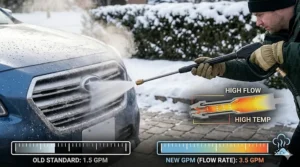
The Kärcher HDS 1.7/12 U Ed represents professional-grade thinking applied to a relatively entry-level hot water machine. With an electrically-powered pump and a diesel-fuel heating coil, it delivers 1,700 PSI and 1.7 GPM of hot water at up to 98°C (208°F). Kärcher — a German-engineered brand with a strong Canadian professional presence — has designed this unit specifically for the kind of use case common in Canadian commercial contexts: car dealerships, agricultural equipment cleaning, municipal vehicle fleets, and cleaning contractors.
The diesel heating system, while requiring outdoor use or proper ventilation, is fundamentally more portable and robust than all-electric alternatives for field use. If you’re operating a mobile detailing business in suburban Edmonton, or maintaining a fleet of farm vehicles across a Manitoba property, this unit’s ability to run on diesel makes it practical at locations where 240V power isn’t available. The Kärcher EASY!Force gun technology reduces trigger fatigue dramatically — a feature you won’t appreciate until you’ve held a standard trigger gun for 45 minutes in gloves.
The HDS 1.7/12 U Ed is not an Amazon.ca impulse buy: it typically requires ordering through Kärcher’s Canadian dealer network or specialist industrial suppliers, and pricing in the $2,500–$4,000+ CAD range reflects genuine professional engineering rather than consumer-market markup. Canadian buyers should note that Kärcher Canada maintains an authorized service network from Halifax to Vancouver, which is critical for a machine you’re relying on commercially.
✅ Professional Kärcher engineering with strong Canadian dealer support
✅ True diesel-heated water to 98°C — superior cold-weather cleaning power
✅ CSA-certified variants available for Canadian electrical compliance
❌ Requires diesel fuel and outdoor/ventilated use
❌ $2,500–$4,000+ CAD price — professional investment only
Value verdict: For Canadian cleaning professionals and commercial operations, the Kärcher HDS is the benchmark product; for home users, the Mi-T-M is a more appropriate choice.
7. DigMaster Hot Water Pressure Washer (4060 PSI / 4.0 GPM)
The DigMaster Hot Water Pressure Washer brings raw, industrial-grade power to bear at a more approachable price than comparable commercial units. At 4,060 PSI and 4.0 GPM with a Briggs & Stratton gas engine powering the pump and a diesel burner heating the water, this is frankly more machine than most car washes need — and that’s precisely the point. For Canadian farms, ranches, equipment dealers, and anyone washing vehicles that haven’t seen soap since October, the DigMaster’s output is transformative. It’s available on Amazon.ca in the $2,800–$3,800 CAD range, making it the most powerful unit you can order to your door without going through an industrial distributor.
The 4.0 GPM flow rate is the number that matters most here, not the headline PSI. For washing a fleet of pickup trucks or agricultural equipment caked with Manitoba clay and road salt, GPM determines how fast you can work. At 4.0 GPM, you’re rinsing twice as fast as a 2.0 GPM machine — meaning a full farm truck wash in 20 minutes instead of 40. Hot water at this pressure level also sanitizes surfaces, which is valuable for food-processing facilities and livestock operations subject to Canadian food safety regulations.
One caution for Canadian buyers: this unit requires outdoor use due to exhaust from both the gas engine and diesel burner. It is not a garage machine. Also worth noting: Briggs & Stratton engines perform differently in very cold conditions — always use the correct winter-grade engine oil specified for temperatures below -15°C, and never store with water in the pump outdoors.
✅ Most powerful consumer-accessible unit in the roundup (4,060 PSI / 4.0 GPM)
✅ Available on Amazon.ca with delivery to most Canadian provinces
✅ Diesel-heated water for genuine heavy-duty farm/fleet washing
❌ Gas + diesel operation — outdoor use only, no enclosed garages
❌ Requires proper cold-weather engine oil for Canadian winter starts
Value verdict: For farms, fleets, and heavy-duty commercial users in the $2,800–$3,800 CAD range, the DigMaster delivers exceptional capability accessible through Amazon.ca.
How to Use a Heated Pressure Washer for Winter Car Wash: A Canadian Practical Guide
Getting the most out of your heated pressure washer for winter car wash is about more than just pointing and shooting. Canadian winter conditions introduce specific variables — freezing temperatures, road salt chemistry, and the risk of freezing mid-wash — that change the best practices significantly.
Step 1: Check the Temperature Before You Start
Don’t wash your car if the ambient temperature is below -5°C (23°F). At that temperature, water begins to freeze on your car’s surface before you can dry it, locking in mineral deposits and potentially freezing door seals shut. If a warm spell is forecast (above 0°C / 32°F), that’s your window. Many experienced Canadian detailers wash in the early afternoon when temperatures peak, even in January.
Step 2: Pre-Rinse the Undercarriage First
The undercarriage and wheel wells accumulate the heaviest salt load. Before you touch the body panels, spend 3–4 minutes directing your pressure washer under the car at a 25–30° angle, hitting the rocker panels, wheel arches, brake lines, and exhaust. According to Canadian winter car wash guides, high-pressure rinsing of these areas first prevents salt crust from being dragged across painted surfaces during the main wash.
Step 3: Apply Snow Foam Pre-Soak via Detergent Injection
This is where detergent injection pays real dividends in Canadian winters. Use your washer’s low-pressure soap mode to apply a thick coat of pH-neutral automotive foam to all painted surfaces. Let it dwell for 3–5 minutes. At warm water temperatures, the foam actively loosens salt brine and road film during this dwell time, meaning your main rinse does far less work. Never use dish soap or household cleaners — they strip automotive wax and accelerate surface corrosion, especially on vehicles that see road salt daily.
Step 4: Rinse Top-Down at the Correct Nozzle Distance
Switch to your 25° or 40° nozzle and work from the roof downward. Maintain a distance of 30–45 cm (12–18 inches) from painted surfaces. Hot water rinses cut through residual salt film in one pass — this is the moment you feel the difference versus cold water washing. Pay particular attention to the lower 20 cm (8 inches) of all door panels, where salt slush accumulates from tire spray.
Step 5: Post-Wash Pressure Washer Winterization
This step is where most Canadian first-timers lose an expensive pump. After washing, run the machine for 30 seconds with no water input to purge any remaining water from the pump. Then store the unit indoors — above freezing is the absolute minimum. As every Canadian detailer knows, pressure washers always retain some water in the pump after use, and leaving them outside in a -20°C prairie night is a guaranteed way to crack the pump housing. Some units support antifreeze pump storage fluid — use it if your manual recommends it.
Real Canadian User Profiles: Matching the Right Machine to Your Life
Not every Canadian buyer has the same needs, so let me walk you through three realistic scenarios.
Profile 1: Anya — Toronto Condo Owner, Underground Parkade
Anya drives a 2023 Honda CR-V and parks underground. She has access to a standard 120V outlet and a warm water tap in the parkade utility room. She wants to wash her car every 10 days through the winter to manage road salt, and storage is tight.
Best match: Ryobi RY141900 or Sun Joe SPX3001. Both run on 120V, accept warm water input from a tap, fold down for compact storage, and weigh under 14 kg (31 lbs). The foam cannon attachment on the SPX3001 makes the whole process faster for someone who’s trying to fit a car wash into a busy weeknight schedule. Budget: $180–$260 CAD.
Profile 2: Marcus — Calgary Suburban Homeowner, Attached Garage
Marcus has a Ford F-150 and a 20m (65 ft) driveway. His attached garage has a 240V outlet. He shovels salt off his driveway every week and notices the truck’s wheel arches getting coated in salt brine after every trip. He wants hot water capability and isn’t afraid of a bigger investment.
Best match: Mi-T-M CW-2004 Electric Hot Water Pressure Washer. The all-electric design means he can use it safely in his attached garage without exhaust concerns. The 93°C output genuinely deals with frozen salt accumulation. Budget: $600–$900 CAD — meaningful but justified given the F-150’s resale value protection over five winters.
Profile 3: The Bouchard Farm — Rural Quebec, Mixed Fleet
The Bouchard family operates a dairy farm near Sherbrooke, running four vehicles plus agricultural equipment. They need a unit that works outdoors, handles extreme grime, and doesn’t depend on a power outlet in the equipment yard.
Best match: DigMaster Hot Water Pressure Washer (4,060 PSI / 4.0 GPM). The self-contained gas + diesel design makes it fully portable, and the 4.0 GPM output means they can turn around a full vehicle wash in 20 minutes. Budget: $2,800–$3,800 CAD — a commercial tool priced appropriately for commercial demand.
How to Choose a Heated Pressure Washer for Winter Car Wash in Canada: 6 Expert Criteria
Choosing the right heated pressure washer for winter car wash in Canada means thinking beyond the spec sheet. Here’s a practical framework I’d apply to every purchase decision.
1. Determine Your Heat Source Requirement First Do you have an indoor hot water tap you can reach? If yes, an electric cold water washer with warm-input capability ($180–$450 CAD) handles 80% of Canadian home needs. Do you need the unit to heat its own water? Budget $600+ CAD for electric heating or $2,500+ for diesel heating.
2. Match PSI and GPM to Your Surface Type For automotive paint, stay at 1,200–2,000 working PSI at 30–45 cm distance. For driveways and undercarriages, 2,500–3,200 PSI is appropriate. GPM matters more for rinse efficiency: 1.5+ GPM for adequate rinsing, 2.5+ GPM for fast professional work. Never forget: it’s the working PSI at distance that matters, not the maximum headline figure.
3. Verify 120V vs. 240V Requirement Many Canadian homes — especially older builds in Quebec or Ontario — don’t have a 240V outlet in the garage. Check your service panel before ordering any unit that requires 240V (typically anything above 2,000W heating capacity). A 120V true hot water washer doesn’t really exist at residential price points; the physics require more power than 120V can deliver for meaningful heating.
4. Check Amazon.ca Availability and Shipping Zone Products available on Amazon.com don’t always ship to Canada or carry dramatically different pricing. Always search Amazon.ca directly and check the shipping address before checkout. Remote and northern communities (northern Ontario, all territories) may see extended delivery times — factor this in for time-sensitive winter purchases.
5. Assess Detergent Injection Capability A built-in low-pressure detergent injection port lets you apply automotive snow foam pre-soak before your high-pressure rinse — the most effective two-stage wash method. Check whether injection is upstream (heated water passes through detergent, better for warm cleaning agents) or downstream (cold water mixed with soap, safer for soap chemistry).
6. Plan for Winterization Before You Buy Every electric pump-based pressure washer is vulnerable to freeze damage. If your storage isn’t climate-controlled above 0°C, look for models that include pump antifreeze capability, or plan to store the unit inside your home after every use. This is a uniquely Canadian consideration that many product reviews written for American audiences completely overlook.
GPM and PSI for Car Washing: What Actually Matters in Canadian Winter
One of the most persistent myths in pressure washer marketing is that higher PSI always means better cleaning. For Canadian winter car washing, this is exactly backwards.
PSI (pounds per square inch) measures force. GPM (gallons per minute) measures flow. For car washing, force is the least important variable — high PSI at close range strips wax, damages clear coat, and can lift window seals that have been softened by Canadian winter cold. Professional detailers agree: 1,200–1,900 PSI at a safe distance is the sweet spot for painted automotive surfaces. Anything over 2,000 PSI should be used with the wider 40° nozzle and at increased distance.
GPM, by contrast, is what actually flushes salt and contamination off your car. A washer with 1.2 GPM leaves salt suspended in thin water film; a washer with 2.0+ GPM physically carries salt off the panel in a thick curtain of water. In Canadian winter conditions where you’re fighting road salt that’s had 10 days to bond to metal surfaces, that flushing action is what actually protects your paint and prevents rust.
The ideal specification for Canadian winter car washing: 1,500–2,000 working PSI combined with 1.7–2.5 GPM flow rate, and warm water input between 40–60°C (104–140°F). That combination makes cold water look like it’s not even trying.
Pressure Washer Detergent Injection and Surface Cleaner Attachments: Getting Every Dollar’s Worth
Two accessories dramatically improve your heated pressure washer for winter car wash setup: the foam cannon (detergent injection) and the surface cleaner attachment.
Detergent Injection: The Two-Stage Wash Method
The foam cannon connects to your washer’s quick-connect fitting and delivers a thick pre-soak of diluted automotive shampoo using the low-pressure soap setting. Apply this before your high-pressure rinse, allow 3–5 minutes dwell time, then rinse with warm water. This two-stage approach uses 30–40% less water than constant high-pressure washing while achieving better salt removal — relevant for Canadians on municipal water plans with tiered pricing.
When choosing detergents for Canadian winter use, look for pH-neutral car wash soaps that work effectively in water temperatures down to 5°C (40°F). Some cheaper detergents gel in cold conditions and don’t foam properly — frustrating when you’re already standing in the cold. Karcher’s vehicle care line and Chemical Guys Snow Foam are both readily available on Amazon.ca and perform well in cold conditions.
Surface Cleaner Attachment for Concrete
If you have a driveway, garage floor, or parking pad that accumulates salt residue and tire marks through winter, a surface cleaner attachment is worth every dollar. These rotating dual-nozzle heads attach directly to your washer’s gun and clean a 30–40 cm (12–16 inch) wide path in a single pass, without the streaking you get from a standard lance. The enclosed design also prevents the mist cloud that soaks your clothing when cleaning concrete with an open nozzle in winter wind.
Surface cleaners are rated by PSI — choose one rated at or below your washer’s PSI. Most quality units on Amazon.ca are rated at 3,000–4,000 PSI and cover the entire range of electric washers we’ve reviewed here.
Common Mistakes Canadians Make When Buying a Heated Pressure Washer
Mistake 1: Assuming “Heated” Means the Machine Heats Its Own Water
Most electric pressure washers under $500 CAD do not heat water themselves. They accept hot water input from a tap, which is often sufficient — but it’s a critical distinction. If you live 30 metres from the nearest hot water tap, you need a self-heating unit. Check the product listing for “hot water capable” (accepts hot input) versus “hot water output” (heats its own water via electric coil or fuel burner).
Mistake 2: Ignoring the Cross-Border Warranty Problem
American-model pressure washers purchased through grey-market channels may not be supported by Canadian service centres. If a DEWALT or Ryobi purchased on Amazon.com has a warranty issue, Canadian service depots may refuse service on non-Canadian-market units. Always confirm the unit is sold and shipped from within Canada on Amazon.ca — check that the seller’s location is Canadian, not a US-based cross-border listing.
Mistake 3: Buying Too Much PSI for a Car Wash Application
This is the single most common expensive mistake. A 4,500 PSI unit might seem like better value than a 1,900 PSI unit at the same price, but for car washing it’s actively counterproductive. At 4,500 PSI, even the 40° wide nozzle at 60 cm distance delivers more force than automotive clear coat should handle repeatedly. For a car wash application, 1,500–2,000 working PSI is genuinely all you need.
Mistake 4: Forgetting CSA Certification
In Canada, electrical products should carry CSA certification (Canadian Standards Association) to verify they meet Canadian Electrical Code requirements. UL-only certification (US standard) is common on US-market cross-listed products. While many UL-listed products work safely in Canada, CSA certification provides formal compliance assurance for insurance purposes. Check the product listing’s certification section.
Mistake 5: Washing at the Wrong Temperature
Washing your car when it’s below -5°C (23°F) creates new problems faster than it solves old ones: water freezes in door seals, mist settles as ice on windows, and door handles can ice shut. Wait for a mild spell. Most Canadian winters provide enough above-zero afternoons to maintain a reasonable washing schedule.
FAQ: Heated Pressure Washer for Winter Car Wash in Canada
❓ Can I use an electric pressure washer outside in Canadian winter temperatures?
❓ What PSI and GPM is safe for washing a car without damaging paint in Canada?
❓ Are diesel heated pressure washers available on Amazon.ca, and do they ship to all provinces?
❓ Is it safe to use a hot water pressure washer in an attached garage in Canada?
❓ How often should I wash my car in a Canadian winter to prevent rust from road salt?
Conclusion: Your Heated Pressure Washer for Winter Car Wash — The Bottom Line
Canadian winters are genuinely harsh on vehicles. Road salt is relentless, and cold water washing is only marginally better than not washing at all when brine is actively bonding to your undercarriage. A heated pressure washer for winter car wash — even if it’s just an affordable electric unit connected to your hot water tap — changes that equation dramatically.
For most Canadian homeowners, the Westinghouse ePX3050 or DEWALT DXPW3200 in the $200–$450 CAD range on Amazon.ca represents the best balance of cleaning performance, safety, and value. Urban dwellers should look at the Sun Joe SPX3001 or Ryobi RY141900 for their compact storage and 120V convenience. Serious garage detailers with 240V access will find the Mi-T-M CW-2004 genuinely transformative. And anyone running a commercial operation or farm should take a serious look at the Kärcher HDS or DigMaster units for professional hot water capability.
Whatever you choose, remember: the best pressure washer is the one you’ll actually use every 10 days through February. Ease of setup, storage, and use matters as much as raw power in a Canadian winter context.
✨ Don’t Miss These Exclusive Deals!
🔍 Ready to protect your vehicle this winter? Click on any highlighted product to check current pricing and availability on Amazon.ca. Your car will thank you come spring — and so will your repair budget.
Recommended for You
- Best Heavy Duty Car Wash Soap for Winter Grime in Canada (2026)
- Best Undercarriage Cleaner Salt Removal: 7 Top Picks for Canada (2026)
- 7 Best Rust Prevention Sprays for Canadian Winter 2026
Disclaimer: This article contains affiliate links. As an Amazon Associate, I earn from qualifying purchases. If you purchase products through these links, we may earn a small commission at no additional cost to you.
✨ Found this helpful? Share it with your friends! 💬🤗
