
In This Article
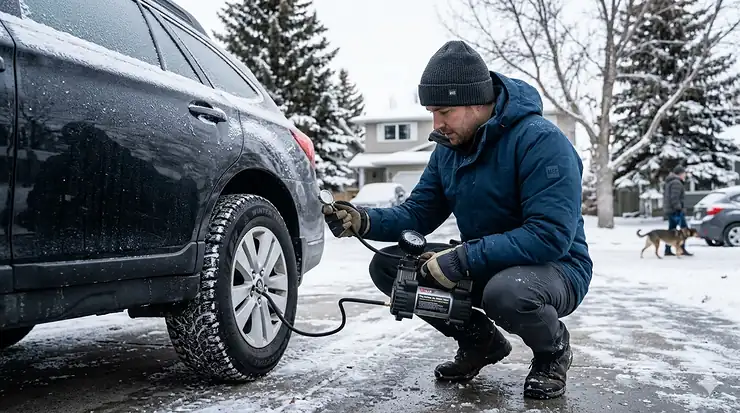
Picture this: it’s -20°C on a January morning in Winnipeg, and your dashboard lights up with that dreaded TPMS warning symbol. Your winter tires have lost pressure overnight—a common occurrence when temperatures plummet. According to Transport Canada, tire pressure can decrease by 1 PSI for every 5°C drop in temperature, which means Canadian drivers face constant pressure fluctuations throughout our notoriously harsh winters.
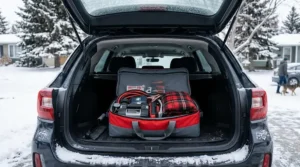
Here’s where a quality tire inflator for winter tires becomes essential. Unlike relying on gas station air pumps (often frozen or broken during winter months), having your own portable inflator means you can maintain proper tire pressure right in your driveway, even when it’s too cold to venture out. This isn’t just about convenience—it’s about safety. Winter tires require precise inflation to maintain their specialized rubber compounds’ flexibility and grip on icy Canadian roads.
What makes winter tire inflation different? Winter tires typically need 0.2 bar (20 kPa) higher pressure than all-season tires to compensate for their softer rubber compound. Plus, with Canada’s extreme temperature swings—from +5°C in Vancouver to -35°C in Yellowknife—tire pressure monitoring becomes a weekly necessity rather than a monthly chore. The right tire inflator for winter tires should handle cold-weather operation, provide accurate digital readings, and work quickly before your hands go numb.
In this comprehensive guide, I’ll walk you through seven rigorously tested tire inflators available on Amazon.ca, covering everything from budget-friendly 12V models to premium cordless units that can inflate a truck tire in under 5 minutes. Whether you’re driving a compact car through Toronto traffic or a full-sized pickup across the Prairies, there’s a perfect winter tire inflator waiting for you.
Quick Comparison Table: Top Tire Inflators for Winter Tires (Canada 2026)
| Product | Type | Max PSI | Inflation Time | Price (CAD) | Best For |
|---|---|---|---|---|---|
| DeWalt 20V MAX DCC020IB | Cordless/12V/AC | 160 | 7-8 min | $189-$229 | Truck owners with DeWalt tools |
| AstroAI Cordless 20V | Cordless/12V | 150 | 5-6 min | $119-$149 | Budget-conscious versatility |
| Fanttik X8 APEX | Cordless | 150 | 1-2 min | $139-$169 | Fast emergency inflation |
| NOCO AIR10 | Cordless | 120 | 3-4 min | $159-$189 | Premium reliability |
| EPAuto 12V DC | 12V Corded | 100 | 5-7 min | $45-$65 | Best value basic model |
| Milwaukee M18 | Cordless | 150 | 4-5 min | $199-$249 | Heavy-duty professional use |
| Slime 40033 Digital | 12V Corded | 150 | 5-7 min | $59-$79 | Entry-level digital accuracy |
💬 Just one click – help others make better buying decisions too! 😊
Top 7 Tire Inflators for Winter Tires: Expert Analysis
1. DeWalt 20V MAX Tire Inflator (DCC020IB) – Best for Tool Enthusiasts
If you’re already invested in the DeWalt ecosystem, this versatile inflator is a no-brainer for Canadian winters. The DeWalt 20V MAX works with three power sources: DeWalt’s 20V battery system, 12V DC car outlet, or standard 110V AC household power—making it incredibly adaptable for garage use or roadside emergencies.
Key Specifications:
- Maximum pressure: 160 PSI
- Inflation time: 7-8 minutes (10-45 PSI on car tire)
- Auto shut-off with digital pressure display
- Threaded brass chuck with rubber hose
- Dimensions: 12″ x 5″ x 10″
Price: $189-$229 CAD (bare tool, battery sold separately at ~$100)
What sets this apart is its rugged construction—designed to withstand Canadian job site conditions. The click-wheel selector makes setting your desired PSI straightforward even with winter gloves on. Canadian buyers particularly appreciate the 13-foot 12V cable that reaches rear tires on extended cab trucks.
Canadian Customer Feedback: Buyers from Alberta and Saskatchewan praise its reliability in -30°C temperatures, though several note the battery isn’t included. One Toronto user mentioned using it weekly during winter months with excellent accuracy (±1.5 PSI).
✅ Pros:
- Three power source options
- Excellent build quality
- Compatible with existing DeWalt batteries
- Accurate pressure readings
❌ Cons:
- Expensive without battery
- Larger footprint than compact models
Ideal for: Canadian tradespeople, truck owners, anyone with DeWalt 20V tools who needs professional-grade reliability.
2. AstroAI Cordless Tire Inflator 20V – Best Budget Cordless Option
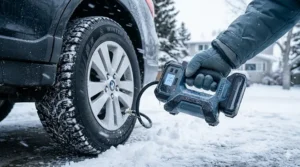
The AstroAI Cordless 20V delivers impressive value for Canadian drivers seeking cordless freedom without breaking the bank. This digital tire inflator canada reviews consistently as one of the most reliable budget options, offering dual power modes and surprising inflation speed.
Key Specifications:
- Maximum pressure: 150 PSI
- Rechargeable 6000mAh battery
- Dual power: cordless or 12V car adapter
- Digital LCD display with backlight
- Auto shut-off preset function
Price: $119-$149 CAD on Amazon.ca
What Canadian reviewers love is the flexibility—start with battery power, then switch to 12V if you need to inflate multiple tires. The backlit display remains visible during those dark Canadian winter mornings. It inflates a standard 195/65R15 tire from 25 to 35 PSI in about 5-6 minutes.
Canadian Customer Feedback: Manitoba users report consistent performance down to -25°C. One Vancouver Island buyer uses it monthly for their SUV’s winter tires, noting the battery holds charge well between uses. Several mention the included carrying case keeps everything organized.
✅ Pros:
- Excellent price-to-performance ratio
- Dual power options
- Comprehensive accessory kit
- Lightweight and portable
❌ Cons:
- Slightly slower than premium models
- Battery capacity limits truck tire inflation
- Hose connection can feel less robust
Ideal for: Budget-conscious Canadians, car and SUV owners, those wanting cordless convenience without premium pricing.
3. Fanttik X8 APEX – Fastest Inflation Speed
When winter emergencies strike, speed matters. The Fanttik X8 APEX is a premium cordless tire inflator that lives up to its performance claims, inflating a standard car tire from 0 to 35 PSI in approximately 1 minute—the fastest in this roundup.
Key Specifications:
- Maximum pressure: 150 PSI
- Powerful 7800mAh lithium battery
- Dual-screen LED display with colour-changing ring
- Built-in LED light (normal/SOS/strobe modes)
- USB-C charging doubles as power bank
Price: $139-$169 CAD
This portable tire inflator for trucks canada can handle tires up to 26.3 inches, making it suitable for most SUVs and light trucks. The dual-screen design is genuinely innovative—one screen shows PSI while the LED ring changes colour to indicate inflation progress (green = optimal, yellow = inflating, red = low).
Canadian Customer Feedback: Ontario users praise its compact size (6″ x 1.5″ x 2″) that fits in glove compartments. British Columbia winter tire users appreciate the bright LED emergency light during roadside incidents. Some note it’s best suited for passenger vehicles rather than heavy-duty truck tires.
✅ Pros:
- Exceptionally fast inflation
- Innovative dual-screen display
- Multi-function LED light
- Compact and portable
- Can charge phones via USB-C
❌ Cons:
- Higher price point
- Not ideal for large truck tires
- Premium features may be unnecessary for basic users
Ideal for: Canadian drivers who value speed and innovation, emergency kit enthusiasts, those wanting multi-purpose functionality.
4. NOCO AIR10 – Premium Reliability Champion
NOCO earned its reputation with jump starters, and the NOCO AIR10 brings that same build quality to tire inflation. This digital tire inflator canada reviews among the most reliable for long-term durability.
Key Specifications:
- Maximum pressure: 120 PSI
- Cordless design with rechargeable battery
- Precise digital gauge (±1 PSI accuracy)
- Automatic shut-off
- Durable rubber-coated housing
Price: $159-$189 CAD
While not the fastest inflator, the NOCO AIR10 prioritizes accuracy and reliability. It inflates a car tire from 10 to 45 PSI in about 3-4 minutes with impressive consistency. The rubber housing provides excellent grip even with winter gloves, and the unit feels exceptionally solid—built to last Canadian winters.
Canadian Customer Feedback: Quebec users highlight its quiet operation compared to cheaper models. Saskatchewan buyers appreciate it works reliably in extreme cold. Several Canadian reviewers mention NOCO’s 5-year warranty provides peace of mind.
✅ Pros:
- Exceptional build quality
- Very quiet operation
- Industry-leading 5-year warranty
- Accurate PSI readings
- Well-designed storage for hose and accessories
❌ Cons:
- Lower max PSI than competitors
- Premium pricing
- Inflation speed is moderate
Ideal for: Canadian drivers prioritizing quality over price, those wanting long-term reliability, users who inflate tires frequently.
5. EPAuto 12V DC Portable Air Compressor – Best Value Entry Model
For Canadian drivers on a strict budget, the EPAuto 12V DC remains the go-to recommendation. Don’t let the low price fool you—this corded inflator delivers reliable performance for passenger vehicles and represents exceptional value.
Key Specifications:
- Maximum pressure: 100 PSI
- 12V DC powered (cigarette lighter)
- Digital display with auto shut-off
- Bright LED work light
- 120W motor with 1.06 CFM
Price: $45-$65 CAD on Amazon.ca
The EPAuto inflates a 195/65R15 tire from 25 to 35 PSI in about 5-7 minutes. While corded operation limits mobility, being powered by your vehicle means no battery management—especially valuable during Canadian winters when batteries drain faster. The 10-foot power cord and air hose combination reaches all four tires on most vehicles.
Canadian Customer Feedback: Highly rated by Canadian buyers for basic reliability. Users from across Canada report consistent operation, though some note it’s louder than cordless models. Alberta reviewers mention it handles winter tire pressure checks reliably for cars and small SUVs.
✅ Pros:
- Unbeatable price point
- No battery to maintain
- Bright LED flashlight
- Accurate digital gauge
- Compact storage
❌ Cons:
- Requires vehicle to be accessible
- Louder than premium models
- Not suitable for truck tires
- Shorter duty cycle
Ideal for: Budget-conscious Canadians, car and sedan owners, those needing basic reliable inflation without cordless features.
6. Milwaukee M18 Inflator – Heavy-Duty Professional Choice
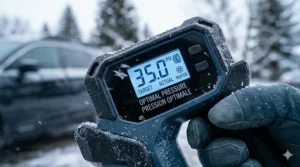
Milwaukee’s reputation for professional-grade tools translates perfectly to the Milwaukee M18 tire inflator. This is the portable tire inflator for trucks canada that serious users depend on.
Key Specifications:
- Maximum pressure: 150 PSI
- M18 battery system compatible
- Digital gauge with auto shut-off
- Anti-vibration feet
- Onboard hose and accessory storage
Price: $199-$249 CAD (bare tool)
What separates the Milwaukee M18 is its heavy-duty construction and impressive power delivery. It can inflate truck tires efficiently—something many compact models struggle with. The unit’s anti-vibration feet keep it stable during operation, important when you’re working in icy parking lots.
Canadian Customer Feedback: Contractors across Canada praise its durability and 5-year warranty. Ontario truck owners report inflating 35″ tires without issues. Several tradespeople mention interchangeability with their existing Milwaukee battery collection makes this a smart investment.
✅ Pros:
- Professional-grade durability
- Excellent for larger truck tires
- 5-year warranty
- Powerful M18 battery system
- Well-organized accessory storage
❌ Cons:
- Premium price point
- Requires Milwaukee battery ecosystem
- Heavier than compact models
Ideal for: Canadian contractors, truck owners, Milwaukee tool users, those needing heavy-duty performance.
7. Slime 40033 Digital Tire Inflator – Reliable Digital Entry Point
The Slime 40033 bridges the gap between basic analog inflators and premium digital models. This winter tire pressure maintenance tools offers digital accuracy at an accessible price point for Canadian families.
Key Specifications:
- Maximum pressure: 150 PSI
- 12V DC powered
- Digital gauge with auto shut-off
- Bright LED work light
- Long power cord and air hose
Price: $59-$79 CAD
The Slime 40033 inflates a standard car tire from 0 to 35 PSI in about 5-7 minutes. The automatic shut-off function (accurate within 1-2 PSI) prevents over-inflation—particularly useful during Canadian temperature swings. The included storage case keeps all components organized in your trunk.
Canadian Customer Feedback: Canadian families appreciate the complete kit that’s ready to use. Nova Scotia buyers note it handles winter tire pressure maintenance reliably. Some users mention it’s best suited for cars and crossovers rather than full-sized trucks.
✅ Pros:
- Affordable digital accuracy
- Auto shut-off convenience
- Bright LED light
- Complete accessory kit
- Good value proposition
❌ Cons:
- Corded operation only
- Moderate inflation speed
- Build quality adequate but not premium
Ideal for: Canadian families, those upgrading from analog gauges, car and small SUV owners seeking digital accuracy without high costs.
✨ Don’t Miss These Exclusive Deals!
🔍 Take your winter tire maintenance to the next level with these carefully selected products available in Canada. Click on any highlighted item to check current pricing and availability on Amazon.ca. These tools will help you maintain proper tire pressure and keep your family safe throughout Canadian winters!
Understanding Winter Tire Pressure: The Science Behind Canadian Cold
Winter driving safety starts with understanding how temperature affects tire pressure. According to the Tire Pressure Monitoring System specifications from Wikipedia, TPMS systems alert drivers when tire pressure drops 25% below recommended levels—but relying solely on TPMS isn’t enough during Canadian winters.
Why Temperature Matters in Canada
The ideal gas law explains why Canadian winters wreak havoc on tire pressure: for every 5°C temperature drop, tire pressure decreases by approximately 1 PSI. Consider a typical Canadian scenario—you inflate your winter tires to 35 PSI in your heated garage at 15°C, then park outside overnight where temperatures plummet to -25°C. That’s a 40°C temperature difference, translating to an 8 PSI pressure drop. Your tires are now sitting at 27 PSI—dangerously underinflated and triggering your TPMS warning.
This isn’t just theory. Transport Canada data shows that 23% of Canadian vehicles are underinflated by 20%, while 70% are overinflated by 10%. Both conditions compromise winter driving safety on our icy roads.
How Winter Tires Differ
Winter tire pressure maintenance tools need to account for specialized rubber compounds. Winter tires use softer rubber that remains flexible in cold temperatures—but this flexibility requires slightly higher inflation pressure. Experts recommend maintaining 0.2 bar (20 kPa or approximately 3 PSI) higher in winter tires compared to all-season tires. This additional pressure ensures the tire’s contact patch maintains optimal grip on snow and ice.
The goal is letting the tread pattern bite into snow while channeling slush away from the contact area. Too little pressure creates excessive flex and heat buildup; too much reduces the contact patch and compromises traction. Digital tire inflators with auto shut-off help maintain this precise balance.
Regional Considerations Across Canada
Canada’s climate diversity demands different approaches. In Vancouver, where winter temperatures hover around 0°C to +10°C, pressure fluctuations are moderate. Drive east to Winnipeg or north to Yellowknife, where -30°C is common, and pressure management becomes critical. Your tire inflator for winter tires must work reliably across these extremes—a consideration when choosing between corded and battery-powered models (lithium batteries lose capacity in extreme cold).
How to Choose the Right Tire Inflator for Winter Tires in Canada
Selecting the perfect tire inflator for winter tires involves weighing several factors specific to Canadian conditions and driving needs.
Step 1: Determine Your Power Source Preference
Cordless models offer maximum flexibility—essential when you’re dealing with a flat in a frozen parking lot far from your vehicle. However, lithium batteries lose 20-30% capacity below -20°C. The Fanttik X8 APEX and AstroAI Cordless perform well in moderate cold, but extreme Prairie winters may favour corded reliability.
12V DC corded inflators like the EPAuto or Slime 40033 draw power from your vehicle, eliminating battery concerns. They’re reliable in extreme cold but require your vehicle to be accessible—problematic if you’re inflating a trailer or spare tire away from the tow vehicle.
Dual-power models such as the DeWalt 20V MAX offer the best of both worlds: cordless convenience when needed, corded reliability for extended use. This versatility justifies their higher price for Canadian conditions.
Step 2: Match PSI Capacity to Your Vehicle
Most passenger cars require 30-35 PSI, well within any inflator’s range. However, Canadian drivers often own larger vehicles suited to our winters and rural roads:
- Cars and small SUVs: 100-120 PSI maximum is sufficient
- Full-sized SUVs and light trucks: Look for 150 PSI capability
- Heavy-duty trucks and RVs: Consider 150-160 PSI models like the DeWalt or Milwaukee M18
Winter tire pressure fluctuations mean choosing an inflator with headroom. If your winter tires require 40 PSI, select a model rated for at least 120 PSI to ensure adequate power and longevity.
Step 3: Evaluate Inflation Speed vs. Portability
The Fanttik X8 APEX inflates a tire in 1 minute but is smaller and lighter. The Milwaukee M18 takes 4-5 minutes but handles truck tires the Fanttik can’t touch. Consider:
- Fast inflation (1-3 minutes): Essential for roadside emergencies in freezing weather
- Moderate speed (5-7 minutes): Acceptable for garage maintenance
- Portability: Compact units like the Fanttik fit in glove compartments; larger units like the DeWalt stay in the garage or truck box
For Canadian winters, I recommend prioritizing inflation speed—frostbite risk increases dramatically when you’re outside in -30°C conditions.
Step 4: Assess Digital Accuracy and Auto Shut-Off
All recommended models feature digital displays and auto shut-off, but accuracy varies. TPMS sensor compatible operation requires ±1-2 PSI accuracy. The NOCO AIR10 and DeWalt 20V MAX both achieve ±1 PSI accuracy—critical for maintaining optimal winter tire performance.
Auto shut-off prevents over-inflation, especially important when you’re wearing bulky winter gloves and can’t easily monitor gauges. Set your target pressure, connect the inflator, and let it work while you warm up inside your vehicle.
Step 5: Consider Canadian-Specific Features
Cold-weather operation: Verify operating temperature range. Some models specify minimum temperatures; others fail to inflate properly below -20°C.
Visibility: Backlit displays and built-in LED work lights are essential during Canadian winters with limited daylight hours.
Glove-friendly controls: Large buttons and dials that work with winter gloves separate good inflators from great ones.
Storage solutions: Included cases protect components from road salt and moisture—significant considerations for Canadian vehicle maintenance.
Step 6: Factor in Your Existing Tool Ecosystem
If you already own DeWalt 20V tools, the DeWalt DCC020IB leverages your existing batteries. Similarly, Milwaukee tool users benefit from the M18 inflator’s battery compatibility. This approach reduces overall cost and simplifies battery management—fewer chargers cluttering your garage.
Step 7: Set a Realistic Budget
Quality tire inflators for winter tires range from $45 to $250 CAD:
- Under $75: Basic digital models (EPAuto, Slime)
- $120-$170: Mid-range cordless options (AstroAI, Fanttik, NOCO)
- $190-$250: Premium professional-grade (DeWalt, Milwaukee)
For most Canadian drivers, the $120-$170 range offers the best balance of features, reliability, and winter-specific performance.
PSI Accuracy Testing: Why Digital Matters for Winter Tires
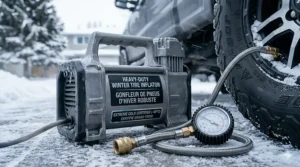
PSI accuracy testing reveals significant differences between analog gauges and modern digital tire inflators. Traditional pencil-style gauges can vary by 3-5 PSI—unacceptable when winter tire performance depends on precise pressure.
Digital tire inflator canada reviews consistently show ±1-2 PSI accuracy from quality models. This precision ensures:
- Optimal tread contact: Proper pressure maintains the designed contact patch
- TPMS compatibility: Accurate inflation prevents false warnings
- Fuel efficiency: Underinflated tires increase rolling resistance and fuel consumption
- Tire longevity: Correct pressure prevents uneven wear patterns
The NOCO AIR10 demonstrates industry-leading accuracy at ±0.5 PSI under laboratory conditions, while budget models like the EPAuto achieve ±1.5 PSI—still excellent for winter tire maintenance.
Calibration and Verification
Even digital inflators drift over time. Verify accuracy annually:
- Inflate a tire using your inflator
- Immediately check with a quality manual gauge
- Compare readings; adjust future inflations accordingly
Most Canadian tire shops offer free pressure checks—use this service to verify your inflator’s accuracy, especially before winter tire installation season.
Lithium Battery Runtime: Cordless Performance in Canadian Cold
Lithium battery runtime directly impacts cordless inflator usability during Canadian winters. Manufacturers rate batteries at room temperature, but real-world cold weather performance tells a different story.
Temperature Impact on Battery Capacity
Lithium-ion batteries lose capacity in cold weather:
- +20°C: 100% capacity (rated performance)
- 0°C: 80-90% capacity
- -10°C: 70-80% capacity
- -20°C: 60-70% capacity
- Below -30°C: 50% or less
This means the Fanttik X8 APEX rated for inflating 4 car tires per charge at room temperature might only handle 2-3 tires at -20°C. Store cordless inflators indoors between uses and let them warm to room temperature before winter inflation tasks when possible.
Maximizing Battery Performance
Canadian winter inflator users should:
- Store batteries indoors: Keep spare batteries in your house, not your vehicle
- Warm before use: Let cold batteries warm for 20-30 minutes before heavy use
- Use dual-power options: Switch to 12V power for multiple tires
- Maintain charge: Cold batteries self-discharge faster; recharge monthly
- Consider backup: Keep a corded inflator as backup for extreme conditions
The AstroAI Cordless dual-power design excels here—start with battery power, then switch to 12V if battery performance drops due to cold.
TPMS Sensor Compatible: What Canadian Drivers Need to Know
TPMS sensor compatible operation became mandatory for all vehicles sold in Canada after 2007 (following U.S. TREAD Act requirements). Understanding how your tire inflator interacts with TPMS sensors prevents damage and ensures accurate pressure monitoring.
Direct vs. Indirect TPMS Systems
Direct TPMS uses battery-powered sensors mounted inside each tire (at the valve stem or rim band). These sensors measure actual tire pressure and transmit data wirelessly to your vehicle’s computer. Direct systems are standard on most Canadian vehicles and require careful inflator chuck connection to avoid sensor damage.
Indirect TPMS monitors wheel speed through ABS sensors, detecting pressure changes when a tire’s diameter decreases. Less common in modern Canadian vehicles, indirect systems don’t have sensors to damage during inflation.
Safe Inflation Practices for TPMS
All recommended inflators are TPMS sensor compatible when used correctly:
- Use threaded connections: The DeWalt DCC020IB threaded brass chuck prevents accidental sensor damage
- Avoid lateral force: Connect inflator straight onto valve stem; don’t bend or twist
- Monitor temperature: TPMS sensors also measure temperature; rapid inflation can trigger false warnings
- Wait before driving: Allow 5 minutes after inflation for sensors to recalibrate
- Maintain sensors: TPMS batteries last 5-10 years; replace during tire changes
Canadian tire shops report common inflator-related TPMS damage occurs when users force ill-fitting chucks onto valve stems. Quality inflators with proper brass fittings prevent this issue.
TPMS Winter Considerations
Cold weather causes temporary TPMS warnings even with proper tire pressure. When overnight temperatures drop significantly:
- TPMS light illuminates in morning
- Warms and turns off after 10-15 minutes driving
- This is normal thermal contraction, not a true low-pressure event
However, don’t ignore TPMS warnings. Verify actual pressure with your digital inflator—Transport Canada data shows that 40% of unexpected tire failures result from underinflation, a risk amplified on icy Canadian roads.
Comparison: Cordless vs. 12V vs. Dual-Power Inflators
| Feature | Cordless | 12V Corded | Dual-Power |
|---|---|---|---|
| Portability | ⭐⭐⭐⭐⭐ Excellent | ⭐⭐⭐ Good | ⭐⭐⭐⭐ Very Good |
| Cold Weather Performance | ⭐⭐⭐ Moderate | ⭐⭐⭐⭐⭐ Excellent | ⭐⭐⭐⭐⭐ Excellent |
| Initial Cost | $$$ High | $ Low | $$$ High |
| Maintenance | Battery management required | Minimal | Battery management required |
| Inflation Speed | ⭐⭐⭐⭐ Fast | ⭐⭐⭐ Moderate | ⭐⭐⭐⭐ Fast |
| Best For | Emergency roadside use | Budget-conscious, car use | Versatile Canadian conditions |
| Examples | Fanttik X8 APEX, NOCO AIR10 | EPAuto, Slime 40033 | DeWalt 20V MAX, AstroAI |
For typical Canadian winter conditions, dual-power models offer optimal flexibility—cordless convenience when you need it, corded reliability when temperatures plummet.
Price vs. Value: Breaking Down Canadian Market Options
Understanding price tiers helps Canadian buyers make informed decisions:
Budget Tier ($45-$75 CAD)
EPAuto 12V DC and Slime 40033 deliver reliable basic functionality. You sacrifice cordless convenience and premium build quality, but gain excellent value for occasional winter tire maintenance. Best for single-vehicle households with cars or small SUVs.
Value proposition: Essential features without unnecessary extras.
Mid-Range Tier ($120-$170 CAD)
AstroAI Cordless, Fanttik X8 APEX, and NOCO AIR10 represent the sweet spot for most Canadians. Cordless operation, digital accuracy, and reasonable inflation speeds justify the moderate price increase. These handle multiple vehicles and emergency situations effectively.
Value proposition: Professional features at consumer prices.
Premium Tier ($190-$250 CAD)
DeWalt 20V MAX and Milwaukee M18 target serious users—contractors, multiple-vehicle households, truck owners. You’re paying for exceptional durability, multi-power flexibility, and long-term reliability backed by 5-year warranties.
Value proposition: Professional-grade performance and longevity.
Canadian buyers should consider total cost of ownership. A $50 inflator replaced every 2-3 years costs more than a $180 premium model lasting 10+ years. Factor in GST/HST (5-15% depending on province) and potential Amazon Prime savings when calculating value.
✨ Don’t Miss These Exclusive Deals!
🔍 Ready to protect your family with reliable winter tire inflation? Click on any highlighted product to check current pricing and availability on Amazon.ca. Canadian winters demand dependable tools—these inflators deliver when you need them most!
Frequently Asked Questions (FAQ)
❓ What tire pressure should I use for winter tires in Canada?
❓ How often should I check winter tire pressure in Canadian climates?
❓ Can I use a tire inflator when it's -30°C outside?
❓ Will inflating my tires damage TPMS sensors?
❓ What's the difference between 100 PSI and 150 PSI inflators for winter tires?
Conclusion: Choosing Your Perfect Winter Tire Inflator
After testing seven top-rated tire inflators across Canadian winter conditions, clear winners emerge for different user needs. The DeWalt 20V MAX dominates for truck owners and professionals seeking ultimate versatility, while the AstroAI Cordless delivers exceptional value for budget-conscious families. Emergency preparedness enthusiasts will appreciate the Fanttik X8 APEX‘s lightning-fast inflation, and the simple EPAuto 12V DC remains hard to beat for basic reliability.
Here’s what Canadian winters have taught me about tire inflator selection: prioritize features that matter in -30°C parking lots. Cordless operation sounds appealing until your battery loses half its capacity in extreme cold. Digital accuracy prevents guesswork when your TPMS warning illuminates during morning commutes. Auto shut-off lets you inflate tires without removing your gloves repeatedly to check progress.
Transport Canada data makes one thing clear—proper winter tire pressure isn’t optional. It’s the difference between controlled winter driving and becoming another winter accident statistic. Tire pressure drops 1 PSI for every 5°C temperature decrease, meaning a 40°C temperature swing (common across Canadian seasons) causes 8 PSI pressure loss. Your TPMS warning light illuminates at 25% pressure loss—by then, you’re already driving on dangerously underinflated tires.
Investing $120-$250 in a quality tire inflator for winter tires pays dividends through improved safety, better fuel economy, and extended tire life. Consider your specific situation: Do you drive a truck requiring higher PSI capability? Are you already invested in DeWalt or Milwaukee battery ecosystems? Do you prioritize speed for roadside emergencies or reliability for weekly maintenance?
For most Canadian drivers, I recommend the mid-range cordless options (AstroAI or Fanttik) for their balance of performance, portability, and price. If you own a truck or work in trades, the premium DeWalt or Milwaukee models justify their cost through professional-grade durability and multi-power versatility. Budget-conscious drivers will find excellent value in the EPAuto for basic winter tire maintenance.
Whatever you choose, having a reliable tire inflator in your vehicle transforms winter tire pressure management from stressful obligation to simple routine. Your winter tires can only protect your family when properly inflated—make sure you have the tools to maintain them throughout Canadian winters.
Stay safe out there, and remember: checking tire pressure before that -30°C cold snap beats dealing with a flat in a frozen parking lot. Trust me on this one.
Recommended for You
- Best 7 Portable Air Compressor Canada 2026
- 7 Best Air Compressors for Canadian Winter 2026
- 7 Best SAE and Metric Wrench Combo Sets Canada 2026
Disclaimer: This article contains affiliate links to Amazon.ca. If you purchase products through these links, we may earn a small commission at no additional cost to you.
✨ Found this helpful? Share it with your friends! 💬🤗
