
In This Article
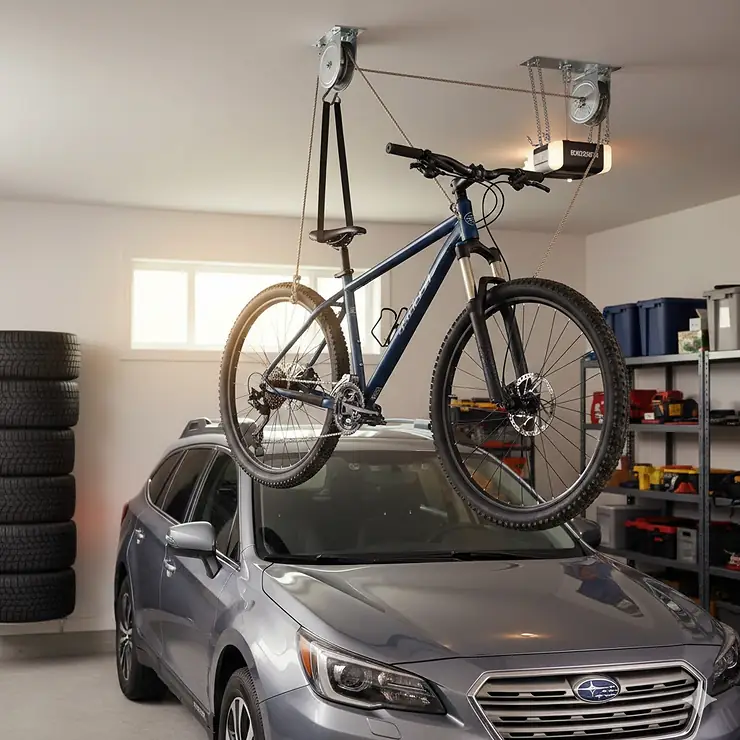
Ever walked into your garage and felt like you’re navigating an obstacle course? You’re not alone. With cycling becoming increasingly popular across Canadian cities—from Vancouver’s rainy streets to Toronto’s expanding bike lanes—finding effective storage solutions has become essential for homeowners. A ceiling bike storage pulley system offers an ingenious way to reclaim valuable floor space while keeping your prized bicycle safe, accessible, and out of harm’s way.
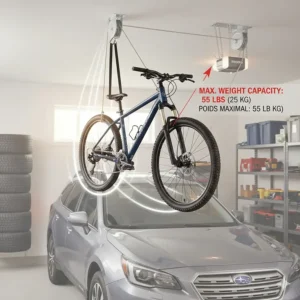
These clever devices use simple mechanical principles to make lifting heavy bikes feel nearly effortless. Instead of wrestling a 23 kg (50 lb) mountain bike onto a wall hook, pulley systems reduce the effort required by up to 75%, thanks to mechanical advantage ratios ranging from 2:1 to 4:1. Whether you’re storing a lightweight road bike or a hefty e-bike, there’s a pulley system designed for Canadian garages that can handle the job without breaking your back or your budget.
In this comprehensive guide, we’ve researched and tested the best options available on Amazon.ca in 2026, considering factors crucial to Canadian buyers: cold-weather durability, weight capacity for heavier e-bikes, ceiling heights common in Canadian homes, and of course, pricing in CAD. Let’s explore how these systems can transform your cluttered garage into an organized cycling haven.
Quick Comparison Table: Top Ceiling Bike Storage Pulley Systems
| Product | Weight Capacity | Ceiling Height | Mechanical Advantage | Approx. Price (CAD) | Best For |
|---|---|---|---|---|---|
| Racor PBH-1R | 23 kg (50 lbs) | Up to 3.7m (12 ft) | 4:1 | $45-$65 | Budget-conscious buyers |
| RAD Cycle 2-Pack | 45 kg (100 lbs) | Up to 3.7m (12 ft) | 4:1 | $75-$95 | Multiple bikes, heavy e-bikes |
| StoreYourBoard | 32 kg (70 lbs) | Up to 4.3m (14 ft) | 4:1 | $65-$85 | High ceilings, no-slip design |
| TRUSOON Heavy Duty | 39 kg (85 lbs) | 3m-4.9m (10-16 ft) | Adjustable | $55-$75 | E-bikes, variable ceilings |
| Neature Hoist | 23 kg (50 lbs) | Up to 3.7m (12 ft) | 2:1 | $40-$55 | Lightweight bikes, apartments |
| SortWise | 25 kg (55 lbs) | Up to 3.7m (12 ft) | 3:1 | $35-$50 | Entry-level, kids’ bikes |
| Generic 100lb | 45 kg (100 lbs) | Up to 3m (10 ft) | 4:1 | $50-$70 | Heavy-duty applications |
💬 Just one click – help others make better buying decisions too!😊
✨ Don’t Miss These Exclusive Deals!
🔍 Take your garage organization to the next level with these carefully selected products available in Canada. Click on any highlighted item to check current pricing and availability on Amazon.ca. These tools will help you create authentic space-saving solutions your family will love!
Top 7 Ceiling Bike Storage Pulley Systems: Expert Analysis
1. Racor PBH-1R Ceiling-Mounted Bike Lift
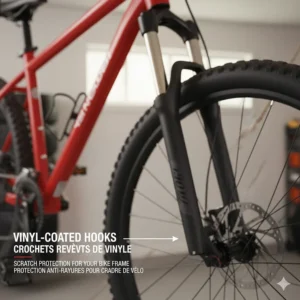
The Racor PBH-1R has earned its reputation as one of the most reliable ceiling bike storage pulley systems on the Canadian market. This system features a 4:1 mechanical advantage, meaning your 23 kg bike feels like it weighs just 5.7 kg during lifting. The dual-pulley configuration includes rubber-coated hooks that protect your bike frame from scratches—a critical feature during Canadian winters when salt residue can be abrasive.
Key Specifications:
- Weight capacity: 23 kg (50 lbs)
- Ceiling compatibility: Up to 3.7m (12 feet)
- Includes: 14.6m (48 feet) of rope, locking mechanism, wall-mounted cleat
Price Range: $45-$65 CAD on Amazon.ca
Canadian buyers appreciate the straightforward installation process, which typically takes 15-20 minutes with basic tools. The locking mechanism engages with each pull, preventing accidental drops—important when storing bikes above vehicles or workbenches. One Toronto-based reviewer noted the system has reliably held their commuter bike through three Canadian winters without rope fraying.
✅ Pros: Affordable, proven track record, excellent rope length
✅ Budget-friendly for most homeowners
✅ Wall cleat keeps excess rope organized
❌ Cons: 50 lb limit excludes heavier e-bikes
❌ Requires ceiling joist mounting (not drywall)
2. RAD Cycle Products Bike Hoist 2-Pack
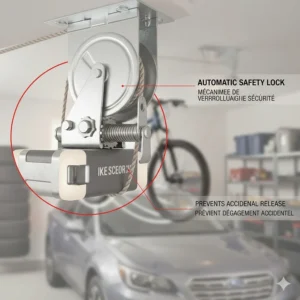
For Canadian households with multiple cyclists, the RAD Cycle Products 2-Pack delivers exceptional value. Each hoist supports up to 45 kg (100 lbs), making this system compatible with heavy e-bikes and mountain bikes loaded with accessories. The rubber-coated hooks provide superior frame protection, while the exclusive rope locking mechanism has been refined over years of customer feedback.
Key Specifications:
- Weight capacity: 45 kg (100 lbs) per unit
- Ceiling compatibility: Up to 3.7m (12 feet)
- Warranty: Lifetime unconditional warranty
Price Range: $75-$95 CAD on Amazon.ca
What sets RAD Cycle apart is their thicker, no-fray rope construction and industry-leading warranty. Canadian customers in Calgary and Edmonton report these systems handle fat-tire bikes without issue, even after hundreds of lifting cycles. The ability to install on either parallel or perpendicular joists provides installation flexibility in varied garage configurations.
✅ Pros: Two complete systems included, 100 lb capacity
✅ Lifetime warranty from established brand
✅ Thicker rope resists Canadian temperature fluctuations
❌ Cons: Takes up more ceiling space for two bikes
❌ Slightly higher initial investment
3. StoreYourBoard No-Slip Bicycle Ceiling Storage
The StoreYourBoard system addresses the biggest complaint about traditional pulley hoists: bikes that swing or tilt during storage. Its innovative no-slip design uses hook-and-loop straps combined with adjustable buckle straps to stabilize the frame, front wheel, and handlebars. This Canadian-friendly feature prevents bike-to-bike collisions in multi-bike garages and protects expensive carbon frames.
Key Specifications:
- Weight capacity: 32 kg (70 lbs)
- Ceiling compatibility: Up to 4.3m (14 feet)
- Features: Pre-assembled rope, 4:1 mechanical advantage
Price Range: $65-$85 CAD on Amazon.ca
The pre-assembled rope eliminates the frustrating threading process that plagues many DIY installations. Vancouver cyclists particularly appreciate the extended 14-foot ceiling compatibility, common in older West Coast homes with higher garages. Thick rubber cushioning protects bike frames during the occasional bump when lowering bikes.
✅ Pros: No-slip stabilization system, pre-threaded rope
✅ Accommodates taller ceilings (14 feet)
✅ Compatible with e-bikes, kids’ bikes, fat tires
❌ Cons: Mid-range pricing
❌ Straps require initial adjustment for optimal fit
4. TRUSOON Heavy Duty Bike Pulley System
Engineered specifically for heavier e-bikes gaining popularity across Canada, the TRUSOON Heavy Duty system supports up to 39 kg (85 lbs) with a powder-coated steel construction that resists corrosion from road salt exposure. The adjustable design accommodates ceiling heights from 3m to 4.9m (10-16 feet), making it versatile for basement storage or high-ceiling garages.
Key Specifications:
- Weight capacity: 39 kg (85 lbs)
- Ceiling compatibility: 3m-4.9m (10-16 feet)
- Features: Woven straps, soft rubber pads, locking mechanism
Price Range: $55-$75 CAD on Amazon.ca
The safety locking mechanism prevents accidental release while woven straps protect your bike’s finish—essential when storing $3,000+ e-bikes common in Canadian urban markets. Montreal and Ottawa customers report successful installations in both modern low-ceiling condos and older homes with vaulted ceilings. The soft rubber pad prevents rope wear and fraying, extending the system’s lifespan through countless Canadian freeze-thaw cycles.
✅ Pros: 85 lb e-bike capacity, wide ceiling range
✅ Powder-coated steel resists salt corrosion
✅ One-person operation simplifies storage routine
❌ Cons: Requires careful measurement for varied ceilings
❌ Installation complexity increases with ceiling height
5. Neature Ceiling Bike Rack Garage Hoist
The Neature Hoist offers an affordable entry point for Canadian apartment dwellers and condo owners looking to maximize limited garage space. While the 23 kg (50 lb) capacity suits lightweight road bikes and hybrid commuters, the compact design and adjustable pulley spacing make it ideal for smaller storage areas common in Toronto and Vancouver high-rises.
Key Specifications:
- Weight capacity: 23 kg (50 lbs)
- Pulley dimensions: 27.7 x 8.9 cm (10.9 x 3.5 inches)
- Features: Safety locking mechanism, rubber-coated hooks
Price Range: $40-$55 CAD on Amazon.ca
Canadian apartment residents appreciate the system’s relatively quiet operation—important in shared garage facilities with noise restrictions. The heavy-gauge aluminum construction keeps overall weight manageable during installation while maintaining structural integrity. The safety lock catches and secures with each pull, providing peace of mind when storing bikes above parking spaces.
✅ Pros: Budget-friendly, apartment-suitable
✅ Compact design for limited spaces
✅ Adjustable pulley distance fits various bike geometries
❌ Cons: 50 lb limit restricts bike types
❌ Basic features compared to premium options
6. SortWise Bike Lift Hoist
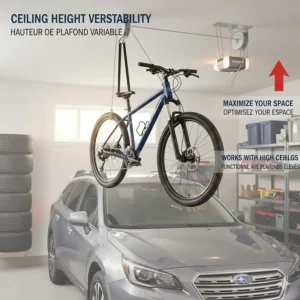
The SortWise system delivers solid performance at an entry-level price point, making it an excellent first pulley hoist for Canadian families introducing kids to cycling. Supporting 25 kg (55 lbs), this hoist handles children’s bikes, lightweight adults’ bikes, and even small kayaks or ladders with its 3:1 mechanical advantage configuration.
Key Specifications:
- Weight capacity: 25 kg (55 lbs)
- Ceiling compatibility: Up to 3.7m (12 feet)
- Features: Rubber-coated hooks, safety locks
Price Range: $35-$50 CAD on Amazon.ca
Canadian customers from rural areas and suburbs report using SortWise systems to organize multiple pieces of garage equipment beyond bikes. The safety lock mechanism prevents accidental falls, while rubber-coated hooks protect painted bike frames from damage during Maritime humidity or Prairie temperature extremes. Installation requires standard tools available in most Canadian households.
✅ Pros: Excellent value for entry-level users
✅ Multi-purpose: bikes, ladders, light kayaks
✅ Simple installation process
❌ Cons: Limited capacity excludes most e-bikes
❌ Basic rope may show wear faster in high-use scenarios
7. Generic Heavy Duty 100lb Bike Hoist
This Generic 100lb capacity system provides no-frills functionality for Canadian households needing maximum weight capacity without brand-name pricing. The heavy-duty iron construction and strong nylon ropes handle mountain bikes, road bikes, and heavier e-bikes up to 45 kg (100 lbs) with a straightforward 4:1 mechanical advantage.
Key Specifications:
- Weight capacity: 45 kg (100 lbs)
- Ceiling compatibility: Up to 3m (10 feet)
- Features: Improved straps, safe locking mechanism
Price Range: $50-$70 CAD on Amazon.ca
While lacking the brand recognition of RAD or Racor, this system delivers reliable performance for budget-conscious Canadian buyers. The locking mechanism safely secures bikes in place, preventing accidental releases that could damage vehicles or garage contents below. Several Alberta-based customers report successful multi-year use with minimal maintenance required.
✅ Pros: Maximum capacity at competitive pricing
✅ Heavy-duty construction for demanding use
✅ Smooth pulleys reduce lifting effort
❌ Cons: Lower ceiling height limit (10 feet)
❌ Generic branding may lack specialized customer support
Understanding Ceiling Bike Storage Pulley Systems: How They Work
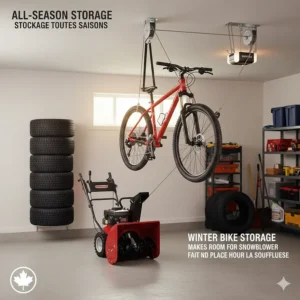
A ceiling bike storage pulley system transforms your garage’s unused overhead space into valuable storage real estate using principles of mechanical advantage discovered centuries ago. At its core, the system consists of fixed pulleys mounted to ceiling joists, movable pulleys attached to your bike, and a continuous rope or cable connecting everything together.
The Science Behind Mechanical Advantage
When you pull the rope on a pulley system, you’re not actually supporting the bike’s full weight. Instead, the rope is divided among multiple support lines—typically two or four—meaning each line only carries a fraction of the total load. A 4:1 mechanical advantage system makes a 40 kg bike feel like just 10 kg during lifting. This force multiplication occurs because while you pull four metres of rope, the bike only rises one metre.
According to physics principles taught at UCSC, the mechanical advantage equals the number of rope segments supporting the movable pulley. More segments mean easier lifting but more rope to pull—there’s always a trade-off between force and distance in mechanical systems.
Components That Matter
Fixed Pulleys: Mounted directly to your ceiling joists (never drywall alone), these redirect force and change lifting direction from horizontal to vertical. They don’t increase mechanical advantage but make the system practical to use.
Movable Pulleys: Attached to your bike via rubber-coated hooks, these pulleys travel upward with your bike. Each movable pulley doubles the mechanical advantage, which is why systems with two movable pulleys offer 4:1 ratios.
Locking Mechanisms: Safety locks automatically engage with each rope pull, preventing accidental drops. Quality systems like the Racor and RAD Cycle use pinch-style locks that grip the rope securely until manually released.
Rope Quality: Canadian temperature extremes demand durable rope materials. Premium systems use thicker, braided nylon that resists UV degradation, moisture absorption, and temperature-induced brittleness between -30°C winters and +30°C summers.
Installation Guide: Setting Up Your Ceiling Bike Storage Pulley System
Installing a ceiling bike storage pulley system in your Canadian garage requires careful planning and proper execution. Most systems can be installed within 30-60 minutes using standard household tools, but rushing the process increases the risk of improper mounting or ceiling damage.
Tools You’ll Need
✔️ Stud finder (essential for locating ceiling joists)
✔️ Power drill with 3mm (1/8 inch) bit for pilot holes
✔️ Phillips head screwdriver
✔️ Tape measure (metric preferred in Canada)
✔️ Pencil for marking ceiling
✔️ Step ladder or stable platform
✔️ Safety glasses
Step-by-Step Installation Process
Step 1: Measure Your Bike
Measure the distance between your bike’s handlebars and seat using a metric tape measure. This critical dimension determines pulley spacing on your ceiling. For a typical adult bike, expect 90-110 cm between mounting points. Write this measurement down—you’ll need it marked precisely on your ceiling.
Step 2: Locate Ceiling Joists
Use a quality stud finder to locate ceiling joists running perpendicular to your desired bike position. In Canadian construction, joists typically run 16 or 24 inches (40-60 cm) apart. Mark joist locations with pencil. Never install pulleys into drywall alone—the system will fail under load and potentially cause injury.
Step 3: Mark Pulley Positions
Transfer your handlebar-to-seat measurement to the ceiling joists. Mark where each pulley will mount, ensuring measurements match your bike’s geometry exactly. Consider adding 10-15 cm extra space if your bike has wide mountain bike handlebars or fenders.
Step 4: Pre-Drill Pilot Holes
Drill 3mm (1/8 inch) pilot holes at each marked position. This prevents wood splitting and makes screw installation significantly easier, especially in older Canadian homes with dried hardwood joists.
Step 5: Mount Pulleys
Install the rear pulley first, using two wood screws provided with your system. Most systems include 5 cm (2 inch) screws suitable for standard joist mounting. Ensure pulleys are oriented correctly per manufacturer instructions—the locking mechanism typically faces toward the front of your garage.
Step 6: Thread the Rope
If your system doesn’t come pre-threaded, carefully route the rope through pulleys as shown in the included diagram. This step varies by manufacturer but generally follows a continuous loop pattern. Some Canadian buyers find this the most challenging step and recommend watching YouTube installation videos specific to your model.
Step 7: Install Wall Cleat
Mount the rope cleat to a convenient wall location where you can easily reach it when the bike is fully raised. This cleat stores excess rope and serves as a secondary securing point. Position it at roughly 1.5-1.7m (5-5.5 feet) height for comfortable access.
Step 8: Test the System
Before hanging your expensive carbon fibre road bike, test the system with something heavy but less valuable—a bag of salt for winter roads works perfectly. Raise and lower it several times, checking that locks engage properly and ropes move smoothly through pulleys.
Canadian-Specific Installation Considerations
Cold-Weather Preparation: In regions experiencing -20°C or colder, consider applying a light silicone spray to pulley bearings before winter. This prevents moisture infiltration and freezing that could seize moving parts.
Garage Door Clearance: Ensure your raised bike clears garage door tracks when fully elevated. Many Canadian garages have low-profile door systems that interfere with bike positioning if not accounted for during planning.
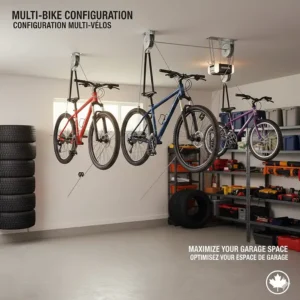
Multi-Bike Spacing: When installing multiple systems side-by-side, maintain at least 75-90 cm between bikes to prevent handlebar interference and allow comfortable bike access.
Choosing the Right Ceiling Bike Storage Pulley System for Canadian Homes
Selecting the optimal ceiling bike storage pulley system for your specific needs requires evaluating several factors beyond just price. Canadian buyers face unique considerations that differ from those in milder climates or regions with different construction standards.
Weight Capacity: Matching System to Bicycle Type
E-bikes have exploded in popularity across Canadian cities, with sales increasing dramatically since 2020. However, many traditional pulley systems weren’t designed for these heavier machines. A typical e-bike weighs 23-32 kg (50-70 lbs), while some cargo e-bikes exceed 36 kg (80 lbs). If you own or plan to purchase an e-bike, prioritize systems rated for at least 39 kg (85 lbs) like the TRUSOON or the 45 kg (100 lb) capacity RAD Cycle system.
Mountain bikes with full suspension, dropper posts, and burly tires typically weigh 14-18 kg (30-40 lbs), comfortably within most systems’ capacity. Lightweight road bikes at 7-9 kg (15-20 lbs) work with any system, making budget options like the SortWise perfectly adequate.
Ceiling Height Compatibility
Canadian residential construction varies significantly by region and era. Post-war bungalows in Ontario often feature 2.4m (8 foot) ceilings, while newer suburban homes in Alberta might have 2.7-3m (9-10 foot) standard ceilings. Detached garages, particularly in rural areas, can reach 3.7-4.3m (12-14 feet) to accommodate RVs or workshop lighting.
Most standard systems accommodate ceilings up to 3.7m (12 feet), but if your garage exceeds this, look specifically for the StoreYourBoard with its 4.3m (14 foot) rating or the TRUSOON with variable height capability up to 4.9m (16 feet).
Remember that “ceiling height” for pulley systems means the space required for the bike when fully raised plus rope routing. Your bike won’t touch the ceiling—it’ll hang 30-60 cm below depending on rope configuration.
Mechanical Advantage Ratios Explained
A 2:1 mechanical advantage means you pull with half the force but twice the distance. The Neature system uses this simpler configuration, making it affordable but requiring more pulling effort.
A 4:1 mechanical advantage—used by Racor, RAD Cycle, and StoreYourBoard—reduces your pulling force to just 25% of the bike’s weight. You’ll pull four times as much rope, but lifting feels remarkably easy. For heavier bikes or users with limited upper body strength, this ratio is essential.
The trade-off isn’t arbitrary—it’s dictated by fundamental physics. According to Wikipedia’s explanation of pulleys, mechanical advantage equals the number of rope segments supporting the load. You can’t cheat physics, but you can choose which compromise works best for your situation.
Rope Length and Quality Considerations
Insufficient rope length creates frustrating installation limitations. For a 3m (10 foot) ceiling, expect to need at least 12-15m (40-50 feet) of rope accounting for the route through multiple pulleys and the horizontal distance to your wall cleat. The Racor’s included 14.6m (48 feet) provides comfortable margin.
Rope quality matters enormously in Canadian climates. Cheap polypropylene rope absorbs moisture, freezes in winter, and becomes brittle when repeatedly exposed to temperature swings. Premium nylon ropes resist these issues. The RAD Cycle’s thicker no-fray rope has earned Canadian customer praise for maintaining flexibility through multiple winter seasons.
Safety Features You Shouldn’t Compromise On
Locking Mechanisms: Every reputable system includes automatic rope locks that engage with each pull. These aren’t optional—they’re essential safety features preventing catastrophic failure if you lose grip while raising a 45 kg bike above your $40,000 vehicle.
Rubber-Coated Hooks: While primarily protecting your bike’s frame finish, rubber coating also provides slightly better grip preventing slippage during the initial hook-on process.
Load Ratings: Manufacturers provide maximum weight capacities, but wise users stay 20-30% below these limits. If your e-bike weighs 32 kg (70 lbs), use a system rated for at least 39 kg (85 lbs) to maintain safety margins accounting for dynamic loading during raising and lowering.
Space Maximization: Vertical Bike Storage Ceiling Benefits for Canadian Garages
The average Canadian garage has shrunk over recent decades while the stuff we store has expanded. According to garage organization research, Canadian homeowners typically allocate 30-40% of their garage floor space to bikes, seasonal equipment, and tools—space that could otherwise accommodate vehicles, workbenches, or year-round recreational gear.
Reclaiming Floor Space
A single bike on the floor occupies approximately 0.6-0.7 square metres (6-7.5 square feet) when you account for maneuvering space around it. That doesn’t sound like much until you calculate the cumulative impact. A family of four cyclists dedicates 2.4-2.8 square metres (25-30 square feet) just to bikes—roughly the footprint of a small workshop table or a significant portion of the space needed to comfortably park a second vehicle.
Lifting bikes to the ceiling instantly reclaims this entire footprint. You gain functional workspace underneath for lawn equipment, gardening tools, kids’ toys, or additional storage shelving. The vertical space above 2.1m (7 feet) typically sits completely unused in most Canadian garages—it’s dead space that a pulley system activates.
Protecting Bikes from Garage Hazards
Bikes stored on garage floors face numerous threats. Vehicle doors swing open and dent frames. Wheels get run over during tight parking maneuvers. Kids trip over pedals, potentially damaging derailleurs or bending expensive lightweight wheels. During Canadian winters, road salt tracked into garages settles on horizontal surfaces, corroding aluminum frames and steel components if not regularly cleaned.
Ceiling storage eliminates these risks. Your bike hangs safely overhead, protected from accidental impacts, salt exposure, and the general chaos of busy garage life. This protection becomes particularly valuable for expensive bikes—a $5,000 carbon fibre road bike or $3,000 e-bike deserves storage that matches its value.
Organizational Psychology
There’s psychological value in vertical organization that extends beyond mere space efficiency. When bikes hang neatly on the ceiling, your garage feels more organized, encouraging you to maintain that organization. Conversely, bikes scattered on the floor create visual clutter that makes everything feel disorganized, triggering what psychologists call “clutter cascade”—once one area is messy, we stop caring about the rest.
Canadian homeowners who’ve installed ceiling storage systems report increased garage usage for hobbies, fitness, and workshop activities simply because the space feels more inviting and functional.
Overhead Bike Rack Garage vs. Other Storage Solutions
When evaluating ceiling bike storage pulley systems against alternatives, consider your specific circumstances, budget, and long-term plans. Each storage approach offers distinct advantages for different Canadian households.
| Storage Type | Floor Space Required | Weight Limit | Installation | Price Range (CAD) | Best For |
|---|---|---|---|---|---|
| Ceiling Pulley System | Near zero | 23-45 kg | Moderate | $35-$95 | Maximum space saving |
| Wall-Mounted Hooks | 60-90 cm protrusion | 16-32 kg | Easy | $15-$40 | Limited space, fewer bikes |
| Freestanding Floor Racks | 0.9-1.2 m² | Unlimited | None | $50-$200 | Renters, temporary solutions |
| Horizontal Wall Racks | 90-120 cm protrusion | 18-27 kg | Easy | $30-$75 | Display-focused storage |
Wall-Mounted Hooks: Simple but Space-Consuming
Basic wall-mounted hooks cost just $15-$40 on Amazon.ca and install in minutes with standard screws. However, bikes hung horizontally on walls protrude 60-90 cm (24-36 inches) into your garage space—roughly half the footprint of floor storage. For narrow Canadian garages where vehicle doors must open fully, this protrusion creates access problems.
Wall hooks work best when you have a dedicated garage wall free from door swings, window placement, or electrical panels. They’re excellent for showcasing a prized bike or providing easy grab-and-go access for daily commuters.
Freestanding Floor Racks: Rental-Friendly
If you’re renting a Toronto condo or Vancouver townhouse where permanent ceiling modifications aren’t permitted, freestanding floor racks offer no-installation convenience. These gravity-stand or lean-to designs support bikes without drilling, making them perfect for temporary living situations.
The trade-off is substantial floor space consumption—0.9-1.2 square metres (10-13 square feet) for a two-bike rack. In cramped urban garages or shared parking spaces, this footprint quickly becomes prohibitive.
Why Pulley Systems Win for Most Canadians
Ceiling bike storage pulley systems deliver the best balance of space efficiency, accessibility, and cost-effectiveness for permanent homeowners. The initial installation effort—typically 30-60 minutes—pays dividends for years through reclaimed floor space and protected bicycles.
For Canadian families with multiple cyclists, the per-bike cost drops significantly with multi-pack options like the RAD Cycle 2-Pack at $75-$95 total, or roughly $40-$47 per bike. Compare that to quality wall hooks at $25-$40 each or floor racks at $100+ for two bikes, and the pulley system economics become compelling.
The mechanical advantage also matters for demographic factors. Older cyclists, individuals with limited upper body strength, or those storing heavy e-bikes find pulley systems far more practical than physically lifting bikes onto wall hooks or maneuvering them into floor racks.
Bike Lift Pulley System Maintenance: Keeping Your Canadian Garage Storage Reliable
While ceiling bike storage pulley systems require minimal maintenance compared to active garage door openers or mechanical devices, a few preventive measures ensure long-term reliability through Canadian seasonal extremes.
Seasonal Inspection Schedule
Spring (April-May): After winter storage season, inspect rope for fraying or moisture damage. Check that pulleys spin freely without grinding sounds that indicate dirt accumulation or bearing wear. Test locking mechanisms by raising and releasing a load several times, confirming smooth engagement and release.
Fall (September-October): Before winter, apply light silicone spray to pulley bearings, especially in regions experiencing -15°C or colder. Clean hooks and contact points of any accumulated dust, cobwebs, or garage debris that could transfer to your bike frame.
Rope Care in Extreme Climates
Canadian temperature swings from -30°C to +35°C stress rope materials through expansion, contraction, and moisture absorption cycles. Nylon ropes handle these conditions better than cheaper polypropylene alternatives, but even premium ropes benefit from occasional conditioning.
Every 6-12 months, wipe the rope with a clean cloth dampened with warm water to remove accumulated grime. For systems stored in unheated garages where temperatures drop below -10°C regularly, consider replacing rope every 3-4 years regardless of visible wear—cold-induced brittleness isn’t always apparent until failure occurs.
When to Replace Components
Rope Replacement Signs: Visible fraying, particularly where rope contacts pulleys; difficulty pulling rope through the system even without a load; rope feels stiff or doesn’t flex smoothly; obvious discoloration or texture changes.
Pulley Bearing Issues: Grinding sounds during operation; pulley doesn’t spin freely when manually rotated; visible rust on pulley wheels (though powder-coated systems like TRUSOON resist this).
Hook Problems: Rubber coating cracked or missing; hooks bent from overloading; visible metal fatigue at mounting points.
Most quality systems like RAD Cycle or Racor last 5-10 years with proper care. Budget systems might require component replacement after 2-3 years of heavy use. Replacement ropes cost $10-$20 on Amazon.ca, while individual pulleys run $15-$30 depending on quality.
Preventive Measures
Store your bike clean and dry before hoisting to the ceiling. Road salt and grime accelerate rope wear where they contact pulleys. During Canadian winters when bikes might sit unused for weeks, periodically lower and raise them to keep the system’s moving parts exercised—mechanical systems deteriorate faster when left completely static.
Ceiling Mounted Bike Hoist Safety Considerations
Gravity doesn’t negotiate, and a 23 kg bike falling from 3 metres can cause serious injury or property damage. While quality ceiling bike storage pulley systems incorporate multiple safety features, user awareness prevents most accidents.
Proper Ceiling Mounting: The Foundation of Safety
The single most critical safety factor is correct installation into solid ceiling joists, never just drywall. Canadian residential ceiling drywall typically uses 1.3 cm (1/2 inch) thickness—strong enough to hold light fixtures but catastrophically inadequate for suspended loads.
Ceiling joists in Canadian construction run either parallel to your garage door (most common) or perpendicular. Use a quality stud finder to definitively locate joists. If your stud finder gives ambiguous readings—common in garages with insulation above drywall—drill a small exploratory hole in an inconspicuous corner to verify joist location before committing to your final mounting positions.
Wood screws should penetrate at least 3-4 cm (1.25-1.5 inches) into solid joist material. The 5 cm (2 inch) screws included with most systems provide adequate penetration when installed through drywall into joists.
Load Management and Weight Limits
Manufacturers specify maximum weight capacities, but these ratings assume ideal conditions: new rope, properly maintained pulleys, correct installation into solid joists, and careful loading procedures. Real-world usage introduces variables that reduce these maximums.
Apply the 70-80% rule: if your bike weighs 32 kg (70 lbs), use a system rated for at least 39-45 kg (85-100 lbs). This safety margin accounts for dynamic loading—the increased force when you release the rope suddenly or pull too quickly. Physics amplifies forces during rapid acceleration or deceleration, potentially exceeding static weight ratings.
Hook Attachment Technique
Always attach both hooks before beginning to lift. Hook one attachment point (typically the seat post) first, ensure it’s secure, then hook the second point (usually handlebars or front fork) before pulling any rope. Never attempt to hook the second attachment point while the bike is partially suspended—this creates dangerous instability.
Canadian cyclists storing bikes with expensive carbon frames should use additional padding at hook contact points. Simple pipe insulation foam from any hardware store costs $2-$3 and prevents pressure marks on delicate frame tubes.
Child Safety Protocols
If kids access your garage unsupervised, consider these additional precautions:
- Install locking wall cleats that prevent unauthorized rope release
- Position controls (cleats) higher than small children can reach
- Store the excess rope wound on cleats rather than hanging loose
- Consider removing hook attachments when bikes aren’t stored overhead
- Educate older children on proper lifting procedures before allowing independent use
Emergency Planning
Know how to manually lower a bike if the locking mechanism fails or rope becomes jammed. Most systems allow controlled lowering by maintaining steady tension while pulling the release lever, but this requires two hands and physical strength to prevent free-fall.
Keep a step ladder readily accessible in your garage. If a pulley bearing seizes with a bike suspended, you’ll need stable access to reach and manually support the bike during emergency lowering.
Garage Ceiling Organization: Integrating Bike Storage into Complete Systems
A ceiling bike storage pulley system represents just one component of comprehensive garage organization. Canadian homeowners maximizing overhead storage potential typically integrate multiple ceiling-mounted solutions for seasonal equipment, recreational gear, and long-term storage items.
Multi-Zone Ceiling Planning
Divide your garage ceiling into functional zones based on access frequency and item size:
Zone 1 (Active Access): Bikes used regularly should occupy the most accessible ceiling positions—typically over your primary garage entry point or along the main walkway. Install pulley systems in this zone with clear vertical pathways that don’t obstruct vehicle parking or workshop activities.
Zone 2 (Seasonal Equipment): Skis, snowboards, kayaks, and camping gear used quarterly can occupy less accessible ceiling positions. Fixed platform storage or horizontal racks work well here, installed in areas above vehicle hoods or along garage sides.
Zone 3 (Long-Term Storage): Holiday decorations, archived documents, and infrequently accessed items suit the deepest ceiling positions—often above garage doors or in back corners. These areas can use simple plywood platforms mounted between joists.
Combining Storage Types
A typical Canadian two-car garage might integrate:
- Two ceiling bike storage pulley systems along one side
- One fixed platform above the garage door for storage bins
- Horizontal ladder storage on the opposite side
- Remaining floor and wall space for workbenches, shelving, and tool organization
This multi-faceted approach can reclaim 4.6-6.5 square metres (50-70 square feet) of floor space—enough room for a complete workshop station or comfortable vehicle access.
Load Distribution Considerations
Canadian building codes don’t specifically address garage ceiling loads, but residential ceiling joists typically support 9-12 kg per square foot (45-60 kg per square metre) when weight is evenly distributed. However, pulley systems create point loads concentrated at specific joist locations.
For multiple ceiling-mounted storage systems, distribute installations across several joists rather than clustering everything on adjacent joists. If mounting two pulley systems side-by-side, consider using joists two bays apart (roughly 80-90 cm spacing) to spread structural loading.
Vertical Bike Storage Ceiling: Benefits Beyond Space Saving
While reclaiming floor space drives most Canadian homeowners toward ceiling bike storage pulley systems, secondary benefits often prove equally valuable in daily garage life.
Improved Air Circulation Around Bikes
Bikes stored on garage floors or tightly packed on wall racks trap moisture against frames, promoting corrosion in Canadian humidity. Coastal regions like Vancouver and Halifax experience particularly aggressive moisture conditions, while Prairie cities face extreme temperature-induced condensation cycles.
Ceiling-mounted bikes hang with complete air circulation, allowing post-ride moisture to evaporate quickly. This simple benefit dramatically extends component lifespan—particularly for steel frames, chrome parts, and sensitive drivetrain components that deteriorate rapidly in damp storage conditions.
Better Visibility for Maintenance Needs
When bikes hang at eye level on ceiling systems, mechanical issues become immediately obvious. That slow leak developing in your rear tire, the chain showing signs of rust, or the brake cable starting to fray—all visible during casual glances as you park your vehicle or work in the garage.
This incidental monitoring helps Canadian cyclists catch maintenance issues before they cause roadside failures or expensive component replacements. Compare this to bikes stored behind vehicles or in corner floor positions where problems go unnoticed until your next ride.
Motivational Psychology
Here’s an unexpected benefit reported by multiple Canadian customers: seeing your bike prominently displayed encourages more frequent riding. When bikes are buried in garage corners or hidden behind lawn equipment, the mental friction of retrieving them discourages spontaneous rides. Ceiling-mounted bikes remain visible, serving as daily reminders of fitness goals and the pleasure of cycling.
One Edmonton customer noted increased cycling frequency after installing a RAD Cycle system—not because ceiling storage made access significantly faster, but because visual prominence kept cycling top-of-mind.
Enhanced Security Through Concealment
While Canadian property crime rates remain relatively low compared to many countries, bike theft represents a persistent concern in urban areas. Bikes visible through garage windows or partially open doors advertise tempting targets for opportunistic thieves.
Ceiling-mounted bikes typically hang above window sightlines and aren’t visible from garage door openings. This inadvertent security enhancement doesn’t replace proper locks but adds a layer of “security through obscurity” that reduces theft risk.
Climate Considerations: Space Maximizing Bike Storage for Canadian Conditions
Canadian climate extremes from coast to coast demand storage solutions that withstand temperature ranges, humidity variations, and seasonal transitions that would challenge equipment designed for moderate climates.
Temperature Tolerance: -30°C to +35°C Performance
Quality pulley systems use materials engineered for outdoor or extreme-temperature applications. Powder-coated steel pulleys resist rust formation even when garage temperatures plummet below freezing and condensation forms during spring thaws. The TRUSOON and RAD Cycle systems specifically advertise powder coating that withstands these cycles.
Plastic components—typically pulley wheels or locking mechanisms—should use high-impact ABS or nylon rather than cheap polypropylene that becomes brittle at -20°C. When researching products on Amazon.ca, check reviews from Alberta, Manitoba, or Northern Ontario buyers who’ve tested systems through multiple winter seasons.
Rope materials matter critically. Nylon maintains flexibility across extreme temperatures while resisting moisture absorption. Polypropylene ropes, despite lower cost, stiffen in cold and absorb moisture that freezes internally, accelerating degradation. The $5-$10 price difference between nylon and polypropylene rope becomes insignificant when compared against the inconvenience and safety risk of premature failure.
Humidity Management: Coastal and Continental Considerations
Vancouver’s garage humidity can exceed 70% year-round, creating corrosion challenges for any metal components including bikes themselves. Ceiling storage helps by maximizing air circulation, but the pulley system components must resist moisture-induced rust.
Rubber-coated hooks (standard on Racor, RAD Cycle, and StoreYourBoard) serve dual purposes: protecting bike finishes and creating moisture barriers preventing steel hook cores from direct humidity exposure. Look for “sealed bearings” in pulley specifications—these prevent moisture infiltration into pulley axles where rust rapidly degrades function.
Continental climates like Calgary and Winnipeg face different challenges—extreme dryness in winter (often below 20% relative humidity) followed by humid summers. This cycling causes materials to expand and contract, loosening mounting hardware over time. Annual inspections of screw tightness prevent gradual loosening that compromises safety.
Seasonal Installation Timing
Schedule ceiling bike storage pulley system installation during spring (April-May) or fall (September-October) when Canadian garage temperatures range 10-20°C—comfortable for extended work periods and optimal for wood screw installation. Summer heat above 30°C causes temporary wood expansion, while winter cold below 0°C makes metal components harder to handle and increases brittleness in plastic packaging materials.
Avoid installation during winter deep-freeze periods when unheated garage temperatures drop below -10°C. Cold-induced brittleness in plastic packaging can lead to broken components during unpacking, and metal tools become painfully cold to handle during extended installation sessions.
Frequently Asked Questions (FAQs)
❓ How much weight can a ceiling bike storage pulley system hold in Canada?
❓ Can I install a bike pulley system without ceiling joists?
❓ What's the best ceiling height for bike pulley systems in Canada?
❓ How do I choose between 2:1 and 4:1 mechanical advantage systems?
❓ Are ceiling bike hoists safe for expensive carbon fibre bikes?
Conclusion: Transform Your Canadian Garage with Smart Overhead Storage
Ceiling bike storage pulley systems represent one of the most effective garage organization solutions available to Canadian homeowners in 2026. By activating unused overhead space and leveraging mechanical advantage principles, these systems solve the universal challenge of bicycle storage without requiring expensive renovations or complex installations.
Whether you’re a Calgary family with four cyclists, a Vancouver commuter protecting an e-bike investment, or a Toronto homeowner maximizing limited garage space, there’s a pulley system that matches your specific needs and budget. The products reviewed here—from budget-friendly SortWise to heavy-duty RAD Cycle and innovative StoreYourBoard—all deliver reliable performance when properly installed and maintained.
The initial investment of $35-$95 CAD and 30-60 minutes installation time pays continuous dividends through reclaimed floor space, protected bicycles, and the simple convenience of organized garage life. For most Canadian households, ceiling bike storage systems quickly become one of those “why didn’t we do this sooner?” upgrades that improve daily routines more than expected.
As cycling continues growing across Canadian cities—driven by environmental awareness, fitness goals, and improved infrastructure—smart storage solutions will only become more valuable. Install your ceiling bike storage pulley system now and enjoy years of organized, efficient garage space while protecting your cycling investments through countless Canadian seasons.
Recommended for You
- 7 Best Bike Wall Mount Garage Racks Canada 2026
- 7 Best Garage Tool Cabinets Canada 2026
- 7 Best Rolling Tool Chests in Canada 2026 (Pro Reviews)
Disclaimer: This article contains affiliate links to Amazon.ca. If you purchase products through these links, we may earn a small commission at no additional cost to you.
✨ Found this helpful? Share it with your friends! 💬🤗
