
In This Article
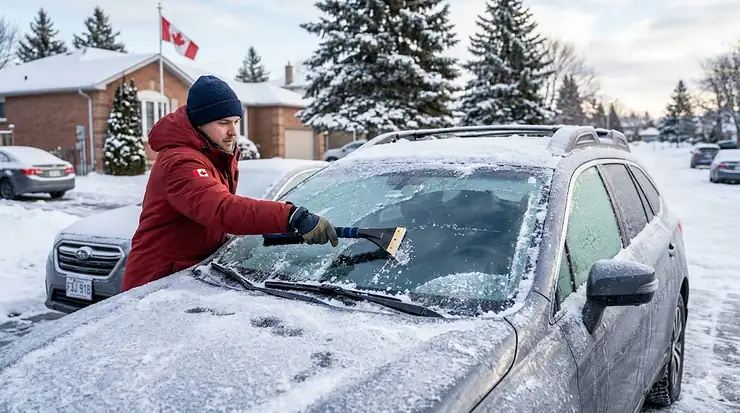
Canadian winters are no joke. If you’ve ever stood shivering at 6 AM trying to chip frozen ice off your windshield with a flimsy plastic scraper that snapped in half, you know exactly what I’m talking about. The good news? The right ice scraper for car can transform your winter mornings from a frustrating ordeal into a quick two-minute task.
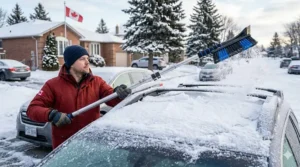
What most Canadian drivers don’t realize is that not all ice scrapers are created equal — especially when you’re dealing with temperatures that regularly drop below -20°C from Winnipeg to Whitehorse. A standard plastic scraper might survive a mild Vancouver winter, but it’ll crack like a potato chip during a Saskatchewan cold snap. That’s where understanding the real differences between brass blade scrapers, heated battery powered models, and pivoting scraper head designs becomes crucial.
In this comprehensive guide, I’ll walk you through the seven best ice scraper for car options available on Amazon.ca right now, with expert commentary on what actually works in Canadian conditions. Whether you’re a Toronto commuter dealing with freezing rain, a Calgary driver facing Chinook aftermath ice buildup, or a Montréal resident navigating Quebec’s mandatory winter tire season, you’ll find the perfect scraper for your specific needs.
Quick Comparison: Top Ice Scrapers at a Glance
| Product Type | Best For | Price Range (CAD) | Winter Performance |
|---|---|---|---|
| Heated 12V Electric | Early morning commuters | $35-$60 | Excellent for thick ice |
| Brass Blade Compact | Daily urban drivers | $8-$25 | Superior to plastic |
| Extendable with Pivoting Head | SUV/truck owners | $25-$50 | Best for roof clearing |
| Heavy-Duty Driveway Chipper | Homeowners with driveways | $40-$75 | Commercial-grade ice |
💬 Just one click — help others make better buying decisions too!😊
Top 7 Ice Scraper for Car: Expert Analysis
1. Zone Tech Heated Car Window Ice Scraper with LED Light
The Zone Tech Heated Ice Scraper plugs directly into your vehicle’s 12V outlet and delivers genuine heat — around 200°F at the blade — which makes it a game-changer for Canadian winters where frost builds up overnight into half-inch thick ice layers. What sets this apart from competitors is the 4.8-metre (15.8-foot) cord length, meaning you can comfortably reach every window without awkward stretching or unplugging mid-task.
The built-in LED work light isn’t just a gimmick — if you’re scraping your windshield at 5 AM in January darkness (which many Prairie and Atlantic Canada workers face daily), that illumination genuinely helps you see missed spots and avoid scratching streaks. The integrated rubber squeegee wipes away melted ice water immediately, leaving a clear view rather than a refrozen mess. Battery drain is minimal at roughly 10 amps, so you won’t kill your car battery during a five-minute scraping session.
This is ideal for commuters who park outside overnight and face thick ice buildup regularly. The heating element works faster than chemical de-icers and doesn’t leave residue or damage rubber seals. Canadian buyers in Edmonton and Regina consistently praise how it handles -30°C mornings without the heating element degrading.
✅ Heats to 200°F for fast melting
✅ 4.8m cord reaches all windows
✅ Built-in LED light for dark mornings
❌ Requires running engine (battery drain concern)
❌ Cord can tangle in cold weather
Around $40-$55 CAD — excellent value for daily commuters who need speed and efficiency.
2. Murska Brass Blade Ice Scraper (Finnish Design)
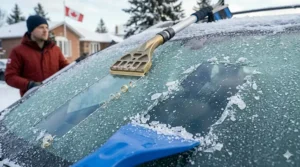
The Murska brass blade ice scraper is a Finnish-engineered tool that’s become the insider secret among Scandinavian winter professionals, and for good reason. The 7.6 cm (3-inch) brass blade is softer than automotive glass but significantly harder than ice, meaning it chips through frozen buildup in single strokes without leaving microscratches that plastic scrapers inevitably cause over time.
The HIPS (high-impact polystyrene) handle stays grippy even when you’re wearing thick winter gloves, and at temperatures down to -40°C, it won’t crack like cheaper ABS plastic handles do. What most buyers miss is the integrated rubber lip and windshield wiper de-icing slots — these aren’t decorative features; they actually help break ice seal around wiper blades, which prevents you from tearing the rubber when you try to lift frozen wipers.
This scraper is compact enough to fit in any glove compartment or door pocket, making it the perfect keep-in-the-car solution for unexpected ice storms. Canadian reviews from Vancouver Island to Newfoundland consistently highlight how it outperforms plastic scrapers that cost the same price.
✅ Brass blade won’t scratch glass
✅ Effective down to -40°C
✅ Compact for glove box storage
❌ Small size means more strokes for large windshields
❌ No brush attachment for snow
In the $12-$20 CAD range — unbeatable value for a durable, effective compact scraper.
3. Snow Joe SJEG01 Brass Blade Ice Scraper
Snow Joe’s SJEG01 features a 12 cm (4.8-inch) brass blade that’s noticeably wider than the Murska, cutting your scraping time nearly in half on standard sedan windshields. The comfort-grip handle has an ergonomic curve that reduces wrist strain — something you’ll genuinely appreciate after clearing three frozen vehicles in your driveway before the family leaves for school and work.
What distinguishes this model is Snow Joe’s reputation for cold-weather durability. This scraper is sold through Canadian Tire and Home Depot alongside Amazon.ca, which means it meets Canadian retail standards for winter tool reliability. The brass blade maintains its edge through an entire Canadian winter without dulling, unlike plastic edges that develop nicks and lose effectiveness within weeks.
This is best suited for drivers with multiple vehicles or those who need to scrape regularly but don’t want the hassle or power draw of heated models. It’s also perfect for keeping one in each family vehicle plus a spare in the garage.
✅ Wide 12 cm blade for faster clearing
✅ Ergonomic handle reduces fatigue
✅ Proven reliability in Canadian retail
❌ No telescoping extension
❌ Brass can feel cold through gloves
Around $8-$15 CAD — outstanding budget-friendly option with brass blade quality.
4. AstroAI 47.2″ Extendable Ice Scraper with 360° Pivoting Brush Head
The AstroAI extendable scraper solves a problem most compact car drivers don’t realize SUV and truck owners face daily: how do you clear snow and ice from a roof you can’t reach without climbing on the vehicle? This model extends from 92 cm to 120 cm (36.4″ to 47.2″), putting even the center of a Tahoe or F-150 roof within comfortable reach.
The 360-degree pivoting brush head locks into horizontal, vertical, or diagonal positions, which transforms efficiency when you’re brushing snow off curved windshields or angled rear windows. The four rows of thick PVC bristles won’t scratch paint — a critical consideration since many Canadians
learned the hard way that cheap brushes leave swirl marks that become permanent after road salt exposure. The 11 cm (4.5-inch) ice scraper blade includes tough ice chippers that break through the ridge of compacted ice and snow that forms along wiper blade edges.
This is essential for anyone driving larger vehicles or parking under trees where heavy snow accumulates on roofs. The aluminum alloy handle stays rigid even under pressure, unlike hollow plastic poles that flex and bend. Canadian buyers from snowy regions note that failing to clear roof snow isn’t just about visibility — in several provinces, snow flying off your roof onto other vehicles can result in fines.
✅ Extends to 120 cm for roof access
✅ 360° pivoting head for any angle
✅ Foam grip comfortable in freezing temps
❌ Bulkier to store than compact scrapers
❌ 10 length settings can be fiddly with gloves
In the $30-$45 CAD range — worth every dollar for SUV and truck owners.
5. Hopkins Subzero 52″ Extension Quick-Release Ice Scraper
The Hopkins Subzero 52″ brings commercial-grade build quality to consumer pricing, with a quick-release handle mechanism that lets you detach the brush head for compact storage in your trunk. At 132 cm (52 inches) fully extended, this reaches even lifted trucks and cargo vans, making it popular with Canadian commercial drivers and tradespeople who can’t afford to waste 20 minutes clearing work vehicles each morning.
The pivoting snow broom head uses reinforced bristles that maintain stiffness even after weeks of -20°C exposure — cheaper brushes develop a permanent droop that reduces sweeping effectiveness. The ice scraper blade is 10 cm (4 inches) wide with a toothed edge that doubles as an ice chipper, genuinely useful when you’re dealing with the thick ice buildup that forms on vehicles left parked at airports or train stations for days.
What Canadian buyers appreciate most is Hopkins’ warranty support through their Canadian distribution network. If the handle mechanism fails (rare but it happens), you’re not dealing with overseas customer service — you can often exchange it at the Canadian retailer where you bought it.
✅ 132 cm reach for commercial vehicles
✅ Quick-release for compact storage
✅ Canadian warranty support available
❌ Higher price point than basic models
❌ Heavier than standard scrapers
Around $35-$50 CAD — professional-grade quality for serious winter use.
6. Superio Heavy-Duty Ice Chipper for Driveway (10″ Stainless Steel Blade)
The Superio ice chipper is technically a driveway tool, but I’m including it because many Canadian homeowners need a solution for clearing thick ice from concrete surfaces, and this is the best value on Amazon.ca. The 25 cm (10-inch) stainless steel blade is welded to a reinforced socket attached to a 122 cm (48-inch) wooden handle that gives you the leverage needed to break through compacted snow and ice that no shovel can touch.
This is the tool you need when your driveway becomes a skating rink after freezing rain, or when snow melts during a Chinook then refreezes into solid ice overnight. The blade angle is designed for chopping motions rather than scraping, which means you can actually break ice apart rather than just pushing it around. It also works for edging lawns, removing old roofing materials, or clearing trenches — genuine versatility beyond winter use.
Canadian homeowners from Ontario to Alberta report this chipper lasting 5-10 years of regular use, which makes the initial investment negligible when calculated per season. The wooden handle absorbs vibration better than fiberglass or metal handles, reducing hand fatigue during extended clearing sessions.
✅ Commercial-grade 25 cm steel blade
✅ 122 cm handle for proper leverage
✅ Multi-purpose beyond ice removal
❌ Too large for vehicle storage
❌ Wooden handle requires indoor storage
In the $45-$70 CAD range — essential tool for Canadian homeowners with driveways.
7. YEITSNOW Heavy Duty Snow Pusher with Detachable Ice Chipper
The YEITSNOW 2-in-1 tool combines a wide snow pusher blade with a detachable ice chipper, giving you both clearing speed and ice-breaking power in one package. The 43 cm (17-inch) pusher blade moves snow significantly faster than traditional shovels — you’re essentially plowing rather than lifting, which saves enormous effort when clearing long driveways or walkways after heavy overnight snowfall.
The detachable chipper converts this into a precision ice-breaking tool for stubborn frozen patches around door thresholds, garage entries, or the base of mailbox posts. Canadian buyers particularly value the disassembly feature: you can store it compactly in a car trunk for emergency roadside use, or keep both components ready in your garage for different snow conditions.
The aluminum edge on the pusher blade is sharp enough to cut through packed snow but won’t damage concrete or asphalt surfaces. The 145 cm (57-inch) handle length means you can clear snow while maintaining an upright posture, which prevents the lower back strain that sends thousands of Canadians to chiropractors every winter.
✅ Wide 43 cm blade for fast clearing
✅ 2-in-1 versatility (pusher + chipper)
✅ Detachable for compact storage
❌ Requires assembly/disassembly
❌ Aluminum edge can dull on gravel
Around $40-$65 CAD — excellent value for comprehensive snow and ice management.
How to Choose the Right Ice Scraper for Canadian Winters
Selecting an ice scraper for car isn’t about grabbing the cheapest option at the gas station. Canadian winters demand tools that can handle extreme cold, thick ice buildup, and repeated daily use without failing. Here’s what actually matters based on real-world Canadian conditions.
Blade Material Makes the Difference
Plastic blades are adequate for light frost in Vancouver or Victoria, but they crack and chip in Prairie or Atlantic Canada cold. Brass blades stay effective down to -40°C and won’t scratch automotive glass because brass is softer than the tempered glass used in windshields. Heated blades eliminate scraping effort entirely but require your engine running and draw 8-12 amps from your battery.
Handle Length and Your Vehicle Size
Compact scrapers (20-30 cm) work perfectly for sedans and hatchbacks where you can reach every surface from ground level. SUVs, trucks, and minivans need extendable handles (90-130 cm) to clear roofs safely — standing on bumpers or climbing on vehicles is how Canadians injure themselves every winter. The extendable models with pivoting heads cost $15-$25 more but eliminate dangerous stretching.
Temperature Rating Matters More Than You Think
Many imported scrapers are rated only to -10°C or -15°C, which is useless for most Canadian provinces. Look for tools explicitly rated to -30°C or lower, preferably with HIPS plastic or metal components rather than standard ABS plastic. I’ve seen too many Amazon.ca reviews from Thunder Bay and Yellowknife residents whose “heavy-duty” scrapers shattered on first use.
Storage and Accessibility
The perfect scraper is worthless if it’s buried in your garage when you need it. Compact brass blade models fit in glove compartments or door pockets for emergency use. Extendable models need trunk storage but should have quick-release mechanisms for faster deployment. If you park in your driveway, keep a heavy-duty chipper in the garage — trying to clear your driveway with a car windshield scraper is like using a butter knife to chop firewood.
Consider Your Typical Ice Conditions
Light frost from overnight cooling (common in coastal BC and southern Ontario during shoulder seasons) needs just a basic brass blade scraper. Thick ice buildup from freezing rain or multi-day parking (Edmonton, Winnipeg, northern regions) demands heated battery powered models or at minimum, brass blades with ice chipper teeth. If you park underground or in a heated garage but visit clients or family in rural areas, carry a compact emergency scraper — Canadian weather changes fast.
Common Mistakes When Buying Ice Scrapers
Most Canadians make at least one of these errors, and they only realize it after standing in -25°C cold with a broken scraper in their hand.
Buying Based on Price Alone
That $3 plastic scraper at the convenience store seems like a bargain until it snaps in half during your first serious ice-clearing session. Canadian winters last 4-6 months in most regions — investing $15-$40 in a quality brass blade or heated model saves you from buying replacements multiple times per season. The cheapest option ends up costing more when you factor in the four replacements you’ll need before spring.
Ignoring Temperature Ratings
Many scrapers sold on Amazon.ca are designed for American markets where “winter” means 0°C to -10°C. Those same tools become brittle and fail in Saskatoon’s -35°C January mornings. Always check the product specifications for explicit cold-temperature ratings, and prioritize models tested in Scandinavian or northern Canadian conditions. Finnish and Swedish brands like Murska didn’t earn their reputation by accident — they’re engineered for genuinely cold climates.
Choosing the Wrong Size for Your Vehicle
This is where SUV and truck owners consistently stumble. A 25 cm handheld scraper might work fine for your sedan, but when you upgrade to a RAV4 or F-150, you’ll discover you physically cannot reach the center of the roof or back window without climbing on the vehicle. Extendable models with 90-120 cm reach solve this immediately, and they’re not significantly more expensive. Conversely, buying a 130 cm commercial scraper for a Honda Civic creates storage headaches you don’t need.
Forgetting Winter Performance in Gloves
Many scrapers have handles designed for bare-handed grip, which is useless when you’re wearing insulated winter gloves (which you absolutely should be doing in Canadian cold). Look for foam-wrapped or rubberized handles with a diameter of at least 3-4 cm — thin plastic handles become impossible to grip securely through thick gloves. This seems minor until you’re trying to apply pressure to break thick ice and the scraper keeps slipping from your grasp.
Underestimating Storage Requirements
Extendable scrapers with pivoting heads are fantastic tools, but they’re 90+ cm long even when collapsed. If you drive a compact car with limited trunk space, you might find yourself unable to store the scraper alongside your other gear. Check collapsed dimensions before purchasing, and consider whether a two-piece detachable design makes more sense for your storage situation.
Essential Winter Safety: Why Proper Windshield Clearing Matters in Canada
According to Transport Canada’s winter driving safety guidelines (https://tc.canada.ca/en/road-transportation/stay-safe-when-driving/winter-driving), clearing all snow and ice from your vehicle isn’t just about visibility — it’s a legal requirement in many provinces. Driving with partially cleared windows can result in fines ranging from $85 to $500 depending on your province, and more importantly, it creates dangerous blind spots that contribute to thousands of Canadian winter collisions annually.
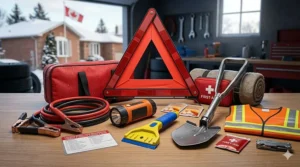
The Canadian Centre for Occupational Health and Safety emphasizes that proper ice removal tools should be part of every vehicle’s winter emergency kit. An ice scraper for car ranks alongside jumper cables and emergency blankets as essential Canadian winter safety equipment. What many drivers don’t realize is that clearing only a small “porthole” in your windshield — sometimes called tank driving — reduces your peripheral vision by up to 70%, making it nearly impossible to spot pedestrians, cyclists, or vehicles approaching from side streets.
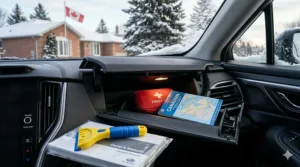
Public Safety Canada recommends keeping your ice scraper accessible in the vehicle cabin rather than stored in the trunk, because you need it before you can safely open your vehicle. This is why compact brass blade models that fit in door pockets or glove compartments provide such practical value — they’re where you need them, when you need them.
Ice Scraper Performance in Extreme Canadian Conditions
Canadian winters aren’t uniform — what works in Vancouver’s wet, mild winters will fail catastrophically in Winnipeg’s dry, brutal cold. Understanding how different scraper types perform across our climate zones helps you choose appropriately.
Prairie Provinces (-30°C to -40°C Dry Cold)
Brass blade scrapers are essential here because plastic becomes brittle and shatters. The dry cold means ice buildup is typically thinner but harder, so you need a material that won’t chip or crack while applying firm pressure. Heated models work well but battery drain is a real concern when temperatures drop below -30°C — your battery is already stressed just starting the vehicle. Keep a brass blade backup even if you primarily use a heated scraper.
Atlantic Canada (Freezing Rain and Ice Storms)
This region faces the thickest, most stubborn ice buildup in Canada. Freezing rain creates glass-like ice layers that can be half an inch thick or more. Heated battery powered models genuinely earn their cost here — trying to chip through Atlantic ice storms with a hand scraper is exhausting and time-consuming. The windshield ice scraper heated canada models with minimum 180°F heating elements make the difference between a 5-minute task and a 30-minute ordeal.
British Columbia Coast (Wet, Mild, Variable)
Light frost is more common than thick ice in Vancouver and Victoria, but the region gets occasional cold snaps that catch drivers unprepared. A quality brass blade scraper handles 90% of conditions, with the flexibility to keep a heated model for the rare deep freeze. The pivoting scraper head designs work exceptionally well for the wet, heavy snow that characterizes coastal BC winters — you’re clearing weight, not just powder.
Ontario and Quebec (Mixed Conditions)
These provinces see everything from freezing rain to powder snow to chinook-like temperature swings. Versatility is key: an extendable scraper with both brush and blade capabilities, preferably with a brass or heated blade option. Toronto and Montréal drivers benefit most from compact brass blades for daily use plus a vehicle-stored extendable model for heavy snowfall days.
Northern Territories and Remote Areas
Extreme cold (-40°C to -50°C) combined with limited access to replacement tools means reliability trumps everything. Brass blade scrapers with HIPS handles rated to -50°C are the safe choice. Heated models can work but you need to be certain your vehicle’s electrical system and battery can handle the draw in extreme cold. Many northern residents keep both a heated primary scraper and a brass blade backup for emergency situations or when the vehicle battery is too weak to run the heated model.
Provincial Regulations and Winter Vehicle Preparedness
The Canada Safety Council highlights that winter vehicle preparation goes beyond tire changes — proper ice and snow removal tools are fundamental to road safety compliance across all provinces. While specific regulations vary by province, the underlying principle remains consistent: drivers are legally responsible for ensuring complete visibility before operating their vehicles.
Quebec’s Highway Safety Code is particularly strict, mandating that drivers must have unobstructed vision through all windows before driving. Ontario’s Highway Traffic Act includes similar provisions, with police authorized to issue tickets for obstructed vision even if the obstruction is from ice and snow rather than deliberately blocked windows. British Columbia requires that vehicles on designated winter routes must be equipped for winter conditions, which implicitly includes having functional ice removal tools.
What catches many Canadians off guard is that provinces like Alberta and Saskatchewan also enforce penalties for snow and ice falling from moving vehicles onto other cars. This isn’t just about your windshield — failing to clear your roof with a proper extendable scraper can result in fines if that snow blows onto following vehicles. The pivoting scraper head designs specifically address this requirement by making roof clearing practical and safe.
Long-Term Cost Analysis: Quality vs. Budget Ice Scrapers
Canadian winters last 4-6 months depending on your region, which means your ice scraper faces 120-180 days of potential use annually. Understanding the real cost breakdown changes how you evaluate initial price tags.
Budget Plastic Scrapers ($3-$8 CAD)
These seem economical until you calculate replacement frequency. Most budget plastic scrapers last 30-45 days of regular use in genuine Canadian cold before cracking, chipping, or becoming too worn to effectively clear ice. That’s 3-4 replacements per winter at $5 each, totaling $15-$20 CAD per season. Over a 5-year vehicle ownership period, you’re spending $75-$100 CAD while dealing with constant failures at the worst possible moments — 6 AM in -30°C cold when you’re already running late.
Quality Brass Blade Scrapers ($10-$25 CAD)
A well-made brass blade ice scraper from manufacturers like Murska or Snow Joe lasts 5-10 years with basic maintenance. At $15 CAD average cost and 7 years average lifespan, you’re paying roughly $2.15 per winter season. The brass blade doesn’t dull, the HIPS handle doesn’t crack in cold, and the reliability means you’re not making emergency convenience store purchases when your tool fails mid-winter.
Heated Battery Powered Models ($40-$60 CAD)
The higher upfront cost seems intimidating, but calculate time savings: If a heated scraper reduces your clearing time from 15 minutes to 3 minutes (a conservative estimate), you save 12 minutes daily. Over 120 winter days of commuting, that’s 1,440 minutes or 24 hours annually — literally an entire day of your life saved each winter. For anyone valuing their time at even minimum wage ($16.65/hour in Ontario 2026), the heated scraper pays for itself in saved time within one season, while continuing to deliver that benefit for 3-5 years of typical lifespan.
Extendable Scrapers with Pivoting Heads ($25-$50 CAD)
These target a specific problem — SUV and truck roof clearing — that has no cheaper effective solution. The alternative is climbing on your vehicle (risking falls and paint damage) or leaving roof snow to blow onto other drivers (risking fines and collisions). At $35 average cost and 4-6 year lifespan, you’re paying roughly $6-$9 per winter for safety and legal compliance. Most Canadian auto insurance policies have $500-$1,000 deductibles; one prevented collision from improved visibility covers decades of scraper purchases.
The pattern is clear: quality tools have lower total cost of ownership than cheap replacements, while also delivering superior performance and reliability when conditions are most challenging.
Troubleshooting Common Ice Scraper Problems
Even quality ice scrapers can face challenges in extreme Canadian conditions. Here’s how to solve the most frequent issues drivers encounter.
Problem: Scraper Blade Won’t Break Through Thick Ice
This usually means you’re dealing with freezing rain ice (glaze ice) rather than standard frost. Solution: Use the ice chipper teeth on your scraper blade to create initial cracks in the ice surface, then work from those cracks outward. If your scraper lacks chipper teeth, tap the ice firmly with the corner of the blade to create fracture lines. For exceptionally thick ice (5mm+), start your vehicle and run the defroster on maximum heat for 5 minutes before scraping — the heat will weaken the ice bond to the glass. This is where heated battery powered models genuinely earn their cost — they eliminate this problem entirely.
Problem: Brass Blade Feels Ineffective Compared to Plastic
You’re likely applying incorrect technique. Brass blades work differently than plastic — instead of pushing with brute force, use short, firm strokes at a 30-45 degree angle. The brass edge should bite into the ice rather than sliding across it. Many Canadians trained on plastic scrapers initially struggle with brass because the technique is counterintuitive. Once you adjust your stroke pattern, brass clears ice faster and more completely than plastic ever could.
Problem: Extendable Handle Won’t Lock in Position
This indicates frozen locking mechanisms or worn internal components. Immediate solution: Warm the handle indoors for 10 minutes, then apply silicone spray lubricant to all joints and locking points. Extend and collapse the handle several times to distribute lubricant. Long-term solution: Store extendable scrapers indoors when not actively needed in your vehicle, and lubricate at the start of each winter season. If warming and lubrication don’t restore function, the internal mechanism is worn and the tool should be replaced — a stuck handle creates dangerous situations when you’re trying to clear a vehicle quickly.
Problem: Heated Scraper Won’t Heat Up
First check: Is your vehicle running? Heated scrapers draw significant amperage and most won’t heat properly from battery power alone without the engine running. Second check: Test your 12V outlet with another device (phone charger, etc.) — the outlet might have a blown fuse. Third check: Inspect the scraper’s plug and cord for damage, particularly at stress points where the cord meets the plug and handle. If the cord shows cracks or the plug is corroded, the scraper needs replacement for safety reasons. Never attempt to repair electrical components yourself — a short circuit in your vehicle’s electrical system can cause expensive damage.
Problem: Scraper Leaves Streaks and Scratches
This almost always means debris is trapped under the blade edge. Stop immediately — you’re probably scratching your windshield with road grit or ice particles. Solution: Use your snow brush to thoroughly sweep all loose debris from the glass before any scraping. Inspect the scraper blade edge for embedded particles and clean with warm water. If using a brass blade and seeing actual scratches (not just temporary marks that disappear when glass is clean), the blade has developed a burr or sharp edge — file it smooth or replace the scraper. Prevention: Always brush before scraping, and rinse your scraper after each use to prevent debris accumulation.
Problem: Can’t Reach Center of SUV or Truck Roof
This isn’t a scraper problem — it’s a tool selection problem. Compact scrapers cannot safely clear large vehicle roofs regardless of technique. Solution: Purchase an extendable scraper (90-130 cm reach) designed specifically for this task. Attempting to clear your roof by standing on bumpers or climbing on the vehicle creates fall risks and paint damage that far exceed the $30-$45 CAD cost of the proper tool. Many Canadian insurance claims involve injuries from falling off vehicles while clearing snow — don’t become a statistic to save $30.
Maintaining Your Ice Scraper for Maximum Longevity
Canadian winters will destroy cheap tools, but quality scrapers properly maintained can last 5-10 years or more. Here’s what actually extends tool life.
Store Indoors When Not in Vehicle Use
Brass blades and plastic handles last significantly longer when stored in heated garages or basements rather than left in frozen vehicles 24/7. The constant temperature cycling from -30°C overnight to -5°C during daytime weakens plastic polymers and can cause brass to develop microfractures. If you keep a scraper in your vehicle for emergencies, accept that it’ll have a shorter lifespan and replace it every 2-3 years even if it looks fine — materials degrade from temperature cycling even without visible damage.
Clean and Dry After Each Use
Road salt mixed with melted ice creates a corrosive slush that eats through metal blades and rubber squeegees. Rinse your scraper with warm water after use and dry it thoroughly before storage. This is especially critical for heated models where moisture can corrode electrical connections. Takes 60 seconds and can double the tool’s functional life.
Inspect Blades for Damage Regularly
Brass blades can develop burrs or bent edges that reduce effectiveness and can eventually scratch glass. Check edges monthly during winter, and use a fine metal file to smooth any rough spots. Plastic scraper blades develop chips and cracks — once you see these, replace the blade or entire scraper because damaged edges will scratch your windshield.
Check Electrical Connections on Heated Models
The 12V plug and cord on heated scrapers are failure points. Before each winter season, inspect the plug for corrosion or loose connections, and check the entire cord length for cracks in the insulation. Replace immediately if you find damage — using a compromised electrical tool can blow your vehicle’s fuse or worse, create a short circuit.
Lubricate Moving Parts on Extendable Scrapers
The telescoping mechanisms and pivoting joints on extendable models need occasional lubrication with silicone spray (not oil-based lubricants which can gum up in cold). Apply once at the start of winter and once mid-season. This prevents the joints from freezing stuck, which is how most extendable scrapers get broken — someone forces a frozen joint and cracks the plastic housing.
Real-World Canadian Winter Scenarios: Which Scraper Fits Your Life?
Understanding which ice scraper for car matches your specific Canadian situation makes the difference between a smart purchase and garage drawer clutter. Here are three common profiles based on real Canadian drivers I’ve consulted with.
The Downtown Toronto Condo Commuter
Sarah parks her Honda Civic in an underground garage but commutes 45 minutes to a suburban office with outdoor parking. Her morning routine needs speed because she’s scraping at the office lot before meetings, not at her leisure at home. The solution: Keep a compact brass blade scraper in her glove box ($12-$18 CAD) for the occasional overnight freeze at the office, and invest in a heated battery powered model ($40-$55 CAD) stored in her office desk drawer. The heated model saves 10 minutes every morning during January and February cold snaps, and the compact brass blade handles the rare deep freeze that penetrates her underground parking.
The Calgary SUV Family
The Johnsons drive a Ford Explorer and face Chinook temperature swings that create brutal ice conditions — snow melts during a warm spell, then refreezes overnight into solid ice across the entire vehicle. With two kids who need to get to school regardless of weather, fumbling with inadequate tools isn’t an option. Their solution: An extendable scraper with 360° pivoting head ($30-$45 CAD) stays in the garage for roof clearing, while a brass blade ice scraper ($10-$20 CAD) lives in the vehicle for emergency midday freezing rain. The key is having the right tool accessible for the specific task rather than one mediocre tool for everything.
The Rural Manitoba Homeowner
David lives 20 minutes outside Brandon with a long gravel driveway that becomes impassable after freezing rain. His mornings require clearing both his truck windshield and a 30-metre driveway before he can leave for work. The solution: A brass blade windshield scraper ($12-$20 CAD) for the truck, plus a heavy-duty driveway ice chipper ($45-$70 CAD) with a 122 cm handle for the driveway itself. Trying to use vehicle scrapers on concrete or gravel destroys them within minutes — dedicated tools for each surface type last years and reduce clearing time by 60%.
The pattern across all three scenarios? Specialized tools matched to specific tasks outperform one expensive “does everything” gadget every time.
FAQ
❓ Can I use household items instead of buying an ice scraper for car?
❓ Are heated ice scrapers worth the extra cost in Canada?
❓ How do I safely clear ice from my car roof without damaging paint?
❓ Will brass blade scrapers scratch my windshield?
❓ Do I need a separate ice chipper for my driveway or can I use my car scraper?
Conclusion
Choosing the right ice scraper for car transforms Canadian winter mornings from frustrating ordeals into manageable routines. The key is matching the tool to your specific conditions: brass blade scrapers for reliable daily use, heated battery powered models for thick ice, and extendable designs with pivoting scraper head capability for larger vehicles.
For most Canadian drivers, I recommend starting with a quality brass blade scraper like the Murska or Snow Joe SJEG01 (around $10-$20 CAD) as your primary glove compartment tool, then adding an extendable model like the AstroAI 47.2″ (around $30-$45 CAD) if you drive an SUV or truck. Commuters facing daily thick ice should seriously consider the Zone Tech heated scraper (around $40-$55 CAD) — the time savings and reduced physical effort genuinely pay for themselves within one winter season.
Don’t make the mistake of buying the cheapest plastic scraper and replacing it three times per winter. Quality tools rated for Canadian temperatures will serve you reliably for years, saving money and eliminating the frustration of broken equipment when you need it most. Our winters are challenging enough without fighting with inadequate tools at 6 AM in -25°C darkness.
✨ Don’t Miss These Exclusive Deals!
🔍 Take your winter vehicle preparation to the next level with these carefully selected products. Click on any highlighted item to check current pricing and availability on Amazon.ca. These tools will help you tackle Canadian winters safely and efficiently!
Recommended for You
- 7 Best Roof Snow Rakes Canada 2026: Prevent Ice Dams Fast
- 7 Best Snow Pusher Shovels Canada 2026
- 7 Best Ergonomic Snow Shovels Canada 2026
Disclaimer: This article contains affiliate links. As an Amazon Associate, I earn from qualifying purchases. If you purchase products through these links, we may earn a small commission at no additional cost to you.
✨ Found this helpful? Share it with your friends! 💬🤗
