
In This Article
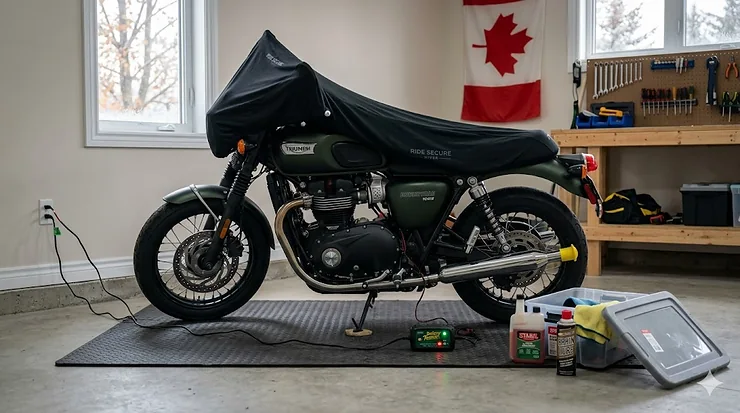
The first snowfall always catches someone off guard. You’ll see them scrambling through Canadian Tire parking lots, desperately hunting for a tarp while their pride and joy sits exposed to the elements. Don’t be that rider. When temperatures plummet to -30°C in Winnipeg or salt trucks blanket Toronto streets, proper winter storage isn’t optional—it’s the difference between firing up your bike next April or facing a four-figure repair bill.
Motorcycles represent a significant investment for most Canadians, with the average sport bike costing around $12,000-$18,000 CAD new. But here’s what surprises most first-time winter storers: the real damage doesn’t come from cold alone. It’s the moisture cycling, the condensation forming inside your engine, the corrosive salt residue from that last October ride, and the fuel degrading into varnish that clogs your carburetor. I’ve watched perfectly good bikes emerge from winter storage as garage queens that won’t even turn over.
The good news? Protecting your motorcycle through Canadian winters doesn’t require professional storage fees running $400-$600 per season. With the right motorcycle winter storage products—most costing under $200 CAD total—you can preserve your bike’s condition at home while avoiding the spring revival headaches. This comprehensive guide examines seven essential products available on Amazon.ca, from waterproof covers engineered for -40°C temperatures to battery maintainers that prevent the sulfation killing 60% of stored motorcycle batteries. Each recommendation addresses the specific challenges of Canadian climate: extreme temperature swings, high humidity, road salt contamination, and extended storage periods lasting five to six months in provinces like Saskatchewan and Manitoba.
Whether you’re storing a cruiser in a heated garage in Vancouver or parking a sport bike in an unheated shed in rural Ontario, these products form the foundation of proper winterization. Let’s explore how spending $150-$250 CAD on the right storage essentials today saves you from $1,000+ in preventable damage come spring.
Quick Comparison: Top Motorcycle Winter Storage Solutions
| Product Type | Price Range (CAD) | Best For | Key Feature |
|---|---|---|---|
| Waterproof Cover | $50-$90 | All climates | 210D Oxford fabric, -40°C rated |
| Battery Tender | $45-$85 | Heated/unheated storage | Smart charging, prevents sulfation |
| Fuel Stabilizer | $15-$35 | 6-month storage | Keeps fuel fresh 24 months |
| Motorcycle Stand | $60-$120 | Preventing tire flat spots | Takes weight off suspension |
| Exhaust Plug | $12-$25 | High humidity areas | Blocks moisture/condensation |
| Oil Change Kit | $40-$70 | All bikes | Removes contaminants pre-storage |
| Tire Care Products | $25-$50 | Long-term storage | Prevents dry rot, maintains pressure |
Looking at these options, riders in the Prairies dealing with extreme cold should prioritize the battery tender and heavy-duty cover combination, investing around $130 CAD total. For coastal riders in BC facing high humidity but milder temperatures, focus your budget on fuel stabilization and exhaust protection—about $50 CAD will handle both. Urban riders storing bikes in unheated Toronto condos absolutely need the stand and cover to prevent flat-spotting and theft, running roughly $150 CAD combined. Notice how the fuel stabilizer delivers the best value at just $15-$35 CAD—this single product prevents the most common spring startup issue (clogged fuel system) affecting nearly 40% of improperly stored motorcycles.
💬 Just one click — help others make better buying decisions too! 😊
Top 7 Motorcycle Winter Storage Products: Expert Analysis
1. Dowco Guardian WeatherAll Plus Motorcycle Cover
If you’re storing outdoors anywhere in Canada, the Dowco Guardian represents the gold standard for year-round protection. This isn’t your basic tarp—the 300-denier polyester construction with heat-sealed seams creates a genuine moisture barrier that withstands Prairie windstorms and Maritime downpours equally well. The soft fleece underbelly won’t scratch your paint during those brutal temperature swings from -25°C at night to +5°C during February warm spells.
What makes this cover exceptional for Canadian conditions is the multiple venting systems. Cheap covers trap condensation underneath, turning your bike into a rust incubator. The Dowco’s strategically placed vents allow air circulation while the taped seams keep precipitation out—critical when you’re dealing with five months of freeze-thaw cycles. The integrated cable lock grommets matter more than you’d think; motorcycle theft spikes 35% during winter months when bikes sit unattended for weeks.
Canadian riders consistently praise this cover’s durability through multiple winters, with many reporting 4-5 seasons of use before needing replacement. The elastic bottom hem stays secure even when January winds hit 80 km/h, and the contrasting stitching makes nighttime visibility excellent if you’re storing on a shared property. Size selection matters here—measure your bike with mirrors and opt for the next size up if you’re between ranges. The XXL accommodates touring bikes with luggage, while sportbikes typically need XL.
Pros:
✅ Heat-sealed seams prevent moisture penetration in Canadian wet/dry cycles
✅ Fleece interior protects paint through temperature extremes
✅ Multiple vent systems eliminate condensation buildup
Cons:
❌ Higher upfront cost at $85-$110 CAD
❌ Bulky when stored during riding season
Available in the mid-$90s CAD range on Amazon.ca, this cover costs about what two oil changes run—but prevents far more expensive weather damage over multiple seasons.
2. Battery Tender Junior 12V 750mA Maintainer
Dead batteries account for 60% of spring startup failures across Canada, and here’s why: modern motorcycles draw power constantly through clocks, alarms, and ECUs. Even in storage, your battery slowly discharges—faster in cold temperatures. By March, a fully charged battery left disconnected will barely turn over your engine. The Battery Tender Junior solves this completely.
This isn’t a trickle charger—it’s smarter. The microprocessor monitors voltage and switches between bulk charging and float maintenance automatically. What this means in practice: plug it in October, leave it all winter, and return to a battery reading 12.6V in April. It works with all 12V lead-acid types (flooded, AGM, gel) and newer lithium batteries, making it compatible with 95% of motorcycles sold in Canada. The spark-proof connection and reverse polarity protection prevent the kind of mistakes that damage batteries during hookup.
Canadian winters test batteries severely. At -30°C, a battery loses roughly 60% of its cranking power—combine that with months of parasitic drain and you’re looking at replacement costs of $150-$250 CAD. The Tender’s 750mA output provides enough current to maintain charge without overheating in heated garages or overshooting voltage limits. The two-colour LED tells you exactly what’s happening: red means charging, green indicates full charge and maintenance mode. Many riders leave it connected for the entire storage period, which the manufacturer explicitly endorses.
Installation takes five minutes. Connect the ring terminal leads to your battery posts, route the quick-disconnect cable somewhere accessible, and plug in the tender. Next autumn, you’ll just clip on and forget it. Riders with multiple bikes often purchase several units because once you’ve experienced reliable spring starts, you won’t go back to jump-starting adventures.
Pros:
✅ Prevents sulfation—the #1 killer of stored motorcycle batteries in Canadian cold
✅ Works with all battery types including expensive lithium units
✅ Five-year warranty covers multiple storage seasons
Cons:
❌ Requires outlet access in your storage location
❌ Initial setup involves opening seat/side panels for battery access
At around $55-$70 CAD on Amazon.ca, it pays for itself by extending one battery’s life through just two winters instead of premature replacement.
3. STA-BIL Storage Fuel Stabilizer 236mL
Fuel degradation ruins more carburetors and injectors than anything else during Canadian storage periods. Here’s what happens without stabilizer: modern ethanol-blended gasoline starts breaking down within 30 days, forming gummy varnish deposits that clog jets, stick float needles, and coat fuel injectors. Come spring, you’re facing $300-$600 CAD in carburetor cleaning or injector service—all preventable with a $20 bottle of STA-BIL.
This isn’t just marketing hype—STA-BIL’s formulation actually works through multiple mechanisms. The anti-oxidant package prevents fuel from reacting with oxygen and forming gum. The corrosion inhibitors protect metal fuel system components from ethanol’s hygroscopic properties (it attracts moisture from air). The detergent package keeps existing deposits from hardening. Together, these additives extend gasoline’s usable life from one month to 24 months, more than covering a six-month Canadian winter.
The proper technique matters. Fill your tank to 95% (leaves expansion room for temperature changes), add STA-BIL at a ratio of 30 mL per 10 litres of fuel, then run the engine for 5-10 minutes. This last step is critical—you need stabilized fuel throughout the entire fuel system, from tank to carburetors to injector rails. Many riders make the mistake of adding stabilizer without running the engine, leaving untreated fuel sitting in their carbs all winter.
Canadian riders appreciate that STA-BIL works in both regular and premium gasoline, with or without ethanol. It also functions in 2-stroke premix, making it suitable for dirt bikes and vintage motorcycles. The 236mL bottle treats 60 litres—enough for most sport bikes’ tanks with multiple applications, or treating your bike plus your lawn equipment before storage.
Pros:
✅ Prevents varnish buildup that clogs Canadian riders’ carbs during 5-6 month storage
✅ One bottle treats 60L—handles most bikes plus small engines
✅ Works in all gasoline types including ethanol blends
Cons:
❌ Must run engine 5-10 minutes to circulate—difficult in already-cold weather
❌ Doesn’t reverse existing fuel system damage from previous unstabilized storage
Priced at $18-$28 CAD on Amazon.ca, it’s the cheapest insurance policy you’ll buy this season.
4. VEVOR Motorcycle Rear Paddock Stand (U+L Fork Type)
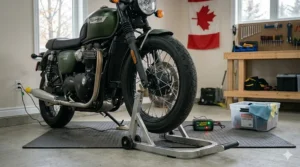
Tire flat-spotting ranks among the most underestimated storage issues Canadian riders face. When a loaded motorcycle sits stationary for six months, the constant pressure on the same tire section creates permanent flat spots—especially in cold temperatures when rubber loses flexibility. These flat spots cause uncomfortable vibration at highway speeds and can necessitate $400-$600 CAD in premature tire replacement. A quality paddock stand eliminates this entirely.
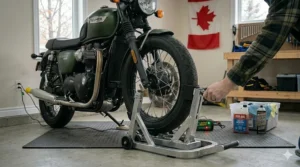
The VEVOR stand impresses through its build quality relative to price point. The industrial-grade steel construction with powder-coated finish handles up to 385 kg (850 lbs)—sufficient for everything from 250cc sportbikes to fully-loaded adventure tourers. The U-shaped and L-shaped fork adaptors accommodate different swingarm designs, fitting most Japanese bikes (Yamaha, Honda, Kawasaki, Suzuki) and many European models. The adjustable width range of 26.7-34.3 cm covers 90% of motorcycles sold in Canada.
What separates this from cheaper alternatives is stability. The wide-stance base design with four rubberized contact points prevents tipping during Canadian garage temperature swings when concrete floors become slippery with condensation. The integrated carrying handle makes repositioning easy, and the two smooth-rolling casters allow you to shift your bike around the garage without wrestling the full weight. This mobility proves invaluable when you need access to the back wall in February or want to rearrange winter storage items.
Usage technique matters for safety. Always lift from both sides simultaneously using the foot pedals, keeping your back straight and using leg strength. The stand clicks into place with an audible confirmation—never trust a silent lift. For bikes without spool mounts, you’ll need to purchase separate spools, but most riders find the $15 CAD investment worthwhile for the convenience of repeated use. The stand also facilitates winter maintenance tasks like chain lubrication, brake inspection, and wheel removal if spring arrives and you want to install new rubber.
Pros:
✅ Eliminates tire flat-spotting during 5-6 month Canadian storage periods
✅ Enables easy winter maintenance—chain service, brake inspection, wheel removal
✅ Sturdy construction withstands repeated use across multiple seasons
Cons:
❌ Requires separate spool bolt installation for bikes lacking OEM mounting points
❌ Learning curve for first-time users—practice before storage day
Available around $85-$115 CAD on Amazon.ca, this accessory pays for itself by extending one set of tires through an additional season.
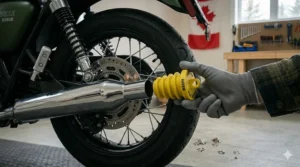
5. uxcell Universal Rubber Exhaust Plug (33-62mm)
This inexpensive component solves a problem most riders don’t realize they have until spring arrives and their exhaust system is corroded from the inside. During storage, temperature fluctuations cause warm, moist air to enter your exhaust. When temperatures drop overnight—common in Canadian garages that aren’t heated—this moisture condenses on the metal interior. Over six months, this repeated condensation cycle causes rust that can perforate mufflers and corrode catalytic converters. A simple rubber plug stops this completely.
The uxcell design uses durable rubber that maintains flexibility even at -30°C, crucial for Canadian applications. The tapered cone shape fits exhaust outlets from 33mm to 62mm diameter, covering everything from 250cc singles to 1800cc cruisers. The bright orange colour serves as a vital safety feature—you’ll spot it during spring prep, preventing the dangerous mistake of starting your bike with the exhaust blocked. Some riders add a “Remove Before Start” tag as additional insurance.
Installation takes literally ten seconds. After your final autumn ride when the exhaust is still slightly warm (this helps the plug seat better), simply press the plug into each exhaust outlet until it sits flush. Check it monthly through winter—severe temperature swings can sometimes work plugs loose, though this happens rarely with quality rubber designs. Come spring, remove all plugs before even thinking about turning the key.
Beyond moisture prevention, these plugs keep out unwanted guests. Mice and insects love dark, protected spaces during Canadian winters, and exhaust pipes provide perfect shelter. I’ve personally pulled mouse nests from stored bikes in April—not only disgusting but potentially dangerous if the blockage causes backpressure during startup. The $12-$18 CAD investment prevents both corrosion damage (hundreds of dollars to repair) and rodent infiltration.
Pros:
✅ Prevents internal exhaust corrosion from condensation during freeze-thaw cycles
✅ Blocks mice and insects seeking winter shelter
✅ Bright colour prevents dangerous startup with plugs installed
Cons:
❌ Must remember to remove before spring startup—failure causes exhaust damage
❌ Some exhausts require two plugs—doubles the cost
Typically priced around $15-$22 CAD on Amazon.ca for a set, it’s the definition of cheap insurance.
6. Motul 7100 4T 10W-40 Synthetic Engine Oil (4L)
Performing an oil change immediately before storage ranks among the most important winterization steps, yet 40% of Canadian riders skip it. Here’s why this matters: used oil contains combustion byproducts, acids, and moisture that corrode engine internals during long storage periods. Fresh oil provides a protective film coating cylinders, bearings, and valve trains, preventing rust formation that can score cylinder walls or damage bearing surfaces. This isn’t just preventative—it’s mandatory for engine longevity.
Motul 7100 4T represents the premium standard for four-stroke motorcycles, meeting JASO MA2 specifications required by most Japanese manufacturers. The 100% synthetic formulation maintains viscosity across Canada’s extreme temperature range—it flows properly for that cold April start even if your garage dropped to -25°C all winter, yet protects adequately if you’re storing in a heated space. The ester-based additive package provides superior film strength compared to conventional oils, meaning critical engine components stay protected even during the six months your bike sits stationary.
The proper pre-storage oil change sequence matters. Warm up your engine to operating temperature (this suspends contaminants in the old oil for better drainage), drain the old oil completely, replace the filter (trapping any remaining debris), fill with fresh Motul to the proper level, and run the engine for 2-3 minutes to circulate new oil throughout. This final step ensures fresh oil coats every internal surface before storage. Riders with multiple bikes often perform all oil changes in one October afternoon, making the process efficient.
Four litres handles most sportbikes and mid-size cruisers with enough left for a spring top-up. Canadian riders appreciate Motul’s wide availability and consistent quality—you won’t experience the batch-to-batch variation that plagues some budget brands. The bright blue colour makes checking fill levels and detecting leaks straightforward. While the upfront cost runs higher than conventional oils, the investment protects engines worth $8,000-$15,000 CAD.
Pros:
✅ Synthetic formula protects engines through -40°C Canadian winters
✅ JASO MA2 specification meets requirements for wet clutches
✅ Removes corrosive contaminants when changed pre-storage
Cons:
❌ Premium pricing at $55-$70 CAD per 4L jug
❌ Some older bikes require specific viscosity grades not covered by 10W-40
Available around $60-$75 CAD on Amazon.ca, factor this into annual maintenance costs rather than viewing it as optional.
7. Slime Digital Tire Gauge with Inflator (0-150 PSI)
Proper tire pressure during storage prevents both flat-spotting and sidewall cracking—two expensive problems that develop silently over Canadian winters. Most riders don’t realize tire pressure drops naturally over time, losing approximately 1-2 PSI per month. After six months of storage, severely underinflated tires develop stress cracks in sidewalls and permanent deformation in contact patches. This $25 CAD gauge prevents $600 CAD in premature tire replacement.
The Slime digital gauge provides accurate readings to 0.5 PSI, important because motorcycle tire pressures often fall in narrow ranges (32-36 PSI for sportbikes, 28-32 PSI for cruisers). The backlit LCD remains readable in dim garages during winter checks, and the unit holds pressure readings after removal—helpful when inflating to a specific target. The integrated inflator means you can adjust pressure immediately without separate equipment, and the flexible hose reaches valve stems even with bikes on stands.
The storage technique combines the gauge with a stand: lift your bike, inflate tires to the manufacturer’s recommended pressure (or 2-3 PSI above for storage), and check monthly through winter. This monthly check catches slow leaks before they cause problems and ensures pressure stays in the optimal range. Temperature affects pressure significantly—expect to see 10% variation between your -30°C February garage and 15°C March garage, so adjust accordingly.
Canadian conditions make this device essential rather than optional. The extreme cold makes tire rubber less flexible, meaning underinflated tires are more susceptible to permanent deformation. The gauge’s wide 0-150 PSI range also handles car tires and bicycle tires, making it useful year-round for vehicle maintenance beyond just your motorcycle. The replaceable AAA battery typically lasts 2-3 years with monthly usage patterns.
Pros:
✅ Prevents tire pressure loss causing flat-spots during long Canadian storage
✅ Integrated inflator eliminates need for separate equipment
✅ Digital accuracy to 0.5 PSI ensures proper pressure across temperature changes
Cons:
❌ Requires monthly winter checks—adds storage season maintenance
❌ Digital display vulnerable to extreme cold below -40°C
Priced around $28-$38 CAD on Amazon.ca, it’s one of those tools you’ll use for decades across multiple vehicles.
Setting Up Your Winter Storage Space: The 30-Minute System
Finding the right storage location determines half your winterization success. Heated garages offer ideal conditions—stable temperatures between 5-15°C prevent the freeze-thaw cycles that cause condensation, and controlled humidity reduces corrosion risk. But 70% of Canadian riders don’t have heated space, and that’s fine. Unheated garages, sheds, or even covered carports work if you follow the proper preparation sequence. What matters most is protection from direct precipitation and reasonable wind protection.
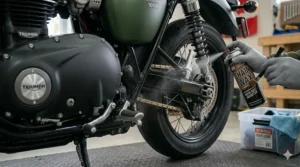
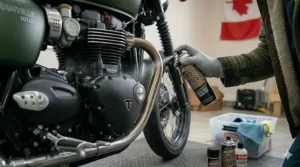
Start by deep cleaning your motorcycle before storage. Road salt from late-season rides eats through chrome and aluminum all winter if left in place. Wash with motorcycle-specific cleaner, paying special attention to the undercarriage where salt accumulates. Dry thoroughly—I mean thoroughly—with compressed air into crevices where water hides. Apply a coat of wax to painted surfaces for additional moisture barrier. Clean and lubricate your chain with proper motorcycle chain lube (not WD-40, which attracts dirt). This cleaning session takes 45 minutes but prevents hundreds of dollars in corrosion damage.
Position your bike away from walls if possible—you want air circulation on all sides. If space is tight, at least ensure the exhaust side faces away from concrete walls where condensation tends to form. Place a piece of plywood under the bike if you’re storing on dirt floors—this prevents moisture wicking up from below. Cover windows with cardboard if your storage area has direct sunlight—UV rays fade seats and plastics even through winter. Finally, crack the storage area door slightly once weekly during warm spells to exchange stale, humid air with fresh, drier air.
For urban Canadian riders storing in shared spaces, security becomes paramount. Use a quality disc lock plus a chain securing your bike to an immovable object. Motorcycle theft statistics spike 35% during winter months when bikes sit unattended for weeks. Consider removing easily-stolen accessories like GPS units and expensive seats. Document your bike’s VIN and take photos of any unique identifiers—this helps police recovery if theft occurs.
Winterization Mistakes That Cost Canadian Riders Thousands
The biggest mistake I see Canadian riders make? Starting their bike every two weeks during storage, thinking they’re “keeping things fresh.” This actually accelerates damage. Short running periods (under 20 minutes) never bring engine oil to operating temperature, creating condensation inside your engine and exhaust. That moisture mixes with combustion byproducts to form corrosive acids. Riders following this advice consistently face scored cylinder walls and rusty exhaust systems come spring. Either ride your bike properly (20+ minutes to full operating temperature) or leave it completely alone between October and April.
The second critical error involves fuel handling. Some riders drain tanks completely before storage, believing empty tanks prevent fuel system issues. Wrong—and potentially dangerous. Empty metal tanks allow moist air inside, leading to severe rust formation on tank interiors. This rust contaminates fuel systems when riders refill tanks in spring. The correct approach: fill tanks to 95% capacity, add fuel stabilizer, and run the engine to circulate treated fuel throughout the system. That full tank of stabilized fuel protects internal tank surfaces while preventing carburetor gumming.
Battery disconnection presents another area of confusion. Simply disconnecting the negative terminal isn’t enough—your battery still slowly discharges through internal resistance, and six months at below-freezing temperatures will sulfate plates beyond recovery. Either remove the battery and store it in a warmer location on a maintainer, or leave it installed with a quality battery tender connected. The $60 CAD tender investment prevents $150-$250 CAD battery replacement costs every other year.
Cover selection matters more than most realize. That cheap $25 CAD tarp from Canadian Tire? It’ll disintegrate by February, leaving your bike exposed through the worst months. Worse, it traps moisture against your bike’s surfaces, creating the perfect environment for corrosion. Invest in a proper motorcycle cover with ventilation panels—the $80-$100 CAD cost spreads over 4-5 seasons while actually protecting your investment. Position the cover carefully: it should drape naturally without tight spots where wind can grab, and secure it properly so gusty winter winds don’t rip it free.
Canadian Regional Considerations: Adapting to Your Climate
Pacific Coast riders from Vancouver to Victoria face unique challenges: mild temperatures but extreme humidity. Your winterization priorities differ from Prairie riders. Focus heavily on moisture management—fuel stabilizer becomes mandatory (ethanol attracts water from humid air), and exhaust plugs rank as essential rather than optional. Consider running a small dehumidifier in your storage area if you have power access. Check your bike monthly for any signs of mildew on seats or condensation on metal surfaces. The constant 5-15°C temperature range with 80%+ humidity creates corrosion faster than -30°C dry cold in Alberta.
Prairie riders (Alberta, Saskatchewan, Manitoba) deal with brutal cold but generally dry conditions. Your battery tender becomes absolutely non-negotiable—batteries lose 60% cranking power at -30°C, and parasitic drain will kill an unattended battery by February. Invest in the heavy-duty cover rated for extreme cold, and position your bike away from garage doors where temperature fluctuations are most severe. The dry cold actually helps in one regard: minimal condensation means exhaust plugs become less critical. Many experienced Prairie riders successfully skip exhaust plugs if storing in unheated but fully enclosed garages.
Ontario and Quebec riders face the worst of all worlds: temperature extremes, high humidity, and aggressive road salt usage. Your pre-storage cleaning must be absolutely thorough—salt residue will corrode aluminum and chrome all winter if not removed completely. Consider professional winterization services ($150-$250 CAD) if you rode late into November; the accumulated salt exposure from those last rides destroys more bikes than six months of storage. Use both quality covers and dehumidification, and seriously consider heated storage if riding an expensive or vintage machine. The investment pays off in preservation.
Atlantic Canada combines moderate cold with extreme precipitation and salt usage. Your cover becomes your first line of defence—spring for the absolute best waterproofing you can afford, and inspect it monthly for damage from ice accumulation. The freeze-thaw cycles here create more condensation than anywhere else in Canada, making fuel stabilizer and exhaust plugs mandatory rather than optional. Many Maritime riders successfully store in unheated outbuildings as long as they’re weathertight and well-ventilated. The key is preventing direct water infiltration while allowing air circulation to prevent condensation.
Spring Revival: The Critical First-Start Checklist
March arrives and the urge to ride becomes irresistible. But rushing your spring startup damages more bikes than improper storage. Follow this sequence religiously: First, visually inspect everything before touching controls. Look for rodent damage to wiring, check for any leaking fluids, examine tires for cracks or dry rot. Remove your cover completely and let your bike acclimate to spring temperatures for 24 hours if possible—this prevents condensation forming when cold surfaces hit warm spring air.
Remove all storage devices: exhaust plugs (critical—starting with these installed causes exhaust damage), battery tender connections, and any protective coverings. Inspect your battery terminals for corrosion—that white or blue-green crusty buildup prevents proper connection even if your tender maintained charge all winter. Clean terminals with a wire brush and baking soda solution if needed. Check tire pressure and inflate to operating specs—remember, pressure drops 10-15% over six months even with monthly checks.
Before starting, complete a fluid check sequence. Engine oil should still be clean from your pre-storage change, but verify level hasn’t dropped. Check coolant level—it shouldn’t have changed, but better safe than facing an overheated first ride. Most importantly, crack open your gas cap and smell your fuel. Properly stabilized fuel should smell like gasoline, not varnish or stale solvent. If fuel smells off despite using stabilizer, drain it and start with fresh gas rather than risking carburetor issues.
The first start requires patience. Turn the key to “on” and wait 30 seconds, allowing fuel pump to prime and ECU to run diagnostics. Don’t touch the throttle during startup—modern fuel injection handles cold starts automatically, and twisting the throttle floods the system. Crank the engine in 5-second bursts with 10-second pauses between attempts. First-start cranking takes longer than normal—expect 2-3 attempts as oil circulates and fuel reaches cylinders. Once running, let your bike idle for 3-5 minutes, then blip the throttle gently to verify clean response. Look underneath for any fluid leaks while idling.
Your first ride should be short—10-15 minutes maximum—and gentle. Avoid hard acceleration, aggressive braking, or tight cornering until fluids reach operating temperature and tires regain flexibility. Many Canadian riders report their bikes feel “tight” for the first few rides—this is normal as seals, rings, and bearings resettle. By your third spring ride, performance should return to normal. If you notice persistent issues—rough idle, poor throttle response, unusual noises—address them immediately before damage compounds.
How Long Can You Really Store a Motorcycle in Canadian Winters?
Six months represents the standard Canadian storage period—October through March or November through April depending on region. Modern motorcycles handle this duration excellently with proper preparation. The fuel stabilizer keeps gasoline fresh for 24 months, your battery tender maintains charge indefinitely, and quality oil protects internal components for years if the engine isn’t running. Some riders stretch to seven or even eight months in northern regions, and bikes emerge fine if winterization was thorough.
Beyond eight months, additional considerations emerge. Fuel degradation accelerates even with stabilizer past 12 months—consider draining the tank and refilling with fresh gas if storage exceeds one year. Rubber components (seals, o-rings, hoses) can develop compression set from remaining in one position too long, potentially causing leaks when you resume riding. Tire flat-spotting becomes more likely even with paddock stands as rubber loses plasticity. For storage exceeding one year, consider rotating tires monthly and running a small amount of oil into cylinders to protect bore surfaces.
The record for successful long-term storage I’ve encountered personally: a friend’s 2008 Yamaha R6 that sat properly prepared for 28 months while he worked overseas. Battery tender remained connected, tank stayed full with stabilized premium fuel, bike was covered and on paddock stands. When he returned and performed the spring startup sequence, the bike fired immediately and ran perfectly. His secret? Following every winterization step religiously and having a family member check monthly for any issues. This proves that with proper preparation, even multi-year storage succeeds.
Climate affects maximum storage duration significantly. Heated storage extends safe duration considerably—stable temperatures prevent condensation, reduce humidity-based corrosion, and protect rubber components. Unheated but enclosed storage works well for standard six-month periods. Storage in unenclosed areas (covered only by tarp) should be limited to 3-4 months maximum—Canadian weather is simply too harsh for longer exposure even with quality covers. If you’re facing storage beyond one year, seriously consider professional climate-controlled facilities or at minimum heated garage space.
The $150 Starter Kit: Everything New Canadian Riders Need
Budget-conscious riders can properly winterize their first motorcycle for approximately $150 CAD by prioritizing the essentials. Start with a quality waterproof cover ($80-$90 CAD)—this single item prevents more damage than any other product. Add a bottle of STA-BIL fuel stabilizer ($20 CAD) to prevent carburetor issues—fuel system repairs cost far more than this preventative measure. Finally, invest in a basic battery tender ($50-$60 CAD) to avoid the $150-$250 CAD battery replacement that 60% of improperly stored bikes require.
This $150 CAD three-product combination addresses the most common storage failures: weather damage, fuel degradation, and battery death. It won’t prevent tire flat-spotting (you’ll need a paddock stand for that) or stop exhaust condensation (requires rubber plugs), but it handles the critical 80% of storage issues for under $200 CAD including taxes. Many first-time winterizers successfully protect their bikes this way, then add supplementary products in subsequent years as budget allows.
As you accumulate winters, expand your kit strategically. Year two, add the paddock stand ($90-$110 CAD) to eliminate flat-spotting—your tires last an extra season, essentially paying for the stand. Year three, purchase exhaust plugs ($15-$20 CAD) for complete moisture protection. By year four, consider upgrading to a premium battery tender with more features ($80-$100 CAD) or a heavy-duty cover rated for extreme weather ($120-$150 CAD). This gradual investment spreads costs while building a comprehensive storage system.
For riders owning multiple bikes, efficiencies emerge. One fuel stabilizer bottle treats 2-3 motorcycles. Paddock stands work on different bikes if you’re willing to swap spools between machines. However, each motorcycle needs its own cover (sizes vary) and battery tender (can’t maintain multiple batteries simultaneously). Budget approximately $200 CAD per additional bike beyond the first, since you’ll reuse some equipment while duplicating others. Many multi-bike households invest in two quality tenders rather than budget options, reasoning that reliability matters more than initial savings.
Common Storage Myths Debunked by Canadian Experience
Myth: Starting your bike every two weeks keeps it fresh. Reality: This causes more harm than good. Short running periods create condensation without fully warming your engine oil or exhaust system, promoting internal corrosion. Either take proper 30+ minute rides to operating temperature or leave the bike completely alone from October to April.
Myth: Premium fuel stores better than regular. Partial truth: Premium contains slightly fewer additives and sometimes less ethanol, which theoretically improves storage stability. However, the difference is minimal compared to using fuel stabilizer. Regular 87-octane fuel with STA-BIL stores just as successfully as premium without stabilizer stores poorly. Your $20 CAD bottle of stabilizer matters far more than spending extra for premium fuel.
Myth: Storing batteries on concrete floors drains them. Old wives’ tale: This belief dates to early 20th-century wood-cased batteries that actually did discharge faster on concrete. Modern plastic-cased batteries are completely unaffected by concrete contact. Battery discharge during storage results from internal resistance and parasitic draws from your bike’s electronics—not floor composition. Store batteries wherever is convenient; focus on maintaining charge with a tender instead.
Myth: Covering bikes prevents all moisture damage. Half-truth: Covers prevent direct precipitation and UV damage but trap moisture underneath if ventilation is inadequate. Many riders create worse corrosion by using tarps without vent panels. Quality motorcycle covers include ventilation systems precisely to prevent this moisture-trap effect. Cheap covers without vents can cause more rust than storing uncovered in a dry garage.
Myth: Modern fuel injection eliminates need for stabilizer. Completely false: Fuel injection systems are actually more sensitive to fuel degradation than carburetors. Clogged injectors cost $400-$800 CAD to clean professionally—far worse than rebuilding carburetors. The fuel degrades identically whether your bike uses injection or carburetors. Always stabilize fuel regardless of your fuel delivery system.
Myth: Draining fluids before storage is required. Mostly false: Drain and replace engine oil (removes contaminants), but keep fuel tanks full (prevents interior rust) and leave coolant as-is (it’s already formulated for extended storage). Brake fluid and transmission oil are fine to leave undisturbed. The only fluid requiring attention is engine oil—change it pre-storage, not post-storage.
❓ Frequently Asked Questions
❓ Can I store my motorcycle outside in Canadian winters with just a cover?
❓ Do I need to remove my motorcycle battery for winter storage in Canada?
❓ How often should I check on my stored motorcycle during Canadian winters?
❓ What's the minimum temperature a motorcycle battery tender can handle in Canada?
❓ Should I put my motorcycle on paddock stands even if storing on heated garage floor?
Conclusion: Your Spring Self Will Thank You
Proper winter storage isn’t complicated, but it demands thoroughness. The Canadian riders who start their bikes effortlessly each April aren’t lucky—they’re prepared. They spent 90 minutes in October following a systematic winterization checklist, invested $150-$250 CAD in quality storage products, and performed monthly 5-minute checks through winter. This preparation prevents the $500-$1,500 CAD in spring repairs that careless storage causes: clogged carburetors, dead batteries, corroded exhausts, and flat-spotted tires.
The seven products reviewed above form the foundation of proper motorcycle winter storage for Canadian conditions. A weatherproof cover protects your investment from precipitation and UV damage. A battery tender maintains charge through six months of parasitic drain. Fuel stabilizer prevents the varnish buildup that clogs fuel systems. A paddock stand eliminates tire flat-spotting. Exhaust plugs block moisture condensation. Fresh synthetic oil protects internal components. A digital tire gauge ensures proper pressure through temperature swings.
Your specific requirements depend on region and storage location, but every Canadian rider needs at minimum the cover, stabilizer, and battery tender—call it the $150 CAD essential trio. Add the paddock stand if you’re serious about tire preservation, and include exhaust plugs if humidity is high in your area. These products aren’t expenses; they’re investments that pay returns through reduced spring repairs, extended component life, and the peace of mind knowing your bike is properly protected.
The difference between riders enjoying trouble-free spring startups and those facing garage repair bills comes down to preparation. Follow the winterization sequence outlined here, invest in the products matched to your climate, and check your bike monthly through storage. That April morning when your neighbours are jumping dead batteries and cleaning clogged carburetors, you’ll turn your key and ride away—because you prepared properly last October.
Recommended for You
- 7 Best Winter Windshield Washer Fluid -40 Canada 2026
- Classic Car Winter Storage Guide: 7 Must-Have Products for Canadian Collectors 2026
- 7 Best Car Cover for Winter Storage Canada 2026
Disclaimer: This article contains affiliate links. As an Amazon Associate, I earn from qualifying purchases. If you purchase products through these links, we may earn a small commission at no additional cost to you.
✨ Found this helpful? Share it with your friends! 💬🤗
