
In This Article
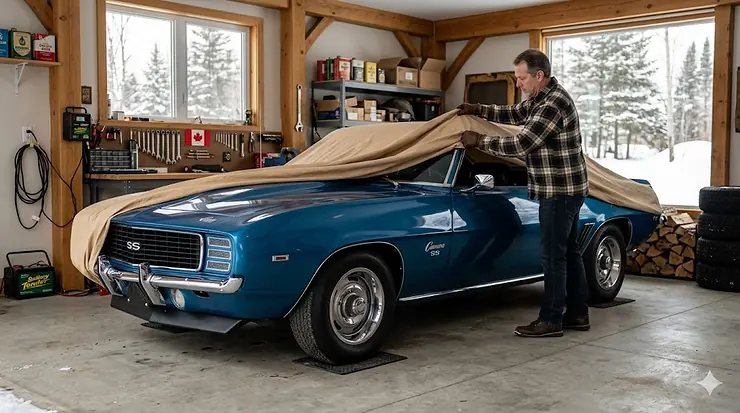
Your 1967 Mustang, 1972 Corvette Stingray, or vintage Porsche 911 isn’t just a vehicle—it’s a rolling piece of automotive history that deserves proper protection during Canada’s brutal winter months. When temperatures plummet to -30°C across the Prairies, road salt blankets Ontario highways, and coastal humidity threatens British Columbia garages, knowing how to properly store your classic car becomes essential to preserving both its value and condition.
Unlike modern vehicles with advanced corrosion-resistant coatings and computerized systems, classic cars require specialized care during winter storage. Canadian winters present unique challenges: extended periods of -10°C to -40°C temperatures affect battery life and fluid integrity, while spring thaw cycles create the perfect storm for rust formation. Many collectors discover too late that improper storage leads to seized engines, flat-spotted tires, corroded brake lines, and rodent damage—repairs that can easily cost $3,000-$8,000 CAD or more.
This comprehensive classic car winter storage guide addresses the specific needs of Canadian collectors, covering everything from climate-appropriate products available on Amazon.ca to winterization techniques that account for our harsh conditions. Whether you’re storing a numbers-matching muscle car in a Montreal garage or protecting a British roadster in a Vancouver storage unit, these strategies will help your investment emerge spring-ready.
Quick Comparison: Top 7 Winter Storage Products at a Glance
| Product Category | Best Budget Option | Premium Choice | Key Canadian Benefit |
|---|---|---|---|
| Battery Maintainer | Battery Tender Junior (~$35-45 CAD) | Battery Tender 4 AMP (~$85-110 CAD) | Handles -40°C cold starts |
| Car Cover | Budge Lite Indoor (~$65-90 CAD) | iCarCover 30-Layer (~$180-240 CAD) | Breathable moisture control |
| Jack Stands | Amazon Basics 3-Ton (~$50-70 CAD) | VEVOR 6-Ton (~$90-120 CAD) | Prevents flat-spotting |
| Fuel Stabilizer | STA-BIL 236mL (~$12-18 CAD) | STA-BIL 946mL (~$28-38 CAD) | 24-month ethanol protection |
| Moisture Absorber | Wisesorb Canisters (~$25-35 CAD) | DriBox Reusable Packs (~$45-60 CAD) | Combats garage humidity |
| Tire Pressure Gauge | ETENWOLF T300 (~$14-22 CAD) | AstroAI Digital (~$25-35 CAD) | Cold weather accuracy |
Looking at this comparison, Canadian collectors face a clear trade-off between initial investment and long-term protection. The budget column delivers adequate performance for heated garage storage in southern Ontario or BC, but Prairie winters and unheated storage demand the premium tier. Notice how the price differential for battery maintainers—roughly $60-65 CAD—represents insurance against a $200+ replacement battery that might fail after a harsh winter. Similarly, the premium car cover’s additional $120-150 CAD prevents thousands in paint and interior restoration costs. What most Canadian buyers overlook is that every product here must perform in humidity ranges from Vancouver’s 80%+ winter moisture to Winnipeg’s bone-dry -30°C conditions—the mid-range options often fail at these extremes.
💬 Just one click — help others make better buying decisions too!😊
Top 7 Classic Car Winter Storage Products: Expert Analysis for Canadian Conditions
1. Battery Tender Plus 12V 1.25 AMP Charger and Maintainer
The Battery Tender Plus stands as the gold standard for winter battery maintenance among Canadian classic car owners, and there’s solid reasoning behind its reputation. This 1.25 AMP float charger maintains your battery at optimal voltage without overcharging—critical when your vintage Camaro sits dormant from November through April.
What makes this unit particularly valuable for Canadian storage is its temperature compensation feature that automatically adjusts charging rates as your garage temperature fluctuates. During a typical Prairie winter where garage temps might swing from -15°C overnight to +5°C during sunny afternoons, inferior chargers deliver inconsistent voltage that gradually damages battery plates. The Battery Tender Plus compensates automatically, extending battery life by 2-3 years compared to unattended storage.
The package includes both alligator clips and ring terminal connectors—the latter being essential for Canadian winter use. Many collectors permanently install the ring terminals under the battery tray, routing the quick-disconnect lead somewhere accessible. This means you can connect the charger in January without exposing yourself to -25°C garage temperatures for 10 minutes while fumbling with clamps.
Canadian customers consistently praise its reliability through harsh winters, with many reporting 5+ years of continuous use. One Toronto collector notes his 1965 Mustang battery has survived six winters on the same Battery Tender Plus, eliminating the $180-220 CAD replacement cycle he experienced before.
Pros:
✅ Spark-proof and reverse-polarity protected for safe winter connection
✅ Works flawlessly in -40°C garage conditions
✅ 10-year warranty backed by actual Canadian customer service
Cons:
❌ 1.25 AMP output takes 24-48 hours for deeply discharged batteries
❌ At around $45-55 CAD, costs 30% more than generic alternatives
Price Range: $45-55 CAD |
Best For: Single-vehicle owners storing in unheated garages
2. Battery Tender 4 AMP Selectable Battery Charger (6V/12V)
For collectors with multiple classics or vehicles stored in extreme conditions, the Battery Tender 4 AMP represents a smarter long-term investment than multiple smaller units. Its switchable 6V/12V capability alone justifies the premium for anyone storing pre-1950s vehicles alongside modern classics—your 1948 Packard and 1969 GTO can share one charger.
The 4 AMP output matters more than most Canadian buyers realize. When your battery reaches deeply discharged states (common after sitting unused through a frigid February), this unit recovers it in 6-8 hours versus the 24+ hours required by 1.25 AMP models. During spring startup preparation, this speed advantage means you can rotate between three stored vehicles in a weekend rather than planning a full week.
The heavy-duty construction shows immediately when handling—this isn’t the lightweight plastic housing found on budget maintainers. Saskatchewan winters are particularly brutal on electronics, but multiple Canadian owners report 7-10 years of reliable outdoor garage use where cheaper units failed within three seasons. The spark-proof technology and reverse-polarity detection prevent the battery damage that occurs when connecting in dim winter lighting.
What Canadian buyers often miss is the microprocessor’s sophistication. It actually tests battery condition and adjusts its charging strategy accordingly—flooded, AGM, and gel batteries all receive optimal treatment. This versatility matters when storing diverse collections where each vehicle might have different battery chemistry.
Pros:
✅ Switchable 6V/12V accommodates vintage and modern classics
✅ 4 AMP fast recovery handles deeply discharged winter batteries
✅ Heavy-duty construction survives Canadian garage conditions
Cons:
❌ Higher $85-110 CAD price point
❌ Larger size requires dedicated shelf space
Price Range: $85-110 CAD |
Best For: Multi-vehicle collectors or extreme cold storage
3. iCarCover 30-Layer Waterproof Breathable Car Cover
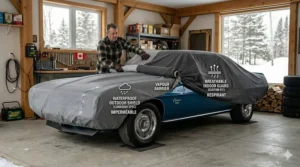
The iCarCover 30-Layer system represents the pinnacle of indoor storage protection for Canadian collectors, though its $180-240 CAD price initially causes sticker shock. Here’s why it’s worth every dollar: Canadian garage conditions fluctuate wildly—Vancouver’s 80% winter humidity, Edmonton’s -30°C dry cold, Toronto’s freeze-thaw cycles—and cheap covers fail spectacularly under these stresses.
This cover’s 30-layer construction includes a waterproof outer barrier, four moisture-wicking middle layers, and an ultra-soft fleece inner lining that won’t scratch your freshly restored paint. The breathability factor is crucial for Canadian storage. Cheap waterproof covers trap condensation inside, creating the perfect environment for rust and mildew—exactly what you’re trying to prevent. The iCarCover’s material allows moisture to escape while blocking external humidity, a feat of engineering that explains its premium price.
The integrated air vent system actively channels moisture away from vulnerable areas like wheel wells and door jambs. During spring thaw when your garage temperature swings 15°C daily, this ventilation prevents the condensation pools that inferior covers allow. Montreal collectors consistently report zero mildew issues after six-month storage periods, while those using budget covers often discover musty interiors come April.
Custom-fit sizing is available for virtually every classic American and European marque from 1955-2005. The tailored fit prevents the wind-whipping that occurs with universal covers in drafty garages, protecting your side mirrors and antenna. Canadian customers note the elastic hem stays tight even after three years of seasonal use—cheap covers lose tension after one winter and slide off.
Pros:
✅ True breathability prevents Canadian garage condensation
✅ Fleece lining protects freshly restored paint finishes
✅ Custom sizing eliminates gaps where moisture enters
Cons:
❌ Premium $180-240 CAD price for custom fit
❌ Requires annual washing for optimal performance
Price Range: $180-240 CAD |
Best For: Show-quality cars in fluctuating garage conditions
4. Amazon Basics Steel Jack Stands 3-Ton Capacity
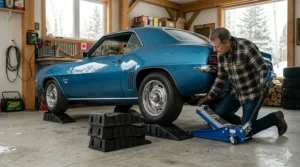
The Amazon Basics 3-Ton Jack Stands might seem like a boring utilitarian purchase, but they’re absolutely essential for preventing the flat-spotting that plagues stored classics. At around $50-70 CAD for the pair, they deliver the safety and reliability Canadian collectors need without the $150+ premium charged by boutique brands.
Here’s what most Canadian first-time winter storers don’t realize: leaving your classic sitting on tires for 5-6 months creates permanent flat spots, particularly when garage temperatures drop below -10°C. The rubber compounds in vintage tires—especially bias-ply originals on numbers-matching muscle cars—don’t have the flexibility of modern radials. They develop memory deformation that creates vibration at highway speeds come spring. Jack stands eliminate this $800-1,200 CAD tire replacement cycle.
These stands feature a self-locking ratchet mechanism that’s both ASME PASE-2014 certified and genuinely foolproof. The ratchet bar has deep teeth that prevent slippage even when metal contracts during cold snaps. Ontario collectors storing in unheated pole barns report these stands remaining rock-solid through temperature swings from -25°C to +15°C during winter sunshine.
The 3-ton (2,722 kg) capacity handles everything from lightweight British roadsters (850-1,100 kg) to heavy American muscle (1,600-1,800 kg) with substantial safety margin. The wide base provides stability on concrete and even slightly uneven garage floors. One Vancouver owner notes his stands have supported his 1972 Corvette Stingray every winter for five years without the slight lean that developed with cheaper stands.
The rustproof powder coating resists the corrosion that attacks unprotected metal in humid coastal garages. After three BC winters, these stands show zero rust compared to the surface oxidation that appeared on budget alternatives within one season.
Pros:
✅ ASME certified safety for long-term vehicle support
✅ Self-locking ratchet prevents cold-weather slippage
✅ Powder coating survives coastal humidity
Cons:
❌ No rubber pads included (purchase separately for $15-20 CAD)
❌ 27.9 cm (11″) minimum height won’t fit very low-profile classics
Price Range: $50-70 CAD |
Best For: Budget-conscious collectors preventing tire flat-spotting
5. STA-BIL Storage Fuel Stabilizer 236mL
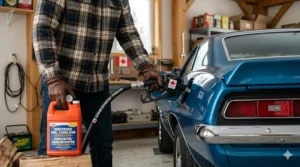
The STA-BIL Storage Fuel Stabilizer is the non-negotiable insurance policy for your classic’s fuel system—at $12-18 CAD for 236mL, it’s the cheapest protection against $2,000-3,500 CAD carburetor rebuild or fuel injection cleaning costs. Canadian ethanol-blended fuel degrades faster than many collectors realize, particularly in the temperature extremes our storage endures.
Here’s the chemistry Canadian owners need to understand: modern pump gas contains 5-10% ethanol that aggressively absorbs moisture from humid air. In an unheated garage through winter, this water separates from the fuel, settles to the tank bottom, and corrodes your fuel sending unit, pickup screen, and eventually reaches your carburetor. STA-BIL’s proprietary formula prevents this phase separation for 24 months while inhibiting gum and varnish formation that clogs tiny carburetor jets.
The 236mL bottle treats approximately 57 litres (15 gallons) of fuel—enough for two full tanks on most classics. Pour it directly into your tank before final fill-up, drive 8-10 km to circulate treated fuel throughout the system, then park for winter storage. This simple process prevents the hard starting, rough idle, and poor performance that plague improperly stored vehicles.
Quebec collectors especially appreciate STA-BIL’s anti-corrosion additives that protect steel fuel tanks and zinc-plated fittings from the moisture that accumulates during spring thaw cycles. Ontario muscle car owners consistently report clean, varnish-free carburetors after six-month storage periods using STA-BIL versus the sticky buildup that occurs with untreated fuel.
The science-backed formula outperforms competitors in independent testing, which explains why it’s been North America’s top-selling fuel stabilizer for decades. Canadian automotive journalists and restoration shops universally recommend it—there’s simply no debate.
Pros:
✅ Prevents ethanol-related fuel system damage
✅ 24-month protection covers two Canadian winters
✅ Works with all gasoline engines and fuel types
Cons:
❌ Must be added BEFORE storage (ineffective on degraded fuel)
❌ Doesn’t restore fuel already damaged by moisture
Price Range: $12-18 CAD (236mL) |
Best For: Every gasoline-powered classic without exception
6. Wisesorb 40g Reusable Desiccant Canisters (Multi-Pack)
The Wisesorb 40g Desiccant Canisters tackle the silent killer of stored classics: moisture accumulation that causes rust, mildew, and corrosion. At around $25-35 CAD for a multi-pack, these small aluminum cans deliver outsized protection for Canadian garage conditions.
Canadian winters create unique moisture challenges that many first-time storers don’t anticipate. Coastal BC garages battle 75-85% winter humidity that condenses on cold metal surfaces. Prairie provinces face the opposite extreme—bone-dry -30°C air that causes rubber seals to crack. Central Canada endures freeze-thaw cycles that pump moisture into closed environments. These desiccant canisters address all three scenarios.
Each 40g canister contains colour-indicating silica gel that changes from orange to light green when saturated—at 20-50% humidity, you’ll see the colour shift. This visual feedback is invaluable in Canadian garages where humidity can spike from 40% to 80% during a single rainy day. Place 2-3 canisters on the dashboard, one in the trunk, and one under each seat for comprehensive protection.
The reusable design represents excellent long-term value. When canisters turn green, simply bake them at 120°C (250°F) for 2-3 hours to drive out absorbed moisture—they’re ready for another storage season. Ontario collectors report 5+ years of continuous use versus throwaway desiccant bags that cost $20-30 CAD annually.
The robust aluminum construction withstands accidental kicks and the jostling that occurs when working around stored vehicles. The screwtop cap seals tightly, preventing premature saturation before placement in your vehicle. Maritime province owners particularly appreciate this feature in high-humidity coastal storage facilities.
Pros:
✅ Colour-indicating beads show saturation status
✅ Reusable design saves $100+ CAD over five winters
✅ Aluminum construction survives garage conditions
Cons:
❌ Requires oven reactivation every 2-3 months
❌ 40g capacity needs multiple units for full-size vehicles
Price Range: $25-35 CAD |
Best For: Preventing interior mildew and metal corrosion
7. ETENWOLF T300 Digital Tire Pressure Gauge (3-200 PSI)
The ETENWOLF T300 Digital Tire Pressure Gauge might seem like an afterthought in a winter storage arsenal, but it’s actually critical for preventing the tire damage that costs Canadian collectors $800-1,200 CAD come spring. At just $14-22 CAD, it’s the bargain that prevents expensive problems.
Here’s the Canadian winter tire science: for every 5.5°C (10°F) temperature drop, tire pressure decreases approximately 7 kPa (1 PSI). When you park your classic in September at 20°C with tires at 207 kPa (30 PSI) and temperatures plummet to -20°C by January, you’ve lost 28-35 kPa (4-5 PSI) through temperature alone. Underinflated tires develop flat spots faster and sustain permanent carcass damage.
The ETENWOLF’s ±0.5% accuracy across its 21-1,379 kPa (3-200 PSI) range delivers precision that pencil-style gauges can’t match, particularly in cold conditions. The backlit LCD remains readable in dim winter garages—a seemingly small feature that prevents the underinflation mistakes that occur when squinting at mechanical gauges in poor lighting.
The industrial-grade calibration meets ANSI B40.7 Grade 2A standards, meaning it maintains accuracy even when the gauge itself is cold. Cheaper gauges read inaccurately when stored in freezing garages, but the ETENWOLF compensates internally. Manitoba collectors storing in unheated sheds report consistent accuracy verified against shop-calibrated equipment.
The replaceable AAA battery design eliminates the frustration of built-in batteries that die mid-winter. The auto-off feature preserves battery life—it shuts down after 20 seconds of inactivity. One Saskatchewan owner notes the original battery lasted three full winters of monthly pressure checks.
Pros:
✅ ±0.5% accuracy remains reliable in cold garages
✅ Backlit display readable in dim winter conditions
✅ ANSI Grade 2A calibration for precision measurement
Cons:
❌ Plastic housing less durable than metal alternatives
❌ No hose attachment for hard-to-reach valve stems
Price Range: $14-22 CAD |
Best For: Monthly winter pressure monitoring
Essential Pre-Storage Winterization Checklist for Canadian Conditions
Before your classic enters winter hibernation, completing this Canadian-specific checklist prevents the costly mistakes that turn pristine vehicles into restoration projects. Many collectors overlook these climate-appropriate steps and pay dearly come spring.
Start with a thorough exterior wash including wheel wells and undercarriage—road salt from your final autumn drive must be completely removed. Southern Ontario and Maritime owners face particularly aggressive salt formulations that corrode steel, aluminum, and chrome if left on surfaces. Follow with a high-quality carnauba wax application that creates a moisture barrier during storage.
Change engine oil and filter even if you’re nowhere near the scheduled interval. Used oil contains combustion byproducts and acids that attack bearings and cylinder walls during inactive periods. Fresh oil provides maximum corrosion protection. Similarly, drain and refill coolant if it’s more than two years old—degraded coolant allows internal engine corrosion that manifests as leaks and overheating problems.
Address brake fluid carefully. If it’s more than three years old or shows any moisture contamination, flush and replace it. Brake fluid absorbs water from humid air, and that water corrodes brake lines and wheel cylinders from the inside. This issue is particularly severe in coastal regions where humidity remains high year-round.
Finally, overinflate tires to 276-310 kPa (40-45 PSI)—approximately 69-103 kPa (10-15 PSI) above normal operating pressure. This counteracts the pressure loss from temperature drops and reduces flat-spotting. If you’re not using jack stands, this overinflation becomes even more critical.
Long-Term Storage: When to Drain Fluids vs. Fill Systems
The drain-versus-fill debate confuses many Canadian collectors because American storage advice doesn’t account for our extreme temperature swings and extended winter duration. Here’s the Canadian-specific guidance restoration professionals actually recommend.
For fuel systems, keep the tank 95% full with stabilized fuel. Empty tanks encourage condensation formation as temperature fluctuates—that moisture then corrodes steel tanks from inside. The small air space at the top prevents pressure buildup while minimizing condensation surface area. Add STA-BIL, drive 10-15 km to circulate treated fuel throughout the system, then park immediately.
Coolant should remain in the system at full strength—typically a 50/50 mix good to -37°C. Draining coolant exposes internal engine passages to corrosion and seals to dry rot. Verify your mixture’s freeze point with a refractometer; Prairie owners sometimes need 60/40 or 70/30 mixes for -45°C protection.
Brake fluid stays in the system unless it’s due for replacement. Draining introduces air that’s nearly impossible to fully bleed out, and empty brake lines corrode rapidly. If fluid is fresh (less than two years old), leave it alone.
Engine oil remains controversial. Some experts advocate draining to remove combustion acids; others argue that coating all internal surfaces with oil provides superior corrosion protection. The Canadian consensus favors the latter—change to fresh oil immediately before storage, run the engine to circulate it, then park. That protective oil film prevents rust formation on cylinder walls and bearings through our long winters.
Canadian Garage Climate Control: Managing Temperature and Humidity
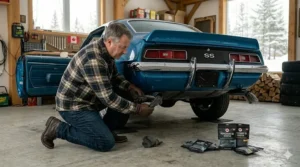
Understanding garage climate dynamics separates successful Canadian winter storage from spring disasters. Temperature and humidity interact in ways that create perfect conditions for corrosion, and many collectors make expensive mistakes by treating these factors independently.
Ideally, maintain stable garage temperature between 10-15°C with 40-50% relative humidity. This combination prevents condensation while keeping lubricants and rubber components supple. However, achieving this ideal requires heating, which becomes costly across Prairie winters where exterior temperatures hit -35°C for weeks.
The practical Canadian solution involves strategic insulation rather than expensive heating. An R-20 insulated garage with sealed doors and windows naturally maintains 5-10°C when exterior temperatures reach -20°C, consuming zero energy. This temperature is cold enough to prevent mildew growth while warm enough to prevent extreme lubricant thickening.
Humidity control proves more challenging and more critical. Unheated garages naturally track exterior humidity levels, which means 80%+ coastal moisture or 20% Prairie dryness. Install a mechanical hygrometer ($25-40 CAD) to monitor actual conditions—don’t guess. If winter humidity exceeds 60% for extended periods, a passive dehumidifier (desiccant bucket style, $45-70 CAD) placed in the garage will moderate extremes without requiring electrical power.
Avoid electric space heaters for “keeping the car warm”—this creates the worst possible scenario. Heating only when you visit causes radical temperature swings that pump moisture into and out of every crevice. Your car cycles between condensing moisture during warm periods and freezing it during cold periods, accelerating corrosion dramatically.
Pest Prevention: Keeping Rodents Out of Your Classic
Mice, rats, and squirrels view your stored classic as premium winter housing, and the damage they inflict costs Canadian owners $1,500-4,000 CAD annually in chewed wiring, destroyed upholstery, and contaminated interiors. Prevention is infinitely cheaper and easier than cleanup.
Start by eliminating entry points. Walk your garage perimeter looking for gaps larger than 6mm (1/4″)—mice compress their bodies through surprisingly small openings. Seal gaps around doors, windows, and service entries with steel wool followed by expanding foam or concrete patch. Don’t use copper mesh or aluminum wire; rodents chew through both.
Remove food sources entirely. That old bag of grass seed, scattered birdseed, or stored pet food attracts rodents who then explore your car as secondary shelter. Store all potential food in sealed metal or heavy plastic containers.
Place steel wool in your exhaust pipes, air intake, and any other openings. This physical barrier prevents entry without damaging components. Remove it before spring startup—mark a reminder on your calendar. Some collectors stuff dryer sheets throughout the interior; while effectiveness is debated, the low cost and pleasant scent make it worthwhile insurance.
Avoid poison baits inside garages. Poisoned mice die in inaccessible locations inside your car’s HVAC system, creating horrific odours that persist for months. Snap traps placed around (not inside) your vehicle provide better control. Check and reset them monthly.
Ultrasonic rodent deterrents deliver mixed results in Canadian garages. Large open spaces reduce effectiveness, and rodents habituate to the sound within weeks. Consider them supplementary to physical barriers rather than primary protection.
Spring Revival: Proper Awakening After Winter Storage
The transition from winter storage to driving season demands methodical attention—rushing this process causes mechanical failures and safety hazards that could be easily prevented. Canadian spring conditions add complexity because freeze-thaw cycles leave lingering moisture issues.
Begin your revival 2-3 weeks before intended first drive. This timeline allows you to address discovered problems without facing time pressure. Start by removing car covers and desiccant canisters. Open all doors, hood, and trunk to air out the interior for several hours—trapped winter moisture must escape before you introduce heat from the engine.
Inspect fluid levels before doing anything else. Check oil, coolant, brake fluid, and power steering fluid for proper levels and signs of contamination. Dark oil suggests moisture intrusion; milky coolant indicates a head gasket issue that developed during storage. Address these problems before attempting to start.
Remove steel wool from exhaust and air intake openings—this critical step is easy to forget with potentially catastrophic results. Walk around the vehicle checking for any winter damage: cracked hoses, deteriorated belts, or evidence of rodent activity.
Check tire pressures and reduce from storage overinflation to normal operating specs. Inspect tires carefully for flat spots. Minor flat spots often disappear after 30-50 km of driving; severe ones require replacement.
Reconnect and charge the battery fully before attempting to start. Even with a battery tender, batteries lose charge over long storage periods. A weak battery stresses the starter motor and makes diagnosis of other issues more difficult.
For first startup, have a helper ready with a fire extinguisher. Prime the fuel system by cycling the key to the run position (without cranking) 3-4 times. This allows the fuel pump to fill lines and the carburetor bowl. When you do crank, expect some hesitation as air purges from the system.
Let the engine warm fully before driving. Check for leaks, unusual noises, or warning lights. Take a short 5-10 km test drive in your neighbourhood before venturing onto highways—this reveals any problems while you’re close to home.
Common Canadian Storage Mistakes That Cost Thousands
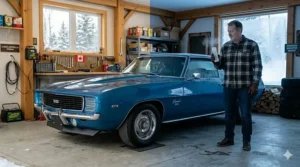
Even experienced collectors make winter storage errors that transform routine hibernation into expensive repair projects. Learning from others’ mistakes is cheaper than discovering them personally.
Mistake #1: Storing on gravel or bare earth. Canadian freeze-thaw cycles pump moisture upward through unprotected floors, rusting floor pans and frame rails from underneath. Always place a vapour barrier (heavy plastic sheeting, $25-40 CAD) between your classic and any non-concrete surface. This single step prevents rust damage that costs $3,000-8,000 CAD to repair.
Mistake #2: Using “waterproof” non-breathable covers. These trap condensation inside, creating a greenhouse effect that accelerates rust and mildew. Maritime collectors discover this mistake when spring reveals musty interiors and surface rust on previously pristine chrome. Spend the extra $80-120 CAD for breathable materials.
Mistake #3: Engaging the parking brake for storage. Brake pads and rotors rust together over winter, particularly in humid coastal garages. Come spring, the brake won’t release, forcing expensive pad and rotor replacement. Use wheel chocks ($15-25 CAD) instead—they’re cheaper than one seized brake caliper rebuild.
Mistake #4: Sporadic heating to “keep the car warm.” This well-intentioned mistake causes more damage than continuous cold storage. Each heating cycle draws humid air into the garage. As temperatures drop, that moisture condenses inside your car, on metal surfaces, and in lubricants. Six months of stable cold beats temperature cycling every time.
Mistake #5: Neglecting to check stored vehicles monthly. Problems don’t announce themselves—mouse infestations, fluid leaks, and battery failures develop silently. A monthly 15-minute inspection catches issues while they’re still minor and inexpensive to address.
Mistake #6: Storing without insurance adjustments. Some classic car policies require notification of storage status; failure to comply can void coverage. Conversely, storage often reduces premiums by 20-30% during winter months. Call your insurer before parking your classic—a five-minute conversation could save $200-400 CAD.
❓ Frequently Asked Questions
❓ Can I store my classic car outside during Canadian winters?
❓ How often should I start my classic car during winter storage in Canada?
❓ What temperature should I maintain in my classic car storage garage?
❓ Do I need climate-controlled storage in Canada for my classic car?
❓ How do I prevent battery drain on my classic car during Canadian winter storage?
Conclusion: Protecting Your Classic Investment Through Canadian Winters
Proper winter storage transforms Canadian classic car ownership from a source of anxiety into reliable long-term enjoyment. The products highlighted in this guide—from battery tenders maintaining charge through -30°C cold snaps to breathable covers managing coastal humidity—address the specific challenges our climate presents.
The investment in quality storage equipment ($400-700 CAD for a comprehensive setup) pales in comparison to repairing the damage inadequate storage causes: $2,000-4,500 CAD for carburetor rebuilds from fuel deterioration, $3,000-8,000 CAD for rust repair from moisture accumulation, $800-1,200 CAD for flat-spotted tire replacement. These problems are entirely preventable with the knowledge and tools covered here.
Remember that Canadian winters demand climate-appropriate strategies that differ significantly from American advice. Our extended storage seasons (5-6 months in many regions), extreme temperature swings (40-50°C annual variation), and unique humidity challenges require specialized approaches. The collectors who thrive in our environment understand these differences and prepare accordingly.
Your classic car represents history, passion, and likely substantial financial investment. It deserves protection that matches its significance. Start with the essential products from this guide, implement the winterization checklist appropriate for your region, and your investment will emerge spring-ready, year after year.
For more comprehensive information on Canadian vehicle storage requirements and regulations, consult Transport Canada’s vehicle safety guidelines and CAA’s seasonal vehicle care resources.
Recommended for You
- 7 Best Car Cover for Winter Storage Canada 2026
- Winter Car Storage Preparation Checklist: Complete Canadian Guide 2026
- 7 Best Battery Blankets for Extreme Cold Canada 2026
Disclaimer: This article contains affiliate links. As an Amazon Associate, I earn from qualifying purchases. If you purchase products through these links, we may earn a small commission at no additional cost to you.
✨ Found this helpful? Share it with your friends! 💬🤗
