
In This Article
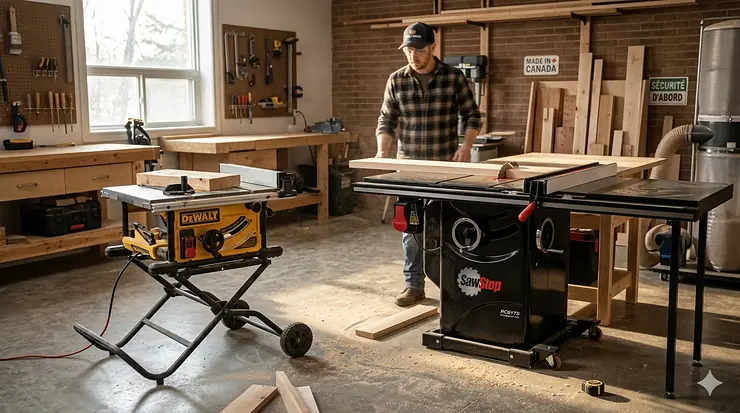
Choosing between a portable table saw vs cabinet saw represents one of the most critical decisions you’ll make for your Canadian workshop. Whether you’re a weekend warrior tackling basement renovations in Calgary or a professional contractor shuttling between job sites across the GTA, understanding the fundamental differences between these two powerhouse tools will save you thousands of dollars and countless hours of frustration.
The portable table saw vs cabinet saw debate isn’t simply about price tags or portability—it’s about matching the right tool to your specific workflow, available space, and project demands. According to the Canadian Centre for Occupational Health and Safety (CCOHS), proper tool selection significantly impacts both safety and productivity in woodworking operations.
In this comprehensive guide, I’ll walk you through seven exceptional table saw options available on Amazon.ca, ranging from compact jobsite models starting around $289 CAD to robust professional-grade machines approaching $989 CAD. You’ll discover which features matter most for Canadian workshops, how rip capacity width affects your project versatility, why arbor size compatibility can’t be overlooked, and how dust collection efficiency transforms your workspace from sawdust nightmare to precision cutting centre.
Quick Comparison: Portable vs Cabinet Table Saws
| Feature | Portable Table Saw | Cabinet Saw |
|---|---|---|
| Weight | 15-35 kg (30-75 lbs) | 180-410 kg (400-900 lbs) |
| Power | 15-amp, 110V | 3-5 HP, 220V required |
| Rip Capacity | 60-82 cm (24-32 inches) | 76-127 cm (30-50 inches) |
| Mobility | Wheels/stands, easily transported | Stationary or mobile base |
| Price Range (CAD) | $289-$989 | $2,500-$8,000+ |
| Best For | Job sites, small shops, DIY | Professional shops, production work |
| Dust Collection | Moderate (2.5-inch port) | Superior (enclosed cabinet, 4-inch port) |
| Vibration | Higher due to lighter construction | Minimal (heavy cast iron) |
| Setup Time | Minutes (folding stands) | Permanent installation |
💬 Just one click – help others make better buying decisions too! 😊
Top 7 Portable Table Saw vs Cabinet Saw Models: Expert Analysis
After researching dozens of models available on Amazon.ca and analyzing feedback from Canadian woodworkers, contractors, and hobbyists, I’ve identified seven outstanding options that represent the best value, performance, and reliability across different price points and use cases.
1. DEWALT DWE7491RS – Best Overall Portable Table Saw
The DEWALT DWE7491RS stands as the undisputed champion for Canadian contractors seeking professional performance without cabinet saw bulk. This 10-inch powerhouse combines a robust 15-amp motor with an impressive 32.5-inch rip capacity that handles full 4×8-foot sheets with confidence.
Key Specifications:
- 15-amp motor delivering 4,800 RPM
- 32.5-inch (82.5 cm) rip capacity to the right
- Integrated rolling stand with 7-inch pneumatic wheels
- Rack-and-pinion fence system (±1/32-inch precision)
Price: $989 CAD on Amazon.ca
Canadian woodworkers consistently praise the fence accuracy and rolling stand durability. One Calgary contractor mentioned hauling this saw through -30°C temperatures across multiple job sites for three years without mechanical issues. The 2.5-inch dust port connects seamlessly to shop vacuums popular in Canadian workshops.
✅ Pros:
- Factory-calibrated fence requires minimal adjustment
- Rolling stand deploys in under 30 seconds
- Superior rip capacity for portable class
❌ Cons:
- Heavier than compact alternatives (42 kg with stand)
- Premium pricing versus entry-level options
2. BOSCH GTS15-10 – Best Heavy-Duty Portable Option
For contractors demanding exceptional jobsite table saw reviews Canada performance, the BOSCH GTS15-10 delivers professional-grade power with the innovative Gravity-Rise wheeled stand that revolutionizes site mobility.
Key Specifications:
- 15-amp electronically-regulated motor
- 32-1/8-inch rip capacity width
- Gravity-Rise stand with 8-inch treaded wheels
- Smart Guard System with three-position riving knife
Price: $649-$699 CAD on Amazon.ca
The Gravity-Rise stand distinguishes this model—one foot release deploys the entire setup in seconds, while the 8-inch wheels navigate rough terrain, stairs, and frozen ground that stops lesser stands cold. Canadian users in Vancouver and Halifax report smooth operation even in high-humidity coastal environments.
✅ Pros:
- Innovative stand deployment system
- All-terrain wheel capability
- Electronically-regulated speed maintains performance under load
❌ Cons:
- Stand adds significant bulk for transport
- Higher price point than standard portable saws
3. SKIL TS6307-00 – Best Budget-Friendly Option
The SKIL TS6307-00 represents exceptional value for hobbyists and DIY enthusiasts establishing their first Canadian workshop. Don’t let the affordable price fool you—this compact table saw for small workshop environments delivers surprising capability.
Key Specifications:
- 15-amp motor with 4,600 RPM
- 25.5-inch (64.7 cm) rip capacity
- Integrated folding legs (no separate stand needed)
- Parallel blade alignment system
Price: $289-$378 CAD on Amazon.ca
This saw excels in basement workshops and garage spaces where storage matters. The integrated legs fold directly into the saw body, creating a compact package that slides behind workbenches or hangs on wall-mounted brackets. Ontario woodworkers appreciate the -2° to 47° bevel range that exceeds typical 0-45° limitations.
✅ Pros:
- Exceptional value under $400 CAD
- Integrated folding stand saves storage space
- Extended bevel range for specialized cuts
❌ Cons:
- Smaller rip capacity limits sheet goods processing
- Lighter construction increases vibration on hardwoods
4. DEWALT DWE7485 – Best Compact Portable Saw
For contractors prioritizing maximum portability, the DEWALT DWE7485 sacrifices nothing in build quality while delivering genuine one-person carry capability. This 8-1/4-inch model weighs just 20 kg (45 lbs), making it ideal for stair navigation and truck-to-site deployment.
Key Specifications:
- 15-amp motor optimized for 8-1/4-inch blade
- 24-inch rip capacity (adequate for most trim work)
- Site-Pro modular guarding system
- On-board storage for accessories
Price: $398-$449 CAD on Amazon.ca
The smaller blade diameter reduces cutting depth (2-1/4 inches at 90°), but Canadian trim carpenters and finish contractors find this perfectly adequate for crown moulding, baseboards, and cabinet installation. The compact footprint fits standard pickup truck beds without requiring bed extenders.
✅ Pros:
- Lightest professional-grade portable option
- Fits standard truck beds
- Lower power consumption on job site generators
❌ Cons:
- Reduced cutting depth versus 10-inch models
- Limited rip capacity for sheet goods
5. Table Saw Fence Upgrade Consideration: SawStop PCS175-TGP236
While technically a cabinet saw, the SawStop PCS175-TGP236 deserves mention as the ultimate upgrade for serious Canadian woodworkers. This 1.75 HP professional cabinet saw includes revolutionary flesh-detection technology that stops the blade in milliseconds upon skin contact.
Key Specifications:
- 1.75 HP motor (110V or 220V configurations)
- 36-inch T-Glide fence system
- Flesh-detection safety system
- Fully-enclosed cabinet with superior dust collection efficiency
Price: $2,499-$2,849 CAD (from specialty Canadian retailers)
Several Quebec cabinet makers credit SawStop technology with preventing career-ending injuries during decade-long ownership. While not portable, this represents the gold standard when transitioning from portable to stationary sawing. The table saw fence upgrade from rack-and-pinion to the T-Glide system delivers micron-level precision.
✅ Pros:
- Industry-leading safety technology
- Professional-grade fence accuracy
- Superior dust collection (4-inch port)
❌ Cons:
- Requires 220V outlet for optimal power
- Replacement brake cartridges cost $100+ CAD
- Not portable
6. BOSCH GTS1031 – Best Ultra-Portable Benchtop
The BOSCH GTS1031 serves contractors needing maximum portability with one-handed carry capability. Weighing just 11.8 kg (26 lbs), this benchtop model transforms any stable surface into a cutting station.
Key Specifications:
- 15-amp motor with 5,000 RPM
- 25-inch rip capacity
- SquareLock rip fence
- Integrated carry handle
Price: $378 CAD on Amazon.ca
This saw shines for finish carpenters working in occupied homes where minimizing disruption matters. The compact size allows easy transport through doorways and up staircases. Alberta contractors appreciate the immediate setup—place it on sawhorses and begin cutting within 60 seconds.
✅ Pros:
- Lightest professional option (11.8 kg)
- One-handed portability
- Minimal storage footprint
❌ Cons:
- Requires separate work surface
- Smaller table surface area
- Vibration noticeable on prolonged use
7. Hybrid Alternative: DEWALT DWE7491X (Scissor Stand Version)
The DEWALT DWE7491X bridges portable flexibility with semi-stationary workshop capability. This variant includes a scissor stand rather than rolling wheels, providing a middle ground for Canadian workshops with limited mobility needs.
Key Specifications:
- 15-amp motor, 4,800 RPM
- 32.5-inch rip capacity width
- Scissor stand with quick-release levers
- Same specifications as DWE7491RS
Price: $798-$849 CAD on Amazon.ca
Basement woodworkers in Toronto and Montreal value this configuration—the scissor stand provides exceptional stability for precision work while still allowing occasional relocation. The stand folds completely flat for wall storage, ideal for multi-purpose workshop spaces.
✅ Pros:
- Enhanced stability versus rolling stands
- Compact folded storage profile
- Professional rip capacity
❌ Cons:
- Heavier and bulkier than dedicated portable units
- Not ideal for frequent job site transport
Understanding the Portable Table Saw vs Cabinet Saw Decision
The fundamental distinction between portable table saw vs cabinet saw options extends far beyond weight and price. Understanding these core differences helps you match capabilities to your actual workshop requirements rather than aspirational fantasies.
Power and Motor Configuration
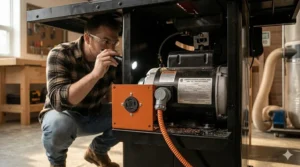
Portable table saws universally employ 15-amp universal motors running on standard 110V household circuits found throughout Canadian homes and job sites. These motors deliver adequate power for ripping hardwoods up to 5 cm (2 inches) thick, handling the vast majority of residential and light commercial applications.
Cabinet saws feature 3-5 horsepower induction motors requiring dedicated 220V circuits. According to Wikipedia’s comprehensive table saw overview, these belt-driven systems provide superior torque for sustained heavy-duty operations. The increased electrical demands necessitate professional electrician installation, adding $300-$800 CAD to setup costs in most Canadian markets.
For contractors working on job sites without 220V access, portable table saw vs cabinet saw becomes a non-decision—portables win by default. However, established workshop owners benefit tremendously from cabinet saw power when processing hardwood lumber, thick stock, or running extended production runs.
Arbor Size Compatibility and Blade Options
Most portable and cabinet saws share the standard 5/8-inch arbor size compatibility, allowing interchangeable blade usage across your tool collection. This standardization simplifies inventory management—one set of quality blades serves multiple saws.
The critical difference emerges in dado blade capacity. Budget portable saws typically limit dado width to 13-16mm (1/2 to 5/8-inch), while professional portables and all cabinet saws accommodate full 19mm (3/4-inch) dado stacks. Alberta woodworkers building custom cabinetry require this expanded dado capability for drawer joinery and shelf supports.
Rip Capacity Width Considerations
Rip capacity width directly impacts which materials you can process efficiently. The 82.5 cm (32.5-inch) rip capacity found on premium portable table saw vs cabinet saw models like the DEWALT DWE7491RS handles standard 4×8-foot plywood sheets cut lengthwise—barely. You’ll still need outfeed support and careful technique.
Cabinet saws routinely offer 127 cm (50-inch) rip capacity, processing sheet goods with generous clearance. Quebec furniture makers working with European-sized sheet materials (larger than North American standards) find this additional capacity essential.
Consider your actual material processing needs. If 90% of your work involves dimensional lumber (2x4s, 2x6s, etc.) and occasional plywood, portable rip capacity suffices. Production cabinet shops processing dozens of sheet goods weekly justify the cabinet saw investment.
Dust Collection Efficiency Reality Check
Let’s address dust collection efficiency honestly—portable table saws collect approximately 60-70% of generated sawdust even with quality shop vacuums attached. The open-bottom design allows significant dust escape, particularly during angled cuts.
Cabinet saws with fully-enclosed cabinets and 100mm (4-inch) dust ports achieve 85-95% collection efficiency when paired with proper dust collection systems. This distinction matters tremendously in Canadian workshops lacking outdoor access during winter months. British Columbia woodworkers operating in attached garages particularly appreciate superior dust containment.
However, dust collection system investment ($600-$2,500 CAD for quality units) must factor into total cabinet saw costs. Factor this when comparing portable table saw vs cabinet saw economics.
✨ Don’t Miss These Exclusive Deals!
🔍 Take your woodworking precision to the next level with these carefully selected table saws available in Canada. Click on any highlighted product name to check current pricing and availability on Amazon.ca. These tools will help you create professional-quality projects your family will love!
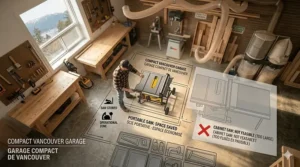
How to Choose Between Portable Table Saw vs Cabinet Saw for Your Canadian Workshop
Selecting the right saw demands honest assessment of five critical factors that determine long-term satisfaction versus buyer’s remorse.
1. Evaluate Your Mobility Requirements
Ask yourself: Do I need this saw at multiple locations weekly, monthly, or never? Contractors shuttling between three job sites weekly need portable capability—no discussion. The rolling stand portability of models like the DEWALT DWE7491RS or BOSCH GTS15-10 becomes essential, not optional.
Conversely, hobbyists working exclusively in dedicated basement workshops gain nothing from portability features. The 180+ kg mass of cabinet saws provides vibration-damping benefits that enhance cutting precision. Saskatchewan woodworkers with permanent shops should prioritize cabinet saw stability over unnecessary mobility.
Consider the “portability tax”—portable designs sacrifice cast iron mass, larger work surfaces, and superior dust collection for their mobility advantage. Ensure you’re actually utilizing that portability before paying the price.
2. Assess Your Available Space
Measure your workshop dimensions before committing to either portable table saw vs cabinet saw options. Cabinet saws demand 2.4 x 3 metres (8 x 10 feet) of dedicated floor space minimum, accounting for outfeed clearance and operator positioning.
Portable saws on folding stands require far less permanent footprint. The SKIL TS6307-00 folds to just 68 cm wide, sliding behind workbenches or hanging on wall-mounted tool racks. Toronto condo owners with single-car garage workshops particularly value this storage flexibility.
Don’t forget electrical infrastructure. Cabinet saws requiring 220V may necessitate electrical panel upgrades costing $800-$1,500 CAD in older Canadian homes. Portable saws plug into existing 110V outlets without modification.
3. Match Power to Your Material Processing
Evaluate your typical cutting demands realistically. Processing primarily softwood dimensional lumber (spruce, pine, fir) common to Canadian construction? The 15-amp motors powering portable saws handle these materials effortlessly.
Working regularly with dense hardwoods (maple, oak, cherry), thick stock over 5 cm, or sustained production runs? Cabinet saw horsepower prevents bog-down frustration. Manitoba furniture makers processing air-dried hardwoods find the torque reserve essential for smooth, burn-free cuts.
Review your last 20 projects. If more than half involved materials challenging for portable saws, cabinet capability justifies the investment. Otherwise, save $2,000+ CAD for blades, jigs, and other workshop essentials.
4. Calculate True Total Cost of Ownership
Comparing portable table saw vs cabinet saw pricing demands analysis beyond initial purchase price. Factor these ownership costs over a typical 10-year lifespan:
Portable Saw Total Cost:
- Initial purchase: $289-$989 CAD
- Blade upgrades: $200-$400 CAD
- Shop vacuum for dust collection: $150-$300 CAD
- Total: $639-$1,689 CAD
Cabinet Saw Total Cost:
- Initial purchase: $2,500-$5,000 CAD
- Electrical installation (220V): $400-$1,200 CAD
- Dust collection system: $600-$2,500 CAD
- Mobile base (optional): $200-$400 CAD
- Blade upgrades: $300-$600 CAD
- Total: $4,000-$9,700 CAD
The 3-6x cost differential justifies serious consideration. Will the cabinet saw’s superior capacity, precision, and dust collection generate sufficient value to warrant this investment? Professional woodworkers billing clients absolutely—hobbyists require honest self-assessment.
5. Consider Future Scalability
Think three to five years ahead. Will your woodworking ambitions expand beyond current capabilities? Contractors establishing workshops often start with quality portable saws, then add cabinet saws as client demands increase. This staged approach spreads costs while maintaining job site flexibility.
Alternatively, serious hobbyists committed to furniture-making might justify skipping portable saws entirely, investing directly in cabinet saw capability. The superior precision and dust collection immediately elevate project quality without later upgrade expenses.
Nova Scotia woodworker communities recommend the “80/20 rule”—if 80% of your work occurs in a single location and you’ve maintained consistent woodworking engagement for 2+ years, cabinet saw investment makes sense. Otherwise, portable flexibility serves most needs.
Jobsite Table Saw Reviews Canada: Real User Experiences
Canadian contractors face unique environmental challenges—extreme temperature fluctuations, moisture exposure, and rough terrain transport that tests equipment durability beyond manufacturer specifications.
Cold Weather Performance
Edmonton contractors report portable saws operating reliably down to -25°C when stored indoors overnight. However, fence systems require 10-15 minutes warming before achieving proper parallel alignment. Cabinet saws in heated workshops maintain precision regardless of outside temperatures.
Pneumatic wheels on rolling stands perform inconsistently in deep snow. Several Winnipeg contractors switched to larger aftermarket wheels (20-25 cm diameter) for improved winter job site mobility.
Humidity and Coastal Environments
Vancouver and Halifax woodworkers note accelerated rust formation on exposed cast iron tables without proper maintenance. Monthly applications of paste wax or dedicated table treatments (Boeshield T-9) preserve surfaces through humid coastal climates.
Cabinet saw enclosed designs provide superior protection for internal components. Portable saws with open motor housings demand more frequent inspection and cleaning to prevent moisture-related deterioration.
Rough Terrain Mobility
Saskatchewan and rural Alberta contractors emphasize wheel size importance. Standard 18 cm (7-inch) wheels struggle with gravel, mud, and uneven terrain common to renovation sites. The BOSCH GTS15-10’s 20 cm (8-inch) wheels demonstrate superior all-terrain capability, worth the premium pricing for contractors working outside urban centres.
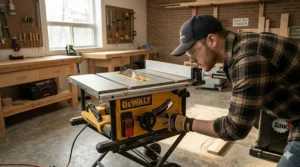
Compact Table Saw for Small Workshop Solutions
Canadian urban woodworkers face increasing space constraints as housing costs drive smaller living arrangements. Optimizing compact table saw for small workshop environments requires creative solutions beyond simply buying the smallest saw available.
Folding Outfeed Tables
Several Ontario makers fabricated wall-mounted folding outfeed tables that deploy when needed, then fold flat when workspace serves double duty. These additions transform 25-inch rip capacity saws into sheet goods processors without permanent floor space commitment.
Plans for these tables appear frequently in Canadian Woodworking magazine and woodworking forums specific to space-challenged makers.
Mobile Bases and Multi-Use Stations
Even portable saws benefit from quality mobile bases in small workshops. Manitoba craftsmen recommend Rockler and Woodcraft mobile bases ($150-$300 CAD) that transform any saw into easily-repositioned equipment. Position the saw center-workshop during use, then roll it against walls for storage.
Some innovative British Columbia woodworkers built combination workbench/saw stations where the saw sits flush with benchtop height, creating seamless work surfaces for assembly operations.
Vertical Storage Systems
The SKIL TS6307-00 and BOSCH GTS1031’s compact profiles enable vertical wall storage using heavy-duty French cleats. Quebec basement workshop owners regularly employ this technique, freeing 1.2-1.8 square metres of valuable floor space.
Ensure wall studs support the 20-30 kg saw weight adequately. Most installations require attachment to at least two 38x89mm studs for safe long-term storage.
Frequently Asked Questions
❓ Which is better for beginners in Canada: portable table saw vs cabinet saw?
❓ Can portable table saws handle hardwood cutting in Canadian workshops?
❓ What rip capacity width do I need for standard Canadian lumber and plywood?
❓ How important is dust collection efficiency for basement workshops in Canada?
❓ What's the typical lifespan difference between portable and cabinet table saws in Canada?
Conclusion: Making Your Portable Table Saw vs Cabinet Saw Decision
The portable table saw vs cabinet saw choice ultimately hinges on honest assessment of your actual needs versus aspirational wants. I’ve watched too many Canadian woodworkers drop $4,000+ on cabinet saws that sit mostly idle while portable saws would have served them better—and vice versa.
For contractors working across multiple job sites, renovation specialists, or makers in space-constrained urban workshops, portable saws like the DEWALT DWE7491RS ($989 CAD) deliver exceptional capability without compromising mobility. The rolling stand portability, professional rip capacity width, and proven Canadian cold-weather reliability make it my top recommendation for 70% of woodworkers reading this guide.
Established shop owners processing significant sheet goods volumes, furniture makers demanding micron-level precision, or professionals running production operations justify cabinet saw investment without question. The superior dust collection efficiency, vibration-free operation, and decades-long lifespan offset the substantial upfront costs.
Budget-conscious beginners should start with the SKIL TS6307-00 ($289-$378 CAD). Learn fundamental techniques on this capable compact table saw for small workshop environments, then upgrade to either premium portables or cabinet saws once your skills and project demands warrant the investment.
Remember—the best saw is the one you’ll actually use consistently. A $5,000 cabinet saw gathering dust helps nobody, while a $600 portable saw creating projects weekly provides immeasurable value. Match your selection to your reality, not someone else’s workshop fantasy.
Recommended for You
- 20V vs 18V Cordless Drill: 7 Best Models Canada 2026
- 7 Best Lightweight Chainsaws for Seniors Canada 2026
- 7 Best Bench Grinders for Knife Sharpening Canada 2026
Disclaimer: This article contains affiliate links to Amazon.ca. If you purchase products through these links, we may earn a small commission at no additional cost to you.
✨ Found this helpful? Share it with your friends! 💬🤗
