
In This Article
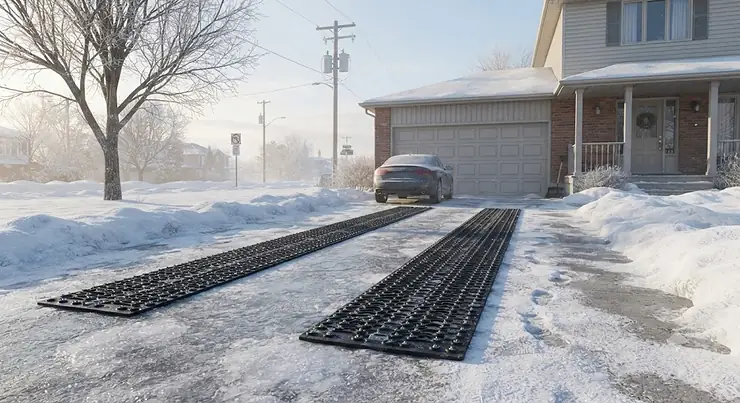
Traction mats for icy driveway use are textured mats — heated, rubber, coir or rigid plastic — that sit on or under a slippery surface to restore grip for tires or feet. Some melt ice outright, others add bite on top of it, and some are emergency boards you jam under a spinning wheel.
That’s the textbook answer. Here’s the real one.
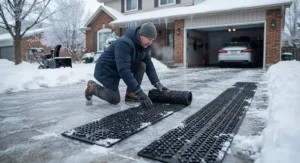
It’s 7:40 on a January morning in Winnipeg. The driveway looks merely wet. It isn’t. That glossy sheen is black ice, a thin, transparent glaze that forms when meltwater or freezing drizzle refreezes on pavement — and it’s the reason your front-wheel-drive hatchback is now politely spinning its tires at the bottom of a 6% grade while you skate toward it with a travel mug in one hand.
Canadian driveways are brutal testing grounds. Freeze-thaw cycles swing from +3 °C to −15 °C in a single day across much of Ontario, Quebec and the Maritimes, turning yesterday’s slush into today’s skating rink. Salt helps, until it’s −18 °C and rock salt basically gives up. Sand helps, until it gets tracked into your front hallway and your garage.
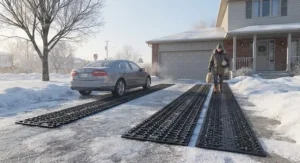
That’s where traction mats for icy driveway problems earn their keep. The category is broader than most shoppers realize: heated mats that melt 5 cm of snow per hour, cheap coir runners you unroll on a walking path, and rugged recovery boards that get a stuck SUV moving again.
In this guide, I break down seven real products available to Canadian shoppers, explain what their specs actually mean at −20 °C, and cover the related questions people ask — from rubber vs coir traction mats to ice cleats vs snow boots for driveway safety. No invented testing claims, just honest analysis of specs, published reviews and aggregated owner feedback.
Quick Comparison Table: The 7 Best Traction Mats at a Glance
| Product | Type | Main Job | Approx. Price (CAD) | Best For |
|---|---|---|---|---|
| HeatTrak Heated Driveway Mat | Heated rubber, tire tracks | Melts snow/ice under tires | C$1,000+ per mat | Steep driveways, hands-off homeowners |
| HeatTrak Residential Heated Walkway Mat | Heated rubber, walkway | Melts ice on foot paths | C$250-C$400 (plus power unit) | Seniors, front steps, car-to-door paths |
| Jumbl 10FT Coco Fiber Ice Carpet | Coir with rubber backing | Adds grip on top of ice | C$35-C$70 | Renters, budget walkway fixes |
| MAXTRAX MKII | Nylon recovery board | Unsticks vehicles | C$450-C$550 per pair | Rural roads, cottage lanes, overlanders |
| Maxsa 20333 Escaper Buddy | Polypropylene traction mat | Unsticks vehicles | C$70-C$120 per pair | Mid-budget drivers with big vehicles |
| X-BULL Gen 3.0 Recovery Boards | Nylon recovery board | Unsticks vehicles | C$90-C$150 per pair | Value-focused truck and SUV owners |
| SubZero 12501 GripTrax | Compact plastic traction aid | Unsticks small cars | C$20-C$40 per pair | Glovebox/trunk emergency kit |
The table exposes a split that most “best of” lists blur: the two HeatTrak mats prevent the problem, while MAXTRAX MKII, Maxsa 20333 Escaper Buddy, X-BULL Gen 3.0 Recovery Boards and SubZero 12501 GripTrax fix it after you’re already stuck. The Jumbl 10FT Coco Fiber Ice Carpet sits in between — cheap, passive, and aimed at feet rather than tires. Decide first whether you’re solving for walking, for driving, or both, and the shortlist shrinks fast.
💬 Just one click — help others make better buying decisions too!😊
Top 7 Traction Mats for Icy Driveway Conditions: Expert Analysis
1. HeatTrak Heated Driveway Mat — best for eliminating tire-track ice entirely
The HeatTrak Heated Driveway Mat doesn’t help you get grip on ice — it removes the ice from your tire tracks altogether, which is a fundamentally different (and more expensive) proposition.
According to HeatTrak’s spec sheet, the mats come 61 cm (24″) wide in lengths from about 3 m to 9 m (10′ to 30′), are roughly 1.3 cm thick, and melt snow at around 5 cm (2″) per hour. In practice, that melt rate keeps pace with most Canadian snowfalls, meaning two strips stay bare through a typical overnight dump. The mats are TÜV-certified to UL 499 and CSA C22.2, which matters: CSA compliance is what your insurer and electrician will want to see on anything plugged in outdoors all winter.
Here’s what to weigh: a 24″ × 20′ mat draws about 11.7 A at 120 V, which nearly saturates a standard 15 A household circuit. Longer lengths are 240 V only, so budget for an electrician. This is a product for steep driveways, mobility-limited homeowners, and anyone who is simply done shovelling.
Published owner reviews consistently praise the “set it and forget it” convenience, while the most common complaint is upfront cost plus the need for a dedicated outdoor circuit.
Pros:
- ✅ Removes ice rather than just adding grip
- ✅ CSA C22.2-compliant for Canadian outdoor use
- ✅ Two strips cover most single-car driveway tracks
Cons:
- ❌ High purchase price, sold per individual mat
- ❌ Longer sizes require 240 V electrical work
At well over C$1,000 per mat (check current price), it’s the priciest option here — but for a steep slope, it’s the only true prevention play.

2. HeatTrak Residential Heated Walkway Mat — best for the car-to-front-door path
The HeatTrak Residential Heated Walkway Mat handles the stretch most driveway injuries actually happen on: the few metres between your parked car and your front step.
The 20″ × 60″ (51 × 152 cm) version draws just 2.5 A at 120 V, and HeatTrak says up to 13 A of mats can daisy-chain from one power unit via watertight connectors. Translation: you could link four or five mats into a continuous heated path without calling an electrician, as long as your outdoor outlet is on a GFCI-protected circuit. The same 5 cm-per-hour melt rate and CSA C22.2 certification apply, and the non-slip textured surface still offers grip when the mat is switched off.
What most buyers overlook: the power unit is sold separately, so the “per mat” price isn’t your real starting cost. Still, for older parents living alone or a household with a toddler and a stroller, removing ice from the single walking route may be worth more than any driveway-wide solution.
Reviewers consistently note that the mats stay flat and don’t curl in deep cold, while some mention that snowbanks pushed by ploughs can bury the edges and reduce effective width.
Pros:
- ✅ Low 2.5 A draw per 20″ × 60″ mat
- ✅ Daisy-chains into a longer heated path
- ✅ Textured top still grips when switched off
Cons:
- ❌ Power unit sold separately, raising entry cost
- ❌ Needs a nearby GFCI outdoor outlet
Expect roughly C$250-C$400 per mat plus the power unit at the time of research — strong value for the one path everyone walks.
3. Jumbl 10FT Coco Fiber Ice Carpet — cheapest way to add grip underfoot
The Jumbl 10FT Coco Fiber Ice Carpet is the low-tech hero of this list: a roll of coconut fibre bonded to a rubber backing that you simply unroll over ice.
It measures about 3 m long and 46 cm (18″) wide. The coarse coir bristles create hundreds of tiny friction points that behave a bit like sandpaper under your boots, while the rubber backing resists sliding on the surface underneath. On paper, that’s exactly the combination you want for a walkway: rough on top, grippy below, no electricity required.
Based on the spec comparison with rubber alternatives, coir’s weakness is water. Coconut fibre absorbs moisture, so on a day that hits +2 °C and then drops to −10 °C overnight, the mat can freeze stiff — or freeze to the driveway. It’s best for renters, budget buyers, and anyone who needs grip on the walk to the car by tomorrow morning.
Aggregated shopper feedback on coir ice carpets of this style is generally positive about immediate grip, with recurring complaints about shedding fibres and mats getting soggy in freeze-thaw weather.
Pros:
- ✅ Instant grip with zero installation
- ✅ Very affordable per metre of coverage
- ✅ Biodegradable natural fibre surface
Cons:
- ❌ Absorbs meltwater and can freeze stiff
- ❌ Sheds fibres that get tracked indoors
Usually in the C$35-C$70 range (prices may vary) — the smartest dollar-per-metre buy for foot traffic.
4. MAXTRAX MKII — premium recovery board built to last decades
The MAXTRAX MKII is the Australian-designed benchmark every other recovery board gets measured against, and its build quality explains the price gap.
Each board measures roughly 114 × 33 × 9 cm (45″ × 13″ × 3.5″) and weighs about 3.4 kg (7.5 lb), moulded from fibre-reinforced engineering-grade nylon that, per Overland Expo’s review, resists cracking and UV degradation. That matters in Canada because cheap plastics turn brittle in deep cold — the exact moment you’re standing on them with a 2,000 kg vehicle. The aggressive cleats bite into packed snow and ice, and the tapered ends double as a shovel for clearing the snow ridge in front of a tire.
Honest take: for a flat suburban driveway, this is overkill. For a long rural lane in northern Ontario, a cottage road in Muskoka, or a laneway that drifts in off a farm field, the lifetime warranty against manufacturing defects turns a steep purchase into something you buy once.
Published reviews consistently rate MAXTRAX as the most effective and durable board, while the common gripe is simply price — and the risk of losing one in a snowbank.
Pros:
- ✅ Fibre-reinforced nylon stays tough in cold
- ✅ Lifetime warranty on manufacturing defects
- ✅ Tapered ends work as a snow shovel
Cons:
- ❌ Steep price for occasional driveway use
- ❌ Bulky to store in small hatchbacks
Around C$450-C$550 per pair at the time of research — premium money for gear that outlasts your vehicle.
5. Maxsa 20333 Escaper Buddy — longest mat for the money
The Maxsa 20333 Escaper Buddy gives you the biggest footprint in this group at a fraction of premium pricing.
Each polypropylene mat measures about 122 × 37 cm (48″ × 14.4″), with treads on both sides, six hand-holds and securing holes; Maxsa rates the pair for vehicles up to 10 tons. That extra length over most competitors means more tire contact before you run off the end — helpful when you need a longer run-up to crest a snowbank at the end of the driveway. Double-sided tread also means you can’t place it upside down in the dark, which is a genuinely underrated feature at 6 a.m.
What the spec sheet won’t tell you, but reviewers note: polypropylene flexes more than nylon. Overlandsite’s comparison flags this as a durability concern for hardcore off-roaders, and the warranty is only 90 days. For a daily driver or pickup that occasionally gets beached, though, that flex is rarely a problem.
Aggregated owner sentiment calls it the best MAXTRAX alternative for casual use, praising easy deployment and value, while some heavy users report bending or wear.
Pros:
- ✅ Longest mat here at about 122 cm
- ✅ Treads on both sides, no wrong way
- ✅ Rated for vehicles up to 10 tons
Cons:
- ❌ Polypropylene flexes under heavy repeated loads
- ❌ Short 90-day warranty
Typically C$70-C$120 per pair (check current price) — outstanding value for drivers who want size without premium cost.
6. X-BULL Gen 3.0 Recovery Boards — best budget nylon board
The X-BULL Gen 3.0 Recovery Boards borrow the MAXTRAX formula — nylon, U-channel shape, lugged surface — at roughly a quarter of the price.
According to Trail4Runner’s long-term review, each board is about 107 × 30 cm (42″ × 12″), a pair weighs roughly 5.9 kg (13 lb), and X-BULL rates them for vehicles up to 10 tons. The zig-zag lug pattern grips soft snow well, and because they’re nylon rather than polypropylene, they resist fatigue and UV better than most budget boards. A carry bag is included, which keeps slush out of your trunk carpet.
Here’s what to weigh: the same reviewer found a stress mark near a handle and scuffed lugs after a hard extraction, and noted they don’t match MAXTRAX build quality. For the typical Canadian scenario — an SUV stuck in the plough windrow at the end of the driveway — that’s an acceptable trade. For weekly off-road abuse, save up.
Across owner reviews, the consensus is strong value for occasional recovery, with durability questions surfacing mainly among heavy off-road users.
Pros:
- ✅ Nylon build at a budget price
- ✅ Rated for vehicles up to 10 tons
- ✅ Carry bag keeps slush contained
Cons:
- ❌ Some lug wear after hard extractions
- ❌ Tapered ends too weak for real digging
Usually in the C$90-C$150 range per pair at the time of research — the sweet spot for most SUV and truck owners.
7. SubZero 12501 GripTrax — smallest, cheapest trunk insurance
The SubZero 12501 GripTrax from Hopkins is the emergency tool you forget you own until the night you desperately need it.
Each piece is compact — roughly 64 × 20 × 5 cm (25″ × 8″ × 2″) per supplier listings — and sold as a two-piece set. That size means it slides under a sedan’s rear seat or into a spare-tire well where full-size boards never fit. For a small front-wheel-drive car that’s lost grip on a slight driveway incline or a church parking lot, a short grippy wedge under each drive wheel is often all you need.
Honest analysis: short length is the limitation. If you’re buried axle-deep, 64 cm of traction won’t carry you far, and cheaper plastics can crack when stomped on at −25 °C. This is a commuter’s glovebox-level insurance policy, not a rural recovery system. Pair it with a folding shovel and you’ve covered 80% of urban stuck-car scenarios.
Available review data is thin and not independently verifiable at the time of research, so treat this as a spec-based recommendation: it’s inexpensive, compact, and fits cars nothing else here does.
Pros:
- ✅ Fits small trunks and under seats
- ✅ Lowest cost of any product here
- ✅ Quick to deploy for minor slips
Cons:
- ❌ Short length limits deep-snow recovery
- ❌ Limited verified long-term review data
Around C$20-C$40 per set (prices may vary) — a no-brainer add-on for any commuter car.
Top 7 Traction Mats Compared: Specs, Build & Review Consensus
| Product | Size (approx.) | Material / Power | Warranty | Review Consensus | Best For |
|---|---|---|---|---|---|
| HeatTrak Heated Driveway Mat | 61 cm × 3-9 m | Heated rubber, 120/240 V | 2 years | Loved for convenience; cost is the gripe | Steep or long driveways |
| HeatTrak Residential Heated Walkway Mat | 51 × 152 cm | Heated rubber, 2.5 A | 2 years | Stays flat in cold; power unit extra | Walkways and steps |
| Jumbl 10FT Coco Fiber Ice Carpet | 46 cm × 3 m | Coir + rubber backing | Not specified | Grips instantly; sheds and gets soggy | Budget foot traffic |
| MAXTRAX MKII | 114 × 33 cm | Reinforced nylon | Lifetime (defects) | Benchmark durability | Rural and cottage lanes |
| Maxsa 20333 Escaper Buddy | 122 × 37 cm | Polypropylene | 90 days | Great value; flexes under abuse | Big vehicles, mid budget |
| X-BULL Gen 3.0 Recovery Boards | 107 × 30 cm | Nylon | Varies by seller | Strong value; minor wear | SUVs and pickups |
| SubZero 12501 GripTrax | 64 × 20 cm | Plastic | Not specified | Limited verified data | Small-car emergency kit |
Reading across the warranty column tells you almost as much as the specs: the MAXTRAX MKII‘s lifetime coverage versus the Maxsa 20333 Escaper Buddy‘s 90 days reflects a real material difference between reinforced nylon and polypropylene. On the heated side, both HeatTrak products share the same melt performance, so the choice comes down to where people actually slip — under tires or under feet. If you’re on a tight budget, pairing the Jumbl 10FT Coco Fiber Ice Carpet with a SubZero 12501 GripTrax set covers both feet and tires for under C$100.
Practical Usage Guide: Setting Up and Maintaining Traction Mats for Icy Driveway Use
A great mat installed badly is just an expensive tripping hazard. Here’s how to get the most from each type.
Heated mats: setup and first 30 days
- ⚡ Plug into a GFCI outlet only. It’s required for outdoor receptacles under the Canadian Electrical Code, and it’s what protects you if a cord gets nicked by a shovel.
- 🕐 Switch on before the storm, not after. A mat melting 5 cm per hour can keep up with falling snow, but it will struggle to chew through 20 cm that’s already compacted.
- 📍 Anchor through the grommets. Plough spray and wind shift mats; a shifted mat leaves a strip of bare ice exactly where your foot lands.
- 🚫 Never shovel with a metal-edged blade across heated mats — use a plastic shovel or a broom.
Recovery boards: technique that actually works
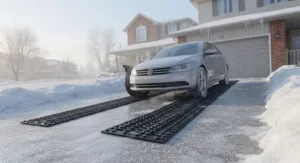
- Clear snow from in front of the drive wheels first — boards can’t overcome a wall.
- Wedge the board tight under the tire tread, cleats facing up.
- Straighten the steering wheel and use the gentlest throttle possible. Spinning melts a polished groove into the board and the ice beneath it.
- Tie a bright leash or cord to each board so it doesn’t vanish into a snowbank.
Coir and rubber runners: maintenance
Lift coir mats after any thaw day, shake out the slush, and dry them in the garage — this single habit doubles their useful life. Rubber mats need only a hose rinse in spring to wash out salt residue, which otherwise hardens the surface over time.
A common first-month mistake is putting a passive mat on black ice without scraping or salting first: the mat itself can then slide. Break the glaze, then lay the mat.
Real-World Scenarios: Matching the Right Mat to Your Driveway
Specs only matter in context, so here are three realistic Canadian profiles and the reasoning behind each pick.
Scenario 1: The retired couple in Sudbury
A 30-metre sloped driveway, two seniors in their 70s, and a daughter who lives three hours away. Snow falls regularly from November to April, and a fall on the front walk could mean a broken hip.
Recommendation: Two HeatTrak Heated Driveway Mat strips for the steepest section, plus three linked HeatTrak Residential Heated Walkway Mat units from the car door to the porch. Yes, it’s a big spend — likely several thousand dollars once an electrician adds a 240 V circuit — but it replaces paid snow-clearing visits and, more importantly, removes daily ice exposure for the people most vulnerable to falls.
Scenario 2: The renter in a Halifax duplex
A shared, flat gravel-and-asphalt parking pad; the landlord handles ploughing (eventually). No outdoor outlet, a compact Honda Civic, and a budget of about C$100.
Recommendation: A Jumbl 10FT Coco Fiber Ice Carpet for the walk to the side door and a SubZero 12501 GripTrax set in the trunk. Everything is portable, nothing needs wiring, and both move with you at lease end.
Scenario 3: The family with a cottage lane in the Laurentians
A Toyota 4Runner, weekend trips up a 1.5 km private road that’s ploughed irregularly, plus a suburban driveway in Laval during the week.
Recommendation: A pair of X-BULL Gen 3.0 Recovery Boards if trips are occasional; MAXTRAX MKII if the family is up there every weekend. The lifetime warranty justifies the premium once usage climbs, and both are rated for a vehicle of that weight with room to spare.
Problem → Solution Guide: Fixing the Most Common Icy Driveway Headaches
Problem 1: “My car spins at the bottom of the driveway every morning.” Solution: This is usually the plough windrow plus a slope. Clear the windrow first, then keep a pair of Maxsa 20333 Escaper Buddy mats by the garage door. Their 122 cm length gives your tires a long grippy runway up the incline.
Problem 2: “The coir mat froze solid to the driveway.” Solution: Coir holds water. Lift it every evening after a thaw day, or switch to rubber for that spot. A light dusting of calcium chloride (effective to roughly −30 °C) under the mat helps prevent re-bonding.
Problem 3: “My heated mat trips the breaker.” Solution: Check the total amperage. A 24″ × 20′ HeatTrak Heated Driveway Mat alone uses 11.7 A; add a block heater on the same circuit and you’ll overload a 15 A breaker. Split loads across circuits or have an electrician add a dedicated one.
Problem 4: “My recovery board disappeared in the snow.” Solution: Buy bright colours — the MAXTRAX MKII and X-BULL Gen 3.0 Recovery Boards both come in high-visibility orange — and tie a leash to the vehicle.
Problem 5: “The walkway is fine, but I still slip stepping out of the car.” Solution: That first step lands on untreated pavement. Place a HeatTrak Residential Heated Walkway Mat or a coir runner right where the driver’s door opens, not just along the sidewalk.
✨ Don’t Miss These Top-Rated Winter Picks! 🔍
Take your winter driveway safety to the next level with these carefully selected traction mats. Click on any highlighted product to check current pricing and availability on amazon.ca. The right mat means safer mornings, fewer stuck tires, and one less winter headache for your whole family!
How to Choose Traction Mats for Icy Driveway Conditions
Use these seven criteria in order — they’re ranked by how often they change the final decision.
- Decide: feet, tires, or both. Walkway mats and recovery boards solve completely different problems; buying the wrong category is the single most expensive mistake.
- Check your power situation. Heated mats need a GFCI outdoor outlet and circuit capacity. No outlet? Your choice narrows to passive mats and boards.
- Measure the slope. Flat driveways rarely need heated tire tracks; steep grades often do, because any traction aid can still slide downhill with the vehicle.
- Look for CSA certification on anything electrical. CSA C22.2 or equivalent certification signals compliance with Canadian electrical safety standards.
- Match length to your vehicle. Longer boards (110 cm+) suit heavier SUVs and trucks; compact boards suit small cars and tight trunks.
- Prefer nylon over basic plastics for deep cold. Reinforced nylon resists brittleness far better when temperatures fall below −20 °C.
- Compare warranties, not just prices. A 90-day warranty versus a lifetime one tells you how much confidence the maker has in cold-weather durability.
For broader context on why grip matters on Canadian roads, Transport Canada’s winter driving guidance stresses winter tires, reduced speed and gentle braking — traction mats complement those habits rather than replacing them.
Rubber vs Coir Traction Mats: Which Surface Grips Better?
The rubber vs coir traction mats debate comes down to one question: what does your driveway do between storms?
Coir: grippy, cheap, thirsty
Coir (coconut fibre) gives outstanding immediate friction. Every bristle acts like a microscopic cleat, and on dry cold days — think −12 °C and sunny in Calgary — a coir mat such as the Jumbl 10FT Coco Fiber Ice Carpet feels almost carpet-like underfoot. The downside is absorption. In cities with frequent freeze-thaw cycles like Toronto, Halifax or Vancouver’s North Shore, coir soaks up meltwater and can refreeze into a stiff, lumpy slab.
Rubber: durable, drainable, heavier
Rubber mats (including the surface of both HeatTrak models) shed water, resist salt, and stay flexible in deep cold if the compound is good. They last many seasons rather than one or two. The trade-off is weight and price, and cheap rubber can still become slick when a film of meltwater freezes over its surface.
The verdict
On paper, rubber vs coir traction mats isn’t a winner-takes-all contest. Choose coir for budget, short-term or dry-cold situations; choose rubber for longevity and wet freeze-thaw climates. Many homeowners sensibly run both: rubber at the high-traffic doorway, coir along the longer path.
Ice Cleats vs Snow Boots for Driveway Safety
Mats cover the ground; footwear covers everything else. That’s why ice cleats vs snow boots for driveway safety deserves its own look — your driveway isn’t fully matted, and the car door, the recycling bin and the mailbox all sit on bare ice.
What the research says about boots
Researchers at the Toronto Rehabilitation Institute’s WinterLab tested 98 types of winter footwear on icy slopes and found that only about 8% met their minimum slip-resistance standard. Put simply: a warm, waterproof snow boot is not necessarily a grippy one. Boots that did pass used specialized sole compounds such as Green Diamond or Arctic Grip.
Where ice cleats win
Strap-on cleats with steel studs or coils physically pierce the ice. For clearing the driveway at dawn, taking out the bins, or walking a dog on a glazed street, they outperform nearly any boot sole. However, they’re dangerous indoors, on tile, and on smooth concrete garage floors — take them off at the door.
Practical recommendation
For ice cleats vs snow boots for driveway safety, the honest answer is “both, used differently.” Wear WinterLab-rated boots as your daily default, keep a pair of cleats by the door for glazed mornings, and let traction mats handle the fixed paths you walk every day. The Canadian Red Cross echoes this layered approach, recommending traction footwear, shorter steps and treated walkways in its guide to avoiding slips and falls in icy weather.
Best Anti-Slip Mats for Garage Floor Winter Safety
The ice doesn’t stop at the garage door. Your vehicle carries snow and brine inside, which melts into a slick puddle on sealed concrete — exactly where you step out in socks-and-slides mode to grab something from the freezer.
What to look for
The best anti-slip mats for garage floor winter use share three traits:
- ✅ Raised channels or a lip to contain meltwater so it doesn’t spread across the floor.
- ✅ Heavy rubber or PVC construction that won’t curl at −10 °C in an unheated garage.
- ✅ A ribbed or studded top surface for foot grip even when wet.
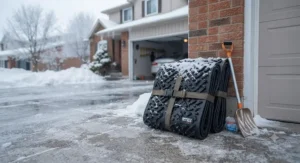
Containment mats that sit under the vehicle catch the bulk of the melt, while ribbed rubber runners (such as heavy-duty 24″ × 36″ ribbed doormats) cover the walking path from the driver’s door to the house entry. Honestly, even the best anti-slip mats for garage floor winter protection only work if you empty and rinse them — a full containment mat is a shallow skating pond.
Garage floor coatings: the long-term fix
Mats are a patch; garage floor coatings address the surface itself. Road salt draws moisture into bare concrete, and during freeze-thaw cycles that trapped water expands, causing pitting and spalling. Epoxy and polyaspartic coatings seal the slab so brine sits on top where you can squeegee it off. Critically, ask for an anti-slip aggregate additive: a glossy uncoated epoxy can be more slippery than bare concrete when wet. Garage floor coatings typically run into the thousands for professional installation, so think of them as a multi-decade investment rather than a winter purchase.
Black Ice Hazards: A Safety Guide for Canadian Driveways
Black ice hazards are uniquely sneaky because the ice is transparent — you see dark pavement, not white ice. It forms most often at dawn and dusk, when temperatures hover around 0 °C, and in shaded spots: the north side of the house, under trees, and at the base of a downspout.
Where it hides on a driveway
- 🌨️ Downspout discharge zones — meltwater from the roof refreezes overnight.
- 🌳 Shaded strips where sun never reaches between December and February.
- 🚗 The garage apron, where cars drip meltwater that refreezes after dark.
How to reduce black ice hazards
- Redirect downspouts away from walking paths with an extension.
- Apply calcium chloride before a freeze, not after — it works at far lower temperatures than rock salt.
- Place heated or passive mats specifically over known refreeze zones.
- Use outdoor lighting with a warm colour temperature; glare on glossy ice is easier to spot.
The honest takeaway about black ice hazards: no product eliminates them entirely. Heated mats come closest on the surfaces they cover, but everywhere else, awareness, footwear and de-icer timing still do the heavy lifting.
Traction Mats vs Traditional Winter Solutions: Salt, Sand and Shovelling
| Solution | Upfront Cost | Works Below −15 °C? | Damages Concrete/Pets? | Ongoing Effort | Best For |
|---|---|---|---|---|---|
| Rock salt | Low | Poorly | Yes, can pit concrete and irritate paws | High (reapply often) | Mild winters |
| Sand/grit | Very low | Yes (grip only) | No, but tracks indoors | High | Rural gravel drives |
| Jumbl 10FT Coco Fiber Ice Carpet | Low | Yes | No | Medium (lift and dry) | Budget walkways |
| HeatTrak Heated Driveway Mat | Very high | Yes | No | Very low | Steep, high-risk driveways |
| X-BULL Gen 3.0 Recovery Boards | Low-medium | Yes | No | Only when stuck | Vehicle recovery |
The table highlights why traction mats are gaining ground: rock salt’s effectiveness drops sharply once temperatures go well below freezing, just when Prairie and northern winters are at their worst. The HeatTrak Heated Driveway Mat costs the most upfront but demands the least effort, whereas sand and salt are cheap per bag yet expensive in time and in concrete repair over a decade. For most households, a hybrid approach — de-icer plus targeted mats — outperforms any single method.
Long-Term Cost & Value: What You’ll Really Spend Over Five Winters
Price tags are misleading; cost-per-winter tells the real story.
Passive mats
A coir runner at roughly C$35-C$70 may last one to two seasons with care. Over five winters, budget roughly C$100-C$200 in replacements — still cheap, but not “buy once.”
Recovery boards
A MAXTRAX MKII pair at roughly C$450-C$550 with lifetime defect coverage works out to around C$50 a year over a decade. The X-BULL Gen 3.0 Recovery Boards at C$90-C$150 might need replacing once in that span, landing at a similar or lower annual cost for occasional users. A single avoided tow — often C$100-C$200 in many Canadian cities — can pay back budget boards on the first use.
Heated mats
The HeatTrak mats are the long game. Electricity cost depends on your provincial rate and hours of use; a 2.5 A walkway mat at 120 V uses roughly 0.3 kWh per hour, so even heavy use is modest per mat. Add the two-year warranty and any electrician costs, and the real comparison is against a seasonal snow-removal contract, which commonly runs several hundred dollars a year in many Canadian cities.
Common Mistakes When Buying Traction Mats for Icy Driveway Safety
- ❌ Buying walkway mats to fix a stuck car. Soft coir or rubber runners tear or shoot out under spinning tires.
- ❌ Ignoring circuit capacity. Heated mats plus a block heater on one circuit is a recipe for tripped breakers at 6 a.m.
- ❌ Skipping CSA certification. Uncertified heated mats may not meet Canadian electrical standards and could complicate insurance claims.
- ❌ Choosing dark-coloured recovery boards. Black boards disappear in slush and night-time snowbanks.
- ❌ Laying passive mats on unbroken black ice. Without scraping first, the whole mat can slide.
- ❌ Assuming one product covers everything. Driveways have tire paths, walking paths and garage floors — each needs a different fix.
FAQ
❓ What are the best traction mats for icy driveway slopes in Canada?
❓ Are heated driveway mats safe to leave out all winter?
❓ Can I drive over a coir walkway mat?
❓ Do traction mats work on black ice?
❓ Is MAXTRAX worth it over cheaper boards for winter driving?
Conclusion
Canadian winters don’t negotiate, but your driveway strategy can be smarter than “salt and hope.” The key insight is that traction mats for icy driveway problems fall into three camps — heated prevention, passive grip underfoot, and rigid vehicle recovery — and the right choice depends on who’s slipping and where.
If budget allows and the slope is steep, the HeatTrak Heated Driveway Mat and HeatTrak Residential Heated Walkway Mat are the closest thing to erasing ice from your routine. For renters and budget shoppers, the Jumbl 10FT Coco Fiber Ice Carpet plus a SubZero 12501 GripTrax set covers the basics for under C$100. Drivers facing rural lanes or plough windrows should look at the X-BULL Gen 3.0 Recovery Boards for value, the Maxsa 20333 Escaper Buddy for length, or the MAXTRAX MKII for buy-once durability.
Layer these with WinterLab-rated boots or ice cleats, smart de-icer timing, and anti-slip garage mats, and you’ve built a system — not just a purchase. Your future self, carrying groceries across a glazed driveway in February, will thank you.
🚀 Ready to Win the War on Winter Ice? ❄️
Don’t wait for the first freezing-rain warning. Click any highlighted product above to check current pricing and availability on amazon.ca, and set up your driveway before the ice arrives. A few minutes today can save you a fall, a tow bill, or a very long morning!
Recommended for You
- 7 Best Ice And Snow Safety Kit For Garage Picks (Proven 2026)
- Smart Garage Door Openers: 7 Best Renter-Friendly Picks (2026)
- Smart Garage Door Opener vs Traditional Opener: 7 Picks 2026
Disclaimer: This article contains affiliate links. As an Amazon Associate, I earn from qualifying purchases. If you purchase products through these links, we may earn a small commission at no additional cost to you.
✨ Found this helpful? Share it with your friends! 💬🤗
