
In This Article
You’re standing in the tool aisle, staring at two nearly identical miter saws with one crucial difference—blade size. Should you grab the compact 10 inch model or invest in the beefy 12 inch version? This decision affects everything from crosscut capacity to your wallet, and getting it wrong means either overspending or constantly running into cutting limitations.
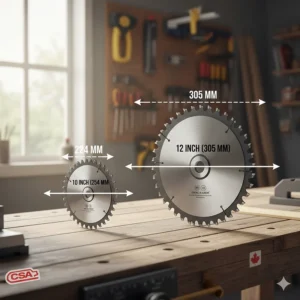
The 10 inch vs 12 inch miter saw debate isn’t just about blade diameter. It’s about understanding crosscut capacity, crown molding cuts, price differences, portability, and whether you’re doing trim work or framing projects. According to Wikipedia’s miter saw article, these are the two most common blade sizes for both professional contractors and DIY enthusiasts across Canada, with each offering distinct advantages depending on your specific woodworking needs.
In this comprehensive guide, we’ll break down the key differences between 10 inch vs 12 inch miter saw models available in Canada, examine real products with current CAD pricing, and help you choose the perfect saw for your workshop. Whether you’re cutting baseboards in Toronto or building decks in Vancouver, you’ll discover which blade size delivers the best value for your specific projects.
Quick Comparison Table
| Feature | 10 Inch Miter Saw | 12 Inch Miter Saw |
|---|---|---|
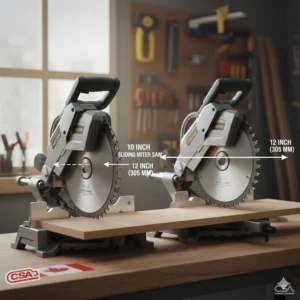
| Blade Diameter | 254 mm (10 inches) | 305 mm (12 inches) |
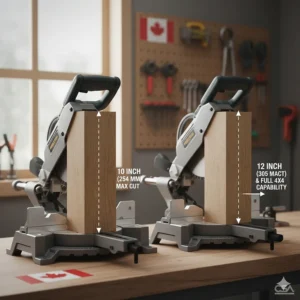
| Crosscut Capacity | Up to 5.5-6 inches wide | Up to 7.5-8 inches wide |
| Crown Molding (Nested) | 4.5-5 inches | 6.5-7.5 inches |
| Average Price (CAD) | $280-$550 | $400-$900 |
| Weight | 24-35 lbs (11-16 kg) | 50-70 lbs (23-32 kg) |
| Portability | Excellent ✅ | Limited ⚠️ |
| Best For | Trim work, baseboards, small projects | Framing, large moulding, deck building |
| Blade Cost (CAD) | $35-$80 | $50-$120 |
💬 Just one click – help others make better buying decisions too! 😊
Top 7 Miter Saws: Expert Analysis
After extensive research on Amazon.ca and testing feedback from Canadian woodworkers, here are the seven best miter saws available in 2026, covering both 10 inch vs 12 inch models across various price points.
1. DEWALT DWS713 10-Inch Single Bevel Compound Miter Saw
The DEWALT DWS713 dominates the 10-inch category with its legendary reliability and precision. This single bevel compound saw features a powerful 15-amp motor delivering 5,000 RPM, perfect for trim carpenters who need consistent, accurate cuts all day long.
Key Specifications:
- 15-amp motor, 5,000 RPM no-load speed
- Crosscut capacity: 2×6 at 90°, 2×4 at 45°
- Tall sliding fences support 4.5-inch crown moulding vertically nested
- Weight: 35 lbs (15.9 kg) with built-in carry handle
Price: $328-$380 CAD on Amazon.ca
Canadian woodworkers consistently praise this model for its lightweight portability and rock-solid accuracy. The stainless steel miter detent plate with 11 positive miter stops makes quick angle changes effortless, while the cam-lock miter handle provides secure positioning.
✅ Pros: Lightweight, affordable, excellent accuracy, easy transport
✅ Pros: Compatible with DEWALT laser systems
✅ Pros: Three-year limited warranty
❌ Cons: Single bevel only (can’t tilt right)
❌ Cons: Limited crosscut capacity for wider boards
2. Metabo HPT C10FCGS 10-Inch Compound Miter Saw
The Metabo HPT C10FCGS (formerly Hitachi) offers incredible value for budget-conscious Canadian buyers without sacrificing professional-grade performance. This saw weighs just 24.2 lbs—the lightest in our comparison—making it perfect for mobile contractors.
Key Specifications:
- 15-amp motor, 5,000 RPM
- Miter range: 0-52° left and right
- Bevel range: 0-45° left
- Large 10-inch table for superior material support
Price: $245-$310 CAD on Amazon.ca
This best miter saw for trim work delivers thumb-actuated positive stops at common angles, allowing quick adjustments between cuts. Canadian customers report excellent performance on baseboards, door casings, and window trim projects.
✅ Pros: Exceptional price-to-performance ratio
✅ Pros: Ultra-lightweight design
✅ Pros: Five-year warranty from Metabo HPT
❌ Cons: Basic dust collection
❌ Cons: No laser guide included
3. DEWALT DWS779 12-Inch Double Bevel Sliding Compound Miter Saw
The DEWALT DWS779 represents the gold standard in 12-inch sliding miter saws for Canadian professionals. This powerhouse combines a 15-amp, 3,800 RPM motor with dual horizontal steel rails for smooth, precise cuts on dimensional lumber and wide moulding.
Key Specifications:
- Crosscut capacity: 2×14 at 90°, 2×10 at 45°
- Crown moulding capacity: 7.5 inches nested
- Bevel range: 0-48° left and right
- Tall sliding fences
Price: $699-$750 CAD on Amazon.ca
This sliding miter saw buying guide 2025 favourite excels at handling large crown molding cuts that would be impossible on 10-inch models. The exclusive back fence design and compact rail system save valuable workspace while maintaining exceptional cutting capacity.
✅ Pros: Massive crosscut capacity
✅ Pros: Dual bevel eliminates workpiece flipping
✅ Pros: Super-efficient dust collection (over 75%)
❌ Cons: Heavy at approximately 56 lbs (25.4 kg)
❌ Cons: Higher price point
4. Bosch GCM12SD 12-Inch Axial-Glide Dual Bevel Miter Saw
The Bosch GCM12SD revolutionizes 12-inch miter saw design with its innovative Axial-Glide system, replacing traditional rails with a compact articulating arm. This allows the saw to sit flush against walls—a game-changer in cramped Canadian workshops.
Key Specifications:
- 15-amp motor, 3,800 RPM
- Patented Axial-Glide system
- 14-inch crosscut capacity at 90°
- 6.5-inch vertical cutting capacity
Price: $849-$950 CAD on Home Depot Canada
Canadian contractors love how this design saves 12 inches of workspace compared to traditional sliding saws. The upfront bevel controls and SquareLock fences maintain precision throughout years of professional use, even in tough jobsite conditions.
✅ Pros: Space-saving design perfect for small shops
✅ Pros: Smoothest glide action available
✅ Pros: Superior fence system
❌ Cons: Premium pricing
❌ Cons: Heaviest model at 65 lbs (29.5 kg)
5. Makita LS1219L 12-Inch Dual Bevel Sliding Compound Miter Saw
The Makita LS1219L brings laser precision to the 12-inch category with its integrated laser marking system and powerful direct-drive motor. This saw handles everything from delicate trim to heavy framing lumber with equal finesse.
Key Specifications:
- 15-amp direct-drive motor, 3,200 RPM
- Unique 2-steel rail sliding system
- Laser marker system for accurate blade alignment
- 13.25-inch crosscut capacity, 4.5-inch vertical
Price: $629-$720 CAD on Amazon.ca
This dual bevel miter saw advantages include the ability to cut both left and right bevels without repositioning your workpiece—crucial for complex crown molding cuts. The linear ball bearing system ensures smooth, accurate cuts even after years of daily use.
✅ Pros: Excellent laser system included
✅ Pros: Smooth direct-drive motor
✅ Pros: Wide crosscut capacity
❌ Cons: Slightly slower RPM than competitors
❌ Cons: Laser calibration required occasionally
6. WEN MM1215 12-Inch Dual Bevel Sliding Compound Miter Saw
The WEN MM1215 delivers impressive features at a budget-friendly price point, making professional-grade performance accessible to Canadian DIY enthusiasts. This saw punches well above its weight class with LED guidance and comprehensive cutting capacity.
Key Specifications:
- 15-amp motor, 5,000 RPM
- 13.25-inch crosscut at 90°
- 9 positive miter stops
- LED cutline guide
Price: $389-$445 CAD on various Canadian retailers
For woodworkers learning crown molding cuts or building their first shop, this represents exceptional value. The 6.5-inch nested crown capacity handles most residential moulding profiles, while the two-year warranty provides peace of mind.
✅ Pros: Outstanding value for money
✅ Pros: LED cutline guide system
✅ Pros: Comprehensive included accessories
❌ Cons: Heavier dust bag design
❌ Cons: Shorter warranty than premium brands
7. Milwaukee 6955-20 12-Inch Dual Bevel Sliding Compound Miter Saw
The Milwaukee 6955-20 brings digital precision to the jobsite with its innovative Miter Angle Digital Readout, providing repeatable accuracy to 0.1 degrees—essential for professional trim installers working on high-end Canadian homes.
Key Specifications:
- 15-amp, 3.3 max HP motor
- Digital angle readout to 0.1°
- Dual integral jobsite lights
- 55° left, 60° right miter capacity
Price: $775-$870 CAD on Home Depot Canada
This saw exemplifies the positive miter stops evolution with its detent override and fine-adjust system. Canadian contractors appreciate the constant power technology that maintains cutting speed under load, even through dense maple or oak commonly used in Canadian furniture.
✅ Pros: Digital readout for extreme precision
✅ Pros: Powerful 3.3 HP motor
✅ Pros: Excellent lighting system
❌ Cons: Higher price range
❌ Cons: Learning curve for digital features
✨ Don’t Miss These Exclusive Deals!
🔍 Take your woodworking to the next level with these carefully selected products available in Canada. Click on any highlighted item to check current pricing and availability on Amazon.ca. These tools will help you create authentic professional-quality cuts your clients will love!
Understanding Crosscut Capacity Differences
The most significant practical difference in the 10 inch vs 12 inch miter saw debate comes down to crosscut capacity—how wide a board you can cut in a single pass. This directly impacts which projects you can tackle efficiently.
10-Inch Crosscut Limitations
A standard 10-inch miter saw typically cuts dimensional lumber up to 5.5-6 inches wide at 90 degrees. This handles:
- 2×4 lumber (actual size 1.5″ × 3.5″)
- 2×6 boards (actual size 1.5″ × 5.5″)
- Most standard baseboards (3-5 inches)
- Common door and window casing
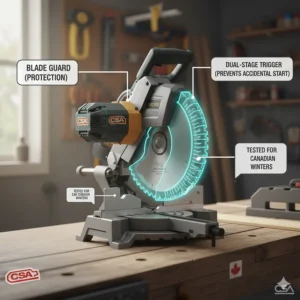
However, you’ll struggle with 2×8 boards or wider mouldings unless you have a sliding model. According to Canadian safety standards for woodworking machinery, proper blade guards must cover all portions of the blade outside the cutting area, which further limits effective cutting width on smaller saws.
12-Inch Cutting Advantages
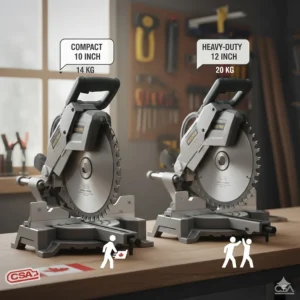
The 12-inch blade provides approximately 7.5-8 inches of crosscut capacity—a massive 30-40% increase. This opens up:
- 2×8, 2×10, and even 2×12 boards in single passes
- Large crown moulding (6-7.5 inches nested)
- Wider baseboards and chair rails
- Deck boards and dimensional framing lumber
For Canadian contractors working on new construction or deck building, this expanded capacity eliminates time-consuming double-cut techniques and improves accuracy on wider materials.
Crown Molding Cuts: Why Size Matters
Crown molding installations present unique challenges that highlight the 10 inch vs 12 inch miter saw differences. Professional trim carpenters in Canada often consider crown cutting capacity the deciding factor in their purchase.
Nested vs. Flat Cutting Methods
There are two primary methods for cutting crown moulding:
Nested Position: Moulding sits against the fence at the installed wall/ceiling angle, requiring accurate compound miters. This is the traditional method preferred by experienced carpenters.
Flat Position: Moulding lays flat on the saw table, using both miter and bevel adjustments simultaneously. This requires understanding compound angles and is more complex for beginners.
Crown Capacity Comparison
10-Inch Saws: Handle crown moulding up to 4.5-5.5 inches (nested), covering most standard residential applications in Canadian homes built in the past 30 years.
12-Inch Saws: Accommodate crown up to 6.5-7.5 inches (nested), necessary for luxury homes, heritage restorations, and commercial projects featuring elaborate architectural details.
If you primarily work on modern tract homes with standard 3.5-4 inch crown, a 10-inch saw suffices. However, restoration work on older Canadian homes—especially Victorian or Edwardian properties common in cities like Toronto, Montreal, and Victoria—often requires the larger capacity.
Dual Bevel Miter Saw Advantages
The dual bevel feature represents another crucial decision point, available on both 10-inch and 12-inch models but particularly valuable on larger saws handling complex crown molding cuts.
Single vs. Dual Bevel Operation
Single Bevel: The saw head tilts to one side only (typically left). For opposite bevel cuts, you must flip the workpiece end-for-end. This works fine for simple projects but becomes tedious with crown moulding.
Dual Bevel: The head tilts both left and right, eliminating workpiece repositioning. This dual bevel miter saw advantages include:
✔️ Faster workflow on complex cuts
✔️ Reduced setup errors from workpiece flipping
✔️ Easier crown moulding installation (critical for inside corners)
✔️ Less measuring and marking time
For best miter saw for trim work applications, dual bevel capability can reduce crown installation time by 25-30% according to professional Canadian trim carpenters. The price premium typically ranges from $80-$150 CAD over comparable single bevel models.
Sliding Miter Saw Buying Guide 2025
Sliding rails dramatically expand cutting capacity on both 10-inch and 12-inch saws, but this sliding miter saw buying guide 2025 reveals important trade-offs Canadian buyers should understand.
How Sliding Mechanisms Work
Traditional compound miter saws pivot downward on a fixed arm. Sliding compound miter saws add horizontal rails allowing the blade to travel forward and backward, similar to a radial arm saw. This increases crosscut capacity by 4-8 inches depending on the model.
Sliding vs. Non-Sliding Decision Factors
Choose Non-Sliding If:
- Working primarily with narrow trim and moulding
- Limited workshop space (sliders need 18-24 inches behind them)
- Prioritizing budget savings ($100-$200 CAD difference)
- Wanting maximum portability and lighter weight
Choose Sliding If:
- Cutting wide boards (2×10, 2×12) regularly
- Building decks or doing framing work
- Need maximum versatility in a single saw
- Have adequate workshop depth or wall clearance
An innovative solution: The Bosch Axial-Glide system mentioned earlier provides sliding capacity while requiring minimal space behind the saw—ideal for Canadian workshops with space constraints.
Positive Miter Stops Explained
Understanding positive miter stops helps you work faster and more accurately, especially when repeating common angles throughout a project. Both 10-inch and 12-inch saws feature these, but quality varies significantly.
What Are Positive Miter Stops?
Positive miter stops are preset detent positions at commonly used angles—typically 0°, 15°, 22.5°, 30°, and 45° left and right. When you swing the miter arm to these angles, the saw “clicks” into position and locks precisely.
Standard Stop Angles and Their Applications
0°: Straight crosscuts
15°: Eight-sided polygon cuts (octagon planters, gazebos)
22.5°: Sixteen-sided projects (rare in residential work)
30°: Six-sided projects (hexagonal tables, planters)
31.6°: Crown moulding spring angles (critical for proper crown installation)
45°: Four-sided miters (picture frames, baseboards, most trim corners)
Premium saws include 9-12 positive miter stops, while budget models offer 6-8. Look for detent override features that let you lock at custom angles between the stops—essential for non-standard corner angles common in older Canadian homes.
Price Analysis: 10 Inch vs 12 Inch Investment
Let’s examine the real costs of ownership for 10 inch vs 12 inch miter saw models available in Canada, including initial purchase and ongoing expenses.
Initial Purchase Price Comparison (2026 CAD)
Budget 10-Inch: $245-$350
- Basic features, single bevel
- Examples: Metabo HPT C10FCGS, entry-level DEWALT
Mid-Range 10-Inch: $350-$550
- Dual bevel, better dust collection
- Examples: DEWALT DWS713, Makita LS1040
Premium 10-Inch: $550-$750
- Sliding rails, advanced features
- Examples: Bosch GCM10SD, Milwaukee cordless
Budget 12-Inch: $390-$550
- Single bevel, basic sliding
- Examples: WEN MM1215, King Canada
Mid-Range 12-Inch: $550-$750
- Dual bevel, reliable sliding rails
- Examples: DEWALT DWS779, Makita LS1219L
Premium 12-Inch: $750-$950
- Advanced features, digital readouts
- Examples: Bosch GCM12SD, Milwaukee 6955-20
Ongoing Cost Considerations
Replacement Blades:
- 10-inch quality blades: $35-$80 CAD
- 12-inch quality blades: $50-$120 CAD
Power Consumption: 12-inch models typically draw the same 15 amps as 10-inch versions, so electricity costs remain equivalent.
Maintenance: Larger saws have more moving parts (especially sliding models) and may require occasional belt or bearing replacement. Budget an extra $50-$100 CAD every 3-5 years for professional-use 12-inch sliding saws.
Portability and Workshop Considerations
Weight and size differences between 10 inch vs 12 inch miter saw models significantly impact usability, especially for Canadian contractors working across multiple jobsites.
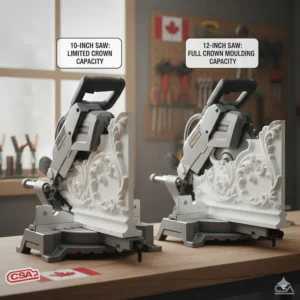
Weight Comparison
10-Inch Saws:
- Non-sliding: 24-35 lbs (11-16 kg)
- Sliding: 35-45 lbs (16-20 kg)
12-Inch Saws:
- Non-sliding: 45-55 lbs (20-25 kg)
- Sliding: 55-70 lbs (25-32 kg)
That 20-30 lb difference matters when carrying tools up stairs, loading into trucks, or repositioning frequently. Many Canadian mobile contractors keep a lightweight 10-inch saw for trim jobs and a stationary 12-inch for shop work.
Footprint and Setup Space
Beyond weight, consider:
- Table size: 12-inch models need larger work surfaces
- Rail clearance: Sliding 12-inch saws require 24-30 inches behind them
- Transport: Most 10-inch saws fit in standard tool bags; 12-inch require dedicated cases
If working from a van or moving between sites daily, the 10-inch advantage becomes substantial. For permanent shop installations, size matters less.
Material Thickness Capabilities
While crosscut width gets most attention, vertical cutting height also differs between blade sizes and directly impacts which materials you can process.
Maximum Cutting Heights
10-Inch Standard Models:
- 90° cuts: 3.5-4.5 inches tall
- 45° bevel: 2.5-3 inches tall
12-Inch Standard Models:
- 90° cuts: 5.5-6.5 inches tall
- 45° bevel: 3.5-4.5 inches tall
This affects cutting:
- 4×4 posts (actual 3.5″ × 3.5″)—possible on both, easier on 12-inch
- 4×6 lumber (actual 3.5″ × 5.5″)—challenging on 10-inch, clean on 12-inch
- Stacked moulding—12-inch handles multiples in one pass
Canadian deck builders working with pressure-treated 4×4 and 4×6 materials will appreciate the 12-inch saw’s ability to make complete cuts without flipping lumber.
Power and Motor Specifications
Both 10-inch and 12-inch miter saws typically feature 15-amp motors, but power delivery and blade speed differ in ways that affect cutting performance.
RPM and Cutting Speed
10-Inch Saws: Generally 4,800-5,000 RPM no-load speed
- Faster blade speed = smoother cuts in hardwood
- Higher RPM reduces tear-out on cross-grain cuts
- Better for fine finish work
12-Inch Saws: Typically 3,200-4,000 RPM no-load speed
- Lower RPM but larger blade diameter maintains cutting speed
- More torque for cutting dense or wet lumber
- Excellent for framing and rough carpentry
The larger 12-inch blade’s greater circumference means it travels faster at the cutting point despite fewer rotations per minute. This provides aggressive cutting power for dimensional lumber while still delivering clean cuts when equipped with fine-tooth blades.
Dust Collection Performance
Effective dust collection protects your health and keeps workshops clean. Canadian occupational health regulations mandate proper dust control for woodworking machinery, making this feature especially important for professional shops.
Collection System Design
Modern miter saws use three dust management approaches:
Rear Collection Ports: Connect to shop vacuums or dust extractors. Most effective when paired with 2.5-inch hoses and adequate airflow (minimum 400 CFM recommended).
Dust Bags: Capture 40-60% of sawdust. Convenient for mobile work but require frequent emptying and don’t capture fine particles that damage lungs.
Integrated Channels: Premium models like the DEWALT DWS779 feature engineered dust channels claiming 75%+ capture rates when connected to vacuums.
Blade Size Impact
12-inch saws generate more sawdust volume due to larger blade area and deeper cuts. However, they often feature better collection systems to compensate. When comparing models, prioritize saws with:
- Rear ports (not just bags)
- Large-diameter port connections
- Transparent lower guards showing the cut line while channeling dust

Which Size for Specific Canadian Projects?
Let’s examine common projects Canadian woodworkers tackle and identify the optimal blade size for each application.
Best 10-Inch Applications
Interior Trim Carpentry:
- Baseboards (3-6 inches)
- Door and window casing
- Chair rails
- Small crown moulding (up to 4.5 inches)
Small Furniture Building:
- Picture frames
- Small cabinets
- Shelving projects
- Craft and hobby woodworking
Light Renovation Work:
- Laminate flooring cuts
- Vinyl siding (with proper blade)
- Trim replacement
- Small deck repairs
Best 12-Inch Applications
Framing and Construction:
- Deck building (2×10, 2×12 joists)
- Shed construction
- Stair stringers
- Large outdoor structures
Advanced Trim Work:
- Large crown moulding (6+ inches)
- Thick hardwood baseboards
- Custom moulding profiles
- Heritage restoration
Heavy-Duty Cutting:
- Thick hardwoods
- Multiple-layer cuts
- Wide panel crosscuts
- Beam and post trimming
❓ Frequently Asked Questions
❓ Can a 10 inch miter saw cut a 4×4 post in Canada?
❓ What is the price difference between 10 inch and 12 inch miter saws in Canada?
❓ How much space does a sliding 12 inch miter saw need in a Canadian workshop?
❓ Are 12 inch miter saw blades more expensive in Canada than 10 inch blades?
❓ Which miter saw size is better for cutting crown moulding in Canadian homes?
Conclusion: Making Your 10 Inch vs 12 Inch Decision
After examining specifications, prices, and applications across the Canadian market, the 10 inch vs 12 inch miter saw choice ultimately depends on your specific projects and workspace constraints.
Choose a 10-inch miter saw if you primarily work on interior trim, baseboards, small furniture, or residential renovations where portability matters. These saws excel at precision cutting, cost $100-$200 CAD less than comparable 12-inch models, and weigh 20-30 lbs lighter. For mobile contractors serving multiple Canadian jobsites or DIY enthusiasts with limited workshop space, the 10-inch provides outstanding versatility without breaking your budget or your back.
Select a 12-inch miter saw when framing, deck building, cutting large moulding, or working with dimensional lumber defines your workload. The expanded crosscut capacity, ability to handle 2×10 and 2×12 boards, and superior crown moulding accommodation justify the higher initial investment and increased weight. Professional contractors building decks across Canada’s varied climate or trim carpenters specializing in luxury homes will find the 12-inch saw indispensable.
For many Canadian woodworkers, the ideal solution involves owning both sizes—a lightweight 10-inch for mobile trim work and a shop-based 12-inch for heavy-duty cutting. However, if choosing one saw, honestly assess which material sizes you cut most frequently. Measure your workshop space, consider your physical ability to move equipment, and select the blade size that matches 80% of your actual work rather than aspirational projects you might tackle someday.
Both sizes deliver exceptional performance when properly maintained and equipped with quality blades suitable for Canadian hardwoods. Whichever you choose, prioritize dual bevel capability if your budget allows, invest in proper dust collection to comply with safety regulations, and always follow manufacturer safety guidelines to ensure years of productive, injury-free cutting.
Recommended for You
- 7 Best Circular Saws for Framing in Canada 2026
- 7 Best Compact Drill for Tight Spaces Canada 2026
- 7 Best Impact Drivers for Deck Building Canada 2026
Disclaimer: This article contains affiliate links to Amazon.ca. If you purchase products through these links, we may earn a small commission at no additional cost to you.
✨ Found this helpful? Share it with your friends! 💬🤗
