

In This Article
Anyone who’s faced a brutal Canadian winter knows the drill—temperatures plummeting to -30°C in the Prairies, freezing rain coating Maritime driveways, or black ice forming on Vancouver sidewalks overnight. What many homeowners overlook is that how you apply ice melt matters just as much as which product you choose. Enter the manual ice melt spreader: a tool that transforms chaotic salt-tossing into precise, efficient winter safety management.

A manual ice melt spreader is a handheld or push-operated device designed to distribute de-icing materials evenly across driveways, walkways, and stairs without electricity or batteries. Unlike dumping product straight from the bag—which wastes material, damages concrete, and leaves dangerous bare spots—a quality spreader gives you controlled application that protects both your property and your budget. According to the Canadian Centre for Occupational Health and Safety, over 42,000 Canadians are injured annually from falls, with winter slips accounting for the majority. Proper ice melt application through a spreader isn’t just convenient; it’s a safety investment.
The right spreader makes a measurable difference in Canadian conditions. When you’re dealing with concrete driveways that are less than three years old, as many recently built homes in growing areas like Ottawa suburbs or Calgary’s new developments have, over-application of salt-based products can cause spalling and pitting that costs thousands to repair. A manual ice melt spreader helps you apply the recommended 6-10 lbs per 1,000 square feet instead of the 3-5 times over-application most homeowners make when pouring directly from bags. This guide covers the best options available on Amazon.ca in 2026, with expert commentary on what actually works in harsh Canadian weather.
Quick Comparison: Top Manual Ice Melt Spreaders at a Glance
| Product | Capacity | Best For | Price Range (CAD) | Key Feature |
|---|---|---|---|---|
| Chapin 8705A Hand Crank | 1.6L (0.3 gal) | Small walkways | $25-$35 | Thumb control gate |
| Scotts Whirl Hand-Powered | Covers 1,500 sq ft | Urban driveways | $45-$60 | Adjustable arm support |
| AquaDoc Handheld Shaker | 2.5L capacity | Stairs & steps | $30-$40 | 3-size sieve options |
| EarthWay Polar Tech 90950 | 50 lbs | Professional use | $180-$220 | Solid linkage control |
| Chapin 88000A Walk-Behind | 80 lbs | Large properties | $160-$200 | Enclosed gearbox |
| Brinly PS10-70BH Broadcast | 70 lbs | All-season use | $200-$250 | 90 calibration settings |
| Snow Joe Handheld | 5 lbs | Quick touch-ups | $20-$30 | Adjustable dial flow |
💬 Just one click — help others make better buying decisions too! 😊
Top 7 Manual Ice Melt Spreaders: Expert Analysis for Canadian Conditions
1. Chapin 8705A Hand Crank Ice Melt Spreader
The Chapin 8705A brings thoughtful design to the handheld category with its 1.6-litre capacity and toothed edge scoop. This compact spreader weighs under 1 kg (2 lbs) empty and features a thumb-controlled gate that lets you open, close, or adjust flow rate without breaking stride—essential when you’re navigating icy steps in winter gloves.
What sets this model apart for Canadian users is the impeller design that handles varied ice melt textures, from fine magnesium chloride pellets to coarser calcium chloride blends. The polypropylene construction won’t crack in -25°C temperatures, a genuine concern with cheaper plastic models that become brittle in Prairie cold. One Toronto homeowner’s review on Amazon.ca noted using it for three consecutive winters on a 15-metre (50-foot) walkway without mechanical failure—impressive longevity for a sub-$35 CAD investment.
The trade-off here is coverage area. At 1.6 litres, you’ll get about 100-150 square feet per fill, meaning multiple trips to reload for standard two-car driveways. This works fine for condo owners or townhouse residents with limited outdoor space, but suburban homeowners might find the constant refilling tedious during major snow events.
Pros:
✅ Thumb control allows precise application without stopping
✅ Made in USA with quality materials that handle extreme cold
✅ Lightweight enough for seniors or those with limited upper body strength
Cons:
❌ Small capacity requires frequent refills on larger properties
❌ Hand-crank operation can be tiring over extended use
At around $30 CAD, the Chapin 8705A represents excellent value for targeted applications. If your priority is stairs, walkways, or small driveways where precision matters more than speed, this delivers professional results without the professional price tag.

2. Scotts Whirl Hand-Powered Spreader
The Scotts Whirl takes handheld spreading into power-tool territory with its battery-free rotary mechanism that covers up to 1,500 square feet of product capacity. Unlike simple shaker models, the Whirl uses a hand-crank that spins an impeller for broadcast distribution—giving you the coverage pattern of a walk-behind spreader in a 1.8 kg (4 lb) handheld package.
For Canadian buyers, the adjustable arm support stands out as more than a comfort feature. When you’re clearing paths in bulky winter coats and insulated gloves, the ability to shift weight distribution across your forearm prevents the hand fatigue that makes people rush through applications (and miss dangerous ice patches). The fully-assembled design means you can start spreading immediately after opening the box—no Allen keys required in frozen fingers.
The hopper mouth accepts chunky ice melt up to 12mm diameter, which matters when you’re buying bulk rock salt from Canadian Tire or Home Hardware where pellet sizes vary. Customer feedback from Edmonton and Winnipeg users consistently praises the even spread pattern, noting it eliminates the “hot spots” of over-concentrated salt that kill lawn edges come spring thaw. That said, the rotary mechanism requires maintenance—you’ll need to rinse and dry it after each use to prevent corrosion, especially if you’re using chloride-based products near the coast where salt air accelerates rust.
Pros:
✅ Broadcast pattern covers 3x more area than shaker-style models
✅ Engineered for smooth operation even with thick winter gloves
✅ No batteries to fail in cold weather
Cons:
❌ Requires post-use cleaning to prevent mechanism corrosion
❌ Higher price point ($45-$60 CAD) than basic shakers
The Scotts Whirl suits urban Canadian homeowners with standard-sized driveways who want efficiency without going full walk-behind. At $50-$55 CAD, it hits the sweet spot between handheld portability and broadcast coverage.
3. AquaDoc Ice Melt Hand Spreader
The AquaDoc Handheld Shaker brings versatility through its toggle cap with small, medium, and large sieve options—essentially three spreaders in one 2.5-litre container. This adjustability shines when you’re dealing with Canada’s diverse winter conditions: fine sieving for light frost on front steps, medium for overnight ice on walkways, and large openings for heavy rock salt on main driveways.
What Canadian buyers appreciate is the multi-season functionality. This same spreader works for spring lawn seeding, summer fertilizer application, and pool shock distribution—maximizing the value of a $30-$40 CAD purchase across the year. The ergonomic handle includes a comfort grip that doesn’t get slippery when wet, addressing a real safety concern when you’re spreading on icy surfaces.
The 2.5-litre capacity strikes a practical balance for suburban homes. You’ll cover a standard 6-metre (20-foot) walkway and front steps on a single fill, reducing the trips back to your garage in subzero temperatures. However, the shaker mechanism does require vigorous arm movement to maintain steady flow, which can be challenging for users with arthritis or shoulder issues—something to consider if mobility is a concern.
Pros:
✅ Three sieve sizes handle everything from fine de-icer to coarse rock salt
✅ Multi-purpose design extends usefulness beyond winter months
✅ Translucent container lets you monitor remaining product level
Cons:
❌ Shaking motion may be difficult for users with limited mobility
❌ Lacks the precision of gate-controlled models for delicate areas
For homeowners seeking year-round functionality, the AquaDoc delivers solid value around $35 CAD. It’s particularly smart for new Canadian homeowners furnishing their first property who want versatile tools that earn their garage space.
4. EarthWay Polar Tech 90950 Professional Spreader
When you see the EarthWay Polar Tech 90950, you immediately understand this isn’t a consumer model that moonlights at winter tasks—it’s purpose-built for ice melt. The 50-lb (22.7 kg) capacity hopper features a 7.6 cm (3-inch) opening specifically designed to handle chunky rock salt up to 5 cm (2 inches) in diameter, eliminating the clogging issues that plague fertilizer spreaders pressed into winter service.
The solid linkage control system is where this spreader earns its $180-$220 CAD price tag. Unlike cable-actuated models that freeze, bind, or fail in Canadian cold, the solid metal linkage maintains precise flow control at -30°C. Professional snow removal crews in Calgary and Montreal rely on this mechanism because it delivers consistent spread patterns even after hundreds of winter service calls. The 23 cm (9-inch) pneumatic tires grip packed snow without the slipping common to plastic wheels, crucial when you’re navigating the sloped driveways typical of hillside neighbourhoods in Vancouver or St. John’s.
EarthWay includes a factory-sealed, self-lubricating gearbox that eliminates the maintenance headache of seasonal greasing. After three years of testing by landscaping contractors across Ontario’s freeze-thaw cycles, the gearbox shows minimal wear—a durability advantage that matters when you’re investing over $200 CAD. The T-handle adjusts for operators around 183 cm (6 feet) or taller, addressing ergonomic needs often overlooked in import models.
The spread width reaches 4.5 metres (15 feet), meaning you’ll cover a standard residential driveway in 2-3 passes versus 5-6 with handheld models. For anyone managing multiple properties or large rural driveways, this time savings pays for the higher initial cost within a single winter season.
Pros:
✅ Purpose-built for ice melt with large hopper opening that prevents clogs
✅ Solid linkage works flawlessly in extreme Canadian cold
✅ Professional-grade durability backed by contractor field testing
Cons:
❌ Higher price point ($180-$220 CAD) creates barrier for casual users
❌ 50-lb capacity may be excessive for small urban properties
The EarthWay Polar Tech 90950 targets serious users who value reliability over economy. At around $200 CAD, it’s the choice for homeowners with expansive properties, side businesses doing neighbour driveways, or those who simply refuse to compromise on winter safety equipment.
5. Chapin 88000A SaltPro Walk-Behind Spreader
The Chapin 88000A sits in that valuable middle ground between prosumer and professional equipment with its 80-lb (36 kg) capacity and residential-focused pricing. The spiked auger design specifically targets ice melt flow, preventing bridging (when material forms an arch in the hopper instead of flowing) that frustrates users of standard fertilizer spreaders during winter.
Canadian homeowners with properties in the 0.25-0.5 acre range find this sweet-spot sizing ideal—large enough to handle significant snowfall events without constant refilling, yet compact enough to store in a typical garage alongside other equipment. The adjustable baffles let you fine-tune spread width from 1.5 to 3 metres (5-10 feet), useful when you need narrow control along walkways versus wide broadcast on open driveways.
The 25 cm (10-inch) tires handle light snow accumulation reasonably well, though they lack the aggressive tread of the EarthWay’s pneumatics. Users in flat Prairie provinces like Saskatchewan report excellent performance, while those in hilly regions of British Columbia note occasional slipping on steep inclines. The coated steel frame resists the corrosion that chloride-based ice melts cause, extending usable life significantly beyond uncoated competitors—a detail that matters when you’re storing equipment in humid coastal garages or salt-aired Maritime environments.
At 15 gate settings, you get adequate calibration for most ice melt products, though not the fine-tuning capability of the Brinly’s 90 settings. For residential use where “good enough” beats “perfect,” this range suffices. The weather-resistant construction includes sealed gears that keep road salt and slush out of critical mechanisms.
Pros:
✅ 80-lb capacity handles multiple winter storms without refilling
✅ Enclosed gearbox protects against corrosive ice melt exposure
✅ Mid-range pricing ($160-$200 CAD) balances features with affordability
Cons:
❌ 10-inch tires struggle on steep inclines or deep snow
❌ Fewer calibration settings than premium models
The Chapin 88000A represents the pragmatic choice for suburban Canadian homeowners. At $180 CAD, it delivers professional-calibre results without the professional price tag, making it especially attractive for growing families who need reliable equipment but face competing budget priorities.
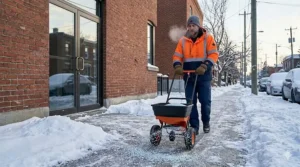
6. Brinly PS10-70BH Broadcast Ice Melt Spreader
The Brinly PS10-70BH distinguishes itself through obsessive attention to calibration with 90 dial settings—more granular control than virtually any residential competitor. For Canadian users dealing with varied ice melt formulations (calcium chloride, magnesium chloride, calcium magnesium acetate, or blended products), this precision matters. Setting 25 might be perfect for fine pelletized magnesium chloride on your walkway, while setting 65 handles coarse rock salt on the main driveway.
The polypropylene hopper construction addresses a critical Canadian concern: material longevity in temperature extremes. Unlike metal hoppers that conduct cold (making them painful to refill with bare hands at -20°C) or cheap plastic that cracks in deep freezes, this heavy-duty poly maintains structural integrity across Canada’s -40°C to +35°C annual range. The material won’t rust, dent, or corrode even after seasons of chloride exposure—a genuine advantage when you’re storing equipment in coastal regions where salt spray accelerates deterioration.
The fully pneumatic tires maintain constant ground contact across uneven terrain, crucial for Canadian driveways that have heaved and settled through multiple freeze-thaw cycles. The solid steel linkage operates smoothly in gritty conditions where cable systems fail, and the enclosed metal gearbox provides uniform spread patterns year after year without the skewing common to open gear designs.
At 70-lb (32 kg) capacity, you’ll cover roughly 14,000 square feet per fill—the equivalent of a quarter-acre property. For rural Canadians with longer driveways or those managing multiple properties, this capacity reduces refill interruptions significantly. The thumb-controlled shutter operates through an ergonomic handle design that works even with heavy winter gloves.
Pros:
✅ 90 calibration settings allow precise tuning for any ice melt product
✅ Poly hopper won’t rust, crack, or conduct painful cold
✅ Professional-grade components at residential pricing ($200-$250 CAD)
Cons:
❌ Higher price point may exceed casual users’ budgets
❌ 70-lb capacity creates bulky storage requirements
The Brinly PS10-70BH serves the detail-oriented Canadian homeowner who views winter equipment as a long-term investment. At $225 CAD, it’s the choice for those who appreciate precision engineering and don’t mind paying modestly more for noticeably better control and durability.
7. Snow Joe Handheld Multi-Purpose Spreader
The Snow Joe Handheld strips spreading down to essentials with its 5-lb (2.3 kg) capacity shaker design and adjustable dial flow control. This ultra-budget option ($20-$30 CAD) appeals to apartment dwellers, condo owners, or anyone with minimal spreading needs who can’t justify $200+ walk-behind investments.
The adjustable dial provides basic flow control across five settings, adequate for differentiating between light frost treatment and heavy ice coverage. The compact size makes it storage-friendly for urban Canadians with limited garage or balcony space—it tucks into a corner alongside snow shovels without dominating valuable square footage.
What you sacrifice for the low price is efficiency and comfort. At 5 lbs capacity, you’ll get maybe 75-100 square feet of coverage per fill, meaning a standard two-car driveway requires 8-10 refills. The shaker mechanism demands vigorous arm motion to maintain consistent flow, which becomes taxing on large areas or during rapid-response situations when freezing rain hits overnight. Canadian reviews frequently mention hand fatigue after 10-15 minutes of continuous use.
The construction quality reflects the price point—adequate but not exceptional. The plastic hopper holds up to a couple of seasons with careful use, but shows brittleness in extreme cold. Users in Thunder Bay and Yellowknife report cracking after one winter of -35°C exposure, while those in milder Pacific climates get 2-3 years of service.
Pros:
✅ Entry-level pricing ($20-$30 CAD) removes financial barriers
✅ Compact size suits apartment balconies or tiny storage spaces
✅ Light weight makes it manageable for elderly users on small areas
Cons:
❌ Tiny capacity requires excessive refills on anything larger than walkways
❌ Build quality doesn’t match multi-season durability of premium models
The Snow Joe Handheld fills a specific niche for budget-conscious Canadians with minimal spreading requirements. At $25 CAD, it’s a sensible first spreader for renters, students, or those testing whether manual spreading beats pouring from bags before investing in higher-end equipment.
How to Choose the Right Ice Melt Spreader for Canadian Winters
Selecting a manual ice melt spreader involves matching tool capabilities to your specific Canadian winter challenges. Start by measuring your coverage area—not just driveway length, but total square footage including walkways, stairs, and approaches. A typical suburban home might have 150-300 square metres (1,600-3,200 sq ft) of surfaces requiring treatment, while rural properties can exceed 1,000 square metres (10,800 sq ft).
Consider your regional climate patterns. Prairie residents facing sustained -25°C to -35°C temperatures need equipment with solid metal linkages and cold-resistant plastics that maintain flexibility at extreme lows. Maritime Canadians dealing with freeze-thaw cycles should prioritize corrosion-resistant materials since repeated wet-dry exposure accelerates rust on standard steel components. Pacific coast users can accept lighter-duty construction given milder winter averages, potentially saving 30-40% on equipment costs.
Evaluate physical limitations honestly. Seniors, individuals with arthritis, or those recovering from injuries should favour walk-behind models with ergonomic handles over handheld shakers requiring vigorous arm motion. The extra $100-$150 CAD investment in a wheeled spreader pays dividends in sustained usability versus abandoning a handheld model after one painful season.
Match spreader capacity to application frequency. If you’re treating surfaces 2-3 times weekly during active winter months, a 50-70 lb walk-behind spreader eliminates the frustration of constant refilling. Weekend-only users or those with on-demand clearing needs might find 5-10 lb handheld models perfectly adequate despite lower capacity.
Don’t overlook calibration capabilities, especially if you’re using premium concrete-safe ice melts. Basic models with 3-5 settings work fine for standard rock salt, but calcium chloride or magnesium chloride blends perform better with precise application rates enabled by 15+ calibration positions. The difference between settings 3 and 4 might represent 30% more or less product—critical when you’re spending $30-$40 CAD per bag on specialty formulations.
Your Winter Prep Checklist: Getting Maximum Performance from Your Spreader
Before the first snowfall hits, run a dry calibration test on your driveway. Fill your spreader with ice melt, set the gate to mid-range, and make a single pass across a measured section. Collect the applied product on a tarp, weigh it, and calculate pounds per square foot. Compare this to product label recommendations (typically 6-10 lbs per 1,000 sq ft for preventive application, 10-15 lbs for active melting). Adjust your gate setting up or down until you hit target rates—this 10-minute investment prevents over-application that damages concrete and wastes money.
Maintain your equipment religiously, especially in Canadian climates where freeze-thaw cycles accelerate deterioration. After each use, empty remaining product completely—residual ice melt attracts moisture and corrodes metal components during storage. Rinse the hopper and mechanisms with plain water, then dry thoroughly with towels or compressed air. Pay special attention to gears, gates, and linkages where trapped salt crystals cause binding. Once monthly during active winter season, apply a light coating of silicone spray or WD-40 to moving parts, avoiding wheel bearings where it can attract dirt.
Storage location matters more than most Canadians realize. Never store spreaders outdoors where moisture condenses in protected hoppers during overnight temperature swings. Unheated garages work acceptably in most regions, but Maritime coastal areas and humid Great Lakes zones benefit from indoor storage where relative humidity stays below 50%. Hang wheeled models on wall hooks to keep tires off cold concrete floors where flat spots can develop. Handheld units store on shelves with hoppers inverted to prevent dust accumulation.
Time your applications strategically using Canadian weather patterns. Apply ice melt before snowfall when possible—pre-treating prevents ice bonding to concrete and reduces the total product needed by 20-30%. For overnight freezing rain forecasts common in Ontario and Quebec, spread in late afternoon while pavement retains warmth. The enhanced melting action during that 2-3 hour window before deep freeze sets in provides better results than morning applications to already-frozen surfaces.

Concrete Protection: Why Application Method Matters
Here’s what the concrete industry doesn’t widely publicize: more driveways are damaged by improper ice melt application than by the products themselves. When you dump ice melt directly from bags, crystals concentrate in piles that create localized super-saturation. These zones absorb up to 50% more water than properly spread areas, and when that water freezes, the expansion pressure generates cracks and spalling.
Canadian concrete needs at least 12 months of curing before any ice melt exposure, yet new subdivision homeowners routinely apply products to 3-6 month old driveways. The Portland Cement Association recommends avoiding all deicers on concrete younger than one year, advice that’s particularly relevant in Canadian housing markets where rapid development means thousands of homes have fresh driveways each year.
A manual ice melt spreader provides the even distribution that protects concrete investment. Proper application creates a thin, uniform layer that lowers freezing points without the pooling effect of concentrated dumps. This matters enormously for Canadian homeowners—replacing a spalled driveway costs $4,000-$8,000 for basic concrete, jumping to $15,000-$25,000 for stamped or decorative finishes common in upscale neighbourhoods.
Choose ice melt formulations carefully for concrete compatibility. Rock salt (sodium chloride) is cheapest but most damaging—it penetrates concrete pores and reacts with calcium hydroxide in the cement matrix, creating progressive deterioration. Calcium chloride works effectively at temperatures down to -29°C and causes less concrete damage, though it can harm vegetation. Magnesium chloride offers the best concrete safety profile while remaining effective to -21°C, adequate for most Canadian populated regions outside the extreme north.
For new concrete (under 3 years old), consider calcium magnesium acetate (CMA) despite its higher cost ($25-$35 CAD per 10 kg bag versus $8-$12 for rock salt). CMA is biodegradable, non-corrosive, and works by preventing ice bonding rather than melting—a mechanism that’s gentler on fresh concrete. While it operates effectively only to -7°C (limiting usefulness in Prairie cold), it’s ideal for coastal and southern Canadian regions during moderate winters.
Common Mistakes That Waste Money and Damage Property
Over-application ranks as the most expensive error Canadian homeowners make. When you can visibly see white residue on your driveway, you’ve applied 3-5 times more product than necessary. This excess doesn’t melt ice faster—ice melt effectiveness depends on chemical concentration at the ice-pavement interface, not total volume. The surplus either runs off during the melt (carrying your money into storm sewers) or concentrates in low spots where it damages concrete through super-saturation.
Many Canadians apply ice melt after shovelling but before sweeping, leaving a layer of loose snow that dilutes product effectiveness. The snow acts as insulation, slowing heat transfer and reducing contact between chemicals and ice. Always shovel first, sweep clear, then spread—this sequencing uses 30-40% less product for the same results. During active snowfall, this might mean spreading lightly every 2-3 hours rather than heavy single applications that get buried.
Using fertilizer spreaders for ice melt creates mechanical problems many don’t anticipate. Standard lawn spreaders have smaller hopper openings (designed for granular fertilizer, not chunky rock salt) and uncoated mechanisms that corrode rapidly when exposed to chlorides. You’ll get one, maybe two winters before the spreader fails—a $60 CAD lawn spreader is effectively disposable at ice melt service. Purpose-built ice melt spreaders like the EarthWay Polar Tech cost triple that price but deliver 5-10 years of winter service, making them cheaper long-term.
Storing opened ice melt bags improperly destroys product effectiveness. Chloride-based products are hygroscopic—they absorb atmospheric moisture, causing clumping and reduced performance. After opening a bag, transfer contents to an airtight container (food-grade 20-litre buckets work excellently) and store in climate-controlled space. A $3 bucket preserves $30 of ice melt across the season, yet most Canadian garage shelves show half-empty bags exposed to humidity and temperature swings.
According to the Public Health Agency of Canada, many fall injuries are preventable with basic environmental controls like proper ice melt application. Taking time to spread correctly reduces slip-and-fall risks that burden Canadian healthcare systems during winter months.
❓ FAQ: Your Manual Ice Melt Spreader Questions Answered
❓ Can manual ice melt spreaders handle Canadian temperatures below -30°C?
❓ Do I need different spreaders for different ice melt types?
❓ How much ice melt spreader maintenance do Canadian winters require?
❓ Are manual spreaders better than electric models for Canadian use?
❓ What's the best ice melt spreader for protecting new concrete driveways?
Conclusion: Making Winter Safer, One Spread at a Time
Choosing the right manual ice melt spreader isn’t about finding the most expensive model or the one with the longest feature list—it’s about matching tool capabilities to your specific Canadian winter conditions. A Toronto condo owner with 30 metres of walkway has fundamentally different needs than a rural Saskatchewan homeowner managing a 100-metre driveway, and both require solutions distinct from coastal BC residents facing occasional freeze events.
The equipment covered in this guide spans from $25 CAD handheld shakers to $250 walk-behind professional models, but price alone doesn’t determine value. The best spreader is the one you’ll actually use consistently and correctly—a $200 walk-behind that sits unused because it’s “too much trouble to set up” delivers zero safety benefit compared to a $35 hand-crank you grab reflexively when freezing rain threatens.
Remember that proper spreading technique protects two critical investments simultaneously: your concrete surfaces (worth thousands to replace) and your physical safety (with Canadian slip-and-fall injuries costing healthcare systems millions annually). The few hundred dollars invested in quality spreading equipment pays dividends across both dimensions while delivering peace of mind that your family and visitors walk on safe, well-maintained surfaces throughout winter’s challenges.
✨ Don’t Miss These Exclusive Deals!
🔍 Take your winter safety to the next level with these carefully selected products. Click on any highlighted item to check current pricing and availability on Amazon.ca. These tools will help you create safe pathways your family will appreciate all season long!
Recommended for You
- Best Ice Scraper for Car Canada: 7 Expert Picks 2026
- 7 Best Roof Snow Rakes Canada 2026: Prevent Ice Dams Fast
- 7 Best Snow Pusher Shovels Canada 2026
Disclaimer: This article contains affiliate links. As an Amazon Associate, I earn from qualifying purchases. If you purchase products through these links, we may earn a small commission at no additional cost to you.
✨ Found this helpful? Share it with your friends! 💬🤗
