
In This Article
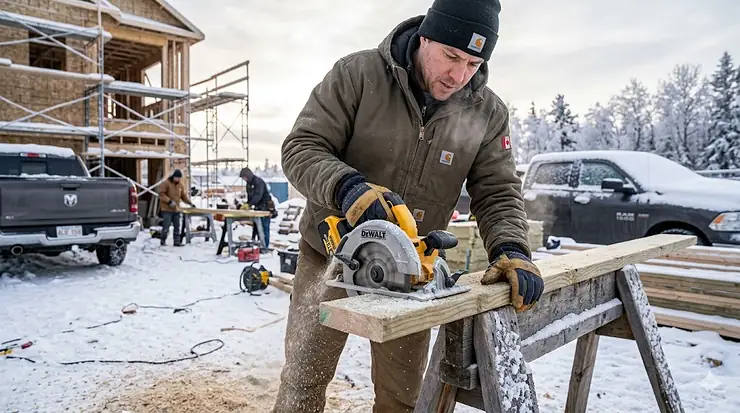
If you’ve ever watched your cordless drill die mid-project on a frigid February morning in Winnipeg, or struggled with a frozen battery pack while framing in Fort McMurray, you know the brutal truth: most power tools aren’t built for Canadian winters. When temperatures plunge below -20°C — a regular occurrence across most of the country — standard lithium-ion batteries lose 30-50% of their capacity, motors struggle against thickened lubricants, and what should be a quick deck repair turns into an exercise in frustration.
The science is straightforward. At –20°C (–4°F) most batteries are at about 50 percent performance level, and that’s assuming your tool even starts. The electrolyte in standard lithium-ion cells thickens like molasses, ion mobility slows to a crawl, and internal resistance spikes. For contractors working through Canadian winters, hobbyists tackling outdoor projects during the shoulder seasons, or anyone storing tools in an unheated garage, this isn’t a minor inconvenience — it’s a productivity killer that costs time and money.
But here’s what most Canadian buyers overlook: not all cordless tools are created equal when it comes to cold performance. Brushless motors generate less friction heat than their brushed counterparts but offer better efficiency. Battery chemistry matters — some lithium-ion formulations handle cold better than others. Tool design, from thermal management systems to cold-weather lubricants, separates the professionals from the pretenders. This guide cuts through the marketing hype to identify which power tools genuinely work in cold weather, what makes them different, and which ones are actually available on Amazon.ca for Canadian buyers. By the end, you’ll know exactly which drill, impact driver, or saw will keep running when your neighbor’s tool has already quit.
Quick Comparison Table: Top Cold-Weather Power Tools
| Tool | Best For | Temperature Rating | Battery Capacity | Price Range (CAD) |
|---|---|---|---|---|
| Milwaukee M18 FUEL | Professional contractors | -18°C operational | 5.0-12.0 Ah options | $400-$650 |
| DeWalt 20V MAX FlexVolt | Versatile platforms | 0°F (-18°C) rated | 6.0-12.0 Ah dual-voltage | $350-$600 |
| Makita 18V LXT Brushless | Compact power | -10°C to 50°C | 3.0-6.0 Ah | $300-$500 |
| Ryobi 18V ONE+ HP | Budget-conscious DIYers | 0°C to 45°C | 2.0-4.0 Ah | $150-$350 |
| Bosch 18V Brushless | Precision work | -10°C operational | 2.0-5.0 Ah | $250-$450 |
💬 Just one click — help others make better buying decisions too! 😊
Top 7 Power Tools That Work in Cold Weather: Expert Analysis
1. Milwaukee M18 FUEL 2-Tool Combo Kit — The Canadian Winter Workhorse
The Milwaukee M18 FUEL combination isn’t just marketing — it’s genuinely engineered for the conditions Canadian tradespeople face daily. The system pairs a 1/2-inch hammer drill with a 1/4-inch hex impact driver, both driven by POWERSTATE brushless motors that generate less heat loss and maintain torque even as battery voltage sags in cold weather.
Here’s what sets this apart for Canadian winters: Each battery pack is durably built for heavy-duty use, runs cooler, and performs in cold weather climates. Milwaukee’s REDLITHIUM battery chemistry includes a temperature management system that monitors individual cell performance — crucial when cells age unevenly after repeated freeze-thaw cycles. The 5.0 Ah batteries included in most kits will deliver roughly 3.5-4.0 Ah of usable capacity at -15°C, enough for most residential jobs without swapping packs.
In practice, what this means: you’re framing a garage addition in Calgary in January, ambient temperature -22°C. A standard tool would struggle or quit entirely. The M18 FUEL maintains 1,200 in-lbs of torque from the hammer drill and 2,000 in-lbs from the impact driver — enough to drive 3-inch structural screws through doubled 2x10s without pre-drilling. The compact 6.9-inch drill length gets into tight joist bays, while the 4.59-inch impact driver fits between studs with room to spare.
Canadian buyers report the anti-kickback technology prevents wrist strain during bind-ups — especially valuable when cold hands have reduced grip strength. The 5-year tool warranty and 3-year battery warranty exceed industry standard, reflecting Milwaukee’s confidence in cold-weather durability.
Pros:
✅ Genuine cold-weather battery chemistry with individual cell monitoring
✅ Industry-leading 5-year tool warranty
✅ Over 250 compatible M18 tools for platform expansion
Cons:
❌ Premium pricing — expect to invest $550-650 CAD for combo kits
❌ Heavier than competitors (though weight provides better balance)
Value Verdict: Around $600 CAD for the 2-tool kit with two 5.0 Ah batteries. For professionals working through Canadian winters, the extended warranty and proven cold performance justify the premium.
2. DeWalt 20V MAX XR Brushless Hammer Drill/Impact Driver Kit — The Dual-Voltage Solution
DeWalt’s 20V MAX XR brings a different advantage to cold-weather work: the FlexVolt battery system. While the drill and impact driver run on standard 20V, the same batteries automatically switch to 60V when you slot them into higher-demand tools like circular saws or grinders. For Canadian buyers building a complete cordless system, this versatility matters — especially when cold weather already limits battery capacity.
The brushless XR motors deliver 2,000 RPM and up to 1,825 in-lbs of torque (impact driver), with electronic brake systems that stop the chuck within 2 seconds of releasing the trigger. What most spec sheets won’t tell you: DeWalt includes a cold-weather operational spec in their technical documentation. Built to operate in extreme conditions, this battery is engineered to function when outside temperatures are as low as 0º F (-18°C).
Real-world application: You’re installing composite decking in Ontario during the spring thaw, temperatures hovering around -5°C. The FlexVolt 6.0 Ah battery maintains approximately 4.8-5.2 Ah of usable capacity at this temperature — significantly better than budget alternatives. The drill’s 3-speed transmission (0-450/1,250/2,000 RPM) lets you match speed to the material, preventing stripped screws in frozen lumber.
The LED work light on both tools provides 20× brighter illumination than standard LEDs — genuinely useful during short Canadian winter days when you’re working in shadows by 4:30 PM. Storage note: while these batteries handle cold discharge well, avoid charging below 0°C. Bring them inside overnight, or keep a second set rotating between the heated cab of your truck and the job site.
Pros:
✅ FlexVolt compatibility means one battery platform powers 20V and 60V tools
✅ Explicitly rated for 0°F (-18°C) operation
✅ Wide availability on Amazon.ca with frequent bundle deals
Cons:
❌ FlexVolt batteries add weight — 12.0 Ah packs feel noticeably heavier
❌ 3-year warranty shorter than Milwaukee’s 5-year coverage
Value Verdict: Typically $450-550 CAD for 2-tool kits. The FlexVolt versatility makes this ideal for Canadian buyers planning to expand beyond drill/driver basics.
3. Makita 18V LXT Brushless 2-Piece Combo Kit — Compact Power for Precision Work
Don’t let the compact size fool you — Makita’s 18V LXT brushless platform delivers serious cold-weather capability in a smaller package than Milwaukee or DeWalt. The hammer drill measures just 7-7/8 inches long, while the impact driver comes in at 5-3/8 inches — measurably shorter than competitors, which matters when you’re reaching into tight spaces with bulky winter gloves on.
The brushless motors here use a different design philosophy: instead of maximizing peak torque, Makita prioritizes sustained power delivery. The drill outputs 530 in-lbs of torque with 2,100 RPM, while the impact driver delivers 1,550 in-lbs at 3,600 impacts per minute. These numbers sound lower than Milwaukee or DeWalt, but here’s the Canadian advantage: the LXT battery system maintains more consistent voltage under cold loads.
Why it matters: standard lithium-ion batteries experience voltage sag when cold — the tool starts strong but power drops as you work. Makita’s battery management system compensates by slightly increasing current draw to maintain voltage, which means more predictable performance. When you’re hanging kitchen cabinets in a house without heat, consistency beats peak power.
The LED lights on both tools feature automatic shutoff after 10 seconds of inactivity, extending battery life — valuable when cold temperatures already reduce runtime by 20-30%. The rubber overmold grips remain tactile even when wearing insulated gloves, unlike some competitors whose grips become slippery in cold conditions.
Canadian availability note: Makita products sometimes have longer shipping times to remote areas like northern BC or the territories. Factor this into purchase planning if you’re outside major urban centres.
Pros:
✅ Most compact professional-grade option — excellent for overhead work
✅ Consistent power delivery in cold conditions
✅ Rubber grips maintain tactility with winter gloves
Cons:
❌ Lower peak torque than Milwaukee/DeWalt (though sustained power compensates)
❌ Smaller battery capacity options (3.0-6.0 Ah vs 12.0 Ah competitors)
Value Verdict: Around $400-450 CAD for 2-tool kits with 3.0 Ah batteries. Ideal for finish carpenters, cabinet installers, and anyone prioritizing access over maximum power.
4. Ryobi 18V ONE+ HP Brushless 2-Tool Kit — Budget-Friendly Winter Performance
Ryobi’s 18V ONE+ platform proves you don’t need to spend $600 CAD to work effectively in cold weather — but you do need to understand the limitations. The HP (High Performance) brushless line represents Ryobi’s premium tier, with motors and electronics that genuinely outperform their older brushed models in temperatures down to 0°C.
The specs: 1/2-inch hammer drill with 500 in-lbs torque and 1,800 RPM; 1/4-inch impact driver with 1,800 in-lbs torque and 3,200 IPM. On paper, these lag behind Milwaukee and DeWalt. In practice, for the homeowner tackling weekend projects or the occasional deck repair, they’re more than adequate. The key Canadian consideration: battery management in cold weather.
Ryobi’s standard lithium-ion batteries work reliably down to about -5°C, but performance drops noticeably below that threshold. At -15°C, expect 40-50% capacity loss — more severe than Milwaukee’s REDLITHIUM or DeWalt’s FlexVolt chemistry. The solution: keep spare batteries inside your coat, rotating them as they warm. For southern Canadian climates (Vancouver, southern Ontario), where -15°C represents an extreme rather than a daily occurrence, this limitation is manageable. For Prairie or Northern buyers, budget up to the Milwaukee or DeWalt tier.
What Ryobi does excel at: platform breadth. The ONE+ system includes over 175 tools — from jigsaws to inflators to shop vacuums — all sharing the same 18V battery. For the DIYer building a complete workshop on a budget, this compatibility creates real value. The initial $200-250 CAD investment for a 2-tool kit pays dividends when each subsequent tool-only purchase saves $80-120 over buying another battery/charger combination.
Pros:
✅ Most affordable entry to brushless cold-weather tools
✅ Massive 175+ tool platform — excellent for DIY workshop building
✅ Widely available at Canadian retailers with frequent sales
Cons:
❌ Standard batteries suffer steeper capacity loss below -10°C
❌ Build quality lighter than professional-tier competitors
❌ 3-year warranty covers tools but only 90 days for batteries
Value Verdict: Typically $180-280 CAD for 2-tool kits. Best for southern Canadian climates and users willing to manage batteries actively in deep cold.
5. Bosch 18V Compact Brushless Drill/Driver and Impact Combo — German Engineering Meets Canadian Winter
Bosch’s professional blue line (distinct from their green DIY line) brings European cold-weather engineering to Canadian job sites. These tools are spec’d for -10°C operational temperature — not as cold-rated as Milwaukee or DeWalt, but designed with a critical advantage: low-temperature lubricants that remain fluid in freezing conditions.
Most power tools use standard bearing grease that thickens below 0°C, increasing friction and draining battery power to overcome mechanical resistance. Bosch specifies low-viscosity synthetic lubricants in their brushless motor bearings, planetary gears, and chuck mechanisms. The result: smoother operation at temperature, less battery drain fighting mechanical friction, and extended motor life because components aren’t grinding against cold-thickened grease.
The compact drill measures 6.2 inches, the impact driver 4.7 inches — dimensionally similar to Makita but with 20% more torque (650 in-lbs drill, 1,700 in-lbs impact). The ergonomic grip design accommodates winter gloves without sacrificing control, and the rubberized surfaces maintain friction even with wet or icy hands.
Canadian tradespeople working in automotive repair, HVAC installation, or electrical work appreciate Bosch’s precision — these tools are calibrated for control rather than brute force. The electronic clutch on the drill prevents over-tightening better than mechanical clutches, crucial when working with brass fittings or electrical boxes that can crack if over-stressed.
Battery note: Bosch uses standard 18V lithium-ion chemistry, not a specialized cold-weather formulation. Store batteries above 0°C when not in use, and expect 25-35% capacity reduction at -15°C. The 4.0-5.0 Ah batteries commonly bundled will deliver approximately 3.0 Ah in typical Canadian winter conditions.
Pros:
✅ Low-temperature lubricants reduce friction losses in cold
✅ Superior precision and control for finish work
✅ Compact size with higher torque than similarly-sized competitors
Cons:
❌ Standard lithium chemistry (not cold-optimized like Milwaukee REDLITHIUM)
❌ Smaller battery selection than Milwaukee/DeWalt platforms
❌ Premium pricing approaching Milwaukee without the cold-weather battery chemistry
Value Verdict: Around $400-500 CAD for 2-tool kits. Best for precision trades (electricians, plumbers, finish carpenters) working in minimally heated spaces rather than fully exposed outdoor conditions.
6. IRON FORGE CABLE Cold Weather Extension Cord — The Essential Cold-Weather Accessory
Not technically a power tool, but no discussion of cold-weather work is complete without addressing the IRON FORGE CABLE all-weather extension cord. When cordless tools fail or you need sustained power for circular saws, miter saws, or other high-draw equipment, a cold-weather extension cord becomes the critical link.
Standard extension cords use PVC insulation that becomes brittle below -5°C — flex it wrong and the insulation cracks, exposing conductors. IRON FORGE uses SJEOW jacketing (synthetic rubber) rated for temperatures as low as -58°F (-50°C) and as high as +194°F while remaining flexible. For Canadian winter work, this means the cord doesn’t stiffen into an unmanageable rod when temperatures drop to -30°C, and won’t crack when you coil it after the job.
The 12-gauge conductor handles 15 amps at 125 volts — sufficient for most portable power tools without voltage drop over 25-foot runs. The lighted socket end indicates when power is flowing, valuable when you’re troubleshooting circuits in poorly-lit conditions. Reinforced blade protectors prevent the prongs from bending, a common failure point when cords freeze and get stepped on.
Practical Canadian application: you’re running a corded miter saw from a heated trailer to an outdoor cutting station, ambient temperature -20°C. A standard extension cord would freeze stiff, making it difficult to position and prone to insulation cracks. The IRON FORGE cord remains pliable enough to route around obstacles, with insulation that won’t fail even if you accidentally drive over it with equipment.
The oil and water resistance matters for spring/fall work when you’re dealing with mud, melting snow, and hydraulic fluid or fuel spills around construction equipment. Where cheaper cords degrade within a season of harsh use, properly maintained SJEOW cords last 5-7 years even with professional-level abuse.
Pros:
✅ Remains flexible down to -50°C — genuine Canadian winter capability
✅ Oil and water resistant for spring mud season
✅ Reinforced blade protectors prevent prong damage
Cons:
❌ More expensive than standard PVC cords ($50-70 CAD vs $20-30)
❌ Heavier and bulkier to transport/store
Value Verdict: Around $55-65 CAD for 25-foot 12-gauge. Essential for anyone mixing cordless and corded tools in Canadian winters.
7. Generac Cold Weather Kit for Standby Generators — Keeping Backup Power Running
For Canadian homeowners relying on standby generators during winter power outages — increasingly common as climate change stresses electrical grids — the Generac Cold Weather Kit represents insurance against catastrophic failure. This isn’t a power tool in the traditional sense, but it’s critical equipment for maintaining power to heat, sump pumps, and medical devices when winter storms knock out the grid.
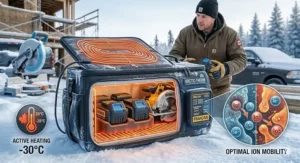
The kit includes two components: a battery warmer and a crankcase oil heater. When the temperature falls below an acceptable level, the thermostat activates the crankcase oil heater and battery warmer in order to maintain optimum battery temperature. Generator batteries are particularly vulnerable to cold — at -20°C, a standard 12V battery may not have enough cranking amps to turn over the engine, and thickened oil creates additional starting resistance.
The oil heater maintains crankcase temperature above 10°C, ensuring 5W-30 synthetic oil remains fluid enough for the starter to spin the engine. The battery warmer keeps the 12V starting battery above 0°C, maintaining full cranking capacity. Combined, these systems ensure your generator starts reliably even when outdoor temperatures hit -30°C — the difference between having heat during a three-day winter storm or not.
Installation note: this kit requires basic mechanical/electrical skills and understanding of generator systems. Generac recommends professional installation, though handy homeowners can complete the work following the provided instructions. The kit draws approximately 150 watts when active, a trivial load that most generators can handle even during a utility outage.
For Canadian homes in rural areas where power restoration after storms can take 24-72 hours, or anywhere utilities are unreliable, this $300-400 investment provides peace of mind that your backup power will actually work when you need it most.
Pros:
✅ Ensures generator reliability in extreme Canadian winters
✅ Prevents battery failure — the most common cold-weather generator issue
✅ Maintains oil fluidity for easy starting
Cons:
❌ Only compatible with specific Generac models (8-22kW range)
❌ Requires electrical/mechanical skill or professional installation
❌ Currently unavailable on Amazon.ca (check Home Hardware, Home Depot Canada)
Value Verdict: Around $350-450 CAD including installation. Essential for rural Canadian homeowners dependent on backup power.
How to Choose Power Tools for Canadian Winter Conditions
1. Battery Chemistry Trumps Brand Loyalty
The single most important factor for cold-weather performance is battery chemistry, yet it’s the spec most manufacturers obscure. Standard lithium-ion cells contain an electrolyte that thickens as temperature drops — imagine trying to drink a milkshake through a straw after it’s been in the freezer. Ion mobility slows, internal resistance spikes, and available capacity plummets.
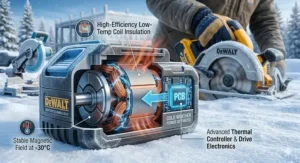
Milwaukee’s REDLITHIUM packs use a proprietary electrolyte formulation with lower viscosity at temperature, plus individual cell monitoring. DeWalt’s FlexVolt batteries include thermal management circuitry. These aren’t marketing gimmicks — they’re engineering solutions to a real physics problem. When you’re comparing tools, prioritize brands that explicitly state cold-weather operational specs (usually found in technical PDFs, not retail packaging).
Standard lithium-ion: -10°C to 45°C operational range, expect 30-50% capacity loss below -15°C
Cold-optimized lithium: -20°C to 50°C operational range, 15-30% capacity loss at -15°C
2. Brushless Motors Are Non-Negotiable
Brushed motors use carbon brushes rubbing against a commutator to switch electrical polarity. In cold weather, the lubricants on those brushes thicken, increasing friction and wasting battery power as heat. Brushless motors eliminate this mechanical contact, using electronic switching instead — more efficient at any temperature, and critically better when it’s cold.
The efficiency difference matters when battery capacity is already compromised by cold. A brushless motor might extract 85% of the available energy from a cold battery, while a brushed motor manages only 60-70%. Over a 4-hour work session at -15°C, that’s the difference between completing the job and running out of power halfway through.
3. Platform Compatibility Matters More Than Individual Tools
You’re not buying a drill — you’re investing in a battery platform. Milwaukee’s M18 system includes 250+ tools; DeWalt’s 20V MAX covers 200+; Makita, Ryobi, and Bosch each offer 150+ compatible devices. For Canadian homeowners and contractors building a workshop, platform breadth determines long-term value.
Consider your three-year tool acquisition plan. If you’ll add a circular saw, reciprocating saw, shop vacuum, and work lights, you’ll spend $600-800 on those tools alone. With a shared battery platform, you’re buying tool-only versions at $100-200 each. With incompatible platforms, each tool requires batteries and charger, inflating costs to $250-350 per tool.
4. Storage Protocol Determines Battery Lifespan
Even cold-optimized batteries degrade if stored improperly. The science: consumer-grade lithium-ion batteries cannot be charged below 0°C (32°F). Although the pack appears to be charging normally, plating of metallic lithium occurs on the anode during a sub-freezing charge that leads to a permanent degradation in performance and safety.
The protocol for Canadian winter:
- Store batteries indoors (10-25°C) when not actively in use
- Allow batteries to warm to room temperature before charging (minimum 2-3 hours)
- Keep a rotation: batteries currently warming, batteries charged and ready, batteries on the tool
- Avoid leaving batteries in unheated vehicles overnight
- Charge at 50-70% capacity for long-term storage (fully charged batteries degrade faster)
Following these protocols extends battery life from 2-3 years (with abuse) to 5-7 years (with care) — real money saved over the tool’s lifetime.
5. Consider Used Professional Tools Over New Budget Tools
The used tool market in Canada offers exceptional value for cold-weather capability. A 3-year-old Milwaukee M18 FUEL combo kit from a retiring contractor might sell for $300 CAD — half the price of new, but delivering twice the cold-weather performance of a new Ryobi kit at the same price. Professional tools are built for 8+ hours daily use over 5-10 years; even with three years of wear, they have substantial life remaining.
Check Kijiji, Facebook Marketplace, and local tool pawn shops. Verify battery health with a voltmeter (should read 18-20V on a fully charged 18V pack), inspect for physical damage or water ingress, and test the chuck/trigger mechanisms. For batteries showing wear, replacement individual cells costs $40-80 CAD for a reputable rebuilder — still cheaper than buying an inferior new tool.
Common Mistakes When Buying Power Tools for Cold Weather
Mistake 1: Choosing Tools Based on Room-Temperature Specs
Manufacturers test and rate tools at 20-25°C — ideal laboratory conditions that bear no resemblance to a Canadian construction site in January. A drill spec’d for 1,500 in-lbs of torque delivers that power at 25°C; at -15°C, you might see 900-1,100 in-lbs depending on battery chemistry and motor design.
The fix: mentally discount advertised specs by 25-30% for realistic cold-weather performance. If you need 1,000 in-lbs for your application, buy a tool rated for 1,300-1,500 in-lbs at room temperature.
Mistake 2: Skimping on Battery Capacity
Bigger batteries cost more, but they’re not a luxury in cold weather — they’re a necessity. The math: a 2.0 Ah battery at -15°C might deliver 1.2-1.4 Ah usable capacity; a 5.0 Ah battery at the same temperature still provides 3.5-4.0 Ah. The percentage loss is similar, but the absolute capacity available is dramatically different.
For Canadian winter work, prioritize 4.0+ Ah batteries. The extra weight is offset by not swapping batteries constantly, and larger batteries include more robust thermal management systems.
Mistake 3: Ignoring Cross-Border Warranty Differences
Some tool manufacturers restrict warranty coverage to the country of purchase. A Milwaukee tool bought on Amazon.com might not be serviceable under warranty in Canada — you’ll pay out-of-pocket for repairs or shipping to the US. Always verify Canadian warranty coverage before purchasing, especially for cross-border deals that seem too good to be true.
The safe approach: buy from Canadian retailers (Amazon.ca, Home Depot Canada, Home Hardware) with explicit Canadian warranty coverage. The 5-10% premium over US pricing includes the value of accessible warranty service through Canadian service centres.
Mistake 4: Assuming “Winter Performance” Equals “Cold Storage Safe”
Marketing materials conflate operational performance with storage tolerances. A battery might discharge reliably at -20°C but suffer permanent damage if charged at -5°C. The lithium plating phenomenon mentioned earlier creates dendritic structures on the anode — effectively dead zones that permanently reduce capacity.
Canadian-specific protocol: if your batteries spent the night in an unheated garage at -25°C, bring them inside for 3-4 hours to warm to 15-20°C before charging. Slow? Yes. But it’s the difference between batteries that last 500 charge cycles versus 150.
Mistake 5: Overlooking Provincial Electrical Code Compliance
Power tool chargers and extension cords must meet Canadian electrical standards for sale and use in Canada. In all ten provinces and two territories of Canada, laws require that electrical machinery and appliances connected to power sources conform to CSA safety standards regardless of type or quantity.
Buying grey-market tools online (imports from the US or overseas without CSA certification) creates liability exposure. If a non-CSA-approved charger causes a fire, your home insurance may deny the claim. The CSA mark isn’t bureaucratic overhead — it’s a safety standard calibrated for Canadian electrical systems and building codes.
Real-World Scenario Guide: Matching Tools to Canadian Climate Zones
Scenario A: Lower Mainland BC / Southern Vancouver Island (Moderate Winter Zone)
Climate characteristics: Temperatures rarely below -5°C; high humidity and frequent rain; occasional snow
Tool recommendations: Ryobi 18V ONE+ or Bosch Blue offer excellent value for this climate. The moderate cold doesn’t push lithium-ion batteries into severe degradation, and the larger concern is water ingress from persistent rain. Look for tools with IP54 or better weather sealing (Bosch excels here). Store batteries indoors to prevent condensation buildup inside the packs.
Budget allocation: $300-400 CAD gets you a 2-tool brushless kit with adequate capacity. Invest savings into proper storage (weatherproof job box, dehumidifier for workshop) rather than premium cold-rated batteries you won’t fully utilize.
Scenario B: Southern Ontario / Quebec (Traditional Four-Season Zone)
Climate characteristics: -10°C to -20°C winter lows; summer highs to 30°C; variable humidity; freeze-thaw cycles
Tool recommendations: DeWalt 20V MAX FlexVolt strikes the ideal balance — genuine cold-weather capability without over-engineering for Arctic extremes. The FlexVolt battery versatility accommodates summer projects (deck building, fencing) where higher-capacity tools make sense. The broader temperature swing demands batteries that handle both extremes.
Budget allocation: $450-550 CAD for 2-tool combo with 6.0+ Ah FlexVolt batteries. The battery investment pays off through all four seasons, and the platform breadth supports workshop expansion.
Scenario C: Prairie Provinces / Northern Ontario (Extended Cold Zone)
Climate characteristics: -25°C to -40°C winter lows common; low humidity; prolonged cold seasons; wind chill
Tool recommendations: Milwaukee M18 FUEL with REDLITHIUM batteries — this is the climate that justifies premium cold-weather engineering. The extended warranty covers the increased wear from thermal cycling, and the battery chemistry genuinely outperforms at -30°C. Keep minimum three batteries in rotation: two warming/charging, one on the tool.
Budget allocation: $600-700 CAD for 2-tool combo with dual 5.0 Ah batteries, plus immediate purchase of a third 5.0 Ah battery ($150 CAD). The rotation protocol is essential for full-day work in deep cold.
Scenario D: Yukon / NWT / Northern Communities (Extreme Cold Zone)
Climate characteristics: -30°C to -50°C winter temperatures; extreme aridity; limited daylight in winter; no access to warm staging areas
Tool recommendations: Milwaukee M18 FUEL remains the best cordless option, but with critical modifications to workflow. Pre-warm batteries inside your coat or vehicle cab before use. Limit outdoor exposure to 15-20 minute work sessions, rotating warm batteries in frequently. For extended projects, corded tools with cold-weather extension cords (IRON FORGE CABLE type) provide more reliable power than battery tools at these extremes.
Budget allocation: $700-800 CAD: Milwaukee 2-tool combo + extra batteries + 50-foot SJEOW extension cord + portable generator if working remote. The harsh reality is that below -35°C, even premium lithium-ion struggles. Plan projects for less extreme weather when possible.
Understanding Lithium-Ion Battery Cold Weather Physics
To make informed tool purchases, you need to understand the fundamental physics limiting battery performance in cold weather — not marketing claims, but actual electrochemistry.
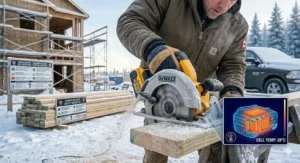
Lithium-ion batteries work by shuttling lithium ions through an electrolyte solution between a graphite anode and a metal-oxide cathode. At room temperature (20-25°C), the electrolyte maintains optimal viscosity — ions move freely, internal resistance stays low, and the battery delivers its rated capacity. As temperature drops, three critical changes occur simultaneously:
Electrolyte thickening: The liquid electrolyte becomes more viscous, like motor oil in winter. Ion mobility decreases proportionally — at -20°C, ions move 3-4× slower than at room temperature. This directly reduces the rate at which the battery can deliver current.
Increased internal resistance: Both the electrolyte resistance and the resistance at the electrode interfaces (where ions transfer to/from the electrode material) increase exponentially with falling temperature. Higher resistance means more voltage drop under load, reducing available power.
Lithium plating risk: During charging at low temperatures, lithium ions may deposit as metallic lithium on the anode surface rather than intercalating into the graphite structure. This metallic lithium is permanently lost — it can’t return to the cathode during discharge. Repeated cold charging builds up this dead lithium layer, permanently reducing battery capacity.
The practical impact: At -20°C, battery capacity can cut to ~50–60% of normal. The electrolyte is very sluggish, internal resistance is huge, and Li⁺ ions barely move. Even premium batteries like Milwaukee REDLITHIUM or DeWalt FlexVolt can’t violate physics — they mitigate the effects through better electrolyte formulations, thermal management circuitry, and cell balancing, but capacity still drops 20-30% at -15°C.
For Canadian buyers, this means:
- Plan for 30% capacity reduction in typical winter conditions (-10 to -20°C)
- Buy larger-capacity batteries than you’d need at room temperature
- Never charge batteries below 0°C — permanent damage is cumulative
- Store batteries indoors to prevent freeze-thaw cycling damage
Long-Term Cost Analysis: Premium vs Budget Tools in Canadian Conditions
Let’s examine the true five-year cost of ownership for power tools in Canadian winter conditions — the numbers marketing materials conveniently omit.
Scenario: Homeowner in Saskatoon, SK, tackling regular DIY projects (deck maintenance, garage improvements, shed construction). Estimates 50 hours annual tool use, 60% of which occurs in conditions below 0°C.
Option A: Ryobi 18V ONE+ HP Brushless 2-Tool Kit
Initial cost: $250 CAD (kit with two 2.0 Ah batteries, charger)
Year 1-2: Adequate performance, but frequent battery swaps in cold weather. User purchases two additional 4.0 Ah batteries ($160 CAD) to reduce mid-project charging.
Year 3: First battery failure (standard batteries degraded by inadvertent cold charging). Replacement cost $80 CAD.
Year 4: Second battery shows reduced capacity. User adds one more 4.0 Ah battery ($80 CAD).
Year 5: Tool chuck on drill becomes loose (wear from overloading due to reduced cold-weather power). Out-of-warranty repair $65 CAD.
Five-year total cost: $635 CAD
Effective cost per work hour: $12.70
Option B: Milwaukee M18 FUEL 2-Tool Combo Kit
Initial cost: $600 CAD (kit with two 5.0 Ah REDLITHIUM batteries, charger)
Year 1-2: Excellent cold-weather performance. User adds one spare 5.0 Ah battery for convenience ($150 CAD).
Year 3-5: No battery failures (proper storage protocol + superior chemistry). Tools perform flawlessly, covered under 5-year warranty.
Five-year total cost: $750 CAD
Effective cost per work hour: $15.00
The raw numbers show Milwaukee costs $2.30 more per work hour — but this ignores productivity and frustration factors. The Ryobi user spends additional time managing battery swaps, experiences project delays from dead batteries, and accepts reduced power in cold weather. Factor these soft costs, and the premium tools deliver equal or better value.
For professional contractors working 1,000+ hours annually, the math shifts even more dramatically. Battery replacement alone can consume the initial savings within two years when using budget tools under professional loads and Canadian winter stress.

FAQs: Power Tools in Canadian Cold Weather
❓ Can I use power tools in -30°C Canadian winters?
❓ Why do my power tool batteries die so fast in winter?
❓ Which Canadian retailers stock cold-weather power tools?
❓ Should I buy 120V or 240V chargers for Canadian power tools?
❓ Do brushless motors really work better in Canadian cold weather?
Conclusion: Winter-Proof Your Workshop for Canadian Conditions
Canadian winters aren’t going anywhere — the January cold snap, the surprise April snow, the extended freeze from November through March. If you’re serious about getting work done through all four seasons, your tools need to match the climate you actually live in, not the idealized conditions in marketing brochures shot in California.
The core takeaway: battery chemistry matters more than brand prestige. Milwaukee’s REDLITHIUM, DeWalt’s FlexVolt cold-rated packs, even Makita’s optimized formulations — these aren’t marginal improvements, they’re fundamental engineering solutions to the physics of cold-weather battery operation. When you’re comparing tools, prioritize those with explicit cold-temperature operational specs over generic “works in all conditions” claims.
For most Canadian buyers, the sweet spot sits in the $400-600 CAD range: genuine brushless motors, cold-optimized battery chemistry, 4.0-6.0 Ah capacity, and a battery platform that supports 150+ tools for long-term expansion. That might be DeWalt FlexVolt for southern climates with mixed cordless/corded needs, Milwaukee M18 FUEL for Prairie winters and professional use, or Makita LXT for compact precision work in minimally heated spaces.
Budget-conscious buyers in moderate climates (coastal BC, southern Ontario) can absolutely succeed with Ryobi 18V ONE+ HP, provided they understand the limitations and manage battery storage/rotation actively. But for extended cold (Prairie provinces, northern communities), the premium paid for Milwaukee or DeWalt delivers genuine value through longer battery life, better cold performance, and extended warranties covering the increased wear from Canadian conditions.
The final piece of advice: your batteries are an investment requiring active management. Store them indoors, warm them before charging, rotate multiple packs through warming/ready/in-use cycles, and never charge below 0°C. Follow these protocols, and even budget batteries last 3-5 years; ignore them, and even premium batteries fail within 18 months. Canadian winters are harsh enough — don’t make tools fight environmental stress and user neglect simultaneously.
Your next power tool purchase should answer one question: “Will this work reliably when it’s -20°C and I’m two hours into a time-sensitive project?” If the honest answer is anything but a confident yes, keep shopping.
Recommended for You
- 7 Best Manual Ice Melt Spreaders Canada 2026
- Best Ice Scraper for Car Canada: 7 Expert Picks 2026
- 7 Best Roof Snow Rakes Canada 2026: Prevent Ice Dams Fast
Disclaimer: This article contains affiliate links. As an Amazon Associate, I earn from qualifying purchases. If you purchase products through these links, we may earn a small commission at no additional cost to you.
✨ Found this helpful? Share it with your friends! 💬🤗
