
In This Article
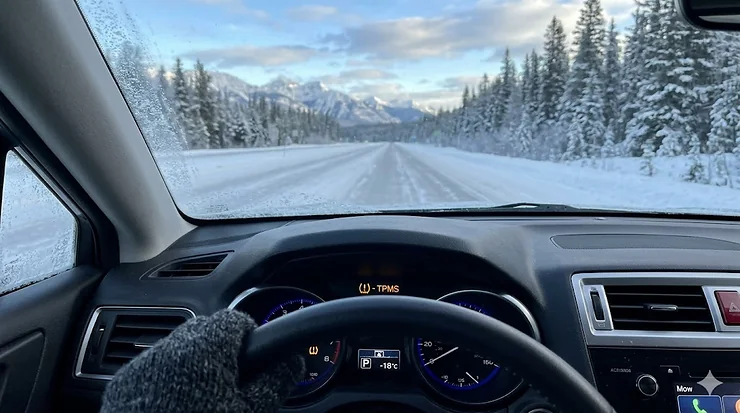
Here is something most Canadian drivers only discover the hard way: you walk out on a −20°C January morning in Winnipeg, your TPMS light is blazing orange on the dashboard, and you are already running late. Was it a slow leak overnight? A nail in the parking lot? Nope — it was just physics doing what physics does. Tire pressure drop in cold weather is one of the most predictable, unavoidable, and most under-managed safety issues on Canadian roads every single winter.
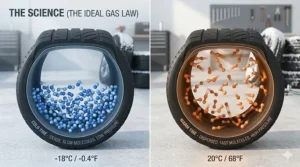
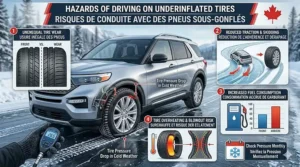
The science is straightforward. According to the ideal gas law, pressure and temperature are directly linked: as the air inside your tire gets colder, its molecules slow down, compress, and exert less force on the inner walls of the tire. The result? For every 6°C (roughly 10°F) drop in temperature, your tires lose approximately 1 PSI (pound per square inch). Run the numbers on a Canadian winter: if you inflated your tires in October at +10°C and you’re driving in January at −30°C — which is not unusual in Calgary, Saskatoon, or Thunder Bay — that is a potential loss of 6–8 PSI without a single puncture. A tire that started at 35 PSI is now knocking on 27 PSI territory. That is underinflated enough to affect braking distance on black ice.
As Transport Canada explicitly warns, “A tire that has good pressure when checked in a warm garage will be under-inflated when it’s below zero outside.” They further emphasize that proper air pressure extends tread life, improves safety, and reduces fuel consumption — all critical concerns during the long Canadian winter. This is not a suggestion from a tire shop trying to upsell you on nitrogen. This is your federal government telling you to check your tires in the cold.
So if you have been ignoring that TPMS light or eyeballing your tires from a distance, this guide is your winter wakeup call. We have researched and reviewed the 7 best tools available on Amazon.ca to help you manage tire pressure drop in cold weather — from budget-friendly digital gauges to intelligent TPMS systems — along with everything you need to know about how to check tire pressure at −30°C, the nitrogen vs. air debate, and why your TPMS sensor starts throwing fits every November.
Quick Comparison: Top 7 Tire Pressure Tools for Canadian Winters
| Product | Type | PSI Range | Best For | Price Range (CAD) |
|---|---|---|---|---|
| AstroAI Digital Gauge (150 PSI) | Digital gauge | 0–150 PSI | Everyday car owners | Under $25 CAD |
| TIRETEK Premium Gauge | Analog dial | 0–60 PSI | Budget-conscious drivers | Under $20 CAD |
| ETENWOLF T300 | Digital gauge | 3–200 PSI | Precision users | $15–$25 CAD |
| AstroAI Heavy Duty (230 PSI) | Digital gauge | 0–230 PSI | Trucks & RVs | $30–$50 CAD |
| Tymate TM12 TPMS | External TPMS | 0–116 PSI | RV/multi-vehicle monitoring | $80–$130 CAD |
| Autel MX-Sensor 433MHz | Internal TPMS sensor | — | Seasonal tire swap users | $120–$180 CAD |
| Autel MaxiTPMS TS501 PRO | TPMS programming tool | — | Shops & advanced DIYers | $200–$350 CAD |
The comparison above reveals a clear market split: if you simply want to check your tire pressure on a cold morning, a quality digital gauge under $25 CAD covers you completely. Where the investment jumps — and where it genuinely pays off for Canadian winters — is in the TPMS sensor and programming tier, which eliminates the guesswork of manual checks in −30°C conditions where bare fingers on a metal valve stem are no fun whatsoever.
💬 Just one click — help others make better buying decisions too!😊
✨ Don’t Miss These Exclusive Deals!
🔍 Take your tire pressure game to the next level with these carefully selected tools. Click on any highlighted item to check current pricing and availability on Amazon.ca. These tools will help you drive confidently and safely through every Canadian winter!
Top 7 Tire Pressure Tools: Expert Analysis for Canadian Conditions
1. AstroAI Digital Tire Pressure Gauge 0–150 PSI
The AstroAI Digital Tire Pressure Gauge is the most practical and popular choice for everyday Canadian drivers, and it is not hard to see why. With a 0–150 PSI range, 0.1 PSI increment accuracy, ANSI B40.7 ±1 PSI calibration, a backlit LCD display, and an integrated lighted nozzle, this compact gauge handles every situation from a quick winter driveway check to a roadside inflator top-up at 11 PM.
What most Canadian buyers overlook about this model is the operating temperature range. The standard AstroAI 150 PSI model is rated for operation down to about −5°C (23°F), which is workable for many southern Canadian cities but potentially borderline for Prairie winters. That said, it stores indoors in your glove compartment or garage perfectly well, and as long as you are warming your hands and the gauge for 60 seconds before use, it performs reliably in real-world Canadian conditions. The four pressure unit settings — PSI, Bar, KPA, Kg/cm² — are useful for Canadian metric-friendly drivers who prefer working in Bar for winter inflation charts.
Canadian drivers on RedFlagDeals forums — where this model has appeared repeatedly as a deal alert — report consistent accuracy to within 0.5 PSI after more than a year of use with the original batteries. The main criticism is the housing: it is functional rather than rugged, and dropping it on a frozen concrete driveway is a bad idea. Keep it in a case or a zip bag.
✅ Backlit LCD works in low-light winter mornings
✅ 4 unit settings including Bar for metric users
✅ Presta valve adaptor included for cyclists
❌ Housing feels fragile — not drop-resistant
❌ Rated operating temperature may be borderline for deep Prairie winters
Price range: under $25 CAD — excellent value for the everyday Canadian commuter who checks pressure monthly.
2. TIRETEK Premium Tire Pressure Gauge (0–60 PSI)
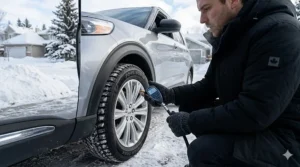
The TIRETEK is proof that analog done right still beats cheap digital any day of the week, especially in truly frigid temperatures. This ANSI-certified, heavy-duty dial gauge with a 45-degree angled chuck and fully swivelling head was built to work without batteries — which matters enormously when you are hunched over a tire at −25°C in a Canadian Tire parking lot and your gloves are making everything awkward.
The integrated relief valve is a genuinely clever feature: you can bleed excess air from the tire while the gauge is still attached to the valve, which eliminates the back-and-forth “attach-check-detach-add-air-reattach” dance that costs you precious PSI on a cold morning. For a Canadian driver switching from summer to winter tires (usually dropping target pressure by 2–3 PSI to compensate for cold-weather loss), this bleed-while-reading feature saves significant time during the seasonal swap.
What stands out about the TIRETEK for Canadian conditions is reliability in the cold. No battery dependency means no worrying about cold-depleted batteries failing at the worst moment. The large dial is readable with mittens on, a detail that sounds minor until you have tried reading a digital display at −30°C with two layers of winter gloves.
Canadian reviewers consistently praise this as a reliable “trunk keeper” — something left in the car permanently and forgotten until needed. It ships from Amazon Fulfillment, making it Prime-eligible.
✅ No batteries — works in any temperature
✅ Built-in air bleed valve
✅ Fully swivelling chuck for awkward valve positions
❌ Analog dial — slightly less precise than digital
❌ 0–60 PSI range unsuitable for commercial truck tires
Price range: under $20 CAD — the best “set it and forget it” truck or car emergency gauge.
3. ETENWOLF T300 Digital Tire Pressure Gauge (3–200 PSI)
The ETENWOLF T300 is what happens when you take the precision of an industrial-grade tool and pack it into an affordable garage staple. Calibrated to ANSI B40.7 Grade 2A (±0.5% accuracy), it reads from 3 to 200 PSI in vivid orange with a bright LED display — and that ±0.5% accuracy spec is genuinely exceptional for this price range. To put it in perspective, most consumer digital gauges claim ±1 PSI; the T300 is rated twice as accurate.
For winter checking at −30°C, the T300’s replaceable AAA batteries are a practical advantage over coin cell models. Lithium AAA batteries (readily available at Canadian Tire, Walmart, and Amazon.ca) perform well in cold temperatures where alkaline batteries can fail, giving you consistent readings in Prairie winter conditions that would stall lesser gauges.
The community feedback from Canadian RedFlagDeals users who purchased the T300 on Amazon.ca is fairly positive overall, with the “EE9 error” appearing in fewer than 3% of units — and most of those cases resulted in warranty replacement. For a gauge at this price point, that is an acceptable failure rate. Where the T300 earns its reputation is in consistent, repeatable readings: the same tire, measured twice in quick succession, gives you the same number. For a tool designed to detect a 1–2 PSI cold-weather drop, that consistency is exactly what you need.
✅ Grade 2A calibration (±0.5%) — exceptional accuracy
✅ Replaceable AAA batteries (cold-tolerant with lithium cells)
✅ 3–200 PSI range covers cars, trucks, and RVs
❌ EE9 error code affects a small percentage of units
❌ Bright orange housing divides opinion
Price range: $15–$25 CAD — the best accuracy-per-dollar gauge on Amazon.ca right now.
4. AstroAI Heavy Duty Digital Tire Pressure Gauge (0–230 PSI)
Where the standard AstroAI serves car and SUV owners, the AstroAI Heavy Duty 230 PSI is built for Canadian truck owners, RV enthusiasts, and anyone hauling a trailer through the Rockies or across the Trans-Canada in January. The stainless steel construction changes the durability equation entirely compared to the standard model — this one can survive being dropped on a concrete shop floor, which the plastic-body gauges emphatically cannot.
The Grade 2A calibration (±0.5%) matches the ETENWOLF T300 in accuracy but covers a wider range — up to 230 PSI — which is essential for light truck tires that run at 65–80 PSI and commercial-adjacent applications. The extended range of 0–230 PSI, 0–16 Bar, 0–16 Kg/cm², and 0–1585 KPA makes it genuinely versatile for Canadian drivers who manage multiple vehicle types. That large stainless-steel construction also means the chuck has a better cold-weather seal on valve stems — a subtle but appreciated detail when valve stems get stiff and slightly corroded from road salt.
The green backlit LCD with integrated flashlight is a night shift driver’s best friend in November in Northern Ontario, when it is pitch dark at 5 PM and you are checking tires at a truck stop. If you own a pickup, a trailer, or a camper van and you run through Canadian winters regularly, this is the gauge that matches your needs.
✅ Stainless steel — drop-resistant and corrosion-resistant
✅ 0–230 PSI covers light trucks, RVs, trailers
✅ Grade 2A accuracy (±0.5%)
❌ Heavier and bulkier than pocket-sized gauges
❌ Overkill for sedan and compact SUV owners
Price range: $30–$50 CAD — the smart choice for truck and RV owners who won’t settle for fragile tools.
5. Tymate TM12 RV Tire Pressure Monitoring System
Here is where we shift from “check your tires manually” to “know your tire pressure while you are driving.” The Tymate TM12 TPMS is a full external monitoring system that straps onto your valve stems and broadcasts real-time pressure and temperature data to an in-cab LCD display with voice alerts. The 2026 version supports solar and USB-C charging, an 80-foot range, up to 12 sensors, and 6 alarm modes covering low pressure, high pressure, high temperature, rapid deflation, and low battery.
For Canadian RV owners — and Canada has a massive seasonal RV culture stretching from the BC coast to the Maritimes — this system addresses a specific nightmare: waking up on an autumn morning at a Quebec campsite to discover two tires have lost 8 PSI overnight from a cold front rolling through. The TM12 does not wait for you to discover that problem. It alarms when the threshold is crossed and monitors continuously during your drive. The solar panel charging is particularly thoughtful for long highway hauls through the Prairies where you are not stopping every hour.
In sub-zero conditions, the external sensors’ operating range matters. The TM12 sensors are rated for cold operation and Canadian reviewers who have used the system on winter RV storage checks report consistent performance down to around −20°C. The IP68 waterproofing rating means road salt spray and slush are not a concern.
✅ Real-time in-cab monitoring — no manual checking required
✅ Solar + USB-C charging — no dead monitor batteries
✅ Up to 12 sensors — ideal for multi-axle RVs and trailers
❌ External cap-style sensors can be tightened/loosened by others
❌ LCD display may need shade cover in bright summer sun
Price range: $80–$130 CAD — genuine peace-of-mind value for Canadian RV and long-haul drivers.
6. Autel MX-Sensor 433MHz Programmable TPMS Sensor
The Autel MX-Sensor is what you buy when you are a Canadian driver who does a proper winter tire swap every October/November onto a separate set of steel rims — and you want your TPMS system to actually work on both sets of tires rather than throwing false low-pressure warnings all winter long. The MX-Sensor is a 2-in-1 programmable sensor (315 MHz and 433 MHz in one unit) that can be coded to virtually any vehicle and mounted on your winter rim set so your car’s factory TPMS system reads correctly year-round.
The practical reality for Canadian winters: your factory TPMS sensors stay on your summer rims. If you buy a separate steel rim set for winters (a very common and smart Canadian practice), your car has no TPMS coverage at all on those rims — it just displays a constant warning light. The Autel MX-Sensor solves that problem permanently. You get accurate TPMS readings on your winter set, and the warning light goes out. As the leading TPMS option in Canada in early 2026 according to automotive technology tracking sites, the Autel MX-Sensor is the professional’s choice for winter rim setups.
The sensor requires programming with a compatible relearn tool (the Autel TS501 PRO below is one option), and your tire shop can also program it during installation. Most Canadian tire shops that handle winter swaps are familiar with Autel sensors and can program them in minutes.
✅ 2-in-1 (315 + 433 MHz) fits virtually any Canadian vehicle
✅ Solves the winter-rim TPMS warning light problem permanently
✅ Rubber valve stem included for easy installation
❌ Requires programming before installation
❌ Higher upfront cost — but eliminates a recurring problem
Price range: $120–$180 CAD — worth every dollar if you run separate winter rims and are tired of a glowing TPMS light all winter.
7. Autel MaxiTPMS TS501 PRO TPMS Programming Tool
The TS501 PRO is the big gun in this list — a professional-grade TPMS programming, activation, and diagnostic tool that activates 99% of TPMS sensors on the market and programs Autel MX-Sensors in both 315 and 433 MHz. The 2026 version (marketed as equivalent to the TS508) includes lifetime software updates, which is crucial as new vehicle models with new TPMS protocols arrive in Canada each year.
Who actually needs this on Amazon.ca? Two types of Canadian buyers: independent mechanics running a winter tire swap business, and serious DIYers who maintain multiple vehicles and want complete control over their TPMS system. If you manage a small fleet — think a family with two cars and a trailer, or a small business with three or four vehicles — the TS501 PRO pays for itself after eliminating just a handful of dealer service visits at $100+ CAD per TPMS relearn.
The TPMS reset functionality is also handy after a cold snap causes multiple TPMS sensors to go offline simultaneously on older vehicles — a frustratingly common scenario in Prairie winters where temperatures swing from −35°C to −10°C inside a single week. Rather than driving to the dealership for a $150 reset, you plug in the TS501 PRO and handle it in your own driveway.
✅ Activates 99% of TPMS sensors — virtually universal
✅ Lifetime free software updates via USB
✅ TPMS diagnostics + relearn in one tool
❌ Premium price point — not for casual single-vehicle owners
❌ Learning curve for first-time TPMS tool users
Price range: $200–$350 CAD — professional-level tool with exceptional long-term value for multi-vehicle households and small shops.
How to Check Tire Pressure at −30°C: The Canadian Winter Protocol
Knowing your tires lose 1 PSI per 6°C is useful in theory. Having a practical system for checking tire pressure in bitterly cold Canadian winters is what actually keeps you safe. Here is a step-by-step approach that accounts for the unique challenges of a deep Prairie or Northern Canadian winter morning.
Step 1 — Check cold, not warm. Always check tire pressure before your first drive of the day or after the vehicle has been parked for at least 3 hours. Driving heats the tires and increases pressure by 4–6 PSI, which can mask an underinflation problem. Transport Canada specifically recommends cold-tire checks for accurate readings.
Step 2 — Bring your gauge inside the night before. Cold affects battery-powered digital gauges. If your gauge lives in the car overnight at −30°C, its battery may read sluggishly or not at all. A quality lithium-battery gauge (or a no-battery analog model like the TIRETEK) handles this better, but storing your gauge in a warm house removes the variable entirely.
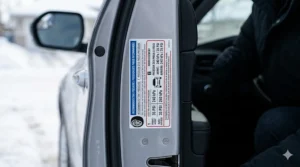
Step 3 — Know your winter target PSI. Your door jamb sticker shows recommended PSI calibrated for typical temperatures. For winter, many Canadian mechanics recommend inflating to 2–3 PSI above the sticker recommendation in autumn, accounting for the pressure you will lose when temperatures drop to seasonal lows. Some owners compensate with nitrogen inflation (more on that below), which reduces the swings significantly.
Step 4 — Wear thin liner gloves. Heavy winter mitts make it nearly impossible to get a clean seal on a valve stem. A thin pair of liner gloves gives you dexterity while protecting your fingertips from the instant burn of a frozen metal valve cap.
Step 5 — Work quickly and systematically. Start at the front driver’s side, move clockwise. Cap the valve immediately after each check to prevent the tiny but real pressure loss from an uncapped stem in wind.
Step 6 — Add to compensate, not to guess. If a tire reads 29 PSI on a −25°C morning and your target is 33 PSI, add 4 PSI — not 6, not 2. Overinflation in cold weather leads to over-hardening of the rubber compound, reducing the tire’s ability to conform to ice and reducing grip. The ideal gas law works both ways: that 33 PSI at −25°C will become 37–38 PSI on a warm spring day. Don’t overshoot.
Step 7 — Recheck after driving in cold conditions for 30 minutes. In extreme cold, tires that seemed properly inflated when stationary in the driveway can still read differently after thermal cycling on a cold highway. A second check is not paranoia — it is sound practice for −30°C+ conditions.
Real-World Scenarios: Which Tool Fits Which Canadian Driver?
Every Canadian driver’s winter tire situation is different. Here is how to match the right tool to your actual life:
The Urban Commuter — Toronto, Vancouver, Montreal If you commute 20–30 km/day in a sedan or compact SUV in a city that rarely dips below −15°C, the AstroAI Digital 150 PSI is all you need. Monthly checks with a good digital gauge in your glove compartment handle everything. Budget: under $25 CAD. You are not in the field; you are in parkades and driveways. Keep it simple.
The Prairie Driver — Winnipeg, Saskatoon, Calgary You face the real Canadian winter. Temperatures of −30°C to −40°C with wind chill are not uncommon from December through February 2026’s cold wave brought lows of −43.7°C to parts of Ontario. You need a gauge that works in extreme cold — the TIRETEK analog (no battery issues) as a primary, with the ETENWOLF T300 with lithium AAA batteries as a precision backup. More importantly, you need to be checking weekly, not monthly. Budget: $30–$45 CAD for both gauges combined.
The Winter Rim Swapper — Most of Canada Outside of BC Lower Mainland If you run a proper separate steel rim set for winter (smart practice, and mandatory in Quebec between December 1 and March 15 for vehicles up to 3,000 kg), your factory TPMS light glows all winter. The Autel MX-Sensor 433MHz programmed to your winter rims ends that irritation permanently. One-time investment; permanent solution. Budget: $120–$180 CAD.
The RV Owner — Cross-Country Seasonal Drivers Fall and spring are shoulder season for Canadian RVers, and temperature swings of 20–25°C overnight are common in October and April in the Rockies and Prairies. The Tymate TM12 TPMS with real-time monitoring means you know about a slow leak at Highway 1 in BC before it becomes a blowout at 110 km/h. Budget: $80–$130 CAD.
PSI Adjustment Temperature Chart: Canada Edition
Understanding the PSI-temperature relationship helps you make informed adjustments rather than guessing.
| Temperature (°C) | Expected PSI Drop from +20°C Baseline | Recommended Action |
|---|---|---|
| +10°C | −2 to −3 PSI | Monitor; minor adjustment if near threshold |
| 0°C | −4 to −5 PSI | Check and top up to recommended PSI |
| −10°C | −5 to −6 PSI | Top up 2–3 PSI above summer sticker target |
| −20°C | −6 to −8 PSI | Weekly checks; use cold-rated gauge or analog |
| −30°C and below | −8 to −10 PSI | Check every 5–7 days; consider nitrogen inflation |
This chart is based on the widely documented 0.19 PSI drop per 1°C decrease in temperature. Note that starting conditions matter enormously: if your tires were already 2–3 PSI underinflated at +10°C, a −30°C January day compounds that deficit dangerously.
The chart above makes one thing clear: the deeper you go into a Canadian winter, the more aggressively your tire pressure drops — and the more frequently you need to check. Monthly checks that work for British Columbia work fine in Victoria or Vancouver but are dangerously inadequate in Regina or Yellowknife.
Nitrogen vs. Air for Tire Inflation: Does It Actually Matter in Canadian Winters?
This debate comes up every autumn at tire swap season in Canada, and it deserves a straight answer rather than marketing spin.
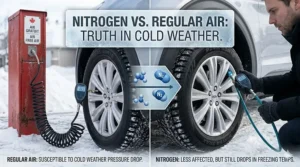
The real science: Regular compressed air is approximately 78% nitrogen already. Pure nitrogen inflation takes that to 95–100% nitrogen and removes water vapour from the equation. Since it is the water vapour (oxygen carrier) in air that expands and contracts most aggressively with temperature, dry nitrogen maintains more consistent pressure across temperature swings. As Continental Tires notes in their Canadian technical guidance, inflation pressure shifts by approximately 1 PSI for every 6°C change in temperature — and nitrogen reduces that shift modestly, though it does not eliminate it.
What nitrogen actually delivers in a Canadian winter:
- More stable pressure across the −30°C to +10°C swings typical of October–April
- Reduced rim corrosion (no moisture inside the wheel) — relevant if you are keeping your current rims for 8–10 years
- Slightly slower pressure loss through the rubber (nitrogen molecules are larger than oxygen molecules)
What nitrogen does NOT deliver:
- Freedom from checking your tires in winter — Transport Canada says check monthly regardless, and that guidance applies to nitrogen-filled tires too
- Magic traction on black ice — that is about tread compound and tire design, not inflation gas
- A massive performance difference for the average Canadian commuter
The honest verdict: For most Canadian passenger vehicle owners, the difference between air and nitrogen is real but modest. If your tire shop charges $20–$30 CAD extra for nitrogen during your winter swap and you plan to keep those rims for many years, it is a reasonable investment for the rim-corrosion benefit alone. If you are topping up a nitrogen tire with regular air at the gas station in February because you are 4 PSI down, do not lose sleep over it. Any reasonably dry air is better than running underinflated.
TPMS Sensor Winter Issues in Canada: Why Your Warning Light Lies (And When It Doesn’t)
If you have driven a Canadian winter in any vehicle built after 2012, you know the TPMS light intimately. It comes on in November. Sometimes it goes out by 10 AM once the tires warm up. Sometimes it stays on. Sometimes it comes on at −5°C even though your tires are perfectly inflated.
Here is what is actually happening and what it means for you:
The cold-trigger TPMS warning. Most factory TPMS systems are set to alert when pressure drops 25% below the recommended level (e.g., below 26 PSI on a tire with a 35 PSI recommendation). On a cold night in Canada, the pressure drop from simple temperature change can be enough to cross that threshold. This is not a sensor malfunction — it is the system working exactly as designed. The problem is that the sensor cannot distinguish between “legitimately low pressure” and “low pressure because it is −20°C and physics.”
Battery failure in cold weather. Factory TPMS sensors use coin cell lithium batteries that typically last 5–10 years. Below −25°C, even lithium batteries become sluggish, which can cause intermittent TPMS signal dropout. The sensor is physically fine; it is just not transmitting reliably in extreme cold. If your TPMS light flickers on and off on very cold mornings, this is often the culprit — especially on vehicles 5+ years old.
The “winter rim problem.” As discussed, running winter tires on rims without TPMS sensors means a permanent TPMS warning light. Transport Canada still requires that you manually check tire pressure monthly per their guidelines even if your vehicle has a TPMS system — the Autel MX-Sensor eliminates the warning light but does not replace the habit of manual verification.
When to take the TPMS light seriously. If your TPMS light comes on at moderate temperatures (above 0°C), stays on after driving for 20+ minutes, or is accompanied by a noticeable change in handling feel, do not assume it is cold weather. Check pressure immediately. A TPMS light that persists after the vehicle warms up is telling you something real.
✨ Find the Right Tool for Your Winter — Check Amazon.ca Now!
🔍 All 7 products in this guide are available on Amazon.ca. Click any highlighted product name to check current pricing, Prime eligibility, and availability in your province. Prime members enjoy free shipping — no $35 CAD minimum required!
How to Choose the Right Tire Pressure Tool for Canadian Winter Conditions
Choosing the right gauge or TPMS tool is not complicated if you think through your actual situation rather than buying the most expensive option or the cheapest one reflexively.
1. Know your minimum temperature. A digital gauge rated to −5°C is genuinely limited if you are in Saskatoon in January. Either choose an analog gauge (no battery dependency), a digital gauge with lithium battery compatibility, or a model with an explicitly cold-rated operating temperature.
2. Analog vs. digital. Analog dial gauges (like the TIRETEK) are slower to read but work at any temperature and never need batteries. Digital gauges (AstroAI, ETENWOLF) are faster and more precise but introduce battery vulnerability. For purely cold-weather emergency use, analog wins. For systematic monthly checking in a heated garage, digital wins.
3. PSI range that matches your vehicles. A 0–60 PSI gauge is perfect for passenger vehicles and light SUVs. If you run a pickup truck with tires at 65–80 PSI, or a trailer, you need at minimum a 0–100 PSI model, and the AstroAI Heavy Duty 230 PSI if you are RV-adjacent.
4. Do you swap onto separate winter rims? If yes, and if you care about your TPMS light not glowing for five months straight, add the Autel MX-Sensor to your shopping list. It is a one-time fix.
5. Do you need real-time monitoring vs. manual checking? Real-time TPMS (like the Tymate TM12) is for drivers who cannot or do not want to manually check tires regularly — RV travellers, long-distance highway commuters, anyone with physical mobility limitations. For city commuters who check tires in their own driveway, a good digital gauge is all you need.
6. Budget in CAD and Amazon.ca shipping. All seven products in this guide are available on Amazon.ca. Most are Prime-eligible for free shipping. Non-Prime members can often combine orders to cross the $35 CAD free-shipping threshold. Canadian pricing on tire gauges typically runs 10–20% above US pricing due to exchange rate and import factors, but you avoid cross-border customs delays and warranty headaches.
Common Mistakes Canadian Drivers Make with Winter Tire Pressure
Mistake 1: Inflating to the sticker number in October and not checking again until April. This is the single most common and dangerous mistake. The sticker number is calibrated for approximately +20°C. By December, you have already lost 4–6 PSI relative to that reading. Check monthly at minimum, and weekly during prolonged extreme cold snaps.
Mistake 2: Checking pressure immediately after driving. Tires heat up during use, which inflates the readings by 4–6 PSI. A tire that reads 34 PSI after a highway drive might actually be at 28–29 PSI cold. Always check cold — before the first drive of the day or after 3 hours of parking.
Mistake 3: Ignoring the spare tire. Your spare sits in the trunk through a Canadian winter and loses pressure right alongside your four running tires. A spare that dropped to 22 PSI from temperature alone is no help in an emergency. Check it during your monthly rotation.
Mistake 4: Over-compensating with excessive over-inflation. Some Canadian drivers, knowing their tires will lose PSI in winter, deliberately over-inflate to compensate. Adding 10–15 PSI “just in case” creates an over-inflated tire with a reduced contact patch, worse grip on ice and snow, and a harsher ride. Add no more than 3–4 PSI above the sticker recommendation as a cold-weather buffer.
Mistake 5: Buying a gauge that can’t be used with mittens on. Sounds trivial until you are in a January parking lot in Lethbridge struggling to read tiny numbers on a micro LCD through frost-coated safety glasses. Choose a gauge with a large, backlit display and a swivelling chuck that doesn’t require perfect hand positioning.
FAQ
❓ How much PSI do tires lose at −30°C compared to summer?
❓ Is it safe to check tire pressure at −30°C with a digital gauge?
❓ Does Quebec's mandatory winter tire law affect tire pressure requirements?
❓ Why does my TPMS light turn off after driving for 20 minutes in winter?
❓ Can I top up nitrogen-filled tires with regular air from a Canadian gas station?
Conclusion: Don’t Let Cold Physics Win This Winter
Tire pressure drop in cold weather is one of the rare automotive problems that is completely predictable, entirely preventable, and yet still responsible for countless underinflated Canadian vehicles every winter. The physics are not going to change — but your habits and tools can.
If you take nothing else from this guide, let it be this: check your tire pressure when the tires are cold, in the actual outdoor temperature, once a month at minimum and once a week during prolonged extreme cold snaps. A quality gauge from Amazon.ca costs less than a single tank of gas. The fuel savings from properly inflated tires — Transport Canada confirms that proper inflation reduces fuel consumption — will pay for that gauge many times over in a single Canadian winter season.
For everyday Canadian drivers, the AstroAI Digital 150 PSI or the TIRETEK analog gauge are all you need. For winter rim swappers tired of the TPMS light, the Autel MX-Sensor is the permanent fix. For RV travellers and long-haul drivers, the Tymate TM12 delivers the real-time monitoring that cold-weather driving demands.
Don’t wait for that orange TPMS light on a −25°C Tuesday morning when you are already late. Get equipped now, check regularly, and drive safely.
✨ Ready to Winter-Proof Your Tires?
🔍 Check current pricing and Prime availability on Amazon.ca for all 7 products reviewed above. A small investment today prevents a cold, dangerous roadside situation this winter. Your tires — and your passengers — will thank you!
Recommended for You
- All-Weather vs Winter Tires: 7 Top Picks Canada 2026
- Studded vs Non-Studded Winter Tires Quebec: 7 Critical Facts 2026
- 7 Best Motorcycle Winter Storage Products Canada 2026
Disclaimer: This article contains affiliate links. As an Amazon Associate, I earn from qualifying purchases. If you purchase products through these links, we may earn a small commission at no additional cost to you.
✨ Found this helpful? Share it with your friends! 💬🤗
