
In This Article
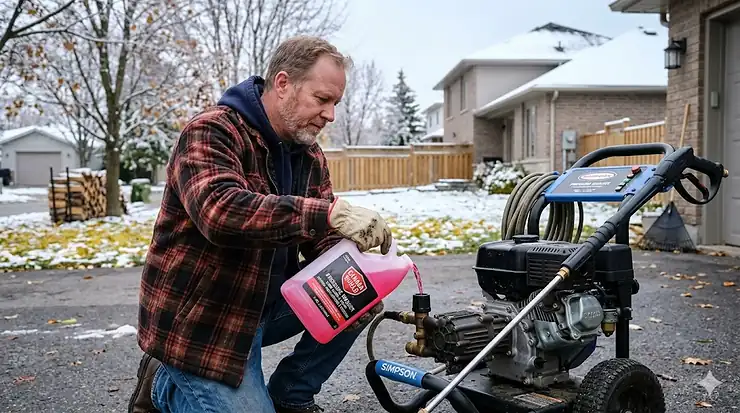
If you’ve ever pulled your pressure washer out of the garage in April only to find the pump cracked, the seals blown, and the whole machine leaking like a garden sprinkler — you already know the pain. And if you haven’t experienced that yet, let’s make sure you never do.
A pressure washer antifreeze solution is a specially formulated product — typically an aerosol foam or pourable liquid — designed to displace water from your pump’s internal components and coat pistons, seals, and valves with a lubricating, freeze-resistant layer. In practical terms, it’s the difference between a pressure washer that fires up on the first pull come spring and one that quietly became a very expensive yard ornament over the winter.
Here’s the uncomfortable truth most product manuals gloss over: freeze damage is not covered by warranty. Almost every major pressure washer brand — from Kärcher to Briggs & Stratton to Simpson — will tell you exactly that, buried in fine print on page 12. Water left inside a pump at temperatures below 0°C (32°F) doesn’t just sit there; it expands by roughly 9% as it freezes, and that expansion is more than enough to crack ceramic pistons, split pump housings, and shred internal O-rings beyond repair.
In Canada, this is especially serious. Winters here aren’t a gentle dip below zero for a few weeks — we’re talking sustained cold in Ontario and Quebec, brutal Prairie deep-freezes in Saskatchewan and Manitoba where temperatures regularly hit −30°C (−22°F) or lower, and surprise cold snaps that catch even Vancouver homeowners off guard in January. Even if you store your machine in an unheated garage — which most of us do — you’re one cold night away from a pump replacement bill that starts around $150 CAD and climbs fast.
Using a quality pressure washer antifreeze solution takes about two minutes and a few dollars. It’s genuinely one of the smartest maintenance habits a Canadian homeowner can build. In this guide, I’ve researched and ranked the 7 best options available on Amazon.ca for 2026, with honest commentary on what each product actually does — and who it’s best for.
Quick Comparison Table: Top 7 Pressure Washer Antifreeze Solutions in Canada
| Product | Type | Volume | Freeze Protection | Best For | Est. Price (CAD) |
|---|---|---|---|---|---|
| STA-BIL Pump Protector 22007 | Aerosol foam | 118 ml (4 oz) | To −32°C (−25°F) | Most Canadian homeowners | Under $20 |
| Briggs & Stratton Pump Saver 6039 | Pressurized aerosol | 118 ml (4 oz) | Deep freeze | B&S pressure washer owners | Under $20 |
| Kärcher Pump Guard 4 oz (8.760-686.0) | Aerosol | 118 ml (4 oz) | Corrosion + freeze | Kärcher machine owners | $15–$25 |
| Kärcher Pump Guard 16 oz | Pourable liquid | 473 ml (16 oz) | Freeze + corrosion | Commercial/multi-machine use | $25–$40 |
| Simpson Cleaning Pump Guard 80273 | Aerosol can | 118 ml (4 oz) | To −32°C (−25°F) | Simpson machine owners | Under $25 |
| Generic Pump Saver w/ Hose (B0FG6M875P) | Pourable liquid | 150 ml (5 oz) | Basic freeze | Budget-conscious buyers | Under $15 |
| RV Antifreeze (propylene glycol, e.g., Camco) | Pourable liquid | 3.78 L (1 US gal) | To −40°C (−40°F) | RV owners, bulk/rural buyers | $12–$20 |
Analysis: Looking at this table, the aerosol-style pump savers (STA-BIL, Briggs & Stratton, Kärcher 4 oz, Simpson) are hands-down the easiest to use for most Canadian homeowners — they connect directly to the water inlet and dispense a measured foam dose in under 60 seconds. The pourable liquids, including RV antifreeze, offer better value for people winterizing multiple machines or doing commercial cold weather pressure washer storage. For most Canadians with a single residential unit, the aerosol format justifies the slightly higher cost-per-use through sheer convenience.
💬 Just one click — help others make better buying decisions too! 😊
✨ Don’t Miss These Exclusive Deals!
🔍 Ready to protect your pressure washer before winter hits? Click on any highlighted product below to check current pricing and availability on Amazon.ca. These tools will help you preserve your investment and avoid expensive spring repairs!
Top 7 Pressure Washer Antifreeze Solutions: Expert Analysis
1. STA-BIL Pump Protector 22007 — The Canadian Winter Standard
If there’s one product that shows up in nearly every pressure washer forum discussion about cold weather pressure washer storage, it’s this one. The STA-BIL Pump Protector 22007 is a 118 ml (4 oz) aerosol that dispenses a white protective foam through a short hose attached to your pump’s water inlet. Once you press the button and foam starts exiting the outlet, you’re done — the pump is coated and protected.
The formulation is rated to −32°C (−25°F), which covers the vast majority of Canadian winter conditions outside of extreme Prairie cold snaps. What the spec sheet doesn’t tell you, though, is how that foam actually works: it doesn’t just displace water — it leaves a thin, lubricating film on your pistons and internal seals that prevents the dreaded “morning-after-storage” stiffness when you fire the machine up in spring. Many Canadian buyers report their seals lasting significantly longer with consistent STA-BIL use versus skipping winter treatment.
In my assessment, this is the best all-around choice for the typical Canadian homeowner — someone with a mid-range residential gas or electric pressure washer stored in an unheated garage in Ontario, Quebec, Alberta, or BC. The two-year shelf life after opening is a real practical benefit too; you won’t feel rushed to use the rest of the can.
Canadian buyers have consistently rated this product well, with reviewers noting ease of use and confidence in pump protection as the top selling points. A few noted that the small 4 oz size is just enough for one thorough treatment.
✅ One-step aerosol application — takes under 60 seconds
✅ Rated to −32°C (−25°F) — handles most Canadian winters
✅ 2-year shelf life after opening
❌ Single-use size — you’ll need to repurchase each season
❌ Small volume means no surplus if you make an error during application
Available on Amazon.ca in the $15–$20 CAD range — excellent value for protection that could save you a $200+ pump replacement.
2. Briggs & Stratton Pump Saver 6039 — Trusted OEM Quality for B&S Owners
Briggs & Stratton is a name Canadians know well — their small engines power countless pressure washers, lawn tractors, and generators sold through Canadian Tire, Home Hardware, and other national retailers. The Pump Saver 6039 is their answer to the winterization question, and it’s available on Amazon.ca with shipping across Canada.
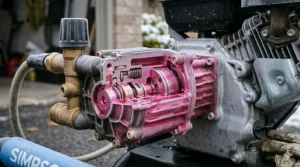
The 6039 uses a pressurized aerosol can design similar to STA-BIL, dispensing an antifreeze and lubricant formula that protects pistons, seals, and internal pump surfaces. What distinguishes it slightly is its explicit coverage of “hard water mineral deposit prevention” — meaning it actively works against the calcium and lime buildup that’s a real problem in many Canadian municipalities, particularly in southern Ontario and parts of Alberta where tap water hardness is notably high. That mineral layer inside a pump, left untreated over winter, acts almost like sandpaper on your seals when you restart in spring.
If you own a Briggs & Stratton-powered pressure washer (and many mid-range Canadian-market units use B&S engines), there’s a certain peace of mind in using the manufacturer’s own product. Briggs & Stratton is also available at PartSource.ca, which explicitly notes its effectiveness against Canadian winters — a nice validation from a Canadian retailer.
Canadian user feedback highlights reliable pump startup in spring as a recurring theme.
✅ OEM formula — ideal for B&S-powered machines
✅ Addresses hard water mineral deposits — relevant for many Canadian municipal water supplies
✅ Compatible with most brands, not just B&S machines
❌ Slightly harder to find on Amazon.ca compared to STA-BIL
❌ Same single-use limitation as other 4 oz cans
Priced in the $15–$20 CAD range on Amazon.ca — solid value from a brand Canadians already trust.
3. Kärcher Pump Guard 8.760-686.0 (4 oz Aerosol) — Best Freeze Protection for Kärcher Machine Owners
Kärcher is arguably the most recognized pressure washer brand in Canada, with machines sold from coast to coast at major retailers. The Kärcher Pump Guard in its 4 oz aerosol format (model 8.760-686.0) is specifically engineered for Kärcher’s own proprietary pump designs, though it also works on most consumer electric and gas models.
What I find notable about this product is that Kärcher designed it with dual-action chemistry: it protects against corrosion and freeze damage simultaneously, down to −32°C (−25°F). The corrosion protection matters more than most people realize — pressure washers stored for six or seven months in a humid Canadian spring and fall cycle are prone to oxidation on internal valves and O-ring seats, which is a separate failure mode from freeze cracking. The Kärcher Pump Guard addresses both in one application.
For Kärcher K-Series owners (the K2, K3, K4, K5 — all popular in Canada), using this product isn’t just smart; it’s the manufacturer’s explicit recommendation. That matters for warranty considerations: if you can demonstrate you followed proper storage procedures, you have a much stronger case in any warranty discussion.
Buyer feedback highlights ease of application and confidence that the pump will perform reliably post-storage.
✅ Dual-action: freeze AND corrosion protection
✅ Official Kärcher formulation — ideal for K-Series users
✅ Compatible with most gas and electric pressure washers
❌ Premium price compared to generic alternatives
❌ 4 oz format is single-use for most pump sizes
Available in the $15–$25 CAD range on Amazon.ca — worth every cent if you own a Kärcher machine.
4. Kärcher Pump Guard 16 oz — The Smart Buy for Multi-Machine Owners and Commercial Use
The larger-format Kärcher Pump Guard (473 ml / 16 oz pourable liquid) is essentially the same excellent formula as the 4 oz aerosol but in a significantly more economical format — and it’s a smarter choice than most buyers realize. At the 16 oz size, you have enough to treat three or four machines thoroughly, which is relevant if you’re a landscaper, property manager, or someone who also winterizes an RV pressure washer and a backup unit.
The pourable format changes the application slightly: rather than a pressurized aerosol hose, you pour the liquid into a container, draw it through the water inlet manually, and run the machine briefly to circulate the solution through the pump internals. This takes two or three extra minutes versus the aerosol method, but it gives you much more control over how thoroughly the pump is flushed — and for cold weather pressure washer storage over a long Prairie winter, that thoroughness pays off.
Where this product really shines is in commercial cold weather pressure washer storage scenarios — think mobile detailing businesses in Alberta or Ontario that shut down between November and March. The cost-per-treatment drops dramatically at the 16 oz size, and the formulation is identical to the premium 4 oz version.
✅ Economical cost-per-treatment for multiple machines
✅ Ideal for commercial operators and landscaping businesses
✅ Same proven Kärcher chemistry in a larger format
❌ Pourable format is slightly more involved than aerosol
❌ Larger upfront cost (though lower cost-per-use)
Available in the $25–$40 CAD range on Amazon.ca — excellent value when divided across two or three machines.
5. Simpson Cleaning Pump Guard 80273 — Workhorse Choice for Simpson Machine Owners
Simpson is another heavy-hitter in the Canadian pressure washer market, and their own Pump Guard 80273 aerosol delivers exactly what you’d expect: a no-nonsense, pressurized pump saver antifreeze spray that protects down to −32°C (−25°F). At 118 ml (4 oz), it mirrors the format of STA-BIL and the Briggs & Stratton saver, but with a formula optimized for Simpson’s AAA and CAT pump systems — the same pumps used in many of their popular CM and MS series machines.
What the product description won’t tell you is that the AAA-pump-specific formulation has slightly higher oil-content lubricants compared to generic pump savers, which translates to better seal conditioning over a long Canadian winter. That’s meaningful if you’re running a higher-PSI Simpson machine (3,000 PSI / 207 bar or above) where seal integrity is critical for reliable spring startup.
The product is also explicitly recommended for any pressure washer sitting unused for more than two weeks — not just winter storage. That’s practical guidance for Canadians who might stow a machine for two months over summer vacation or during a renovation project.
✅ Optimized for AAA and CAT pump systems — common in Canadian-market Simpson washers
✅ Rated to −32°C (−25°F) — handles most Canadian winters
✅ Two-week-or-more idle period recommendation — practical Canadian usage guidance
❌ Primarily beneficial for Simpson machine owners; other brands may prefer their own OEM product
❌ Single-use 4 oz format
Priced under $25 CAD on Amazon.ca — a smart buy for any Simpson machine owner.
6. Generic Pump Saver with Hose (B0FG6M875P / B0FHP7W8CC) — The Ultra-Budget Option
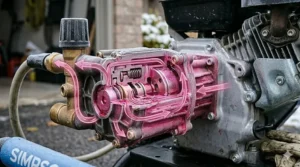
Available on Amazon.ca in the $10–$15 CAD range, this category of generic pump savers (including products like the 150 ml / 5 oz pourable pump saver with included pour hose from various sellers) represents the most budget-conscious entry point for pump saver antifreeze spray protection. These products are available from multiple third-party sellers on Amazon.ca, often with free shipping on Prime-eligible orders.
To be honest with you: these products will provide basic freeze resistance and mineral deposit prevention for the average homeowner. What they won’t give you is the R&D backing, the precise formulation confidence, or the verified temperature rating of a brand-name product like STA-BIL or Kärcher. For a Canadian storing an entry-level electric pressure washer in a moderately insulated garage in Vancouver or Victoria — where winter temperatures rarely drop below −5°C (23°F) — the generic option is probably “good enough.” For someone in Winnipeg, Regina, or rural Northern Ontario, I’d strongly recommend investing in a name-brand product with a verified deep-freeze rating.
The included pour hose is a thoughtful touch, making the application a bit more controlled than trying to pour liquid directly into the pump inlet.
✅ Most affordable option on Amazon.ca
✅ Includes a pour hose for easier application
✅ Adequate for mild winter climates (coastal BC, southern Ontario)
❌ No verified temperature rating — risky in Prairie provinces
❌ Variable quality between sellers
Best for mild climates and very tight budgets — under $15 CAD. If you live east of the Rockies, invest a few dollars more in a name-brand product.
7. RV Antifreeze (Propylene Glycol, e.g., Camco TastePURE) — The Canadian Cottage-Country Classic
Before dedicated pump saver aerosols existed, Canadian pressure washer owners — and RV enthusiasts from Kelowna to Halifax — were already using propylene glycol RV antifreeze to winterize their equipment. This remains a completely valid method, and for many Canadians, particularly those who already buy RV antifreeze for their trailers or seasonal cottages, it’s the most economical choice.
Propylene glycol RV antifreeze (non-toxic, unlike ethylene glycol automotive antifreeze — do NOT use automotive antifreeze in your pressure washer) can protect down to −40°C (−40°F) when used as a straight pour-through solution, which covers even the most extreme Canadian winter conditions. Brands like Camco TastePURE are widely available across Canada at camping supply stores, Canadian Tire, and on Amazon.ca, typically in 3.78 L (1 US gallon) jugs in the $12–$20 CAD range.
The application method requires slightly more hands-on work: draw the antifreeze through the pump inlet manually, run the machine briefly (for gas units), or pull the starter cord a few times to circulate the solution. It’s worth the extra two minutes, though, because a 3.78 L jug gives you enough to treat a pressure washer, an RV water system, a garden hose reel, and still have some left over for next season. For budget-minded Canadians and those in remote northern areas where Amazon shipping timelines are longer, buying RV antifreeze at a local Co-op or Canadian Tire is the most practical solution.
✅ Widest temperature range — down to −40°C (−40°F)
✅ Economical for multi-use (RV + pressure washer + other equipment)
✅ Widely available at Canadian retailers beyond Amazon.ca
❌ More involved application than aerosol pump savers
❌ Must be propylene glycol (RV-type) — NEVER use automotive/ethylene glycol antifreeze in a pressure washer
Best for: RV owners, rural Canadians, and anyone who needs maximum cold protection on a tight budget.
How to Winterize a Pressure Washer Pump: A Step-by-Step Guide for Canadian Conditions
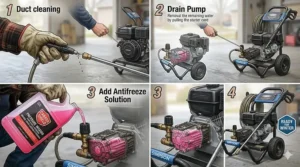
Most product listings will tell you “connect to inlet, press button, done.” That’s accurate for the aerosol products — but what they don’t tell you is what to do before and after that step, which matters a lot if you’re storing equipment for a six-month Canadian winter. Here’s the complete process:
Step 1: Flush Detergent and Clear the Lines
Before you apply any pressure washer antifreeze solution, make sure there’s no soap or cleaning chemical sitting in your system. Run clean water through the machine for 30–60 seconds with the trigger held open. Detergent residue mixed with antifreeze can reduce the protective formula’s effectiveness and leave corrosive deposits on seals.
Step 2: Disconnect the Water Supply and Purge the System
With the water supply disconnected, squeeze the trigger gun several times until no more water exits. This removes the bulk of residual water from the pump and hoses. For gas pressure washers, run the engine briefly during this step to use the pump’s own action to expel water.
Step 3: Apply Your Pressure Washer Antifreeze Solution
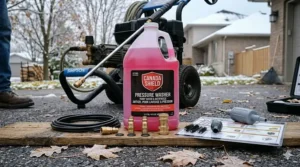
For aerosol pump savers (STA-BIL, Briggs & Stratton, Kärcher, Simpson): attach the included hose to the water inlet, press the button, and hold until you see the formula (usually white foam or coloured liquid) exit from the pump outlet or the spray nozzle. That’s your signal that the pump internals are coated. For pourable liquid products or RV antifreeze, draw the solution through the inlet manually and run a few pump strokes. 🇨🇦
Prairie-specific tip: In Manitoba, Saskatchewan, or northern Alberta where temperatures can sustain −35°C (−31°F) for weeks at a time, consider doing a 60:40 antifreeze-to-water mixture if using pourable RV antifreeze, rather than the standard 50:50 mix.
Step 4: Drain Fuel (Gas Machines) or Unplug (Electric)
For gas-powered pressure washers, add a quality fuel stabilizer (like STA-BIL Storage, also available on Amazon.ca) to a full tank, run the engine for two minutes to circulate it, then drain the carburettor float bowl if your model has one. Ethanol-blended gasoline — standard at Canadian pumps — degrades faster in cold storage and can varnish the carburettor by spring. For electric models, simply unplug and coil the power cord loosely without tight bends.
Step 5: Store Correctly — Location Matters More Than Most Canadians Realize
An unheated, uninsulated garage in January in Calgary can reach −25°C (−13°F) or colder. Even after applying pump saver, if you’re in an extreme cold climate, consider placing your pressure washer inside a large contractor garbage bag with a few silica gel packets (or even a folded moving blanket around the pump housing) to add a buffer against ambient temperature swings. Never store directly on a concrete floor — concrete wicks cold and moisture. Use a pallet, a rubber mat, or a simple wooden skid. This takes two minutes and meaningfully extends equipment life.
Step 6: Pre-Season Startup Check
In spring, before running the machine at full pressure: reconnect the water supply, let water flow through briefly to flush any remaining antifreeze out of the pump, and run the unit at low pressure for 30–60 seconds before engaging full PSI. The antifreeze residue is non-toxic (propylene glycol types) or minimal (aerosol formulas), but flushing ensures you’re starting clean.

Real Canadian User Scenarios: Which Product Is Right for You?
The right pressure washer antifreeze solution depends enormously on your specific situation — where you live, what machine you own, and how you store your equipment. Here are three realistic Canadian buyer profiles:
🏠 Profile 1: The Toronto Suburban Homeowner
Setup: 1,800 PSI electric pressure washer (Kärcher K3 or similar), stored in an attached double garage in Mississauga or Markham. Garage temperature rarely drops below −10°C (14°F) even on the coldest nights.
Best choice: Kärcher Pump Guard 4 oz aerosol (8.760-686.0). Since this buyer is likely running a Kärcher machine, the OEM formula is the safest choice. An attached garage keeps temperatures moderated, so the standard aerosol coverage is more than sufficient. Budget around $15–$25 CAD. Application takes under two minutes.
🌾 Profile 2: The Prairie Acreage Owner in Saskatchewan
Setup: 3,100 PSI gas pressure washer (Simpson or Generac), stored in a detached metal shop building that gets down to −35°C (−31°F) in January. Uses the pressure washer for farm equipment cleaning, deck cleaning, and vehicle washing May through October.
Best choice: RV antifreeze (propylene glycol, 3.78 L jug) mixed at 60:40 with water, combined with STA-BIL Storage fuel stabilizer for the engine. The RV antifreeze covers extreme cold conditions, and buying it locally at Co-op or Peavey Mart means no shipping wait. Budget around $12–$20 CAD for a full winter’s protection across two machines.
🏕️ Profile 3: The Seasonal Cottage Owner in Muskoka or the Okanagan
Setup: Mid-range electric pressure washer used only May–September, stored in an unheated lakeside garage or boathouse from October to May. Equipment is adjacent to an RV and a boat, all of which also need winterization.
Best choice: Kärcher Pump Guard 16 oz pourable, or RV antifreeze (which is already on hand for the boat’s water system and RV). At the 16 oz size, one bottle handles the pressure washer and tops up whatever other winterization jobs are on the list. Cost-per-use drops significantly. Budget $25–$40 CAD for the Kärcher 16 oz, or $12–$20 CAD per gallon of RV antifreeze for a multi-use approach.
How to Choose a Pressure Washer Antifreeze Solution in Canada: 6 Key Criteria
With several solid products on the market, here’s how to make the right call for your specific needs:
1. 🌡️ Match Freeze Rating to Your Climate
The most important number on any pump saver is the freeze protection temperature. For coastal BC and southern Ontario, a standard −25°C (−13°F) rating is adequate. For Alberta, Manitoba, Saskatchewan, and northern regions, look for products rated to −40°C (−40°F) or use propylene glycol RV antifreeze, which offers superior protection in extreme cold.
2. 🔧 Consider Your Machine’s Pump Type
Gas pressure washers with crankshaft-driven pumps (most units over 2,500 PSI) benefit from the higher lubricant content in name-brand formulas like Briggs & Stratton 6039 or Kärcher Pump Guard. Electric machines with induction-type pumps are generally less sensitive to formula specifics, making them more suitable for generic or RV antifreeze options.
3. ⚙️ Aerosol vs. Pourable: Match to Your Setup
Aerosol pump savers are faster, cleaner, and more foolproof for most homeowners. Pourable products (including RV antifreeze) offer better economy when treating multiple machines or doing thorough flush treatments. If you own one residential machine, aerosol is the smarter convenience choice. If you run a small landscaping operation, go pourable.
4. 📦 Check Amazon.ca Availability and Shipping to Your Province
Some products ship faster in central Canada (Ontario, Quebec) than to remote Prairie addresses or northern communities. Check estimated delivery dates before assuming next-day availability. Prime members generally get better shipping across Canada, but northern addresses (north of 60°) may still see extended timelines regardless of Prime status.
5. 💰 Value in CAD — Don’t Overbuy or Underbuy
A $15–$20 CAD aerosol pump saver is the right investment for a single residential machine. Scaling up to the 16 oz Kärcher ($25–$40 CAD) only makes sense if you have multiple machines or plan to use it commercially. Buying a full gallon of RV antifreeze for a single residential electric pressure washer is overkill — unless you’re already buying it for an RV or boat.
6. 🏷️ OEM vs. Third-Party: When It Matters
For machines still under warranty, using the manufacturer’s own pump saver (Kärcher for Kärcher, B&S for B&S, Simpson for Simpson) gives you the strongest documentation that you followed proper storage procedures. For machines out of warranty, trusted third-party options like STA-BIL are just as effective and often easier to find on Amazon.ca.
Pressure Washer Antifreeze Solution vs. Traditional Winterization Methods
Canadian pressure washer owners have used several approaches over the years. Here’s how they compare:
| Method | Effectiveness | Cost (CAD) | Effort | Risk Level |
|---|---|---|---|---|
| Dedicated pump saver aerosol (STA-BIL, Kärcher, etc.) | ★★★★★ | $15–$25 per season | Very low — 2 min | Minimal |
| Propylene glycol RV antifreeze (poured through) | ★★★★★ | $12–$20 per gallon | Low — 5–10 min | Minimal (if using PG type) |
| Air compressor blow-out only | ★★★☆☆ | ~$0 (if you own compressor) | Medium | Moderate — residual water risk |
| Heated garage storage (no chemical treatment) | ★★★☆☆ | Variable (heating costs) | Low | Moderate — one power outage voids protection |
| No treatment at all | ★☆☆☆☆ | $0 | Zero | Very high — almost certain pump damage in hard winters |
Analysis: The data here is telling: chemical treatment (either dedicated pump saver or RV antifreeze) is overwhelmingly the most cost-effective and reliable solution. The “heated garage” approach is deceptively risky — a single overnight power outage or furnace failure during a Manitoba cold snap can drop an unheated garage to dangerous temperatures within hours. Chemical freeze protection works independently of whether your garage heater keeps running. For less than $20 CAD, you’re eliminating a failure mode that could cost $150–$400 to repair.
What to Expect: Real-World Pressure Washer Pump Damage from Canadian Winters
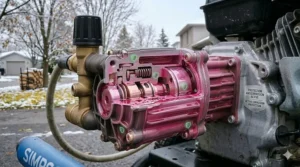
Understanding exactly what freeze damage looks like helps you appreciate why pump saver antifreeze spray is a non-negotiable investment. When water freezes inside a pressure washer pump, several things can happen — and none of them are cheap:
Cracked pump housing: The most dramatic failure. A hairline crack in a ceramic or brass pump body appears when expanding ice forces the material apart. Repair is almost always “replace the entire pump” — costs typically range from $150–$350 CAD for mid-range residential units.
Blown O-rings and seals: Even without a visible crack, freeze-thaw cycling compresses and distorts rubber seals, causing persistent leaks and pressure loss. Seal kits exist, but replacing them requires disassembling the pump — not a beginner DIY job.
Stuck pistons: Corrosion accelerated by freeze-thaw moisture cycling can seize pistons against their cylinder walls. On a gas machine that sat over a long winter, this shows up as abnormally high pulling resistance on the starter cord before finally releasing — if it releases at all.
Mineral deposit buildup: Not freeze damage per se, but hard Canadian municipal water leaves calcium and lime deposits inside pump passages over winter. These deposits are abrasive on seal surfaces and restricting on valves, leading to premature wear that shows up in reduced pressure output come spring.
A quality pressure washer antifreeze solution addresses all four of these failure modes simultaneously. It’s one of the highest-ROI maintenance items in your garage.
Common Mistakes When Winterizing a Pressure Washer in Canada
❌ Mistake 1: Using Automotive Antifreeze
This bears repeating with emphasis: ethylene glycol automotive antifreeze is toxic and will chemically attack rubber seals and O-rings inside your pressure washer. Always use propylene glycol RV-type antifreeze or a dedicated pump saver product. This matters especially because automotive antifreeze and RV antifreeze can look very similar — check the label for “propylene glycol” and “RV/marine” designation before pouring anything into your pump.
❌ Mistake 2: Applying Pump Saver Without Purging Water First
This is probably the most common error, and it renders the pump saver significantly less effective. If you spray the antifreeze foam into a pump that still has a cup of water sitting in it, the formula gets diluted and may not coat critical surfaces adequately. Always purge the system by triggering the gun until no water flows before applying pump saver.
❌ Mistake 3: Assuming One Application Lasts Forever
Pump saver products are typically rated for a single season — one winter of protection. The lubricating oils in the formula slowly migrate and dry over six to eight months. Reapply fresh product each autumn, and note the opened-date on your bottle for products with a two-year shelf life (like STA-BIL).
❌ Mistake 4: Ignoring the Hoses and Gun
The pump gets all the attention, but water trapped in a 15-metre (50-foot) hose can also freeze and crack the hose’s inner liner. Drain your hose by holding it straight and walking it off a reel, then coil loosely and store indoors. The spray gun and wand should also be drained and stored in a warm location — gun seals are just as vulnerable as pump seals.
❌ Mistake 5: Assuming a Mild Winter Means No Treatment Needed
Vancouver and Victoria homeowners are particularly prone to this mistake. Average winter lows of −3°C to −5°C (27°F to 23°F) feel mild, but a single cold snap — which Environment and Climate Change Canada confirms happens in most BC coastal areas multiple times per decade — can push overnight temperatures down to −12°C (10°F) or lower. Two minutes of pump saver application in October eliminates this risk entirely.
❓ Frequently Asked Questions About Pressure Washer Antifreeze in Canada
❓ Can I use RV antifreeze in a pressure washer pump?
❓ How long does pump saver antifreeze protection last in a Canadian winter?
❓ Does Amazon.ca ship pressure washer pump savers to rural and northern Canada?
❓ Do I need to apply pump saver if I store my pressure washer in a heated garage?
❓ What's the difference between pump saver and pump oil for a pressure washer?
Conclusion: Protect Your Investment Before the First Freeze
Canadian winters don’t forgive equipment neglect. Whether you’re in Victoria counting on mild Pacific weather to be kind, in Calgary bracing for a −30°C (−22°F) cold snap, or in Halifax dealing with freeze-thaw cycling all season long, the principle is the same: water left inside a pressure washer pump in winter is a liability.
The good news is that pressure washer antifreeze solution products have made winterization genuinely easy. The STA-BIL Pump Protector 22007 remains my top overall recommendation for most Canadian homeowners — it’s affordable, effective to −32°C (−25°F), and the aerosol format means the job is done in under two minutes. Kärcher machine owners should reach for the Kärcher Pump Guard (4 oz for convenience, 16 oz for economy), while Prairie residents dealing with extreme cold should seriously consider propylene glycol RV antifreeze for its unmatched −40°C (−40°F) protection.
Whatever product you choose, the most important thing is simply doing it — consistently, each autumn, before the first hard freeze hits. A $15–$20 CAD investment in pump saver antifreeze spray beats a $250 pump replacement every time.
✨ Don’t Miss These Exclusive Deals!
🔍 Take your pressure washer winterization to the next level with these carefully selected products. Click on any highlighted item to check current pricing and availability on Amazon.ca. These tools will help you preserve your equipment and skip the costly spring repairs!
Recommended for You
- Best Heated Pressure Washer for Winter Car Wash in Canada 2026
- Best Heavy Duty Car Wash Soap for Winter Grime in Canada (2026)
- Best Undercarriage Cleaner Salt Removal: 7 Top Picks for Canada (2026)
Disclaimer: This article contains affiliate links. As an Amazon Associate, I earn from qualifying purchases. If you purchase products through these links, we may earn a small commission at no additional cost to you.
✨ Found this helpful? Share it with your friends! 💬🤗
