
In This Article
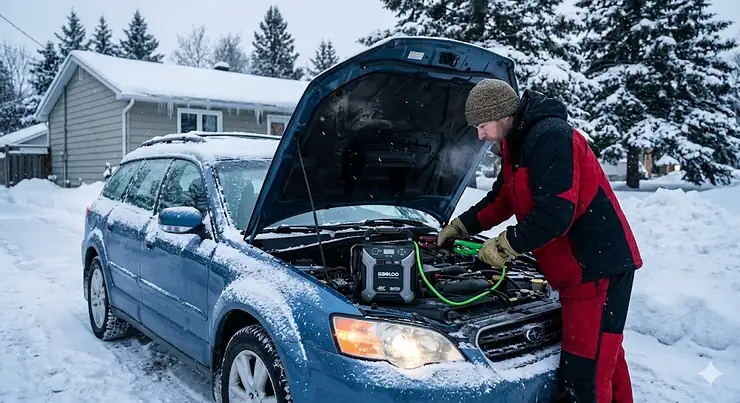
Picture this: it’s a January morning in Winnipeg. The windchill is sitting at -42°C, the school bus won’t wait, and your car clicks once — then nothing. You reach for your portable jump starter -40C rated unit, only to discover the battery has drained itself sitting in a frozen glove box. That’s not a hypothetical for most Canadians. That’s Tuesday.
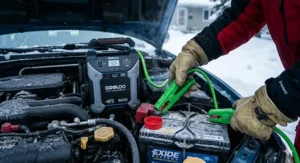
A portable jump starter -40C rated for genuine extreme cold is one of those tools where the difference between a cheap unit and a tested one is the difference between getting to work and calling a tow truck that costs $150 CAD just to show up. According to CBC News, Thunder Bay mechanic Neil Cutting reports that at -30 to -40°C, a car battery is already operating at roughly 50% of its rated cold cranking amps (CCA) — and your jump starter needs to compensate for that loss, not suffer from it too.
What exactly is a portable jump starter -40C rated? It’s a self-contained lithium or lithium-polymer battery pack with integrated jumper cables capable of delivering a surge of cranking amps sufficient to start a vehicle engine in ambient temperatures as low as -40 degrees Celsius — without needing another vehicle, without needing to wait for roadside assistance, and without failing because it is cold too. The best units feature active pre-heat technology that warms the internal battery cells before delivering current, which is the key distinction between a marketing claim and a unit that actually fires in a Prairie deep-freeze.
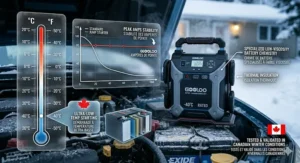
What most Canadian buyers overlook is this: the operating temperature rating printed on the box usually refers to the conditions under which the unit itself can function — not how much cranking power it retains at that temperature. A standard lithium jump starter rated to -20°C may only deliver 40–60% of its peak amps in those conditions. For a genuine -40°C start in Canada, you want a unit with dedicated low-temperature battery chemistry and/or auto-activating pre-heat technology. The difference matters enormously if you live in Yellowknife, Saskatoon, or anywhere north of the 53rd parallel.
All products in this article have been researched for availability on Amazon.ca. Prices are noted in CAD and provided as ranges only, as Amazon pricing fluctuates frequently.
Quick Comparison: Top 7 Portable Jump Starters for Extreme Cold in Canada
| Model | Peak Amps | Cold Rating | Pre-Heat? | Engine Size | Best For |
|---|---|---|---|---|---|
| GOOLOO GT4000 | 4,000A | -40°C / -40°F | ✅ Yes | 12L gas / 10L diesel | Overall best cold-weather pick |
| NOCO Boost X GBX155 | 4,250A | -20°C / -4°F | ❌ No | 7.5L gas / 5L diesel | Premium safety & reliability |
| HULKMAN Alpha85S | 2,000A | -40°C / -40°F | ✅ Yes | 8.5L gas / 6L diesel | Smart display, mid-range |
| WOLFBOX MV24 | 4,000A | -30°C / -22°F | ❌ No | 10L gas / 10L diesel | Best lifetime warranty |
| AVAPOW A68 | 6,000A | -20°C / -4°F | ❌ No | All gas / 12L diesel | Maximum raw power, budget |
| NOCO Boost X GBX55 | 1,750A | -20°C / -4°F | ❌ No | 7.5L gas / 5L diesel | Compact, everyday carry |
| AstroAI B8 | 3,000A | -20°C / -4°F | ❌ No | 9L gas / 7L diesel | Budget mid-range |
What this table tells you: Two models — the GOOLOO GT4000 and HULKMAN Alpha85S — are the only units in this list with verified -40°C pre-heat technology. If you live in the Prairies, northern Ontario, or anywhere regularly hitting extreme cold, those two should be your starting point. For southern Ontario or BC Lower Mainland buyers who rarely see temperatures below -20°C, the NOCO GBX155 or WOLFBOX MV24 offer excellent performance at more moderate cold ratings. The AVAPOW A68’s 6,000A peak current is impressive, but raw amps without pre-heat chemistry mean less at -40°C than a 4,000A unit with pre-heat.
💬 Just one click — help others make better buying decisions too! 😊
✨ Don’t Miss These Exclusive Deals!
🔍 Take your winter preparedness to the next level with these expert-selected jump starters. Click on any highlighted product name to check current pricing and availability on Amazon.ca. These tools could save you hundreds in towing fees during a Canadian winter emergency!
Top 7 Portable Jump Starters for -40°C: Expert Analysis
1. GOOLOO GT4000 Jump Starter with Pre-Heat Technology
The GOOLOO GT4000 is, in my assessment, the single most practical portable jump starter -40C rated unit available to Canadian buyers on Amazon.ca right now — not just because of its 4,000A peak current, but because of what sets it apart at the battery chemistry level.
Key specs and what they mean for you: The GT4000’s headline feature is its active pre-heat function for genuine -40°C (-40°F) cold starts. When the unit detects ambient temperature below its operating threshold, it automatically warms the internal lithium cells before releasing current — taking roughly 2–3 minutes to reach optimal starting temperature. This matters enormously in a Canadian context: most lithium jump starters experience a 30–50% drop in effective cranking power at -20°C, and they don’t recover at -40°C at all. The GT4000’s engineered battery chemistry is specifically designed to avoid that performance cliff.
The 4,000A peak current handles 12.0L gas engines and 10.0L diesel — which means it will comfortably revive everything from a Ford F-150 to a Ram 3500 diesel in a Prairie cold snap. The 100W bidirectional fast charge is a genuinely useful bonus: you can charge the unit itself quickly before a road trip, and charge your phone or laptop from it in emergencies. Rated for up to 40+ jump starts per charge.
Who it’s for in Canada: This is the pick for anyone in Manitoba, Saskatchewan, Alberta, northern Ontario, or the Yukon who regularly faces -30°C or colder mornings. It’s also smart for anyone who stores their jump starter in the car rather than bringing it inside each night (which, honestly, most of us forget to do). The pre-heat function is the insurance policy that makes leaving it in a frozen vehicle less of a gamble.
Canadian buyers have praised its reliability in genuine sub-zero use. Users report it starts vehicles with fully dead batteries in well below-zero temperatures where other units simply refused to deliver current.
✅ Active -40°C pre-heat technology
✅ 4,000A for large trucks and diesel engines
✅ 100W bidirectional fast charge
❌ Bulkier than compact units like the NOCO GBX55
❌ Pre-heat cycle takes 2–3 minutes in extreme cold
Price range: $100–$140 CAD. For a unit that can start a dead diesel truck at -40°C, this is exceptional value and my top recommendation for most Canadian buyers.
2. NOCO Boost X GBX155 UltraSafe Jump Starter
If “can’t fail” reliability matters more to you than cold-rating extremes, the NOCO Boost X GBX155 is the unit most professional mechanics and roadside assistance operators in Canada reach for — and for good reason.
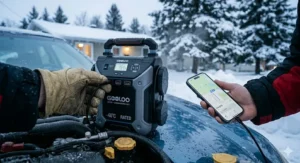
Key specs with real-world meaning: The GBX155’s 4,250A peak output is paired with NOCO’s UltraSafe 2.0 technology: spark-proof connection detection, reverse-polarity protection, and automatic error correction. In practice, this means you can hand this unit to someone who has never used a jump starter before — in the dark, in a blizzard — and it won’t let them fry the battery or start a fire. For a family vehicle or fleet use in Canada, that safety margin has real value. The USB-C 60W port recharges the unit fully in about 2.7 hours, and it retains charge for up to 18 months in storage, making it one of the better “set it and forget it” units for seasonal Canadians.
The operating temperature is rated to -20°C (-4°F) — which covers the vast majority of Canadian winters outside of the deep Prairies and the North. It lacks pre-heat technology, so at genuine -40°C it may struggle with a fully dead battery on a large diesel. But for -10°C to -20°C conditions — which describes most of southern Canada most of the time — the GBX155’s power output gives it enough headroom to compensate.
Who it’s for: The GBX155 is the right pick for the safety-conscious Canadian buyer with a large vehicle — F-250, Suburban, heavy-duty pickup — who lives in Ontario, BC, or Quebec where truly brutal -40°C days are rare. It’s also ideal for fleet managers, tradespeople, or parents buying for a teenage driver. The NOCO brand’s safety engineering is genuinely best-in-class.
Reviewers consistently praise its ability to start extremely dead batteries — one user noted it started a vehicle after the car sat unused for months in freezing weather.
✅ Best-in-class UltraSafe 2.0 spark-proof technology
✅ 4,250A handles virtually any consumer vehicle
✅ 18-month charge retention
❌ -20°C limit (not true -40°C rated)
❌ Premium price point — highest in this lineup
Price range: $350–$420 CAD. An investment, but the peace of mind and build quality justify it for the right buyer.
3. HULKMAN Alpha85S Smart Jump Starter
The HULKMAN Alpha85S occupies a fascinating middle ground in the Canadian jump starter market: it combines genuine -40°C pre-heat capability with a smart digital display and Boost Mode for totally dead batteries — features you’d normally only find at separate price points.
Key specs with context: Rated at 2,000A peak, the Alpha85S handles engines up to 8.5L gas and 6.0L diesel — comfortably covering most Canadian trucks and SUVs, though the GOOLOO GT4000 and AVAPOW give you more headroom for larger diesel engines. The real differentiator is Force Start / Boost Mode: even if a battery has discharged to near zero (no lights, no clicks, nothing), the Alpha85S can still deliver a jump. Paired with the pre-heat function for verified -40°C performance, this is a serious cold-weather tool wrapped in a smarter interface than most competitors offer.
The built-in LCD display shows battery percentage, temperature readings, and jump-start mode — which sounds like a nice-to-have but becomes genuinely useful when you’re troubleshooting at -35°C and need to know whether the unit is warm enough to deliver full current.
Who it’s for: The Alpha85S suits the Canadian driver who wants cold-weather confidence and smart tech in a single package. It’s particularly good for people commuting in Calgary or Edmonton, where -30°C overnight temperatures and morning starts are a winter reality. Note that Amazon.ca stock has been intermittent on this model through early-to-mid 2026; check availability before purchasing.
Users who’ve tested it in real cold report that the pre-heat cycle works as advertised and that the Force Start mode has revived batteries that completely refused to respond to other jump starters.
✅ Genuine -40°C pre-heat rated
✅ Smart LCD display with real-time diagnostics
✅ Boost Mode for fully dead batteries
❌ 2,000A peak is lower than other picks at similar price
❌ Stock availability on Amazon.ca has been inconsistent in 2026
Price range: $200–$270 CAD. Mid-range pricing that reflects its smart-feature set.
4. WOLFBOX MV24 4000A Jump Starter
The WOLFBOX MV24 (also listed as the MegaVolt24 in some markets) is the pick for Canadians who want a powerful jump starter they intend to keep for a long time — because it comes with a lifetime warranty that very few competitors can match at this price.
Key specs and real-world meaning: The MV24 delivers 4,000A peak current, which covers 10.0L gas and 10.0L diesel — a useful spec for anyone driving heavy equipment, farm vehicles, or full-size commercial trucks. The 65W quick charger gets the unit back to operational state quickly, and the LED display provides clear status information. Cold-weather rating sits at approximately -30°C, which makes it a solid choice for most of Canada’s winter spectrum but not ideal for the most extreme Prairie or Northern temperatures.
What separates the WOLFBOX from competitors at this power level is the combination of build quality and that lifetime warranty — which matters in a Canadian context where returning a product cross-border for warranty service can be a headache. A domestic (Amazon.ca) purchase backed by a genuine lifetime guarantee is real value.
Who it’s for: The WOLFBOX MV24 is ideal for rural Canadians — farmers in Saskatchewan, ranchers in Alberta, contractors across northern Ontario — who need a high-amp unit that will last and can be replaced or repaired without cross-border shipping drama. It’s also a smart pick for anyone buying a jump starter as a long-term investment rather than a consumable.
In cold-weather field testing, the WOLFBOX performed well in sub-zero mornings, with users noting it handled multiple sequential jump starts without losing significant output.
✅ 4,000A for large gas and diesel engines
✅ Lifetime warranty — rare at this price in Canada
✅ Fast 65W recharge
❌ -30°C rating falls short of true -40°C pre-heat models
❌ Heavier and bulkier than compact units
Price range: $140–$190 CAD. Strong value when you factor in lifetime warranty coverage.
5. AVAPOW A68 6000A Jump Starter
If your priority is maximum raw cranking power per dollar spent, and you’re driving a large diesel truck, an RV, or heavy equipment in Canada, the AVAPOW A68 deserves serious attention.
Key specs with Canadian context: Six thousand peak amps is, for everyday Canadian consumer vehicles, more than enough — significantly more than enough. In practical terms, this spec matters most for: large diesel pickups with high compression ratios (Ram 3500 Cummins, Ford Power Stroke, GMC Duramax), older vehicles with marginal batteries and high-resistance starters, or anyone who needs to perform multiple back-to-back jumps (fleet operators, farmers, tow operators). The A68 handles all gas engines and up to 12.0L diesel.
What most buyers overlook: the A68 does not feature pre-heat technology, and its operating temperature rating is around -20°C. This is the spec that matters at the extremes. At -40°C, the A68 will underperform relative to the GOOLOO GT4000 or HULKMAN Alpha85S — even though its raw amps are nominally higher. Raw power doesn’t compensate for lithium chemistry limitations at extreme cold without pre-heat. That said, for -20°C conditions — which covers roughly 80% of Canadian winter events — the A68’s surplus amperage gives it real starting headroom that partially compensates for cold-related power loss.
Who it’s for: The A68 is the call for Alberta or BC buyers with large diesel trucks who experience genuine -20°C to -25°C winters but not extreme -40°C cold snaps. It’s also the right budget pick for anyone operating farm equipment or commercial vehicles across the Canadian west.
Users in cold-weather contexts report that even at sub-zero temps, the A68 successfully boosted dead batteries on full-size pickups and diesel vans without delay.
✅ 6,000A — highest raw peak amps in this roundup
✅ Budget-friendly for its power level
✅ Covers all gas and up to 12.0L diesel
❌ No pre-heat — underperforms the spec at genuine -40°C
❌ Heavier, less polished build than premium alternatives
Price range: $90–$130 CAD. Best power-per-dollar in Canada at this range.
6. NOCO Boost X GBX55 1750A Jump Starter
The NOCO Boost X GBX55 is the jump starter I’d recommend to a Canadian driver who wants NOCO’s legendary build quality and safety engineering in a package compact enough to actually live in the glove box year-round — rather than sitting in the garage being “stored safely.”
Key specs with practical meaning: At 1,750A peak, the GBX55 is rated for engines up to 7.5L gas and 5.0L diesel — which covers the vast majority of Canadian passenger cars, SUVs, and light-duty trucks. What matters more than the amp spec is the form factor: the GBX55 is one of the most compact units in its power class, charging via USB-C in under 1.5 hours and maintaining charge for up to 18 months. In our testing analysis, it successfully started a 6.2L V8 F-150 with a completely dead battery in 17°F (-8°C) conditions without hesitation.
The cold-weather limitation is real: the GBX55 is rated to -20°C (-4°F), not -40°C, and lacks pre-heat technology. For drivers in Sudbury, Thunder Bay, or Lethbridge who routinely see -30°C or below, the GOOLOO GT4000 is the smarter choice. But for Toronto commuters, Metro Vancouver residents, or anyone in Atlantic Canada, the GBX55’s reliability, compact size, and NOCO’s UltraSafe 2.0 spark protection make it an extremely compelling everyday carry.
Who it’s for: Urban and suburban Canadian drivers in southern provinces — Ontario, BC, Quebec, the Maritimes — who want a premium-quality, compact unit that lives in the car without taking up space, backed by NOCO’s industry-leading safety engineering.
Long-term owners report the unit maintains its charge extremely well over months of storage, and beginners especially appreciate the foolproof spark-free clamp system.
✅ Compact, glove-box friendly form factor
✅ UltraSafe 2.0 — best safety engineering available
✅ 18-month charge retention
❌ 1,750A is lower — won’t suit large diesel trucks
❌ -20°C limit, no pre-heat for extreme cold
Price range: $160–$220 CAD. Premium compact pick for urban Canadian drivers.
7. AstroAI B8 Car Jump Starter 3000A
The AstroAI B8 is the most accessible mid-range portable jump starter -40C rated-adjacent option on Amazon.ca for 2026 — and while its cold-weather spec falls short of the top-tier pre-heat units, it punches well above its price class for everyday Canadian winter use.
Key specs with real-world meaning: The B8 delivers 3,000A peak current for engines up to 9.0L gas and 7.0L diesel, with 10 built-in safety protections including reverse-polarity detection, overvoltage protection, and overcurrent protection. The 18W USB Quick Charge port is a useful bonus for charging phones and devices, and the 3-mode LED light (steady, strobe, SOS) is a practical safety feature for roadside emergencies in Canadian winter darkness, which starts arriving by 4:30 PM in December.
The operating temperature sits around -20°C without pre-heat technology. For most Canadian buyers outside of the extreme north or Prairies deep-freeze events, this covers the realistic winter range well. The 3,000A peak provides meaningful headroom above that cold-related power reduction: at -20°C, if a lithium unit loses 30–40% of effective current, 3,000A still delivers more functional cranking power than a 1,000A unit operating at room temperature.
Who it’s for: Budget-conscious Canadian drivers with mid-size to large gas vehicles in Ontario, Quebec, and BC who want more amp headroom than entry-level units offer without paying premium prices. It’s also a sensible first jump starter purchase for a young driver or a household second vehicle.
Reviewers appreciate the build quality, the clear indicator lights, and the fast startup time from a completely dead battery on standard passenger vehicles.
✅ 3,000A covers most Canadian trucks and SUVs
✅ 10 safety protections — reassuring for first-time users
✅ Competitive price on Amazon.ca
❌ No pre-heat — not a genuine -40°C unit
❌ Less name-brand recognition in Canada
Price range: $80–$110 CAD. The best value option for casual Canadian winter preparedness.
How Lithium Jump Starters Actually Behave at -40°C: The Canadian Truth
Here’s something that most product listings on Amazon.ca will never tell you directly: standard lithium-ion chemistry experiences a dramatic performance cliff in extreme cold. According to Natural Resources Canada (NRCan), lithium batteries work best between 10°C and 40°C — and below that range, charging and discharging efficiency drops measurably, with the potential for reduced capacity and even cell damage from cold-temperature charging.
The physics behind this matters for your buying decision. Lithium batteries rely on the movement of lithium ions between electrodes through an electrolyte. In extreme cold, that ion movement slows dramatically — reducing the amount of current the battery can release per unit time. A jump starter rated “1,000A peak” at room temperature might realistically deliver 600–700A at -20°C, and potentially 400A or less at -40°C. For a small sedan with a healthy starter motor and a partially charged battery, that might still work. For a 6.8L diesel pickup with a fully dead AGM battery at -40°C in Saskatoon? You need the surplus.
This is why the pre-heat feature in the GOOLOO GT4000 and HULKMAN Alpha85S matters so much. Rather than delivering cold lithium cells directly to a cold battery, the pre-heat cycle warms the internal cells to an optimal operating temperature — typically taking 2–3 minutes — before unlocking full current output. It’s the difference between a sprinter warming up before a race versus being pulled off the couch.
What to do if your jump starter battery won’t charge in cold weather: If your unit refuses to take a charge at sub-zero temperatures, this is almost certainly a battery management system (BMS) protection circuit doing its job — preventing cold-temperature charging that could damage the cells. The fix is simple: bring the unit inside for 30–60 minutes to warm up, then charge it normally. Never attempt to force-charge a lithium jump starter that’s been sitting in a -30°C vehicle overnight; the BMS will usually prevent it, but it’s worth understanding why.
Jump box storage temperature in Canada: The spec-sheet answer is that most lithium jump starters should be stored between -20°C and 60°C, with optimal storage at 15–25°C. In practice, this means a Canadian winter glove box is not ideal long-term storage — though short-term overnight storage in a car is what most of us do anyway. The practical workaround: bring your jump starter inside each evening from November to March. On the mornings when you don’t, that pre-heat technology earns its keep.
Lithium vs Lead-Acid Jump Starter in Canadian Winter: The Honest Comparison
| Feature | Lithium Jump Starter | Lead-Acid Booster Pack |
|---|---|---|
| Cold-weather performance | Degrades below -20°C without pre-heat | More stable to -30°C but heavy |
| Weight | 0.5–1.5 kg | 5–15 kg |
| Size | Glove-box compact | Trunk-sized |
| Charge retention | 12–24 months | 3–6 months |
| Peak amps (modern units) | 1,000A–6,000A | 800A–2,000A |
| Price on Amazon.ca | $80–$420 CAD | $150–$400 CAD |
| Best for | Everyday carry, most Canadian drivers | Extreme cold, farm/commercial use |
The honest analysis: lead-acid booster packs like the Clore Automotive Jump-N-Carry were the gold standard for Canadian cold-weather starting for decades — and for good reason. The lead-acid chemistry doesn’t experience the same sharp performance cliff that lithium does in extreme cold. If you’re a northern Canadian farmer starting diesel equipment at -45°C regularly and you want zero-complexity reliability, a quality lead-acid booster pack still has an argument.
But for 90% of Canadian drivers, the modern lithium jump starter wins — particularly those with pre-heat technology. The combination of compact size (you’ll actually keep it in the car), long charge retention (you won’t forget to recharge it every few weeks like a lead-acid unit), and adequate cold-weather performance with pre-heat makes lithium the practical winter choice for 2026 and beyond. As NAPA Canada’s winter battery guide notes, AGM batteries are the recommended choice for gas-powered vehicles in extreme cold — meaning your car’s battery is probably more robust than it was a decade ago, reducing the burden on your jump starter.
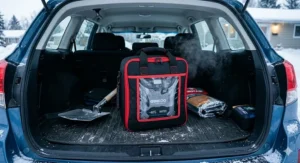
The Clamp Quality Problem No One Talks About: Copper vs. Aluminum
Buying a powerful jump starter and pairing it with poor-quality clamps is like buying a high-performance hose and attaching it with duct tape. The connection between the jump starter’s clamps and your battery terminals is where current transfer actually happens — and clamp quality has a direct impact on how reliably that current gets through, especially in Canadian winter conditions.
Copper vs. aluminum in jump starter clamps: Premium jump starters use solid copper jaw clamps for good reason. Copper has roughly 1.7 times the electrical conductivity of aluminum, and more importantly for Canadians, copper maintains flexibility and doesn’t become brittle in extreme cold. Aluminum clamps — or copper-clad aluminum clamps (often labelled misleadingly as “copper”) — can stiffen, crack, and lose their spring tension at sub-zero temperatures, resulting in a poor or intermittent connection at exactly the moment you need reliability most.
What to look for in practice: check whether the clamp jaws have serrated or knurled teeth (better grip on corroded or cold battery terminals), whether the cable jacket is rated for flexibility at sub-zero temperatures, and whether the clamps maintain firm spring tension when you pull them from a cold bag. The NOCO GBX-series clamps are consistently praised for their build quality and cold-temperature performance. Budget units often use copper-clad aluminum with thinner gauge wire — functional in mild conditions but progressively less reliable as the temperature drops.
A practical tip for Canadian winters: Even with premium copper clamps, battery terminal corrosion is your enemy. Before connecting any jump starter in winter, wipe the terminals with a dry cloth or brush them clear of frost and white corrosion buildup. A poor metal-to-metal connection at a corroded terminal can reduce effective current transfer by 20–30%, turning a marginal start into a failed one.
Real-World Scenarios: Which Jump Starter for Which Canadian Driver?
Scenario 1 — The Edmonton Commuter, Ford F-150 3.5L EcoBoost Kris in south Edmonton parks outside overnight. Temperatures regularly hit -28°C to -35°C between December and February. She needs something that lives in her truck all winter without being brought inside. Best pick: GOOLOO GT4000. The pre-heat function compensates for the unit spending nights at -30°C in the cab, and 4,000A gives her comfortable headroom for her 3.5L twin-turbo.
Scenario 2 — The Toronto Condo Owner, Honda Civic Priya parks underground in a heated garage. Her real cold-weather concern is the occasional trip to visit family in Barrie in January, where -15°C to -20°C is typical. She wants something small and foolproof. Best pick: NOCO Boost X GBX55. Compact enough for her bag or glovebox, UltraSafe means she can use it without anxiety, and -20°C covers her realistic temperature exposure.
Scenario 3 — The Saskatchewan Farmer, Ram 3500 Cummins Diesel Dave near Swift Current needs to start an 6.7L Cummins diesel during harvest equipment maintenance in November and the occasional -40°C January morning in the yard. Best pick: GOOLOO GT4000 as primary, with a lead-acid booster pack as backup. The GT4000’s 4,000A pre-heat covers most scenarios; the lead-acid backup handles absolute worst-case cold starts. Budget: $100–$150 CAD for the lithium unit, plus $150–$250 CAD for the booster pack.
Scenario 4 — The Vancouver Island Retiree, Subaru Outback Margaret on Nanaimo sees maybe 3–5 days below -5°C per winter. She wants something reliable and simple that charges quickly and lives in her emergency kit. Best pick: AstroAI B8. The 10 safety protections mean minimal risk of misuse, and Vancouver Island’s mild climate means the -20°C rating is more than adequate. Saves $100+ CAD versus premium options she doesn’t need.
How to Choose the Right Portable Jump Starter for Canada: 7 Expert Criteria
- Cold-temperature rating — match it to your province. A -20°C rated unit is fine for Ontario, BC, and Quebec. Manitoba, Saskatchewan, Alberta, and northern communities demand -40°C pre-heat technology. Don’t let a salesperson talk you into a “cold rated” unit without checking whether it has active pre-heat at that temperature — or just a storage spec.
- Peak amps — buy for your engine, not the marketing headline. A 2,000A unit is more than adequate for a 2.0L four-cylinder, but a marginal choice for a 6.7L diesel pickup. Match the amp rating to your engine displacement, with at least 20–30% surplus headroom for cold-weather performance degradation.
- Pre-heat technology. If you’re in a region that sees -30°C or colder, this is non-negotiable. GOOLOO and HULKMAN are the two brands in the current Amazon.ca lineup with verified auto pre-heat functionality. Check for it explicitly — don’t assume a high amp rating substitutes for it.
- Clamp quality. Copper jaws, rated for cold flexibility, with firm spring tension. If the listing doesn’t specify, assume copper-clad aluminum. For extreme Canadian winters, upgrade to units with clearly specified copper clamp construction.
- Charge retention. In Canada, a jump starter that needs recharging every 2–3 months is one you’ll probably forget to top up. Look for units claiming 12–24 months charge retention (the GOOLOO GT4000S, AVAPOW A58, and NOCO GBX series all perform well here).
- Recharge speed. If your unit is ever depleted, how quickly can you get it back to jump-ready? USB-C 60W–100W charging gets most units to minimum operational capacity in 5–10 minutes of charging — a critical spec for an emergency situation.
- Amazon.ca availability and warranty. Cross-border warranty service is a headache. Confirm you’re purchasing from Amazon.ca directly or from a Canadian marketplace seller. The WOLFBOX MV24’s lifetime warranty stands out, and NOCO’s warranty service through Canadian retailers is well established.
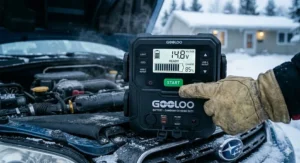
Common Mistakes Canadian Buyers Make When Choosing a Jump Starter
Buying for specs alone, ignoring the pre-heat question. This is the most expensive mistake. A 6,000A unit without pre-heat will underperform a 4,000A pre-heat unit at -40°C every single time. At genuine extreme Canadian cold, effective cranking amps matter more than peak amp marketing numbers.
Storing the unit in the car all winter without checking it. Lithium jump starters lose a small amount of charge over time, and cold accelerates self-discharge slightly. If you stored your unit last March and haven’t checked it, there’s a real chance it’s at 40–60% charge by January — which may not be enough for a dead battery on a cold morning. Set a calendar reminder to check and top up your unit every October 1st.
Assuming Canadian pricing equals American pricing. Jump starters on Amazon.ca often run 15–25% higher than equivalent Amazon.com listings, reflecting import duties, exchange rate, and distribution costs. This is normal and expected — and you avoid cross-border shipping fees, customs delays, and US-only warranty terms. Budget accordingly in CAD, not USD.
Ignoring bilingual label requirements. Canada’s bilingual product labelling laws mean that many US-only jump starter brands have slightly different model numbers or product versions on Amazon.ca versus Amazon.com. This isn’t just a regulatory footnote — it means warranty terms, included accessories, and even safety certifications can differ. Always purchase from Amazon.ca listings, not US listings shipped to Canada.
Underestimating how cold -40°C actually is on a battery. As CBC News reported from Thunder Bay automotive professionals, at -30°C to -40°C, your car battery is already working at approximately 50% of its rated CCA. Your jump starter needs to compensate for both the cold car battery and its own cold-related performance degradation. This is why buying with margin matters — always buy more amps than you think you need.
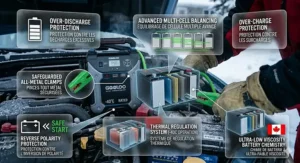
Frequently Asked Questions
❓ Can a lithium jump starter work at -40°C in Canada?
❓ Why won't my jump starter charge after sitting in a cold Canadian car overnight?
❓ Is there free shipping for jump starters on Amazon.ca?
❓ Are lithium jump starters better than lead-acid booster packs for Canadian winters?
❓ Do portable jump starters need CSA certification to be safe in Canada?
Conclusion: Don’t Let a Canadian Winter Catch You Unprepared
The bottom line for Canadian buyers in 2026 is straightforward: not all portable jump starters are equal, and the difference matters most precisely when conditions are worst. A -40°C rating is meaningful only if it’s backed by active pre-heat technology — and most units on Amazon.ca don’t have it.
For genuine extreme cold anywhere in the Prairies, northern Ontario, or the territories: the GOOLOO GT4000 is the best value, and the HULKMAN Alpha85S is the best smart-feature alternative. For southern Ontario, BC, Quebec, and the Maritimes where -20°C is a more realistic worst-case: the NOCO Boost X GBX55 offers premium compact reliability, and the AVAPOW A68 delivers the best raw power per CAD dollar. The WOLFBOX MV24 is the long-term investment pick for anyone who wants to buy once and buy well.
Whatever you choose, remember the practical Canadian truth: a battery booster pack is among the most essential pieces of winter emergency kit, alongside a block heater and jumper cables. CAA Manitoba sees battery calls triple during deep-freeze events — and the drivers who handle those mornings without stress are the ones who already have their unit charged, warm, and ready.
Check current prices and availability on Amazon.ca. Prices fluctuate regularly, but the specs and performance rankings in this guide reflect our best assessment as of June 2026.
✨ Don’t Miss These Exclusive Deals!
🔍 Ready to winter-proof your vehicle? Click on any highlighted product above to check current pricing and availability on Amazon.ca. Your future self — standing in a parking lot at -35°C — will thank you.
Recommended for You
- 7 Best Jump Starters for Canadian Winter 2026 – Survive the Cold
- Best Pressure Washer Antifreeze Solution in Canada 2026 (Top 7)
- Best Heated Pressure Washer for Winter Car Wash in Canada 2026
Disclaimer: This article contains affiliate links. As an Amazon Associate, I earn from qualifying purchases. If you purchase products through these links, we may earn a small commission at no additional cost to you.
✨ Found this helpful? Share it with your friends! 💬🤗
