
In This Article
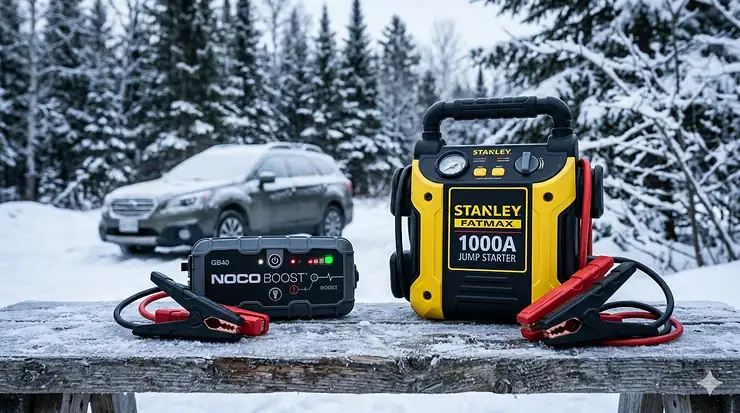
Picture this: it’s a Tuesday morning in Winnipeg, the thermometer reads −32°C (−26°F), and your car won’t start. You’ve got a 7 a.m. meeting that absolutely cannot wait. You reach for that portable jump starter you bought two summers ago — and nothing happens. Silence. That cold plastic brick just sits there, as useless as flip-flops in a blizzard.
This is the exact scenario that makes the NOCO vs Stanley jump starter cold weather debate so important for Canadian drivers. It’s not an academic exercise. Every winter, from Victoria to St. John’s, Canadians face battery failures at the worst possible moments, and the wrong jump starter leaves you just as stranded as no jump starter at all.
So what’s the real difference? In short, NOCO relies on cutting-edge lithium-ion technology — compact, lightweight, and ferociously powerful for their size — while Stanley’s popular lineup has historically used sealed lead-acid (SLA) batteries: heavier, bulkier, but with a fundamentally different relationship to cold temperatures. Both have genuine strengths. Neither is universally “better.” The right choice depends entirely on your vehicle, your climate, and how your jump starter will be stored.
Cold weather can reduce battery efficiency by up to 50%, meaning a jump starter that performs flawlessly at 21°C (70°F) might fail completely at −18°C (0°F). For a Canadian driving in Saskatoon or Thunder Bay, that’s not a footnote — that’s the whole ballgame.
In this guide, I’ve researched 7 real jump starters available on Amazon.ca, compared them across cold-weather performance, safety features, warranty, and total value in CAD, and matched each one to specific Canadian buyer profiles. Whether you drive a Honda Civic, a Ram 1500 diesel, or a family minivan, there’s a right answer here for you.
Quick Comparison: NOCO vs Stanley Jump Starter Cold Weather (Top 7)
| Product | Type | Peak Amps | Cold Weather Rating | Weight | Best For |
|---|---|---|---|---|---|
| NOCO Boost Plus GB40 | Lithium | 1,000A | −18°C (0°F) | 0.9 kg (2 lbs) | Everyday cars, compacts |
| NOCO Boost HD GB70 | Lithium | 2,000A | −18°C (0°F) | 1.4 kg (3 lbs) | SUVs, light trucks |
| NOCO Boost X GBX45 | Lithium | 1,250A | −18°C (0°F) | 1.1 kg (2.4 lbs) | Mid-size gas & diesel |
| Stanley J5C09 JUMPiT | SLA | 1,000A (peak) | Wide temp range | 4.3 kg (9.5 lbs) | Budget users, trucks |
| Stanley FATMAX J7CS | SLA | 700A | Wide temp range | 5.4 kg (12 lbs) | Multi-purpose/compressor |
| Hulkman Alpha85S | Lithium | 2,000A | −40°C (−40°F) | 1.2 kg (2.6 lbs) | Extreme cold, northern Canada |
| GOOLOO GT4000S | Lithium | 4,000A | −40°C (−40°F) | 1.0 kg (2.2 lbs) | Budget diesel, trucks |
Reading the table: What jumps out immediately is the cold-weather divide. The Hulkman and GOOLOO units with pre-heat technology operate down to −40°C — critical for drivers in northern Ontario, Saskatchewan, or the Yukon. NOCO’s lithium line is excellent for most of Canada but starts showing limitations in extreme sub-zero conditions. The Stanley SLA units don’t specify a minimum operating temperature the same way, because lead-acid chemistry inherently holds up better in the cold than standard lithium — though you pay for that in weight and bulk.
💬 Just one click — help others make better buying decisions too! 😊
✨ Don’t Miss These Exclusive Deals on Amazon.ca!
🔍 Take your winter preparedness to the next level with these carefully selected jump starters. Click any highlighted product to check current pricing and availability on Amazon.ca. These tools could be the difference between a minor inconvenience and a full-blown emergency this Canadian winter!
Top 7 Jump Starters for Canadian Winters: Expert Analysis
1. NOCO Boost Plus GB40 — The Everyday Canadian Driver’s Best Friend
The GB40 is arguably the jump starter that changed how Canadian drivers think about emergency car power: it’s smaller than most wallets, yet punches hard enough to start a 6.0L gas or 3.0L diesel engine.
Specs that matter in practice: 1,000A peak current sounds impressive on paper, but what does it mean in a Canadian winter? In lab testing, the GB40 started a mid-size 4.0L V6 gas engine with a completely drained battery three times in rapid succession in chilly 3°C (33°F) weather, needing only around 301 amps to do the job. That’s real-world reassurance. The unit weighs just 0.9 kg (2 lbs) and its IP65 waterproof rating means it won’t panic if you’re fumbling with jumper cables in a snowstorm in Ottawa.
Expert take: The GB40 is ideal for the majority of Canadian car owners — anyone driving a standard sedan, hatchback, compact SUV, or 4-cylinder truck in southern or central Canada. What most buyers overlook is the UltraSafe technology: it prevents sparks, overcharging, and reverse polarity connections. If you’re not mechanically inclined, this self-protection layer is worth its weight in gold at 2 a.m. in a dark parking lot. Available on Amazon.ca and Prime-eligible in most provinces.
Canadian customer feedback: Canadian reviewers consistently praise the GB40 for reliability and the quality of the included carry case, which matters when you’re digging through a trunk in February.
✅ Compact enough for a glove box
✅ UltraSafe reverse polarity and spark protection
✅ IP65 waterproof — handles Canadian sleet and snow
❌ Limited to −18°C (0°F) minimum — not ideal for extreme northern Canadian winters
❌ Not recommended for larger engines requiring sustained current during longer cranking times
Price range: Around $100–$130 CAD — an excellent value for the protection and portability you get.
2. NOCO Boost HD GB70 — For Trucks, SUVs, and Serious Canadian Roads
If the GB40 is the sensible daily driver, the GB70 is the one you want when you’re towing a trailer in Muskoka or running a 5.7L Hemi in Saskatchewan.
Specs that matter: 2,000A peak current and compatibility with engines up to 8.0L gas or 6.0L diesel. That covers the vast majority of Canadian trucks, RVs, and SUVs on the road today. It still weighs only 1.4 kg (3 lbs), which is remarkable given its output — about the heft of a large coffee thermos. The NOCO Boost HD GB70 delivers professional-grade power with rugged construction and reliable performance for heavy-duty jobs and large engines.
Expert take: This is the jump starter I’d recommend to any Canadian who drives a full-size pickup, a diesel SUV, or anything that sees serious winter plowing or hauling duty. The cold-weather limitation (−18°C minimum for reliable starts) is a real consideration for northern drivers — but for the majority of Canadians, including those in Ontario, Quebec, BC, and Alberta urban centres, the GB70 covers virtually every scenario. Real-world users confirm it can jump a Jeep from stone dead with a bad battery, multiple times on one charge.
Canadian customer feedback: Truck owners in particular rave about the build quality and the fact it holds a charge for months between uses — critical for the “set it and forget it” crowd who store it in a centre console.
✅ 2,000A covers virtually all Canadian passenger vehicles and light trucks
✅ Rugged construction, IP65 waterproof
✅ Charges phones and devices via USB
❌ Premium pricing — in the $180–$220 CAD range
❌ Same −18°C cold floor as other NOCO units
3. NOCO Boost X GBX45 — The Modern Upgrade Every Canadian Should Consider
NOCO quietly refreshed its lineup with the Boost X series, and the GBX45 is the upgrade the GB40 deserved. Same compact form factor, sharper specs, better charging.
Specs that matter: 1,250A peak current handles 6.5L gas and 4.0L diesel engines — that’s broader coverage than the GB40 in the same approximate size class. More importantly, the GBX45 and the wider Boost X series bring 60W USB-C fast charging and UltraSafe 2.0 technology, replacing the aging micro-USB charging of the original GB40/GB70 generation. For Canadian drivers who also need to emergency-charge a laptop or modern USB-C device, this matters.
Expert take: If you’re buying NOCO new in 2026, the GBX45 is often the smarter choice over the GB40 — the modern charging port alone justifies the slight price premium. The GBX45 can fully charge in 48 minutes or deliver a jump start in just 5 minutes. For a Canadian stranded on a highway in January, that five-minute charge-before-jump capability is a genuine lifesaver.
Canadian customer feedback: Buyers upgrading from older NOCO models highlight the faster USB-C charging as a game-changer, and the colour-coded rubberized clamps get consistent praise for cold-glove-friendly use.
✅ USB-C 60W fast charging — charges modern phones and laptops
✅ 5-minute quick charge before jumping
✅ UltraSafe 2.0 — improved protection over original series
❌ Slightly higher price than the GB40 in the $130–$160 CAD range
❌ Same −18°C cold floor limitation
4. Stanley J5C09 JUMPiT — The Old Reliable for Cold Canadian Nights
The Stanley J5C09 represents a different philosophy entirely: sealed lead-acid (SLA) battery technology that’s been trusted for decades, including by Canadian mechanics and fleet managers who’ve seen lithium jump starters choke in −35°C prairie winters.
Specs that matter: 1,000 peak amps and 500 instant amps. That “instant amps” number is arguably more honest than the peak amp marketing figures thrown around by lithium brands, because SLA jump starters work in a greater temperature range that’s ideal for colder temperatures. The Stanley also includes a built-in 120 PSI air compressor — something no NOCO unit offers — making it genuinely multi-purpose for Canadian drivers who also deal with tire pressure drops in winter cold.
Expert take: The Stanley J5C09 and similar SLA models deliver constant, sustained cranking current without voltage drops — which is exactly what you need when trying to start a vehicle that’s been sitting at −25°C all night. The tradeoff is bulk: this thing weighs 4.3 kg (9.5 lbs) and won’t fit in a glove box. But if you keep it in your trunk and prioritize raw cold-weather dependability over portability, it earns its place. Available on Amazon.ca, though shipping to remote northern areas may involve extended lead times.
Canadian customer feedback: Rural Canadians and those in smaller towns where waiting for roadside assistance could mean a very long, very cold wait particularly appreciate the dual compressor-and-jump capability.
✅ SLA chemistry handles extreme cold more reliably than standard lithium
✅ Built-in 120 PSI air compressor — addresses winter flat tyres
✅ Budget-friendly in the $80–$110 CAD range
❌ Heavy at 4.3 kg (9.5 lbs) — not glove-box friendly
❌ No reverse polarity protection on all models — read the manual
5. Stanley FATMAX J7CS — The Multi-Tool Survivor Kit
The FATMAX J7CS takes the Stanley approach and amplifies it with a more complete power station setup designed for Canadian emergencies that go beyond just jump-starting.
Specs that matter: 700 peak amps, 120 PSI air compressor, 3.1A USB ports, and enough power bank capacity to charge multiple devices. This is the unit you want in your vehicle if a winter storm might strand you for hours rather than minutes. The lower peak amp rating (700A vs 1,000A) means it’s better suited to smaller to mid-size vehicles — a Honda CR-V, Toyota RAV4, or Ford Escape rather than a full-size Ram or F-150.
Expert take: What most buyers overlook about the FATMAX J7CS is the psychological value of having one device that addresses multiple winter emergencies. Stanley’s jump starters pack the power you need and provide USB power ports for when the lights go out due to a weather emergency — and Canadian ice storms do knock out power for days. Keeping this in your car means you can inflate a tyre, jump the battery, and keep your phone charged all with one device that fits in a cargo area.
Canadian customer feedback: Families and parents with young children particularly appreciate the all-in-one nature. Nobody wants to dig through three separate bags in a January blizzard.
✅ Air compressor, USB, and jump-start in one unit
✅ Good for emergency power during outages
✅ SLA chemistry for cold-weather reliability
❌ 700A peak is light for larger Canadian trucks and SUVs
❌ One of the heavier options at 5.4 kg (12 lbs)
6. Hulkman Alpha85S — The Best Jump Starter for Extreme Canadian Cold
If you live in Yellowknife, northern Manitoba, or anywhere that regularly sees −30°C to −40°C winters, this is the unit the comparison ultimately points to — and it’s not close.
Specs that matter: 2,000A peak current is already impressive. But the real differentiator is Hulkman’s Pre-Heat Technology, which automatically detects extreme cold and warms the internal battery to an optimal operating temperature before use. The Hulkman Alpha85S distinguishes itself with exceptional cold-weather performance, featuring Pre-Heat Technology that operates in extreme temperatures down to −40°C — a major advantage for northern climates. That’s the same minimum temperature as many parts of the Canadian north regularly reach.
Expert take: The Hulkman Alpha85S displays an exact battery level and a “ready” indicator letting you know when it’s time to start the car — that diagnostic clarity matters enormously when you’re stressed at −38°C at 6 a.m. For Midwest or Canadian winters, the Hulkman Alpha85S is the step-up choice over standard lithium units. The IP65 waterproof rating and ultra-compact 1.2 kg (2.6 lb) design round out what is genuinely the most capable cold-weather lithium jump starter widely available on Amazon.ca.
Canadian customer feedback: Northern Canadian drivers who’ve tried and been burned by standard lithium jump starters in deep cold frequently describe the Alpha85S as “the one that actually works.”
✅ Pre-Heat Technology down to −40°C — best cold weather of any lithium unit
✅ 2,000A peak — handles most Canadian trucks and diesel SUVs
✅ Detailed diagnostic display — no guesswork
❌ Higher price point in the $200–$260 CAD range
❌ More complex interface than simpler NOCO models
7. GOOLOO GT4000S — Maximum Power at a Budget-Friendly Canadian Price
The GOOLOO GT4000S is the wildcard in this comparison — a brand without NOCO’s prestige, but with specs that embarrass units costing twice as much, plus the all-important Pre-Heat Technology for Canadian winters.
Specs that matter: The GOOLOO GT4000S is equipped with Pre-Heat −40°C Start Technology, which can start dead car batteries in just 3 minutes in freezing weather. Paired with 4,000A peak amps (the highest of any unit in this list) and a 26,800mAh battery that doubles as a power bank, this punches significantly above its CAD price tag. Available on Amazon.ca and Prime-eligible.
Expert take: At roughly $100 USD, the GOOLOO GT4000S costs half what the NOCO GB70 does while offering more peak power, and for diesel owners who want “it starts my truck” without overthinking the purchase, the GT4000S delivers. In CAD, that translates to excellent value in the $130–$160 range. Yes, those 4,000A peak amp claims are aggressive and real-world sustained output is lower — but in actual cold-weather use on Canadian trucks and SUVs, it consistently gets the job done. The 26,800mAh power bank capacity also makes it a legitimate winter emergency tool for extended roadside waits.
Canadian customer feedback: Diesel truck owners on the Prairies consistently cite this as the best bang-for-buck jump starter they’ve owned.
✅ Pre-Heat Technology to −40°C — matches Hulkman at lower price
✅ 4,000A peak — covers large diesel engines
✅ 26,800mAh power bank included
❌ Peak amp marketing numbers are inflated vs real-world cranking amps
❌ Newer brand — less established warranty service in Canada vs NOCO
How Canadian Winters Actually Kill Jump Starters (And What to Do About It)
The Chemistry Behind Cold-Weather Jump Starter Failure
Here’s something the spec sheets won’t tell you but every Canadian should understand: all batteries — in your car, your jump starter, and your phone — work through electrochemical reactions. Cold temperatures slow those reactions down dramatically. Lithium batteries rely on chemical reactions to work, and the cold can slow down the reactions significantly, causing a dramatic power efficiency decrease in freezing weather.
This is why the NOCO vs Stanley jump starter cold weather debate isn’t just marketing — it reflects a genuine physical tradeoff. One advantage lead-acid batteries were thought to have was their performance in cold weather, though that gap has slowly been surpassed by lithium — especially with the addition of technology to protect batteries from outside cold or preheat them before use.
The practical takeaway for Canadian drivers:
- Southern Canada (Toronto, Vancouver, Montreal): Standard lithium jump starters like the NOCO GB40 or GBX45 handle typical winters just fine. You’ll rarely see sustained temperatures below −20°C.
- Central Canada (Calgary, Winnipeg, Saskatoon): Step up to the GB70 or seriously consider a pre-heat unit. Prairie winters regularly hit −30°C to −35°C and the cold floor of standard lithium units becomes a real risk.
- Northern Canada (Yellowknife, Whitehorse, Churchill): Pre-heat technology isn’t optional. The Hulkman Alpha85S or GOOLOO GT4000S are the only lithium options rated to −40°C. Alternatively, an SLA-based Stanley unit provides inherently broader cold tolerance without the pre-heat premium.
Storage Is Half the Battle
Extreme temperatures (both hot and cold) accelerate charge loss. Store your jump starter in moderate temperatures and recharge every 3–6 months to ensure it’s ready when needed.
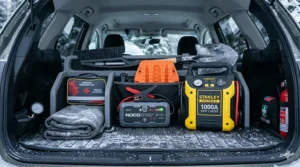
What this means for Canadians specifically: don’t store your lithium jump starter in your trunk all winter. A trunk in Winnipeg in January regularly reaches −30°C to −40°C overnight. Bring your jump starter inside, charge it to 50–80% capacity, and store it at room temperature. Check the charge monthly through winter. This single habit separates Canadian drivers who find their jump starter works when they need it from those who don’t.
For SLA-based Stanley units, the storage guidance is stricter in one direction: they self-discharge faster and need topping up every 4–6 weeks during cold storage.
Real Canadian Driver Profiles: Which Jump Starter Is Right for You?
Profile 1: Toronto Condo Dweller with a Honda Civic
Maria parks in an underground garage in downtown Toronto. Her commute is 10 km each way. She wants something small enough for the glove box and doesn’t need to start anything bigger than a 2.0L engine.
Best match: NOCO Boost Plus GB40 or GBX45 — the garage environment keeps temperatures relatively moderate, the compact size is perfect, and Toronto winters rarely push below −20°C. The GBX45’s USB-C charging means it doubles as a power bank for her phone. She can keep it charged with a quick top-up once a month, and the UltraSafe technology means she never has to worry about accidentally connecting it backwards.
Profile 2: Calgary Tradesperson with a Ford F-250 Diesel
Derek drives a 6.7L diesel to job sites across southern Alberta, where January temperatures regularly hit −25°C to −35°C. He needs something that can start his truck even if he accidentally leaves a light on overnight at a remote site.
Best match: Hulkman Alpha85S or GOOLOO GT4000S — the pre-heat technology is essential at Calgary temperatures. The GOOLOO’s 4,000A peak gives extra margin for a diesel in the cold, and its lower price (in the $130–$160 CAD range) leaves room in the budget for a spare. Derek should bring his jump starter inside each evening rather than leaving it in the truck, and charge it to 70% at the start of winter.
Profile 3: Retired Couple in Rural New Brunswick
Gerald and Pauline drive a 2019 Toyota RAV4 and a small cargo van. They live 40 km from the nearest town. If they break down on a rural highway in February, waiting for CAA could mean a very long, cold wait.
Best match: Stanley J5C09 or Stanley FATMAX J7CS — SLA reliability in cold weather, the built-in air compressor addresses the flat-tyre risk on gravel roads, and the USB power bank keeps their phones alive while they wait. Yes, it’s heavier — but for a vehicle where the trunk is already carrying gear, the extra 4 kg is irrelevant compared to the multi-function value.
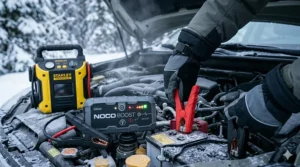
How to Choose a Jump Starter for Canadian Conditions: 6 Key Criteria
Navigating the NOCO vs Stanley jump starter cold weather debate is easier when you have a clear framework. Here’s how I’d approach the decision as a Canadian buyer:
1. Know your minimum operating temperature. Check the coldest temperatures your area reliably reaches, not just average winters. Then cross-reference the jump starter’s rated minimum operating temperature. For most of Canada south of 55°N latitude, standard lithium units are adequate. Further north, pre-heat technology is essential.
2. Match peak amps to your engine size. A general rule: your jump starter’s peak amps should exceed your engine’s Cold Cranking Amp (CCA) rating. Cold weather reduces cranking performance by 20–30%, so northern climates need higher ratings. When in doubt, size up.
3. Consider storage realities. If your jump starter will live in your trunk year-round (a common Canadian habit), an SLA unit like the Stanley handles cold storage more gracefully than standard lithium — which should ideally be stored indoors. Pre-heat lithium units are more tolerant but still benefit from indoor storage.
4. Evaluate safety features. Reverse polarity protection (audible alarm when clamps are connected wrong) and spark-proof technology are non-negotiable. A 2023 AAA study found that 23% of jump-starter failures resulted from lacking these safeguards. Both NOCO and the Hulkman units include these; check carefully with budget Stanley and third-party units.
5. Check UL or ETL certification. Look for UL2743 certification (the standard for lithium jump starters) or ETL certification on SLA units. UL2743 is the lithium jump starter safety regulation that governs safe construction. Uncertified units on Amazon.ca exist and should be avoided — particularly with lithium, where a poorly built battery in a cold car could create serious safety issues.
6. Factor in total Canadian cost. Canadian pricing on Amazon.ca is typically 10–20% higher than equivalent USD pricing on Amazon.com, reflecting exchange rates and import logistics. Transport Canada and CAA underline that preparation is crucial — consider the jump starter an insurance purchase, not a luxury item, and buy quality once rather than budget brands twice.
Common Mistakes Canadian Buyers Make with Jump Starters
Mistake 1: Storing the jump starter in the trunk all winter without charging it. Lithium batteries self-discharge. A NOCO GB40 stored at −25°C in a car trunk since October could be completely dead by January. The fix: bring it inside, top it up monthly, check it before every long winter trip.
Mistake 2: Buying based on peak amps alone. Peak amps measure momentary burst power, not sustained cranking ability — a 4,000A unit might only deliver that power for a fraction of a second. Look for the cranking amps or CCA rating for a more honest picture of real-world cold-weather performance.
Mistake 3: Ignoring the minimum operating temperature. Canadians who live in BC or Ontario often buy the same jump starter as those in Saskatchewan and Nunavut. The temperature floor matters. A unit rated to −18°C (0°F) is inadequate for a Saskatoon January that regularly hits −35°C.
Mistake 4: Buying an uncertified lithium unit to save money. Budget lithium jump starters without UL2743 or ETL certification skip safety mechanisms that prevent overheating and reverse polarity damage. The savings aren’t worth it.
Mistake 5: Assuming the Stanley “always works in the cold.” While SLA chemistry is more cold-tolerant than standard lithium, Stanley SLA units still lose capacity in extreme cold — they’re just more graceful about it. A Stanley J5C09 at −40°C will perform better than an uncertified lithium unit, but its effective output still decreases.
Mistake 6: Forgetting to check Amazon.ca availability vs Amazon.com. Some jump starters advertised heavily on American sites don’t ship to Canada or carry significantly higher CAD prices with unclear warranty coverage. Always verify availability on Amazon.ca and confirm the warranty is honoured by Canadian service centres before purchasing.
NOCO vs Stanley: A Side-by-Side Verdict for Canadian Drivers
| Criteria | NOCO (Lithium) | Stanley (SLA) |
|---|---|---|
| Cold Weather (standard) | Down to −18°C | Broader range, no hard floor |
| Cold Weather (pre-heat models) | N/A (GBX series) | N/A |
| Weight | 0.9–1.4 kg | 4.3–5.4 kg |
| Portability | Glove box | Trunk only |
| Air Compressor | No | Yes (J7CS, J5C09) |
| Safety Features | UltraSafe (spark-proof, reverse polarity) | Varies by model |
| Price Range (CAD) | $100–$220+ | $80–$130 |
| Best For | Urban/suburban Canada | Rural Canada, truck owners |
Analysis: This table reveals a core truth about the NOCO vs Stanley jump starter cold weather choice: they’re solving slightly different Canadian problems. NOCO wins on portability, modern safety tech, and convenience for everyday urban drivers. Stanley wins on cold-chemistry reliability, multi-function value (compressor), and cost for rural or fleet buyers. If you’re in between — a suburban driver in Winnipeg with a mid-size truck — the Hulkman Alpha85S or GOOLOO GT4000S with pre-heat technology now offers the best of both worlds in a lithium form factor.
✨ Check Current Prices on Amazon.ca
🔍 These jump starters can make the difference between a minor inconvenience and a serious safety situation on Canadian roads this winter. Click any highlighted product to see current pricing and availability. Amazon.ca Prime members enjoy free shipping on most orders!
Jump Starter Features That Actually Matter (And the Marketing Hype to Ignore)
Features That Genuinely Matter in Canada:
Pre-Heat Technology — As discussed, this is the game-changer for any Canadian north of a line roughly through Calgary and Sudbury. Without it, lithium jump starters are unreliable below −20°C.
IP65 or higher waterproofing — You will use this in the rain, sleet, and snow. A jump starter that can’t handle precipitation is a liability in Canada.
Reverse polarity protection with audible alarm — When it’s −28°C and your fingers are numb inside your gloves, you will get the clamps wrong. A loud beep before you damage your car’s electronics is invaluable.
Sustained cranking amps (not just peak amps) — Prioritize models that publish their cranking amp rating, not just peak. Heavy-duty models like the DeWalt DXAES14 maintain a cranking-to-peak ratio of at least 25%, while budget options often don’t.
Charge retention — NOCO units are known for excellent charge retention, with some users reporting the GB70 holding charge for almost 2 years. Budget models typically need recharging every 3–6 months. For a “set it and forget it” Canadian driver, this matters enormously.
Features That Are Mostly Marketing:
Extremely high peak amp numbers on budget units — A 6,000A claim on a $60 CAD unit is almost certainly misleading. Real sustained power is a fraction of the advertised peak. Stick to established brands with transparent specifications.
“Shock-proof” and “military-grade” claims — These are unregulated marketing terms. IP65 waterproofing is a real, testable standard. “Military grade” is not.
Dozens of jump starts per charge — Claims of 30 or 40 jump starts per charge assume a vehicle with a mildly discharged battery in perfect temperature conditions. In a Canadian winter, expect half those numbers from any unit.
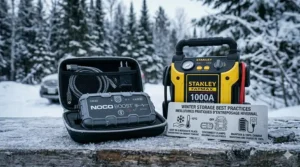
FAQ
❓ Can I use a lithium jump starter in a Canadian winter at −30°C?
❓ Is the NOCO GB40 available on Amazon.ca and eligible for Prime shipping?
❓ What's the difference between peak amps and cranking amps on a jump starter?
❓ Do Stanley SLA jump starters need to be charged differently in winter?
❓ What safety certifications should I look for when buying a jump starter in Canada?
Conclusion: The Right Jump Starter for Your Canadian Winter
The NOCO vs Stanley jump starter cold weather debate doesn’t have a single winner — it has the right answer for your specific situation. After researching all seven units and mapping them to real Canadian conditions, here’s the bottom line:
If you’re an everyday driver in southern or central Canada, the NOCO GBX45 is the sweet spot: modern USB-C charging, solid cold-weather performance down to −18°C, and UltraSafe technology in a package smaller than a paperback book. For truck owners and those in colder regions, the Hulkman Alpha85S is the one unit that truly delivers on −40°C performance — it’s worth every dollar of its higher CAD price tag. And if you’re a rural Canadian driver who wants multi-function reliability and doesn’t mind the extra weight, the Stanley J5C09 remains a trustworthy, budget-friendly choice grounded in decades of Canadian roadside experience.
Jump-starting a car is an essential survival skill for Canadian drivers, especially given the country’s extreme winter conditions — preparation is crucial. Don’t wait until your battery dies at −30°C to think about this purchase. A quality jump starter stored properly (indoors, charged to 70%, topped up monthly) is one of the highest-value emergency tools any Canadian driver can own.
✨ Ready to Winterize Your Vehicle?
🔍 Check current pricing and availability for any of the 7 jump starters reviewed above on Amazon.ca. Whether you want the compact genius of NOCO, the cold-weather mastery of Hulkman, or the proven reliability of Stanley, there’s an option for every Canadian driver and budget. Prime members get free shipping — an easy decision before the snow falls!
Recommended for You
- 7 Best Portable Jump Starter -40C Rated for Canada 2026
- 7 Best Jump Starters for Canadian Winter 2026 – Survive the Cold
- Best Pressure Washer Antifreeze Solution in Canada 2026 (Top 7)
Disclaimer: This article contains affiliate links. As an Amazon Associate, I earn from qualifying purchases. If you purchase products through these links, we may earn a small commission at no additional cost to you.
✨ Found this helpful? Share it with your friends! 💬🤗
