
In This Article
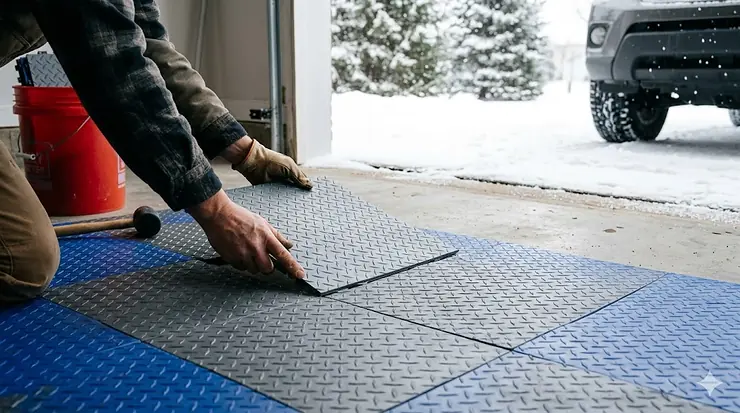
Garage floor tiles for cold climates are interlocking floor coverings — usually polypropylene, PVC, or recycled rubber — engineered to resist cracking, warping, and salt damage through repeated Canadian freeze-thaw cycles, while channelling away the slush your vehicle drags in every January.
If you’ve ever pulled into your garage after a slushy commute and watched a puddle of grey, salty water creep toward your toolbox, you already know why this matters. Bare concrete in a Canadian garage takes a beating: de-icing chloride soaks into the pores, freezes overnight, and slowly spalls the surface. A good interlocking tile sits above all that, channels the mess away, and still snaps together fine when your hands are too cold to feel your fingers. The trick is that not every tile on Amazon.ca is built for this. Some rigid plastics that work beautifully in Phoenix get brittle and crack in a Winnipeg cold snap. This guide walks through seven real, Amazon.ca-available options, how they actually behave once the mercury drops, and how to avoid the costly mistake of choosing on looks alone.
As an Amazon Associate, I earn from qualifying purchases — more on that below. All prices are in CAD and shown as ranges, since Amazon.ca pricing shifts often; check the listing for the current figure.
Quick Comparison Table: Best Garage Floor Tiles for Cold Climates
| Tile | Material | Drainage | Best For | Price Range (CAD) |
|---|---|---|---|---|
| VEVOR Interlocking Garage Tiles | Polypropylene | Solid, non-vented | Budget DIY garages | $70–$200 |
| Swisstrax Ribtrax PRO | PP copolymer (vented) | Self-draining | Unheated detached garages, premium builds | $320–$420 |
| Big Floors RaceDeck Free-Flow | Copolymer (vented) | Self-draining | Wet, snowy, slush-heavy garages | $230–$300 |
| Big Floors GarageTrac Diamond | Copolymer | Solid | Mid-range everyday garages | $180–$240 |
| IncStores Diamond Nitro | Polypropylene | Solid | First-time tile buyers on a budget | $160–$210 |
| Norsk Duraflex PVC Tiles | Flexible PVC | Air-dry vented underside | Uneven slabs, basements doubling as garages | $65–$85 per 6-pack |
| Rubber-Cal Interlocking Rubber Tiles | Recycled rubber | Solid | Cold workshops, anti-fatigue standing | $180–$240 |
Looking at the table, the vented copolymer tiles from Swisstrax and RaceDeck cost more per square foot, but that premium buys self-draining channels that matter most in an unheated detached garage where snowmelt has nowhere to evaporate quickly. Budget polypropylene options from VEVOR and IncStores are perfectly serviceable for a heated attached garage where slush isn’t sitting around for hours, while the Norsk PVC and Rubber-Cal rubber options solve a different problem entirely — uneven concrete and cold-weather flexibility rather than drainage.
💬 Just one click — help others make better buying decisions too! 😊
✨ Don’t Miss These Exclusive Deals!
🔍 Take your garage floor to the next level with these carefully selected tiles. Click on any highlighted product to check current pricing and availability on Amazon.ca. These floors will help you build a space your whole family — and your car — will actually enjoy through every Canadian winter! 🇨🇦
Top 7 Garage Floor Tiles for Cold Climates: Expert Analysis
1. VEVOR Interlocking Garage Floor Tiles
VEVOR Interlocking Garage Floor Tiles are the entry point most Canadians start with, and there’s no shame in that. These 12-by-12-inch polypropylene tiles use a six-loop interlocking system and a double-sided diamond texture, sold in 25- or 50-tile packs.
What most buyers overlook about this tile is that it’s a solid, non-vented design — fine for a heated garage in Mississauga, less ideal for an unheated shop in rural Saskatchewan where melted snow has nowhere to go but pool on top until you sweep it. Canadian reviewers generally praise the price and the snap-together speed, though a few note the tiles can pop loose if you turn your wheels sharply while parking, which is more noticeable once the plastic stiffens in deep cold.
Pros:
✅ Lowest cost per square foot
✅ Fast tool-free install
✅ Wide colour selection
Cons:
❌ No drainage channels
❌ Can pop apart under sharp tire turns in cold weather
Best for: budget-conscious DIYers with a heated or semi-heated garage. Price runs around $70–$200 CAD depending on pack size — solid value if drainage isn’t your main worry.
2. Swisstrax Ribtrax PRO Interlocking Garage Floor Tiles
Swisstrax Ribtrax PRO Interlocking Garage Floor Tiles sit at the premium end, and the spec sheet earns it: Swisstrax rates these polypropylene copolymer tiles for a temperature range of roughly -30°C to 120°C, which covers essentially every Canadian winter on record, including the brutal January 2026 cold snap that pushed Kirkland Lake, Ontario down to -43.7°C — admittedly colder than the rated floor, but a useful reminder of how extreme our winters can get.
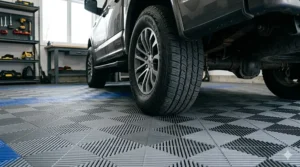
The 3/4-inch vented, two-tone design lifts the floor off the slab so slush drains through instead of sitting on top, which is the single biggest advantage for an unheated detached garage. In my experience, the trade-off is upfront cost — these run roughly $320–$420 CAD per 24-tile set covering about 41 square feet — but a lifetime residential warranty and the ability to mix 18-plus colours make it the floor people actually show off.
Pros:
✅ Documented cold-weather rating
✅ Self-draining vented design
✅ Lifetime residential warranty
Cons:
❌ Highest price per square foot
❌ Avoid pressure-washing per manufacturer instructions
Best for: unheated detached garages and anyone who wants a true freeze-thaw garage tile system for Canada with the engineering data to back it up.
3. Big Floors RaceDeck Free-Flow Garage Flooring Tiles
Big Floors RaceDeck Free-Flow Garage Flooring Tiles are built around an open-rib, self-draining surface that the manufacturer specifically markets toward wet, muddy, and snowy climates — exactly the brief for a Canadian winter. The copolymer tiles snap together in a 12-by-12-inch format and are rated to handle rolling loads well into the tens of thousands of pounds, so a loaded pickup or SUV isn’t a concern.
What stands out here is the multi-level understructure: it’s not just vented on top, it’s channelled underneath too, so meltwater actually has somewhere to go rather than just sitting under the tile until it refreezes. That second layer of drainage is what separates Free-Flow from cheaper “vented” tiles that only perforate the surface.
Pros:
✅ Genuine two-tier drainage
✅ High load rating
✅ Mixes with other RaceDeck/Big Floors tiles
Cons:
❌ Pricier than solid tiles
❌ US-made, so confirm Amazon.ca shipping timelines before ordering
Best for: Canadians whose garage doubles as a wash bay or who park a salt-crusted vehicle daily. Expect $230–$300 CAD for a 48-square-foot pack.
4. Big Floors GarageTrac Diamond Garage Flooring Tile
Big Floors GarageTrac Diamond Garage Flooring Tile is the solid-surface sibling in the same product family, built from high-impact copolymer with a diamond tread pattern rated for rolling loads over 40,000 lbs. No drainage channels here — it’s designed for garages where the floor stays reasonably dry, more attached-and-heated than detached-and-frozen.
The diamond tread genuinely helps with grip when you’re walking in wet winter boots, which a lot of flat PVC tiles can’t match. Canadian buyers in milder coastal climates like Vancouver report fewer issues than buyers in the Prairies, where the lack of venting means standing water has to be swept or shop-vacced out manually after a slushy day.
Pros:
✅ Strong load rating
✅ Good wet-boot traction
✅ Interlocks with RaceDeck-family tiles
Cons:
❌ No drainage for standing slush
❌ Best suited to heated or semi-heated garages
Best for: mid-range buyers in milder Canadian winter zones. Typically $180–$240 CAD per 48-square-foot pack.
5. IncStores Diamond Nitro Garage Tiles
IncStores Diamond Nitro Garage Tiles are a polypropylene diamond-pattern tile sold in large packs (around 52 tiles, covering roughly 52 square feet), positioned as a budget-to-mid alternative to epoxy. The spec sheet won’t tell you this, but extra-thick PP tiles like these resist road-salt staining far better than painted concrete, since the chloride brine simply can’t soak into solid plastic the way it soaks into porous concrete.
One Canadian-relevant note: as a smaller-batch import line, stock on Amazon.ca for specific colourways has shown up as temporarily unavailable at times — worth checking current availability before planning around a particular shade, or going through the manufacturer’s own site if Amazon.ca shows it backordered.
Pros:
✅ Strong stain and salt resistance
✅ Competitive price for the coverage
✅ Limited lifetime warranty
Cons:
❌ Solid, non-vented surface
❌ Amazon.ca stock can fluctuate by colour
Best for: first-time tile buyers replacing painted or bare concrete on a budget. Expect $160–$210 CAD for a 52-square-foot set.
6. Norsk Duraflex PVC Interlocking Floor Tiles
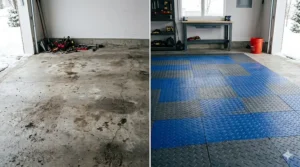
Norsk Duraflex PVC Interlocking Floor Tiles take a different approach entirely: flexible PVC instead of rigid polypropylene, in an 18.3-by-18.3-inch raised coin pattern with a patented air-dry underside that lets trapped moisture evaporate rather than mould against the slab. Sold in 6-packs covering about 14 square feet, so a typical two-car garage needs roughly 14 to 16 packs.
Here’s the practical insight Amazon’s bullet points skip over: flexible PVC compounds generally stay more pliable than rigid PP at the temperatures a typical Canadian garage actually reaches, which is why installers recommend letting any tile — PVC included — warm up indoors overnight before a winter install, since cold plastic of any kind is harder to snap into place. The flexibility also makes Norsk tiles forgiving on slightly uneven or cracked older slabs where rigid tiles would rock.
Pros:
✅ Flexes over uneven concrete
✅ Air-dry underside design
✅ Quieter underfoot than rigid PP
Cons:
❌ Sold in smaller 6-packs, so more packs needed
❌ Less abrasion-resistant than rigid diamond-plate tiles
Best for: older garages or finished basements with imperfect concrete. Roughly $65–$85 CAD per 6-pack.
7. Rubber-Cal Interlocking Rubber Floor Tiles
Rubber-Cal Interlocking Rubber Floor Tiles are made from recycled tire rubber in 20-by-20-inch puzzle-lock pieces, available in a few thicknesses depending on the line. What most Canadian buyers overlook about rubber tiles is that they don’t share the glass-transition brittleness problem rigid plastics face — recycled rubber stays noticeably more flexible in deep cold than a thin-walled polypropylene tile, which is exactly why it shows up in cold-storage and outdoor industrial settings.
The trade-off is weight and look: these are heavier to ship and install than snap-together plastic, and the surface reads more “workshop” than “showroom.” But for a detached, unheated garage that doubles as a workspace where you’re standing for hours in winter, the cushioning and grip are hard to beat.
Pros:
✅ Stays flexible in extreme cold
✅ Excellent slip resistance
✅ Made from recycled material
Cons:
❌ Heavier and pricier to ship
❌ Less polished aesthetic than diamond-plate tiles
Best for: unheated workshops and anyone prioritizing anti-fatigue comfort over showroom looks. Around $180–$240 CAD for a 10-tile pack.
Practical Usage Guide: Installing and Winterizing Garage Floor Tiles in Canada
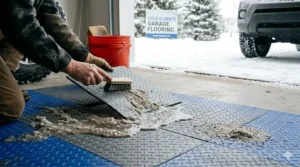
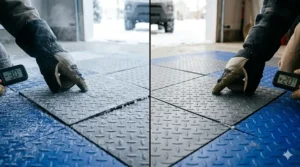
Letting your tiles warm up indoors for 24 hours before installation is the single most useful tip nobody puts on the box — cold plastic of any kind, rigid or flexible, is stiffer and harder to snap together, and forcing a chilled tile can crack a connector tooth. Sweep and degrease the slab first; oil residue under a tile traps moisture that just sits and freezes.
Leave a small expansion gap (often a quarter-inch) around the perimeter for rigid polypropylene tile expansion, since PP genuinely shrinks and grows more than concrete across a Canadian seasonal swing — this is less of an issue with vented tiles like Ribtrax PRO, since airflow evens out the temperature faster than a solid slab. Each winter, sweep out road salt before it has a chance to sit, and avoid a pressure washer on tiles that warn against it, since high-pressure cold water can drive brine straight into the seams.
Real-World Scenarios: Matching Tiles to Your Canadian Garage
A Winnipeg homeowner with an unheated detached double garage and a daily salt-crusted commute is the textbook case for a vented system like Ribtrax PRO or RaceDeck Free-Flow — the drainage genuinely earns its premium when slush has nowhere else to go for hours at a time. A Toronto condo owner with a heated, attached single-car garage faces a much gentler environment, and a budget solid tile like VEVOR or GarageTrac Diamond covers the need without overpaying for drainage they don’t need.
A rural Alberta family running a workshop out of their garage all winter — standing for hours fixing equipment — does better with Rubber-Cal’s cushioned rubber tiles than a hard plastic floor that’s brutal on the knees by February. And a Maritimes household dealing with an older, slightly cracked slab benefits most from the flexible Norsk PVC tiles, which forgive unevenness that would rock a rigid tile loose.
How to Choose Garage Floor Tiles for Cold Climates in Canada
- Check the temperature rating, if published. Few brands publish one, but Swisstrax does, and that -30°C figure is a genuine differentiator worth paying for.
- Decide if you need drainage. Heated, attached garages rarely need vented tiles; unheated detached ones almost always benefit.
- Match material to your slab. Rigid PP and copolymer suit flat, newer concrete; flexible PVC or rubber suit older, uneven slabs.
- Budget for expansion gaps. Rigid tiles need a perimeter gap; vented tiles need less, since airflow moderates temperature swings.
- Confirm Amazon.ca stock and shipping. Several strong options are US-manufactured, so check delivery timelines before committing to a winter install date.
- Plan for road salt, not just snow. The tile’s stain and chemical resistance matters more over five winters than its day-one shine.
- Buy a few extra tiles. Cold makes plastic more prone to chipping if dropped during install, so a small buffer saves a second order.
Polypropylene vs PVC vs Rubber: Which Material Survives Canadian Winters
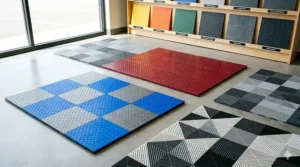
Polypropylene is the most common garage tile material because it’s stiff, stain-resistant, and cheap to mould — but that stiffness comes from a glass transition temperature generally sitting between roughly -20°C and -10°C, below which the plastic shifts from tough to genuinely brittle. That’s thermal shock resistance in a nutshell: above that threshold, a PP tile flexes; below it, the same impact that would just dent a warm tile can crack a cold one. Flexible PVC, by contrast, is formulated to stay pliable across a wider range, which is why Norsk markets its tiles as anti-fatigue and forgiving on uneven concrete, though PVC also stiffens somewhat in extreme cold — just less dramatically. Recycled rubber sits at the flexible end of the spectrum and is the most forgiving option in a deep cold snap.
In practice, this means a rigid PP tile installed without an expansion gap is far more likely to crack during a January thaw-and-refreeze cycle than the same tile installed correctly, and it’s why vented PP-copolymer designs like Ribtrax PRO outperform solid PP tiles of similar thickness — venting moderates the temperature swing the plastic actually experiences.
Garage Floor Tiles vs Epoxy Coating: Which Wins in Cold Climates
| Factor | Interlocking Tiles | Epoxy Coating |
|---|---|---|
| Cold-weather cracking risk | Low to moderate (material-dependent) | Higher — epoxy can delaminate from cold concrete |
| DIY installation | Yes, no curing time | Difficult; needs warm, dry conditions to cure |
| Repairability | Swap a single tile | Full re-coat usually required |
| Slip resistance when wet | Generally good, varies by texture | Can be slippery unless flakes/grit added |
The table makes the seasonal case fairly clear: epoxy needs warm, dry curing conditions that a Canadian garage often can’t reliably provide outside of a short summer window, while tiles install in any season once they’ve acclimatized indoors. Tiles also let you replace one damaged piece instead of redoing an entire coated floor, which matters more once de-icing salt starts working on a surface year after year.
Common Mistakes When Buying Garage Floor Tiles for Cold Climates
Skipping the expansion gap is the most common and most expensive mistake — rigid polypropylene tile expansion across a Canadian seasonal swing is real, and tiles installed wall-to-wall with no gap can buckle by the second winter. A close second is buying a solid, non-vented tile for an unheated detached garage expecting it to “just dry out” — without venting or heat, melted snow sits until you sweep it, full stop.
Buyers also frequently ignore the manufacturer’s cleaning instructions, using a pressure washer on tiles explicitly rated against it, which forces brine into the seams rather than away from them. Finally, ordering exactly enough tiles with zero spares is a mistake that bites in cold weather specifically, since chilled plastic chips more easily during install than the same tile handled in summer.
What to Expect: Real-World Performance in Canadian Winter Conditions
On paper, every tile in this guide handles “cold.” In practice, the difference shows up in the details: a vented tile lets a slushy SUV’s meltwater disappear within an hour, while a solid tile leaves a damp footprint that’s still there at bedtime. De-icing salt itself is genuinely corrosive to bare concrete — chloride brine seeping into porous concrete drives the freeze-thaw cycle that cracks driveways and garage slabs across the country, which is exactly the mechanism a tile system protects against by keeping brine off the concrete entirely. Anyone wanting the engineering detail behind why winter road salt corrodes infrastructure can dig into the Transportation Association of Canada’s research on de-icing corrosivity.
The other real-world factor is sound: rigid PP and copolymer tiles can develop a hollow “clicky-clack” underfoot in extreme cold as the plastic contracts slightly, while rubber and properly-installed Ribtrax-style tiles stay notably quieter.
Long-Term Cost & Maintenance in Canada
A budget VEVOR or IncStores floor at roughly $1.50–$3 CAD per square foot installed cost is the cheapest entry point, but expect to replace individual cracked tiles more often if you skip the expansion gap in an unheated space. Premium vented systems like Ribtrax PRO run closer to $7–$9 CAD per square foot, but the lifetime residential warranty and documented cold rating mean fewer replacements over a decade — often a better total cost of ownership for a detached garage that sees genuine Canadian extremes.
Either way, sweeping out road salt regularly costs nothing and does more for tile longevity than any single product choice. Import duties generally aren’t a factor for these brands when bought directly through Amazon.ca, since pricing already reflects landed Canadian cost.
Canadian Regulations & Safety Considerations for Garage Flooring
There’s no Canada-specific CSA certification that applies directly to interlocking garage floor tiles the way there is for, say, electrical fixtures — these products fall under general consumer goods rules rather than a dedicated flooring standard. Where Canadian standards do apply is garage layout itself: CMHC’s accessibility guidance references the CSA/ASC B652 standard for minimum garage clearances in adaptable housing, which is a useful check if you’re tiling a garage that also needs to accommodate a mobility device or wider vehicle. Bilingual packaging is required on retail goods sold in Canada under federal labelling rules, so expect English/French packaging regardless of which brand you choose.
Garage Floor Tiles for Different Canadian Audiences
Urban condo owners with a single attached, heated garage spot rarely need more than a budget solid tile — the environment is mild enough that drainage and cold ratings matter less than just covering up oil stains. Suburban families with a double attached garage doing daily winter driving sit in the middle, where a mid-range copolymer tile like GarageTrac Diamond balances cost and durability well. Rural and northern Canadians with a detached, unheated garage facing real freeze-thaw garage tiles Canada conditions are the group that benefits most from spending up on a vented, cold-rated system — that’s where the price premium of Ribtrax PRO or RaceDeck Free-Flow earns itself back in fewer winters of standing slush and cracked plastic.
Frequently Asked Questions
❓ Can garage floor tiles handle Canadian winters and road salt?
❓ Will polypropylene garage tiles crack in extreme cold like -30°C?
❓ Do I need to remove garage floor tiles before winter?
❓ What's the best garage tile for an unheated detached garage in Canada?
❓ Does Amazon.ca offer free shipping on garage floor tiles?
Conclusion
Choosing garage floor tiles for cold climates in Canada really comes down to one honest question: does your garage stay above freezing, or does it live through everything our winters throw at it? Heated and semi-heated garages have an easy, budget-friendly path with tiles like VEVOR or GarageTrac Diamond. Genuinely cold, unheated, detached garages are where it pays to spend more on a vented, cold-rated system like Ribtrax PRO, and anyone dealing with an older, uneven slab should look seriously at flexible Norsk PVC or Rubber-Cal’s recycled rubber tiles instead of fighting a rigid plastic into place.
Whichever you choose, the expansion gap and a quick winter-night warm-up before installing will save you more headaches than any single brand decision.
✨ Found Your Match Yet?
🔍 Browse the full lineup above and click through to Amazon.ca for current pricing, colours, and availability. Your garage — and your knees, come February — will thank you.
Recommended for You
- 7 Best Battery Chargers for Canadian Winter 2026 (Tested Picks)
- NOCO vs Stanley Jump Starter Cold Weather: 7 Best in Canada 2026
- 7 Best Portable Jump Starter -40C Rated for Canada 2026
Disclaimer: This article contains affiliate links. As an Amazon Associate, I earn from qualifying purchases. If you purchase products through these links, we may earn a small commission at no additional cost to you.
✨ Found this helpful? Share it with your friends! 💬🤗
