
In This Article
It’s 6:40 a.m. in late January. The freezing rain stopped overnight, and your driveway is now a skating rink with a mortgage attached. You drag a bag of something out of the garage, scatter it with the confidence of a farmer sowing wheat, and hope. Sometimes the ice gives up in ten minutes. Sometimes it sits there, smug, while you watch your boots slide. Often the difference is the chemistry in the bag, not your throwing arm.
That’s why the calcium chloride vs rock salt ice melt question matters more than it looks. Calcium chloride releases heat as it dissolves and keeps working in brutal cold. Rock salt is cheap, familiar and hard to beat on a mild morning. Choosing between them depends on your winters, your concrete and your tolerance for re-spreading.
This guide compares seven real products sold in Canada, from Canadian-mined rock salt to pure calcium chloride pellets. It sorts out label claims from real-world behaviour. It also covers what these salts do to your driveway, which is the part most buyer guides skip.
One note on method. This article synthesizes manufacturer specifications, published concrete research and retailer-listing review themes. It is not based on hands-on testing. Where reviews couldn’t be verified, I say so. Stock on Amazon.ca shifts through the season, so confirm the listing before you buy.
Quick Comparison: Calcium Chloride vs Rock Salt Ice Melt at a Glance
| Product | Main Chemistry | Label Low Temp | Concrete Note | Best For |
|---|---|---|---|---|
| Safe Step 7300 Calcium Chloride | 100% calcium chloride | -32°C (-25°F) | Cured, air-entrained concrete only | Deep-freeze regions |
| Scotwood Winter Heat Calcium Chloride | Calcium chloride pellets | About -32°C (-25°F) | Follow label; avoid new slabs | Heavy ice build-up |
| Sifto Safe Step Xtreme Ice Melter | Calcium chloride + potassium chloride | -31°C | Cured, air-entrained concrete | Fast-acting all-rounder |
| Scotwood Road Runner Ice Melt | Sodium, magnesium and calcium chloride blend | About -26°C (-15°F) | Marketed as safer than salt | Mixed-weather value |
| Sifto Safe Step Enviro-Guard Ice Melter | Gentler formula (composition not verified) | -23°C | Positioned as softer on surfaces | Pets and plantings nearby |
| Sifto Safe Step Ice Salt | Sodium chloride | -15°C | Plain salt; don’t over-apply | Budget, mild winters |
| Windsor Safe-T-Salt | Sodium chloride | -15°C | Plain salt; remove slush | Traction and low cost |
The pattern is clear. Every step down in price also steps up the temperature at which the product quits. If your January lows stay above -10°C, the rock salt rows do the job at a fraction of the cost. Once the cold deepens, Safe Step 7300 Calcium Chloride and Sifto Safe Step Xtreme Ice Melter earn their premium. The blends sit in the middle, with a milder price and a milder ceiling.
💬 Just one click — help others make better buying decisions too!😊
Top 7 Ice Melts: Expert Analysis
Prices below are ranges in Canadian dollars at the time of research. Check current prices, because they move with season and region.
1. Safe Step 7300 Calcium Chloride — coldest melt on this list
This is straight, high-purity calcium chloride, labelled to melt ice down to -32°C. Retailer Q&A puts purity at roughly 90-94%. It’s sold as pellets in 8 lb jugs and 50 lb (22.7 kg) bags.
Here’s what the spec means in practice. The dissolving pellet generates heat, so it starts working on contact instead of waiting for ambient warmth. The label directs about 1 cup per square yard, which works out near 340 g/m², and it recommends removing the slush afterward. Based on the spec comparison, this is the pick when overnight lows regularly drop below -20°C.
It’s less suited to anyone with fresh concrete. The manufacturer says it is safer only on air-entrained, cold-weather concrete at least one year old. Retailer Q&A answers consistently flag that it isn’t pet-safe either. I couldn’t verify Amazon.ca review content for this listing.
Pros:
- ✅ Labelled effective down to -32°C
- ✅ Heat-releasing pellets bite into thick ice
- ✅ No powdery residue per manufacturer
Cons:
- ❌ Not pet-friendly; rinse paws after walks
- ❌ Concrete under one year old is at risk
Expect a price around the C$40-C$65 range for a 50 lb bag. Excellent value if your winters are severe; overkill if they aren’t.

2. Scotwood Winter Heat Calcium Chloride — concentrated pellets for heavy ice
Winter Heat is a concentrated calcium chloride pellet in a 50 lb bag, rated to -25°F (about -32°C). The maker claims it is 2-5 times faster than rock salt or blends. That figure is a marketing claim, so treat it as directional.
The physics behind it is sound. Dissolving calcium chloride is exothermic, so each pellet creates its own warm pocket and sinks through ice. The listing also says it won’t leave the white film that cheap salts do. Consider that useful if you track grit into the house.
Who should buy it? Homeowners whose driveways slope toward the street and refreeze nightly. Fewer re-applications matter more to them than the bag price. Reviewer data was not retrievable for this product, so I can’t summarize buyer sentiment honestly. The manufacturer lists it as not pet-friendly, so the same paw precautions apply as for any calcium chloride.
Pros:
- ✅ Same -32°C ceiling as premium rivals
- ✅ Pellets penetrate rather than skate across ice
- ✅ Stored easily when kept sealed and dry
Cons:
- ❌ Hygroscopic; bag must stay tightly closed
- ❌ Not labelled pet-friendly
Budget around the C$40-C$65 range per 50 lb bag. Good value for harsh climates.
3. Sifto Safe Step Xtreme Ice Melter — fast-acting blue crystals
This Canadian-sold pail (20 kg) contains calcium chloride plus potassium chloride. A manufacturer reply on the Canadian Tire listing says it performs down to -31°C. The blue crystals show where you’ve already spread, which helps prevent the over-application that damages concrete.
Think of this as the practical middle path. You get calcium chloride’s heat on contact, and the listing says it’s safe for properly air-entrained, cured concrete when used as directed. It also claims it won’t stain carpets or floors, which matters if boots carry crystals indoors.
Retailer Q&A shows one buyer joking that the tulips would be lacklustre this year. That’s a reminder to keep it off garden edges. It isn’t a verified pet-safe product, and a manufacturer reply pointed pet owners to the Enviro-Guard line instead.
Pros:
- ✅ Labelled effective to about -31°C
- ✅ Blue crystals show coverage clearly
- ✅ Pail is easy to store and pour
Cons:
- ❌ Not pet-safe per retailer Q&A
- ❌ Can stress nearby plants
Expect roughly the C$30-C$55 range. A solid all-rounder for Canadian winters.
4. Scotwood Road Runner Ice Melt — calcium pellets inside a salt blend
Road Runner combines sodium chloride with magnesium chloride and a calcium chloride pellet. It’s rated to -15°F (about -26°C) and sold in 20 lb bags and 12 lb jugs. The pellet is the trick: the maker says it lets the product melt faster, longer and at lower temperatures than plain salt.
Here’s the honest reading. Because most of the bag is still sodium chloride, you’re paying for a hybrid. You get better cold-weather performance than rock salt without the premium of pure calcium chloride. The listing says it’s safer on concrete and vegetation when used correctly, but pet-friendliness is listed as “No.”
Mixed-weather regions suit it best. Think Southern Ontario or the Maritimes, where a week at -18°C is followed by a thaw. Retailer pages show about 20 reviews on one listing, but I couldn’t retrieve their content, so I won’t characterize sentiment.
Pros:
- ✅ Beats rock salt in colder snaps
- ✅ Lower price than pure calcium chloride
- ✅ Fewer applications than plain salt per maker
Cons:
- ❌ Not pet-friendly per listing
- ❌ Colder ceiling than calcium chloride pellets
A realistic range is C$25-C$45 for a 20 lb bag, depending on retailer. Fair value for blended performance.
5. Sifto Safe Step Enviro-Guard Ice Melter — gentler option, melts to -23°C
When a manufacturer rep on a retailer listing was asked about pets, the answer was to consider Enviro-Guard, which melts to -23°C. That’s the clearest verified fact here. I could not confirm its exact chemical composition, so check the bag’s ingredient list.
What does -23°C mean for you? It’s still far colder than rock salt can handle. For most of the Prairies’ average cold snaps, and certainly for Ontario and Quebec, it covers the vast majority of mornings. It trades some ultimate cold performance for a gentler profile.
That makes it a smart pick for households with dogs, small gardens along the driveway or interlock pavers. Even “gentler” doesn’t mean harmless, since all chloride products can dry paws. Wipe them down after walks. Amazon.ca review content wasn’t verified.
Pros:
- ✅ Labelled to -23°C
- ✅ Manufacturer-recommended for pet households
- ✅ Same Sifto brand and packaging system
Cons:
- ❌ Colder limit than calcium chloride pellets
- ❌ Full ingredient list needs checking on-pack
Expect around the C$30-C$55 range. A thoughtful buy for dogs and gardens.

6. Sifto Safe Step Ice Salt — Canadian-mined rock salt with traction
Mined in Canada, this is 100% sodium chloride, crushed and screened for even spreading. Sold in 10 kg and 20 kg bags, it’s labelled to melt ice to -15°C and undercut it to -21°C. The distinction matters, because undercutting is slower than melting.
The recommended rate is 340 g/m², roughly 1 cup per square yard. That’s a lot of salt for a full driveway. At that rate one 20 kg bag treats about 60 m².
A Canadian Tire reviewer called it effective but found the granules too large for small patio areas. They also noted that on asphalt the granules hadn’t fully dissolved after the ice cleared. Home Depot Canada reviewers include a snow contractor who runs it through a spreader on sidewalks and praises the traction. The takeaway: great for steps and bulk jobs, clunky for tiny spaces.
Pros:
- ✅ Made in Canada from domestic salt
- ✅ Granules add traction on ice
- ✅ Inexpensive for large areas
Cons:
- ❌ Slows sharply below about -10°C
- ❌ Large granules linger on some surfaces
Budget around the C$10-C$20 range for a 20 kg bag. Hard to beat if your winters are moderate.
7. Windsor Safe-T-Salt — the classic striped bag
The striped bag is a Canadian winter fixture. Safe-T-Salt is economical rock salt labelled to melt to -15°C, offered in 10 kg and 20 kg sizes. The listing highlights traction under stuck tires, a feature calcium chloride simply can’t offer.
That traction angle is underrated. Grit provides mechanical grip while chemistry does the slow work. For a driveway at -5°C to -8°C, it’s a perfectly rational choice.
Review data is real here, though not from Amazon.ca. Home Hardware’s 10 kg listing shows 74 reviews, with 59 five-star and 14 four-star ratings, averaging about 4.8. The 20 kg listing shows a much smaller sample of 10 reviews averaging 4.2. Small pools deserve caution, but the pattern is consistently positive.
Pros:
- ✅ Very low cost per square metre
- ✅ Added traction under tires and boots
- ✅ Long shelf life when kept dry
Cons:
- ❌ Fades fast in deep cold
- ❌ Slush needs removing to protect concrete
Expect roughly C$6-C$10 per 10 kg bag. Strong value in mild climates.
Practical Usage Guide: Getting More From Every Scoop
Even the best bag fails when it’s spread badly. Here’s a routine that stretches your supply.
Before the storm. Apply a thin line of product before freezing rain or snow arrives. Pre-treating stops ice from bonding to the pavement, so you shovel instead of chip. It also needs far less product than fighting a thick glaze later.
During application. Use the label rate, roughly 340 g/m², as a ceiling rather than a target. Thin ice needs less. Broadcast evenly, and avoid piles, which just concentrate chloride on one patch.
After it works. Remove the slush. The manufacturer of Safe Step 7300 Calcium Chloride specifically instructs this, and it matters. Leftover brine can refreeze overnight and keeps working against your concrete.
First 30 days mistakes. Using it on a slab poured this autumn is the big one. Spreading near garden beds and re-applying every hour are close behind. Wait for melt to begin; calcium chloride acts quickly, while Windsor Safe-T-Salt needs patience.
Storage. Keep products sealed and off damp floors. Sifto notes that sodium chloride has an effectively infinite shelf life, while hygroscopic products containing calcium chloride or magnesium chloride last shorter if stored badly.

Problem → Solution Guide: Fixing Common Ice Melt Headaches
Problem: it’s -22°C and rock salt does nothing. Switch to calcium chloride. Sifto Safe Step Xtreme Ice Melter or Safe Step 7300 Calcium Chloride will keep working where salt stalls.
Problem: white residue tracked indoors. Residue comes from product that hasn’t dissolved or from chloride salts drying on boots. A mat at the door and prompt slush removal help. Scotwood Winter Heat Calcium Chloride is marketed as leaving no powdery film.
Problem: the dog limps after walks. All chloride products can irritate paws. Choose a gentler option like Sifto Safe Step Enviro-Guard Ice Melter, and still wipe feet after each outing.
Problem: crusty patches on the driveway after winter. That’s often salt scaling, which is surface flaking, on marginal or young concrete. Cut your application rates, remove slush, and wait out the first year on new slabs.
Problem: clumped, hardened bag in the garage. Moisture got in. Seal calcium-based products tightly; plain Sifto Safe Step Ice Salt forgives rough storage better.
What Is Calcium Chloride vs Rock Salt Ice Melt?
Calcium chloride vs rock salt ice melt compares two chloride de-icers. Calcium chloride releases heat as it dissolves and works at colder temperatures, while rock salt, which is sodium chloride, is cheaper and adds traction but slows sharply in deep cold. Both lower water’s freezing point.
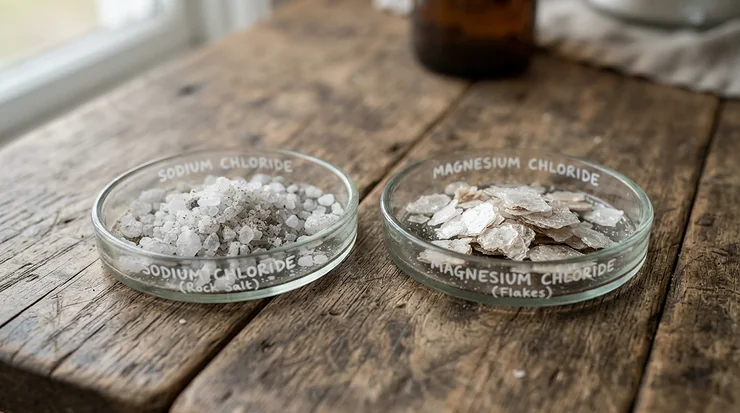
The difference is where each product runs out of steam. Rock salt is endothermic, so it actually absorbs a little heat as it dissolves. Calcium chloride does the opposite, and that small bonus is why it can bite into ice before the sun arrives.
How to Choose Calcium Chloride vs Rock Salt Ice Melt: 6 Steps
- Check your coldest regular night. If lows hover above -10°C, rock salt is enough. Below -15°C, move to calcium chloride or a calcium blend.
- Confirm your concrete’s age. Manufacturers like Safe Step say one year minimum on air-entrained, cured concrete. Younger slab? Use sand for traction instead.
- Count your passengers. Dogs and young children push you toward gentler formulas like Sifto Safe Step Enviro-Guard Ice Melter.
- Consider the surface area. Large driveways favour cheap bulk rock salt; small steps justify premium pellets.
- Look at your landscaping. Chloride runoff stresses plants, so keep a buffer from garden beds and trees.
- Plan storage. A damp garage punishes hygroscopic products. Buy sealed pails or jugs if moisture is a problem.
Effective Temperature Range: What the Bag Promises vs What You’ll Get
An effective temperature range on a label is the lowest temperature at which the product can still melt ice, under ideal conditions. It’s not the temperature where it works well. The listing for Sifto Safe Step Ice Salt is honest about this. It melts to -15°C but only undercuts ice to -21°C, and many guides treat salt as barely useful below about -9°C (15°F).
Calcium chloride is a different animal. Its exothermic dissolving helps it keep going. Reference data puts the brine’s eutectic freezing point near -52°C, far below the -21°C of salt, though real-world pavement performance is always more modest than chemistry tables.
| Category | Label Low Temp | Heat on Dissolve | Concrete Caution | Best For |
|---|---|---|---|---|
| Rock salt (Windsor Safe-T-Salt, Sifto Safe Step Ice Salt) | About -15°C | Absorbs heat | Moderate; remove slush | Mild winters, traction |
| Blends (Scotwood Road Runner Ice Melt) | About -26°C | Partial | Moderate | Mixed weather |
| Gentler formula (Sifto Safe Step Enviro-Guard Ice Melter) | -23°C | Varies | Positioned as gentler | Pets and gardens |
| Calcium chloride (Safe Step 7300 Calcium Chloride, Scotwood Winter Heat Calcium Chloride) | About -32°C | Releases heat | Needs mature concrete | Severe cold |
The table shows a real gap between labelled and practical limits. A product rated to -15°C is a mild-weather tool. If you live where January brings -25°C, only the calcium-based rows are realistic. Match the rating to your worst week, not your average day.
Melting Speed Comparisons: Heat, Penetration and the Clock
Speed comes down to two things: how fast the product dissolves and whether it warms itself while doing so. A U.S. Federal Highway Administration explainer notes that calcium chloride dissolves much faster than salt and releases a considerable amount of heat in the process.
There’s a subtlety. One patent analysis estimates you need about 27% more calcium chloride by freezing-point theory alone than salt for the same job. The heat release is what flips the result, making it faster pound for pound in practice.
So how much faster? Manufacturer claims range widely, and they should be taken as marketing. The Scotwood Winter Heat Calcium Chloride listing says 2-5 times, and one review site claims three times for a 94% pellet. I couldn’t verify any of these figures independently.
Here’s the practical ranking. Pure pellets such as Safe Step 7300 Calcium Chloride act first. Calcium-containing blends like Sifto Safe Step Xtreme Ice Melter and Scotwood Road Runner Ice Melt come next. Plain rock salt trails, particularly once temperatures dip.
Speed also depends on ice thickness. On a thin glaze, the gap narrows. On a 1 cm sheet at -15°C, it widens dramatically.

Surface Corrosion Risk: What Chloride Does to Concrete and Metal
Here’s where simple “calcium chloride is harsher” stories fall apart. Research is mixed, and the winner depends on the concrete.
A McGill University concrete study found moderate scaling with calcium chloride, with different behaviour for magnesium chloride and sodium chloride depending on air content. An Iowa State University project found calcium chloride caused the most damage to portland cement materials in freeze-thaw conditions. A Korean lab study measured scaling after 56 cycles at about 33 times tap water for sodium chloride and 18 times for calcium chloride. On the other hand, a 36-year Portland Cement Association outdoor test, summarized by a calcium chloride producer, found minimal scaling for both on good concrete.
Reconcile those and you get this. Concrete quality dominates. Air-entrained, properly cured slabs tolerate chlorides well. Poorly air-entrained or young slabs suffer under any of them. That’s why every premium manufacturer, including the maker of Safe Step 7300 Calcium Chloride, insists on a one-year-old, air-entrained surface.
For metal, chlorides accelerate rust on rails, vehicles and exposed rebar in any form. Rinse cars and wipe railings in spring. No product on this list is corrosion-free, so choose by dose and cleanup, not by marketing.
Ice Melt Pellets vs Granular Ice Melt: Does Shape Matter?
Ice melt pellets vs granular ice melt is mostly a debate about penetration and handling. Pellets, like those in Safe Step 7300 Calcium Chloride, are uniform spheres that drop through snow and sink into ice. The manufacturer says that shape penetrates deeper and gives a time-release effect for more even melting.
Granular products, like Windsor Safe-T-Salt, are crushed crystals with irregular edges. That roughness is a benefit, because it gives grit under tires and boots. The downside appeared in one Canadian Tire review of Sifto Safe Step Ice Salt: big granules can linger undissolved.
Flakes are the third form. They dissolve quickly but are typically a lower-concentration calcium chloride than pellets, so check the percentage on the bag.
Handling matters too. Pellets spread cleanly in a hand spreader and bounce less. Granules scatter unevenly if you’re heavy-handed. Neither wins universally. Choose pellets for thick ice and precision, granules when traction is part of the goal.
Best Ice Melt for Concrete Driveways: A Practical Verdict
The best ice melt for concrete driveways is the lowest-risk product that still works at your temperature, applied sparingly. That sounds boring, and it’s accurate.
If the slab is new, skip chemicals completely for the first winter and use sand. If it’s mature and air-entrained, rock salt like Windsor Safe-T-Salt is fine in mild weather, provided you remove slush. In harder cold, Sifto Safe Step Xtreme Ice Melter gives a good balance and a visible blue guide to prevent over-spreading.
For driveways that also touch gardens or pet routes, Sifto Safe Step Enviro-Guard Ice Melter is the softer pick. For severe-cold regions, Safe Step 7300 Calcium Chloride is justified, but only on cured concrete.
One more point: pavers and decorative stone. Interlock stone is more vulnerable to freeze-thaw than many people realize. Use the lowest effective dose, and sweep up spent melt in spring.
Long-Term Cost & Maintenance: The Real Price of a Clear Driveway
Price per bag misleads. What matters is cost per cleared square metre, including re-applications and potential repairs.
| Product | Pack | Price Range (CAD) | Value Verdict | Best For |
|---|---|---|---|---|
| Windsor Safe-T-Salt | 10 kg | C$6-C$10 | Excellent in mild climates | Steps and small driveways |
| Sifto Safe Step Ice Salt | 20 kg | C$10-C$20 | Excellent bulk value | Large, mild-weather areas |
| Scotwood Road Runner Ice Melt | 20 lb | C$25-C$45 | Fair hybrid value | Mixed weather |
| Sifto Safe Step Xtreme Ice Melter | 20 kg pail | C$30-C$55 | Good all-rounder | Cold regions |
| Safe Step 7300 Calcium Chloride | 50 lb | C$40-C$65 | Strong if truly cold | Severe winters |
Ranges are approximate and vary by retailer and province. Check current price before buying.
The cheapest bag isn’t always the cheapest season. Rock salt wins on price per kilogram. But if you’re re-spreading daily in a deep freeze, calcium chloride may cost less overall, because it works the first time. Add maintenance: rinsing vehicles, resealing driveways and replacing scaled concrete costs far more than any bag.
Safety, Regulations and Canadian Context
Chloride road salts carry a unique status in Canada. A federal assessment concluded that road salts containing inorganic chloride salts are “toxic” under section 64 of the Canadian Environmental Protection Act, 1999, because of effects on freshwater, soil and vegetation. The Code of Practice for the Environmental Management of Road Salts covers sodium, calcium, magnesium and potassium chloride.
What does it mean for your driveway? Mostly nothing legally. The Code is voluntary, targets road authorities using more than 500 tonnes per year, and explicitly doesn’t address private properties. Quebec has its own strategy. Municipal bylaws may add local rules, so check yours.
The practical lesson is moderation. Chloride doesn’t vanish; it washes into storm drains and groundwater. Sweep up excess in spring, don’t pile product, and use only what the ice requires. Wear gloves with calcium chloride, since it can dry skin, and keep all products away from children and pets.

FAQ
❓ Can I mix calcium chloride and rock salt together?
❓ Is calcium chloride vs rock salt ice melt cheaper per season?
❓ How much ice melt does a two-car driveway need?
❓ Will ice melt hurt my interlock pavers?
❓ Can I store ice melt in an unheated garage?
Conclusion
Here’s the short version of the calcium chloride vs rock salt ice melt debate. Rock salt is the sensible workhorse for moderate winters: cheap, gritty and reliable down to the single-digit negatives. Windsor Safe-T-Salt and Sifto Safe Step Ice Salt cover that ground well. Calcium chloride is the specialist for brutal cold, and Safe Step 7300 Calcium Chloride and Scotwood Winter Heat Calcium Chloride deliver where salt gives up.
In between sit the blends. Sifto Safe Step Xtreme Ice Melter and Scotwood Road Runner Ice Melt trade a little purity for a lot of flexibility. If pets or gardens matter most, Sifto Safe Step Enviro-Guard Ice Melter is the softer route.
Whatever you pick, the driveway itself matters as much as the chemistry. Wait a year before treating new concrete, use the minimum dose, remove slush and rinse up in spring. Treat the bag as a tool, not a magic spell.
✨ Ready for winter?
🔍 Compare the picks above, check current pricing and availability on Amazon.ca, and get your ice-melt shelf stocked before the first freezing-rain forecast hits!
Recommended for You
- Ice Melt For Driveways: 7 Best Proven Picks In Canada 2026
- Roof Rake For Snow Removal: 7 Proven Picks For Canada (2026)
- 7 Best Traction Mats For Icy Driveway Safety In 2026
Disclaimer: This article contains affiliate links. As an Amazon Associate, I earn from qualifying purchases. If you purchase products through these links, we may earn a small commission at no additional cost to you.
✨ Found this helpful? Share it with your friends! 💬🤗
