
In This Article
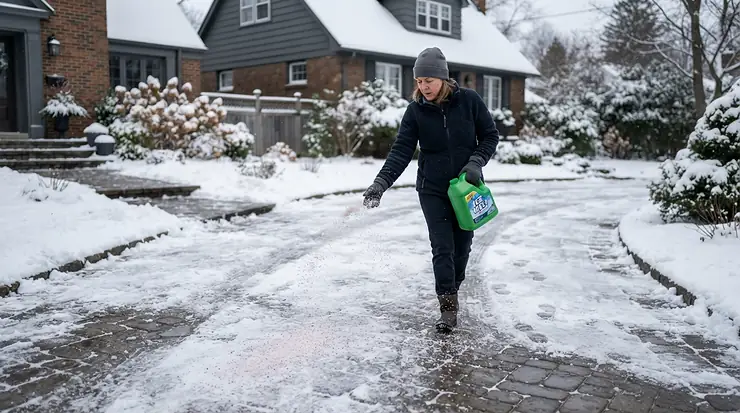
Ice melt for interlocking pavers is a de-icing product chosen to loosen snow and ice on concrete paving units without speeding up surface scaling, joint-sand loss or white efflorescence. The best options are low-residue formulas applied sparingly, because the dose and how fast you clear the slush matter more than the chemical on the label.

Here’s the uncomfortable truth about winter in Canada. Your pavers are tougher than you think, and your habits are tougher on them than the winter is. According to the Interlocking Concrete Pavement Institute’s technical bulletin on deicing chemicals, properly manufactured pavers resist deicing salts well, and the key is using only as much product as the job needs. Dump half a bag on a driveway and walk away, and you’re running a slow chemistry experiment on your most expensive hardscape.
This guide covers seven real products you can find in Canada, plus the practical stuff product pages skip. That includes what “low residue” actually means, how bag size and coverage work out on a real driveway, how to store the leftovers, and how to prevent paver damage. Availability on amazon.ca shifts through the season, and some of these brands sell mainly through hardware chains. So treat each listing as a starting point and check current stock and price before you buy.
Quick Comparison Table: Ice Melt for Interlocking Pavers at a Glance
| Product | Main chemistry | Stated low-temperature limit | Best For |
|---|---|---|---|
| Yardworks Envirosafe Ice Melt | CMA-enhanced blend | -26°C (-15°F) | Everyday paver driveways and walkways |
| Snow Joe MELT Eco Clean (MELT40ECO) | CMA + sodium chloride + fertilizer | Not stated on listing | Large areas with nearby lawn |
| Paw Thaw Pet Safe Ice Melter | CMA-based blend | Not stated on listing | Households with dogs |
| SPLASH Pet Safe Ice Melt | Magnesium chloride + CMA | -26°C (-15°F) | Small patios and entry steps |
| Safe Step 7300 Calcium Chloride | Calcium chloride | -32°C (-25°F) | Deep-freeze emergencies |
| Snow Joe MELT Calcium Chloride Pellets | 94% calcium chloride | -32°C (-25°F) | Fast action on thick ice |
| Sifto Safe Step Xtreme | Premium blend | -31°C | Prairie and northern cold snaps |
Look at the “Best For” column and you’ll see a pattern. The cheapest, coldest-rated products are not the gentlest ones, and the gentlest ones usually give up a few degrees of low-temperature range. Yardworks Envirosafe Ice Melt and SPLASH Pet Safe Ice Melt balance the two best on paper. The two calcium chloride options earn their place for brutal cold, but they demand a lighter hand. Paw Thaw Pet Safe Ice Melter and Snow Joe MELT Eco Clean don’t list a low-temperature limit on the pages I reviewed, so confirm that on the bag before counting on them below about -10°C.
💬 Just one click — help others make better buying decisions too!😊
Top 7 Ice Melt for Interlocking Pavers: Expert Analysis
1. Yardworks Envirosafe Ice Melt — made-in-Canada CMA-enhanced all-rounder
Yardworks pitches this as less harmful to surfaces, vegetation and pets, and the CMA (calcium magnesium acetate) enhancement is what backs that claim up. CMA is a low-corrosion de-icing compound that’s widely used where chloride runoff is a concern.
The listing states a melt range down to -26°C (-15°F). It describes a formula that bonds to the surface to reduce corrosion and stay put longer, which should reduce refreezing between applications. That’s the practical win on pavers, because fewer reapplications means less total chemical load in the joints. The teal colouring helps too. You can see where you’ve applied it, so you don’t double up.
On paper, this suits homeowners who want one bag that handles most Canadian winter days without fuss. Retail Q&A on the listing includes an owner reporting about four years on a finished cement driveway with no pitting. That’s one anecdote, not a lab result, but it’s consistent with the product’s “safe on good-quality, air-entrained concrete when used as directed” wording. I couldn’t verify a large pool of aggregated ratings, so treat reputation here as promising rather than proven.
Pros:
- ✅ Rated to -26°C (-15°F) for most Canadian days
- ✅ CMA formula is gentler on surfaces and vegetation
- ✅ Visible teal colour prevents over-application
Cons:
- ❌ Costs more per kilogram than plain blends
- ❌ Not the pick for extreme -30°C cold snaps
Expect roughly C$30–C$50 for a 20 kg (44 lb) bag; check current price. The value verdict is strong if your pavers are your priority.

2. Snow Joe MELT Eco Clean (MELT40ECO) — best for paver edges that border lawn
Pavers rarely sit alone. They run right up against turf, shrub beds and gardens. This 40 lb (about 18 kg) bag combines CMA, sodium chloride and a time-release fertilizer, which is a smart compromise for those mixed borders.
The green-coated crystals work as a visual guide, so you can see your coverage and avoid piling product in one spot. They’re also described as non-tracking, which matters if your mudroom floor takes a beating. The listing says this blend works longer and reduces reapplication. That’s a claim I’d test on a small section first, since I couldn’t find independent testing.
The honest analysis here is that the sodium chloride portion is the part to respect. A blend isn’t magic, and salt in joints still adds up over a season, so the sweep-and-clear routine later in this guide applies fully. I couldn’t verify aggregated customer ratings for this model, so I’m not summarizing review sentiment.
Pros:
- ✅ CMA component softens the chemical load
- ✅ Green crystals show where you’ve applied
- ✅ Large 18 kg bag suits wide driveways
Cons:
- ❌ Contains sodium chloride, so still apply lightly
- ❌ Low-temperature rating isn’t clearly stated
Plan on about C$40–C$70 for the 40 lb bag; check current price. It’s good value for big, lawn-adjacent installations.
3. Paw Thaw Pet Safe Ice Melter — pet-first formula with a pH buffer
Dog owners know the winter paw-lick problem. Paw Thaw leans into it with a CMA-based mix, pH stabilizers, a food-grade colour marker and a non-corrosive spray. The manufacturer’s copy notes that rock salt is highly alkaline and that calcium chloride generates heat, both of which can irritate paws.
For pavers, the interesting bit is the time-released formula, which is said to stay on the surface longer and help control the freeze-thaw cycle. That’s a real concern, because meltwater that refreezes inside the paver surface does more damage than the salt itself. A jug (the version I found was 12 lb, about 5.4 kg) is also handy for a front step or a small patio you hit daily.
The catch is scale. This is a spot-treatment product. The one retail listing I reviewed showed no customer reviews, so there’s no sentiment to report. If you’re covering a whole driveway, the economics get awkward fast.
Pros:
- ✅ Gentler on paws than rock salt or calcium chloride
- ✅ pH stabilizers moderate alkalinity
- ✅ Jug format is easy for steps
Cons:
- ❌ Poor value for large paver areas
- ❌ Limited verified review data
Expect roughly C$20–C$35 for a 12 lb jug; check current price. The value verdict is fair for small zones and weak for big ones.
4. SPLASH Pet Safe Ice Melt — magnesium chloride and CMA in a shaker jug
SPLASH’s pet-safe version combines magnesium chloride and CMA with no urea. Its 8 lb (about 3.6 kg) shaker jug melts down to about -15°F (-26°C) according to the retailer listing.
Magnesium chloride is generally considered less aggressive than calcium chloride, though still a chloride. The shaker jug controls dosage. You can’t scoop a heavy pile out of a jug, and that natural throttle is useful on pavers. Don’t mistake “pet safe” for “plant safe,” though. A manufacturer Q&A states plainly that the product contains salt, which can damage vegetation.
The same Q&A also gives the most honest line in the whole category. All ice melts, combined with freeze-thaw cycles, can damage concrete. The fix is to use only enough to loosen snow and ice, then promptly remove the slush. Reviews I saw were mixed, with one buyer praising it as “tremendous” on an icy driveway and another saying it took a lot of product to melt ice. That split is typical of small-jug products. They work, but coverage runs out quickly.
Pros:
- ✅ No urea, with magnesium chloride and CMA
- ✅ Shaker jug naturally limits dosage
- ✅ Rated to about -26°C (-15°F)
Cons:
- ❌ Contains salt, so keep it off lawn edges
- ❌ Small jug covers little ground
Budget roughly C$15–C$30 for the 8 lb jug; check current price. It’s a sensible pick for entry steps and small patios.
5. Safe Step 7300 Calcium Chloride — deep-freeze power with strict rules
When it’s -28°C and the ice is thick, calcium chloride earns its reputation. Safe Step 7300 is described as high-purity calcium chloride that melts ice down to -32°C (-25°F). It’s a self-heating reaction, so melting starts on contact.
The label guidance is where the paver lesson lives. It’s described as safer when used as directed on air-entrained, cold-weather concrete at least one year old. It calls for roughly one cup (10 oz) per square yard, spread evenly, with the slush removed afterward. Retailer Q&A states that it isn’t considered pet safe or vegetation safe, and that it can damage new concrete. If your pavers went in this past summer, many installers recommend skipping chemicals the first winter. Confirm with your installer or manufacturer.
The review sentiment I saw was practical rather than glowing. It’s a professional-grade product, not a gentle one. Use it as your cold-snap backup, not your daily driver.
Pros:
- ✅ Works down to -32°C (-25°F)
- ✅ Pellets penetrate ice and release evenly
- ✅ Doesn’t leave a powdery residue per the label
Cons:
- ❌ Not pet or vegetation safe
- ❌ Risky on newly installed pavers
Expect roughly C$12–C$20 for 8 lb (3.6 kg) and C$50–C$90 for 50 lb (22.7 kg); check current price. It’s good value as a deep-freeze reserve.

6. Snow Joe MELT Calcium Chloride Pellets (MELT20CPP) — 94% pure and fast on thick ice
This 20 lb (about 9 kg) bag packs 94% calcium chloride, rated to -25°F (-32°C), with the listing claiming up to 24 hours of longevity. It also claims pellets penetrate ice up to three times faster than conventional ice melt. That’s a manufacturer claim I can’t independently confirm, so file it under marketing.
The longevity point is the interesting one for pavers. If the product keeps working for hours, you can apply it before a storm as a pre-treatment so ice never bonds to the surface, which is gentler than chipping at it later. It also means you need less of it per event, which is the real way to protect your joints.
Same cautions as any calcium chloride. It’s not marketed as pet friendly, it’s hard on plants, and you should wait on new installations. I found no verified aggregated ratings for this exact SKU, so I’m not claiming any.
Pros:
- ✅ 94% calcium chloride acts on contact
- ✅ Handy for pre-storm anti-icing
- ✅ Compact 9 kg bag stores easily
Cons:
- ❌ Harsh on lawns and paws
- ❌ Over-application is easy with strong pellets
Budget roughly C$35–C$60 for the 20 lb bag; check current price. The value is good if you apply it lightly.
7. Sifto Safe Step Xtreme — the prairie cold-snap heavyweight
Sifto’s Xtreme pail (20 kg) features blue crystals for easy application and an advanced formula that generates heat to melt ice on contact. Retail Q&A places its performance down to about -31°C. It’s described as safe for properly air-entrained, cured concrete when applied as directed.
That “when applied as directed” phrase carries a lot of weight. The blue colouring is your friend because it lets you see your coverage and stop sooner. One Q&A response advises that a product without a pet-safe label will bother pets’ feet. For a gentler alternative, the same brand’s Enviro-Guard line is rated to about -23°C, which is plenty for much of southern Ontario and the Maritimes.
I’m not summarizing review sentiment for the Xtreme pail because I couldn’t verify aggregated reviews. As a plain analysis, it suits Alberta, Saskatchewan and Manitoba households where -30°C is a real planning scenario.
Pros:
- ✅ Performs to about -31°C
- ✅ Blue crystals show your coverage
- ✅ Durable 20 kg pail resists moisture
Cons:
- ❌ Not marketed as pet friendly
- ❌ Overkill for mild coastal winters
Expect roughly C$25–C$45 for the 20 kg pail; check current price. It’s strong value for cold regions.
How to Use Ice Melt for Interlocking Pavers: A Step-by-Step Practical Guide
Amazon listings never tell you this part, so here’s the routine. Think of it as a four-beat rhythm: prevent, apply lightly, clear, rinse.
- Anti-ice early. If freezing rain is forecast, apply a light layer before it starts. Ice that never bonds is ice you don’t have to fight.
- Shovel first. Remove loose snow before you spread anything. Chemistry should only handle the thin film that’s left.
- Spread by hand or with a handheld spreader. Aim for a scattering where you can still see paver between granules. Coloured products make this easy.
- Wait, then remove the slush. Don’t let brine sit and refreeze. ICPI guidance, reprinted by Turf & Rec, says to promptly remove loosened snow, ice and excess product so the chemical doesn’t build up.
- Rinse and sweep in spring. Flush the surface once the thaw is steady, then check your joint sand.
In the first 30 days, the common mistakes are over-applying, skipping the slush removal, and using sand on permeable pavers. ICPI notes that sand shouldn’t be applied to permeable interlocking pavements, since it clogs the voids.
Real-World Scenarios: Matching the Right Ice Melt to Your Pavers
Scenario 1: The Ontario family with a dog and a new driveway. Pavers went in last summer, and the budget is tight. Skip chemical melt this first winter if your installer agrees, and shovel promptly. After year one, Yardworks Envirosafe Ice Melt is the sensible default.
Scenario 2: The Calgary homeowner facing -30°C. A cold snap is forecast and the walkway is glazed. Sifto Safe Step Xtreme or Safe Step 7300 Calcium Chloride fit, applied lightly and cleared promptly. Keep a gentler blend for ordinary days.
Scenario 3: The condo owner with a small paver patio and a cat. Two entry steps, one balcony-level patio. An 8 lb SPLASH Pet Safe Ice Melt jug covers it for a whole season, and you never fight a big bag.
Scenario 4: The Halifax homeowner with lawn along the edges. Freeze-thaw cycles are constant, and the lawn matters. Snow Joe MELT Eco Clean (MELT40ECO) suits the mixed borders, with careful sweeping of strays.
How to Choose Ice Melt for Interlocking Pavers
- Check your paver’s age. New pavers (under a year) deserve extra caution. Ask your installer.
- Match the product to your coldest realistic temperature. A -15°C product is fine in much of southern Ontario but not in Winnipeg in January.
- Prefer low-chloride-load options for routine use. CMA blends and magnesium chloride are gentler than straight calcium chloride.
- Look for coloured crystals. Visibility prevents over-application.
- Consider pets and plants. “Pet safe” doesn’t mean “plant safe,” so read the label.
- Choose a bag size you’ll finish. Leftover product is a storage problem.
- Confirm the product states it’s safe for concrete pavers or properly cured concrete.
The reasoning behind step 1 is simple. Standards bodies test pavers against freeze-thaw and saline conditions, as described in ASTM C1645, but a paver that passes the test isn’t immune. It just survives longer when you treat it kindly.
Best Low Residue Ice Melt: What “Low Residue” Really Means
“Best low residue ice melt” is a phrase worth unpacking, because manufacturers use “residue” to mean several different things. Some mean powdery dust tracked indoors. Others mean chemical build-up left in paver joints. Others mean the white film that shows up when brine dries.
For pavers, the second and third meanings matter most. A product that “won’t leave a powdery residue” on the label, like Safe Step 7300 Calcium Chloride, solves the dust problem, not necessarily the joint-chemistry problem. Meanwhile CMA-based blends such as Yardworks Envirosafe Ice Melt and Paw Thaw Pet Safe Ice Melter are chosen for lower corrosion, which is a different kind of “clean.”
So how do you pick the best low residue ice melt? Use three tests. Look for coloured, evenly sized granules you can measure by eye. Check that the label states a concrete-safe use. And plan on a spring rinse regardless. Even the cleanest product leaves some salts behind, and rinsing is cheaper than re-sanding joints.
Bag Size and Coverage: How Much Ice Melt Do You Actually Need?
Bag size and coverage is where most buyers guess wrong, and labels vary enormously. The Safe Step 7300 Calcium Chloride label calls for about one cup (10 oz) per square yard. Do the arithmetic and that’s roughly 0.34 kg per square metre. Other bag labels suggest much lighter rates for a thin glaze. The table below uses the Safe Step label as a heavy ceiling and a light 0.05 kg/m² as my planning assumption. Always follow your own bag’s directions.
| Bag size | Heavy label rate (~0.34 kg/m²) | Light preventive rate (~0.05 kg/m²) | Best For |
|---|---|---|---|
| 3.6 kg (8 lb) SPLASH Pet Safe Ice Melt jug | ~11 m² | ~72 m² | Steps and small patios |
| 9 kg (20 lb) Snow Joe MELT Calcium Chloride Pellets | ~27 m² | ~180 m² | Mid-size walkways |
| 18 kg (40 lb) Snow Joe MELT Eco Clean | ~53 m² | ~360 m² | Full driveways |
| 20 kg (44 lb) Yardworks Envirosafe Ice Melt | ~59 m² | ~400 m² | Whole-property seasons |
Take a 6 m × 6 m (36 m²) paver driveway. At the heavy ceiling you’d use about 12 kg in one application. At the light rate you’d use under 2 kg. That gap is exactly why careful application saves money and pavers. The numbers also show why a 40 lb bag usually outlasts a Canadian winter for a typical home when you apply lightly and clear slush promptly.
Ice Melt Storage Tips
Ice melt storage tips sound boring until you open a bag in January and find a brick. Calcium chloride is hygroscopic, which means it pulls moisture out of the air, so a torn bag turns into a lump faster than you’d expect.
Follow these ice melt storage tips and your leftovers stay usable:
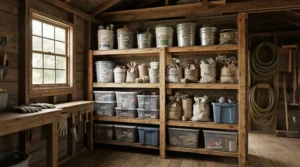
- Keep it sealed and dry. Transfer opened bags into a lidded pail. Pails like the Sifto format resist moisture well.
- Store it off bare concrete floors. A pallet or shelf keeps damp from wicking upward.
- Keep it away from metal tools and bikes. Chloride corrodes.
- Label the pail. If kids or pets share the garage, a clear label matters.
- Separate products. Don’t mix different formulas in one pail.
One manufacturer says its salt-free product has an unlimited shelf life, but I’d treat that as a product-specific claim. For any bag, dryness is the variable that matters most. Done right, these ice melt storage tips mean you can carry a half-bag into next winter instead of buying a new one.
Interlocking Paver Damage Prevention: What Actually Protects Your Surface
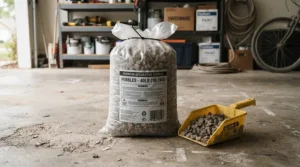
Interlocking paver damage prevention isn’t about finding a miracle product. It’s about reducing the three things that hurt pavers: concentration, standing brine and refreezing.
Concentration. ICPI’s guidance is blunt: don’t over-apply, follow the dosage, and remove loosened snow and excess product promptly so the chemical doesn’t build up. Think of salt like hot sauce. A little lifts the dish, and a lot ruins it.
Standing brine. Slope and drainage matter. If water pools on your pavers, melted brine lingers and refreezes. Fix grading problems in summer, not January.
Refreezing. Applying a product that keeps working, or shovelling after the melt, limits the freeze-thaw cycle. The Masonry Contractors Association notes that no pavers are fully deicing-salt-proof, which is exactly why minimizing exposure is the best protection.
Joints and sealers. Joint sand holds the system together. Check it each spring and top it up. A good sealer applied on clean, dry pavers in summer can also help, but follow your installer’s advice on timing.
Add those up and interlocking paver damage prevention is mostly a habit, not a purchase.
Ice Melt vs Alternatives: Sand, Shovelling and Snow-Melting Systems
| Option | How it works | Paver impact | Best For |
|---|---|---|---|
| Yardworks Envirosafe Ice Melt (CMA blend) | Chemical melt, lower corrosion | Low when applied lightly | Routine winter use |
| Safe Step 7300 Calcium Chloride | Heat-generating chemical melt | Moderate; use sparingly | Extreme cold |
| Sand | Traction only | Can clog joints and permeable voids | Temporary grip on non-permeable areas |
| Shovelling alone | Mechanical removal | None, but leaves thin ice | Light snow |
| Snow-melting system | Embedded heat | Minimal chemical use | New installations |
Sand gives grip but not melting, and it tracks everywhere. On permeable pavements it’s specifically discouraged. Shovelling is the gentlest approach, and for light snow it may be all you need.
The premium route is a heated system. The ICPI Tech Spec on snow melting systems covers embedded systems designed for interlocking concrete pavements, and notes that they largely avoid the need to spread deicing salts. It’s a big upfront cost and a design decision for new builds, not a retrofit for most homeowners. For everyone else, careful ice melt use beats the alternatives on convenience and cost.
Common Mistakes When Buying Ice Melt for Interlocking Pavers
Buying on the coldest rating alone. A -32°C product on a -8°C day is overkill and harder on surfaces than it needs to be.
Ignoring paver age. New pavers are the most vulnerable. If yours are under a year old, ask before spreading anything.
Assuming “pet safe” equals “paver safe.” They’re separate questions. A pet-friendly formula can still contain chlorides.
Buying a bag you can’t finish. Half-used bags absorb moisture and clump.
Skipping the label. Application rates vary widely, as the coverage table showed.
Chasing the cheapest price per kilogram. A cheap rock-salt-heavy product can cost more once you account for joint re-sanding and cleanup. If you’ve ever pulled up a soggy bag in March, you know the feeling.
Safety, Regulations and Environmental Context in Canada
Canada takes road salt seriously. According to Environment and Climate Change Canada, the Code of Practice for the Environmental Management of Road Salts notes that about 5 million tonnes of road salts are used each year as de-icers on roadways. The government’s 2001 assessment concluded that high releases of chloride road salts harm freshwater ecosystems, soil, vegetation and wildlife.
Here’s the nuance. The Code is aimed at road authorities, and it explicitly does not address parking lots and private properties. So your driveway isn’t regulated by it. But the environmental logic still applies, and municipal bylaws or condo rules may add their own requirements.
On the paver side, Canadian pavers are made to CSA A231.2, the precast concrete paver standard referenced in ICPI’s bulletin. Ask your installer for documentation on your pavers. Meanwhile, keep products out of storm drains where you can, and sweep excess granules off lawns and into the paver surface to be shovelled, not washed into the street.
Long-Term Cost and Maintenance: What Ice Melt Really Costs You Over a Winter
| Approach | Typical annual product cost* | Hidden cost | Best For |
|---|---|---|---|
| Light CMA blend use | Lower to moderate | Fewer repairs | Most homeowners |
| Heavy calcium chloride use | Moderate | Joint and paver wear risk | Emergencies only |
| Shovel plus occasional melt | Lowest | Time and effort | Small areas |
*Estimated from the price ranges in this guide; actual costs vary.
The cheapest bag isn’t the cheapest winter. Re-sanding joints, replacing a spalled paver or hiring a cleaner for efflorescence costs far more than a few extra dollars on a better product. Individual pavers can be replaced if damaged, but ICPI notes it should be done by an experienced installer, which adds up.
A smart routine costs little. Buy one gentle blend for daily use and one small bag of calcium chloride for emergencies. Rinse in spring, top up joint sand, and you’ll likely spend less over five winters than someone who buys the biggest bag on sale and uses it freely.
FAQ: Ice Melt for Interlocking Pavers
❓ Is ice melt safe for interlocking pavers?
❓ What's the best low residue ice melt for pavers in Canada?
❓ How much ice melt do I need per square metre?
❓ Can I use rock salt on my paver driveway?
❓ How should I store leftover ice melt?
Conclusion
Choosing ice melt for interlocking pavers comes down to restraint more than brand. The seven products here cover the realistic range. Yardworks Envirosafe Ice Melt and Snow Joe MELT Eco Clean (MELT40ECO) suit everyday paver care. Paw Thaw Pet Safe Ice Melter and SPLASH Pet Safe Ice Melt fit small, pet-heavy spaces. Safe Step 7300 Calcium Chloride, Snow Joe MELT Calcium Chloride Pellets and Sifto Safe Step Xtreme are your deep-freeze reserves.
Whatever you buy, the winning routine is the same. Shovel first, spread lightly, remove the slush, store the leftovers dry and rinse in spring. That’s the heart of interlocking paver damage prevention, and it costs almost nothing.
Before you commit, compare current listings for size and price, since availability on amazon.ca changes through the season. Pick the bag you’ll finish, and your pavers should come through winter looking like they went in last summer.
Recommended for You
- Calcium Chloride Vs Rock Salt Ice Melt: 7 Proven Picks 2026
- Ice Melt For Driveways: 7 Best Proven Picks In Canada 2026
- Roof Rake For Snow Removal: 7 Proven Picks For Canada (2026)
Disclaimer: This article contains affiliate links. As an Amazon Associate, I earn from qualifying purchases. If you purchase products through these links, we may earn a small commission at no additional cost to you.
✨ Found this helpful? Share it with your friends! 💬🤗
