
In This Article
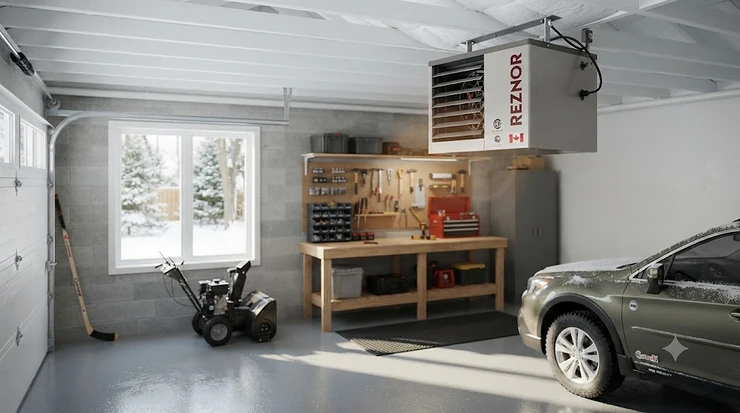
There’s a very specific kind of cold that lives in a Canadian garage in January — the kind that turns wrenches into ice cubes and makes your breath hang in the air like a tiny, judgmental cloud. If you’ve ever tried to bleed brakes with numb fingers or watched a coat of paint refuse to cure at 4°C, you already know why so many homeowners eventually give up on space heaters and portable propane torpedoes and go looking for something that can actually keep pace with a Prairie cold snap or a Muskoka deep freeze. That’s usually where the search for a natural gas garage heater begins.
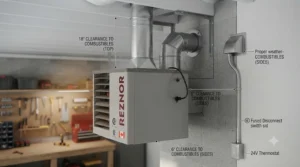
A natural gas garage heater is a fixed heating appliance — typically ceiling-mounted or wall-mounted — that burns natural gas piped in from your home’s gas line to produce continuous, thermostat-controlled heat for a garage, workshop, or detached shop. Unlike portable propane heaters, it’s plumbed in permanently, vented according to Canadian code, and sized in BTUs to match your specific square footage. Done right, it’s one of the most cost-effective ways to heat a Canadian garage long-term, largely because space heating accounts for the majority of energy used in the average Canadian home, and natural gas remains, dollar for dollar, one of the cheaper ways to generate that heat.
This guide walks through seven real, currently available natural gas garage heater models spanning budget, mid-range, and premium territory, plus the sizing math, the CSA certification requirements, the installation realities, and the long-term running costs nobody puts on the box. None of this is a rewritten spec sheet. It’s the analysis I wish existed before I started falling down BTU-calculator rabbit holes at midnight.
Quick Comparison Table
| Product | BTU Output | Type | Best For | Price Range (CAD) |
|---|---|---|---|---|
| Mr. Heater Big Maxx MHU50 | 50,000 | Forced-air, power-vented | 1.5-car garage on a budget | C$650-C$800 |
| Mr. Heater Big Maxx MHU80 | 80,000 | Forced-air, power-vented | 2-3 car garage | C$800-C$1,000 |
| Mr. Heater Big Maxx MHU125 | 125,000 | Forced-air, power-vented | Oversized shop or 3+ bays | C$1,100-C$1,400 |
| Modine Hot Dawg HD45 | 45,000 | Forced-air, power-vented | Quiet, daily-use workshop | C$950-C$1,150 |
| Modine Hot Dawg HD75 | 75,000 | Forced-air, power-vented | Heavy-use 2-3 car shop | C$1,300-C$1,600 |
| Williams Direct-Vent Furnace | 30,000 | Direct-vent wall furnace | No electricity, small garage | C$500-C$650 |
| Calcana CAL-40A NG | 40,000 | Infrared tube heater | Radiant heat, Canadian-made | C$1,400-C$1,800 |
A quick read on this table tells you most of what you need before you dig into specs: BTU output roughly tracks price, but so does build quality and design philosophy. The Mr. Heater Big Maxx line dominates the budget-to-mid range because it’s mass-produced and widely stocked, while the Modine Hot Dawg units trade a slightly higher price for the kind of commercial-grade fan motor and heat exchanger that shops running daily tend to prefer. The Williams Direct-Vent Furnace is the outlier — it needs no electrical hookup at all, which matters more than people expect during a winter power outage.
💬 Just one click — help others make better buying decisions too!😊
Top 7 Natural Gas Garage Heaters: Expert Analysis
Coverage here spans forced-air convection heaters, a direct-vent wall furnace, and a radiant infrared tube heater, because “best” depends heavily on your garage’s ceiling height, insulation, and how you actually use the space. Every product below reflects real specifications gathered from manufacturer documentation and major Canadian and North American retailers at the time of research.
1. Mr. Heater Big Maxx MHU50 — best budget pick for a one-and-a-half car garage
The MHU50 opens the Big Maxx lineup at 50,000 BTU, and that number matters more than the price tag once you understand what it actually buys you. The unit uses a built-in high-velocity fan that pulls cool air across a heat exchanger before forcing warm air into the room, which is a fancy way of saying it heats fast rather than gently. It’s CSA certified, features spark ignition with a self-diagnostic control module, and supports Category 1 vertical or Category 3 horizontal venting, with the vent kits sold separately — a detail that trips up a lot of first-time buyers who assume venting is included. Based on the low-profile design and 1-inch mounting clearance, this is the model most likely to fit in a garage with a lower ceiling where a bulkier heater simply won’t tuck in flush. What most buyers overlook about a 50K unit is that it’s genuinely sized for a single-bay or 1.5-car garage — stretch it across a full two-and-a-half car space and you’ll be running it constantly instead of cycling on a thermostat. Reviewers online consistently note reliable ignition and reasonably quiet fan operation, with the more common complaints centred on needing to source vent kit and gas line hookup separately, which adds to the true installed cost. It’s a straightforward, no-frills workhorse rather than a showpiece.
Pros:
- ✅ CSA certified with spark ignition and self-diagnostic controls
- ✅ Low-profile design suits low-clearance garages
- ✅ Right/left piping and flue flexibility for tight layouts
Cons:
- ❌ Vent kit and thermostat sold separately, adding to true cost
- ❌ Undersized for anything larger than a 1.5-car bay
At around C$650-C$800 before installation, the Mr. Heater Big Maxx MHU50 is one of the most affordable legitimate entry points into gas garage heating, and it’s a solid value if your space genuinely matches its output.
2. Mr. Heater Big Maxx MHU80 — sweet spot for a two-to-three car garage
If the MHU50 is the budget starting point, the MHU80 is where most two-car-garage owners actually land, and for good reason. This natural gas unit heater provides 125,000 BTU capable of heating up to 3,125 square feet in the largest model, while the 80,000 BTU version comfortably covers a 2-to-3 car garage or workshop — in practice, this means the MHU80 handles a typical two-car garage with room to spare even on colder days, rather than running flat-out. It uses a built-in electric high-velocity fan to pull cool air across a heat exchanger and force warm air outward, requires only 115V AC power, and can be vented vertically or horizontally depending on local code. On paper, the jump from 50K to 80K BTU looks incremental; in practice, it’s the difference between a heater that plays catch-up all evening and one that recovers temperature within minutes of the garage door opening. Mr. Heater backs the unit with a 3-year warranty on parts and burners and a 10-year warranty on the heat exchanger, which speaks to a level of confidence in the build that budget-tier heaters rarely offer. Aggregated feedback from major retailers points to strong satisfaction with heat output and mounting simplicity, with occasional notes about fan noise on high — worth factoring in if your garage doubles as a home office or music space.
Pros:
- ✅ Genuinely sized for a real 2-3 car Canadian garage
- ✅ 10-year heat exchanger warranty shows manufacturer confidence
- ✅ 1-inch mounting clearance simplifies ceiling installation
Cons:
- ❌ Fan noise is noticeable at full output in smaller spaces
- ❌ LP conversion kit adds bulk if you ever switch fuel types
Expect to pay in the C$800-C$1,000 range at the time of research, which puts the Mr. Heater Big Maxx MHU80 squarely in “best all-around value” territory for the average Canadian two-car garage.
3. Mr. Heater Big Maxx MHU125 — most power for oversized shops and heated bays
The MHU125 is the heavyweight of the Big Maxx family, and it’s built for garages that stop being garages and start being small commercial shops. At 125,000 BTU, it’s capable of heating up to 3,125 square feet, making it suitable for 2-to-3-car garages and workshops that need serious recovery speed, especially with a bay door cycling open and closed all day. Here’s what the spec sheet won’t tell you, but contractors who size these units for a living will: a 125K unit isn’t really about square footage alone — it’s about air changes. A garage with a big overhead door that opens constantly loses heated air fast, and that’s precisely the scenario where the extra headroom of a 125K BTU unit earns its keep, recovering the room to temperature in a fraction of the time a 50K unit would need. This is the pick for a hobbyist welder, a heated three-bay shop, or anyone who treats their garage as a genuine second workspace rather than a place to park a car in winter. The trade-off is straightforward: higher gas consumption when it’s running, and — because of how forced-air heat exchangers scale — a system that benefits from professional load calculations rather than a rough guess. Reviewers who’ve run these in colder regions report dependable performance through sustained cold snaps, with the main critique being that oversizing for a smaller garage leads to short-cycling and uneven comfort.
Pros:
- ✅ Fastest recovery time after a bay door opens
- ✅ Handles sustained sub-zero cold snaps without lagging
- ✅ Shares the reliable Big Maxx spark-ignition platform
Cons:
- ❌ Overkill — and inefficient — for anything under 2.5 car bays
- ❌ Higher gas draw means noticeably higher peak-usage bills
Priced around C$1,100-C$1,400 at the time of research, the Mr. Heater Big Maxx MHU125 only makes financial sense if your square footage actually calls for it — sizing this correctly matters more here than with any other unit on this list.
4. Modine Hot Dawg HD45 — quietest commercial-grade build in this lineup
Modine has been building thermal management equipment since 1916, and the Hot Dawg line is where that industrial pedigree shows up in a residential garage. The HD45 is a low-profile, powerful unit heater suitable for residential, commercial, and industrial applications, weighing approximately 60 pounds with a compact 22 x 26.8 x 12.2-inch footprint, and it carries a notably long 10-year warranty on the heat exchanger and 2 years on parts. Rated at 30,000 BTU/hr input for the entry model in the line, with direct spark ignition running on 115V single-phase power — though the HD45 specifically steps that up to 45,000 BTU, appropriately sized for a 1-to-2 car garage. Based on the spec comparison against the Big Maxx line, the Hot Dawg’s dimpled tube heat exchanger and power-vented design are engineered less around price and more around longevity and quiet operation, which explains the premium over comparably rated Mr. Heater units. Real owner feedback found through major retailers frequently mentions the peace of mind of moving away from open-flame heaters entirely, along with appreciation for how unobtrusive the unit is once it’s mounted and running — a detail that matters if your garage backs onto a bedroom wall. A conversion kit is available to switch it to propane if your circumstances change down the road.
Pros:
- ✅ Commercial-grade dimpled heat exchanger built for daily cycling
- ✅ Noticeably quieter fan operation than budget alternatives
- ✅ 10-year heat exchanger warranty backed by a century-old manufacturer
Cons:
- ❌ Higher upfront cost than an equivalent Big Maxx unit
- ❌ 3-inch venting must be purchased separately in most kits
At roughly C$950-C$1,150, the Modine Hot Dawg HD45 costs more than a comparable 50K Mr. Heater, but the build quality and warranty terms make a strong case for buyers who plan to run their garage heater for a decade or more.
5. Modine Hot Dawg HD75 — built for daily-driver workshops
Step up to the HD75 and you’re in commercial-adjacent territory. The HD75AS0111 unit delivers 75,000 BTU, powerful enough for a three-and-a-half car garage or a similarly sized commercial or industrial space, and it hangs from the ceiling for an easy, floor-space-saving installation. This model draws its combustion air from within the space being heated and vents to the outside, and the 3-inch venting system required for the unit isn’t included — it needs to be purchased separately in the field, which is worth budgeting for before you fall in love with the sticker price. Here’s the honest analytical read: the HD75 occupies an odd middle ground price-wise between the MHU80 and MHU125, but what you’re actually paying for is Modine’s fan motor and heat exchanger engineering rather than raw BTU output — the kind of thing that shows up as fewer service calls five winters down the line rather than as a spec you can compare on a chart. Modine positions the Hot Dawg line as the go-to choice for garages, workshops, warehouses, and light commercial applications where quiet, efficient operation matters as much as raw heat. This is the model to pick if your garage functions as a genuine daily workspace — a home-based auto detailing business, a serious woodshop, or a mechanic’s side hustle — rather than an occasional weekend project space.
Pros:
- ✅ Sized correctly for a 3-3.5 car workshop
- ✅ Power-vented design allows flexible horizontal or vertical venting
- ✅ Corrosion-resistant construction built for daily-use durability
Cons:
- ❌ Venting materials are a separate, easy-to-forget line item
- ❌ Premium pricing versus comparable Big Maxx output
Expect a price range of roughly C$1,300-C$1,600, positioning the Modine Hot Dawg HD75 as a genuine investment-grade choice for anyone running their garage as a working shop rather than a storage bay.
6. Williams Direct-Vent Furnace — no electricity needed, works through power outages
Every heater on this list so far shares one quiet vulnerability: they all need 115V electrical power to run their blower fan, which means a winter power outage leaves you cold exactly when you need heat most. The Williams Direct-Vent Furnace solves that problem entirely by design. It mounts on an outside wall and occupies minimal room space, with a continuous seam-welded combustion chamber that draws air from outside and exhausts through a concentric vent system, meaning it never uses interior room air for combustion. The design features a matchless pilot igniter along with an automatic thermostat and safety controls, and no electricity is required to operate it at all — a genuine advantage during a power outage. All venting material is included and compatible with walls up to nine inches thick, with extensions available for walls up to 24 inches. Reviewers and installers frequently point to this model as the pick for detached, unheated structures where running an electrical circuit is inconvenient or where a homeowner specifically wants a heat source that survives a grid failure. The honest trade-off: gravity-vented wall furnaces run at a lower AFUE — this class of Williams furnace is rated around 66% AFUE — meaning more of your fuel dollar escapes up the flue compared with a power-vented forced-air unit, and the BTU ceiling on this style tops out lower than the forced-air heaters above.
Pros:
- ✅ Operates with zero electricity — genuinely outage-proof
- ✅ All venting hardware included in the box
- ✅ Sealed combustion chamber keeps garage air out of the flame
Cons:
- ❌ Lower AFUE than power-vented forced-air alternatives
- ❌ Lower BTU ceiling, better suited to smaller garages
At around C$500-C$650, the Williams Direct-Vent Furnace is both the most affordable entry on this list and the only one that keeps working when the power grid doesn’t — a specific but genuinely valuable niche.
7. Calcana CAL-40A NG — CSA-certified infrared heat made in Canada
Every heater above works on the same basic principle: warm the air, circulate it with a fan, done. The Calcana CAL-40A NG works differently, and that difference is the whole point. It’s a CSA-certified, Canadian-made infrared heater built with stainless-steel construction, approved for indoor and outdoor use, rated at 40,000 BTU/hr, with a 10-foot reflector length. Rather than heating air, infrared tube heaters like this one heat objects and surfaces directly — floors, workbenches, tools, and vehicles — which is why manufacturers claim they use 30-40% less energy than a comparable forced-air system. Based on that spec comparison, the practical everyday difference is real: infrared heat doesn’t disappear the instant a bay door opens the way forced-air heat does, because it’s warming the concrete and the tools rather than a volume of air that vanishes with the next draft. The unit uses a 3-try direct spark electronic ignition with 100% safety shut-off, and there are no pilot lights to light by hand and no thermocouples to replace over the years. What most buyers overlook here is mounting height and reflector length matter as much as BTU rating for infrared units — get that wrong and you’ll get uneven, patchy heat rather than the even radiant warmth the design promises. This is a premium, specialist pick best suited to buyers who specifically want radiant heat, Canadian manufacturing, or a heater engineered for the country’s own certification requirements from the ground up.
Pros:
- ✅ Radiant heat holds up better through frequent door openings
- ✅ Canadian-made and CSA certified to domestic standards
- ✅ No pilot light or thermocouple to maintain over time
Cons:
- ❌ Highest price point in this lineup
- ❌ Uneven heat if reflector length and mounting height are misjudged
At roughly C$1,400-C$1,800, the Calcana CAL-40A NG is a premium buy, but for radiant-heat loyalists and anyone who values Canadian manufacturing, it’s a genuinely different — and in some scenarios superior — approach to warming a garage.
Top 7 Products: Full Spec Comparison
| Product | BTU | Venting | AFUE/Efficiency | Warranty | Best For |
|---|---|---|---|---|---|
| Mr. Heater Big Maxx MHU50 | 50,000 | Power-vented | ~80% | 3 yr parts / 10 yr exchanger | Budget, 1.5-car garage |
| Mr. Heater Big Maxx MHU80 | 80,000 | Power-vented | ~80% | 3 yr parts / 10 yr exchanger | Standard 2-3 car garage |
| Mr. Heater Big Maxx MHU125 | 125,000 | Power-vented | ~80% | 3 yr parts / 10 yr exchanger | Oversized shops, fast recovery |
| Modine Hot Dawg HD45 | 45,000 | Power-vented | ~80% | 2 yr parts / 10 yr exchanger | Quiet daily-use garages |
| Modine Hot Dawg HD75 | 75,000 | Power-vented | ~80% | 2 yr parts / 10 yr exchanger | Heavy-use 3-car workshop |
| Williams Direct-Vent Furnace | 30,000 | Direct-vent, gravity | ~66% | Manufacturer standard | No-power, outage-proof heat |
| Calcana CAL-40A NG | 40,000 | Sidewall/roof vent | Radiant, 30-40% savings claimed | Manufacturer standard | Radiant heat, Canadian-made |
Reading across this table, efficiency isn’t the whole story — a power-vented forced-air unit at 80% AFUE moves heat fast but loses it fast too, while the Calcana’s radiant design trades a lower headline efficiency number for heat that clings to surfaces rather than escaping through an open door. If your garage door goes up and down all day, the Calcana CAL-40A NG or a correctly sized Mr. Heater Big Maxx with fast recovery will outperform the gentler Williams Direct-Vent Furnace in real-world comfort, even though the Williams wins outright on affordability and grid independence.
✨ Not Sure Which BTU Size Fits Your Garage?
🔍 Skip the guesswork — check the current price and availability on any heater above and compare it against your own square footage using the sizing math further down this guide. These are the exact models Canadian garage owners are installing this winter to finally beat the cold.
Natural Gas Garage Heater Installation in Canada: Practical Usage Guide
Buying the right unit is maybe 40% of the job — the other 60% is getting it installed and running correctly, and this is where a lot of Canadian homeowners get tripped up. First, the legal reality: natural gas garage heater installation in Canada is not a DIY weekend project. Any fuel-burning appliance installation or replacement in Canada is regulated under provincial technical standards legislation and CSA B149.1, the Natural Gas and Propane Installation Code, and the work itself is compulsory-trade work that only a licensed gas technician can legally perform. In Ontario specifically, contractors must be registered with the Technical Standards and Safety Authority (TSSA), which licenses fuel facilities, registers contractors, and certifies the tradespeople who install and service regulated equipment — every province runs an equivalent program, so check your provincial gas safety authority before hiring anyone.
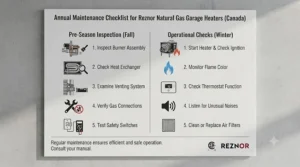
The actual installation sequence typically runs like this: a licensed technician calculates your gas load in BTUs, sizes and runs a dedicated gas line hookup for the garage (often the single biggest line item in your total install cost), mounts the heater according to the manufacturer’s clearance-to-combustibles specifications, connects the vent kit through your wall or roof per code, wires in the 115V electrical connection for power-vented units, and pressure-tests the whole system before signing off. A natural gas line extension for an appliance like this typically runs a few hundred dollars depending on the distance from your existing gas meter and whether the line needs to be routed through walls or underground, so get a firm quote before committing to a specific heater model. Common first-30-days mistakes: skipping the required clearance-to-combustibles distance around stored paint, solvents, or fuel; forgetting that power-vented units need a dedicated, code-compliant electrical circuit rather than an extension cord; and mounting height guesses that leave infrared units delivering patchy, uneven heat. Set a maintenance reminder for an annual inspection — cleaning the burner assembly, checking the vent termination for blockages, and testing the safety shut-off — and your heater will comfortably outlast its warranty.
Real-World Scenarios: Matching the Right Heater to Your Garage
Sizing advice lands better with a face attached to it, so here are three realistic profiles.
The weekend hobbyist in a 1-car garage: Working with roughly 250-300 square feet, standard 8-foot ceilings, and a heater that only needs to run a few evenings a week. The Williams Direct-Vent Furnace or the entry-level Mr. Heater Big Maxx MHU50 both fit comfortably here, and the Williams’ zero-electricity design is a nice bonus for anyone whose garage circuit is already maxed out with tools and a shop vac.
The family with a 2-car garage that doubles as a workshop: Around 500-600 square feet, a door that opens multiple times a day for vehicles, and a desire to keep the space usable through a full Canadian winter without a huge gas bill. The Mr. Heater Big Maxx MHU80 or the Modine Hot Dawg HD45 both size correctly here — the Modine if quiet operation and long-term durability matter more than upfront price, the Big Maxx if budget is the deciding factor.
The serious tradesperson running a heated 3-bay shop: 900+ square feet, daily door cycling, and equipment that genuinely needs a stable working temperature to function — paint curing, epoxy work, engine rebuilds. This is where the Mr. Heater Big Maxx MHU125, the Modine Hot Dawg HD75, or the radiant Calcana CAL-40A NG earn their higher price tags, each solving the fast-recovery problem in a slightly different way.
How to Choose a Natural Gas Garage Heater
- Measure your actual square footage and ceiling height first. BTU requirements scale directly with volume, not just floor area — a 12-foot ceiling needs meaningfully more output than an 8-foot one for the same footprint.
- Decide between forced-air and infrared before you compare brands. Forced-air heaters like the Mr. Heater Big Maxx and Modine Hot Dawg recover quickly after a door opens; radiant units like the Calcana CAL-40A NG hold heat in surfaces rather than air.
- Confirm your existing gas line can support the added load. A licensed technician needs to verify your meter and line size before you commit to a large-BTU unit.
- Check whether you need electricity-free operation. If outage resilience matters, the Williams Direct-Vent Furnace is the only model here that qualifies.
- Factor in venting costs, not just sticker price. Most forced-air units sell the heater and the vent kit separately — always price both together.
- Look at warranty length on the heat exchanger specifically. It’s the single most expensive part to replace and the best proxy for long-term build quality.
- Confirm CSA certification before you buy anything. It isn’t optional in Canada, and it directly affects whether an installer will legally hook the unit up.
Natural Gas Heater BTU Calculator for Garages
Sizing a natural gas garage heater correctly is genuinely the single highest-leverage decision in this whole process — oversizing wastes money and causes uncomfortable short-cycling, while undersizing leaves you running the heater constantly and still shivering. The rough industry formula contractors use as a starting point: multiply your garage’s square footage by 30 to 45 BTU per square foot for an average-insulation Canadian garage, adjusting upward for higher ceilings, poor insulation, or an especially cold climate zone, and downward for a well-insulated, tightly sealed space.
| Garage Size | Approx. Square Footage | Suggested BTU Range | Matching Products |
|---|---|---|---|
| 1-car | 250-300 sq ft | 25,000-35,000 BTU | Williams Direct-Vent Furnace |
| 1.5-car | 300-400 sq ft | 35,000-50,000 BTU | Mr. Heater Big Maxx MHU50, Modine Hot Dawg HD45 |
| 2-car | 400-550 sq ft | 50,000-80,000 BTU | Mr. Heater Big Maxx MHU80, Calcana CAL-40A NG |
| 3-car+ | 600-900+ sq ft | 80,000-125,000 BTU | Mr. Heater Big Maxx MHU125, Modine Hot Dawg HD75 |
This table is intentionally a starting point rather than a final answer — insulation quality, climate zone, ceiling height, and how often the bay door opens all shift the real number meaningfully. A poorly insulated 2-car garage in Winnipeg needs noticeably more BTU headroom than the same footprint in coastal British Columbia, which is exactly why a licensed installer’s heat-loss calculation should always have the final say over a rough table like this one.
Vented vs Unvented Natural Gas Garage Heaters
This distinction matters more than almost anything else in this guide, and it’s worth being direct about it: an unvented (ventless) natural gas heater releases its combustion byproducts — including carbon monoxide and moisture — directly into the room it’s heating, while a vented natural gas heater garage installation routes those byproducts safely outside through a dedicated flue. Every single product featured in this guide is a vented model, and that’s not a coincidence — it’s a deliberate editorial choice, because ventless gas heaters carry meaningfully higher carbon monoxide risk in an enclosed garage, especially one where a vehicle might also be running. All seven heaters above rely on either power-venting (the Mr. Heater Big Maxx and Modine Hot Dawg lines), direct venting through a sealed wall assembly (the Williams Direct-Vent Furnace), or sidewall/roof venting (the Calcana CAL-40A NG). The practical takeaway: if you see an unvented natural gas heater marketed for garage use, treat that as a red flag rather than a value opportunity, and always pair any gas appliance with a certified carbon monoxide detector regardless of venting type.
CSA Certification: What It Means for Your Garage Heater
CSA certification is not a marketing sticker — it’s a legal requirement for gas appliances sold and installed in Canada, and it’s worth understanding what it actually verifies. CSA Group’s B149.1 code, first published in 1958 and updated regularly since, provides detailed requirements for the installation and operation of natural gas and propane equipment, including appliances, piping systems, and venting components, and nearly two-thirds of Canadians rely on natural gas for space and water heating, which is exactly why this code exists and gets revised. A CSA-certified gas heater has been independently tested against this code for combustion safety, venting compatibility, and mechanical durability — it’s the certification your installer legally needs to see before they’ll connect the unit to your gas line, and it’s what your home insurer will ask about if you ever file a claim involving the appliance. Every product featured in this guide carries CSA certification, and honestly, that should be a non-negotiable filter on any natural gas garage heater shortlist, full stop — price and BTU output are worth debating, certification isn’t.
Long-Term Running Cost: Natural Gas vs Electric vs Propane
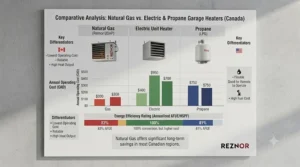
This is the section that actually determines whether your heater purchase pays for itself, and it’s also the section most product listings conveniently skip. Natural gas remains one of the more cost-stable heating fuels available to Canadian homeowners, largely because it’s delivered through fixed utility infrastructure rather than trucked in like propane, and its pricing is overseen federally. The Canada Energy Regulator, the federal agency responsible for regulating interprovincial and international oil, gas, and electric utilities, monitors these energy markets on an ongoing basis, which contributes to natural gas pricing being generally less volatile than propane, whose cost swings more with delivery logistics and seasonal demand spikes. In practical terms, running a properly sized natural gas garage heater for the average Canadian heating season typically costs meaningfully less per BTU delivered than an equivalent electric resistance heater, and often less than propane too, though your exact number depends on your local utility rate, your province, and how efficiently your specific unit is running. The honest ROI math: a higher-efficiency forced-air unit like the Modine Hot Dawg HD45 costs more upfront than a base-tier alternative, but that efficiency gap compounds every winter for the 10-15+ year lifespan a well-maintained heat exchanger can deliver, which is exactly the kind of total-cost-of-ownership thinking that separates a good garage heater decision from a merely cheap one.
Common Mistakes When Buying a Natural Gas Garage Heater
The same handful of errors show up again and again. First: buying based on price per BTU alone rather than matching output to actual square footage — an oversized heater short-cycles constantly and wears out its ignition components faster. Second: forgetting to budget for the vent kit, gas line hookup, and licensed labour, which combined often cost as much as the heater itself. Third: assuming a heater rated for the U.S. market is automatically compliant in Canada — always confirm CSA certification specifically, not just UL or ETL listing. Fourth: skipping the clearance-to-combustibles check around stored fuel, paint, or solvents, which is both a code violation and a genuine fire risk. Fifth: choosing a ventless model to save money upfront, a decision that trades long-term safety for a short-term discount that simply isn’t worth it in an enclosed space.
Frequently Asked Questions
❓ How many BTU do I need for a 2 car garage natural gas heater?
❓ Is a natural gas garage heater cheaper to run than electric?
❓ Do I need a permit for natural gas garage heater installation in Canada?
❓ Can I install a natural gas heater in an attached garage?
❓ What's the difference between a vented and unvented natural gas heater for a garage?
Conclusion
There’s no single “best” natural gas garage heater in this lineup — there’s a best one for your specific garage, and the honest answer depends on square footage, insulation, whether you need electricity-free backup heat, and how often that bay door swings open. For most Canadian two-car garages, the Mr. Heater Big Maxx MHU80 or the Modine Hot Dawg HD45 hit the sweet spot between price and performance. For outage resilience on a budget, the Williams Direct-Vent Furnace is genuinely unmatched. And for anyone chasing radiant comfort with Canadian manufacturing behind it, the Calcana CAL-40A NG is worth the premium. Whichever direction you go, don’t skip the sizing math, don’t skip CSA certification, and don’t skip the licensed installer — a natural gas garage heater is one appliance where cutting corners costs far more than it saves.
🔥 Ready to Stop Freezing in Your Own Garage?
🔍 Check current pricing and availability on any of the seven heaters above and see which one matches the BTU range your garage actually needs. Your future self, working on a project at 9pm in February, will thank you.
Recommended for You
- Gas Garage Heater Guide 2026: 7 Top Picks for Canadian Winters
- Wall Mount Garage Heater: 7 Top Picks for Canadian Garages (2026)
- Forced Air Garage Heater: 7 Best Picks Canadians Trust in 2026
Disclaimer: This article contains affiliate links. As an Amazon Associate, I earn from qualifying purchases. If you purchase products through these links, we may earn a small commission at no additional cost to you.
✨ Found this helpful? Share it with your friends! 💬🤗
