
In This Article
An electric garage heater is a fan-forced, radiant, or ceramic space heater built to warm a garage or workshop using standard household electricity instead of propane or natural gas. Most run on 120V or 240V circuits, and the right choice depends almost entirely on your garage’s size, insulation, and existing wiring. If you have ever stood in a January garage trying to bleed brake lines with fingers too stiff to hold a wrench, you already know why this matters more than any spec sheet suggests.

Here is the honest version of what nobody tells you at the hardware store: the heater is rarely the hard part. The circuit is. A 120V unit plugs into almost any outlet but tops out around 1,500 watts, which barely dents an uninsulated two-car garage on a windy Ontario night. A 240V unit can deliver three to seven times that output, but it usually needs a dedicated circuit an electrician has to install first. That single decision — plug-in convenience versus real heating power — shapes almost everything else in this guide.
Below, we break down 7 real, currently available electric garage heaters spanning budget ceramic units to premium two-stage 240V systems, explain exactly how many watts your specific garage size actually needs, and walk through the safety certifications the Canadian Standards Association requires before any of these products can legally be sold here. Every price below is shown as a range in Canadian dollars, since retailer pricing shifts constantly and Amazon.ca discourages listing exact figures. By the end, you should know not just which electric garage heater to buy, but which electrical setup you actually have to work with first.
Quick Comparison Table
| Heater | Voltage | Max Wattage | Best For |
|---|---|---|---|
| Fahrenheat FUH54 | 240V | 5,000W | Best value ceiling-mount |
| NewAir G56 | 240V | 5,600W | Best portable all-rounder |
| Dr. Infrared DR-988 | 240V | 5,600W | Best plug-in, no hardwiring |
| Comfort Zone CZ225ER | 240V | 6,000W | Best digital/smart control |
| King Electric KB ECO2S+ | 240V | up to 10,000W | Best for large or 3-car garages |
| Broan-NuTone 198 | 120V/240V | 4,000W | Best dual-voltage flexibility |
| Lasko Pro-Ceramic Utility | 120V | 1,500W | Best budget, no electrician needed |
Looking at the spread above, the split is really between plug-and-go 120V units that trade power for zero installation hassle, and true 240V workhorses that need an electrician but heat two to three times the space per dollar of running cost. The King Electric KB ECO2S+ sits well above the rest on raw output, which matters only if your garage is large, uninsulated, or both. Budget-conscious buyers should note that the Lasko Pro-Ceramic Utility Heater costs a fraction of the 240V units but is realistically a supplemental heater, not a primary one, for anything bigger than a single-car bay.
💬 Just one click — help others make better buying decisions too!😊
Top 7 Electric Garage Heaters: Expert Analysis
1. Fahrenheat FUH54 — best value ceiling-mounted 240V heater
The Fahrenheat FUH54 has become something of a default recommendation among garage-heater forums, and the reasoning holds up under scrutiny. It draws between 1,874W and 5,000W depending on how it is wired, on a 208/240V circuit, and delivers roughly 17,065 BTU at full output with a thermostat range of 45°F to 135°F. Ceiling mounting keeps floor space clear for a workbench or a vehicle lift, and the adjustable louvers let you aim airflow at a specific work zone rather than heating the whole volume of air evenly.
Based on the spec comparison with similar ceiling units, the FUH54’s fan-delay feature — which keeps the fan running briefly after the element shuts off — is a small but meaningful detail that squeezes extra heat out of every cycle rather than wasting it. Reviewers consistently report that it runs quieter than comparable forced-air units, though a handful mention the mounting bracket rattling slightly at full fan speed until tightened. It is best suited to a well-insulated single or two-car garage where a permanent, hardwired solution beats moving a portable unit around.
Pros:
- ✅ Quiet fan-forced operation for a hardwired unit
- ✅ Ceiling mount keeps garage floor space clear
- ✅ Adjustable louvers direct heat to the work area
Cons:
- ❌ Requires an electrician if no 240V circuit exists
- ❌ Struggles in poorly insulated or drafty garages
At a price generally in the C$300-C$400 range before installation, the Fahrenheat FUH54 delivers strong value per watt for anyone who already has, or is willing to install, a 240V circuit.
2. NewAir G56 — best portable all-rounder for renters and workshops
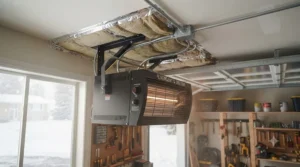
Unlike the ceiling-mounted FUH54, the NewAir G56 is fully portable — a steel-bodied unit with a carry handle and cord wrap that plugs into a 240V, 6-30R style outlet rather than being hardwired. At 5,600 watts, it produces roughly 19,000 BTU and is rated by the manufacturer to cover up to 800 square feet, though independent reviewers using it in real insulated two-car garages report more realistic coverage closer to 600 square feet.
What most buyers overlook about this model is that portability cuts both ways: you can move it between a garage, a shed, and a workshop as needed, but it also means the unit sits on the floor where sawdust, moisture, and foot traffic are more of a concern than with a ceiling-mounted design. The adjustable single-pole thermostat runs from 45°F to 95°F, which is a narrower range than the FUH54 but plenty for comfortable working temperatures. Aggregated review sentiment across retailer platforms is generally positive, with recurring praise for how evenly the fan distributes heat and recurring complaints about fan noise at full output in smaller enclosed spaces.
Pros:
- ✅ Fully portable between garage, shed, or workshop
- ✅ Plug-in 240V design avoids hardwiring labour
- ✅ UL-certified overheat protection and auto shut-off
Cons:
- ❌ Still needs a 240V outlet installed if none exists
- ❌ Noticeably loud on high fan speed in tight spaces
Priced typically in the C$280-C$360 range, the NewAir G56 is the heater to buy if you want 240V power without giving up the flexibility of a portable unit.
3. Dr. Infrared DR-988 — best plug-in hybrid radiant and forced-air heater
The Dr. Infrared DR-988 takes a genuinely different approach: it combines an infrared radiant element with a fan-forced air system in one 5,600-watt, 240V unit. The radiant side heats people and objects directly rather than just circulating warm air, which is why users often feel warmer faster than the thermostat reading alone would suggest. It comes with a NEMA 6-30P plug, meaning it is one of the few 240V garage heaters that plugs directly into a matching outlet without hardwiring — though that outlet itself still needs to be installed if your garage does not already have one.
Here’s what to weigh: in a well-insulated garage, the DR-988’s radiant-plus-forced-air combination genuinely outperforms straight forced-air units of similar wattage, because the radiant element keeps you comfortable even in the seconds before the air itself has fully warmed. In an uninsulated, drafty garage, though, several owners report it struggles against serious heat loss, particularly in extreme cold. The thermostat runs from 37°F to 113°F, a comfortable working range for most shop use.
Pros:
- ✅ Radiant plus forced-air combo feels warmer faster
- ✅ Comes with a plug — no hardwiring required
- ✅ Runs quieter than pure forced-air ceiling units
Cons:
- ❌ Needs a 30-amp 240V outlet already installed
- ❌ Underperforms in uninsulated or drafty garages
Expect to pay in the C$230-C$310 range, making the Dr. Infrared DR-988 a strong pick for anyone who wants radiant comfort without a hardwiring project.
4. Comfort Zone CZ225ER — best digital, remote-controlled ceiling heater
The Comfort Zone CZ225ER is a hard-wired, ceiling-mounted 240V heater rated at 6,000 watts, and it distinguishes itself with a digital thermostat, included remote control, and a 12-hour timer — features you will not find on most of the more mechanical units in this list. Overheat protection and a thermal cut-out switch are built in, meeting the safety expectations Canadian buyers should demand from any 240V appliance.
The spec sheet won’t tell you this, but the practical value of a remote and digital display becomes obvious the first time you need to adjust temperature from across a cold garage instead of walking over to a dial. Based on the feature set compared with mechanical-thermostat competitors like the FUH54, the CZ225ER trades a small premium in price for meaningfully better day-to-day usability, particularly for anyone running the heater on a schedule rather than manually each time. It is ETL compliant, which Canadian electrical inspectors generally recognize alongside CSA marks.
Pros:
- ✅ Digital thermostat with included remote control
- ✅ 12-hour timer for scheduled or unattended use
- ✅ Overheat protection and thermal cut-out switch
Cons:
- ❌ Hardwired installation only, no plug-in option
- ❌ Premium features add cost over mechanical units
Typically priced in the C$260-C$350 range, the Comfort Zone CZ225ER suits buyers who want set-it-and-forget-it convenience more than raw wattage.
5. King Electric KB ECO2S+ — best for large, three-car, or poorly insulated garages
When a garage is genuinely large, uninsulated, or both, the King Electric KB ECO2S+ is the heater reviewers point to most often. It scales up to 10,000 watts on a 240V circuit with two-stage electronic control, meaning it automatically uses only the wattage needed to hold a set temperature rather than running at full output constantly. A wireless remote sensor lets the thermostat read temperature from the coldest corner of the garage instead of wherever the unit itself is mounted.
Based on the spec comparison with single-stage 5,000-watt units, the two-stage design is what most buyers overlook as marketing fluff until they actually own one: it meaningfully reduces the on/off temperature swings that make a garage feel alternately too hot and too cold. Owners running this in three-car and even four-car insulated garages report consistent, even heat that smaller units simply cannot match. At 10,000W on 240V, this draws roughly 41.7 amps, so it requires a dedicated 50-amp circuit — this is not a casual weekend install, and a licensed electrician should handle it.
Pros:
- ✅ Two-stage control reduces temperature swings
- ✅ Remote sensor targets the garage’s coldest spot
- ✅ Scales to heat three- and four-car garages reliably
Cons:
- ❌ Requires a dedicated 50-amp circuit and electrician
- ❌ Significant upfront cost compared to smaller units
Priced in the C$1,900-C$2,600 range, the King Electric KB ECO2S+ is a premium investment best justified by genuinely large or cold spaces.
6. Broan-NuTone 198 — best dual-voltage flexibility for undecided buyers
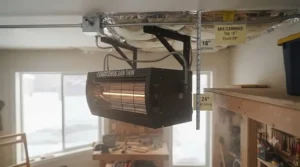
The Broan-NuTone 198 solves a specific problem: it can be wired for either a 120V circuit, where it draws up to 2,000 watts, or a 240V circuit, where it delivers its full 4,000-watt output. That flexibility makes it a genuinely useful option for anyone who is not yet sure whether they will commit to a 240V upgrade, since the same physical unit works either way. It is a wall-mounted, fan-forced design with a heavy-duty 18-gauge steel grille and downflow louvers that direct warm air toward the floor.
What most buyers overlook about dual-voltage units like this one is that the difference between the two wiring options is not small — running it on 120V effectively halves your available heat, so treat the 240V configuration as the “real” spec and the 120V mode as a stopgap rather than the intended use case. Reviewers who tested both configurations found the 120V mode produced noticeably weaker output, describing it as adequate for light supplemental use but not a primary heat source. The removable faceplate makes cleaning simple, a small but genuinely useful detail for a dusty garage environment.
Pros:
- ✅ Works on either 120V or 240V wiring
- ✅ Wall-mounted design saves ceiling and floor space
- ✅ Removable faceplate simplifies cleaning
Cons:
- ❌ 120V mode delivers roughly half the heat output
- ❌ Best performance still requires a 240V circuit
Generally priced in the C$150-C$220 range, the Broan-NuTone 198 works well as a bridge option for buyers weighing 240V vs 120V electric garage heater setups.
7. Lasko Pro-Ceramic Utility Heater — best budget pick, no electrician required
For garages that only need occasional supplemental heat, or for anyone unwilling to touch their electrical panel, the Lasko Pro-Ceramic Utility Heater is the practical entry point. It runs on a standard 120V household outlet, drawing 1,500 watts with two heat settings plus a fan-only mode, and features a pivoting head so you can aim warm air at a workbench rather than heating the whole garage evenly.
Reviewers consistently note that this heater is honest about its limitations: it is genuinely useful for taking the chill off a small, enclosed workshop or warming your feet at a workbench, but it is not designed to raise the temperature of a full two-car garage on a cold night, and buyers who expect that tend to leave disappointed reviews. The ETL-listed safety certification, cool-touch exterior, and automatic overheat protection make it a low-risk purchase, and its portability means it doubles as a supplemental heater in a basement or workshop outside of winter garage season.
Pros:
- ✅ Plugs into any standard outlet, no electrician needed
- ✅ ETL listed with overheat protection built in
- ✅ Pivoting head directs heat exactly where needed
Cons:
- ❌ 1,500W is not enough for a full-size garage
- ❌ Better suited to supplemental than primary heating
Usually priced under C$80, the Lasko Pro-Ceramic Utility Heater is the lowest-friction way to add electric heat to a small space today.
Practical Usage Guide: Setup, First 30 Days, and Maintenance
Getting a new electric garage heater right starts before you plug it in. First, confirm your circuit: 240V units need either a matching outlet (like the NEMA 6-30P the Dr. Infrared DR-988 uses) or hardwiring by a licensed electrician into a dedicated breaker sized to the heater’s amperage draw. Never assume an existing outlet is rated for it — mismatched amperage is a genuine fire risk, not a theoretical one.
Once installed, keep the first 30 days simple. Run the heater at a moderate setting rather than maxing it out immediately; this lets you notice unusual smells (a faint “burning dust” smell on first use is normal and should fade within 20-30 minutes as manufacturing residue burns off, but a persistent or worsening smell is not) and confirms the thermostat cycles correctly before winter fully sets in. Clear at least one metre of clearance from anything combustible, including parked vehicles with fuel residue nearby.
Maintenance afterward is minimal but not optional. Vacuum dust from intake grilles monthly during heavy use, since dust buildup is one of the most common causes of nuisance overheat shutoffs. Check that mounting brackets remain tight, particularly on portable units that get moved often, and inspect the power cord for any fraying each season before first use. A heater that has sat unused all summer deserves a visual inspection, not just a flip of the switch.
✨ Ready to stop shivering through winter projects?
🔍 Compare the 7 electric garage heaters above side by side and pick the one that actually matches your garage size and wiring. These picks will help you get real, comfortable warmth back into your workspace this winter!
Real-World Scenarios: Which Heater Fits Which Garage
Consider three common situations. First, a condo owner with an attached single-car garage and no existing 240V circuit, used mainly for hobby woodworking on weekends: the Lasko Pro-Ceramic Utility Heater or the 120V mode of the Broan-NuTone 198 makes sense here, since installing a dedicated 240V circuit for occasional weekend use rarely pays off financially.
Second, a homeowner with a detached, insulated two-car garage used as a home gym and workshop several times a week, who already has 240V service nearby for a welder or compressor: the NewAir G56 or Fahrenheat FUH54 fits well, delivering enough heat for regular use without the installation cost of the largest units.
Third, a tradesperson or serious hobbyist with an uninsulated three-car garage used daily through the winter for vehicle repair: this is exactly the scenario the King Electric KB ECO2S+ was built for, where the higher upfront and installation cost is offset by consistently reaching a workable temperature even against significant heat loss.
How to Choose an Electric Garage Heater
Choosing the right unit comes down to seven practical checks, in roughly this order of importance:
- Confirm your available circuit first. A 240V circuit unlocks every unit on this list; without one, your realistic options are 120V models like the Lasko Pro-Ceramic Utility Heater.
- Measure your garage’s square footage. Manufacturer coverage claims run optimistic, so plan for roughly 25-30% less real-world coverage than advertised.
- Assess insulation honestly. An insulated garage can run on the low end of wattage recommendations; an uninsulated one needs the high end or more.
- Decide portable versus hardwired. Portable units like the NewAir G56 offer flexibility; hardwired ceiling units like the Fahrenheat FUH54 free up floor space permanently.
- Check for CSA, cUL, or cETL certification. No electrical heating product should be purchased without one of these marks, full stop.
- Factor in installation cost, not just sticker price. A cheaper heater needing a new 240V circuit may cost more total than a pricier plug-in unit.
- Match the thermostat type to your habits. Digital and remote thermostats like on the Comfort Zone CZ225ER suit scheduled use; mechanical dials suit simple on/off use.
Watts to Heat Garage Size: How Much Power Do You Actually Need?
As a starting benchmark, uninsulated garages generally need about 10 watts per square foot, while well-insulated garages can often get by on 5-7 watts per square foot.
| Garage Size | Insulated (approx. watts) | Uninsulated (approx. watts) |
|---|---|---|
| Single-car (~200 sq ft) | 1,000-1,400W | 2,000W |
| Two-car (~400 sq ft) | 2,000-2,800W | 4,000W |
| Three-car (~600 sq ft) | 3,000-4,200W | 6,000W+ |
On paper, this means a two-car insulated garage is genuinely well served by a 5,000-6,000W unit like the Fahrenheat FUH54 or Comfort Zone CZ225ER, with headroom to spare rather than running flat-out constantly. An uninsulated three-car space, on the other hand, is precisely the scenario where undersized heaters disappoint owners the most, and where a two-stage unit like the King Electric KB ECO2S+ earns its higher price. Insulation quality matters as much as square footage here — a properly sealed and insulated garage door alone can meaningfully cut the wattage you actually need.
240V vs 120V Garage Heater: Which Should You Choose?
This is the single most consequential decision in this whole buying process, and it comes down to a straightforward tradeoff. A 120V circuit is what almost every garage already has, capped by a standard 15-20 amp breaker, which limits output to roughly 1,500-1,800 watts — enough for supplemental heat but rarely enough to be a primary heat source for a full garage. A 240V circuit, by contrast, doubles the voltage and typically allows 3,000 to 10,000+ watts depending on the breaker size, but very few garages have one already installed.
| Factor | 120V | 240V |
|---|---|---|
| Typical max output | ~1,500-1,800W | 3,000-10,000W+ |
| Installation | Plug into existing outlet | Often needs new circuit/electrician |
| Best for | Small spaces, supplemental heat | Full garage, primary heat source |
| Example from this list | Lasko Pro-Ceramic Utility Heater | King Electric KB ECO2S+ |
Based on the spec comparison, the honest advice is this: if your garage is under roughly 250 square feet and well insulated, a 120V unit may genuinely be enough, and the Broan-NuTone 198 even lets you start on 120V and upgrade to 240V wiring later without buying a new heater. For anything larger, or genuinely cold, budgeting for the 240V circuit upfront tends to save money over buying and returning an underpowered 120V unit first.
Top Rated Garage Heaters in Canada: What Reviewers Actually Say
Across retailer and forum reviews for the models covered here, a few patterns repeat often enough to be worth trusting. Reviewers consistently rate the Fahrenheat FUH54 and NewAir G56 highly for reliability over multiple winters, with complaints clustering around fan noise rather than heating failure — a fair tradeoff for most buyers. The King Electric KB ECO2S+ draws the strongest satisfaction scores among owners with large or uninsulated garages specifically, though it is rarely the “best” pick for anyone with a small, well-sealed space, where its extra capacity goes unused.
A common thread worth flagging: several reviewers who left three-star or lower ratings on 120V units did so because they expected full two-car garage coverage from 1,500 watts, which no manufacturer’s own specifications actually promise. This is less a product flaw than a mismatch between expectations and the physics of a standard household circuit, and it is exactly the kind of misunderstanding this guide aims to prevent before you buy rather than after.
Garage Heater Safety Features That Actually Matter
Not every safety feature marketed on a garage heater box carries equal weight. Overheat protection with an automatic shut-off — present on every product in this list — is non-negotiable; it is the feature that actually prevents fires when airflow is blocked or the unit is left running unattended. A cool-touch exterior matters more in a workshop with children or pets nearby than in a locked garage used only by adults.
Certification marks deserve more attention than most buyers give them. Health Canada advises checking for CSA, cUL, or cETL marks before buying any electrical product that plugs into an outlet, and portable electric heaters specifically should be kept at least one metre from combustible material and never plugged into an extension cord or power bar. A tip-over switch matters for portable floor units like the NewAir G56 far more than for ceiling-mounted models like the Fahrenheat FUH54, which cannot tip over in the first place. Fan-delay circuitry, found on several units here, is a subtler safety-adjacent feature: by keeping the fan running briefly after the element shuts off, it prevents residual heat from building up inside the housing.
Long-Term Cost & Maintenance
The purchase price is only the first line item. Installation for a 240V circuit typically runs an additional C$150-C$500 depending on how far the new circuit has to run from your electrical panel, and this cost applies once regardless of which 240V heater you eventually choose. Running costs then depend heavily on your provincial electricity rate and how insulated your garage is; as one energy analyst noted in CBC’s coverage of home heating costs, electric resistance heating like these units use is straightforward but not the cheapest per unit of heat compared to gas in provinces where gas is available.
A practical way to estimate ongoing cost: multiply the heater’s wattage by hours used, divide by 1,000 to get kWh, then multiply by your local rate per kWh. A 5,000W heater like the Fahrenheat FUH54 running two hours a day through a Canadian winter adds up meaningfully, but far less than running it constantly — which is exactly why thermostat-equipped units, especially two-stage designs like the King Electric KB ECO2S+, tend to pay back their higher purchase price through lower cumulative running costs. Maintenance costs stay low across this category; budget for nothing beyond occasional dust removal and, for hardwired units, an electrician’s inspection if you ever notice tripped breakers or unusual noise.
Common Mistakes When Buying an Electric Garage Heater
The single most common mistake is buying wattage based on the garage’s square footage alone while ignoring insulation, ceiling height, and how many garage doors are original single-pane steel with no weatherstripping. The second is assuming a 240V-rated heater will work acceptably on a 120V outlet through some kind of adapter; it will not, and attempting it is a safety hazard, not just a performance compromise.
A third recurring error is skipping the certification check entirely because a listing “looks legitimate” on a marketplace. The CSA Group’s electrical standards exist precisely because uncertified imports do circulate online, and installing one — especially on a 240V circuit — can create real liability and safety exposure. Finally, many buyers underestimate installation cost when comparing sticker prices between a cheaper hardwired unit and a pricier plug-in model, only to find the “cheaper” option costs more once an electrician’s invoice is added.
Frequently Asked Questions
❓ Do I need an electrician to install a 240V garage heater?
❓ Can I run a 240V garage heater on a 120V outlet with an adapter?
❓ How many watts do I need to heat a two-car garage in Canada?
❓ Are electric garage heaters expensive to run all winter?
❓ What certification should I look for on a garage heater sold in Canada?
Conclusion
Choosing the right electric garage heater really comes down to answering one question honestly before you even look at wattage: do you have, or are you willing to install, a 240V circuit? That single answer filters this entire list down to a manageable shortlist almost immediately. For most insulated two-car garages, something in the 5,000-6,000W range like the Fahrenheat FUH54 or NewAir G56 hits the sweet spot between heating power and installation cost. Larger or uninsulated spaces justify stepping up to the King Electric KB ECO2S+, while smaller spaces or renters unwilling to touch their electrical panel are well served by the Lasko Pro-Ceramic Utility Heater or the flexible Broan-NuTone 198.
Whichever you choose, prioritize genuine CSA, cUL, or cETL certification over marginal wattage differences between similar models — it is the one spec that protects your home, not just your comfort. With the right match between your garage’s size, insulation, and available circuit, a properly chosen electric garage heater turns a cold, avoided space back into one you actually want to spend time in this winter.
✨ Found the right electric garage heater for your space? Bookmark this guide and check current pricing before the first cold snap sells out the good units.
Recommended for You
- Oil and Water Containment Mat Garage: 7 Best Picks for 2026
- Garage Containment Mats for SUV: 7 Best Picks for 2026
- Salt Containment Mat Review Canada: 7 Top Picks for 2026
Disclaimer: This article contains affiliate links. As an Amazon Associate, I earn from qualifying purchases. If you purchase products through these links, we may earn a small commission at no additional cost to you.
✨ Found this helpful? Share it with your friends! 💬🤗
