
In This Article
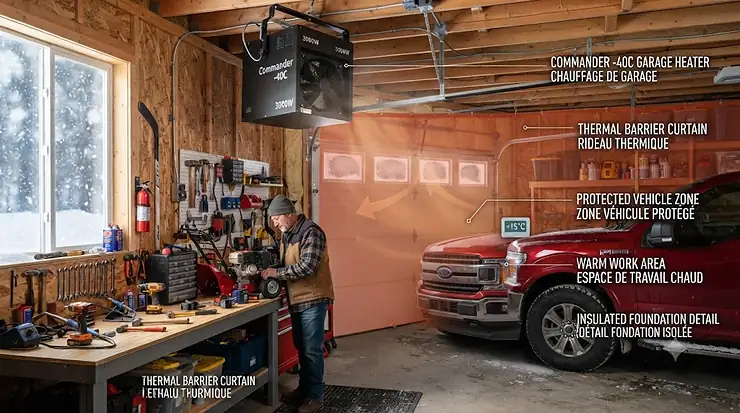
Somewhere around -30°C, your garage stops being a garage and turns into a walk-in freezer with a car parked in it. Tools crack. Grease seizes. Your breath hangs in the air like it’s plotting something. And if you’re shopping for a heater for garage -40c conditions, you already know the stakes: this isn’t about “cozy,” it’s about whether your space is usable at all between November and March. ❄️
Here’s the short answer, because you deserve one up front: no single heater “solves” -40°C on its own — the right pick depends on your fuel access, your garage’s insulation, and how much BTU headroom you actually need, which is typically 50-60 BTU per square foot for a poorly insulated space in true prairie cold, versus roughly 30 BTU per square foot for an insulated one. Everything below unpacks that math with real products.
Environment and Climate Change Canada treats wind chills near -40°C as an extreme cold warning threshold — the kind of event where frostbite becomes a ten-minute risk, not an overnight one. Your garage heater isn’t just comfort equipment at that point; it’s the difference between finishing a project and abandoning it halfway with numb fingers. We researched seven real, currently available heaters — electric, natural gas, and propane — priced and rated for the Canadian market, so you can pick based on your actual garage instead of a marketing photo of someone in a t-shirt working on a motorcycle in what is clearly not -40°C.
Quick Comparison Table
| Heater | Fuel Type | Heat Output | Best For | Price Range (CAD) |
|---|---|---|---|---|
| Dr. Infrared Heater DR-988 | Electric (240V) | ~19,000 BTU | Insulated 2-car garage, existing 240V | C$260-C$340 |
| NewAir G56 | Electric (240V) | ~19,100 BTU | Budget portable electric | C$230-C$300 |
| King Electric PKB-FM | Electric (240V) | Up to ~51,000 BTU equiv. | Uninsulated shop, no gas line | C$550-C$950 |
| Mr. Heater Big Maxx MHU80NG | Natural Gas | 80,000 BTU | Large 2-3 car detached garage | C$650-C$850 |
| Mr. Heater Big Maxx MHU50NG | Natural Gas | 50,000 BTU | Single-car detached garage | C$500-C$650 |
| Dyna-Glo Delux RMC-FA125DGD | Propane | 70,000-125,000 BTU | Ventilated pre-heat / job site | C$220-C$300 |
| Mr. Heater Portable Buddy (Canada Edition) | Propane | Up to ~9,000 BTU | Indoor-safe spot heat, backup | C$150-C$210 |
Looking at the spread above, the real split isn’t cheap-versus-expensive, it’s plugged-in versus piped-in versus tank-fed. The two 5,600-watt electrics (Dr. Infrared Heater DR-988 and NewAir G56) top out around 19,000 BTU no matter how you dress them up, which puts a hard ceiling on how much uninsulated square footage they can realistically fight in true prairie cold. The natural gas Big Maxx units and the propane Dyna-Glo Delux RMC-FA125DGD blow past that ceiling by 3-6x, but they demand infrastructure — a gas line, a vent, or at minimum a cracked door — that the plug-and-play electrics don’t.
💬 Just one click — help others make better buying decisions too!😊
Top 7 Heaters for Garage -40C: Expert Analysis
1. Dr. Infrared Heater DR-988 — near-instant heat for an insulated two-car bay
The standout here is speed: plug it into a dedicated 240V circuit and it starts pushing warm air within seconds, no pilot light, no waiting on a burner ramp-up. Under the hood it’s a 5,600-watt (4,800W if you’re on 208V) forced-air unit rated around 18,500-19,100 BTU, with an adjustable thermostat and a NEMA 6-30P plug that requires its own 30-amp 240V circuit — the same class of outlet your electric dryer uses, not a regular wall socket. That distinction matters more than the wattage number, because it means an electrician visit is often part of the real cost of ownership, not an optional upgrade.
Based on the spec comparison against similar 5,600W electrics, this is a genuinely capable secondary or primary heater for an insulated attached or detached garage, but at true -40°C ambient in an uninsulated space, 19,000 BTU is fighting a losing battle against heat loss — electric resistance heaters simply don’t have the BTU headroom that gas-fired units do. Owners on garage-enthusiast forums consistently report bringing an 800-square-foot shop from around 2°C to 16°C in 30-45 minutes, while also noting it behaves more like an “auxiliary” heater than a fast fix when starting from a truly frozen baseline below -1°C.
Pros:
- ✅ Clean, odorless electric heat with zero venting required
- ✅ Delayed fan start avoids blasting cold air on startup
- ✅ Wall or ceiling mountable to free up floor space
Cons:
- ❌ Requires a dedicated 240V/30A circuit most garages don’t already have
- ❌ BTU ceiling is modest for a genuinely uninsulated -40°C space
At around C$260-C$340, the Dr. Infrared Heater DR-988 is strong value only if 240V power is already sitting in your garage — factor in electrician costs before comparing it head-to-head with gas options.
2. NewAir G56 — budget-friendly plug-in workhorse
The short version: this is nearly the same heater as the DR-988 for less money, which is either a great deal or a sign the DR-988’s premium isn’t buying much — depending on how you look at it. It shares the same 240V/5,600-watt/23.4-amp architecture, the same roughly 19,107 BTU output, and the same NEMA 6-30R plug requirement, but ships in a lighter, more overtly portable 16.6-pound steel body with a simple manual thermostat dial running 45-95°F.
What most buyers overlook about this model is that its marketed “800 square feet” coverage claim assumes a mild, well-insulated space near room temperature — not a detached, uninsulated garage at -40°C wind chill, where realistic effective coverage shrinks dramatically. Reviewers consistently note the plug-and-play simplicity as the biggest selling point, alongside occasional mentions of a loud fan cycle on the “on” setting versus “auto.” As with any resistance-electric unit, don’t expect it to out-punch a gas heater at the coldest end of the Prairie temperature range.
Pros:
- ✅ Lower price point than comparable hardwired electric models
- ✅ Genuinely portable with a built-in carry handle
- ✅ Simple single-dial thermostat, no learning curve
Cons:
- ❌ Marketed coverage area is optimistic for true extreme-cold use
- ❌ Same demanding 240V/30A dedicated circuit as pricier rivals
Priced around C$230-C$300, the NewAir G56 earns its spot as the budget pick among electrics — just don’t expect it to punch above its 19,000-BTU weight class.
3. King Electric PKB-FM — commercial-grade power for uninsulated shops
Here’s where electric heating stops apologizing for itself. The King Electric PKB-FM line is field-selectable from roughly 5,000 watts up to 15,000 watts depending on the model size you order, and at the top end that works out to somewhere near 51,000 BTU equivalent — nearly triple what the two smaller electrics on this list can muster, while still avoiding gas lines and venting entirely.
That extra capacity comes from spiral-finned steel heating elements and a heavier-duty 20-gauge steel enclosure, built to the kind of “made in America, jobsite-tough” spec sheet you’d expect on a commercial unit rather than a hardware-store impulse buy. Here’s what to weigh: pushing 15,000 watts through a standard residential panel usually means an electrical service upgrade, since that draws roughly 62 amps at 240V — well beyond a typical dryer circuit. We couldn’t verify a meaningful pool of individual consumer star-ratings for this model, since it’s sold primarily through commercial HVAC and industrial suppliers rather than typical online retail; what is verifiable is the build spec itself, which includes an epoxy-coated motor, automatic overheat shutoff, and a non-mercury tip-over switch.
Pros:
- ✅ Scalable wattage across the lineup fits multiple garage sizes
- ✅ Rugged 20-gauge steel construction built for jobsite abuse
- ✅ Automatic overheat shutoff plus tip-over safety switch
Cons:
- ❌ Top-wattage models likely require an electrical panel upgrade
- ❌ Premium pricing compared to residential-grade electric heaters
Expect a price range of roughly C$550-C$950 depending on the wattage tier, making the King Electric PKB-FM the go-to when you want gas-heater output without the gas line.
4. Mr. Heater Big Maxx MHU80NG — whole-garage warmth on piped natural gas
If your garage already has a natural gas line run to it, this is the ceiling-mounted answer to -40°C. The 80,000 BTU output dwarfs anything electric on this list, and because combustion — not electric resistance — is doing the heavy lifting, the unit only draws a modest 115V for its fan and spark ignition rather than a heavy-duty 240V circuit. That’s a meaningful practical difference: big heat without touching your electrical panel.
What the spec sheet won’t tell you is that “80,000 BTU heats up to 2,000 sq ft” assumes a reasonably sealed, moderately insulated building — in a genuinely draughty, uninsulated detached garage at -40°C, plan for real coverage closer to half that. Installation requires an 8-foot minimum ceiling clearance and professional gas-line and venting work, since it can be vented either vertically or horizontally depending on your building’s layout. Aggregated buyer feedback on the smaller MHU50NG sibling (same platform, half the BTU) sits around 4.2 to 4.5 out of 5 stars across roughly two dozen ratings, with quiet fan operation the most frequently repeated compliment, alongside a few first-time buyers noting the gas-fitting install cost caught them off guard.
Pros:
- ✅ Massive 80,000 BTU output for large detached garages
- ✅ Low-profile design fits buildings with limited ceiling height
- ✅ Includes a natural-gas-to-propane conversion kit for flexibility
Cons:
- ❌ Requires professional gas line and venting installation
- ❌ Overkill capacity — and cost — for a single-car garage
At roughly C$650-C$850 for the unit alone (installation is a separate cost, often another C$300-C$800), the Mr. Heater Big Maxx MHU80NG is the serious answer for a two-to-three-car space that needs to stay warm all winter, not just during a work session.
5. Mr. Heater Big Maxx MHU50NG — right-sized natural gas for a single-car bay
Think of this as the Big Maxx MHU80NG‘s smaller, more sensible sibling. Same spark-ignition, self-diagnostic control module, same low-profile ceiling-mount design requiring only about an inch of clearance — just scaled down to 50,000 BTU and roughly 1,250-1,667 square feet of rated coverage, which lines up far better with a single-car or modest two-car detached garage than its bigger sibling does.
The practical upside of “right-sizing” isn’t just sticker price — a smaller BTU draw generally means a smaller gas meter capacity requirement and a marginally cheaper install, since you’re not over-provisioning a line for heat output you’ll never use in a smaller space. On paper this means lower upfront and ongoing cost for anyone whose garage genuinely doesn’t need 80,000 BTU of firepower. Aggregated review data for this model shows the same roughly 4.2-star average across about 26 ratings as its bigger sibling, with quiet operation again the standout praise point and no significant recurring complaint pattern beyond the usual “thermostat sold separately” surprise.
Pros:
- ✅ Sized appropriately to avoid overpaying for unused BTU capacity
- ✅ Quiet high-velocity fan distributes heat evenly
- ✅ Includes natural-gas-to-propane conversion kit
Cons:
- ❌ Still requires professional gas line and venting installation
- ❌ Thermostat is sold as a separate accessory
Priced around C$500-C$650, the Mr. Heater Big Maxx MHU50NG is the value-conscious pick for anyone with gas access and a garage under roughly 500 square feet.
6. Dyna-Glo Delux RMC-FA125DGD — biggest BTU-per-dollar propane blast
Nothing else on this list gets you this much raw heat for this little money. The Dyna-Glo Delux RMC-FA125DGD is a continuously variable 70,000-125,000 BTU forced-air propane heater that weighs under 20 pounds, connects to a standard propane tank via an included hose and regulator, and can run anywhere from 4.5 to 30 hours depending on tank size and the output level you dial in.
Here’s the critical distinction reviewers and spec sheets alike are clear about: this is a construction-site-style heater, not an indoor-safe appliance. It’s built for ventilated use — door cracked, exhaust fan running, or genuinely open-air job sites — rather than sealed, unattended operation in an occupied garage. Based on the spec comparison, the smartest use case is pre-heating a detached, uninsulated garage for twenty or thirty minutes before you start working, then either shutting it off or keeping ventilation active throughout. Aggregated buyer commentary across retailer listings consistently flags the light weight and fast hose-and-regulator setup as the standout, but it is honestly not marketed or reviewed as suitable for enclosed unattended use, and treating it that way would be a genuine safety mistake.
Pros:
- ✅ Enormous, continuously adjustable 70,000-125,000 BTU range
- ✅ Lightweight and genuinely portable at under 20 pounds
- ✅ Fast setup with included hose and regulator
Cons:
- ❌ Requires active ventilation, not rated for sealed unattended use
- ❌ Propane tank costs add up fast under heavy winter use
At around C$220-C$300 for the unit (tank and regulator sometimes bundled, sometimes not), the Dyna-Glo Delux RMC-FA125DGD is the cheapest way to summon serious BTU — provided you respect the ventilation requirement every single time.
7. Mr. Heater Portable Buddy (Canada Edition) — grab-and-go indoor-safe propane spot heat
Every list like this needs a “just keep it in the trunk” option, and this is it. The Canadian-approved Portable Buddy line runs a lower BTU ceiling than the U.S.-market Big Buddy (which, worth noting honestly, is not sold in Canada due to differing safety certification requirements), typically topping out in the 4,000-9,000 BTU range depending on the exact model, with an oxygen depletion sensor (ODS) and automatic tip-over shutoff built in.
The ODS is the feature that actually matters here: it’s engineered to shut the heater down before oxygen levels in a small, enclosed space drop to dangerous levels, which is a fundamentally different safety design than the ventilation-dependent Dyna-Glo unit above. What most buyers overlook is that this lower BTU ceiling — a direct result of the safety certification that lets it operate indoor-safe at all — means it’s realistically a spot-heat or backup tool, not a primary heat source for a full uninsulated garage at -40°C. Aggregated reviews of the Buddy heater family commonly praise the reliable piezo ignition and safety shutoffs, while cold-climate users candidly note that a single small unit warms a person, not a whole single-car bay, at genuinely extreme temperatures.
Pros:
- ✅ Indoor-safe with oxygen depletion sensor and tip-over shutoff
- ✅ Zero installation — connect a cylinder and go
- ✅ Portable enough to double as a cabin or job-site heater
Cons:
- ❌ Modest BTU ceiling compared to piped or hardwired options here
- ❌ Small cylinders need frequent swapping for extended sessions
At roughly C$150-C$210, the Mr. Heater Portable Buddy (Canada Edition) is the backup every garage should own, even if it’s not your daily driver.
Full Spec, Price & Best-For Comparison
| Heater | Voltage/Fuel Draw | Install Complexity | Runs Unattended? | Best For |
|---|---|---|---|---|
| Dr. Infrared Heater DR-988 | 240V/30A | Moderate (dedicated circuit) | Yes | Insulated garage, existing 240V |
| NewAir G56 | 240V/24A | Moderate (dedicated circuit) | Yes | Portable budget electric |
| King Electric PKB-FM | 240V, up to ~62A | High (possible panel upgrade) | Yes | Large uninsulated shop, no gas |
| Mr. Heater Big Maxx MHU80NG | 115V + gas line | High (professional install) | Yes | 2-3 car detached garage |
| Mr. Heater Big Maxx MHU50NG | 115V + gas line | High (professional install) | Yes | Single-car detached garage |
| Dyna-Glo Delux RMC-FA125DGD | Propane tank | Low (hose/regulator) | No — ventilation required | Pre-heat, job site use |
| Mr. Heater Portable Buddy (Canada Edition) | Propane cylinder | None | Yes (indoor-safe) | Backup spot heat |
The pattern in this table is really about trade-offs, not winners. Both Big Maxx models and the King Electric PKB-FM can run unattended safely because their combustion or heating elements are engineered and vented (or fully enclosed) for that; the Dyna-Glo Delux RMC-FA125DGD cannot, no matter how tempting it is to just leave it running while you grab coffee. If “install complexity” is your limiting factor rather than budget, the two 240V electrics sit in a sweet spot — real power without a gas-fitter on speed dial, so long as an electrician has already sorted your circuit.
🔍 Compare Real Options Before the Next Cold Snap Hits
See current availability and verified specs for each pick above — click through, check today’s price, and grab the one that actually matches your garage before the next extreme cold warning rolls in.
Practical Usage Guide: Setting Up Any Heater for Garage -40C the Right Way
Buying the right heater for garage -40c conditions is maybe 60% of the battle — installation and first-use habits are the other 40%, and they’re where most people lose the heat they paid for. Start with clearance: every unit heater and electric forced-air heater on this list has a minimum mounting clearance (commonly 8 feet from floor for ceiling-mounted gas units, and manufacturer-specified distances from combustibles for electrics), and skipping that spec is the single most common install mistake.
For gas-fired units like the Mr. Heater Big Maxx models, budget for a licensed gas fitter, not a weekend DIY job — Canadian gas codes require it, and getting it wrong risks both safety and insurance coverage. For the electric options, confirm your panel has spare capacity before an electrician quotes the job; a 30-amp 240V circuit for the Dr. Infrared Heater DR-988 or NewAir G56 is a meaningfully bigger ask than a standard 15-amp outlet. During the first 30 days, run the heater on a lower thermostat setting overnight if the garage is occupied by a vehicle, since rapid temperature swings on cold metal and glass can cause condensation — and condensation in a Canadian winter garage means ice by morning.
A quick maintenance habit that pays off all season: vacuum intake grilles monthly on electric units, and have gas units inspected annually by the installing technician, since carbon monoxide risk rises with poorly maintained combustion appliances far more than with a well-maintained one. Optimization trick worth stealing from contractors: run any forced-air unit for 15-20 minutes before you start working, rather than trying to heat and work simultaneously — you’ll use less total fuel or electricity reaching a stable temperature than fighting constant heat loss while the garage door cycles open and closed.
Heater for Unheated Garage Winter: Real-World Scenarios
Matching a heater to your actual life matters more than matching it to a spec sheet, so here are three genuinely different Canadian garage situations and the reasoning behind each pick.
The apartment-adjacent single-car garage in Winnipeg: no gas line, no interest in one, occasional weekend wrenching. Here, a heater for unheated garage winter use really comes down to the NewAir G56 for planned sessions plus the Mr. Heater Portable Buddy (Canada Edition) for the fifteen minutes it takes to grab winter tires — cheap, no installation, and realistic about the space’s occasional-use pattern.
The detached two-car workshop garage outside Saskatoon, used most weekends all winter: this is where the math shifts toward natural gas if the line is available, since regular multi-hour use over a full prairie winter makes the Mr. Heater Big Maxx MHU50NG‘s lower running cost outweigh its higher install cost within a season or two of heavy use.
The uninsulated pole-barn-style garage near Red Deer used for occasional big jobs: here, ventilated pre-heat with the Dyna-Glo Delux RMC-FA125DGD followed by the King Electric PKB-FM for sustained work makes more sense than committing to a gas line for a space used only a handful of times a month.
Common Extreme-Cold Heating Problems (And Real Fixes)
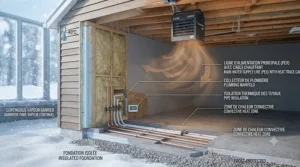
Problem: the heater runs constantly but the garage never gets comfortable. This is almost always an insulation or air-sealing issue, not a heater-capacity issue — check weatherstripping around the garage door first, since that single gap often accounts for more heat loss than an underpowered unit.
Problem: condensation forming on tools and the vehicle after heating sessions. Cycle a lower, steadier temperature rather than blasting high heat for short bursts; the Dr. Infrared Heater DR-988 and NewAir G56‘s thermostats both support this if you set them and leave them rather than manually cranking to max each time.
Problem: gas smell or unusual odour near a natural gas unit heater. Shut off the gas supply, ventilate immediately, and call your gas utility’s emergency line before troubleshooting anything yourself — this isn’t a DIY situation under any circumstances.
Problem: propane forced-air heater struggling in genuinely sub -30°C conditions. Propane vapour pressure drops as tank temperature falls, which can starve a forced-air unit like the Dyna-Glo Delux RMC-FA125DGD of fuel flow; keeping the tank slightly warmer (never near the heater itself) or switching to a larger tank often resolves it.
Problem: electric heater trips the breaker repeatedly. This usually means the circuit wasn’t sized correctly for the unit’s amperage draw — the King Electric PKB-FM at its higher wattage settings is a common culprit if installed on an undersized breaker, and it needs a proper electrician review, not a bigger fuse.
How to Choose a Garage Heater for Extreme Cold Canada Conditions
- Confirm your fuel access first. Natural gas beats propane on running cost, and both beat electric resistance heat on raw BTU-per-dollar — but only if the infrastructure already exists or is affordable to add.
- Measure your garage, then measure it again. Square footage alone undersells the problem; ceiling height and insulation level change the real BTU requirement more than most buyers expect.
- Decide if the heater needs to run unattended. This single question eliminates ventilated-only units like the Dyna-Glo Delux RMC-FA125DGD for anyone wanting to leave a heater running while working elsewhere in the garage.
- Check your electrical panel capacity before falling in love with an electric unit. A 240V/30A circuit is a real ask, and the King Electric PKB-FM‘s higher wattage tiers ask for even more.
- Budget for installation, not just the unit price. Gas and high-wattage electric heaters both typically cost more to install than to buy.
- Prioritize safety certification for anything running indoors. CSA or ULC certification, an oxygen depletion sensor on propane units, and overheat protection on electrics aren’t optional extras.
- Buy slightly more BTU capacity than your calculation suggests, since -40°C wind chill events push real-world heat loss above textbook averages.
BTU Calculation for -40C Garage: The Real Math
Here’s the direct answer for search engines and impatient readers alike: for a poorly insulated garage in genuinely extreme cold, plan for 50-60 BTU per square foot; for a well-insulated garage, 30 BTU per square foot is a more realistic starting point — then round up, not down.
| Garage Size | Insulated (30 BTU/sq ft) | Uninsulated, -40C (55 BTU/sq ft) |
|---|---|---|
| 250 sq ft (1-car) | 7,500 BTU | 13,750 BTU |
| 500 sq ft (2-car) | 15,000 BTU | 27,500 BTU |
| 750 sq ft (2.5-car/workshop) | 22,500 BTU | 41,250 BTU |
| 1,000 sq ft (3-car) | 30,000 BTU | 55,000 BTU |
The jump between the insulated and uninsulated columns is the whole story of this article in table form: a 500-square-foot uninsulated garage at -40°C wind chill needs nearly double the BTU of the same space with decent insulation, which is exactly why an insulated garage can run comfortably on the Dr. Infrared Heater DR-988‘s roughly 19,000 BTU while an equivalent uninsulated space genuinely can’t. If your real-world number lands above what an electric unit can deliver, that’s your signal to look seriously at the Big Maxx natural gas line or the King Electric PKB-FM‘s top wattage tier instead of forcing an underpowered plug-in to work overtime.
Insulated vs Uninsulated Garage Heating: Which One Changes Your Whole Heater Choice
This comparison matters more than almost any spec on this page, because insulation status doesn’t just change how comfortable your garage feels — it changes which category of heater is even viable. An insulated garage retains heat well enough that a 19,000-BTU electric unit like the NewAir G56 can realistically hold a stable temperature through a -40°C night, cycling on and off rather than running flat-out constantly.
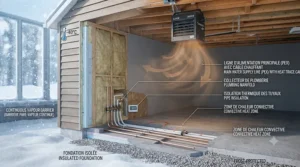
An uninsulated garage, by contrast, is essentially heating the outdoors with extra steps — heat generated indoors bleeds out through the walls, door, and often an unfinished ceiling almost as fast as it’s produced. In that scenario, even the Mr. Heater Big Maxx MHU80NG‘s 80,000 BTU output is working harder than its rated square footage would suggest, and the ventilated Dyna-Glo Delux RMC-FA125DGD‘s pre-heat approach — blast it hot for thirty minutes, then work in the residual warmth — often makes more practical sense than trying to hold a constant temperature all day. If insulation upgrades are on the table at all, even basic measures like weatherstripping the garage door and insulating an attic hatch typically deliver a better return than jumping to a bigger heater.
Cold Start Heater Performance: What Actually Happens at -40C
“Cold start” performance — how a heater behaves when both the garage and the heater itself have been sitting at -40°C — is where marketing claims and reality diverge the most. Gas-fired units like the Big Maxx MHU80NG generally cold-start reliably because spark ignition doesn’t care much about ambient temperature, though the fan and controls do draw on a standard 115V circuit that performs normally regardless of cold.
Propane units are the ones to watch here: liquid propane’s vapour pressure drops as the tank itself gets cold, and at genuinely extreme temperatures a tank that’s been sitting outside overnight can struggle to feed a forced-air unit like the Dyna-Glo Delux RMC-FA125DGD at full output until it warms slightly — a detail that matters for anyone expecting instant full-BTU performance the moment they open the valve. Electric resistance heaters like the Dr. Infrared Heater DR-988 and NewAir G56 don’t have a “cold start” problem in the fuel-delivery sense, but their heating elements do take a short warm-up period before output ramps to full wattage, and reviewers note the delayed-fan-start feature specifically exists to avoid blowing genuinely cold air during that first minute rather than warm air prematurely.
Best Heater Prairie Winters: Matching the Heat Source to Alberta, Saskatchewan and Manitoba Garages
Prairie winters bring a particular combination that other regions don’t deal with as often: extended multi-day cold snaps rather than isolated cold nights, frequently paired with wind that turns an already brutal air temperature into an even worse wind chill. Extreme cold warnings across Saskatchewan and Manitoba routinely cite wind chill values near -40°C lasting well into the following day, which is a meaningfully different heating challenge than a brief overnight dip.
For that pattern — sustained cold over days, not hours — running cost and reliability matter more than raw speed, which tilts the calculus toward the Mr. Heater Big Maxx models for anyone with gas access, since natural gas pricing across the prairie provinces is typically the cheapest per-BTU option available. Rural or acreage garages without a gas line, which describes a huge share of prairie properties, are the strongest real-world case for the King Electric PKB-FM‘s higher wattage tiers, since running an electric heater for days at a time without combustion venting concerns simplifies a genuinely tricky rural heating situation. Keep the Mr. Heater Portable Buddy (Canada Edition) in the truck regardless of which primary heater you choose — a multi-day prairie cold snap is exactly the scenario where a stalled vehicle or a farm-yard emergency makes a grab-and-go indoor-safe heater worth its modest price many times over.
Safety, Regulations & Carbon Monoxide Compliance for Garage Heaters
Every combustion heater on this list — the two Big Maxx natural gas units and the Dyna-Glo Delux RMC-FA125DGD propane heater — produces carbon monoxide as a byproduct, and Canadian health authorities are consistent on this point: a working, Canadian-certified carbon monoxide alarm belongs in any structure using fuel-burning heating equipment, garages included, and it should be tested regularly rather than installed and forgotten. Look specifically for CSA or ULC certification on any heater or detector you buy, since that’s the recognized safety-agency standard referenced by propane and gas industry bodies across Canada.
Installation compliance matters just as much as the appliance itself. Natural gas unit heaters like the Big Maxx MHU80NG and MHU50NG require licensed gas-fitter installation to meet provincial gas codes — this isn’t a suggestion, it’s a legal requirement in every Canadian province, and skipping it can void both manufacturer warranty and home insurance coverage. Ventilated-only units like the Dyna-Glo Delux RMC-FA125DGD should never be run in a sealed, unattended garage regardless of how tempting that is on the coldest days; that’s precisely the DIY-installation and improper-use pattern that Canadian safety investigators have flagged after fatal incidents involving improperly used propane appliances. When in doubt, treat the manufacturer’s clearance, ventilation, and certification requirements as non-negotiable, not as fine print.
Long-Term Cost & Maintenance: What a Winter of -40C Heating Actually Costs
Sticker price is a small fraction of what any of these heaters cost over a full Canadian winter, and the fuel-type differences compound fast. A natural gas unit like the Mr. Heater Big Maxx MHU50NG, run several hours per weekend across a full prairie winter, typically lands as the cheapest per-BTU option in provinces with piped gas access, though the upfront install cost takes a season or two of heavy use to fully offset against a cheaper electric alternative.
Propane running cost sits noticeably higher than natural gas per BTU delivered, which matters for anyone using the Dyna-Glo Delux RMC-FA125DGD regularly rather than occasionally — a heavy-use winter can mean multiple large propane tank refills, and that ongoing cost should factor into any comparison against a one-time gas-line installation. Electric options like the Dr. Infrared Heater DR-988, NewAir G56, and King Electric PKB-FM carry no fuel-delivery logistics at all, but electricity pricing varies significantly by province, and in regions where electricity is comparatively expensive relative to natural gas, a high-wattage electric heater run for hours at a time can rival or exceed gas running costs despite its simpler installation. Maintenance costs stay modest across the board if you follow basic upkeep — annual gas-appliance inspections, monthly filter or intake cleaning on electrics — but skipping that upkeep is where small problems on any of these units become expensive ones.
✨ Ready to Stop Fighting the Cold?
🔥 Compare current pricing and availability on the pick that matches your garage size and fuel access. A few minutes now beats another weekend working in mitts.
Frequently Asked Questions
❓ What size heater do I need for a 2-car garage at -40C?
❓ Can I run a propane heater indoors safely in a garage?
❓ Is electric or natural gas cheaper to run a garage heater in Canada?
❓ Do I need a permit to install a natural gas garage heater?
❓ Will a garage heater keep pipes from freezing at -40C?
Conclusion
There’s no single “best” heater for garage -40c conditions — there’s only the best heater for your specific garage, fuel access, and how you actually use the space. If you’ve already got 240V power and decent insulation, the Dr. Infrared Heater DR-988 or budget-friendly NewAir G56 will genuinely carry you through most of the season. If natural gas is piped to your property, the Mr. Heater Big Maxx lineup delivers the BTU headroom that true prairie winters demand, sized to match a single bay or a full three-car shop. Uninsulated, off-grid, or occasional-use spaces lean toward the King Electric PKB-FM or a ventilated pre-heat routine with the Dyna-Glo Delux RMC-FA125DGD, and every single garage — regardless of primary heater — benefits from keeping a Mr. Heater Portable Buddy (Canada Edition) on hand for the fifteen-minute emergencies that -40°C weather has a habit of creating.
Whatever you choose, treat installation, ventilation, and carbon monoxide safety as the non-negotiable part of the purchase, not an afterthought. A heater that’s correctly sized and correctly installed will earn its keep for years; one that’s undersized or improperly vented will disappoint you exactly when you need it most — on the coldest night of the year.
🚀 Find Your Match Before the Next Cold Snap
Don’t wait for the next extreme cold warning to start shopping. Check current pricing and availability on today’s pick, and get your garage winter-ready while there’s still time to install it properly.
Recommended for You
- Electric Garage Heater Canada 2026: 7 Top Rated Picks That Work
- Oil and Water Containment Mat Garage: 7 Best Picks for 2026
- Garage Containment Mats for SUV: 7 Best Picks for 2026
Disclaimer: This article contains affiliate links. As an Amazon Associate, I earn from qualifying purchases. If you purchase products through these links, we may earn a small commission at no additional cost to you.
✨ Found this helpful? Share it with your friends! 💬🤗
