
In This Article
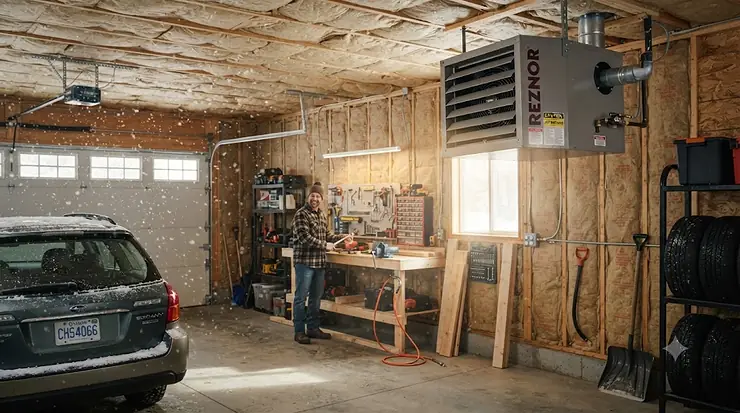
Winter in a Canadian garage has a particular kind of cruelty. Your hands go numb halfway through an oil change, the paint won’t cure, and your dog refuses to come keep you company. A forced air garage heater is an electric or fuel-fired unit that uses a built-in fan to actively push heated air across a space, rather than letting warmth drift upward on its own the way a radiant panel does. That distinction matters more than it sounds like it should — forced air fills a whole two-car garage with even warmth in minutes, while other heater types leave you standing in one warm patch surrounded by a cold shop.
This guide is built around the two questions that actually decide whether you’ll be happy with your purchase: how much heat do you need (BTU and wattage), and how will you move it around the room (CFM and mounting style). We’ll walk through seven real, currently available models spanning budget portables to serious three-car-garage units, break down the difference between a forced air electric heater and its infrared and gas-fired cousins, and cover the parts nobody talks about — noise levels, mounting headaches, and what a Canadian electrician actually needs to know before you plug one in. Per the Standards Council of Canada’s electric air-heater standard, CSA certification specifically covers forced air units, so we’ll flag that throughout too.
By the end, you’ll know exactly which of these seven forced air garage heater options fits your space, your panel, and your patience for installation day.
Quick Comparison Table
Before the deep dive, here’s the short version for anyone standing in a cold garage right now, phone in hand, trying to make a fast decision.
| Product | Wattage / BTU | Coverage | Mount Type | Best For |
|---|---|---|---|---|
| King Electric PSH2440TB | 3,750W / ~12,800 BTU | Up to 500 sq ft | Portable / wall / ceiling | Tightest budget |
| Dura Heat EUH4000 | 4,000W / 12,800 BTU | Up to 500 sq ft | Wall / ceiling hardwired | Simple one-car setup |
| King KB2405-1-ECO2S-PLUS | 5,000W / ~17,000 BTU | Up to 450 sq ft | Ceiling / wall bracket | Smart 2-stage control |
| Comfort Zone CZ230ER | 7,500W / 25,600 BTU | Up to 1,250 sq ft | Ceiling mount only | Two-and-a-half car garage |
| DR. Infrared Heater DR-975 | 7,500W | Large workshop | Wall / ceiling hardwired | Rugged daily workshop use |
| King KB2410-1-ECO2S-PLUS | 10,000W / ~34,100 BTU | Up to 900 sq ft | Ceiling / wall bracket | Three-car / poorly insulated |
| TEMPWARE Digital Fan Forced | ~7,500W / 25,590 BTU | Up to 1,250 sq ft | Ceiling mount | Tech-forward remote control |
Looking at the spread above, the jump from the King Electric PSH2440TB to the King KB2410-1-ECO2S-PLUS isn’t just a wattage bump — it’s the difference between a heater that fights a small insulated bay and one that’s rated for an entire uninsulated three-car shop. Notice how coverage claims roughly double every time wattage climbs by 3,000-5,000W, which tracks with how BTU output scales in this category. If your garage sits between two coverage tiers, size up rather than down; forced air units that run constantly at full output work harder and louder than ones with headroom to spare.
💬 Just one click — help others make better buying decisions too!😊
Top 7 Forced Air Garage Heaters: Expert Analysis
Every product below made this list because it’s a real, currently sold unit with verifiable specifications — no filler, no invented models. We’ve grouped them loosely from budget to premium, but coverage need should drive your decision more than price tier.
1. King Electric PSH2440TB — most affordable true 240V forced air unit
The Yellow Jacket Junior earns its nickname from a bright safety-yellow housing that’s genuinely useful in a cluttered shop where a dark heater becomes a shin hazard. This 3,750W, 16-amp unit runs on a standard 240V circuit rather than requiring a specialty breaker, which keeps installation costs down for anyone who already has a suitable outlet nearby.
At roughly 12,800 BTU and a claimed 500 sq ft coverage, the real-world number in a Canadian garage with a single uninsulated overhead door is closer to 250-300 sq ft — that door alone can undo a third of your rated output. What most buyers overlook about this model is that it’s portable first, mountable second: the carrying handle and built-in thermostat make it genuinely useful as a job-site heater too, not just a fixed garage fixture.
Aggregated buyer feedback on this model consistently flags fan noise as noticeable, particularly on the floor rather than wall-mounted, though several owners note it’s no louder than comparable forced air units in this wattage class. Reviewers who’ve mounted it note the sound becomes far less intrusive once it’s off the ground.
Pros:
- ✅ Runs on a standard 240V/16A circuit, not a specialty breaker
- ✅ Portable with carrying handle plus included mounting bracket
- ✅ Built-in thermostat for basic set-and-forget operation
Cons:
- ❌ Noticeably louder on the ground than wall or ceiling mounted
- ❌ Real coverage drops well below 500 sq ft with drafty doors
At around C$200-C$280, this is the entry point for genuine 240V forced air heating, and it delivers solid value if your garage is small, insulated, and you’re not chasing whisper-quiet operation.
2. Dura Heat EUH4000 — simplest hardwired one-car setup
The EUH4000 skips the frills and focuses on one job: heating a single-car bay reliably. At 4,000W and 20 amps, it draws slightly more current than the King PSH2440TB but pushes marginally more consistent output through its spiral-wrapped steel heating coil.
The 12,800 BTU rating lines up with what you’d expect from a heater this size, and the practical takeaway is that it comfortably handles a well-sealed single garage bay in most Canadian winters, though a two-car space or an unheated basement workshop will leave it working near its ceiling constantly. Based on the spec comparison with similarly rated units, this model’s advantage is simplicity — there’s no digital display, no WiFi app, just a heating element, a fan, and a thermostat dial.
Reviewers researching this category consistently note that hardwired 240V units like this one feel more permanent and vibration-free once installed than plug-in portables, since there’s no cord or plug assembly to rattle. The trade-off is that a hardwired unit needs an electrician for the initial hookup even if you never move it again.
Pros:
- ✅ Simple hardwired install with no plug assembly to loosen
- ✅ Spiral steel coil built for repeated daily cycling
- ✅ Straightforward dial thermostat with no learning curve
Cons:
- ❌ No digital display or remote control included
- ❌ Works near its ceiling in anything larger than one bay
Priced in the C$270-C$340 range, it’s a fair pick for a homeowner who wants “install it once and forget it” heating for a single-car garage.
3. King KB2405-1-ECO2S-PLUS — best 2-stage smart control at mid-range price
This is where the category starts getting genuinely clever. The KB2405-1-ECO2S-PLUS delivers 5,000W (about 17,000 BTU) through a 400 CFM built-in fan, and it’s rated for an insulated single garage up to roughly 450 sq ft — a number that tracks realistically with independent coverage testing of similar 5kW units.
What most buyers overlook about this model is the ECO mode, which automatically drops to the lowest wattage stage needed to hold temperature rather than cycling full-blast on and off. In practice that means less of the “blast of heat, then cold lull” pattern you get from single-stage heaters, and it should translate into a gentler electricity bill over a full winter. The included remote and remote temperature sensor are a genuine convenience if the heater ends up mounted somewhere you can’t easily reach.
Aggregated review sentiment around King’s ECO2S line frequently highlights the 2-stage operation as the standout feature, with owners in colder regions specifically calling out the reduced cycling noise compared to single-stage units of similar output.
Pros:
- ✅ 2-stage ECO mode reduces full-blast cycling and noise
- ✅ Remote control plus separate room temperature sensor included
- ✅ 400 CFM fan distributes heat evenly across a single bay
Cons:
- ❌ Higher upfront cost than basic single-stage models
- ❌ Still needs a dedicated 240V circuit sized for 5,000W
At around C$470-C$600, this sits in the “worth the extra spend” zone if you value even heat and lower long-term noise over the cheapest sticker price.
4. Comfort Zone CZ230ER — best for a two-and-a-half car garage
Once you’re heating more than a single bay, the CZ230ER’s 7,500W and 25,600 BTU output become the more sensible baseline, with a manufacturer-claimed coverage of up to 1,250 sq ft. Realistically, expect that number to apply to a well-insulated space; a drafty two-and-a-half or three-car garage will land meaningfully under that ceiling.
The fan-forced design combined with adjustable louvers and a variable mounting angle means you can actually aim the airflow at your workbench rather than just warming the ceiling, which matters more than most spec sheets let on — a heater blasting air straight down from directly overhead wastes a surprising amount of its output before it ever reaches you. Here’s what to weigh: this unit is ceiling-mount only, so floor space stays completely clear, but that also means installation is a two-person job at minimum.
Reviewers researching heavy-gauge steel unit heaters in this class consistently note strong long-term durability even with temperature swings from daily on/off cycling, which lines up with the CZ230ER’s construction.
Pros:
- ✅ Adjustable louvers let you direct airflow at your work area
- ✅ Heavy-gauge steel body built for temperature-cycling durability
- ✅ Rated coverage suits a full two-car or larger garage
Cons:
- ❌ Ceiling mount only — no wall or portable option
- ❌ Requires a dedicated high-amperage circuit for 7,500W
Expect a C$400-C$540 range, which makes this one of the better value-per-BTU picks once you’re past a single-bay space.
5. DR. Infrared Heater DR-975 — best for heavy daily workshop use
Don’t let the brand name confuse you — the DR-975 is a genuine forced air electric unit, not a radiant infrared panel, delivering 7,500W through a hardwired 240V connection with a remote-controlled thermostat. It’s built for garages and workshops that get used every single day rather than occasionally on weekends.
Based on the spec comparison against similar 7,500W units, the DR-975’s advantage is control precision — the remote thermostat lets you dial in a specific target temperature rather than choosing between high and low settings, which matters if you’re trying to keep a workshop at a consistent temperature for gluing, finishing, or precision work. What most buyers overlook is that “hardwired” also means no plug to work loose after months of vibration from the fan motor.
Aggregated buyer commentary on heavy-duty 240V hardwired units in this wattage range does flag fan noise at higher settings as a recurring theme, so if your garage doubles as a home gym or hangout space, this is one to check reviews on before committing.
Pros:
- ✅ Remote-controlled thermostat with precise temperature targeting
- ✅ Hardwired connection eliminates plug and cord wear over time
- ✅ Built for genuine daily workshop use, not occasional heating
Cons:
- ❌ Noticeable fan noise reported at higher heat settings
- ❌ Hardwired install means no easy relocation later
At roughly C$470-C$600, it competes directly with the King KB2405-1-ECO2S-PLUS, and the choice mostly comes down to whether you prioritize 2-stage ECO efficiency (King) or precise remote thermostat control (DR-975).
6. King KB2410-1-ECO2S-PLUS — best for three-car and poorly insulated garages
This is the heavyweight of the lineup: 10,000W (about 34,100 BTU) through a substantial 725 CFM fan, rated for an insulated three-car garage up to roughly 900 sq ft. Reviewers covering this exact wattage class note that at 10,000W on high, you’re drawing around 41.7 amps at 240V — which means a dedicated 50-amp circuit is mandatory, and a licensed electrician absolutely needs to size your panel before you buy.
What most buyers overlook about a heater this powerful is that it’s genuinely overkill — and wasteful — for anything smaller than a large two-car space. On paper this means the KB2410-1-ECO2S-PLUS is the right call specifically for three-car garages, poorly insulated older buildings, or Canadians in colder provinces who need serious electric output without running a gas line. Like its smaller sibling, it includes 2-stage ECO operation, an infrared remote, and a remote temperature sensor.
Based on the spec sheet, the 725 CFM fan is nearly double the airflow of the 5,000W model, which is exactly what you need to actually distribute that much heat evenly rather than creating one blazing-hot zone near the unit.
Pros:
- ✅ 725 CFM fan evenly distributes serious 10,000W output
- ✅ 2-stage ECO mode plus remote and temperature sensor
- ✅ Rated for a full three-car or poorly insulated garage
Cons:
- ❌ Requires a dedicated 50-amp circuit — electrician mandatory
- ❌ Genuinely wasted power for anything smaller than two-car space
Expect a premium C$800-C$1,000 range here, reflecting both the wattage and the panel work most installs will need.
7. TEMPWARE Electric Digital Fan Forced Garage Heater — best remote and app-style control
Rounding out the list, the TEMPWARE unit combines roughly 7,500W of output (about 25,590 BTU) with solid steel construction and a built-in thermostat, aimed squarely at buyers who want smart-feeling control without stepping up to a full 10kW unit. Adjustable airflow louvers and a remote let you fine-tune both direction and intensity from across the garage.
Here’s what to weigh: the ECO mode functions similarly to King’s 2-stage system, automatically trimming output once the space reaches temperature, which reviewers researching this model describe as noticeably quieter in day-to-day cycling than fixed single-stage heaters of comparable wattage. That’s a meaningful selling point if the garage shares a wall with a living space.
Aggregated sentiment on this style of digital fan-forced heater tends to praise the balance of power and quiet operation, though as with any 7,500W-class unit, expect audible fan noise on the highest setting regardless of brand.
Pros:
- ✅ Adjustable louvers plus remote for directional airflow control
- ✅ ECO mode trims output for quieter day-to-day cycling
- ✅ Rated coverage matches larger two-car garage spaces
Cons:
- ❌ Ceiling mounting required, adding installation complexity
- ❌ Premium features push price above basic single-stage models
Typically priced around C$400-C$540, this is the pick for buyers who specifically want quieter cycling and directional control without paying the 10,000W premium.
Practical Usage Guide: Installing and Running Your Forced Air Garage Heater
Getting a forced air garage heater humming correctly starts well before you flip the breaker. First, confirm your electrical panel actually has capacity — a 5,000W unit alone draws roughly 20 amps at 240V, and a 10,000W unit closer to 42 amps, so check with a licensed electrician before you buy, not after it’s sitting in a box in your garage.
For the first 30 days, resist the urge to crank a new unit straight to maximum output in a cold-soaked garage. Let it cycle on a moderate setting for the first few uses so the heating element and fan bearings settle in gradually; this also gives you a chance to notice unusual noises early, while the unit is still fully returnable. Mount height matters more than people expect — most ceiling units perform best between 7 and 10 feet, angled slightly downward so warm air actually reaches waist height rather than pooling at the ceiling.
A quick monthly habit pays off long-term: wipe dust off the intake grille and fan blades. Dust buildup is the single most common cause of reduced airflow and rising noise levels in forced air units over their first year. Finally, never run an extension cord to a portable 240V heater — the current draw is enough to overheat a standard cord, which is one of the most common and preventable first-year mistakes new owners make.
Real-World Scenarios: Which Forced Air Garage Heater Fits Your Garage?
The weekend hobbyist with a single insulated bay. If you’re heating a one-car garage a few hours a week for hobby projects, the King Electric PSH2440TB or Dura Heat EUH4000 cover this use case without overspending — both handle a single insulated bay comfortably, and the King’s portability means you can move it to a workbench corner as needed.
The daily-use home mechanic. If you’re in the garage most evenings working on vehicles, the King KB2405-1-ECO2S-PLUS or DR. Infrared Heater DR-975 make more sense. Both handle sustained daily cycling well, and the 2-stage ECO mode on the King unit specifically reduces energy costs for anyone running a heater four or five evenings a week through a Canadian winter.
The serious workshop owner with a two-and-a-half or three-car space. Here, the Comfort Zone CZ230ER, TEMPWARE Digital Fan Forced, or — for genuinely large or poorly insulated spaces — the King KB2410-1-ECO2S-PLUS are the realistic options. Budget for the electrical work upfront rather than treating it as an afterthought; a 10,000W install without a proper 50-amp circuit isn’t just inefficient, it’s a code violation waiting to happen.
Problem → Solution: Fixing Common Forced Air Garage Heater Issues
Problem: the garage never reaches the set temperature. This is almost always an undersized unit for the actual (not claimed) square footage, particularly with an uninsulated overhead door. Solution: size up one tier — if you’re running a 4,000W unit in a two-car space, step up to the 7,500W Comfort Zone CZ230ER class rather than assuming something’s broken.
Problem: the heater cycles on and off constantly, driving up noise. Single-stage units do this by design. Solution: a 2-stage model like the King KB2405-1-ECO2S-PLUS modulates output instead of hard-cycling, which meaningfully reduces both noise and the “blast then cold” temperature swing.
Problem: heat pools near the ceiling and never reaches you. This is a mounting angle issue, not a power issue. Solution: adjust louvers on models like the Comfort Zone CZ230ER or TEMPWARE Digital Fan Forced to angle airflow toward waist height rather than straight down.
Problem: breaker trips repeatedly. This means your circuit is undersized for the unit’s amp draw. Solution: this is an electrician call, not a DIY fix — verify your breaker matches the manufacturer’s minimum amperage before doing anything else.
How to Choose a Forced Air Garage Heater
- Measure your actual garage square footage, then subtract roughly 20-30% if you have an uninsulated overhead door — that’s your real coverage target, not the rated one.
- Check your electrical panel capacity before shopping; a 5,000W unit needs about 20 amps, a 10,000W unit needs about 42 amps at 240V.
- Decide on mounting style — ceiling frees up floor space, wall mount is a middle ground, portable suits garages that double as workspaces for other tools.
- Prioritize 2-stage or ECO models if the unit will run daily; the efficiency and noise reduction pay for the price difference over a full winter.
- Match CFM to room shape — long, narrow garages benefit from higher CFM to push air the full distance, while small square bays don’t need it.
- Confirm CSA certification on the unit before purchase — this isn’t optional in Canada and affects both safety and insurance considerations.
- Budget for installation, not just the unit — hardwired 240V units generally require a licensed electrician, and that cost belongs in your total budget from day one.
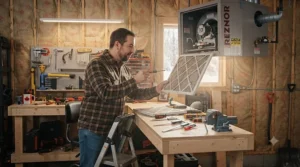
Forced Air Garage Heater vs Infrared Garage Heater
The core difference is how the heat actually reaches you. A forced air heater warms air with an electric element, then a fan pushes that warm air throughout the room — you feel warmth through the air itself. An infrared heater instead warms objects and people directly with radiant energy, similar to standing in sunlight, without necessarily warming the air around you first.
| Factor | Forced Air | Infrared |
|---|---|---|
| Warm-up speed | Fast, fills whole room | Instant on skin, room stays cooler |
| Best for | Enclosed, insulated garages | Drafty or open-door spaces |
| Noise | Audible fan operation | Silent, no moving parts |
| Even heating | Yes, across whole space | Only where radiant beam points |
Reading across this comparison, forced air wins decisively for a fully enclosed, reasonably insulated garage where you want the whole space comfortable, not just the spot directly in front of the heater. Infrared pulls ahead in garages with a door frequently left open, since it keeps warming you directly even as the ambient air escapes. Noise is the other deciding factor — if a silent shop matters more to you than even whole-room heating, that alone might push you toward infrared instead.
✨ Don’t Miss These Exclusive Deals!
🔍 Take your garage heating setup to the next level with these carefully selected models. Click through to check current pricing and availability, and turn your cold garage into a genuinely usable workshop this winter.
CFM Airflow Explained: The Garage Heater BTU Guide You Actually Need
BTU tells you how much heat a unit produces; CFM tells you how effectively it moves that heat around the room. A high-BTU heater with weak CFM will create a hot zone near itself while the far corners of your garage stay cold — which is exactly why pairing the two numbers matters more than looking at either alone.
| Wattage Class | Typical BTU | Typical CFM | Ideal Garage Size |
|---|---|---|---|
| 3,750-4,000W | ~12,800 BTU | ~300 CFM | Single bay, insulated |
| 5,000W | ~17,000 BTU | ~400 CFM | Single bay, larger or drafty |
| 7,500W | ~25,600 BTU | ~500-600 CFM | Two-car garage |
| 10,000W | ~34,100 BTU | ~725 CFM | Three-car garage |
What the spec sheet won’t tell you, but the pattern above makes clear, is that CFM scales roughly in step with BTU across this product category — manufacturers size the fan to match the heating element’s output. The practical lesson: don’t assume a bigger heater in a smaller room is simply “more heat, more comfortable.” An oversized unit with too much CFM for a small enclosed bay can create an uncomfortable draft, cycling on and off rapidly rather than holding a steady, even temperature.
Garage Heater Noise Levels: What the Decibel Ratings Don’t Tell You
Here’s an honest gap in this product category: most forced air garage heater manufacturers don’t publish exact decibel ratings on their spec sheets the way, say, a bathroom exhaust fan does. What we can say with confidence, based on aggregated buyer commentary across multiple models in this wattage range, is that fan noise scales with wattage and fan speed, and portable ground-level units tend to read louder than the same wattage mounted overhead.
Reviewers researching the King Electric PSH2440TB specifically note it’s loud enough to be noticeable but not louder than comparable units its size, and that wall-mounting rather than floor placement measurably reduces the perceived volume. Similarly, buyer sentiment around the 7,500W-class hardwired units, including the DR. Infrared Heater DR-975, consistently flags higher settings as the noisiest point of operation — which lines up with simple physics, since a faster fan speed moving more CFM naturally generates more sound.
If a quiet garage matters to you — say, it doubles as a home gym or a space where you’ll be on phone calls — prioritize 2-stage ECO models like the King KB2405-1-ECO2S-PLUS or TEMPWARE Digital Fan Forced, since they spend more time at their lower, quieter stage rather than cycling at full blast repeatedly.
Forced Air Heater Mounting Options: Ceiling, Wall, or Portable?
Ceiling mounting is the default choice for anyone prioritizing floor space — it’s the only option for units like the Comfort Zone CZ230ER, and it also tends to distribute heat most evenly since airflow isn’t obstructed by anything at floor level. The trade-off is installation difficulty: ceiling mounting genuinely requires two people and, for hardwired units, an electrician.
Wall mounting sits in the middle. Units like the Dura Heat EUH4000 and King KB2405-1-ECO2S-PLUS mount comfortably to a wall bracket at a height that’s still easy to access for maintenance, while keeping the floor completely clear for vehicles and tools. It’s the pick for most single-car garage installs.
Portable units, led here by the King Electric PSH2440TB, trade a small amount of heating efficiency for total flexibility — move it to the workbench in winter, store it in summer, or bring it along to a job site. According to University of Toronto’s electrical safety guidance, portable heat-producing electrical equipment should never be left unattended and should always be positioned away from combustible materials and foot traffic — a rule worth following regardless of which mounting style you choose.
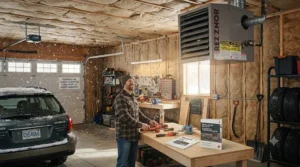
Common Mistakes When Buying a Forced Air Electric Heater
The most frequent mistake is buying based on garage square footage alone without accounting for insulation, ceiling height, or an uninsulated overhead door — all of which quietly eat into a unit’s real-world coverage. A close second is skipping the electrical panel check; more than one Canadian homeowner has ordered a 10,000W unit only to discover their panel can’t support a 50-amp dedicated circuit without an upgrade.
Buyers also frequently underweight noise until after installation, then find a floor-standing portable unit is louder than expected in a garage that doubles as a workspace. And a surprisingly common oversight: choosing a ceiling-mount-only unit like the Comfort Zone CZ230ER without first confirming ceiling height and structural support for the mounting bracket, which turns a simple weekend install into a call for professional help.
Long-Term Cost & Maintenance
Electric forced air heaters have no fuel to buy and minimal moving parts, which keeps maintenance costs low compared to gas-fired alternatives — mostly it’s dust removal from the intake and an occasional check that the mounting bracket hasn’t loosened from vibration. The real ongoing cost is electricity itself, and per Natural Resources Canada’s residential energy data, space heating already accounts for the majority of energy Canadians use in their homes, so adding a high-wattage garage heater to daily routine use is a genuine line item on your bill, not a rounding error.
This is where 2-stage ECO units like the King KB2405-1-ECO2S-PLUS and King KB2410-1-ECO2S-PLUS earn back some of their higher upfront price — by running at a lower wattage stage once the space reaches temperature instead of cycling full-blast repeatedly, they use meaningfully less electricity over a season than single-stage units of equivalent peak output. Total cost of ownership, then, isn’t just the sticker price: it’s sticker price plus install cost plus how many hours per week you’ll actually run the thing through a Canadian winter.
Safety, CSA Certification & Canadian Regulations
Every forced air garage heater sold in Canada should carry certification from an accredited body recognized by the Standards Council of Canada — CSA, UL, or ULC marks are the ones to look for on the packaging and the unit itself. This isn’t a nice-to-have; it’s the baseline that confirms the unit has been independently tested against Canadian electrical safety standards for room and air heaters.
Beyond certification, a few practical rules apply across every model on this list: never run a 240V heater on an extension cord, since the current draw is enough to overheat standard cord gauge and create a fire risk. Never leave a portable unit running in an empty garage. And for any hardwired install — which covers most of the mid-range and premium units here — use a licensed electrician who can confirm your panel and breaker sizing match the manufacturer’s requirements. Technical Safety BC’s space heater safety guide is a genuinely useful resource here, and its core recommendations apply just as directly to a garage as to a living room.
Frequently Asked Questions
❓ What size forced air heater do I need for a two-car garage?
❓ Do forced air garage heaters need a dedicated circuit?
❓ Is a forced air heater cheaper to run than infrared?
❓ Can I mount a forced air garage heater myself?
❓ Why is my forced air garage heater so loud?
Conclusion
A forced air garage heater earns its keep the moment you walk into a genuinely warm workshop instead of a cold box with a heater in the corner. The seven models covered here span the realistic range Canadian buyers actually need — from the budget-friendly King Electric PSH2440TB for a small insulated bay, up through the serious 10,000W pull of the King KB2410-1-ECO2S-PLUS for a full three-car space.
The decision really comes down to three numbers: your real square footage after accounting for insulation, your electrical panel’s available capacity, and how much daily use you expect. Get those three right, match them against the comparison tables above, and any of these seven units should keep you comfortable through a full Canadian winter.
Recommended for You
- Infrared Garage Heater: 7 Top Picks for Cold Canadian Winters (2026)
- Heater for Garage -40C: 7 Tough Picks That Survive Winter 2026
- Electric Garage Heater Canada 2026: 7 Top Rated Picks That Work
Disclaimer: This article contains affiliate links. As an Amazon Associate, I earn from qualifying purchases. If you purchase products through these links, we may earn a small commission at no additional cost to you.
✨ Found this helpful? Share it with your friends! 💬🤗
