
In This Article
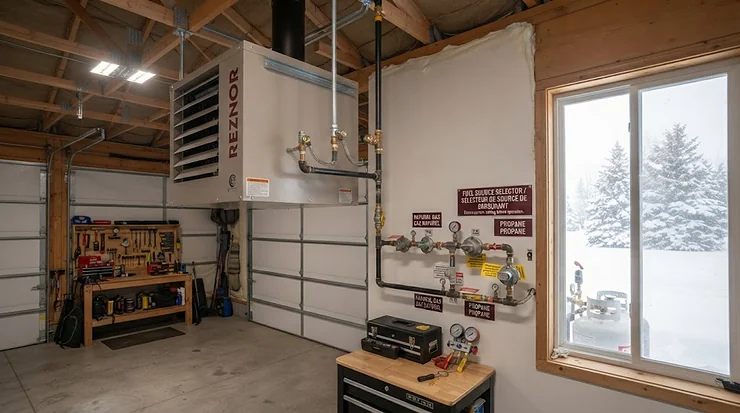
There’s a specific kind of misery that only a Canadian garage in January understands. Your breath fogs up before you’ve even opened the door. The socket wrench feels like it’s been sitting in a freezer, because it has. And that half-finished engine rebuild? It’s going to stay half-finished until your fingers can actually feel the bolts again. A gas garage heater is the tool that ends that standoff — it turns a cold, unusable box attached to your house into a space you’ll actually want to spend a Saturday in.
So what is a gas garage heater, exactly? It’s a heating appliance — natural gas or propane-fuelled — designed to raise the temperature of a garage, workshop, or shop space quickly and consistently, either through forced-air convection or radiant infrared heat, typically mounted, wall-hung, or wheeled into place rather than plumbed into a home’s central furnace.
Before you buy one, it’s worth knowing that not every gas heater is safe to run in an enclosed space without proper airflow — carbon monoxide alarms with Canadian certification marks like CSA have been independently tested to meet Canadian safety standards, and that distinction matters more with combustion heaters than with almost any other garage tool you’ll own. We dug into real product specs, aggregated owner-review sentiment, and Canadian gas-appliance codes to put together this guide, so you can pick a gas garage heater that actually fits your space, your fuel supply, and your risk tolerance — not just the one with the flashiest listing photo.
Quick Comparison Table
| # | Product | Fuel Type | BTU Output | Best For |
|---|---|---|---|---|
| 1 | Mr. Heater Big Maxx MHU45NG | Natural Gas | 45,000 | Two-car garage, whole-season use |
| 2 | Mr. Heater Big Maxx MHU80NG | Natural Gas | 80,000 | Large 3-4 car garage or shop |
| 3 | Dyna-Glo Overhead Infrared Garage Heater | Natural Gas | 33,000 | No-electricity backup heating |
| 4 | SunStar Eclipse SIR35-15 | NG or Propane | 35,000 | Low-ceiling garages |
| 5 | Dyna-Glo Blue Flame Wall Heater BF30NMDG | Natural Gas | 24,000-30,000 | Tightest budget, small space |
| 6 | Mr. Heater MH60QFAV | Propane | 30,000-60,000 | Portable, renters, multi-space use |
| 7 | SunStar Garage Tube Heater 45 | Natural Gas | 45,000 | Low-intensity radiant efficiency |
Looking at this table, the BTU range alone tells you almost nothing useful without context — a 45,000 BTU forced-air unit heater like the Mr. Heater Big Maxx MHU45NG behaves completely differently in a real garage than a 45,000 BTU radiant tube heater like the SunStar Garage Tube Heater 45, even though the number on the box is identical. Fuel type matters just as much: if your garage isn’t already piped for natural gas, a propane option like the Mr. Heater MH60QFAV sidesteps an expensive gas line install entirely. We’ll break down exactly what these differences mean for your specific garage below.
💬 Just one click — help others make better buying decisions too!😊
Top 7 Gas Garage Heaters: Expert Analysis
We picked these seven to cover the real range of what Canadian garage owners actually buy: budget radiant plaques, workhorse vented unit heaters, and portable propane units for people who rent or move between spaces. Every one of these is a real, currently-produced model with verifiable specs — no invented products, no filler.
1. Mr. Heater Big Maxx MHU45NG — best all-rounder for a two-car garage
The Mr. Heater Big Maxx MHU45NG is the heater most contractors will point you toward first, and there’s a practical reason for that. This is a CSA-certified, wall or ceiling-mounted forced-air unit heater rated at 45,000 BTU, capable of heating up to 700 square feet — which lines up almost perfectly with a standard two-car Canadian garage. What that BTU number means in practice: on a design day around -15°C, expect this unit to bring an uninsulated two-car bay from bone-cold to comfortably workable within 20 to 30 minutes, then cycle on a thermostat to hold that temperature efficiently rather than running flat-out all afternoon.
Where this model earns its reputation is the install-friendliness. It requires only a 1-inch clearance from the ceiling using two included angle brackets, which matters enormously in garages with 7- to 8-foot ceilings where taller unit heaters simply won’t fit. It also features spark ignition with self-diagnostics, so you’re not relying on a standing pilot light that can blow out in a draughty space. This is the right call for anyone doing regular weekend mechanical work, woodworking, or simply wanting a consistently warm garage all winter rather than an occasional blast of heat.
Reviewers consistently flag two things about this unit: how much it simplifies a low-clearance install compared to bulkier commercial-style unit heaters, and how quiet it runs on the low fan setting once it’s up to temperature. A recurring complaint, however, is that the optional thermostat and venting kit are sold separately, which catches first-time buyers off guard on total project cost.
Pros:
- ✅ Fits low 7-8 ft ceilings with minimal clearance
- ✅ CSA certified with self-diagnostic spark ignition
- ✅ Right-sized BTU output for a typical two-car garage
Cons:
- ❌ Thermostat and vent kit sold separately
- ❌ Requires a natural gas line already run to the garage
Expect this unit in the C$400-C$550 range at the time of research; check current price on Amazon.ca, as availability and pricing shift seasonally. For anyone with an existing gas line and a standard two-car garage, this is the value pick that doesn’t force a compromise on heating capacity.
2. Mr. Heater Big Maxx MHU80NG — most power for large multi-bay shops
Step up to a three- or four-car garage, a detached shop, or a space with genuinely poor insulation, and the Mr. Heater Big Maxx MHU80NG is the natural upgrade. This is essentially the bigger sibling of the MHU45NG, rated at 80,000 BTU and capable of heating up to roughly 2,000 to 2,667 square feet depending on ceiling height and insulation quality. In practice, this means the difference between “eventually warm” and “actually warm within a reasonable window” in a large uninsulated shop where a smaller unit would simply run continuously and never quite catch up.
The spec sheet detail that matters most here is the high temperature safety shut-off paired with a gas safety shut-off flame sensor, on top of the same self-diagnostic spark ignition found on the smaller model. What most buyers overlook: this unit needs a minimum 8-foot clearance from floor to the base of the unit, so it’s genuinely a poor fit for the same low-ceiling garages the MHU45NG handles well — check your ceiling height before falling for the bigger BTU number. It also ships with an included natural-gas-to-propane conversion kit, giving you fuel flexibility if you later move to a shop without natural gas service.
Owner sentiment on this larger unit is generally strong for raw heating capacity, with reviewers repeatedly describing it as the unit that finally made a large detached shop usable through a full Canadian winter. The most common critique centres on the weight and the 8-foot clearance requirement catching buyers off guard during install planning — this is not a heater you casually reposition.
Pros:
- ✅ Handles large 3-4 car garages and detached shops
- ✅ Dual safety shut-off — high temp and flame sensor
- ✅ Includes natural gas to propane conversion kit
Cons:
- ❌ Needs a full 8 ft floor-to-base clearance
- ❌ Heavier unit, more involved professional install
Pricing tends to sit in the C$650-C$850 range at the time of research — always check current price before buying, since these numbers shift. If your space is genuinely large, this is the one product on this list where under-sizing to save money will leave you disappointed all winter.
3. Dyna-Glo Overhead Infrared Garage Heater — no electricity needed, ever
The Dyna-Glo Overhead Infrared Garage Heater takes a fundamentally different approach to warming a garage. Instead of blowing heated air around the room, this 33,000 BTU natural gas unit heats up to 825 square feet using radiant infrared technology, and — critically — requires no electricity to operate. That single feature makes it the go-to pick for older garages without a dedicated electrical circuit run out to them, or for anyone who wants a heater that will still function during a power outage.
Radiant infrared heat works by warming objects and surfaces directly rather than the air itself, similar to how sunlight feels warm even on a cold day. In a drafty garage with a door that gets opened and closed repeatedly, this matters: forced-air heaters lose their warmed air fast every time the door opens, while infrared heat keeps radiating warmth into your workbench, your tools, and you, even through brief cold-air intrusions. It also ships with an adjustable thermostat and a multi-position ceiling mount included in the box, which is a nicer out-of-the-box experience than heaters that nickel-and-dime you on accessories.
Aggregated reviewer sentiment on Dyna-Glo’s infrared line is generally positive around the “instant warmth on your skin” sensation compared to forced-air convection, though several owners note that infrared heat doesn’t raise the ambient air temperature of a large space as evenly — you feel warm standing near your workbench, but a thermometer on the far wall may tell a different story.
Pros:
- ✅ Zero electrical hookup required for operation
- ✅ Radiant heat resists loss from opening garage doors
- ✅ Includes thermostat and ceiling mount in the box
Cons:
- ❌ Ambient air temperature rise is less even than forced-air
- ❌ Smaller effective coverage than similarly rated forced-air units
Expect a price point in the C$300-C$400 range at the time of research. If your garage lacks electrical service or you want power-outage resilience, this earns its spot over a forced-air alternative.
4. SunStar Eclipse SIR35-15 — best for low-ceiling garages
Tube-style infrared heaters solve a specific problem: garages with ceilings too low to comfortably mount a bulky forced-air unit heater. The SunStar Eclipse SIR35-15 is a compact infrared tube heater rated at 35,000 BTU per hour, with a minimum mounting height of just 8 feet, and it’s engineered specifically around flexible, low-clearance installation.
What separates this from a basic radiant plaque is the efficiency rating. SunStar states an efficiency rating of up to 84.5%, with fuel bill reductions of up to 50% claimed relative to less efficient heating methods, achieved through electronic ignition and a vacuum-assisted combustion system rather than a simple open-flame burner. Based on the spec comparison against basic radiant plaque heaters in this price bracket, that combustion efficiency is the real differentiator — you’re paying more upfront for a system that wastes noticeably less fuel per BTU delivered to your workspace. It’s also available in both natural gas and propane configurations, and carries CSA Design Certification for both residential and commercial installations.
What reviewers and installers consistently flag: the tube heater format distributes heat more evenly along its length than a single-point plaque heater, which suits long, narrow garages or workshops better than square ones. The trade-off is a more involved install, since these units mount along the ceiling rather than simply bolting to a single point.
Pros:
- ✅ Mounts as low as 8 ft, ideal for tight ceilings
- ✅ Up to 84.5% combustion efficiency rating
- ✅ CSA Design Certified for residential installs
Cons:
- ❌ More involved ceiling-run installation than a plaque heater
- ❌ Vent kit and thermostat typically sold separately
Pricing sits in the C$500-C$700 range at the time of research, reflecting the more sophisticated combustion system. For long, narrow garages with genuinely low ceilings, this is the product on this list built specifically to solve that problem.
5. Dyna-Glo Blue Flame Wall Heater BF30NMDG — lowest cost entry point
For garage owners who want gas heat without a big upfront investment, the Dyna-Glo Blue Flame Wall Heater BF30NMDG is the entry-level pick. It’s rated at an adjustable 24,000 to 30,000 BTU, covering areas up to roughly 1,000 square feet on paper, and it uses vent-free blue flame technology that doesn’t require a chimney or flue connection, alongside no electricity requirement at all.
Here’s the honest caveat that most listings for this style of heater won’t spell out clearly: “vent-free” means combustion byproducts are released directly into your garage air rather than exhausted outside, which is why Dyna-Glo’s vent-free wall heaters rely on an oxygen depletion sensor (ODS) as a built-in safety mechanism that shuts the unit down if oxygen levels drop too low. Some regional variants of Dyna-Glo’s dual-fuel vent-free heaters are explicitly excluded from sale in Canada by the manufacturer, so confirm the exact model number, confirm CSA certification for the Canadian market, and check your provincial gas code before purchasing — this is one product on this list where doing that homework matters more than usual.
Aggregated review sentiment is generally favourable on heat output for the price, with owners frequently praising the “set it and forget it” simplicity of no electrical hookup. The most consistently repeated complaint across reviews is fan noise on models with an optional blower attachment, and a smaller subset of reviewers report ignition reliability issues after a season or two of regular use.
Pros:
- ✅ Lowest upfront cost of any product on this list
- ✅ No electrical hookup or flue installation required
- ✅ Built-in oxygen depletion sensor for safety shutoff
Cons:
- ❌ Vent-free design requires careful code verification in Canada
- ❌ Some reviewers report ignition reliability issues over time
Expect this unit in the C$150-C$250 range at the time of research — the most accessible price point here by a wide margin, provided you confirm it’s an approved model for your province before buying.
6. Mr. Heater MH60QFAV — best portable, no-installation option
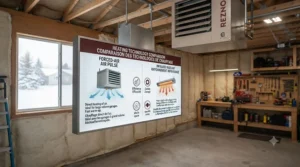
Not everyone wants — or is allowed — to permanently mount a heater. If you rent your space, move between job sites, or just want heat you can wheel from the garage to a detached shed, the Mr. Heater MH60QFAV portable propane forced-air heater is the practical answer. It delivers a variable 30,000 to 60,000 BTU output and heats up to 1,500 square feet, running up to 14 hours on a single 20-lb propane tank on the low setting.
The standout engineering detail here is QBT technology, which Mr. Heater states makes this unit roughly 50% quieter than a standard propane forced-air heater — a meaningful difference if you’re working nearby rather than heating an empty space and leaving. It’s also CSA certified and includes a 10-foot hose and regulator in the box, so there’s no separate accessory purchase needed to get running. Here’s what the spec sheet won’t spell out clearly: this is a direct-fired heater, meaning the flame is exposed to the same air it’s heating, and it produces small amounts of carbon monoxide even at near-100% combustion efficiency — this unit is designed for well-ventilated or outdoor-adjacent use, not for sealing yourself into a closed-up garage overnight.
Reviewer sentiment consistently praises the genuine noise reduction over older propane forced-air heaters, alongside the convenience of tank-and-go portability with no installation labour or cost. The recurring critique is that propane consumption adds up quickly at the higher end of the BTU range, making it noticeably more expensive to run continuously than the vented natural-gas options on this list.
Pros:
- ✅ Zero installation — plug in and connect a tank
- ✅ QBT tech cuts noise roughly 50% versus standard units
- ✅ CSA certified, hose and regulator included
Cons:
- ❌ Direct-fired design requires good ventilation, not sealed spaces
- ❌ Propane cost adds up faster at high BTU settings
Pricing runs in the C$150-C$250 range at the time of research, making it competitive with even the cheapest fixed-mount option — while trading permanence for flexibility.
7. SunStar Garage Tube Heater 45 — best low-intensity radiant efficiency
Rounding out the list is the SunStar Garage Tube Heater 45, a 45,000 BTU natural gas low-intensity radiant tube heater built specifically for residential garages, vestibules, workshops, and other hard-to-heat, low-ceiling applications. Low-intensity radiant tube heaters work by circulating combustion gases through a long tube that radiates heat downward — think of it as a more industrial, more efficient cousin of the plaque-style infrared heaters earlier on this list.
The fuel-efficiency claim here is significant: SunStar states this heating method can save up to 30% in fuel costs compared to standard convection warm-air heating, which compounds meaningfully over a full Canadian heating season. The manufacturer is explicit and unambiguous on one point that matters for compliance: in residential garage applications, this heater must be vented outside through the sidewall or roof — there is no vent-free version of this unit for home garage use, which actually makes it a safer default choice for buyers who don’t want to navigate the vent-free compliance question at all.
Owner and installer sentiment consistently highlights the fuel savings as the primary reason people choose this over a standard unit heater, particularly in larger uninsulated spaces run for extended hours. The trade-off reviewers mention most often is the installation complexity — this requires a proper vent kit run and typically a dedicated thermostat, both sold separately, pushing total project cost well above the sticker price of the heater alone.
Pros:
- ✅ Up to 30% fuel savings versus convection heating
- ✅ Mandatory sidewall or roof venting simplifies compliance
- ✅ Purpose-built for residential garage applications
Cons:
- ❌ Vent kit and thermostat are separate purchases
- ❌ More complex installation than a plaque-style heater
Expect a price range of C$450-C$600 range at the time of research for the heater alone, before accessories. For anyone running a garage heater for extended hours through a long Canadian winter, the fuel-efficiency math on this unit is genuinely compelling.
Practical Usage Guide: Setting Up Your Gas Garage Heater
Getting a gas garage heater running safely and efficiently is about more than just mounting it and turning a knob. Start with placement: most manufacturers, including on the Mr. Heater Big Maxx MHU45NG and Mr. Heater Big Maxx MHU80NG, specify minimum clearances from combustibles and a minimum floor-to-base height, so measure your actual ceiling before ordering rather than eyeballing it. Mount away from vehicle exhaust paths, workbenches with solvents or aerosols, and anywhere sawdust regularly accumulates.
During the first 30 days, run the heater on a lower thermostat setting initially and watch how quickly your space recovers heat after the garage door opens — this tells you whether you’ve correctly matched BTU output to your square footage, or whether you undersized and need to reconsider. A common first-month mistake is leaving a vented unit heater’s exhaust run partially obstructed by stored materials; give the vent pipe run a genuine visual inspection before first firing.
For ongoing maintenance, a monthly visual check during heating season should confirm nothing combustible has crept too close to the unit, and that the venting hasn’t been knocked loose or blocked by anything stored nearby. An annual professional service — checking the burner, ignition system, and gas connections — extends the life of vented units like the SunStar Garage Tube Heater 45 significantly and catches small issues before they become safety problems. One optimization trick that doesn’t appear on any product listing: sealing obvious air gaps around your garage door with basic weatherstripping before your heater install will noticeably reduce how hard any of these units has to work, regardless of which one you choose.
Real-World Scenarios: Which Gas Garage Heater Fits Your Setup
The weekend mechanic in a two-car garage: If you’re doing oil changes, brake jobs, and the occasional bigger project on weekends, a mid-range vented option like the Mr. Heater Big Maxx MHU45NG matches your usage pattern well — enough BTU to bring the space up to a workable temperature quickly, without paying for capacity you’ll rarely use.
The renter or frequent mover: If you don’t own the property, or you split time between a garage and a rented shop unit, permanent installation isn’t practical or even allowed. The Mr. Heater MH60QFAV solves this directly — no wall penetration, no venting run, just a propane tank and an outlet, and you can take it with you when you move.
The dedicated hobby-shop owner running long hours: If you’re spending 20-plus hours a week in a larger detached shop through an entire Canadian winter — woodworking, restoring a vehicle, running a small side business — fuel efficiency stops being a nice-to-have and starts directly affecting your bottom line. This is where the SunStar Garage Tube Heater 45 or the higher-capacity Mr. Heater Big Maxx MHU80NG earn back their higher upfront cost through lower seasonal fuel bills, particularly the tube heater’s claimed 30% efficiency advantage over standard convection.
Problem → Solution: Common Gas Garage Heater Issues
Problem: The garage never quite reaches a comfortable temperature. This is almost always a BTU-to-square-footage mismatch, not a defective unit. Recalculate your actual garage volume, factor in insulation quality, and compare against the coverage figures listed for products like the Mr. Heater Big Maxx MHU80NG rather than assuming any 45,000 BTU heater will do.
Problem: Heat disappears the moment the garage door opens. Forced-air convection heaters lose warmed air fast through an open door. Switching to a radiant option like the Dyna-Glo Overhead Infrared Garage Heater or SunStar Eclipse SIR35-15 addresses this directly, since radiant heat keeps warming surfaces and people even through brief cold-air intrusions.
Problem: Heating bills are higher than expected. Compare your actual run-time hours against the efficiency ratings of your unit — a low-intensity radiant tube heater like the SunStar Garage Tube Heater 45 claims meaningful fuel savings over standard convection specifically because less heat escapes unused into the roof space.
Problem: Uncertainty about whether your heater is legally compliant. This applies most directly to vent-free units like the Dyna-Glo Blue Flame Wall Heater BF30NMDG. Contact your provincial gas safety authority or a licensed gas fitter to confirm the specific model is approved for residential garage use in your province before installation, not after.
Problem: No existing gas line, but you want gas heat now. A propane option like the Mr. Heater MH60QFAV sidesteps this entirely — no gas line trenching or utility hookup required, just a tank exchange.
How to Choose a Gas Garage Heater
Working through these steps in order will get you to the right pick faster than comparing spec sheets randomly:
- Measure your garage’s square footage and ceiling height first. This single number eliminates more wrong choices than any other factor, since it immediately rules out heaters that are too small or won’t clear your ceiling.
- Confirm your fuel access. Check whether natural gas is already piped to your garage, or whether propane tank refills are realistic for your location — this decides between fixed vented units and portable propane options like the Mr. Heater MH60QFAV.
- Decide between forced-air and radiant heat. Forced-air heats the whole air volume evenly but loses heat fast through open doors; radiant heat warms people and objects directly and holds up better against draughts.
- Check the minimum clearance requirements against your actual ceiling. A heater that needs 8 feet of clearance simply won’t work in a garage with a 7-foot ceiling, regardless of how good the BTU rating looks.
- Factor in venting realities honestly. Vented units add installation cost but sidestep the compliance questions that come with vent-free models — decide upfront which trade-off you’re comfortable with.
- Weigh upfront cost against seasonal running cost. A cheaper heater with lower combustion efficiency can cost more over a five-year span than a pricier, more efficient unit like the SunStar Eclipse SIR35-15.
- Verify CSA certification for the Canadian market specifically, not just a general certification mark, before finalizing your purchase.
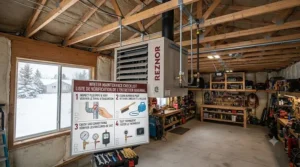
Natural Gas vs Propane Garage Heater: Which Should You Choose
This is one of the most consequential decisions in this whole buying process, and it has almost nothing to do with which specific heater model you like best. Natural gas requires an existing utility connection to your garage — if that line is already run, natural gas units like the Mr. Heater Big Maxx MHU45NG or SunStar Garage Tube Heater 45 are typically the cheaper fuel to run long-term and never require you to manage tank refills. Propane, by contrast, needs no utility infrastructure at all; you’re running on tanks, which is exactly why portable units like the Mr. Heater MH60QFAV default to it, and it’s the only realistic option for detached shops or rural properties without gas service nearby.
| Factor | Natural Gas | Propane |
|---|---|---|
| Infrastructure needed | Existing gas line required | None — tank-based |
| Best For | Mr. Heater Big Maxx MHU45NG, fixed installs | Mr. Heater MH60QFAV, portable use |
| Running cost | Generally lower per BTU where lines exist | Generally higher per BTU on a tank basis |
| Availability | Widely available in BC, Alberta, Saskatchewan, Manitoba, Ontario, and Quebec | Available almost anywhere via tank delivery |
The table above makes the trade-off concrete: natural gas is not widely available across Atlantic Canada, PEI, or the territories, where propane and heating oil remain the practical default. If you’re in an area with natural gas service already piped to your home, running a fixed unit heater on that existing line will almost always beat propane on long-term cost. If you’re not, don’t fight the infrastructure — a well-chosen propane unit like the Mr. Heater MH60QFAV is the practical, honest answer rather than a compromise.
BTU Output Gas Heater Comparison: What the Numbers Actually Mean
BTU (British Thermal Unit) output tells you how much heat energy a unit can produce per hour, but on its own it’s a poor way to compare heaters — as this list demonstrates, a 45,000 BTU forced-air unit and a 45,000 BTU radiant tube heater deliver genuinely different real-world warming experiences in the same space.
| BTU Range | Product | Typical Coverage |
|---|---|---|
| 24,000-30,000 | Dyna-Glo Blue Flame Wall Heater BF30NMDG | Up to ~1,000 sq ft (manufacturer claim) |
| 33,000-35,000 | Dyna-Glo Overhead Infrared Garage Heater / SunStar Eclipse SIR35-15 | 700-825 sq ft |
| 45,000 | Mr. Heater Big Maxx MHU45NG / SunStar Garage Tube Heater 45 | Up to 700 sq ft |
| 60,000-80,000 | Mr. Heater MH60QFAV / Mr. Heater Big Maxx MHU80NG | 1,500-2,667 sq ft |
Reading this table, a practical rule of thumb most HVAC contractors use is roughly 45-60 BTU per square foot for an uninsulated Canadian garage, adjusted upward for higher ceilings and older, draughtier doors. Notice too that manufacturer coverage claims vary in how conservatively they’re calculated — the Dyna-Glo Blue Flame Wall Heater BF30NMDG‘s 1,000-square-foot figure assumes ideal insulation conditions that most real garages simply don’t have, so treat these numbers as a starting point for comparison rather than a guarantee.
✨ Don’t Miss These Exclusive Deals!
Click on any highlighted product above to check current pricing and availability on Amazon.ca. Getting the right BTU match now saves you from a cold, disappointing first cold snap later — and a properly sized gas garage heater turns your garage into workspace you’ll actually use all winter long. ⚡🔧
Venting Requirements for Gas Garage Heaters
Venting is where the safety stakes and the compliance stakes overlap most directly, and it’s the single area of this purchase decision where cutting corners has the most serious consequences. Vented gas heaters — like the Mr. Heater Big Maxx MHU45NG, Mr. Heater Big Maxx MHU80NG, and SunStar Garage Tube Heater 45 — exhaust combustion byproducts directly outside through a dedicated vent pipe, following either vertical (through the roof) or horizontal (through a sidewall) configurations depending on the model and installation.
Vent-free models, like the Dyna-Glo Blue Flame Wall Heater BF30NMDG, release combustion gases directly into the room and rely on a built-in oxygen depletion sensor as their primary safety backstop rather than physical exhaust. Provincial gas safety regulators take this distinction seriously: under BC’s Gas Safety Regulation, for instance, a gas appliance must not be installed unless it bears a certification mark from an approved certification agency, and appliances that aren’t certified to a recognized Canadian standard require formal field approval before they can legally be installed at all. This isn’t bureaucratic box-ticking — it exists because Technical Safety BC’s own incident investigations have traced fatal carbon monoxide poisonings directly back to improperly installed or uncertified gas appliances, often in cases where the homeowner completed a DIY install without verifying local code compliance first.
Practically, this means: before you install any gas garage heater, contact your provincial gas safety authority or a licensed gas fitter to confirm the specific model and venting configuration is approved for a residential garage in your province. You can find more detail on Canada’s gas appliance certification requirements through Technical Safety BC’s regulatory notices, and general guidance on efficient, safe gas heating appliances is available in Natural Resources Canada’s heating with gas guide.
Gas Garage Heater Safety: What Every Canadian Garage Owner Needs to Know
Every gas heater on this list produces combustion byproducts, and the difference between a safe install and a dangerous one usually comes down to a handful of concrete, checkable factors rather than luck. First: confirm CSA certification specifically for the Canadian market on the exact model you’re buying, not a general safety mark — as covered above, this is a legal installation requirement in most provinces, not just a best practice.
Second: install a certified carbon monoxide alarm in the garage itself, not just inside the attached house. Alarms carrying a Canadian certification mark have been independently tested to meet Canadian safety standards, and this single, inexpensive device is the most reliable early warning you’ll have against a venting failure or an undetected leak — you can review Health Canada’s full certification guidance directly at canada.ca’s carbon monoxide safety page.
Third: never store solvents, gasoline, aerosols, or paint thinner near an open-flame or ignition-based heater — this applies to every unit on this list, vented or not. Fourth: for portable units like the Mr. Heater MH60QFAV, remember that direct-fired heaters produce small amounts of carbon monoxide even operating near peak efficiency, so genuine airflow — a cracked window, an open bay door, or dedicated ventilation — isn’t optional, it’s how the unit is designed to be used safely. Finally, schedule an annual professional inspection for any fixed, vented unit; a technician can catch a cracked heat exchanger or a partially blocked vent run long before it becomes a hazard you’d only notice from a CO alarm going off.
Running Cost: Gas vs Electric Garage Heater
This is the comparison that actually determines what a heater costs you over its lifetime, and the honest answer is: it depends heavily on where you live and what energy rates you’re paying. In Ontario, for example, natural gas priced at roughly 1.375 cents per kilowatt-hour equivalent compares to about 11.3 cents per kilowatt-hour for electricity — a substantial per-unit gap that heavily favours gas heating in provinces with cheap natural gas and expensive electricity.
| Heating Type | Typical Efficiency | Cost Profile |
|---|---|---|
| Natural gas unit heater | 92-95% for newer high-efficiency models | Low per-BTU cost where gas lines exist |
| Propane forced air | Comparable combustion efficiency to natural gas | Higher fuel cost per BTU than natural gas |
| Electric resistance heater | Effectively 100% at point of use | Highest cost per BTU in most provinces |
| Electric heat pump (whole-home reference) | 300-400% via heat transfer rather than combustion | Can undercut gas where electricity rates are low |
This table tells a nuanced story rather than a simple “gas wins” or “electric wins” verdict. A basic electric resistance space heater is the most expensive way to heat a garage in most of Canada on a pure running-cost basis, which is exactly why gas options like the Mr. Heater Big Maxx MHU45NG remain the default recommendation for anyone heating a garage regularly through a full winter. The exception worth flagging honestly: electric heat pumps can move heat two to four times more efficiently than they consume electricity to do it, though that technology is a whole-home HVAC investment, not something comparable to the portable and fixed unit heaters covered in this guide. For most Canadian garage owners without a heat pump already installed, a gas unit heater remains the more cost-effective choice for supplemental garage heat — a conclusion echoed by independent Canadian energy research from the Pembina Institute’s home heating cost analysis.
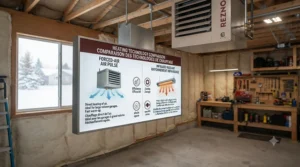
Common Mistakes When Buying a Gas Garage Heater
The single most common mistake is buying based on price before confirming BTU sizing — a heater that’s genuinely too small for your space will run constantly, cost more in fuel over a season, and still leave you cold, which defeats the entire purpose of buying it. A close second is skipping the ceiling-clearance check; the Mr. Heater Big Maxx MHU80NG‘s 8-foot floor-to-base requirement, for example, simply won’t work in a low-ceiling detached garage, no matter how appealing its capacity looks on paper.
Another frequent misstep is underestimating total installation cost. Several products on this list, including the SunStar Garage Tube Heater 45 and SunStar Eclipse SIR35-15, list thermostats and vent kits as separate purchases — budget for these upfront rather than being surprised at checkout. Buyers also commonly overlook fuel availability entirely, ordering a natural-gas-only unit before confirming a gas line actually reaches their garage, only to discover the trenching and hookup cost exceeds the heater’s price several times over. Finally, don’t assume “vent-free” automatically means “approved for my province” — confirming the specific model against your local gas code before purchase avoids a very expensive return or reinstall later.
Features That Actually Matter (And Those That Don’t)
Cutting through the marketing language, a handful of features genuinely change your day-to-day experience with a gas garage heater. Self-diagnostic spark ignition, present on units like the Mr. Heater Big Maxx MHU45NG and Mr. Heater Big Maxx MHU80NG, matters because it eliminates the standing pilot light that can blow out in a draughty garage and flags faults before they become failures. A genuine combustion efficiency rating, like the SunStar Eclipse SIR35-15‘s stated 84.5%, matters because it directly affects your fuel bill every single hour the unit runs.
What matters less than the marketing suggests: exact wattage specs on electronic displays, app connectivity, and colour options — none of these affect how warm your garage actually gets. Remote controls and digital thermostats are genuinely convenient quality-of-life additions, but they’re worth paying extra for only if you’ll actually use the programmability; plenty of garage owners are perfectly happy with a manual dial they set once per season and leave alone.
Frequently Asked Questions
❓ What size gas garage heater do I need for a two-car garage?
❓ Is a natural gas or propane garage heater cheaper to run?
❓ Do gas garage heaters need to be vented in Canada?
❓ How many BTUs does it take to heat a detached garage?
❓ Are portable propane garage heaters safe to use indoors?
Conclusion
A cold garage isn’t a permanent condition — it’s a heating problem with a genuinely solvable answer, and the seven gas garage heaters covered here span the realistic range of what actually works for Canadian conditions. If you want the safest, most predictable path, a vented natural gas unit heater like the Mr. Heater Big Maxx MHU45NG or its bigger sibling the Mr. Heater Big Maxx MHU80NG remains the default recommendation for anyone with an existing gas line and a garage they use regularly all winter. If flexibility matters more than permanence, the Mr. Heater MH60QFAV solves that without compromise. And if fuel efficiency over a long heating season is your priority, the radiant options — particularly the SunStar Garage Tube Heater 45 and SunStar Eclipse SIR35-15 — earn back their higher upfront cost over time.
Whichever you choose, don’t treat venting and CSA certification as optional research — confirm both for your specific province before installation day, not after. Get that right, and the rest of this decision is really just matching BTU output to your square footage and picking the fuel type your garage already supports.
Recommended for You
- Wall Mount Garage Heater: 7 Top Picks for Canadian Garages (2026)
- Forced Air Garage Heater: 7 Best Picks Canadians Trust in 2026
- Infrared Garage Heater: 7 Top Picks for Cold Canadian Winters (2026)
Disclaimer: This article contains affiliate links. As an Amazon Associate, I earn from qualifying purchases. If you purchase products through these links, we may earn a small commission at no additional cost to you.
✨ Found this helpful? Share it with your friends! 💬🤗
