
In This Article
There’s a particular kind of cold that lives in an unheated Canadian garage — the kind that turns wrenches into ice cubes and makes your morning coffee go lukewarm before you’ve finished bleeding the brake lines. A propane garage heater is, for a lot of us, the fastest fix for that problem. No electrician, no gas line trenched through the yard, no waiting three weeks for a permit. Just a tank, a hose, and heat on demand.
That simplicity is exactly why propane heaters remain so popular for Canadian garages, workshops, and detached shops in 2026. They fire up in seconds, they don’t care if your garage panel is already maxed out with a compressor and a welder, and a decent unit can take a two-car bay from bone-chilling to workable in well under an hour. But “propane heater” is not one product — it’s a whole family of tools, from pocket-sized radiant units to forced-air monsters that can heat a small barn, and picking the wrong one means either freezing or overspending.
This guide breaks down seven real, currently available propane garage heater options sold through Amazon.ca, compares them head-to-head, and — just as importantly — walks through the ventilation, tank sizing, and carbon monoxide safety rules every Canadian garage owner needs to understand before lighting one up. We’ll also cover BTU sizing math, propane tank size guidance, and the difference between vent-free and vented models, since getting that wrong is where most garage-heating headaches start.
Quick Comparison Table
Before we get into the weeds, here’s the fast version — the propane garage heater picks that came up again and again in our research, sorted by what they’re actually best at.
| Heater | Type | BTU Range | Best For |
|---|---|---|---|
| Mr. Heater MH9BX Portable Buddy | Radiant | 4,000–9,000 | Tightest budget, small jobs |
| Mr. Heater MH18B Big Buddy | Radiant | 4,000–18,000 | Indoor-rated all-rounder |
| Mr. Heater MH60QFAV | Forced air | 30,000–60,000 | Two-car garage, fast recovery |
| Dyna-Glo Delux RMC-FA300DGD | Forced air | Up to 300,000 | Oversized shops, multi-bay garages |
A quick glance tells the real story here: BTU output and coverage area climb together, but so does the need for real ventilation. The Mr. Heater MH9BX and Mr. Heater MH18B are small enough that a cracked window or a partially open garage door is often sufficient airflow, while anything in the 60,000–300,000 BTU range genuinely needs a fresh-air opening sized to the burner, not just good intentions. If you’re heating a single-car detached garage for a couple of hours on a Saturday, don’t buy the heater built for a commercial bay — you’ll pay more, burn more propane, and create more of a ventilation problem than you need to solve.
💬 Just one click — help others make better buying decisions too!😊
Top 7 Propane Garage Heaters: Expert Analysis
We picked these seven because they cover the full range a Canadian garage owner actually shops in: pocket-sized radiant units for occasional use, mid-range forced-air heaters for a weekend workshop, and heavy-duty units for the person who practically lives in their shop from November through March. Every spec below is paired with what it actually means once the tank’s connected and the door’s shut.
1. Mr. Heater MH9BX Portable Buddy — smallest footprint for weekend garage jobs
If your “garage heating” needs amount to warming your hands while you change a tire on a Saturday afternoon, this is probably as much heater as you need. The Canada-approved version of the MH9BX puts out 4,000 or 9,000 BTU from a single 1-lb propane cylinder, and it’s CSA certified for outdoor use in this country specifically — a detail that matters more than it sounds like it should, since some U.S. Mr. Heater models simply aren’t approved for sale here at all.
At this BTU range, expect to comfortably take the edge off a small detached garage or well-ventilated bay with the door cracked, not fully heat a two-car space. Reviewers consistently describe the ignition as foolproof — push, turn, done — and praise how little space it takes up on a shelf. A common thread in aggregated feedback is that runtime on a single 1-lb cylinder is short, which tracks with the math: you’re looking at roughly five hours on high before you’re swapping bottles.
Pros:
- ✅ Runs off a cheap, swappable 1-lb cylinder
- ✅ CSA certified for sale and outdoor use in Canada
- ✅ Genuinely portable — fits in a truck box
Cons:
- ❌ Rated for outdoor/well-ventilated use, not sealed indoor spaces
- ❌ Short runtime on small cylinders means frequent swaps
Expect to pay somewhere in the C$80–C$120 range, prices may vary. For occasional, short-duration use, it’s hard to argue with the value here — just don’t expect it to heat a full garage on its own.
2. Mr. Heater MH18B Big Buddy — most trusted indoor-rated radiant heater in Canada
Step up from the Portable Buddy and you land on the heater that shows up in almost every “best garage heater” roundup for a reason: the Big Buddy is CSA certified for indoor use in Canada, which is a genuinely different safety category from most portable propane heaters on the market. It runs 4,000, 9,000, or 18,000 BTU off two 1-lb cylinders or, with an optional hose, a standard 20-lb tank.
What actually separates this from the smaller Buddy isn’t just the BTU ceiling — it’s the layered safety system. An oxygen depletion sensor continuously reads the air and shuts the gas off before oxygen drops to a dangerous level, and a tip-over switch kills the flame if the unit gets knocked over, which matters in a garage where you’re moving ladders and bikes around a lit heater. Aggregated reviews frequently mention the built-in fan improving heat distribution, though a few note the fan itself needs D-cell batteries or an optional AC adapter to run — the heater still puts out heat without it, just less evenly.
Pros:
- ✅ CSA certified indoor-safe for Canadian use
- ✅ Oxygen depletion sensor plus tip-over shutoff
- ✅ Scales from small cylinders up to a 20-lb tank
Cons:
- ❌ Fan requires batteries or an AC adapter to run
- ❌ 450 sq ft coverage still won’t heat a large two-bay garage alone
Price sits around C$220–C$270 typically. For anyone who wants one heater that covers casual workshop time through genuinely cold days, this is the safest bet in the portable radiant category.
3. Mr. Heater MH18CH Cabinet Heater — whisper-quiet cabinet design that stows its own tank
This one solves a problem the Big Buddy doesn’t: where do you put the tank? The Cabinet Heater’s 20-lb propane tank sits inside its own housing behind the burner, so there’s no loose cylinder rolling around your garage floor. It offers three heat settings — 6,000, 12,000, and 18,000 BTU — runs entirely without electricity, and is, by every account we found, genuinely quiet compared to a forced-air unit.
Here’s the honest caveat: manufacturer documentation rates this model for well-ventilated and outdoor applications, not sealed indoor rooms, which puts it in a different use case than the Big Buddy despite the similar BTU numbers. In practice that means it suits a garage with a door left partially open, an attached carport, or outdoor projects — not a tightly sealed workshop. Reviewers who use it in semi-open spaces report reliable, consistent radiant heat and appreciate not hearing a fan drone for hours.
Pros:
- ✅ No electricity required at all
- ✅ Tank stows cleanly inside the cabinet
- ✅ Whisper-quiet radiant operation
Cons:
- ❌ Rated for well-ventilated or outdoor use, not sealed rooms
- ❌ Bulkier footprint than a portable Buddy-style unit
Look for it around C$180–C$230. It’s a strong pick if your garage door stays cracked anyway, or for a covered outdoor workspace.
4. ProCom MNSD300TGA Dual Fuel Vent-Free Garage Heater — purpose-built wall-mount for a dedicated shop
This is the heater actually designed and marketed as a garage heater rather than adapted from a camping product. Wall-mounted, thermostatically controlled, and rated at 30,000 BTU, it runs on either liquid propane or natural gas, which is a nice hedge if you’re not sure which fuel line you’ll eventually run to a detached shop.
What most buyers overlook about vent-free wall heaters like this one is that “vent-free” doesn’t mean “install anywhere” — it describes the appliance’s combustion design, not a blanket permission slip. The built-in oxygen depletion sensor is a real safety feature, automatically cutting gas flow if oxygen levels drop, but Canadian provinces regulate vent-free appliance installations under CSA B149.1, and a permanent wall-mount installation like this one is the kind of job most homeowners should have inspected or installed by a licensed gas fitter rather than DIYed. Aggregated buyer feedback highlights the thermostat as a genuine upgrade over manual-control heaters — it holds a set temperature instead of just running full blast until you turn it off.
Pros:
- ✅ Thermostat holds a steady temperature automatically
- ✅ Dual fuel — runs on propane or natural gas
- ✅ Wall-mounted, so it frees up floor space entirely
Cons:
- ❌ Vent-free design means provincial code compliance matters
- ❌ Permanent installation is a job for a licensed gas fitter
Expect roughly C$220–C$280. Best suited to someone setting up a dedicated, semi-permanent garage workspace rather than someone who wants to unplug and pack it away.
5. Mr. Heater MH60QFAV Forced Air Heater — quietest forced-air blower in its class
Forced-air heaters work differently from radiant models — instead of warming objects directly, they blast heated air across the room with a fan, which is exactly what you want when you need to bring a whole two-car garage up to a workable temperature fast. The MH60QFAV delivers a variable 30,000–60,000 BTU, covers up to roughly 1,500 sq ft on paper, and runs about 14 hours on a 20-lb tank at the low setting.
The standout feature here is Mr. Heater’s Quiet Burner Technology, which the manufacturer claims cuts noise by roughly half compared to a standard forced-air unit — a genuinely useful upgrade if you’re also trying to hold a conversation or listen to a podcast while you work. Based on the spec comparison with cheaper forced-air units, the trade-off is that this heater needs a 110V outlet to run its blower, so it’s not a grab-and-go solution the way the radiant Buddy heaters are. It also, like all direct-fired forced-air propane heaters, needs serious cross-ventilation — this is not a sealed-room appliance.
Pros:
- ✅ Quiet Burner Technology noticeably reduces noise
- ✅ Variable 30,000–60,000 BTU covers a real garage
- ✅ CSA certified with high-limit safety shut-off
Cons:
- ❌ Requires a 110V outlet to power the fan
- ❌ Needs substantial fresh-air ventilation to run safely
Pricing typically lands around C$180–C$250. This is the heater to reach for when you need a whole garage warm in 30–40 minutes rather than just taking the chill off one corner.
6. Dyna-Glo Delux RMC-FA60DGD Forced Air Heater — widest tank compatibility for long, unattended runtimes
Nearly a direct competitor to the MH60QFAV on paper, the Dyna-Glo Delux forced-air heater also runs a variable 30,000–60,000 BTU and covers a similar footprint — Dyna-Glo rates it up to about 1,350 sq ft. Where it separates itself is tank flexibility: this unit is built to accept 20-lb, 40-lb, or 100-lb liquid propane tanks, which means you can scale your fuel supply up without buying a different heater.
That flexibility translates directly into runtime math. On a small 20-lb tank you’re in similar territory to the MH60QFAV, but step up to a 100-lb tank and manufacturer figures put continuous runtime as high as 70 hours — a meaningful difference if you’re heating a shop for entire weekends rather than a couple of hours at a time. Reviewers and owner forums note the continuous electronic ignition reliably avoids the delayed-ignition “whump” that can happen with older pilot-style heaters, and the overheat auto shut-off is a genuine safety layer rather than a marketing bullet point.
Pros:
- ✅ Accepts 20-lb, 40-lb, or 100-lb tanks
- ✅ CSA listed with overheat auto shut-off protection
- ✅ Includes a 10-ft hose and regulator out of the box
Cons:
- ❌ Forced-air fan noise is noticeable during operation
- ❌ Still requires outdoor-grade ventilation, same as any forced-air unit
Look for a price around C$170–C$230. If you already own a larger propane tank from a barbecue or camper setup, this is the more fuel-flexible of the two forced-air options here.
7. Dyna-Glo Delux RMC-FA300DGD Heavy-Duty Forced Air Heater — heavy-duty output for oversized shops and multi-bay garages
This is the heater equivalent of bringing a chainsaw to trim a hedge — appropriate for the right job, wildly overkill for the wrong one. Rated up to 300,000 BTU with thermostat control, Dyna-Glo lists this unit as capable of heating spaces up to roughly 7,000 sq ft, which puts it firmly in barn, warehouse, and multi-bay commercial garage territory rather than a typical residential single-car space.
What the spec sheet won’t tell you, but the fine print will, is that this heater needs a genuinely large propane supply to perform — most sources specify a 100-lb tank or larger, since smaller tanks can’t maintain sufficient vapor pressure to feed a burner this size, especially in cold weather. Based on the spec comparison with the 60,000 BTU models above, the jump here isn’t incremental; it’s a categorical difference in scale, fuel consumption, and ventilation requirements. For the right buyer — someone heating a large detached shop, a farm building, or a multi-vehicle bay — the thermostat control and continuous ignition make it a genuinely capable tool. For a typical single-car garage, it’s simply too much heater.
Pros:
- ✅ Massive coverage up to roughly 7,000 sq ft
- ✅ Thermostat control for consistent temperature
- ✅ CSA listed, built to commercial-grade specifications
Cons:
- ❌ Requires a 100-lb+ tank to run properly
- ❌ Excessive and costly for a single-car garage
Budget C$550–C$700 for this tier. Only worth it if your space genuinely demands this kind of output.
Best Propane Heater for Garage in Canada: A Decision Framework
With seven solid options on the table, the fastest way to narrow it down is to match your situation to a category rather than agonizing over spec sheets. Here’s a simple framework:
If you’re heating a small detached garage for occasional weekend projects, choose a radiant heater like the Mr. Heater MH9BX because it’s cheap, portable, and doesn’t demand a dedicated fuel setup. If you need genuine indoor-rated safety certification and moderate output, choose the Mr. Heater MH18B Big Buddy because it’s one of the few portable models actually CSA certified for indoor Canadian use. If you’re setting up a semi-permanent workshop and want hands-free thermostat control, choose the ProCom MNSD300TGA because a wall-mounted, thermostatically controlled heater beats manually adjusting a portable unit every twenty minutes. If you’re heating a full two-car garage fast and repeatedly, choose the Mr. Heater MH60QFAV or Dyna-Glo RMC-FA60DGD because forced-air recovery time beats radiant heat for larger volumes of cold air. And if you’re heating a large shop, barn, or multi-bay space, choose the Dyna-Glo RMC-FA300DGD, full stop — nothing else on this list has the output to match.
A quick gut-check before you buy: measure your garage’s cubic footage (length × width × ceiling height), not just floor area, since a garage with a 12-foot ceiling needs meaningfully more BTU than the same footprint with an 8-foot ceiling. Insulation matters just as much — an insulated, weatherstripped garage door will hold heat far better than an old uninsulated one, which changes how much heater you actually need.
Propane Heater BTU Size Guide: How Many BTUs Do You Actually Need?
What is a propane garage heater’s BTU rating? BTU stands for British Thermal Unit, and in this context it measures how much heat a propane heater can produce per hour. A higher BTU rating means faster heating and larger coverage, but it also means higher propane consumption and a bigger ventilation requirement.
Here’s the practical breakdown most manufacturers and installers work from:
| Garage Size | Typical BTU Needed | Example Heater |
|---|---|---|
| Small (1-car, insulated) | 9,000–18,000 | Mr. Heater MH18B |
| Medium (1.5–2 car) | 30,000–60,000 | Mr. Heater MH60QFAV |
| Large (2+ car, uninsulated) | 60,000–125,000 | Dyna-Glo RMC-FA60DGD (upper range) |
| Shop / barn / multi-bay | 150,000–300,000 | Dyna-Glo RMC-FA300DGD |
Reading this table honestly: BTU need isn’t just about square footage, it’s about square footage times insulation quality times how cold your region actually gets. A well-insulated single-car garage in southern Ontario and a drafty single-car garage in rural Saskatchewan are not the same heating problem, even though they’re the same size. Reviewers across multiple products in this guide consistently note that manufacturer coverage estimates assume a reasonably sealed, insulated space — an uninsulated garage with a single-pane window and a gap under the door will underperform those numbers noticeably.
As a rule of thumb, figure roughly 30–45 BTU per square foot for a poorly insulated Canadian garage in winter, and closer to 20–30 BTU per square foot if it’s properly insulated and weatherstripped. When in doubt, sizing up slightly and running a heater on a lower setting is more efficient — and safer — than undersizing and running a small unit flat-out for hours.
Propane Tank Size for Garage Heater: Matching Cylinder to Output
Choosing the right tank size isn’t just about how long you want to run the heater — it’s about whether the tank can physically keep up with the burner’s demand, especially in cold weather.
- For radiant heaters under 20,000 BTU (like the MH9BX or MH18B), a 1-lb disposable cylinder or a standard 20-lb barbecue-style tank both work fine, since these burners draw fuel slowly enough that a 20-lb tank can supply them even in cold temperatures.
- For mid-range forced-air heaters at 30,000–60,000 BTU (like the MH60QFAV or RMC-FA60DGD), a 20-lb tank works for shorter sessions, but a 40-lb tank gives noticeably longer unattended runtime without needing a refill mid-project.
- For heavy-duty heaters above 150,000 BTU (like the RMC-FA300DGD), you generally need a 100-lb tank or larger, because smaller tanks simply can’t vaporize propane fast enough to keep feeding a large burner — this is a physics problem, not a design choice, and it gets worse as ambient temperature drops.
- In cold weather specifically, undersized tanks lose vapor pressure faster, which is why several manufacturers explicitly warn that a heater rated for a 20-lb tank may need a 100-lb tank once temperatures drop well below freezing.
- Always check the hose and regulator rating matches your tank size — most included hoses are matched to the heater’s intended tank range, and mismatching them can restrict flow or, in rare cases, create a safety issue.
Getting tank size wrong doesn’t just mean running out of fuel mid-project — an undersized tank straining to feed a large burner can cause weak, inconsistent flames or ignition problems, which is exactly the kind of malfunction that erodes confidence in an otherwise safe heater.
Ventless Propane Heater Garage Safety: What Canadian Homeowners Need to Know
“Ventless” or “vent-free” heaters — like the ProCom MNSD300TGA in this guide — burn fuel without an external flue or chimney, releasing combustion byproducts directly into the room instead of venting them outside. That design has real advantages: no need to cut a hole in a wall or roof, lower installation cost, and simpler setup. It also comes with real trade-offs that Canadian buyers specifically need to understand.
Every legitimate vent-free heater sold in Canada includes an oxygen depletion sensor (ODS) that’s designed to shut the gas off automatically before oxygen in the room drops to a dangerous level. That’s a genuine safety feature, not marketing fluff — but it’s a backstop, not a substitute for proper ventilation. Vent-free appliances still produce moisture and combustion byproducts as a normal part of operation, and running one in a genuinely sealed space, even with a functioning ODS, is asking a single sensor to do the job that ventilation should be doing continuously.
This is also where Canadian rules diverge meaningfully from casual online advice aimed at U.S. buyers. Installation of gas-burning appliances in Canada — vent-free or otherwise — falls under CSA B149.1, the Natural Gas and Propane Installation Code, which is incorporated by reference into building and gas-fitting regulations in every province and territory. Some vent-free models sold in the U.S. aren’t even approved for sale in Canada at all, which is why several products in this guide specifically call out their Canadian CSA certification — it’s not a redundant label, it’s a real distinction. Before installing any permanent vent-free heater in an attached garage, check with your local gas fitting authority or a licensed installer, since requirements vary by province and by whether the garage is attached to living space.
Propane Heater Ventilation Requirements for Garages
Ventilation isn’t optional for any direct-fired propane heater, vent-free or otherwise, and the rule of thumb used across the industry is worth knowing by heart: provide roughly three square feet of fresh outside air opening for every 100,000 BTU per hour of heater rating, with more required if you’re running multiple heaters in the same space.
Scaled down to the products in this guide, that means a small radiant heater like the Mr. Heater MH18B at 18,000 BTU needs comparatively little fresh air exchange — a cracked window or door is often enough in a detached garage. But a forced-air unit like the Mr. Heater MH60QFAV running at its full 60,000 BTU needs meaningfully more airflow, and the Dyna-Glo RMC-FA300DGD at 300,000 BTU needs a fresh-air opening roughly nine square feet in size — that’s not a cracked window, that’s a garage door left substantially open or a dedicated air intake.
A few practical notes worth internalizing: never run a propane heater — vent-free or forced-air — in a fully sealed, weatherstripped garage with the door shut and no other airflow, even briefly. Never use an outdoor-rated heater like the MH9BX or MH18CH in a closed indoor space, regardless of how cold it is outside; that rating exists for a reason. And if you’re heating an attached garage, keep the interior door between the garage and the house closed at all times while the heater runs, since that door is the main pathway for combustion byproducts to migrate into living space — a point Health Canada specifically flags as a household carbon monoxide risk.
Carbon Monoxide Safety with Propane Heaters
Carbon monoxide is colourless, odourless, and produced any time propane, natural gas, or another carbon-based fuel burns — including inside a perfectly functioning, well-maintained heater. The danger isn’t a malfunctioning heater specifically; it’s a properly working heater running in a space without enough fresh air to disperse the CO it inevitably produces.
The numbers are sobering enough to take seriously without becoming alarmist about it: carbon monoxide poisoning is responsible for an estimated 300 deaths and 200 hospitalizations in Canada every year, and it remains a leading cause of unintentional poisoning death nationally, according to federal public health data. Garages — especially attached garages, and especially in winter when doors and windows stay shut — show up repeatedly in Canadian CO poisoning case reports, sometimes involving exactly this kind of portable heater used with good intentions and insufficient airflow.
Every propane garage heater in this guide includes some form of safety shutoff — an oxygen depletion sensor, a tip-over switch, an overheat limit, or some combination — and those features genuinely reduce risk. But the single most effective, cheapest safety upgrade you can make is a battery-powered or plug-in carbon monoxide alarm rated for garage or workshop use, placed at breathing height, not on the ceiling where CO doesn’t concentrate the way smoke does. If an alarm sounds, the advice from Canadian fire and safety authorities is consistent: leave the area immediately, don’t stop to investigate the source, and call emergency services from outside — a protocol Canadian broadcasters and safety authorities have repeated after every cold-snap poisoning cluster for a reason. Combine a working CO alarm with proper ventilation sized to your heater’s BTU output, and you’ve addressed the two biggest risk factors that show up again and again in real incident reports.
Practical Usage Guide: Setup, First Use, and Maintenance
Getting a new propane garage heater right in the first month matters more than most buyers expect, and a surprising number of “the heater’s broken” complaints trace back to setup mistakes rather than product defects.
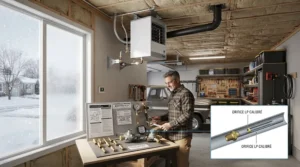
Setup: Before first use, inspect the hose and regulator for cracks, abrasion, or kinks — most manufacturers explicitly require this check before every use, not just once at unboxing. Connect the tank fully, then do a simple soap-and-water leak test on every fitting: bubbles forming mean a leak, full stop, and the heater shouldn’t be lit until it’s fixed. Position the heater on a stable, level, non-flammable surface with generous clearance — several feet, minimum — from anything combustible, including stored fuel, cardboard boxes, and paper.
First 30 days: Most early problems are ignition-related in cold weather; if the heater won’t light on the first try, check that the tank isn’t too cold or too empty to maintain vapor pressure before assuming a defect. Run the heater for shorter test sessions initially so you can monitor for unusual smells (beyond propane’s normal odorant), unusual flame colour, or excessive soot, all of which indicate incomplete combustion and warrant a service check rather than continued use.
Ongoing maintenance: Inspect the hose and regulator at least once per season, and immediately if you notice cracking or wear. Keep the burner area free of dust and debris, since a dirty burner can cause inefficient, sootier combustion. Store tanks upright, outdoors or in a detached structure per local code, never inside a heated living space. And test your carbon monoxide alarm’s battery on the same schedule you test your smoke alarms — most fire services recommend twice a year, often tied to daylight saving time changes.
Real-World Scenarios: Which Heater Fits Your Situation?
The weekend hobbyist: Runs a detached single-car garage for a few hours most Saturdays, mostly light repairs and hobby projects, on a tight budget. The Mr. Heater MH9BX or MH18B fits well here — low upfront cost, no need for a dedicated propane setup, and enough output for short, occasional sessions without overspending on capacity that’ll sit unused.
The serious home mechanic: Works in an insulated two-car garage several evenings a week year-round, including full engine swaps that take hours in the cold. This is squarely Mr. Heater MH60QFAV or Dyna-Glo RMC-FA60DGD territory — forced-air recovery time matters when you need the whole bay workable fast, and the longer runtime on a 40-lb tank supports multi-hour sessions without a mid-job refill.
The shop owner or serious hobbyist with a large detached building: Heats a barn-sized shop, multiple bays, or a space well beyond typical residential garage dimensions, often running the heater for full days at a stretch through winter. Here the Dyna-Glo RMC-FA300DGD earns its higher price tag — nothing smaller on this list has the sustained output for a space that size, and the thermostat control avoids babysitting a manual unit all day.
Common Mistakes When Buying a Propane Garage Heater
The single most common mistake is buying by budget instead of by BTU need — a cheap radiant heater in a large, uninsulated two-car garage will run constantly and still leave you cold, which ends up costing more in wasted propane than buying the right-sized unit upfront. A close second is ignoring the indoor-versus-outdoor rating entirely; several genuinely good heaters in this guide, including the MH9BX and MH18CH, are explicitly rated for outdoor or well-ventilated use only, and using them in a sealed space isn’t a grey area — it’s outside the manufacturer’s safety design.
Buyers also frequently underestimate tank requirements, assuming a 20-lb barbecue tank will feed any heater regardless of BTU rating — as covered above, that assumption falls apart fast once you’re running a forced-air unit above 60,000 BTU, especially in cold weather when vapor pressure drops. Finally, skipping a dedicated carbon monoxide alarm because “the heater has a safety sensor built in” is a mistake that shows up in incident reports more often than it should; the built-in ODS is a real safeguard, but it’s not a substitute for an independent alarm.
Propane vs Electric Garage Heaters: Which Wins for Canadian Winters?
| Factor | Propane | Electric |
|---|---|---|
| Upfront cost | Lower to moderate | Moderate to higher for high-output models |
| Heat-up speed | Very fast | Slower, especially at high output |
| Power outage resilience | Works without grid power | Useless without electricity |
| Ventilation needs | Required, scales with BTU | None (no combustion) |
| Best for | Large, uninsulated, or off-grid spaces | Small, well-sealed, occasional-use spaces |
Reading this table honestly, propane wins decisively on raw heating speed and reliability during a power outage — a real consideration in rural Canada, where winter storms and outages tend to arrive together. Electric heaters win just as decisively on ventilation and hands-off convenience, since there’s no combustion byproduct to manage at all. Based on the spec comparison, the deciding factor usually comes down to garage size and insulation: a small, tight, well-sealed garage often does fine with electric resistance heat, while anything larger or draftier benefits from propane’s faster, higher-output recovery — provided the ventilation and safety steps covered earlier in this guide are actually followed.
Long-Term Cost & Maintenance: Total Cost of Ownership
Propane heaters are cheap to buy but not free to run, and the ongoing fuel cost is where buyers are most often surprised. As a rough real-world benchmark, a 60,000 BTU forced-air heater running about six hours per weekend across a typical Canadian winter — say, twenty-two weekends from November through March — burns somewhere in the neighbourhood of eight to ten twenty-pound tank refills over the season. At typical refill pricing, that lands in a seasonal fuel cost range that’s worth budgeting for up front rather than discovering halfway through January.
Maintenance costs, by comparison, are modest: an annual hose and regulator inspection, occasional replacement of a worn hose (a low-cost part), and periodic carbon monoxide alarm battery replacement. Where total cost of ownership really diverges between models is tank compatibility — a heater like the Dyna-Glo RMC-FA60DGD that accepts 100-lb tanks can take advantage of bulk refill pricing that’s often cheaper per pound than repeatedly refilling small 20-lb cylinders, which can meaningfully lower cost-per-hour of heat for anyone running a heater regularly through the season.
FAQ
❓ How many BTUs do I need to heat a two-car garage in Canada?
❓ Is it safe to use a propane heater in an enclosed garage?
❓ What size propane tank do I need for a garage heater?
❓ Do vent-free propane heaters produce carbon monoxide?
❓ How long does a 20-lb propane tank last in a garage heater?
Conclusion
There’s no single “best” propane garage heater in 2026 — there’s a best heater for your specific garage, your insulation level, and how you actually use the space. A weekend hobbyist working a small detached garage is genuinely well served by something as simple as the Mr. Heater MH9BX, while a serious two-car workshop that sees daily winter use is better matched to the recovery speed of the Mr. Heater MH60QFAV or Dyna-Glo RMC-FA60DGD. At the far end, oversized shops and multi-bay buildings need the sustained output only the Dyna-Glo RMC-FA300DGD can realistically deliver.
What shouldn’t change regardless of which heater you land on is the safety baseline: match ventilation to BTU output, never run an outdoor-rated heater in a sealed space, size your propane tank correctly for cold-weather performance, and install a dedicated carbon monoxide alarm even if your heater has a built-in sensor. Get those fundamentals right, and a propane garage heater turns a genuinely miserable Canadian winter workspace into somewhere you can actually get things done.
✨ Ready to warm up your garage this winter? Check current prices and availability on the picks above before the cold snap hits — the right heater makes the whole season easier. 🔥
Recommended for You
- Best Natural Gas Garage Heater in Canada (2026): Top 7 Picks
- Gas Garage Heater Guide 2026: 7 Top Picks for Canadian Winters
- Wall Mount Garage Heater: 7 Top Picks for Canadian Garages (2026)
Disclaimer: This article contains affiliate links. As an Amazon Associate, I earn from qualifying purchases. If you purchase products through these links, we may earn a small commission at no additional cost to you.
✨ Found this helpful? Share it with your friends! 💬🤗
