
In This Article
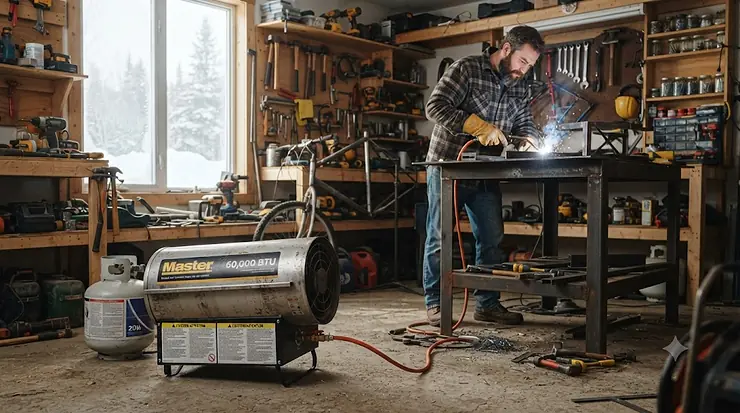
Somewhere around the third time you’ve dropped a wrench because your fingers won’t cooperate, you start Googling space heater for workshop at eleven o’clock at night. Been there. A cold shop doesn’t just make you miserable — it makes glue set slower, finishes crack, batteries drain faster, and every task take twice as long because you’re wearing three layers and mittens that don’t actually let you grip anything. The right heater fixes that, but “the right heater” is doing a lot of heavy lifting in that sentence, because a heater that’s perfect for a 10×12 hobby corner will barely dent a detached two-car bay, and a heater built for a detached bay might trip your breaker in a smaller space.
A space heater for workshop use is any purpose-built electric or propane unit designed to heat a garage, shed, or standalone shop — as opposed to a living-room space heater, which is usually underpowered and lacks the safety features a dusty, tool-filled environment demands. That distinction matters more than it sounds like it should, and it’s the first thing Health Canada’s safety review of portable electric heaters flags: heaters used near flammable materials, sawdust, and construction debris carry real risk if they’re not built and rated for that environment.
This guide walks through seven real, currently available heaters spanning propane and electric, portable and hardwired, budget and premium — plus the sizing math, safety rules, and insulation tricks that make any of them work better. Everything here is grounded in real specs and aggregated review patterns, not guesswork, so you can actually trust the recommendation you land on.
Quick Comparison Table: Space Heater for Workshop Options
| Product | Type | Output | Best For |
|---|---|---|---|
| Mr. Heater 18,000 BTU Big Buddy PRO | Propane, portable | 4,000–18,000 BTU | No-power detached shops |
| Dr. Infrared Heater DR-968 | Electric, 120V infrared | 5,200 BTU | Quiet small workshops |
| Lasko Pro-Ceramic Utility Heater | Electric, 120V portable | ~5,120 BTU | Tightest budgets |
| Fahrenheat FUH54 | Electric, 240V hardwired | 17,065 BTU | Budget permanent install |
| VEVOR 5000W Digital Garage Heater | Electric, 240V hardwired | ~17,000 BTU | Mid-range control freaks |
| Comfort Zone CZ230ER | Electric, 240V hardwired | ~25,600 BTU | Larger single-bay shops |
| TURBRO 15,000W GH15K Smart | Electric, 240V hardwired, WiFi | ~51,000 BTU | Big detached workshops |
Looking at the spread above, the real split isn’t budget versus premium — it’s whether you have 240V power run to your shop at all. If you don’t, the Mr. Heater 18,000 BTU Big Buddy PRO is your entire budget-to-premium category rolled into one, since propane sidesteps the electrical question completely. If you do have 240V available, the jump from the Fahrenheat FUH54 to the TURBRO 15,000W GH15K Smart is really a jump in square footage, not just price.
💬 Just one click — help others make better buying decisions too!😊
Top 7 Space Heaters for Workshop: Expert Analysis
1. Mr. Heater 18,000 BTU Big Buddy PRO — runs without a single outlet
If your workshop is a detached shed with zero electrical service, this changes the entire conversation, because you’re no longer choosing between heaters, you’re choosing between running electrical or running propane. The Big Buddy PRO puts out an adjustable 4,000, 9,000, or 18,000 BTU from one or two 1-lb propane cylinders, or a hose-fed 20-lb tank, and Mr. Heater rates it to cover roughly 450 square feet, which lines up with a typical single-car detached shop. Based on the spec sheet, what stands out is the built-in Oxygen Depletion Sensor and accidental tip-over shutoff — both required features for any propane heater marketed as indoor-safe in Canada, and neither is optional window dressing here. This is the pick for anyone in a rural property or older shed where running a 240V circuit isn’t happening this season, and reviewers consistently note that the piezo ignition lights reliably even in cold hands. What the spec sheet won’t tell you is that you’ll burn through 1-lb cylinders fast at the 18,000 BTU setting, so budget-conscious users tend to switch to a hose-and-adapter setup for a refillable tank fairly quickly.
Pros:
- ✅ No electrical wiring needed at all
- ✅ Adjustable output for small or larger spaces
- ✅ Built-in oxygen and tip-over safety shutoffs
Cons:
- ❌ Needs steady ventilation even when “indoor-safe”
- ❌ 1-lb cylinders run out quickly at high heat
At the time of research, this heater sits around C$150-C$210, and for a shop with no power run to it, there’s genuinely no electric equivalent at any price — the value here is less about dollars and more about it being your only real option.
2. Dr. Infrared Heater DR-968 — quietest plug-and-play pick
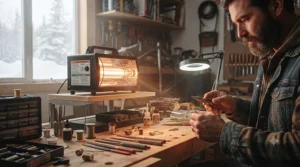
The DR-968 plugs straight into a standard 120V outlet, which sounds unremarkable until you realize most hardwired workshop heaters demand a 240V circuit and an electrician. At 1,500 watts and roughly 5,200 BTU, it’s not going to heat a two-car bay, but for a small workshop corner or a bench area you actually sit at, the dual heating system — an infrared quartz tube paired with a PTC element — puts heat into you and your tools directly rather than just warming the air around them. On paper this means faster comfort in a drafty space, since infrared heat doesn’t rely on air circulation the way a fan-forced unit does. Reviewers consistently report the 39 dB blower is noticeably quieter than typical shop heaters, which matters more than people expect once you’ve spent a winter next to a heater that sounds like a hair dryer for eight hours straight. It’s UL certified for both US and Canadian markets, and the cherry wood cabinet is an odd detail for a shop heater, but nobody’s complaining that it doesn’t look like a construction site reject.
Pros:
- ✅ Plugs into any standard 120V outlet
- ✅ Genuinely quiet at 39 dB blower noise
- ✅ Dual infrared and PTC heating elements
Cons:
- ❌ Limited coverage for larger detached shops
- ❌ 12.5-amp draw can trip shared circuits
Price sits around C$140-C$190 at the time of research, and for a small heated zone rather than a whole shop, that’s solid value — you’re paying for quiet, certified engineering rather than raw output.
3. Lasko Pro-Ceramic Utility Heater — cheapest grab-and-go heat
Sometimes you don’t need a heating solution, you need forty-five minutes of warmth aimed directly at your hands while you finish one job. That’s this heater’s whole reason for existing. At 1,500 watts with a pivoting head, it’s built to be picked up, carried to wherever you’re working, and pointed at exactly that spot — a tubular steel base and comfort-grip handle make that genuinely practical rather than a marketing bullet point. Based on the spec comparison against every other unit on this list, it’s the only one that costs less than a good pizza night, and that matters if you’re testing whether heating your workshop at all is worth the investment before committing further. What most buyers overlook about this model is that it’s a supplemental heater, not a primary one — Tractor Supply lists coverage around 225-300 square feet, which is fine for a bench but won’t touch a full detached shop. Reviewers frequently mention the cool-touch housing as a genuine safety plus around kids or pets who wander into the garage.
Pros:
- ✅ Lowest price point on this list by far
- ✅ Pivoting head aims heat exactly where needed
- ✅ Cool-touch housing and overheat protection
Cons:
- ❌ Coverage limited to a small zone
- ❌ Not a realistic primary heat source
Expect to pay under C$70 at the time of research, making this the easiest “just try it” purchase on the list, even if it’s the first one you’ll outgrow.
4. Fahrenheat FUH54 — budget hardwired ceiling mount
Once you’ve decided you want a permanent, out-of-the-way solution and you’ve got 240V service in the shop, the FUH54 is the no-frills entry point. It’s a straightforward 5,000-watt, 17,065 BTU ceiling-mounted unit with a plate-finned element and a built-in single-pole thermostat adjustable from 45°F to 135°F — nothing digital, nothing app-connected, just a dial and a switch. Here’s what to weigh: the automatic control delays fan action until the element warms up, and keeps the fan running after shutoff until the element cools, which extends component life and avoids blasting you with a cold gust on startup. That’s smarter engineering than the plain price tag suggests. Reviewers who’ve run this in drafty two-car garages report it holding the mid-50s to low-60s°F when it’s well below freezing outside, which tracks with its rated output for a moderately insulated single bay. It requires a licensed hardwire connection to a 240V circuit, so factor installation into your total cost.
Pros:
- ✅ Strong output-to-price ratio for hardwired units
- ✅ Ceiling mount frees up all floor space
- ✅ Simple analog controls with few failure points
Cons:
- ❌ Requires professional 240V hardwiring
- ❌ No remote or digital thermostat
At the time of research this runs roughly C$190-C$240 before installation, and it remains one of the better cost-per-BTU values in the hardwired category.
5. VEVOR 5000W Digital Garage Heater — digital control on a budget frame
This one splits the difference between the analog simplicity of the Fahrenheat and the remote-and-app features of pricier units. It’s still a 5,000-watt, 240V hardwired ceiling or wall-mount heater, but VEVOR added a digital display and remote control for precise temperature settings instead of a dial you’re guessing at from across the shop. What most buyers overlook about this model is that “digital” doesn’t mean smarter heating physics — it’s still resistive fan-forced heat with roughly the same real-world output as the FUH54 — but it does mean you can dial in an exact setpoint and walk away, which matters if your shop sits empty for hours and you don’t want to hover near an analog thermostat. The 9-hour timer is a practical touch for anyone worried about leaving a heater running unattended overnight. Aggregated reviewer feedback tends to be positive on the remote’s range and the overheat protection tripping reliably in testing, with some noting the plastic housing feels less rugged than steel-bodied competitors.
Pros:
- ✅ Digital thermostat with precise setpoints
- ✅ Included remote control for adjustments
- ✅ Built-in 9-hour safety timer
Cons:
- ❌ Housing feels less industrial than steel units
- ❌ Still requires 240V hardwire installation
Price sits around C$160-C$210 at the time of research, making it a reasonable step up from the FUH54 if control matters more to you than build ruggedness.
6. Comfort Zone CZ230ER — remote-controlled comfort for bigger bays
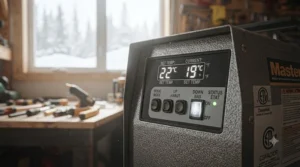
Step up to 7,500 watts and roughly 25,600 BTU, and you’re now in territory that can genuinely handle a full single-car or smaller two-car bay rather than just taking the edge off. The CZ230ER pairs that output with a digital thermostat, full-function remote, and a 12-hour timer, and Comfort Zone’s own installation guidance specifies a minimum 72-inch floor clearance and 13-inch side-wall clearance for the ceiling mount — details that matter if your shop has lower ceilings or tight bays. Based on the spec comparison, the jump from 5,000 to 7,500 watts on the same 240V circuit type usually means a dedicated higher-amperage breaker, so this isn’t necessarily a drop-in replacement for a smaller unit; check your panel capacity first. Reviewers consistently describe the remote as genuinely useful rather than gimmicky, since adjusting a ceiling-mounted unit by hand means dragging out a ladder every time. This is the heater for the workshop owner who’s outgrown a budget unit and is ready to commit to a real permanent solution.
Pros:
- ✅ Higher output suited to larger single bays
- ✅ Full-function remote avoids ladder trips
- ✅ Digital thermostat with 12-hour timer
Cons:
- ❌ May require a dedicated higher-amp circuit
- ❌ Overkill and inefficient in small spaces
At the time of research, expect around C$260-C$330, plus installation — a fair jump from the budget tier, but justified if square footage demands it.
7. TURBRO 15,000W GH15K Smart — WiFi control for the biggest detached shops
At 15,000 watts and roughly 51,000 BTU, this is the heavyweight of the lineup, built for large detached two-car workshops or shops with high ceilings and poor insulation where smaller units simply can’t keep up. The headline feature is WiFi connectivity, letting you fire the heater up from your phone before you walk out to the shop on a frigid morning — genuinely useful rather than a novelty, since propane and smaller electric units can’t offer that at all. Here’s what to weigh: at 15,000 watts, this unit demands a serious dedicated circuit, and running it constantly in a poorly insulated shop will show up fast on your electricity bill, so pairing it with the insulation upgrades covered later in this guide isn’t optional if you want it to be cost-effective. Reviewers report the app connectivity working reliably, with occasional mentions of a learning curve on initial WiFi setup. Overheat protection, a 12-hour timer, and a full-function remote round out the safety and convenience package.
Pros:
- ✅ Massive output for large detached shops
- ✅ WiFi app control from your phone
- ✅ Full safety suite including overheat protection
Cons:
- ❌ Demands a serious dedicated electrical circuit
- ❌ Expensive to run without good insulation
Price runs roughly C$480-C$620 at the time of research, positioning it as a genuine investment rather than an impulse buy — but for the right space, nothing electric on this list comes close to its coverage.
How to Choose a Space Heater for Workshop: A BTU Sizing Guide
Getting the workshop heater btu guide math right up front saves you from buying twice. Here’s the process, step by step:
- Measure your square footage. Multiply length by width for a rough floor area — a one-car bay is typically 200-250 sq ft, a two-car bay closer to 400-500 sq ft.
- Account for ceiling height. Anything over 8 feet increases the air volume you’re heating; add roughly 10% BTU for every extra foot of ceiling height.
- Rate your insulation. An uninsulated metal shed loses heat far faster than a drywalled, insulated garage — budget 30-50% more BTU output for uninsulated spaces.
- Multiply square footage by 30-40 BTU per square foot as a baseline for moderately insulated Canadian winters, then adjust up or down per the insulation step above.
- Factor in your coldest realistic temperature, not the average — a shop in a region that regularly hits -20°C needs meaningfully more output than one that rarely drops below -5°C.
- Decide portable versus hardwired based on power availability, since that constraint often narrows your choice before BTU math even matters.
- Round up, not down. A slightly oversized heater cycles on and off efficiently; an undersized one runs constantly and never quite catches up.
Running that math for a typical 400 sq ft detached, moderately insulated single-bay shop lands you around 14,000-16,000 BTU as a comfortable target — which explains why the Fahrenheat FUH54 and VEVOR 5000W both land in that exact range and why they’re popular picks for that shop size specifically.
What to Expect: Real-World Performance of a Space Heater for Cold Garage Workshop
Spec sheets promise a lot, so here’s what a space heater for cold garage workshop actually delivers once winter hits. A correctly sized hardwired electric unit in a moderately insulated garage typically brings the space from near-freezing to a workable 15-18°C within 20-30 minutes, then holds steady with periodic cycling. Propane units like the Big Buddy heat faster — often noticeably warm within 10 minutes — because radiant heat warms objects and people directly rather than waiting for air circulation to catch up, but that speed comes with the tradeoff of needing active ventilation monitoring.
What the spec sheet won’t tell you is that real-world performance drops meaningfully below -15°C outdoor temperatures, especially in uninsulated spaces, because heat loss through an uninsulated garage door and walls can outpace even a well-sized heater’s output. Reviewers in colder provinces consistently mention layering strategies — running the heater an hour before starting work rather than expecting instant results, and closing off unused sections of a shop with a heavy curtain to shrink the effective space being heated. That single trick, borrowed from job-site heating practices, often does more for comfort than upgrading to a bigger unit.
Best Heater for Small Workshop vs Large Bay
The best heater for small workshop and the best heater for a full two-car bay are rarely the same unit, and treating them the same is the single most common overspend in this category.
If you’re working in under 200 sq ft — a bench nook, a small shed, a corner of a basement — a portable electric unit like the Lasko Pro-Ceramic Utility Heater or the Dr. Infrared Heater DR-968 is genuinely sufficient. You don’t need hardwiring, permits, or a dedicated circuit, and the lower output actually matches the smaller air volume you’re heating rather than wastefully overshooting it.
If you’re working in a single-car bay (roughly 200-350 sq ft), the Fahrenheat FUH54 or VEVOR 5000W hardwired units hit the sweet spot — enough output to hold a comfortable temperature through a Canadian winter without the installation complexity or running cost of the largest units.
If you’re in a full two-car or larger detached workshop, the Comfort Zone CZ230ER or TURBRO 15,000W GH15K Smart become worth their higher price and installation demands, since undersizing here means running a heater constantly and never actually feeling warm.
Detached Workshop Heating Solution: Propane vs Hardwired Electric
For anyone weighing a detached workshop heating solution, the propane-versus-electric decision usually comes down to one question: do you have 240V service run to the building? If yes, hardwired electric is almost always the better long-term call — no fuel deliveries, no cylinder swaps, and no active ventilation monitoring required the way propane demands. If no, running that electrical service can cost more upfront than years of propane cylinders, making a unit like the Big Buddy PRO the pragmatic choice.
| Factor | Propane (Big Buddy PRO) | Hardwired Electric (Fahrenheat–TURBRO range) |
|---|---|---|
| Upfront cost | Lower | Higher (includes install) |
| Ongoing fuel cost | Cylinder refills add up | Electricity, often cheaper long-term |
| Ventilation needs | Required, active | None |
| Installation | None | Licensed electrician recommended |
| Best for | No-power detached sheds | Shops with existing 240V service |
Interpreting that table honestly: propane wins on flexibility and zero installation friction, but hardwired electric wins on convenience and total cost of ownership if you’re running the heater regularly across multiple winters. If you suspect you’ll be heating the space for more than two or three seasons, running electrical service once and installing a hardwired unit typically pays for itself compared to years of propane cylinder purchases. Provincial guidance on combustion appliances, including British Columbia’s carbon monoxide awareness resources, is worth reviewing regardless of which province you’re in, since the ventilation principles for propane heaters in enclosed spaces are consistent nationwide.
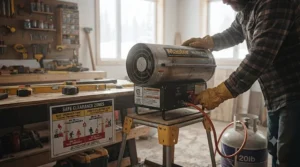
Practical Setup & Maintenance Guide
Getting a new space heater for workshop use running safely and efficiently takes more than plugging it in. First 30 days matter most: run the unit on a lower setting initially to burn off manufacturing residue and check for any unusual smell that lingers beyond the first hour — that’s normal for a brand-new heating element, but anything persisting past day one warrants a check. Mount hardwired units at the manufacturer’s specified minimum clearance from the floor and combustible materials; skipping this is the single most common installation mistake, and it’s also a factor in the heater-related fire incidents Health Canada’s product safety assessment documents. For hardwired 240V installs, having a licensed electrician handle the connection isn’t just good practice — it’s the standard covered under Canadian Electrical Code workplace safety requirements, similar in spirit to the broader principles laid out in CSA’s workplace electrical safety standard.
Ongoing maintenance is minimal but non-negotiable: vacuum dust and debris from vents monthly during heavy use, since a shop environment accumulates far more airborne particulate than a living room ever would. Check propane hose connections for wear each season before first use, and test tip-over and overheat shutoffs periodically by simulating the trigger condition per the manual. A five-minute monthly check beats a mid-winter breakdown every time.
Real-World Scenarios: Which Workshop Heater Fits Your Situation
The weekend woodworker with a 250 sq ft attached garage bay: power is already run to the space, projects happen a few hours at a time on weekends, and budget matters more than app connectivity. The Fahrenheat FUH54 fits cleanly — simple, reliable, sized correctly, and cheap enough that the install cost doesn’t sting.
The metalworker in a detached shed with no electrical service: running 240V to a standalone building isn’t in this year’s budget, but heat is needed now for welding prep and tool maintenance through winter. The Mr. Heater Big Buddy PRO solves the immediate problem without any electrical work, provided ventilation is genuinely maintained every session.
The serious hobbyist running a full two-car detached workshop most days of the week: this is enough regular use to justify a real investment. The TURBRO 15,000W GH15K Smart, paired with the insulation upgrades below, keeps the space comfortable enough to work in shirtsleeves through a Canadian winter, and the WiFi start means the shop is already warm by the time boots hit the driveway.
Sawdust & Dust Safety: Heater Rules Every Workshop Should Follow
Sawdust dust safety heater workshop concerns are not hypothetical — fine wood dust is combustible, and any heater with an exposed heating element or open flame near accumulated sawdust is a genuine fire risk that generic living-room heater guidance doesn’t address. A few non-negotiable rules: never operate any heater within several feet of a dust collection area or uncleaned sawdust pile, regardless of how the unit is rated. Choose enclosed-element units like the ceramic or PTC-style heaters on this list over exposed-coil designs when working in a dusty environment, since exposed coils can ignite airborne particulate that drifts too close. Clean sawdust accumulation around any heater — portable or hardwired — before every session, not just occasionally, since it builds up faster than most people expect during active woodworking.
Propane heaters add a second layer of concern: combustion consumes oxygen and produces carbon monoxide, so active ventilation isn’t optional even on units with an oxygen depletion sensor, which is a safety backstop, not a substitute for airflow. Provincial fire safety authorities are consistent on this point nationwide, and it’s worth a periodic re-read regardless of how familiar the rule feels after a season or two.
Workshop Insulation & Heating Efficiency: Getting More Heat for Less
No heater, no matter how powerful, fixes a poorly insulated shop efficiently — it just burns more fuel or electricity fighting a losing battle against heat loss. Before or alongside buying a new heater, weatherstripping the main door, insulating an uninsulated garage door, and sealing obvious gaps around windows typically cuts heating time and running cost meaningfully. Natural Resources Canada’s home efficiency guidance notes that air leaks around doors, windows, and walls are often the biggest drain on any heating system’s efficiency, and that principle applies just as directly to a workshop as it does to a house.
Practical, low-cost upgrades that pair well with any heater on this list: hang a heavy shop curtain or plastic sheeting to section off the area you’re actually working in rather than heating the whole bay, add foam board insulation to an uninsulated garage door, and seal the gap under the main door with a sweep. These changes routinely let a mid-range heater perform like a larger one, which matters most for anyone running a hardwired 240V unit where the electricity bill scales directly with runtime.
Common Mistakes When Buying a Space Heater for Workshop
The most frequent overspend is buying a unit sized for the whole shop’s square footage rather than the actual zone being worked in — sectioning off a smaller area with a curtain, as mentioned above, often makes a smaller heater perform better than a bigger one heating open space. The second common mistake is skipping the electrical capacity check: a 5,000-watt-plus hardwired unit demands a dedicated circuit, and discovering that after purchase means an unplanned electrician visit. Third, buyers frequently underestimate ventilation needs with propane units, treating the oxygen depletion sensor as a substitute for a cracked window or door rather than a backup safety layer. Finally, ignoring insulation entirely and expecting a heater alone to solve comfort problems in a drafty, uninsulated space leads to disappointment and inflated running costs regardless of which unit gets purchased.
Features That Actually Matter (And Those That Don’t)
Genuinely worth paying for: correctly matched BTU output for your actual space, overheat and tip-over protection (non-negotiable in a shop environment), and a hardwired install if you’re heating regularly across multiple winters. Digital thermostats and remotes are a real quality-of-life upgrade, not marketing fluff, especially on ceiling-mounted units you can’t easily reach. WiFi connectivity earns its keep specifically for detached shops you want pre-heated before you walk out.
Less essential than the marketing suggests: built-in humidifiers on plug-in units are a nice-to-have for comfort but irrelevant to actual heating performance, and cosmetic cabinet finishes like wood-look housing matter zero to function despite looking nicer sitting in a corner.

Frequently Asked Questions
❓ What size space heater do I need for a two-car garage workshop?
❓ Can I run a propane heater in my workshop overnight?
❓ Is an infrared heater or a fan-forced heater better for a workshop?
❓ How much does it cost to run an electric garage heater in Canada?
❓ Do I need a permit to hardwire a garage heater in Canada?
Conclusion
There’s no single best space heater for workshop use — there’s only the best one for your specific shop, your electrical setup, and how many months a year you’re actually out there working. If you’ve got no power run to a detached shed, the Mr. Heater 18,000 BTU Big Buddy PRO solves that immediately. If you’re heating a small bench area, the Lasko Pro-Ceramic Utility Heater or Dr. Infrared Heater DR-968 cover it without any installation hassle. And if you’re running a full detached two-car workshop several days a week, the TURBRO 15,000W GH15K Smart or Comfort Zone CZ230ER justify their higher price with output that actually matches the space.
Whatever you land on, pair it with the BTU sizing math and insulation upgrades covered above — a correctly sized heater in a properly sealed shop will outperform an oversized one in a drafty space every single time, and cost you less to run while doing it. Stay warm out there, and build something good.
✨ Don’t Miss These Exclusive Deals!
🔍 Take your workshop heating setup to the next level with these carefully selected picks. Click on any highlighted product above to check current pricing and availability before the cold snap hits. A properly heated shop means more finished projects and fewer excuses to head back inside.
Recommended for You
- Propane Garage Heater 2026: 7 Best Picks for Canada
- Best Natural Gas Garage Heater in Canada (2026): Top 7 Picks
- Gas Garage Heater Guide 2026: 7 Top Picks for Canadian Winters
Disclaimer: This article contains affiliate links. As an Amazon Associate, I earn from qualifying purchases. If you purchase products through these links, we may earn a small commission at no additional cost to you.
✨ Found this helpful? Share it with your friends! 💬🤗
