
In This Article
Here’s a garage-shaped paradox. The people who’d benefit most from smart garage door openers — renters in townhouses, basement-suite tenants with a shared garage, anyone who’s ever stood in a Winnipeg driveway at −30°C fumbling for a remote with a dying battery — are often the people who assume they can’t have one. It’s not their opener. It’s not their ceiling. It’s definitely not their wiring.
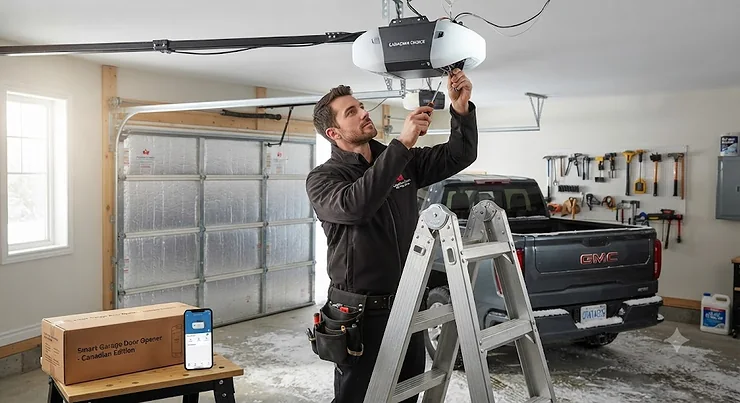
That assumption is about five years out of date. Smart garage door openers in 2026 split cleanly into two camps: full replacement units that swap the whole motor-and-rail assembly, and small smart garage door controllers that bolt onto (or simply sit near) the opener you already have. The second camp is where things get interesting for tenants, because several of them install with double-sided tape, an outlet, and roughly the same effort as hanging a picture frame.
This guide compares seven real, currently sold options — from a sub-C$60 wireless hub to a full belt-drive replacement with battery backup — and it does so honestly. You’ll get real specs, real aggregated review sentiment, and zero invented “I tested this for six months” stories. We’ll also dig into three things most roundups skip: the retrofit vs full replacement decision in actual dollars, genuinely rental-friendly installation (the kind your landlord won’t notice when you move out), and smart opener data privacy — because a device that knows exactly when you leave home deserves the same scrutiny as your banking app.
What Are Smart Garage Door Openers?
Smart garage door openers are Wi-Fi, Bluetooth, or locally networked devices that let you open, close, and check the status of a garage door from a phone app, voice assistant, or automation routine. They come either as complete opener units with the radio built in, or as add-on controllers that make an existing “dumb” opener connected.
Think of them as one small branch of the broader home automation family tree — the same lineage that gave us smart thermostats and connected locks. The difference is that a garage door is both a physical security barrier and a 100-kg moving object, so the stakes around reliability, safety reversal, and who can trigger it remotely are noticeably higher than with a smart bulb.
In practice, most Canadians don’t need the full-replacement route. If your opener still lifts the door without groaning, a controller in the C$40-C$180 range delivers nearly everything the app experience promises. Five of the seven picks below are exactly that kind of add-on.
Quick Comparison Table
| Product | Type | Install Style | Best For | Price Range (CAD) |
|---|---|---|---|---|
| Chamberlain myQ Smart Garage Control (myQ-G0401) | Wireless hub | No wiring on compatible openers | Tenants who can’t touch the opener | Under C$60 |
| meross Smart Wi-Fi Garage Door Opener (MSG100) | Wired controller | 2 low-voltage wires + reed sensor | Cheapest full-featured upgrade | C$35-C$55 |
| meross Smart Garage Door Opener (MSG200) | Wired controller | Low-voltage wires, multi-door | Apple Home households, 2+ doors | C$70-C$100 |
| ismartgate Mini | Wired controller | Low-voltage wires + wireless sensor | Privacy-first, local data storage | C$130-C$180 |
| Tailwind iQ3 | Wired controller | Low-voltage wires, up to 3 doors | Hands-free auto-open on arrival | C$100-C$150 |
| Konnected GDO blaQ | Protocol controller | 3 wires, no door sensor | Home Assistant users, local-only | C$120-C$150 |
| Genie StealthDrive Connect 7155-TKV | Full replacement | Complete opener install | Owners replacing a dying opener | C$450-C$600 |
Read the “Install Style” column before anything else — it’s the column that decides whether this is a renter’s purchase or a homeowner’s. The Chamberlain myQ Smart Garage Control is the only pick that can, on compatible Chamberlain and LiftMaster openers, work without touching a single terminal, while the meross Smart Wi-Fi Garage Door Opener (MSG100), meross Smart Garage Door Opener (MSG200), ismartgate Mini, Tailwind iQ3, and Konnected GDO blaQ all need two or three thin low-voltage wires — reversible, but still a conversation with your landlord. The Genie StealthDrive Connect 7155-TKV is a different animal entirely: it replaces the opener, so it only makes sense if you own the house.
💬 Just one click — help others make better buying decisions too!😊
Top 7 Smart Garage Door Openers for 2026: Expert Analysis
Before the individual breakdowns of these smart garage door openers, here’s the spec snapshot that separates these seven on the three things that matter most in 2026: ecosystem support, where your data goes, and whether you’ll ever see a subscription prompt.
| Product | Voice / Ecosystems | Local Control | Subscription | Best For |
|---|---|---|---|---|
| Chamberlain myQ Smart Garage Control (myQ-G0401) | myQ app; voice via paid partner routes | No (cloud) | Optional, for some integrations | Zero-wiring rentals |
| meross Smart Wi-Fi Garage Door Opener (MSG100) | Alexa, Google, SmartThings, IFTTT | Limited | No | Budget buyers |
| meross Smart Garage Door Opener (MSG200) | Apple Home (HK version), Alexa, Google | Limited | No | Apple households |
| ismartgate Mini | Apple Home, Alexa, Google, SmartThings | Yes, local data | No | Privacy-minded tenants |
| Tailwind iQ3 | Alexa, Google, SmartThings, Home Assistant | Local API | Optional paid tier | Auto-open automation |
| Konnected GDO blaQ | Home Assistant, Hubitat, SmartThings, Alexa | Yes, local-first | No | Tinkerers and privacy purists |
| Genie StealthDrive Connect 7155-TKV | Aladdin Connect, Alexa, Google | No (cloud) | No | Full opener replacement |
The “Local Control” column is the quiet headline here. The ismartgate Mini and Konnected GDO blaQ can keep working — and keep your comings and goings — inside your own network, while the Chamberlain myQ Smart Garage Control and Genie StealthDrive Connect 7155-TKV route commands through the manufacturer’s cloud. Neither approach is wrong, but they’re very different answers to the smart opener data privacy question we’ll unpack later.
1. Chamberlain myQ Smart Garage Control (myQ-G0401) — the true no-wiring renter pick
The Chamberlain myQ Smart Garage Control earns its “renter pick” crown for one reason: on most Chamberlain, LiftMaster, and Craftsman openers made since the mid-1990s, the hub talks to the opener by radio, just like your car remote does. You plug the hub into a nearby outlet, stick the door sensor to the top panel with adhesive, and pair — no terminals, no ladder gymnastics beyond reaching the sensor.
That design matters enormously in a rental. When you move out, you peel off the sensor, unplug the hub, and the garage is exactly as you found it. It also supports up to two doors and Amazon Key in-garage delivery, handy if porch piracy is a hobby on your street.
The trade-offs are real, though. Chamberlain blocked third-party integrations in late 2023 — Home Assistant formally removed its myQ integration that November — and voice control now leans on paid partner routes. Aggregated review sentiment is consistent: owners praise the core open/close reliability and a painless setup, while the most common complaints target ads in the app and the paywalled integrations.
Pros:
- ✅ Radio pairing means zero wiring on compatible openers
- ✅ Leaves no trace when you move out
- ✅ Mature app with the biggest support community
Cons:
- ❌ Closed ecosystem; third-party integrations blocked since 2023
- ❌ Voice assistants require paid partner services
At the time of research this sits under C$60 — the best value in the category if you rent a Chamberlain-family garage and mostly want status checks.
2. meross Smart Wi-Fi Garage Door Opener (MSG100) — most features per dollar
The meross Smart Wi-Fi Garage Door Opener (MSG100) is the “why pay more?” pick: a small 2.4 GHz Wi-Fi controller that works with Alexa, Google Assistant, SmartThings, and IFTTT, with no subscription attached. Setup means running two thin wires to the opener’s wall-button terminals and mounting a wired magnetic reed sensor on the door track.
Here’s what those specs mean day to day. Wiring to the wall-button terminals makes the MSG100 brand-agnostic — it “presses the button” the same way your wall switch does, so it works with most openers that have standard push-button terminals. The wired reed sensor, meanwhile, never needs a battery, which is a quiet win in an unheated garage where coin cells die fast in January. Chamberlain owners should note one wrinkle: newer Security+ 2.0 openers use a data-style wall button, and meross lists compatibility steps for those models — check before ordering.
Reviewers frequently call it the easiest wired install in its price bracket, while the recurring criticism is that the wired sensor cable can be fiddly to route neatly on some door layouts.
Pros:
- ✅ Lowest price for a full, subscription-free feature set
- ✅ Battery-free wired sensor handles cold garages well
- ✅ Works across most opener brands
Cons:
- ❌ No Apple Home support on this version
- ❌ Sensor cable routing can look messy
Expect roughly C$35-C$55 — unbeatable value if you have landlord sign-off for two low-voltage wires.
3. meross Smart Garage Door Opener (MSG200) — Apple Home plus multi-door control
The meross Smart Garage Door Opener (MSG200) takes the MSG100’s recipe and scales it: one hub, multiple doors, and — on the HomeKit-certified version — native Apple Home and Siri support alongside Alexa and Google Assistant. For a duplex tenant with two bays, or a family with a double garage split into two single doors, that consolidation matters.
On paper, the hardware story is familiar: low-voltage wiring to each opener’s button terminals plus wired sensors per door. What changes is the ecosystem reach. Apple Home support means you can build automations like “close the garage when the last person leaves” without a third-party bridge, and HomeKit’s local handling keeps some commands inside your home network rather than bouncing off a distant server. Aggregated owner feedback describes HomeKit pairing as dependable, with the most common gripe being that multi-door wiring takes longer than the single-door installation videos suggest.
Pros:
- ✅ Native Apple Home and Siri on the HK version
- ✅ One hub handles multiple garage doors
- ✅ No subscription for any core feature
Cons:
- ❌ Multi-door wiring runs means a longer install
- ❌ Pricier than MSG100 if you only have one door
Pricing lands around C$70-C$100 — worth it for Apple households or multi-door garages, overkill otherwise.
4. ismartgate Mini — privacy-first with locally stored data
The ismartgate Mini is the pick for anyone who reads privacy policies for fun. The manufacturer states it stores data locally rather than in the cloud, supports Apple Home, Alexa, Google Assistant, and SmartThings, and charges no recurring fees — with up to 10 users included free, and extra-user plugins sold as one-time purchases.
That local-first design is the headline. A cloud-dependent controller logs every open and close on a server somewhere; a locally storing unit keeps that pattern-of-life data under your roof. For renters sharing a garage with an upstairs unit, the free multi-user system is also practical — each person gets their own login, so you can remove access for a departing roommate without resetting everything.
It connects with low-voltage wires and offers wireless or wired door sensors, so you can pick the one that leaves the fewest holes. Reviewer sentiment highlights the privacy stance and the flexible user management, while the common knock is an app interface that feels more utilitarian than polished.
Pros:
- ✅ Local data storage, no cloud dependency
- ✅ Ten free users with individual access
- ✅ Wired or wireless sensor options
Cons:
- ❌ Higher price than meross for single-door use
- ❌ App design feels functional rather than refined
Expect it in the C$130-C$180 range — a fair premium if smart opener data privacy is your top priority.
5. Tailwind iQ3 — hands-free auto-open as you pull in
The Tailwind iQ3‘s party trick is automatic opening: using your phone’s location plus a Bluetooth link to your car, it can raise the door as you approach and close it after you leave. It controls up to three doors from one hub and works with Alexa, Google Assistant, SmartThings, and Home Assistant via a local API.
In a Canadian winter, auto-open isn’t a gimmick. It’s the difference between rolling straight into a warm garage and sitting at the end of the driveway, window down, snow blowing into the cabin. The three-door capacity also makes it a sensible choice for households juggling a main garage plus a workshop bay.
Installation follows the standard wired pattern — thin wires to the opener’s terminals plus sensors — so it’s reversible but not tape-only. Reviewers consistently praise the local API and the auto-open feature when properly tuned, while a recurring note is that geofence timing can need adjusting to avoid the door opening too early (or too late) on short driveways. There’s also an optional paid tier for extras, though the core features stay free.
Pros:
- ✅ Genuinely useful car-arrival auto-open
- ✅ Controls up to three doors
- ✅ Local API for Home Assistant
Cons:
- ❌ Auto-open timing needs tuning on short driveways
- ❌ Some extras sit behind an optional paid tier
Pricing typically sits around C$100-C$150 — solid value for commuters who drive in and out daily.
6. Konnected GDO blaQ — local, open-source, and sensor-free
The Konnected GDO blaQ is the enthusiast’s answer to myQ. Instead of pretending to press a button, it speaks Chamberlain’s Security+ and Security+ 2.0 protocol directly, which means it reads door position straight from the opener — no separate door sensor required. It runs on open-source ESPHome firmware and is, in Konnected’s words, “local & private, cloud-optional.”
What that means in practice: fewer parts on the door, sub-second local response in Home Assistant or Hubitat, and extras like light and lockout control, partial-open positions, and a visual and audible warning before remote closing. Installation is three wires to the back of the motor unit plus a regular outlet for power.
There’s a crucial compatibility catch: it supports openers with yellow, red, orange, blue, purple, or brown learn buttons, but not the newer Security+ 3.0 (white learn button) models. Aggregated reviews rate its speed and local control highly, while the main criticism is that it rewards users already comfortable with Home Assistant. Availability on amazon.ca can vary, so check current listings.
Pros:
- ✅ Reads door status directly, no sensor needed
- ✅ Open-source firmware with local-first control
- ✅ Light, lockout, and partial-open control included
Cons:
- ❌ Not compatible with Security+ 3.0 openers
- ❌ Best experience requires Home Assistant or Hubitat
Expect roughly C$120-C$150 — excellent value if you run a local smart home.
7. Genie StealthDrive Connect 7155-TKV — full replacement with battery backup
The Genie StealthDrive Connect 7155-TKV is our full-replacement benchmark: a 1-1/4 HPc belt-drive opener with Aladdin Connect Wi-Fi built in, battery backup, a wireless keypad, and two remotes in the box. It isn’t a smart add-on — it’s the whole opener, smart from day one.
Every spec here translates to something tangible. The belt drive is noticeably quieter than chain drives, a real consideration if there’s a bedroom above the garage. The battery backup keeps the door operating during outages — relevant anywhere ice storms knock out power. Aladdin Connect support means app control and Alexa or Google voice commands without a separate hub.
Is it for renters? Almost never — you’d be replacing your landlord’s hardware. It’s for homeowners whose existing opener is failing anyway, and for them it bundles opener, smart control, and backup power into one install. Reviewers consistently highlight the quiet operation and the value of the bundled keypad and remotes, while the recurring complaint is that installation is a genuine half-day project best left to a pro if you’re not comfortable with rail assemblies.
Pros:
- ✅ Built-in Wi-Fi, no add-on hub required
- ✅ Battery backup for power outages
- ✅ Includes keypad and two remotes
Cons:
- ❌ Full install is a half-day project
- ❌ Not suitable for tenants or rental properties
At the time of research, expect roughly C$450-C$600 — strong value if you’d be buying a new opener anyway.
Rental-Friendly Installation: A No-Drama Setup Guide
Rental-friendly installation starts before you open a box. Take a photo of your opener’s learn button (it’s on the motor unit, usually under the light cover) — its colour tells you which smart garage door controllers will work, and it gives you a baseline “before” photo for move-out.
Step 1: Get the green light in writing
Most provincial tenancy rules treat hardware changes as something to clear with your landlord, and Ontario’s standard lease guidance for renters points tenants back to their lease for maintenance and modification terms. A short email — “May I add a plug-in smart controller to the garage opener? It’s removable and I’ll restore it when I leave” — protects you at deposit time (or, in provinces without deposits, from damage claims).
Step 2: Choose the lightest-touch option that works
For true rental-friendly installation, ranking these smart garage door controllers by footprint goes:
- Chamberlain myQ Smart Garage Control — radio pairing plus adhesive sensor, no wiring.
- ismartgate Mini with the wireless sensor — two thin wires, no drilled sensor mounts.
- meross Smart Wi-Fi Garage Door Opener (MSG100), meross Smart Garage Door Opener (MSG200), Tailwind iQ3, or Konnected GDO blaQ — low-voltage wiring, fully reversible.
Step 3: Mount without holes
Use removable mounting strips rated for cold temperatures, not standard indoor ones — adhesives that hold fine in a heated hallway can let go in an unheated garage in February. Route wires along existing brackets with reusable cable clips.
Step 4: Document the exit plan
The last step of rental-friendly installation is really the first step of moving out. Keep the original wall-button wiring layout photographed and the terminal screws labelled. Removal then takes ten minutes, and you leave nothing behind but a slightly smug feeling.
Real-World Scenarios: Matching Smart Garage Door Openers to Real Households
Specs are easier to judge when they’re wearing a person’s clothes. Here are three realistic Canadian profiles for smart garage door openers and the reasoning behind each match.
The Halifax townhouse renter
Priya rents an end-unit townhouse with an attached single garage and a Chamberlain opener her landlord installed a decade ago. Her lease says “no alterations without written consent,” and her landlord is slow on email. Budget: under C$75. Usage: twice daily, plus the occasional panic check from work. The Chamberlain myQ Smart Garage Control is the obvious fit — no wiring means no alteration debate, the adhesive sensor peels off cleanly, and status alerts solve her actual problem. She accepts the ads and skips voice control.
The Calgary duplex couple with a privacy streak
Marc and Jen rent the main floor of a duplex and share a two-door garage with the basement tenant. They run Apple Home, dislike cloud logging, and have written landlord permission for reversible wiring. Budget: up to C$180. The ismartgate Mini suits their privacy priorities, with free individual logins for the downstairs neighbour. If covering both doors from one hub mattered more than local data, the meross Smart Garage Door Opener (MSG200) would be the value alternative.
The Sudbury homeowner with a dying opener
Doug owns his house. His 1990s chain-drive opener sounds like a freight train and struggles in cold snaps. Budget: around C$600, with a friend to help install. Retrofitting a failing opener just puts a smart hat on a tired motor, so the Genie StealthDrive Connect 7155-TKV makes more sense — quieter belt drive, battery backup for outages, and smart control built in. If he later wants hands-free arrival, a Tailwind iQ3 can still layer on top.
Retrofit vs Full Replacement: Which Upgrade Makes Sense?
The retrofit vs full replacement decision is mostly about the health of your existing opener, not about the smart features — because both routes deliver nearly identical app control.
| Factor | Traditional Opener + Remote | Retrofit Smart Controller | Full Smart Replacement |
|---|---|---|---|
| Upfront cost | Already paid | C$35-C$180 | C$450-C$600+ plus install |
| Install time | — | 10-60 minutes | Half a day or more |
| Renter-suitable | Yes | Often, with permission | Rarely |
| Remote status check | No | Yes | Yes |
| Battery backup | Depends on unit | Rarely | Common on premium models |
| Best For | Minimalists | Chamberlain myQ Smart Garage Control, meross Smart Wi-Fi Garage Door Opener (MSG100) | Genie StealthDrive Connect 7155-TKV |
The table says what most spec sheets won’t: a retrofit gets you roughly 90% of the smart experience for maybe a tenth of the cost. The Genie StealthDrive Connect 7155-TKV only pulls ahead when you need what a retrofit can’t bolt on — battery backup, a quieter motor, or a replacement for an opener on its last legs. For anyone whose current opener works, retrofit wins on value every time.
Where this gets interesting is the timing question. If your opener is 15+ years old, a C$50 retrofit is a sensible bridge, but it’s also money you won’t recover if the motor dies next winter. A reasonable rule: if the opener is noisy, slow to reverse, or has needed repairs in the past two years, put the retrofit budget toward full replacement instead. If it’s quiet and reliable, retrofit confidently.
There’s also a protocol wrinkle in 2026. Chamberlain’s newest openers use Security+ 3.0, which blocks most third-party controllers, including the Konnected GDO blaQ and wired-terminal options. So if you’re buying a new Chamberlain-family opener, you’re effectively choosing the myQ ecosystem too. The retrofit vs full replacement choice, in other words, is also a choice about which ecosystem you’ll live with for the next decade.
Best Smart Garage Door Opener for Renters: What Really Matters
The best smart garage door opener for renters isn’t the one with the longest feature list — it’s the one that survives your move-out inspection. That reframes priorities in a way most roundups ignore.
Reversibility beats features
When hunting for the best smart garage door opener for renters, a tenant should rank options by how completely they can be removed. Radio-paired hubs like the Chamberlain myQ Smart Garage Control win outright; low-voltage wired controllers come second; anything involving new rail hardware is off the table.
Portability to your next home
Renters move. A controller that works across brands — the meross Smart Wi-Fi Garage Door Opener (MSG100), ismartgate Mini, or Tailwind iQ3 — is more likely to work at your next address than a brand-locked hub. Think of it as buying for the next two garages, not just this one.
Shared-garage etiquette
Many Canadian rentals share a garage between units. Multi-user access with individual logins, like the ismartgate Mini offers, prevents awkward “who left it open?” conversations and lets you revoke access cleanly.
Cost ceiling
Because you may leave within a year or two, keep the spend modest. For most tenants, the best smart garage door opener for renters costs under C$100 and installs in under an hour. If you’re weighing the best smart garage door opener for renters above that line, anything more expensive should earn its price through privacy or multi-door needs, not bells and whistles.
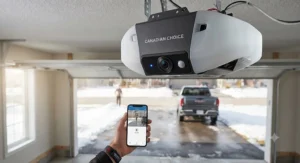
Smart Garage Door Controllers Explained: Wired, Wireless and Protocol-Based
Not all smart garage door controllers work the same way — and that’s the least-discussed difference between smart garage door openers — and understanding the three designs saves a lot of return-shipping frustration.
Button-emulating controllers
The meross Smart Wi-Fi Garage Door Opener (MSG100), meross Smart Garage Door Opener (MSG200), ismartgate Mini, and Tailwind iQ3 essentially act as a remote-controlled wall button. They close a circuit across the opener’s terminals, then use a separate sensor to report whether the door is open. Upside: near-universal compatibility. Downside: an extra sensor to mount and occasionally recalibrate.
Radio-paired hubs
The Chamberlain myQ Smart Garage Control pairs with compatible openers wirelessly, the way a car remote does. Upside: no wiring. Downside: it works best within its own brand family.
Protocol-level controllers
The Konnected GDO blaQ speaks the opener’s own digital language, reading door position, light state, and obstruction status directly. Upside: no door sensor, richer data, faster response. Downside: it only works with the specific protocols it supports.
The practical takeaway: if you know your opener brand and learn-button colour, you can eliminate half this list in thirty seconds. Smart garage door controllers aren’t interchangeable, and the wrong design means a returned box and a wasted weekend.
✨ Don’t Miss These Exclusive Deals! 🔍
Take your garage upgrade to the next level with these carefully selected smart garage door openers. Click on any highlighted product to check current pricing and availability — a garage that answers to your phone is closer than you think!
Smart Opener Data Privacy: What Your Garage Knows About You
Smart opener data privacy sounds abstract until you picture the log. Every open and close, timestamped, tied to your account: when you leave for work, when you’re home for lunch, when the house is empty for a week in March. That’s a surprisingly intimate diary.
In Canada, private-sector companies handling personal information in commercial activities are generally governed by PIPEDA, the federal private-sector privacy law, which sets out rules for consent, purpose, and access to your data. It’s a useful baseline — but it governs how a company treats your data, not whether that data exists in the first place.
That’s where design choices matter. The ismartgate Mini stores data locally and the Konnected GDO blaQ runs local-first, so the activity log can stay under your roof. The Tailwind iQ3 offers a local API alongside its cloud app. The Chamberlain myQ Smart Garage Control and Genie StealthDrive Connect 7155-TKV, by contrast, are cloud-centred, which is convenient but means your patterns live on the manufacturer’s servers.
Practical privacy moves
- ✅ Read the app’s privacy policy for data retention periods.
- ✅ Turn off location history features you don’t use.
- ✅ Prefer local control options where your setup allows.
- ✅ Use a unique password and two-factor authentication.
How to Choose Smart Garage Door Openers
Work through these steps in order and the right answer usually appears by step four:
- Check your learn-button colour. It tells you whether protocol-based options like the Konnected GDO blaQ work, and flags Security+ 3.0 openers that block most third-party gear.
- Confirm your ownership situation. Renters should start with the Chamberlain myQ Smart Garage Control or reversible wired controllers; owners can consider full replacement.
- Decide how much privacy matters. If local data is non-negotiable, shortlist the ismartgate Mini or Konnected GDO blaQ.
- Match your ecosystem. Apple households lean toward the meross Smart Garage Door Opener (MSG200) or ismartgate Mini; Home Assistant users toward the Konnected GDO blaQ or Tailwind iQ3.
- Count your doors. Multi-door garages favour the meross Smart Garage Door Opener (MSG200) or Tailwind iQ3.
- Check subscription costs. Tally what voice control or extra features cost annually, not just the sticker price.
- Test Wi-Fi in the garage itself. Stand where the controller will sit and run a speed test on your phone — weak signal causes most “unreliable” complaints.
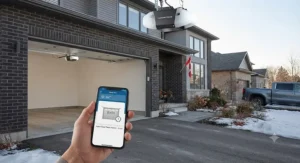
Common Mistakes When Buying Smart Garage Door Openers
The most expensive mistake with smart garage door openers is buying before checking compatibility. A controller that doesn’t speak your opener’s protocol is a paperweight with a Wi-Fi radio. With Security+ 3.0 now on newer Chamberlain-family openers, that risk is higher in 2026 than ever.
The second mistake is renters skipping the landlord conversation. Even with a reversible device, a surprise alteration can sour a tenancy. A two-line email costs nothing.
Third: ignoring the cold. Adhesive mounts and coin-cell sensors that behave perfectly in a warm hallway can fail in an unheated garage at −25°C. Wired sensors, like those on the meross Smart Wi-Fi Garage Door Opener (MSG100), sidestep the battery issue, and cold-rated mounting strips solve the adhesive one.
Fourth: underestimating subscriptions. The Chamberlain myQ Smart Garage Control looks cheapest at checkout, but paid integrations can make it pricier over three years than the subscription-free meross Smart Garage Door Opener (MSG200).
Fifth: retrofitting a dying opener. If the motor is on borrowed time, a retrofit just adds an app to the eventual breakdown. That’s where the Genie StealthDrive Connect 7155-TKV makes more financial sense.
Finally, treating smart opener data privacy as an afterthought. Once you’ve built routines around an app, switching platforms is a hassle — so choose your data model upfront.
Long-Term Cost & Maintenance of Smart Garage Door Openers
| Tier | Products | Upfront (CAD) | Likely 3-Year Extras | Best For |
|---|---|---|---|---|
| Budget retrofit | Chamberlain myQ Smart Garage Control, meross Smart Wi-Fi Garage Door Opener (MSG100) | C$35-C$60 | Possible paid integrations (myQ) | Renters on a budget |
| Mid-range retrofit | meross Smart Garage Door Opener (MSG200), Tailwind iQ3, Konnected GDO blaQ | C$70-C$150 | Optional tiers only | Multi-door or automation fans |
| Privacy retrofit | ismartgate Mini | C$130-C$180 | Optional user plugins | Privacy-first households |
| Full replacement | Genie StealthDrive Connect 7155-TKV | C$450-C$600 + install | Backup battery replacement | Homeowners with failing openers |
The numbers show that a retrofit’s total cost of ownership stays low as long as you avoid recurring fees. The meross Smart Wi-Fi Garage Door Opener (MSG100) and Konnected GDO blaQ have essentially no ongoing costs, while the Chamberlain myQ Smart Garage Control can creep up if you add paid integrations. The Genie StealthDrive Connect 7155-TKV carries the highest upfront cost, but it replaces an opener you’d have to buy anyway.
Maintenance on smart garage door openers is refreshingly light. Test the opener’s safety-reversal sensors monthly, keep any battery sensors fresh before winter, and let firmware update automatically. The Canadian Centre for Cyber Security’s guidance on IoT security flags outdated firmware and default credentials as common weak points, so a five-minute monthly check in the app is time well spent.
Problems and Solutions: Canadian Garages, Canadian Headaches
Problem 1: The controller drops offline in January. Unheated garages and distant routers make a bad combination. Solution: Add a mesh node or extender near the garage wall, and pick a controller with wired sensors like the meross Smart Wi-Fi Garage Door Opener (MSG100) to remove battery weakness from the equation.
Problem 2: The power goes out during an ice storm. Most retrofits go dark with the power. Solution: Know where the manual release cord is, keep a physical remote handy, and if you own the home, consider the battery-backed Genie StealthDrive Connect 7155-TKV.
Problem 3: The door opens as you pull out of the driveway, not in. Geofence timing is off. Solution: On the Tailwind iQ3, adjust arrival sensitivity and car-Bluetooth settings.
Problem 4: Your landlord wants the garage restored. Solution: Radio-paired hubs like the Chamberlain myQ Smart Garage Control remove cleanly; for wired controllers, the before photo from setup makes restoration quick.
Problem 5: A new opener blocks your controller. Security+ 3.0 openers reject many third-party devices. Solution: Check the learn-button colour before buying — the Konnected GDO blaQ won’t work with white-button models.
Frequently Asked Questions
❓ Can I install smart garage door openers without landlord permission?
❓ Which smart garage door controllers work with Chamberlain Security+ 3.0?
❓ Are smart garage door openers safe from hackers?
❓ Do smart garage door openers work during a power outage?
❓ How much do smart garage door openers cost in Canada?
Conclusion
Smart garage door openers no longer demand a homeowner’s toolbox or a landlord’s blessing for a full renovation. For most renters, the Chamberlain myQ Smart Garage Control is the lowest-friction path — no wiring, no trace at move-out — provided you’re comfortable with its closed ecosystem. If you can get sign-off for two thin wires, the meross Smart Wi-Fi Garage Door Opener (MSG100) delivers the most features per dollar, while the meross Smart Garage Door Opener (MSG200) suits Apple households and multi-door garages.
Privacy-minded tenants should look hard at the ismartgate Mini, and Home Assistant users will find the Konnected GDO blaQ faster and more private than any cloud hub — as long as their opener isn’t Security+ 3.0. Commuters who want the door open before they reach it will appreciate the Tailwind iQ3. And homeowners with a tired opener should skip the retrofit and go straight to the Genie StealthDrive Connect 7155-TKV.
Whichever you choose, settle three things first: whether you own or rent, which ecosystem you live in, and how much of your daily routine you’re comfortable storing in someone else’s cloud. Answer those honestly, and the right pick practically chooses itself.
🚗 Ready to stop wondering whether you closed the garage? Check current prices on your pick and enjoy a door that finally answers to your phone!
Recommended for You
- Smart Garage Door Opener vs Traditional Opener: 7 Picks 2026
- Smart Garage Door Opener: 7 Best Picks For Canada (2026)
- Belt Drive Openers: 7 Best Quiet Picks For Canada In 2026
Disclaimer: This article contains affiliate links. As an Amazon Associate, I earn from qualifying purchases. If you purchase products through these links, we may earn a small commission at no additional cost to you.
✨ Found this helpful? Share it with your friends! 💬🤗
