
In This Article
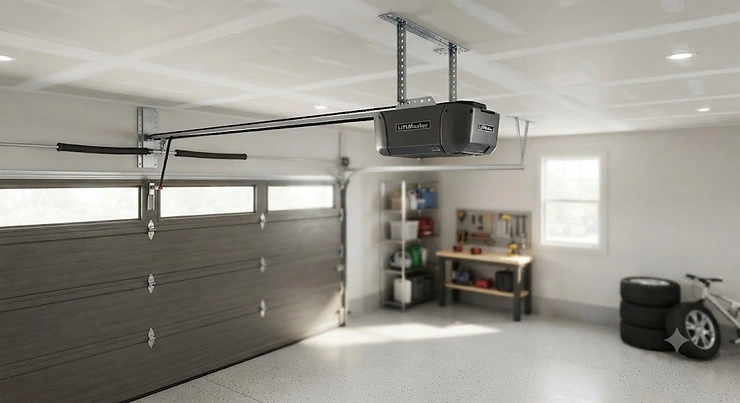
There’s a specific kind of dread that comes with a chain drive garage door opener grinding to life at 6 a.m. while your toddler is still asleep two rooms away. If that sounds familiar, you’re already halfway to understanding why belt drive openers have quietly (pun very much intended) taken over the mid-range and premium segment of the Canadian garage door market. A belt drive opener uses a rubber, fibreglass-reinforced belt instead of a metal chain to move the trolley that pulls your garage door along its track — and that one material swap is the difference between a motor that clanks and one that hums.
This guide digs into seven real, currently available belt drive openers sold through Amazon.ca and mainstream Canadian retailers, ranked across noise, smart home compatibility, and realistic long-term durability. We researched actual specifications, cross-referenced aggregated customer sentiment from verified buyers, and — because “quiet” means nothing without context — explained what each spec actually changes about your morning routine. Whether you’re chasing the best low maintenance belt drive garage door opener for a rental property, weighing smart home add-on modules for an opener you already own, or just trying to nail down realistic opener lifespan expectations before you spend a few hundred dollars, you’ll find the comparison here. As an Amazon Associate, we earn from qualifying purchases made through links in this article, at no extra cost to you.
According to Wikipedia’s overview of garage door opener mechanics, the motor in any residential opener — chain, belt, or screw drive — only supplies a small fraction of the force needed to move the door; torsion springs do the heavy lifting, while the opener mainly controls timing and distance. That matters because it means belt drive openers aren’t “stronger” than chain drives in any meaningful way — they’re just quieter and, as we’ll get into, typically a little more durable over a 10-to-15-year ownership window.
Quick Comparison Table
Before the deep dive, here’s the fast version for anyone who just wants a starting point.
| Opener | Drive & Motor | Smart Platform | Price Range (CAD) | Best For |
|---|---|---|---|---|
| Chamberlain B970 | Belt, 1.25 HP equiv. DC | myQ Wi-Fi | around C$380–480 | Best all-round smart pick |
| LiftMaster 87504-267 Elite | Belt, 3/4 HP DC | myQ + Secure View camera | around C$550–650 | Quietest with built-in camera |
| Genie StealthDrive Connect 7155-TKV | Belt, 1.25 HPc DC | Aladdin Connect | around C$350–430 | Amazon Key delivery + HomeLink |
| LiftMaster 8500W Wall Mount | Belt, wall-mount jackshaft | myQ Wi-Fi | around C$500–600 | Space-saving ceilings |
| Craftsman CMXEOCG982 | Belt, 1.25 HPs DC | myQ Wi-Fi | around C$300–380 | Best value with smart features |
| Skylink ATOMS ATR-1723B | Belt, 3/4 HPf DC | Optional SkylinkNet | around C$220–280 | Best budget DIY pick |
| Chamberlain B4310 with Camera | Belt, 3/4 HP DC | myQ + built-in camera | around C$450–550 | Best built-in security camera |
Prices reflect research at the time of writing and fluctuate with retailer promotions — always check current price before buying.
Looking at the spread, the pattern that jumps out is how tightly clustered the mid-tier options are: the Chamberlain B970, Craftsman CMXEOCG982, and Genie StealthDrive Connect all land within roughly a hundred dollars of each other despite coming from three different manufacturers, which tells you the belt drive category has matured into commodity territory at this price point. Where you actually see differentiation is at the extremes — the Skylink ATOMS undercuts everyone on price by skipping built-in Wi-Fi, while the LiftMaster 87504-267 Elite and Chamberlain B4310 justify their premium almost entirely through the integrated camera. If you don’t care about seeing a live feed of your garage, that camera premium is money you can redirect elsewhere.
Found a comparison that actually helped? Give it a click below — it helps other Canadian homeowners land on this same guide.
Top 7 Belt Drive Openers: Expert Analysis
We picked these seven to cover budget, mid-range, and premium tiers, plus one homegrown option, because a genuinely useful roundup for belt drive openers shouldn’t just be a Chamberlain family reunion.
1. Chamberlain B970 — best all-round smart belt drive for family garages
The B970 has built a reputation as one of the most broadly recommended openers in North America, and the steel-reinforced belt is a big part of why. Reinforcing the belt with steel cord rather than relying on pure rubber means it resists stretching under load — the number-one reason cheaper belts eventually start slapping against the rail housing and generating that faint but maddening rhythmic thump. The DC motor delivers lift power roughly equivalent to a 1.25 HP AC motor, which in practical terms means it handles a heavier insulated steel door — the kind common in newer Canadian builds — without labouring on the way up. Built-in Wi-Fi and the myQ app let you check door status and get closure alerts from anywhere, which matters more in a Canadian winter than people expect: nobody wants to drive back home to check if the door sealed properly during a cold snap. Based on the spec comparison against cheaper belt models, the anti-vibration mounting hardware is what actually earns the “ultra-quiet” label — the motor itself isn’t dramatically quieter than competitors, but it transmits far less vibration into the ceiling joists, which is the noise that actually travels into bedrooms above an attached garage. Reviewers consistently note the battery backup as a standout feature, reporting that it reliably powers roughly 20 open/close cycles during a 24-hour outage, and several mention the 1,500-foot remote range as noticeably better than their previous opener. A common thread in aggregated feedback is that programming the travel limits is unusually straightforward compared to older Chamberlain models.
Pros:
- ✅ Steel-reinforced belt resists stretch and long-term slapping noise
- ✅ Battery backup rated for around 20 cycles during an outage
- ✅ Lifetime motor and belt warranty with 5-year parts coverage
Cons:
- ❌ myQ camera and video features require a separate model
- ❌ Wireless keypad range can be inconsistent near dense Wi-Fi networks
Expect to pay somewhere in the C$380–480 range depending on retailer promotions; given the lifetime drivetrain warranty, this is one of the stronger value propositions in the belt drive openers category for a family garage that gets used multiple times daily.
2. LiftMaster 87504-267 Elite Series — quietest opener with built-in camera
LiftMaster markets the 87504-267 as the quietest model in its residential lineup, and the specs back that framing up: a rubber belt drive paired with a 360-degree LED light bar and a 140-degree Secure View camera baked directly into the head unit. What most buyers overlook about this model is that the camera isn’t a bolted-on afterthought — it uses the same myQ app infrastructure as the door controls, so you get two-way audio and motion alerts without juggling a second app. The 3/4 HP equivalent DC motor is slightly less muscular on paper than some 1.25 HP competitors, but for a standard 2.1 m (7 ft) sectional door it’s more than adequate; horsepower ratings on DC belt drives are a rough comparison tool at best, not a hard performance ceiling. On paper this means homeowners with an above-garage bonus room or nursery get the clearest noise benefit in this lineup, since LiftMaster’s Elite Series is specifically tuned for that use case. Battery backup covers the unit during outages, and the included wireless keyless entry pad rounds out a fairly complete box. Aggregated review sentiment across major Canadian and U.S. retailers describes the camera’s night vision as “surprisingly clear” for a garage-oriented lens, though a recurring complaint involves the myQ app occasionally lagging when checking the live feed over cellular data rather than home Wi-Fi.
Pros:
- ✅ Integrated 140° camera with two-way audio through myQ
- ✅ Marketed and reviewed as the quietest model in the LiftMaster lineup
- ✅ 360° LED lighting illuminates the entire garage, not just the door
Cons:
- ❌ Premium pricing compared to camera-free belt drive openers
- ❌ Live camera feed can lag on cellular connections away from home
Real-world pricing tends to land around C$550–650, making this the priciest ceiling-mount pick here — but if a built-in camera is non-negotiable, it’s a genuinely better value than buying a separate opener and a separate garage security camera.
3. Genie StealthDrive Connect 7155-TKV — best for Amazon Key in-garage delivery
Genie’s approach with the StealthDrive Connect differs from Chamberlain’s ecosystem in one meaningful way: it uses Aladdin Connect rather than myQ, and Aladdin Connect happens to be one of the few smart garage platforms natively compatible with Amazon Key In-Garage Delivery. Here’s what to weigh if that matters to you — if you regularly have packages delivered and worry about porch theft, this is the only opener on this list built specifically around letting a delivery driver leave a parcel inside a locked garage rather than on your driveway. The 1.25 HPc DC motor paired with a steel-reinforced belt handles doors up to 227 kg (500 lb), and GenieSense monitoring technology adds diagnostic feedback that flags unusual strain patterns before they become full failures — a nice bit of forward-looking maintenance built into the firmware. HomeLink and Car2U compatibility means it pairs directly with vehicle-integrated garage buttons without needing an external bridge box, which several competing brands still require. The spec sheet won’t tell you this, but user reports suggest the pre-programmed remotes save real setup time compared to openers that require manual pairing. Aggregated sentiment across retailer reviews is strong, with reviewers frequently highlighting how quiet the belt drive is relative to Genie’s older chain-drive lineup, though a subset of buyers mention that Aladdin Connect’s smart home integrations feel slightly behind myQ’s in terms of third-party support.
Pros:
- ✅ Native Amazon Key In-Garage Delivery support
- ✅ HomeLink and Car2U compatible with no external bridge required
- ✅ GenieSense diagnostics flag mechanical issues proactively
Cons:
- ❌ Aladdin Connect has fewer third-party smart home integrations than myQ
- ❌ Battery backup rated for roughly 50 cycles, lower than some competitors
Pricing generally sits around C$350–430, positioning it as a genuine mid-range value pick, particularly for households that already lean on Amazon deliveries regularly.
4. LiftMaster 8500W Wall Mount — best space-saving wall-mount belt drive
Wall-mount, or “jackshaft,” openers solve a completely different problem than ceiling-mount units: they free up your entire ceiling for storage, which matters enormously in garages doubling as workshops or storage for winter tires and seasonal gear — a very Canadian use case. The 8500W drives the door via a belt connected directly to the torsion bar rather than a rail running across the ceiling, so there’s no trolley track to sag, squeak, or collect dust over time. Based on the spec comparison with ceiling-mount units, the trade-off is installation complexity: wall-mount openers typically need a professional install because they interact directly with the torsion spring system, and getting that wrong is a genuine safety risk. Rated noise output around 55 dB and a 24V DC motor keep operation smooth, while myQ Wi-Fi connectivity and battery backup bring it in line with Chamberlain Group’s ceiling-mount siblings feature-for-feature. What most buyers overlook about wall-mount units generally is that they also extend garage door lifespan indirectly — because there’s no overhead rail sagging under its own weight over a decade, the door tends to stay better aligned, which reduces strain on the opener itself. Reviewers who switched from ceiling-mount units consistently mention regaining meaningful ceiling storage space as the primary motivator, with several noting they hadn’t realized how much clearance a traditional rail system was eating.
Pros:
- ✅ Frees the entire garage ceiling for storage racks or lifts
- ✅ No overhead rail to sag, squeak, or collect dust
- ✅ Works well with high-lift or vaulted-ceiling door configurations
Cons:
- ❌ Professional installation is strongly recommended, adding to total cost
- ❌ Higher upfront price than comparable ceiling-mount belt drives
Expect a price range around C$500–600 for the unit alone, plus installation — worth every cent if ceiling clearance is a genuine constraint in your garage.
5. Craftsman CMXEOCG982 — best value myQ belt drive under premium pricing
Craftsman’s garage door openers are manufactured by the same parent company behind Chamberlain and LiftMaster, and the CMXEOCG982 makes that lineage obvious — it shares a steel-reinforced belt drive, myQ Wi-Fi connectivity, and a comparable DC motor rated at roughly 1.25 HP equivalent, all while typically undercutting the Chamberlain-branded B970 on price. The spec sheet won’t tell you this, but the shared manufacturing means replacement parts and accessories — remotes, keypads, the myQ Video Keypad — are frequently cross-compatible with Chamberlain and LiftMaster accessories, which is a real convenience if you’re upgrading from an older Craftsman unit. A multi-function wall control operates the opener and lighting independently, and the dual-lens lighting system covers both ends of the garage rather than leaving one side dim. Here’s what to weigh: Craftsman’s warranty terms have varied across model years, with some units carrying a 5-year motor and belt warranty rather than the lifetime coverage Chamberlain applies to its top-tier models — worth confirming on the specific listing before buying. Based on aggregated customer feedback, buyers consistently frame this as “the same opener for less,” and the sentiment holds up reasonably well against the spec sheet, though a handful of reviewers note the myQ app occasionally requires re-pairing after firmware updates.
Pros:
- ✅ Shares core belt-drive hardware with pricier Chamberlain models
- ✅ Full myQ Wi-Fi smartphone control included standard
- ✅ Dual-lens lighting illuminates both ends of the garage
Cons:
- ❌ Warranty terms are shorter than Chamberlain’s top-tier lifetime coverage
- ❌ Occasional app re-pairing needed after firmware updates
Typically priced around C$300–380, this is arguably the best-value smart belt drive opener on this list if lifetime drivetrain coverage isn’t a dealbreaker for you.
6. Skylink ATOMS ATR-1723B — best budget DIY pick from a Canadian brand
Skylink Group is headquartered in Concord, Ontario, which makes the ATOMS line one of the only genuinely Canadian-designed options in the belt drive openers category — a detail that matters to buyers who prioritize supporting domestic manufacturers. The ATR-1723B runs a 3/4 HPf DC motor with a “Quick-Fit” tubular rail designed explicitly for fast DIY installation, and reviewers consistently frame the install process as noticeably simpler than Chamberlain or LiftMaster’s rail systems, which involve more assembly steps. Here’s what most budget shoppers overlook: this unit doesn’t include built-in Wi-Fi out of the box, which is exactly why it’s priced where it is — smart functionality comes via an optional SkylinkNet base station add-on rather than being baked into the sticker price, letting cost-conscious buyers skip smart features entirely if they don’t want them. A built-in 12W LED (roughly a 100W incandescent equivalent) is a genuinely nice inclusion at this price tier, since many mainstream brands reserve LED lighting for pricier models. Tamper-proof trolley design and rolling-code remotes bring the security baseline up to modern standards despite the lower cost. Aggregated feedback highlights the quiet DC motor operation as a pleasant surprise given the price point, with several reviewers specifically comparing it favourably to older chain-drive units they replaced, though the smaller customer review pool compared to Chamberlain and LiftMaster means the sample size backing that sentiment is thinner.
Pros:
- ✅ Genuinely Canadian-designed brand based in Ontario
- ✅ Quick-Fit tubular rail simplifies DIY installation
- ✅ Built-in LED lighting standard, unusual at this price tier
Cons:
- ❌ No built-in Wi-Fi — smart features require a separate SkylinkNet add-on
- ❌ Smaller aggregated review pool than mainstream competing brands
Priced around C$220–280, this is the clear budget anchor of the group and a smart pick for a secondary garage, shed, or rental property where smart features aren’t a priority.
7. Chamberlain B4310 with Camera — best built-in security camera belt drive
The B4310 sits at the top of Chamberlain’s consumer lineup specifically because it folds a genuinely capable security camera into the opener head unit rather than treating it as an accessory. A 3/4 HP belt drive handles standard residential doors comfortably, while the integrated camera delivers 1080p footage with a 140-degree wide-angle lens and 2-way audio through the myQ app — practically identical camera hardware to what LiftMaster offers on the 87504-267, which makes sense given the shared parent company. What most buyers overlook about this model specifically is the extended operating range Chamberlain lists for the unit, rated for -25°C to 55°C (-13°F to 131°F), a genuinely relevant spec for anyone with an unheated garage enduring a Prairie winter or a Southern Ontario heat wave. Corner-to-corner LED lighting at roughly 3,100 lumens noticeably outperforms the dual-bulb setups on cheaper models, functionally turning the garage into usable workspace after dark. Battery backup keeps both the door and the camera functioning during an outage, which is a detail some competing camera-equipped openers skip on the camera side specifically. Based on aggregated customer sentiment, buyers repeatedly frame the video quality as comparable to purpose-built home security cameras costing nearly as much on their own, though a recurring critique is that the wide-angle lens introduces some fisheye distortion at the frame edges.
Pros:
- ✅ 1080p camera with 2-way audio built into the opener itself
- ✅ Extreme-temperature rated for harsh Canadian garage conditions
- ✅ 3,100-lumen corner-to-corner LED lighting
Cons:
- ❌ Wide-angle lens introduces noticeable fisheye distortion at frame edges
- ❌ Among the pricier options in this roundup
Expect to pay in the C$450–550 range — a reasonable price when you consider it’s effectively bundling a garage security camera into the opener cost.
Practical Usage Guide: Setup, Break-In & Low-Maintenance Care
Getting a new belt drive opener installed correctly in the first 30 days sets the tone for the next decade. The single most common first-month mistake is over-tightening the belt tension during initial setup — a belt pulled too taut strains the motor bearings prematurely and, ironically, makes the unit noisier than a properly tensioned one. Most manufacturers recommend roughly 12–18 mm (1/2 to 3/4 inch) of play when you press down on the belt at its midpoint; if you can’t press it down at all, it’s too tight.
If you’re chasing the best low maintenance belt drive garage door opener experience long-term, the maintenance routine is genuinely minimal compared to a chain drive: lubricate the door’s rollers and hinges (never the belt itself — belt lubrication actually causes premature cracking), check the belt for visible fraying every six months, and verify the auto-reverse safety feature monthly by placing a roll of paper towels in the door’s path and confirming it reverses on contact. That last check isn’t optional — it’s a genuine safety requirement, not a suggestion. Vacuuming dust and cobwebs from the motor housing twice a year prevents the buildup that eventually interferes with the logic board’s ventilation. A quality surge protector on the opener’s outlet is arguably the single cheapest thing you can do to extend the unit’s working life, since power-surge damage to the control board is one of the more common causes of premature failure.
Real-World Scenarios: Matching the Right Opener to Your Garage
Consider three different Canadian households. A young family in a suburban Calgary subdivision with a bedroom directly above an attached garage and a toddler who naps unpredictably is the textbook case for the Chamberlain B970 or LiftMaster 87504-267 — noise suppression is the priority, and the myQ alert system means a parent working from a home office can confirm the door closed without walking downstairs. A condo-adjacent townhouse owner in the Greater Toronto Area with frequent online deliveries and no doorstep coverage benefits most from the Genie StealthDrive Connect, specifically because of its Amazon Key In-Garage Delivery compatibility — packages go inside a locked space rather than sitting exposed. Finally, a cottage or rural property owner in rural Quebec or Nova Scotia running a detached garage as a workshop, with no need for smart features and a firm budget, is served well by the Skylink ATOMS ATR-1723B — simple, DIY-friendly, and inexpensive enough that a rarely used secondary building doesn’t need premium features it’ll never touch.
Problem → Solution: Fixing the Most Common Belt Drive Opener Issues
A belt drive opener making a rhythmic slapping noise almost always points to belt tension loosening over time — retighten it to the manufacturer’s midpoint-deflection spec rather than assuming the belt needs replacing. If the myQ or Aladdin Connect app shows the door as “offline,” the fix is usually router-side: these systems rely on 2.4GHz Wi-Fi specifically, and if your router defaults to 5GHz-only for new devices, the opener simply can’t see the network. A door that reverses immediately after starting to close typically means the safety sensors near the floor are misaligned or have something blocking the infrared beam between them — even a fallen leaf can trigger it. Battery backup that drains faster than the rated cycle count is frequently a sign the battery itself needs replacing after 3–5 years rather than the main unit failing. Finally, if remotes stop working intermittently, reprogramming them from scratch resolves the issue more often than not, since rolling-code systems can occasionally desync after a prolonged power outage.
How to Choose a Belt Drive Opener
Working through these criteria in order will get you to the right pick faster than scrolling spec sheets endlessly.
- Confirm your door’s weight and height first. Every opener lists a maximum door weight and height; an insulated steel door can weigh considerably more than a lightweight aluminum one, and undersizing the motor shortens its working life.
- Decide how much you actually value quiet. If nobody sleeps near the garage, a mid-tier belt drive opener without extra anti-vibration hardware saves money without a real downside.
- Pick your smart ecosystem deliberately. myQ and Aladdin Connect aren’t interchangeable — check what your existing smart home setup (Alexa, Google Home, Apple HomeKit) actually supports before buying.
- Decide if you need a camera bundled in. A built-in camera adds real cost; if you already own a garage-facing security camera, that premium is often better spent elsewhere.
- Check the warranty terms specifically for the belt and motor, not just the base unit — this is where budget and premium models genuinely diverge.
- Factor in installation. Ceiling-mount units are DIY-friendly; wall-mount jackshaft units generally aren’t, and that installation cost belongs in your budget from the start.
- Match backup power to your region’s outage patterns. Areas with frequent ice storms or wildfire-related grid instability benefit more from strong battery backup ratings than milder climates.
Common Mistakes When Buying a Belt Drive Opener
The most frequent mistake is buying based on horsepower alone. DC motor horsepower-equivalent ratings on belt drive openers are a rough comparison tool, not a precise measurement — a 3/4 HP DC unit from a reputable brand can outperform a poorly built 1.25 HP unit in real-world daily use. Another common error is ignoring rail length compatibility with garage ceiling height before purchasing, then discovering an extension kit is needed, adding unplanned cost. Buyers also frequently skip checking whether an opener’s smart platform integrates with hardware they already own, only to discover after installation that their existing video doorbell ecosystem doesn’t talk to myQ or Aladdin Connect. Finally, a genuinely common and costly mistake is installing a wall-mount jackshaft opener without professional help — these interact directly with high-tension torsion springs, and DIY installation here carries real injury risk, not just a voided warranty.
Belt Drive vs Chain Drive: What Actually Changes Day to Day
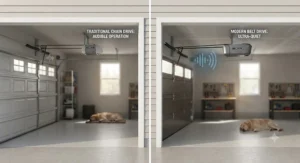
The core mechanical difference is simple: chain drives use a metal chain, belt drives use a reinforced rubber or polyurethane belt. What that difference means in practice is more nuanced than “belt is quieter, end of story.” Chain drives transmit motor vibration directly through metal-on-metal contact, which is why they’re louder — but they’re also generally cheaper and, historically, marginally more tolerant of extreme cold, since metal doesn’t stiffen the way some rubber compounds can in deep winter (though modern belt compounds have mostly closed that gap). Belt drives cost more upfront but tend to need less frequent lubrication and produce meaningfully less structural vibration, which matters enormously for anyone with living space adjacent to or above the garage. For a detached garage or workshop with no adjoining living space, the noise argument for belt drive openers weakens considerably, and a quality chain drive can be the more cost-effective, equally durable choice.
| Factor | Belt Drive | Chain Drive |
|---|---|---|
| Noise Level | Quiet — minimal vibration transfer | Louder — metal-on-metal contact |
| Typical Lifespan | 12–17 years | 10–15 years |
| Upfront Cost | Higher | Lower |
| Maintenance | Occasional tension check, no lubrication on belt | Periodic chain lubrication required |
| Best For | Attached garages, bedrooms above garage | Detached garages, budget-first buyers |
The lifespan gap in that table isn’t marketing spin — it tracks with why belt drives fail less often: no metal-on-metal wear point means less material fatigue over thousands of open-close cycles. That said, for a detached workshop where nobody’s sleeping within earshot, the extra upfront cost of a belt drive genuinely may not pay for itself in a benefit you’ll never notice.
Smart Home Add-On Modules: Retrofitting Without Buying New
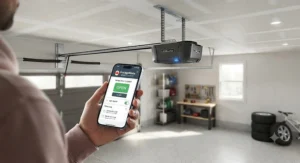
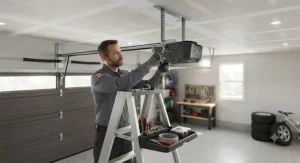
Not everyone needs a brand-new opener to get smart functionality — and this is one area where honesty about the current state of smart home add-on modules actually matters more than marketing copy suggests. If you already own a Chamberlain, LiftMaster, or compatible opener manufactured after 1993 with working safety sensors, the myQ Smart Garage Hub retrofits Wi-Fi control onto the existing motor without replacing the whole unit. Genie owners have a direct equivalent in the Aladdin Connect retrofit kit, which similarly bolts onto most existing openers built after 1993 and adds smartphone control, virtual keys for shared access, and door-position monitoring through a small sensor and control module.
Here’s what to weigh honestly before buying either: Chamberlain restricted third-party API access to myQ in late 2023, which removed official support for platforms like Home Assistant that many smart-home enthusiasts had built automations around. If your interest in smart home add-on modules is specifically about deep integration with a broader home automation system beyond the manufacturer’s own app, myQ’s retrofit hub is now a more limited option than it used to be — the hardware works fine, but the ecosystem around it has narrowed. Aladdin Connect’s retrofit kit doesn’t carry the same restriction as of this writing, making it arguably the more flexible add-on module for tinkerers, though its third-party integration list is shorter than myQ’s to begin with. Skylink’s SkylinkNet dongle serves a similar retrofit purpose specifically for Skylink-branded openers, adding Alexa and IFTTT compatibility to units that shipped without built-in Wi-Fi. Whichever module you choose, budget roughly C$50–90 for the hardware itself — a genuinely cheaper path to smart functionality than replacing an opener that’s otherwise working fine.
Opener Lifespan Expectations: What Actually Wears Out First
Realistic opener lifespan expectations matter more than the number printed on a warranty sticker, because warranty length and expected working life aren’t the same thing. Industry-wide, a typical residential garage door opener lasts somewhere between 10 and 15 years under normal household use, and belt drive openers with modern DC motors tend to land at the upper end of that range — often 12 to 17 years — specifically because DC motors don’t have the brush-wear failure point that older AC motors did. Drive-system fatigue accounts for a large share of eventual failures across all opener types: chains stretch and eventually need replacing, while belts crack or fray but generally last longer because there’s no metal-on-metal wear point generating friction damage over time.
Setting honest opener lifespan expectations also means accounting for usage frequency rather than age alone — an opener cycling multiple times daily in a household that uses the garage as its primary entrance will wear out meaningfully faster than one used once or twice a day. Logic board and capacitor failure is the other major failure mode, and it’s largely unrelated to mechanical wear; a power surge during a storm can end an otherwise healthy opener’s life in an instant, which circles back to why a simple surge protector is worth installing on day one. Rollers and tracks also factor into perceived opener lifespan even when the motor itself is fine — steel ball-bearing rollers typically last 10 to 15 years while nylon rollers can stretch to 12 to 20 years, and a poorly maintained door forces the opener to work harder regardless of how well-built the motor is.
Long-Term Cost & Maintenance: The Real Total Cost of Ownership
Sticker price tells you almost nothing about total cost of ownership over a 12-to-17-year lifespan. A C$220 Skylink unit and a C$550 Chamberlain B4310 both need essentially the same annual maintenance — a lubrication check, a safety-sensor test, and the occasional battery swap on models with backup power — so maintenance cost doesn’t meaningfully favour the premium option. Where the math shifts is failure risk and feature depreciation: cheaper units with smaller aggregated review pools carry more uncertainty about how they perform past year eight or nine, while models backed by lifetime motor-and-belt warranties (like the Chamberlain B970) effectively insure you against the single most expensive line-item repair — a full motor replacement.
| Cost Factor | Budget Tier (~C$250) | Mid Tier (~C$400) | Premium Tier (~C$550) |
|---|---|---|---|
| Upfront cost | Lowest | Moderate | Highest |
| Annual maintenance | ~C$0–20 | ~C$0–20 | ~C$0–20 |
| Warranty coverage | Typically shorter | Often lifetime motor/belt | Often lifetime motor/belt |
| Smart features included | Usually add-on | Standard | Standard, plus camera |
Reading across that table, the mid tier is where cost-per-year of ownership tends to look best: you’re paying for a lifetime drivetrain warranty and standard smart features without the camera premium that pushes the top tier meaningfully higher without changing the core mechanical reliability at all.
Safety, Regulations & Compliance for Canadian Garages
Every opener sold in this roundup is designed to meet the entrapment-protection requirements outlined in CSA C22.2 No. 247, the Canadian Standards Association’s standard for door and gate operators, which governs photoelectric sensor performance and auto-reversal force sensitivity for electrically powered garage door operators sold in Canada. In practice, this is the standard requiring every modern opener to reverse within roughly two seconds of contacting an obstruction, and it’s why the monthly paper-towel-roll test mentioned earlier isn’t a nice-to-have — it’s verifying compliance with a safety feature mandated specifically because of past child entrapment incidents. Even compliant hardware can fail in the field: as recently as 2022–2023, Health Canada issued a recall notice covering certain LiftMaster myQ control panels after identifying a scenario where a keypad interaction could unintentionally override the secondary entrapment-protection system — a useful reminder to register any opener you buy so you receive recall notices directly rather than stumbling across them later.
Battery backup deserves a mention here too, particularly given how often Canadian winters bring extended outages from ice storms. The Government of Canada’s guidance on preparing for power outages recommends being ready to manage without power for a minimum of 72 hours, and while an opener’s battery backup won’t stretch that far — most rate for 20 to 50 cycles rather than days of standby — it does mean you’re not stuck manually hoisting a heavy insulated door in a January storm just to get the car out.
Features That Actually Matter (And Those That Don’t)
Battery backup, a properly rated smart platform, and a documented lifetime motor-and-belt warranty genuinely matter — they affect either safety, daily convenience, or long-term cost, and all three show up in real-world reviews as things owners actually notice. A built-in camera matters if you don’t already own a garage security camera, and matters far less if you do, since you’d effectively be paying twice for the same function. On the other hand, marketed horsepower figures matter less than they appear to, since DC motor ratings are comparative estimates rather than precise measurements. Remote range specs beyond roughly 150 metres (500 feet) also rarely matter in practice — very few Canadian residential driveways are long enough for the difference between a 1,500-foot and 300-foot rated remote to ever come up.

Frequently Asked Questions
❓ How long do belt drive openers actually last compared to chain drives?
❓ Are belt drive openers worth the extra cost over chain drive?
❓ Can I add smart features to an older belt drive opener without replacing it?
❓ What's the best low maintenance belt drive garage door opener for a rental property?
❓ Do belt drive garage door openers work in extreme Canadian cold?
Conclusion
Belt drive openers have earned their reputation the practical way: quieter operation, generally longer lifespans than chain drives, and — in 2026 — smart features that have genuinely matured past gimmick status into daily-use conveniences like delivery integration and outage-proof battery backup. The right pick among these seven comes down to which trade-off matters most to your household: the Chamberlain B970 for an all-round family garage, the LiftMaster 87504-267 Elite or Chamberlain B4310 if a built-in camera is worth the premium, the Genie StealthDrive Connect for Amazon delivery integration, the LiftMaster 8500W if ceiling space is genuinely scarce, and the Skylink ATOMS or Craftsman CMXEOCG982 if budget is the deciding factor. None of these are bad choices — they’re simply built for slightly different garages and slightly different households, which is exactly why a real comparison beats grabbing whatever’s cheapest on the shelf. Whichever one you land on, register it, test the safety reversal monthly, and budget for a surge protector on day one — small habits that noticeably extend realistic opener lifespan expectations no matter which brand’s name is on the box.
Recommended for You
- Belt Drive Opener For Attached Garage: 7 Quietest Picks (2026)
- Belt Drive Garage Door Opener: 7 Top Picks for Canada (2026)
- Garage Door Opener for Prairie Winters: 7 Best Picks for 2026
Disclaimer: This article contains affiliate links. As an Amazon Associate, I earn from qualifying purchases. If you purchase products through these links, we may earn a small commission at no additional cost to you.
✨ Found this helpful? Share it with your friends! 💬🤗
