
In This Article
Here’s a scene that plays out in thousands of Canadian homes every winter morning: someone hits the wall button at 6:15 a.m., and half a second later a metallic groan rattles up through the floor joists and into the bedroom directly above the garage. Somebody’s toddler wakes up. Somebody’s partner mutters something unrepentant into the pillow. Nobody’s happy. If that sounds familiar, the fix usually isn’t a new house — it’s a belt drive opener for attached garage setups, and it’s a smaller project than most homeowners expect.
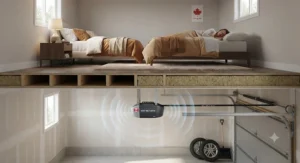
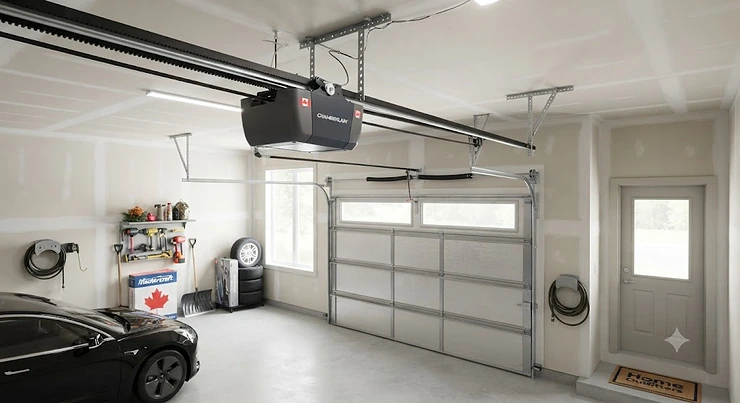
The basic mechanics of a garage door opener haven’t changed much since the design became mainstream after the Second World War — a motorized trolley still pulls the door along a track — but what that trolley rides on has changed enormously. A belt drive opener for attached garage use replaces the metal chain found in older, cheaper units with a steel-reinforced rubber belt, which glides along the rail instead of clanking against it. Paired with a DC motor and soft-start, soft-stop programming, the difference isn’t subtle: instead of a mechanical clatter, you get a low hum that barely registers one room away. For a garage sharing a wall, ceiling, or floor with living space — which describes most attached garages in Canada — that difference matters every single day, not just on the mornings you notice it.
This guide breaks down seven real, currently available belt drive openers, compares them head-to-head on noise, power, and smart features, and then goes further than a typical listing: setup and maintenance tips, real-world scenarios for different home layouts, a problem-solving section for lingering vibration issues, and a plain-English breakdown of what those decibel numbers on the box actually mean for the room above your garage. Prices below are shown as ranges in Canadian dollars, since retailer pricing shifts constantly — always check current pricing before buying.
Quick Comparison Table: Belt Drive Openers at a Glance
| Opener | Motor / Power | Noise Profile | Best For |
|---|---|---|---|
| LiftMaster 98022 | DC, wall-mount jackshaft | Virtually silent — no ceiling motor | Bedroom directly above garage |
| Chamberlain B6753T | 1-1/4 HP equivalent DC | Ultra-quiet, 2,000-lumen LED, camera | Best overall smart belt drive |
| LiftMaster 87504-267 | DC belt drive | Quietest ceiling model in the lineup | Buyers who want LiftMaster’s hush factor |
| Genie StealthDrive 750 | 1-1/4 HPc DC | Ultra-quiet, lightweight rail | Easy DIY install, battery backup |
| Genie QuietLift Connect 3053-TKV | 3/4 HPC DC | Quiet, Alexa/Google native | Best value smart belt drive |
| Craftsman CMXEOCG982 | 1-1/4 HPs | Quiet with extra winter torque | Heavy or solid-wood doors |
| Chamberlain B2405 | 1/2 HP | Quiet for its price class | Tightest budgets |
Looking at this table, the pattern is pretty clear: horsepower and hush don’t trade off against each other the way they do with chain drives, but ceiling-mounted belt drives still transmit some vibration through the rail brackets no matter how quiet the motor itself is. If a bedroom sits directly overhead, the LiftMaster 98022‘s wall-mount jackshaft design sidesteps that problem entirely by moving the motor off the ceiling altogether. Everyone else on this list is a strong ceiling-mount belt drive, and the right one comes down to how much smart-home integration and lifting power you actually need.
💬 Just one click — help others make better buying decisions too!😊
Top 7 Belt Drive Openers for Attached Garages: Expert Analysis
1. LiftMaster 98022 — zero ceiling vibration by design
The LiftMaster 98022 solves the noise problem differently than everything else on this list: instead of quieting a ceiling-mounted motor, it removes the motor from the ceiling entirely. This wall-mount jackshaft opener bolts beside the door and turns the torsion bar directly, which means there’s no rail, no trolley, and — critically — no vibrating hardware bolted to the joists above a bedroom. It replaced the discontinued 8500W and now ships standard with integrated battery backup and an automatic garage door deadbolt, features that used to be optional add-ons. Rated to lift sectional doors up to roughly 385 kg (850 lbs), it has the muscle for oversized or insulated doors that would strain a standard rail-mounted unit. Installers who work in older homes with bedrooms over the garage consistently point to jackshaft conversions as the single biggest noise fix available, more effective than any rubber isolator retrofit. Because it’s a specialty install requiring side clearance and a compatible torsion system, professional installation is the norm rather than the exception, which nudges the total project cost higher than a plug-and-play ceiling unit.
Pros:
- ✅ Motor mounted beside the door, not on the ceiling
- ✅ Built-in battery backup and auto-lock included standard
- ✅ Frees up ceiling space for storage or a lift
Cons:
- ❌ Requires professional installation in most homes
- ❌ Needs side clearance some garages don’t have
Expect to pay in the C$650-C$800 range for the head unit alone, climbing toward C$1,200-C$1,300 installed through a dealer — a premium price, but for anyone whose primary complaint is a shaking ceiling, the LiftMaster 98022 is arguably the only entry here that fixes the root cause rather than muffling the symptom.
2. Chamberlain B6753T — best all-around smart belt drive
The Chamberlain B6753T is the opener most installers reach for when a customer asks for “the good one,” and the spec sheet explains why. Chamberlain’s MAX Lift Power System delivers lifting force equivalent to 1-1/4 HP, the steel-reinforced belt is paired with a soft-start, soft-stop DC motor, and a 130-140° built-in camera streams live video and two-way audio to the myQ app. On paper, that camera is the headline feature; in practice, it’s also where real buyers report the most friction. Aggregated feedback compiled by The Inside Review found roughly 40 negative mentions out of 105 feedback items pointed specifically at intermittent camera issues — feed dropouts, delayed motion alerts, and occasional reconnection failures after firmware updates. That’s a meaningful chunk of a otherwise well-regarded unit, and it’s worth weighing if the camera is the reason you’re buying rather than a bonus. The belt drive and 2,000-lumen corner-to-corner LED lighting draw far less criticism; most complaints circle back to the connected features, not the mechanical core. Battery backup, Security+ 2.0 rolling codes, and Amazon Key in-garage delivery round out the package for households already living in the myQ ecosystem.
Pros:
- ✅ 1-1/4 HP-equivalent MAX Lift power for heavier doors
- ✅ 2,000-lumen corner-to-corner LED lighting
- ✅ Battery backup meets emergency-access needs
Cons:
- ❌ Camera reliability complaints in aggregated user feedback
- ❌ myQ video storage requires an ongoing subscription
Retail pricing typically lands in the C$380-C$520 range depending on promotions, and given the combination of lifting power, lighting, and connected features, it earns its reputation as the safe default pick — as long as you go in knowing the camera is the part most likely to occasionally annoy you.
3. LiftMaster 87504-267 — the quietest name in LiftMaster’s lineup
Formerly sold as the LiftMaster 8550, the LiftMaster 87504-267 carries a specific reputation inside the brand’s own catalogue: dealers and LiftMaster’s own product literature identify it as the quietest door opener LiftMaster makes. That’s a meaningful claim from a company with a wide product range, and the engineering backs it up — a rubber belt drive system paired with a DC motor, plus a 360° LED light ring that puts out 2,000 lumens without needing a separate garage light fixture. A built-in Secure View camera with a 140° wide-angle lens and two-way audio joins the myQ Wi-Fi and Bluetooth stack, and the warranty coverage is unusually generous: lifetime coverage on the motor and belt, five years on parts, one year on the battery. Where this model earns its keep over the flashier B6753T is in households that specifically prioritize hush over horsepower; LiftMaster positions this as the pick for rooms directly above or beside the garage. It’s also one of the few openers on this list with confirmed Canadian retail pricing, which is a useful sanity check against U.S.-only listings.
Pros:
- ✅ Marketed by LiftMaster itself as its quietest model
- ✅ Lifetime motor and belt warranty
- ✅ 360° LED lighting eliminates need for separate fixture
Cons:
- ❌ Premium price relative to non-camera competitors
- ❌ Camera subscription costs extra for extended video storage
Canadian retail listings put this unit in the C$950-C$1,250 range before installation, occasionally discounted closer to C$980. That’s toward the top of this roundup, but if quiet operation is the entire point of the upgrade, the LiftMaster 87504-267 is built specifically to deliver on that promise.
4. Genie StealthDrive 750 — lightweight rail, easy DIY install
The Genie StealthDrive 750 takes a different engineering approach to quiet operation: rather than leaning entirely on motor design, Genie built a five-piece modular rail system that’s unusually light and snaps together without special hardware, which reduces the resonant hum that comes from a poorly seated rail. A 1-1/4 HPc DC motor lifts sectional doors up to 2.1 m (7 ft) high and 227 kg (500 lbs), and GenieSense monitoring technology continuously tracks door operation, flagging changes that might indicate a developing mechanical issue before it becomes a failure. Battery backup covers up to 50 cycles during a power outage, transitioning instantly with no manual switchover required. Real owner feedback is genuinely mixed on power delivery — one verified buyer compared the 1-1/4 HPc rating unfavourably to an older 1/2 HP LiftMaster on a similarly sized door, describing the lift as underwhelming for the horsepower claim, while professional installers and manufacturer documentation continue to position it as suitable for standard 7-ft sectional doors. That gap is worth noting honestly rather than glossing over: horsepower-equivalent ratings on DC motors aren’t measured the same way as AC motors, so direct comparisons based on the number alone can mislead.
Pros:
- ✅ Lightweight modular rail simplifies DIY installation
- ✅ Battery backup powers up to 50 cycles
- ✅ GenieSense diagnostics flag issues proactively
Cons:
- ❌ Some owner reports describe underwhelming lift for the HP rating
- ❌ No wall-mount option for the base rail model
Pricing generally sits in the C$300-C$400 range for the head unit, making it a reasonable middle-of-the-pack choice for anyone comfortable installing it themselves and prioritizing quiet operation over class-leading raw power.
5. Genie QuietLift Connect 3053-TKV — best value smart belt drive
For shoppers who want smart-home features without paying camera-tier prices, the Genie QuietLift Connect 3053-TKV is the pragmatic middle path. It runs a 3/4 HPC DC motor over a steel-reinforced belt, and rather than locking into a single ecosystem, Aladdin Connect Wi-Fi works natively with both Alexa and Google Assistant — a genuine advantage for households that have already picked a smart-home camp and don’t want a third app cluttering the phone. Independent aggregated review analysis compiling roughly 70 verified reviews scored this model 8.08 out of 10 across ten measured features, with owners repeatedly describing it as noticeably quieter and smoother than the chain-drive units it replaced. That said, the same aggregated data and individual owner reports flag two recurring weak points: the safety-sensor wiring gauge is thin enough to work loose from vibration over time, and a subset of buyers reported sensor or control-board failures within two to three months of installation, requiring warranty troubleshooting. Neither issue is universal, but both show up often enough in independent feedback to mention plainly rather than bury.
Pros:
- ✅ Works natively with both Alexa and Google Assistant
- ✅ Strong 8.08/10 aggregated review score across measured features
- ✅ Five-piece rail system snaps together for easy setup
Cons:
- ❌ Thin-gauge sensor wiring prone to working loose
- ❌ Some reports of sensor or board failures within months
Street pricing typically runs C$230-C$300, occasionally financed at roughly C$40 per month through select retailers, positioning this as one of the strongest dollar-for-dollar smart belt drives in this comparison, provided you tighten the sensor wiring connections during install and keep an eye on them seasonally.
6. Craftsman CMXEOCG982 — best raw lifting power for heavy doors
Households with a solid-wood, insulated, or otherwise oversized door tend to gravitate toward the Craftsman CMXEOCG982, and the spec sheet explains the appeal: a 1-1/4 HPs belt drive rated to deliver extra lifting boost specifically in cold-weather conditions, which matters more in a Canadian winter than the marketing copy might suggest. A door frozen to its weatherstripping at -20°C (-4°F) puts real strain on a motor, and Craftsman’s positioning around “extreme weather conditions… sticking due to frozen ice” is a rare instance of a spec genuinely written with a Canadian-style climate in mind rather than a mild-winter market. Security+ 2.0 rolling code technology protects against remote code interception, and built-in Wi-Fi keeps it inside the myQ app ecosystem alongside Chamberlain and LiftMaster units, which is convenient for households running multiple garage doors on different brands under one control panel. The belt itself is described as steel-reinforced, delivering the quiet operation this whole category promises, though Craftsman’s brand recognition for openers specifically is thinner than Chamberlain or LiftMaster, so buyers occasionally hesitate before fewer are covered by independent long-term reliability data than the more established names.
Pros:
- ✅ Extra lift boost engineered for frozen or stuck doors
- ✅ Security+ 2.0 encrypted rolling codes
- ✅ Compatible with the shared myQ smart-home app
Cons:
- ❌ Less independent long-term reliability data than Chamberlain or LiftMaster
- ❌ Fewer accessory options than the bigger opener brands
Pricing sits roughly in the C$280-C$380 range, positioning it squarely against the Chamberlain B6753T on price while trading the built-in camera for winter-specific lifting reassurance — a fair trade for anyone whose door has ever groaned at them on a January morning.
7. Chamberlain B2405 — the honest budget pick
Every roundup needs an honest entry point, and the Chamberlain B2405 is it. A 1/2 HP motor is on the lighter end for this category, and Chamberlain’s own product page describes the motor as AC rather than DC on this specific model — worth flagging, since DC motors are generally associated with smoother soft-start and soft-stop performance than AC. Even so, the belt drive itself still delivers meaningfully quieter operation than a same-price chain-drive competitor, and the unit still connects to the myQ app over built-in Wi-Fi with Bluetooth for setup, supports Amazon Key in-garage delivery, and uses BILT’s 3D-guided installation instructions, which measurably shorten first-time DIY install time based on user forum discussion of the app. Security+ 2.0 encryption is included standard, which is notable at this price point since some budget competitors reserve rolling-code security for higher tiers. This isn’t the opener for a heavy insulated door or a household chasing camera features, but for a standard-weight door on a tight budget, it’s a legitimately quieter and smarter alternative to whatever chain-drive unit came with the house.
Pros:
- ✅ Meaningfully quieter than comparably priced chain drives
- ✅ Security+ 2.0 encryption included at the entry price point
- ✅ BILT 3D instructions simplify DIY installation
Cons:
- ❌ 1/2 HP motor is light for heavier or oversized doors
- ❌ AC motor lacks DC soft-start smoothness of pricier models
Typical pricing runs C$200-C$280, making this the pick for first-time buyers, rental properties, or anyone replacing a dead chain-drive unit without wanting to spend real money to do it.
Setting Up and Maintaining Your Belt Drive Opener the Right Way
Buying the quietest belt drive on the market and then bolting it to a loose, unlubricated rail is how people end up disappointed. During the first install, torque the rail-to-motor bolts to the manufacturer’s spec rather than “snug,” since an under-tightened joint is one of the most common sources of rattle that gets wrongly blamed on the motor. Check belt tension after the first 48 hours of use; belts stretch slightly during break-in, and a too-loose belt will slip and click under load. If a bedroom sits directly above the garage, install rubber isolator washers between the rail brackets and the ceiling joists at initial setup rather than as a later fix — retrofitting them is more work and marginally less effective than installing correctly the first time.
For ongoing maintenance, most manufacturers recommend a light silicone-based lubricant (never grease or oil, which attracts dust) on the belt and rail every six months, plus a visual check of the safety sensor alignment monthly, since a knocked sensor is the single most common service call for openers under two years old. Battery backup units need their battery tested or replaced roughly every three to five years — most units chirp or flash an indicator when capacity drops, but don’t wait for the warning if the unit is older than the stated battery lifespan. In the first 30 days, the most common mistake new owners make is over-tightening the travel limits, forcing the door to slam the last few centimetres of travel; a properly set opener should ease into full open and full closed, not bang into them.
Real-World Scenarios: Matching the Opener to Your Home
Consider three households shopping this category. The first is a young family in a Calgary two-storey with the primary bedroom directly above the garage — for them, the priority isn’t the cheapest option or the flashiest app, it’s finding the best belt drive garage door opener for bedroom above garage use specifically, and a wall-mount jackshaft unit like the LiftMaster 98022 is worth the installation premium because it removes ceiling vibration rather than just reducing motor noise. The second is a retired couple in a bungalow in the Maritimes with a detached-feeling but technically attached garage connected by a breezeway — noise transfer is less urgent here, so a mid-range pick like the Genie QuietLift Connect 3053-TKV delivers smart-home convenience without paying a premium for hush they don’t strictly need. The third is a landlord managing a rental duplex in Ontario who needs something reliable, inexpensive, and quick to install between tenants — the Chamberlain B2405 fits that budget and turnaround requirement without requiring an electrician or a specialty installer.
The throughline across all three: match the opener to the actual noise-sensitivity of the layout, not to whichever model has the most reviews online. A homeowner obsessing over decibel specs for a garage nobody sleeps near is solving a problem that doesn’t exist, while a family ignoring vibration transfer into a nursery directly overhead is underspending on the one feature that would actually improve daily life.
Problem → Solution: Fixing Noise and Vibration That Won’t Go Away
Even a genuinely quiet belt drive opener can still transmit noise if the surrounding hardware isn’t addressed, so here are the most common complaints and what actually fixes them. If the motor itself sounds fine but a low thump travels through the ceiling every time the door starts moving, the rail brackets are likely bolted directly to the joists with no cushioning — installing vibration-dampening mounts between the bracket and the joist is the standard fix, and rubber isolator kits designed specifically for this purpose are inexpensive and take under an hour to retrofit. If the noise is more of a rattle than a thump, check the door’s own rollers first; steel rollers on steel tracks are a bigger noise source than most people assume, and swapping to nylon rollers often reduces perceived noise more than any change to the opener itself. Discussion among garage-door forum members with hands-on retrofit experience consistently notes that rubber isolators help meaningfully but can’t be relied on alone to eliminate vibration — the more dramatic fix, when budget allows, is switching to a jackshaft-style wall-mount unit that removes the ceiling motor entirely, which multiple owners describe as making a bigger difference than any isolator or roller upgrade combined.
If the issue is intermittent — the door works fine most days but occasionally reverses or refuses to close — the safety sensor alignment is the first thing to check, since a sensor knocked even a few millimetres out of alignment by a bumped ladder or stored bicycle will trigger a safety reversal. Finally, if remote range has dropped noticeably since installation, check for new sources of RF interference nearby, such as an LED bulb not rated for opener compatibility; some LED bulbs interfere with the same frequency band used by rolling-code remotes.
How to Choose a Belt Drive Opener for an Attached Garage
- Confirm door weight and size first. A door heavier than the motor’s rating strains the system daily, shortening its lifespan regardless of how quiet it sounds in the showroom.
- Decide how much you actually value the camera. If in-garage delivery monitoring isn’t a priority, skipping the camera tier saves money and removes the single most common source of connected-feature complaints in this category.
- Check ceiling clearance and side-mount feasibility. Homes with low headroom or a bedroom directly overhead should seriously evaluate a jackshaft wall-mount before defaulting to a ceiling rail.
- Prioritize battery backup if the area loses power often. A backup battery isn’t just a convenience feature; it’s the only way to get a vehicle out of an attached garage during an extended outage.
- Match the smart-home ecosystem you already use. Buying a myQ-exclusive unit when the rest of the house runs on Google Home creates ongoing app-switching friction that’s easy to avoid upfront.
- Read aggregated sensor and wiring feedback, not just headline ratings. Several models in this comparison scored well overall but had specific, repeatable complaints about sensor wiring gauge or camera reliability worth weighing individually.
- Budget for installation, not just the unit. Wall-mount jackshaft models in particular usually require professional installation, which can add several hundred dollars to the sticker price.
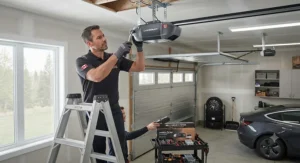
Belt Drive vs Chain Drive vs Direct Drive: Which One Actually Wins
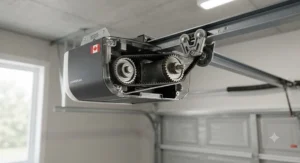
The core trade-off hasn’t changed much in twenty years: chain drives are the cheapest and handle heavy doors reliably, but a metal chain dragging across a metal rail is mechanically loud by design, typically producing noise in the 65-80 dB range — comparable to a running vacuum cleaner. Belt drives replace that chain with a steel-reinforced rubber belt, dropping typical operating noise into roughly the 45-60 dB range, closer to a quiet conversation than a construction site. Direct drive and jackshaft designs go a step further by minimizing moving parts or relocating the motor entirely off the ceiling, often landing at the quietest end of the spectrum, though usually at a higher price point and with pickier installation requirements. Screw drives sit in an odd middle position: fewer moving parts than a chain, but performance that can suffer in temperature extremes, which matters more in a Canadian climate that swings from -30°C winters to 30°C-plus summers than in more temperate markets.
For a genuinely attached garage — one sharing a wall, ceiling, or floor with a living space — belt drive is the sensible default for the vast majority of households, with jackshaft models reserved for the specific case of a bedroom directly overhead. Chain drive still makes sense for a detached garage, workshop, or any structure where noise simply doesn’t reach anyone who’d notice.
Decibel Ratings for Openers: What the Numbers Actually Mean
Manufacturers love printing decibel figures on the box, but the number means little without context, so here’s the plain-English version. Scientists measure everyday loudness on the A-weighted decibel scale: the threshold of human hearing sits at 0 dBA, breathing registers around 10 dBA, and a normal conversation lands around 60 dBA, according to Health Canada’s overview of noise and hearing. A typical chain-drive opener operating in the 65-80 dB range is louder than a normal conversation and edges toward levels associated with hearing risk over prolonged daily exposure, which is a meaningful consideration for anyone standing in the garage every single morning. A belt drive humming along at 45-60 dB sits at or below normal conversation volume — noticeable if you’re standing right beside it, but easy to sleep through one floor away. Jackshaft and direct-drive units marketed in the 40-50 dB range approach the volume of a quiet library.
The catch: decibel ratings on packaging are almost always measured at the motor itself under ideal lab conditions, not through a ceiling, insulation, and drywall into an actual bedroom. Real-world perceived loudness depends heavily on the transmission path — a “quiet” 45 dB motor bolted straight to unisolated joists can still transmit more noticeable vibration into a room above than the printed number suggests, which is exactly why the mounting hardware and vibration-dampening mounts discussed earlier matter as much as the opener’s own spec sheet.
Soundproofing Shared Walls: Beyond the Opener Itself
Buying a quieter opener solves motor noise, but it doesn’t address structure-borne vibration that travels through shared framing regardless of how quiet the source is — which matters for anyone dealing with soundproofing shared walls between a garage and an adjacent room, not just the ceiling above. According to guidance sourced from the Canada Mortgage and Housing Corporation and summarized by CAA-Quebec’s residential advisory service, effective sound reduction between floors typically involves mechanically decoupling the structure — attaching resilient channels to joists before hanging drywall, filling the cavity completely with insulation, and sealing the drywall-to-wall junction with acoustic sealant rather than relying on insulation alone. The same decoupling principle applies to a shared wall between a garage and a bedroom: a wall with drywall fastened directly to shared studs on both sides transmits vibration efficiently in both directions, while a properly decoupled assembly interrupts that direct path.
For a homeowner not ready for a full wall renovation, cheaper interim measures still help meaningfully: adding a second layer of drywall with a viscoelastic damping compound between layers, sealing every electrical box and penetration in the shared wall (a surprisingly large source of flanking noise), and, on the garage side specifically, making sure the opener’s own mounting hardware isn’t the thing transmitting vibration into that wall in the first place. Combining a genuinely quiet belt drive opener with even modest wall decoupling measures produces a noticeably bigger improvement than either change alone.
Long-Term Cost & Maintenance: What These Openers Really Cost Over Time
The sticker price is only the opening bid. Over a typical 10-15 year opener lifespan, factor in a replacement battery every three to five years (roughly C$40-C$80 per swap for backup-equipped models), periodic belt lubrication supplies (inexpensive but easy to forget), and the eventual remote or keypad battery replacement that every household puts off until the exact moment they’re locked out. Camera-equipped models add an optional but tempting ongoing cost: extended video storage subscriptions through myQ or Aladdin Connect typically run a modest monthly fee, which adds up over several years even though the core opener functions perfectly well without it.
Where belt drives earn back their higher upfront cost compared to chain drive is in reduced wear-related noise complaints and, anecdotally, lower rates of rail and roller replacement, since belt systems don’t grind metal against metal the way a chain does over thousands of cycles. Warranty coverage varies meaningfully across this list — from LiftMaster’s lifetime motor-and-belt coverage on the 87504-267 down to shorter parts warranties on some budget units — and that coverage gap is worth pricing into any total cost of ownership comparison rather than looking at the sticker price alone.
Features That Actually Matter (And Those That Don’t)
Battery backup, a DC motor with soft-start/soft-stop, and rolling-code security genuinely matter for daily reliability and safety, and they’re worth prioritizing even on a tighter budget. A built-in camera is a genuine convenience for package monitoring, but based on aggregated user feedback across multiple models in this comparison, it’s also the single most common source of post-purchase frustration when firmware updates or connectivity hiccup — treat it as a nice-to-have, not a must-have, unless in-garage delivery monitoring specifically solves a problem you already have. Voice assistant compatibility matters far less than marketing suggests for most households; nearly every model here eventually opens and closes via a phone app regardless of which voice ecosystem it’s nominally built for. Horsepower-equivalent ratings deserve healthy skepticism, since DC motor lift ratings aren’t measured identically across brands — the aggregated review data on a specific model’s real-world lifting performance is more useful than the number printed on the box.
Safety, Regulations, and Compliance for Garage Door Openers in Canada
Every opener sold for residential use in Canada is expected to meet the binational CAN/UL 325 safety standard, which is referenced directly in the Canadian Electrical Code and covers entrapment protection, safety reversing sensors, and construction requirements for automatic door and gate operators. Practically, this means confirming a listed unit includes photo-eye safety sensors mounted no more than roughly 15 cm (6 in) off the floor on both sides of the door opening, and testing them periodically by placing an object in the door’s path during closing to confirm an automatic reverse. According to UL Solutions’ overview of the standard, CAN/UL 325 compliance is the most direct way manufacturers demonstrate they meet the electrical code requirements referenced by Canadian building authorities, so checking for UL or CSA certification markings on the unit itself — not just trusting a brand name — is a reasonable step before installation, particularly for anyone buying a used or older unit secondhand.
Frequently Asked Questions
❓ Is a belt drive opener quiet enough for a bedroom above the garage?
❓ How much does a belt drive garage door opener cost in Canada?
❓ Do vibration-dampening mounts actually reduce garage door opener noise?
❓ What is the difference between a belt drive and a chain drive garage door opener?
❓ How long does a belt drive garage door opener last?
Conclusion
A belt drive opener for attached garage use isn’t a luxury upgrade so much as a quality-of-life fix hiding in plain sight — most homeowners never connect a groggy morning or a startled toddler to the specific rattle of a chain-drive motor overhead until they replace it and notice the silence. Across this comparison, the honest advice holds regardless of budget: match the opener to the actual noise sensitivity of the layout, don’t skip the mounting hardware details that determine whether “quiet on paper” translates to quiet in the bedroom above, and weigh camera and smart-home features against their real-world reliability rather than the marketing copy alone. Whether the right pick ends up being the wall-mount LiftMaster 98022 for a household that needs to eliminate ceiling vibration entirely, or the budget-friendly Chamberlain B2405 for a straightforward door replacement, every option on this list delivers a meaningful step up from the chain-drive noise most Canadian garages started with.
✨ Ready to stop dreading the 6 a.m. door rattle? Browse current availability on any of the seven picks above and give your household’s mornings the quiet upgrade they’ve been waiting for! 🔧🏠
Recommended for You
- Belt Drive Garage Door Opener: 7 Top Picks for Canada (2026)
- Garage Door Opener for Prairie Winters: 7 Best Picks for 2026
- 7 Best Cold Weather Rated Garage Door Openers for 2026
Disclaimer: This article contains affiliate links. As an Amazon Associate, I earn from qualifying purchases. If you purchase products through these links, we may earn a small commission at no additional cost to you.
✨ Found this helpful? Share it with your friends! 💬🤗
