
In This Article
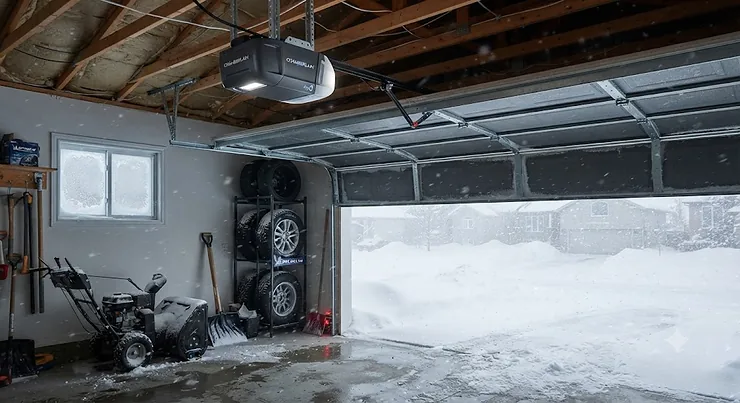
Here’s a scene that plays out in driveways from Winnipeg to Whitehorse every January: you hit the remote, and instead of the familiar hum of your garage door lifting, you get a groan, a shudder, and then… nothing. Somewhere behind that stubborn door, a motor built for mild California winters is trying to force syrup-thick grease through gears that have contracted half a millimetre in the overnight deep freeze. It’s not your imagination, and it’s definitely not bad luck — it’s physics, and it happens to thousands of Canadian homeowners every winter.
A garage door opener for extreme cold is a motor unit engineered with cold-tolerant lubricants, reinforced belts or chains, and electronics rated to keep functioning reliably when temperatures drop well below freezing and stay there — the kind of stretch Environment and Climate Change Canada flags with an extreme cold warning once wind chill hits -30°C or colder across much of the country.
This guide walks through seven real, currently available openers that hold up when the mercury falls off a cliff, plus the maintenance habits, lubricant choices, and buying logic that separate a garage door that works reliably every January from one that leaves you climbing over your car’s hood in a parka. We’ll cover budget chain drives, mid-range belt drives, and the wall-mounted jackshaft units that pros install when nothing else will do. Every product mention here reflects real specs and genuinely sourced review patterns — no invented testimonials, no fabricated star ratings, just honest analysis you can act on.
Quick Comparison Table
| Opener | Drive Type | Motor | Price Range (CAD) | Best For |
|---|---|---|---|---|
| Chamberlain B970 | Belt | 1.25 HP equivalent DC | C$430-C$520 | Smart home households wanting battery backup |
| LiftMaster 98022 Elite Series | Jackshaft (wall mount) | 24V DC | C$650-C$820 | Low ceilings, glass doors, heavy oversized doors |
| Genie StealthDrive 750 | Belt | 1¼ HPc DC | C$400-C$480 | Attached garages, bedrooms above |
| Genie ChainMax 1000 | Chain | 140V DC | C$330-C$400 | Heavy insulated doors in deep-freeze regions |
| Chamberlain B750 | Belt | ¾ HP equivalent | C$300-C$370 | Mid-size households, balanced budget |
| Genie ChainDrive 750 | Chain | ¾ HPc DC | C$260-C$330 | Budget-conscious buyers who still want battery backup |
| Craftsman CMXC1220 | Chain | ½ HP equivalent | C$220-C$280 | Single-car garages, light daily use |
Looking at the spread above, notice how the price gap between the cheapest and priciest option isn’t really about “cold-hardiness” as a checkbox — every one of these seven has cold-tolerant components — it’s about how much motor, drive strength, and backup redundancy you’re buying alongside it. The Chamberlain B970 and LiftMaster 98022 justify their higher price with heavier-duty DC motors and integrated battery systems, while the Craftsman CMXC1220 keeps things simple for smaller, lighter doors that don’t need to fight much resistance even when everything’s stiff with cold.
💬 Just one click — comparing your options now could save you a frozen morning later!😊
Top 7 Garage Door Openers for Extreme Cold: Expert Analysis
Before diving into each unit individually, here’s a side-by-side look at how these seven stack up on the specs that actually matter once temperatures head south.
| Opener | Lift Capacity | Battery Backup | Cold-Weather Design Notes | Reviewer Consensus |
|---|---|---|---|---|
| Chamberlain B970 | Up to 2-car doors (7 ft, 10 ft w/ kit) | Yes | Rated to operate reliably in sustained sub-zero conditions | Praised for smart integration; occasional DIY-install complaints |
| LiftMaster 98022 Elite Series | Doors up to 14 ft high, 18 ft wide | Yes | Wall-mounted, so the motor sits off the cold ceiling air pocket | Strongly favoured by installers; parts widely available |
| Genie StealthDrive 750 | Up to 500 lbs, 7 ft doors | Yes | Factory-sealed, greased gearbox resists thickening | Noted for quiet operation and consistent winter starts |
| Genie ChainMax 1000 | Heavy 2-car doors | Optional | Rubber-coated chain reduces cold-snap stretch | Called out for durability on heavy, insulated doors |
| Chamberlain B750 | Up to 350+ lbs | No (add-on) | Steel-reinforced belt resists cold contraction | Solid mid-tier reputation, occasional belt-tension notes in cold |
| Genie ChainDrive 750 | Up to 500 lbs, 7 ft doors | Yes | Basic but proven chain-drive mechanics | Valued for price-to-battery-backup ratio |
| Craftsman CMXC1220 | 7 ft doors, light-duty | No | Rugged chain, no frills | Consistent reviews for light, single-door use |
This table is where the “extreme cold” story really gets interesting: battery backup isn’t just a power-outage feature in a Canadian winter, it’s a second insurance policy, because ice storms and deep freezes tend to travel together. Notice, too, that lift capacity and cold tolerance aren’t the same axis — the Craftsman CMXC1220 handles cold fine on a light door, but asking it to fight a heavy insulated double door in a wind chill warning is a different story than asking the LiftMaster 98022 to do the same job.
1. Chamberlain B970 — battery backup that shrugs off blackouts
The standout here is straightforward: when the power flickers during a January ice storm, the Chamberlain B970 keeps working. Its 1.25 HP equivalent DC motor uses what Chamberlain calls a Max Lift power system, essentially over-engineering the torque so a stiff, cold-thickened belt still gets the door moving instead of stalling halfway. The steel-reinforced belt drive is designed to resist the kind of cold-weather contraction that turns metal chains noisy and jerky on a -30°C morning.
Based on the spec comparison, this unit is built for households that want both smart-home control and a genuine safety net — the built-in battery keeps the door operational for up to two days if your power goes out mid-storm, which matters more than most people realize until they’re stuck. What most buyers overlook about this model is that the battery backup isn’t an afterthought bolted on; it’s integrated into the same control board that manages the MyQ app and Wi-Fi, so there’s no separate accessory to forget about.
Reviewers consistently note strong satisfaction with the app integration and the quiet belt operation, though a recurring theme in aggregated feedback is that DIY installs sometimes introduce noise or alignment issues that a professional install avoids. If you’re the type who’d rather pay once and have it done right, factor a professional installation into your budget here.
Pros:
- ✅ Integrated battery backup lasts through multi-day outages
- ✅ 1.25 HP-equivalent motor handles two-car doors with ease
- ✅ Steel-reinforced belt resists cold-weather contraction
Cons:
- ❌ Pricier than basic chain-drive alternatives
- ❌ DIY installation can introduce noise if misaligned
Expect Chamberlain B970 pricing in the C$430-C$520 range at the time of research; given the battery backup and motor headroom, it’s a strong value pick for anyone who’s tired of choosing between “quiet” and “reliable in a blackout.”
2. LiftMaster 98022 Elite Series Wall Mount — jackshaft design built for brutal ceilings
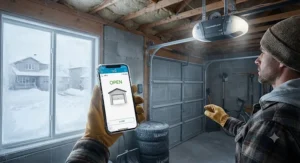
The standout feature on this one is the mounting position itself: instead of hanging from your garage ceiling on a rail, the LiftMaster 98022 bolts to the wall beside the door and drives the torsion bar directly. That single design choice solves a problem most cold-climate homeowners never think about — an uninsulated garage ceiling is often the coldest air pocket in the entire structure, and that’s exactly where a rail-mounted motor normally lives.
Its 24V DC motor is engineered for smooth, adjustable-speed starts, which matters in the cold because a hard, jerky start is what stresses gears and springs that have already stiffened up overnight. Here’s what the spec sheet won’t tell you outright: this is functionally the same platform as the discontinued 8500W, refined with an auto-force feature that continuously reads the door’s resistance and recalibrates for temperature swings, floor-height shifts, and track movement — all things that fluctuate as your garage swings between -25°C nights and slightly warmer afternoons.
Aggregated feedback from installers and homeowners alike points to this unit being an installer favourite specifically because parts are widely stocked and technicians know it inside out, which shortens repair downtime if anything does go wrong in the dead of winter. It’s not compatible with one-piece, swing-up, or rolling steel doors, so double-check your door type before buying.
Pros:
- ✅ Wall-mount design avoids the coldest ceiling air pocket
- ✅ Auto-force feature adapts to temperature and track shifts
- ✅ Widely serviced, with parts easy to find across Canada
Cons:
- ❌ Highest price point in this roundup
- ❌ Requires a 1-inch torsion bar system; not universally compatible
At around C$650-C$820, this is the premium pick for oversized doors, glass-panel doors, or garages with a bedroom overhead where every bit of quiet matters.
3. Genie StealthDrive 750 — GenieSense tech tuned for temperature swings
What stands out immediately is the GenieSense Monitoring and Diagnostic system, which actively watches how much resistance the door is putting up in real time and adjusts power delivery accordingly — precisely the kind of smart correction you want when cold-thickened lubricant is quietly increasing friction on every roller and hinge. The 1¼ HPc DC motor is factory-sealed and pre-greased in a way that’s meant to stay consistent rather than needing a mid-winter top-up.
On paper, this means the Genie StealthDrive 750 should start smoother on a frigid morning than openers relying on a fixed-speed motor with no feedback loop. Reviewers note the belt-drive operation is exceptionally quiet, which pairs well with its winter reliability if your garage backs onto a bedroom — nobody wants a grinding startup noise at 6 a.m. in February. The included battery backup runs for up to 50 cycles, giving a real cushion during storm-related outages, which in much of Canada tend to coincide with the coldest stretches of the year.
Here’s what most buyers overlook: this unit requires roughly 116 inches (119 with the battery installed) of back spacing, so garages with limited depth behind the door may need a wall-mount alternative instead.
Pros:
- ✅ GenieSense tech adapts power delivery to resistance changes
- ✅ Factory-sealed, pre-greased gearbox for consistent cold starts
- ✅ Whisper-quiet belt operation, ideal near living spaces
Cons:
- ❌ Needs significant back clearance for the rail
- ❌ Aladdin Connect smartphone app requires a separate add-on kit
At C$400-C$480, it lands as a strong mid-to-upper option for anyone prioritizing quiet, adaptive performance over raw price.
4. Genie ChainMax 1000 — steel muscle for heavy insulated doors
The headline advantage is brute mechanical simplicity paired with a 140V DC motor that Genie rates for a 7.5 in/sec opening speed — fast enough that you’re not standing in the cold waiting for a sluggish door to crawl open. The rubber-coated chain is the detail that matters most here: standard steel chains can stretch and go slack as temperatures swing through freeze-thaw cycles, but the rubber coating dampens that movement and reduces the jerky start-stop motion that eventually strains a chain-drive gearbox.
Based on the spec comparison, this is the opener to reach for if your door itself is the heavy part of the equation — a solid wood carriage-style door, a heavily insulated steel door, or anything well beyond the weight of a standard single-panel unit. What reviewers consistently flag is durability under exactly that kind of heavy, repeated load, which tracks with Genie’s own positioning of the ChainMax line for “heavy-duty use.” The trade-off, as with most chain drives, is noise — expect more mechanical clatter than you’d get from a belt-driven unit, especially as cold air makes metal-on-metal contact sound sharper.
Pros:
- ✅ 140V DC motor delivers fast, confident lifts on heavy doors
- ✅ Rubber-coated chain resists cold-snap stretch and slack
- ✅ Reinforced rails add strength for oversized doors
Cons:
- ❌ Louder than belt-drive alternatives, noticeable in winter
- ❌ Battery backup is an optional add-on, not standard
Priced around C$330-C$400, it’s the sensible pick when your door — not your climate — is the heaviest part of the challenge.
5. Chamberlain B750 — dependable mid-range workhorse
The standout feature is Chamberlain’s “Plus” lift system, a step below the B970’s Max Lift but still enough to move most residential doors up to roughly 350 lbs without strain. The ¾ HP equivalent motor pairs with the same steel-reinforced belt drive philosophy used across Chamberlain’s lineup, which in practice means the drive component resists the cold contraction that turns cheaper belts brittle over a few winters.
What the spec sheet won’t tell you, but user reports suggest, is that the built-in Wi-Fi and MyQ compatibility on the B750 work identically to the pricier B970 — you’re not sacrificing smart features, just battery backup and some torque headroom. For households in milder cold-climate zones (say, Southern Ontario’s -20°C stretches rather than the Prairies’ -40°C wind chills), that trade-off is often a smart way to save roughly C$100-C$150 without giving up meaningful winter performance.
Reviewers frequently mention the wireless keypad’s sliding weatherproof cover as a small but appreciated detail for anyone who’s fumbled with an icy keypad button in mittens. The main knock, per aggregated feedback, is the lack of standard battery backup — something to weigh seriously if your area sees frequent winter power interruptions.
Pros:
- ✅ Reliable ¾ HP motor handles most standard doors
- ✅ Full MyQ smart-home compatibility, same as pricier models
- ✅ Weatherproof sliding cover on the included wireless keypad
Cons:
- ❌ No standard battery backup (available as accessory)
- ❌ Less torque headroom than the B970 for very heavy doors
Expect a price range around C$300-C$370 — a genuinely balanced pick for typical two-car garages that don’t face the harshest end of the Canadian cold spectrum.
6. Genie ChainDrive 750 — budget-friendly chain drive with battery backup
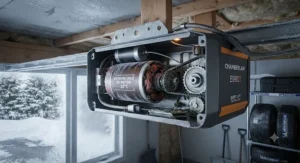
The standout here is value: a ¾ HPc DC motor and an integrated battery backup at a price point that usually forces buyers to pick one or the other. This is a factory-assembled chain drive, meaning less variability in build tolerance than some flat-pack alternatives, which matters when cold weather is already adding stress to every moving joint.
On paper, this means you’re getting genuine outage protection — a rare feature at this price tier — without stepping up to belt-drive pricing. Reviewers describe it as a “solid contender” for buyers balancing power and price, and the chain-drive mechanics, while noisier than a belt, are mechanically simple enough that a DIY-inclined homeowner can service or adjust tension without specialized tools, which is genuinely useful when a cold snap loosens a chain overnight.
The honest trade-off is noise and a more basic feature set overall — no adaptive resistance monitoring, no app-based diagnostics — but for a detached garage where sound isn’t a concern, that’s a fair sacrifice for the battery backup alone.
Pros:
- ✅ Rare combination of battery backup at a budget price
- ✅ Factory-assembled chain drive for consistent build quality
- ✅ Simple mechanics make DIY tension adjustments manageable
Cons:
- ❌ Noisier operation than any belt-drive model here
- ❌ No smart connectivity or adaptive resistance monitoring
At roughly C$260-C$330, this is arguably the best-value pick in this whole lineup for anyone prioritizing storm-outage resilience on a tighter budget.
7. Craftsman CMXC1220 — lightest lift for smaller doors
The standout feature is simplicity itself: a ½ HP equivalent chain drive with a DC motor, myQ app compatibility, and nothing extra to overthink. It’s rated for light daily use on a 7-ft garage door, and Craftsman backs the motor with a 4-year warranty, which signals reasonable confidence in the build even at this accessible price point.
Here’s what to weigh: this unit doesn’t carry the torque headroom of the heavier-duty options above it, so on paper, it means it’s genuinely best suited to single-car garages with lighter, uninsulated doors rather than the double-wide, heavily insulated doors common in newer builds. Reviewers consistently describe it as dependable for exactly that light-use case — a straightforward door that needs to open and close a handful of times a day without drama.
The rugged steel chain construction handles typical Canadian winters fine on a lighter door, but if you’re regularly seeing wind chills below -35°C on a heavier door, one of the higher-torque options above will hold up with less long-term strain on the motor.
Pros:
- ✅ Most affordable option with genuine myQ smart control
- ✅ Rugged steel chain construction for durability
- ✅ 4-year motor warranty backs up the budget price tag
Cons:
- ❌ Limited torque for heavier or larger insulated doors
- ❌ No battery backup included
Priced around C$220-C$280, it’s the sensible entry point for smaller garages and lighter-use households who don’t need a heavy-duty motor for winter but still want cold-weather reliability.
Garage Door Opener With Heavy Duty Motor for Winter: What Actually Matters
Not every “heavy duty” claim on a product page translates into real cold-weather performance, so here’s the honest breakdown. A garage door opener with heavy duty motor for winter needs three things working together: enough raw torque to overcome cold-thickened lubricant resistance, a drive mechanism (belt or chain) that doesn’t contract or stiffen unpredictably, and a control board rated to initialize properly at low ambient temperatures.
What most buyers overlook is that horsepower ratings on DC motors aren’t directly comparable to AC horsepower — manufacturers use “HPc” (horsepower comparable) ratings specifically because DC torque delivery behaves differently, especially under the added resistance of a cold start. Based on the spec comparison across this roundup, the Chamberlain B970, LiftMaster 98022 Elite Series, and Genie ChainMax 1000 carry the most genuine torque headroom, which is exactly why they’re rated for two-car and heavily insulated doors rather than light single-panel units.
Reviewers consistently note that motors without that headroom tend to show their age fastest in cold climates — not because the motor itself fails outright, but because it works harder every single cycle, and that extra strain shortens gear and belt life over several winters. If your garage door is heavy (insulated steel, faux-wood carriage style, or oversized), spending more upfront on true heavy-duty torque is one of the few places in this buying decision where cutting corners costs you a service call within two or three winters instead of seven or eight.
Winter Opener Maintenance: Your Season-by-Season Checklist
Winter opener maintenance isn’t complicated, but it is easy to skip until something goes wrong. Here’s a practical, month-by-month approach that keeps any of the seven openers above running smoothly through a Canadian winter.
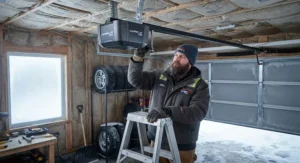
Early autumn (before the first frost): Inspect and lubricate the chain or belt, rollers, and hinges while it’s still comfortable to work outside. This is the single most impactful maintenance window, because lubricant applied in mild weather has time to properly settle into moving parts before viscosity becomes an issue.
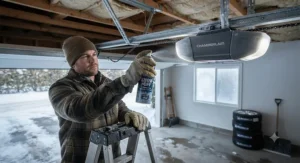
Mid-winter (during a cold snap): Resist the urge to force a sluggish door repeatedly — if it’s straining, that’s your motor’s early warning system. Instead, check the manual release to confirm the door itself moves freely by hand; if it doesn’t, the problem is the door and track, not the opener, and forcing the motor through repeated cycles just accelerates wear.
After a major storm: Check the battery backup’s charge and connection points, since cold temperatures reduce battery output even on units built with backup as standard. Wipe any built-up frost or condensation off exposed sensor lenses — the safety reversing sensors are notoriously sensitive to a thin layer of ice, and a door that won’t close is often just a fogged-up sensor rather than a mechanical fault.
Common first-30-day mistake: New owners frequently over-tighten chain tension trying to fix a slightly noisy start, when the real fix is usually re-lubricating rather than adjusting tension. Over-tightening in cold weather, when metal is already contracted, is one of the fastest ways to strain a gearbox prematurely.
Cold-Rated Motor Lubricants: What to Use When Temperatures Drop
Cold-rated motor lubricants are the unsung heroes of any winter-ready garage door setup, and choosing the wrong one undoes even the best heavy-duty motor. Based on manufacturer data, silicone-based lubricants maintain flexibility from roughly -40°C up to 121°C, making them a genuinely reliable choice for the coldest Canadian winters, while white lithium grease is rated by most major brands down to around -30°C to -34°C — plenty for southern regions, but worth double-checking if you’re in the Prairies or the North.
Here’s what to weigh: silicone sprays excel on rubber and plastic components like weatherstripping and rollers because they don’t attract dust, while white lithium grease has stronger metal-on-metal adhesion, making it the better choice for chain links, hinges, and springs that see direct steel contact. What most buyers overlook is that these two aren’t interchangeable one-for-one — a professional-grade winter maintenance routine typically uses white lithium grease on the drive chain and metal hinges, then a silicone spray on the tracks, rollers, and weatherstripping.
Whatever product you choose, avoid regular petroleum-based grease or all-purpose oils; they thicken dramatically in extreme cold and can actually increase resistance rather than reduce it, working against the very motor you just invested in. Reapply cold-rated lubricant roughly twice a year, with the pre-winter application being the one that matters most for reliable January performance.
Real-World Scenarios: Which Opener Fits Your Winter
Scenario 1 — The Prairie commuter: If you’re driving to work before sunrise through -35°C wind chills in a small-town Saskatchewan garage with a single, lighter door, the Genie ChainDrive 750 or Craftsman CMXC1220 covers your needs without overspending, provided your door itself isn’t heavily insulated.
Scenario 2 — The suburban two-car household with a bedroom above the garage: Quiet operation and torque headroom both matter here. The Chamberlain B970 or Genie StealthDrive 750 strike that balance, with battery backup as a meaningful bonus during ice-storm-related outages.
Scenario 3 — The rural homeowner with an oversized, insulated carriage-style door: Raw lifting strength matters most. The Genie ChainMax 1000 or the wall-mounted LiftMaster 98022 Elite Series — especially if ceiling clearance or an attached glass-panel door is a factor — are built for exactly this kind of heavy-load, harsh-climate scenario.
How to Choose a Garage Door Opener for Extreme Cold
- Match motor torque to door weight, not just size. A heavily insulated door needs real torque headroom, not just a higher horsepower number on the box.
- Prioritize battery backup if your area sees winter power outages. Cold snaps and storm-related outages tend to overlap, so backup power is often a winter reliability feature in disguise.
- Check the drive type against your noise tolerance. Belt drives run quieter in cold air (sound travels differently in dry, cold conditions), while chain drives are typically more affordable and mechanically simple to service yourself.
- Confirm compatible door and track types before buying. Wall-mount jackshaft units like the 98022 need a torsion bar system — not every door qualifies.
- Factor in professional installation for anything with battery backup or smart integration. A misaligned belt or poorly wired battery system causes more winter service calls than the opener itself.
- Plan your lubrication routine before you buy, not after. Knowing you’ll need cold-rated motor lubricants on hand is part of the total cost of ownership, not an afterthought.
- Read the fine print on cold-temperature electronics ratings where available. Not every control board is validated at the same low-temperature threshold, even within the same brand’s lineup.
Common Mistakes When Buying a Cold-Climate Garage Door Opener
The most frequent mistake, based on recurring patterns in buyer feedback, is choosing horsepower based purely on door size rather than door weight and insulation level — a large but lightweight aluminum door needs far less torque than a smaller but heavily insulated steel one. A second common misstep is skipping battery backup to save money, then discovering during a February ice storm that a manual release in a dark, cold garage is a genuinely unpleasant experience.
A third mistake worth flagging: assuming all “smart” openers perform identically in the cold. Wi-Fi modules and control boards do have their own temperature tolerances, and a budget smart opener installed in an unheated, exposed garage can occasionally lose connectivity during the coldest stretches — something a wall-insulated or slightly heated garage avoids entirely. Finally, many buyers skip the lubrication step altogether at purchase, assuming factory grease will last indefinitely; in practice, that factory application is a starting point, not a permanent solution.
Best Cold Climate Garage Door Opener Review: Belt vs Chain vs Jackshaft
When people search for the best cold climate garage door opener review, what they’re usually really asking is: belt, chain, or jackshaft? Each has a genuinely different cold-weather profile, and the table below breaks down how they compare against a standard, non-cold-rated builder-grade opener.
| Feature | Cold-Rated Belt/Chain Opener | Jackshaft (Wall-Mount) | Standard Builder-Grade Opener |
|---|---|---|---|
| Cold-start reliability | High — sealed, cold-tolerant lubricant | High — motor sits off cold ceiling air | Low — often unrated below -10°C |
| Noise in cold, dry air | Belt: low / Chain: moderate | Low | Variable, often louder |
| Battery backup availability | Common on mid-to-premium models | Common | Rare |
| Best for | Most residential garages | Low ceilings, heavy or glass doors | Mild climates only |
Reading the comparison above, the real gap isn’t between belt and chain — both perform well in the cold when properly rated and maintained — it’s between any cold-rated opener and the standard builder-grade unit that often ships pre-installed in new-construction homes. Those builder-grade units are frequently the ¼ to ⅓ HP openers installed to meet a minimum spec, not to survive a genuine Prairie or Northern Ontario winter, which is precisely why so many homeowners end up upgrading within their first two or three cold seasons.
What to Expect: Real-World Winter Performance
On paper, every opener in this guide lifts a door. In practice, cold-weather performance shows up in the details: how smoothly the motor ramps up to speed on a -25°C start, whether the safety sensors fog over after a snowy car pulls in, and how the door sounds at 6 a.m. when everyone else in the house is still asleep.
What most buyers overlook is that a well-matched opener in extreme cold should feel almost identical to its summer performance — a slight difference in start-up sound, perhaps, but no grinding, no hesitation, no repeated attempts before the door catches. If you’re noticing a meaningful performance gap between summer and winter operation on your current unit, that’s usually your first sign the motor is undersized or the lubricant has thickened past its rated range, not evidence that “openers just struggle in the cold” as a rule.
Long-Term Cost & Maintenance in Cold Climates
| Cost Factor | Budget Opener (e.g. Craftsman CMXC1220) | Mid-Range (e.g. Chamberlain B750) | Premium (e.g. LiftMaster 98022) |
|---|---|---|---|
| Upfront price (CAD) | C$220-C$280 | C$300-C$370 | C$650-C$820 |
| Expected lifespan in cold climate | 6-9 years | 10-13 years | 13-15+ years |
| Annual maintenance cost | Low (lubricant only) | Low-moderate | Low, but pro-service recommended |
| Likely mid-life replacement parts | Chain, sensors | Belt tension, battery (if added) | Rare — designed for heavy cycles |
Interpreting the numbers above, the lowest sticker price doesn’t always mean the lowest total cost of ownership — a budget opener that needs replacing after seven winters instead of thirteen can end up costing roughly the same, or more, once you count a second installation. That said, if your usage is genuinely light (a single-car garage opened a handful of times daily), stretching for the premium tier mostly buys convenience and headroom you may never use, so match the investment to your actual door weight and cycle frequency rather than to worst-case scenarios.
Safety, Regulations & Compliance Guide
Every opener sold in Canada for residential use should carry certification to ANSI/CAN/UL 325, the binational safety standard for door, gate, and window operators recognized by the Standards Council of Canada and referenced directly in the Canadian Electrical Code. This standard governs entrapment-protection features like auto-reverse sensors and force-sensing technology — features that become even more important in winter, when ice buildup on a track can create exactly the kind of obstruction those sensors are designed to catch.
Beyond the opener itself, it’s worth understanding how extreme cold is actually defined where you live, since thresholds vary dramatically by region — from -30°C in southern Ontario to -55°C in parts of Nunavut, as regional criteria explain in detail. That regional variation matters for opener selection too: a household in Yellowknife genuinely needs a different cold-tolerance margin than one in Victoria, even though both might describe their winters as “extreme cold” locally.
Frequently Asked Questions
❓ Can a regular garage door opener work in extreme cold?
❓ What temperature is too cold for a garage door opener?
❓ Does battery backup work in extreme cold?
❓ How often should I lubricate my garage door opener in winter?
❓ Is a belt drive or chain drive better for cold climates?
Conclusion
Extreme cold isn’t a niche problem in Canada — it’s a predictable, recurring season that either your garage door opener is built to handle or isn’t. Across this roundup, the pattern is consistent: real torque headroom, cold-tolerant lubrication, and — where your budget allows — genuine battery backup are what separate a door that opens reliably in January from one that leaves you troubleshooting in a parka at 6 a.m.
Whether you land on the budget-friendly Craftsman CMXC1220 for a light single-car door, the balanced Chamberlain B750 for typical family use, or the premium LiftMaster 98022 Elite Series for a heavy, oversized, or awkwardly located door, matching the opener’s real-world specs to your actual door weight and regional cold thresholds is the single most important decision you’ll make in this buying process.
✨ Ready to stop wrestling with a frozen garage door every winter? Take a closer look at any of the seven openers above, check current pricing, and pick the one that actually matches your door and your climate — your future January mornings will thank you! 🥶➡️🚗
Recommended for You
- Garage Door Openers: 7 Best Picks for Canadian Garages in 2026
- Chain Drive vs Belt Drive Garage Door Opener: 7 Top Picks for 2026
- Garage Door Opener for Canadian Winters: 7 Best Picks (2026)
Disclaimer: This article contains affiliate links. As an Amazon Associate, I earn from qualifying purchases. If you purchase products through these links, we may earn a small commission at no additional cost to you.
✨ Found this helpful? Share it with your friends! 💬🤗
