
In This Article
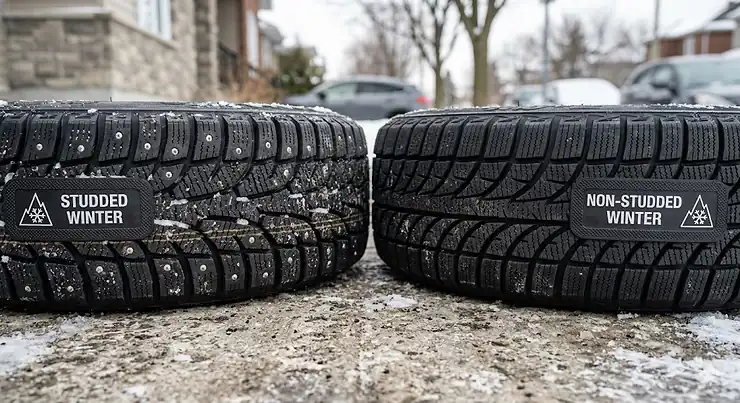
Every October, Quebec drivers face the same question: studded or non-studded winter tires? With Quebec’s strict winter tire law requiring proper tyres from December 1 to March 15, and studded tyres permitted from October 15 to May 1, the stakes are high. Choose wrong, and you’re risking a $200-$300 CAD fine, compromised safety on icy Laurentian highways, or unnecessary noise on Montreal’s cleared streets.
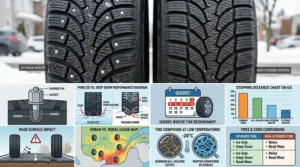
Here’s what most drivers don’t realize: the performance gap between premium studded and non-studded tyres has narrowed dramatically since 2020. Independent testing from Kal Tire shows studded tyres stop in 22.6 metres on ice from 30 km/h, whilst non-studded tyres need 27.2 metres—just 4.6 metres difference. That’s significant on black ice near Mont-Tremblant, but negligible on salted urban roads where Quebec spends $188 million annually on de-icing.
This guide cuts through the marketing noise with real-world data from Canadian winters. You’ll discover which tyre type matches your driving patterns, the seven best products available on Amazon.ca in 2026, and exactly when studded tyres justify their extra cost and road noise. Whether you’re commuting along Highway 40 through freezing rain or weekend skiing in the Eastern Townships, you’ll leave knowing precisely which winter tyre technology deserves your money.
Quick Comparison Table: Studded vs Non-Studded Winter Tyres
| Feature | Studded Winter Tyres | Non-Studded Winter Tyres |
|---|---|---|
| Ice Traction | Excellent (22.6m stopping distance) | Very Good (27.2m stopping distance) |
| Snow Performance | Good to Excellent | Excellent |
| Noise Level | High (metal-on-pavement clatter) | Low (quiet ride) |
| Legal Period (Quebec) | October 15 – May 1 | No restrictions |
| Road Wear | Higher (damages asphalt) | Minimal |
| Dry Pavement Handling | Reduced grip vs non-studded | Superior |
| Price Range (CAD) | $150-$350 per tyre | $120-$320 per tyre |
| Best For | Rural/icy roads, gravel, minimal plowing | Urban/mixed conditions, highway driving |
Looking at this comparison, the choice isn’t straightforward. Studded tyres deliver that crucial 17% shorter stopping distance on glare ice—a genuine safety advantage when navigating unplowed rural routes in Gaspésie or Abitibi-Témiscamingue. However, if 80% of your winter driving happens on salted Highway 20 between Montreal and Quebec City, you’re enduring constant road noise for marginal benefit. Non-studded tyres actually outperform studded models on packed snow and deliver noticeably better handling on dry cold pavement, which describes most urban Quebec winter conditions after the snowplows pass. The premium non-studded options we’ll examine—like the Michelin X-Ice Snow and Nokian Hakkapeliitta R5—now incorporate microscopic grip crystals and advanced siping that nearly match studded traction without the drawbacks.
💬 Just one click — help others make better buying decisions too! 😊
Top 7 Winter Tyres for Quebec: Expert Analysis
1. Nokian Hakkapeliitta R5 (Non-Studded)
The Hakkapeliitta R5 represents the current pinnacle of studless winter tyre technology, engineered specifically for Nordic conditions that mirror Quebec’s harsh winters. This Finnish-designed tyre features Arctic Grip Crystals—microscopic particles embedded throughout the tread compound that create sharp, tough grip edges. What sets this apart from competitors is the Double Block Grip design with interlocking 3D sipes that maintain biting edge effectiveness even as the tyre wears down to 2mm tread depth, extending winter performance 1-2 seasons beyond typical non-studded models.
For Quebec drivers, the R5 excels in mixed conditions: freezing rain on Highway 40, black ice patches near Lac-Saint-Jean, and slushy city streets in Laval. The tread compound remains flexible down to -40°C, crucial during January cold snaps when temperatures in Saguenay regularly hit -35°C. Canadian reviewers consistently praise its confidence-inspiring grip on polished ice—the type that forms on shaded Montreal overpasses—whilst noting the remarkably quiet ride compared to studded alternatives. One Quebec City driver reported: “Climbed my icy hill like it was a different car altogether, no studs needed.”
Pros:
✅ Consumer Reports Recommended 2025
✅ Exceptional ice grip without stud noise
✅ Longer tread life than competitors
Cons:
❌ Premium pricing in the $220-$280 CAD range
❌ Limited availability on Amazon.ca (often ships from speciality retailers)
Price & Verdict: Around $220-$280 CAD per tyre depending on size. If you prioritize quiet, refined winter performance and drive primarily in urban/suburban Quebec with occasional highway trips, the R5 justifies its premium. However, availability on Amazon.ca varies—verify current stock before committing.
2. Michelin X-Ice Snow (Non-Studded)
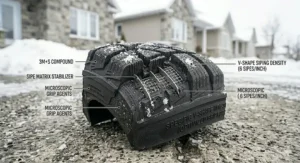
Michelin’s X-Ice Snow brings laboratory-tested engineering to real Canadian winters with impressive results. The tyre utilizes Flex-Ice 2.0 compound combined with EverWinterGrip technology—essentially microscopic rubber inclusions that emerge as the tyre wears, creating fresh biting edges throughout the tyre’s life. Independent testing shows it delivers 2.7 metres shorter stopping distances on ice compared to leading competitors, and maintains performance when worn to 4mm tread depth.
What Quebec drivers appreciate most is the versatility. The V-shaped tread pattern with full-depth sipes handles Montreal’s freeze-thaw cycles expertly—morning black ice followed by afternoon slush becomes manageable rather than terrifying. The wide transversal grooves provide excellent resistance to aquaplaning during spring thaw conditions, when Quebec roads transform into rivers. For families commuting from Brossard to downtown Montreal, or weekend trips to Mont-Sainte-Anne, this tyre delivers consistent confidence without drama. Canadian winter testing by Kal Tire rated it among the best for braking on snow and cornering on wet roads.
Pros:
✅ Excellent all-around winter performance
✅ Backed by 64,000 km treadwear warranty
✅ Widely available on Amazon.ca with Prime shipping
Cons:
❌ Not the absolute best on pure ice (that’s where studs shine)
❌ Some users report faster wear in high-torque vehicles
Price & Verdict: In the $180-$250 CAD range depending on size. This represents outstanding value for Quebec drivers who want one set of winter tyres that handles everything competently. Available on Amazon.ca with consistent stock—a practical choice for busy Montreal or Quebec City professionals.
3. Continental VikingContact 7 (Non-Studded)
Continental’s VikingContact 7 brings German precision engineering to Nordic winter conditions with PolarPlus Technology that keeps the tread flexible in brutal Canadian cold. The optimized Active Grip Silica compound, enhanced with rapeseed oil composition, provides superb adaptation to both snow and ice. What distinguishes this tyre is the intelligent groove network design—hundreds of 3D sipes create thousands of biting edges whilst the efficient channel system evacuates water and slush with exceptional efficiency.
For Quebec’s unique winter challenges—think Highway 15 through the Laurentians during a snowstorm, or navigating Sherbrooke’s hills after freezing rain—the VikingContact 7 delivers predictable, progressive handling. The interlocked block bridges maintain tread block stability during aggressive cornering, essential when that transport truck sprays slush across your windshield on the 20 and you need immediate lane correction. Independent testing ranked it consistently strong across all winter surfaces, with particularly impressive wet asphalt performance during those 2°C November days before the real cold arrives. The 3-Peak Mountain Snowflake certification confirms it meets stringent TRAC (Tire and Rubber Association of Canada) severe winter standards.
Pros:
✅ Excellent balance of snow, ice, and wet performance
✅ Precise steering response appreciated by driving enthusiasts
✅ Available on Amazon.ca in common sizes
Cons:
❌ Mid-premium pricing without being the absolute best in any single category
❌ Some sizes experience longer shipping times to Quebec
Price & Verdict: Expect $190-$270 CAD per tyre. The VikingContact 7 suits Quebec drivers who want refined winter capability without compromises—urban professionals who occasionally venture into cottage country. Check Amazon.ca availability for your specific vehicle size before assuming stock.
4. Nokian Hakkapeliitta 10 (Studded)
When Quebec winters throw their worst—continuous ice, unplowed rural roads, or weekly trips through Charlevoix’s mountain passes—the Hakkapeliitta 10 with studs delivers uncompromising traction. Nokian’s Double Stud Technology distributes studs strategically: centre studs improve acceleration and braking grip, whilst shoulder studs maximize grip during turning and lane changes. Each stud features an air cushion that reduces road noise and damage compared to traditional rigid studs, though it’s still noticeably louder than any non-studded option.
The real-world advantage becomes clear on untreated ice. Kal Tire testing showed studded tyres stop 4.6 metres shorter than premium non-studded models from 30 km/h—potentially the difference between stopping before the intersection or sliding into cross-traffic on a -20°C morning in Rimouski. Quebec drivers in regions with minimal road salting report transformative confidence: “Black ice that used to terrify me became just another surface to drive on.” However, the tradeoff is significant on bare pavement: increased noise, reduced fuel economy, and accelerated road wear that contributes to Quebec’s $1.2 billion annual road maintenance burden.
Pros:
✅ Unmatched ice traction for extreme winter conditions
✅ Strategic stud placement optimizes grip in all directions
✅ Eco-friendly stud design reduces environmental impact
Cons:
❌ Significant road noise on cleared pavement
❌ Important: Cannot be shipped to Quebec addresses from many retailers—verify local availability
Price & Verdict: Around $200-$320 CAD per tyre where available. Critical note: Due to shipping restrictions, Hakkapeliitta studded models often cannot be delivered directly to Quebec addresses via Amazon.ca. Check local Point S or Kal Tire dealers instead. Best for rural Quebec drivers, gravel road commuters, or those in regions with minimal winter road maintenance.
5. Bridgestone Blizzak IcePeak (Non-Studded – New 2026)
Bridgestone’s all-new Blizzak IcePeak, launching nationally in May 2026, represents a breakthrough: the first Bridgestone tyre earning both 3-Peak Mountain Snowflake AND Ice Grip certifications. This double distinction means it passed rigorous testing for both snow traction and ice braking—a rare achievement that bridges the gap between conventional studless tyres and studded performance. The tyre incorporates ENLITEN technology, optimizing the compound for improved tyre wear life and lower rolling resistance whilst maintaining winter grip.
For Quebec drivers, the IcePeak addresses a persistent frustration: previous Blizzak generations delivered phenomenal ice traction when new but performance degraded noticeably after 30,000 km. The IcePeak’s optimized compound promises consistent winter performance throughout its service life. Early testing indicates it matches studded tyre ice braking in temperatures warmer than -5°C, whilst delivering superior snow and wet handling—exactly the mixed conditions Quebec experiences during November and March shoulder seasons. The ENLITEN technology also makes it suitable for hybrid and electric vehicles, addressing the unique weight and torque characteristics of EVs increasingly common in Montreal and Laval.
Pros:
✅ Dual certification for snow and ice performance
✅ Suitable for EVs and hybrids (important as Quebec pushes electrification)
✅ Improved tread life vs previous Blizzak generations
Cons:
❌ Very limited availability until full rollout (107 sizes by fall 2026)
❌ Pricing not yet confirmed but expect premium positioning ($200-$300 CAD estimated)
Price & Verdict: Estimated $200-$300 CAD per tyre when fully available. For Quebec drivers seeking cutting-edge winter technology, especially EV owners concerned about winter range loss, the IcePeak represents the future. However, availability on Amazon.ca won’t be comprehensive until late 2026—early adopters should monitor stock carefully.
6. Goodyear Ultra Grip Ice WRT (Non-Studded)
Goodyear’s Ultra Grip Ice WRT offers solid mid-tier winter performance at prices that don’t require sacrificing your RRSP contributions. The WRT (Winter/Rain/Traction) designation signals its engineered focus: delivering reliable winter grip whilst maintaining wet road handling during Quebec’s unpredictable freeze-thaw cycles. The tread design features directional grooves that funnel water and slush away from the contact patch, reducing hydroplaning risk when Highway 40 transforms into a skating rink during March’s ice storms.
Canadian reviewers consistently describe this tyre as “competent” and “reassuring” rather than “exceptional”—damning with faint praise until you consider the value proposition. At $120-$190 CAD per tyre, it costs 30-40% less than premium Nokian or Michelin options whilst delivering 85% of the winter performance. For budget-conscious Quebec families—perhaps a young couple in Trois-Rivières with two vehicles to equip—this represents practical winter protection without premium pricing. One Ontario reviewer noted: “Good in the snow but not as good as Blizzaks, but I expected that.” That honest assessment captures the Ultra Grip’s position perfectly.
Pros
✅ Excellent value for money ($120-$190 CAD range)
✅ Decent all-around winter capability for mixed conditions
✅ Better availability on Amazon.ca than premium alternatives
Cons:
❌ Ice traction trails premium non-studded options
❌ Some road noise reported, though less than studded tyres
Price & Verdict: Around $120-$190 CAD per tyre depending on size. For Quebec drivers prioritizing budget without abandoning safety, the Ultra Grip Ice WRT delivers sensible winter capability. It won’t impress driving enthusiasts, but it’ll get your Corolla or RAV4 through Montreal winters reliably whilst leaving funds for other priorities.
7. General AltiMAX Arctic 12 (Studdable – Budget Option)
The AltiMAX Arctic 12 occupies a unique position: it’s sold as a non-studded tyre but features pre-drilled holes allowing professional stud installation if desired. This flexibility appeals to Quebec drivers uncertain about committing to full studded tyres but wanting the option if winter conditions prove severe. Tire Rack testing showed the non-studded version delivers solid ice traction for the category, whilst studded versions improved ice braking from 40.0 feet to 35.4 feet from 12 mph—a meaningful 11.5% reduction.
For Quebec drivers, this represents a practical middle ground. Purchase the tyres in October, evaluate early winter conditions, then decide by mid-November whether to invest the additional $80-$120 CAD for professional stud installation. If you’re commuting from Saint-Jérôme to Montreal and roads are well-maintained, keep them studless. If you’re navigating Charlevoix’s mountain routes weekly, adding studs provides that extra security margin. The tradeoff is noise: Tire Rack testers described the studded version’s road noise as “intense,” though this matters less if you’re primarily on rural routes where cabin noise is already higher.
Pros:
✅ Flexibility to add studs later based on conditions
✅ Budget-friendly pricing ($100-$160 CAD range)
✅ Solid ice traction even without studs
Cons:
❌ Adding studs significantly increases road noise
❌ Not legal everywhere if studded (verify Quebec regulations: Oct 15-May 1)
Price & Verdict: Around $100-$160 CAD per tyre, plus $80-$120 CAD for professional stud installation if desired. This suits Quebec drivers who want options without commitment. However, most will find premium non-studded tyres deliver better all-around performance than this studded version for similar total cost.
Choosing Tyres for Your Quebec Driving Pattern
Match your situation to the optimal tyre:
Montreal Urban Commuter (80%+ cleared roads): Michelin X-Ice Snow or Continental VikingContact 7—premium non-studded tyres excel without stud noise on salted routes.
Rural Gaspésie/Côte-Nord (frequent unplowed ice): Nokian Hakkapeliitta 10 studded for maximum ice grip when maintenance is minimal.
Quebec City Suburban Family (two vehicles): Michelin X-Ice Snow on primary vehicle, Goodyear Ultra Grip Ice WRT on secondary—balances performance and budget.
Eastern Townships Weekender (mixed conditions): Continental VikingContact 7—handles both city commutes and cottage routes without compromise.
Understanding the Science: Why Studded and Non-Studded Tyres Perform Differently
The fundamental difference between studded and non-studded winter tyres lies in their grip mechanism, and understanding this science helps Quebec drivers make informed choices.
How Studded Tyres Work
Studded winter tyres embed small metal pins (typically tungsten carbide) into the tread rubber. When the tyre contacts ice, these studs penetrate the surface, creating mechanical grip similar to ice cleats on boots. The Nokian Hakkapeliitta 10, for example, features approximately 190 studs strategically positioned across the tread. During braking or acceleration on glare ice, these studs dig in whilst the rubber between them provides secondary traction.
The advantage is undeniable on pure ice: Kal Tire testing showed studded tyres stop in 22.6 metres from 30 km/h compared to 27.2 metres for premium non-studded models. That 4.6-metre difference could prevent a collision when black ice appears on a shadowed Quebec bridge approach. However, studs become liability on bare pavement—they reduce the rubber contact patch, actually decreasing grip on dry roads whilst creating that distinctive metallic clatter Quebec drivers either tolerate or despise.
How Non-Studded (Friction) Tyres Work
Modern non-studded winter tyres employ sophisticated rubber compounds and mechanical features to grip ice without metal studs. Three technologies dominate:
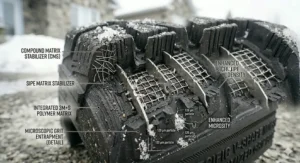
- Micropore Technology: Bridgestone’s Multicell compound features microscopic pores that act like suction cups, pulling a thin water layer off ice to improve rubber contact. Think of it as thousands of tiny squeegees constantly clearing the contact patch.
- Grip Crystals: Nokian’s Arctic Grip Crystals and Michelin’s Cryo Crystal particles embed hard, sharp particles throughout the rubber compound. As the tyre wears, fresh particles continuously expose, maintaining grip even at 4mm tread depth. These work like sandpaper—microscopically rough surface increases friction.
- 3D Sipes: All premium winter tyres feature thousands of tiny slits (sipes) cut into tread blocks. These create biting edges that grip snow and ice whilst remaining flexible enough to conform to road irregularities. Continental’s interlocking sipe design prevents tread block squirm during cornering, maintaining stability.
Temperature Considerations
Here’s where Quebec’s climate becomes crucial: studded tyres deliver maximum advantage near the freezing point (-5°C to 0°C), where ice has a thin water layer that studs penetrate effectively. At temperatures below -15°C—common during Quebec January—ice becomes harder and drier, reducing stud penetration whilst advanced rubber compounds in non-studded tyres maintain flexibility. This explains why Tire Reviews testing found studded and studless tyres performed similarly on rough ice at very cold temperatures, with studs only dominating on smooth, near-freezing ice.
For Quebec drivers, this science translates to practical advice: if you primarily encounter ice during November and March shoulder seasons (near 0°C), studs provide maximum benefit. If your harshest conditions occur during January-February deep freeze (-20°C to -35°C in northern regions), premium non-studded tyres with advanced compounds might actually match or exceed studded performance whilst eliminating noise.
Quebec Winter Tyre Regulations: Legal Requirements You Must Know
Quebec enforces the strictest winter tyre regulations in Canada, and ignorance provides no legal protection. Here’s exactly what the law requires:
Mandatory Period: December 1 to March 15
Since December 1, 2019, all motorized road vehicles registered in Quebec must be equipped with winter tyres from December 1 through March 15 inclusive. This applies to:
- Passenger vehicles (cars, SUVs, minivans)
- Taxis and ride-share vehicles
- Light trucks under 3,000 kg gross vehicle weight
- Mopeds and motorized scooters
- Motorcycles (if operated during winter)
Rental vehicles rented for less than one week are exempt if rented outside Quebec. Out-of-province vehicles passing through Quebec must comply if registered in Quebec, but those with valid out-of-province plates receive some leniency for short visits.
What Qualifies as a “Winter Tyre” Under Quebec Law
Since the December 15, 2014 regulatory amendment, only two tyre types satisfy Quebec’s legal definition:
- Three-Peak Mountain Snowflake (3PMSF) Symbol: The tyre sidewall must display a pictogram showing a mountain with three peaks and a snowflake inside. This symbol confirms the tyre passed standardized snow traction testing under ASTM F1805 standards. The older “M+S” (Mud and Snow) designation alone does NOT meet Quebec requirements as of 2014.
- Studded Tyres: Any tyre equipped with metal studs automatically qualifies, regardless of other markings. However, studded tyres face their own date restrictions (see below).
Studded Tyre Specific Regulations
Studded winter tyres are permitted from October 15 to May 1 on:
- Passenger vehicles
- Taxis and comparable vehicles
- Commercial vehicles with gross vehicle weight NOT exceeding 3,000 kg
Important prohibitions:
- Heavy trucks over 3,000 kg CANNOT use studded tyres in Quebec
- Using studded tyres before October 15 or after May 1 results in $60-$100 fines per vehicle
- Chains are prohibited on heavy trucks (permitted only on emergency vehicles, farm tractors, and snow removal equipment)
Tread Depth Requirements
Whilst legislation permits tyres down to 1.6mm (2/32 inch) tread depth year-round, Quebec’s winter tyre guidance strongly recommends minimum 4.8mm (6/32 inch) for winter safety. Most tyre experts suggest replacing winter tyres at 5mm remaining tread to maintain effective snow traction. The simple test: insert a Canadian quarter into the tread groove with the caribou’s nose pointing down—if you can see the tip of the nose, tread is below 4.8mm.
Penalties for Non-Compliance
Driving without compliant winter tyres during the December 1-March 15 period results in:
- Base fine: $200-$300 CAD
- Court costs and victim surcharge: typically adds $100-$150
- Total penalty: often $350-$450 per violation
Quebec Provincial Police (Sûreté du Québec) conduct regular winter tyre spot checks, particularly during the first two weeks of December. Officers use simple visual inspection of the 3PMSF symbol—no tread depth measurement unless tyres appear severely worn.
Insurance Implications
Beyond legal fines, operating without winter tyres during the mandatory period can void insurance coverage if you’re involved in a collision. Quebec insurance adjusters may assess tyre choice as a contributing factor in fault determinations, potentially affecting claims and future premiums. Conversely, most Ontario insurers are legally required to offer 2-5% winter tyre discounts—Quebec drivers should verify if their provider offers similar incentives.
Sources: Société de l’assurance automobile du Québec (SAAQ), Tire and Rubber Association of Canada
Common Mistakes Quebec Drivers Make When Choosing Winter Tyres
After fifteen Canadian winters and countless conversations with Quebec drivers, certain mistakes appear repeatedly. Avoiding these can save money, improve safety, and eliminate winter frustration.
Mistake 1: Waiting Until November to Shop
Quebec’s December 1 deadline creates predictable panic buying during the last two weeks of November. By mid-November, popular sizes in premium brands disappear from both Amazon.ca and local retailers, forcing drivers to accept whatever remains in stock. Worse, installation appointments become scarce—reputable shops book solid for 2-3 weeks, meaning you’re scrambling to find any available slot days before the legal deadline.
Smart approach: Order tyres in early October when selection is maximum and prices haven’t yet spiked from demand. Schedule installation for mid-to-late November, avoiding both the early-October rush (eager beavers) and the late-November panic (procrastinators). Amazon.ca often offers early-season discounts in September-October that disappear by November.
Mistake 2: Installing Only Two Winter Tyres
Budget-conscious drivers sometimes install winter tyres only on drive wheels—fronts on FWD vehicles, rears on RWD. This creates dangerous handling imbalance. If front tyres have winter grip but rears have all-seasons, the rear will lose traction first during braking or cornering, causing spins. The inverse—winter on rear, all-season on front—creates understeer where the vehicle won’t turn when you need it to.
Quebec reality: With mandatory winter tyre laws, police can ticket partial installations. More critically, that $200-$300 saved installing only two tyres disappears the moment you slide off icy Highway 15 because rear traction didn’t match front capability. All four tyres must be winter-rated for both legal compliance and safe handling dynamics.
Mistake 3: Assuming Studs Are Always Better
Many Quebec drivers—particularly those from rural regions or with memories of 1990s winter tyre technology—believe studded tyres are inherently superior. This was true twenty years ago when studless tyres struggled on ice. Modern premium studless tyres have essentially closed the gap except on pure glare ice near freezing temperatures.
The nuance: If you drive primarily on well-maintained urban routes (Montreal, Quebec City, Laval), studded tyres deliver minimal safety benefit whilst creating constant cabin noise, increased fuel consumption, and accelerated road wear. The 4.6-metre ice braking advantage means nothing on salted pavement. However, for rural Quebec drivers on minimally maintained routes, or those regularly navigating steep icy hills, studs remain the safest choice.
Mistake 4: Mixing Tyre Brands or Models
Financial constraints sometimes lead drivers to install mismatched tyres—perhaps two Michelin X-Ice on front and two Bridgestone Blizzak on rear, or mixing old and new tyres. Different tyre models have different tread patterns, rubber compounds, and handling characteristics. This creates unpredictable vehicle behaviour during emergency maneuvers—exactly when you need consistency.
Professional standard: All four winter tyres should be identical brand, model, and ideally similar tread depth. If budget forces compromise, better to choose four identical mid-range tyres (like Goodyear Ultra Grip Ice WRT) than mixing two premium and two budget models. Predictable handling beats maximum grip in mismatched combinations.
Mistake 5: Ignoring Tyre Age
Winter tyres don’t wear out—they age out. Rubber compounds degrade from UV exposure, temperature cycling, and chemical oxidation regardless of tread depth. A winter tyre with 8mm tread depth but manufactured in 2017 has hardened rubber that provides significantly less grip than a fresher tyre. Most manufacturers recommend replacing tyres after 6-8 years regardless of appearance.
Check the DOT code: Every tyre sidewall displays a four-digit code showing manufacturing date. “3218” means 32nd week of 2018. When purchasing winter tyres on Amazon.ca, verify you’re receiving current-year production, not old warehouse stock. Sellers sometimes discount 2-3 year old tyres without disclosure—that’s not a deal, it’s reduced lifespan.
Mistake 6: Neglecting Seasonal Storage
Quebec drivers often toss summer tyres in the garage corner, then wonder why they crack and degrade. Improper storage—particularly exposure to UV light, ozone, and temperature extremes—accelerates rubber deterioration. Tyres stored in unheated garages experience freeze-thaw cycles that damage internal structure.
Optimal storage: Clean tyres, remove from rims if storing only tyres, stack horizontally in a cool, dark, dry location. Basement storage beats garage storage. If storing wheels and tyres together, suspend vertically or store flat, rotating position monthly. Many Quebec tyre shops offer seasonal storage ($50-$80 CAD per season) that protects your investment.
Mistake 7: Believing All-Weather Tyres Eliminate Seasonal Changes
All-weather tyres (carrying 3PMSF symbol) legally satisfy Quebec’s winter tyre mandate and seem to offer year-round convenience. However, they represent compromises in both directions—inferior winter performance compared to dedicated winter tyres, reduced summer handling compared to summer tyres. For Quebec’s temperature extremes (-35°C to +35°C), dedicated seasonal tyres deliver superior safety and performance at each extreme.
When all-weather makes sense: If you drive under 15,000 km annually, primarily in urban areas, and prioritize convenience over maximum capability, all-weather tyres simplify life. For everyone else—particularly families, highway commuters, or those driving 20,000+ km annually—seasonal changes deliver noticeably better safety margins.
True Cost of Winter Tyre Ownership in Quebec
Initial purchase represents just the starting point. Here’s the complete financial picture for Quebec drivers:
Initial Purchase (Set of 4)
- Budget tyres: $400-$600 CAD
- Mid-range tyres: $600-$800 CAD
- Premium tyres: $800-$1,200+ CAD
Installation Costs
- Seasonal swap (on rims): $40-$80 per change
- Full mount/dismount: $80-$160 per change
- Second rim set investment: $300-$500 (pays for itself in 3-4 years)
- Stud installation: $60-$100 one-time cost
5-Year Total Cost Example (Montreal Driver, 20,000 km/year)
- Budget non-studded (Goodyear): $1,700 CAD ($340/year)
- Premium non-studded (Michelin): $1,900 CAD ($380/year)
- Premium studded (Nokian): $2,290 CAD ($458/year including fuel costs)
Hidden Benefits
- Insurance discounts: 2-5% annually ($36-$90/year)
- Resale value increase: 5-10% for well-maintained vehicles
- Reduced collision risk and repair costs
The premium tyre investment—roughly $40/month extra over budget options—delivers measurably better safety margins during Quebec’s harshest conditions. For families and daily commuters, this represents genuine value rather than luxury.
How to Choose the Right Winter Tyres for Your Quebec Lifestyle
Selecting winter tyres shouldn’t be guesswork. Follow this systematic approach:
Step 1: Assess Your Primary Driving Environment
Categorize your typical winter driving into one of these profiles:
- Urban/Suburban (75%+ paved, maintained roads): Montreal, Quebec City, Laval, Gatineau, Longueuil—roads receive regular plowing and salting. Choose premium non-studded tyres prioritizing quiet ride and wet handling.
- Mixed Urban-Rural (50/50 split): Sherbrooke to Eastern Townships, Quebec City to Charlevoix, Trois-Rivières to Mauricie. Roads vary from well-maintained to sporadically plowed. Choose premium non-studded with superior ice credentials or consider studdable tyres.
- Rural/Remote (75%+ minimally maintained routes): Gaspésie, Abitibi-Témiscamingue, Côte-Nord, Saguenay-Lac-Saint-Jean regions. Roads often unplowed overnight, black ice common, gravel surfaces. Choose studded tyres or absolute best non-studded models.
Step 2: Calculate Your Winter Kilometres
Annual winter driving volume affects tyre choice:
- Under 10,000 km/year: Budget or mid-range tyres acceptable—they’ll last 4-5 seasons before wearing out
- 10,000-20,000 km/year: Mid-range to premium tyres recommended—balance of longevity and performance
- Over 20,000 km/year: Premium tyres only—they’ll wear to replacement in 2-3 seasons but provide superior safety during heavy use
Step 3: Evaluate Your Risk Tolerance
Honestly assess your comfort with winter driving:
- Confident winter driver, flexible schedule: Can wait out worst storms, adjust speed for conditions. Mid-range non-studded tyres sufficient.
- Moderate confidence, fixed schedule: Must drive for work, school runs, appointments regardless of conditions. Premium non-studded minimum.
- Low confidence or anxiety-prone: Winter driving stresses you significantly. Premium studded or best non-studded tyres reduce anxiety, worth the investment.
Step 4: Consider Household Vehicle Count
Equipping multiple vehicles changes the equation:
- Single vehicle: Invest in premium tyres—your only winter lifeline
- Two vehicles: Premium on primary, budget/mid-range on secondary
- Three+ vehicles: Prioritize by usage—daily driver gets premium, occasional vehicles get budget
Step 5: Factor Noise Tolerance
Studded tyre noise frustrates many drivers:
- Noise-sensitive or frequent highway driving: Studded tyres’ constant clatter on bare pavement becomes exhausting. Choose premium non-studded.
- Noise-tolerant or primarily rural routes: Studs’ superior ice grip outweighs noise concerns. Studded tyres justified.
Step 6: Match Tyre to Vehicle Type
Vehicle characteristics affect tyre performance:
- Compact/Sedan (Honda Civic, Toyota Corolla): Any winter tyre works—lighter vehicles less demanding
- CUV/SUV (Honda CR-V, Toyota RAV4): Heavier vehicles benefit from premium tyres’ superior braking
- Full-size SUV/Truck (Suburban, F-150): Require load-rated winter tyres, premium strongly recommended
- Electric Vehicle: Choose tyres rated for EV use (higher weight, instant torque)—Bridgestone Blizzak IcePeak specifically designed for this
Step 7: Set Realistic Budget
Don’t skip winter tyres due to cost—creative financing works:
- Payment plans: Many retailers offer 6-12 month interest-free financing
- Phased purchase: Buy rims this year, tyres next year
- Used rims: Facebook Marketplace, Kijiji often have clean used rims 50% off retail
- Group buys: Split shipping costs with friends buying same tyre size
Decision Matrix Example:
Profile: Young professional, Laval to downtown Montreal commute, 15,000 km annually, moderate winter confidence, Honda Accord, noise-sensitive
Recommended choice: Michelin X-Ice Snow or Continental VikingContact 7
Reasoning: Urban driving doesn’t need studs, moderate kilometre means mid-premium justified, noise sensitivity eliminates studded options, premium tyres reduce anxiety through superior performance
Profile: Family of four, Rimouski resident, frequent rural routes, 22,000 km annually including winter travel, two vehicles (minivan + sedan), budget-conscious
Recommended choice: Nokian Hakkapeliitta R5 on minivan (family safety priority), Goodyear Ultra Grip Ice WRT on sedan
Reasoning: Rural Rimouski demands excellent ice capability, high kilometre justifies premium on primary vehicle, budget constraints mean secondary gets adequate not premium
✨ Don’t Miss These Exclusive Deals!
🔍 Take your winter driving safety to the next level with these carefully selected products. Click on any highlighted item to check current pricing and availability on Amazon.ca. These tyres will help you create authentic peace of mind your family will appreciate all winter long!
Frequently Asked Questions
❓ Can I use studded tyres year-round in Quebec to avoid seasonal changes?
❓ Do winter tyres actually reduce insurance costs in Quebec?
❓ How long do winter tyres last in Quebec's climate?
❓ Are studded tyres worth the extra noise for Quebec winters?
❓ Can I buy winter tyres on Amazon.ca and have them installed locally in Quebec?
Conclusion: Making Your Quebec Winter Tyre Decision
Quebec winters demand respect, and your tyre choice directly impacts safety, stress levels, and financial investment over multiple seasons. The decision between studded and non-studded winter tyres isn’t universal—it hinges on your specific driving environment, kilometre, budget, and risk tolerance.
For the majority of Quebec drivers—those navigating Montreal’s autoroutes, Quebec City’s bridges, or Laval’s suburbs—premium non-studded tyres like the Michelin X-Ice Snow, Continental VikingContact 7, or Nokian Hakkapeliitta R5 deliver optimal winter performance without constant road noise or legal date restrictions. These modern friction tyres have essentially closed the ice performance gap with studded options except in the most extreme glare ice conditions, whilst providing superior snow handling and wet grip.
However, for rural Quebec residents, gravel road commuters, or those regularly navigating minimally maintained routes in Gaspésie, Côte-Nord, or Abitibi-Témiscamingue, studded tyres remain the safest choice. The Nokian Hakkapeliitta 10 delivers uncompromising ice traction when you genuinely need it, though availability restrictions mean purchasing from local Quebec dealers rather than Amazon.ca.
Budget-conscious families can achieve adequate winter protection through mid-range options like the Goodyear Ultra Grip Ice WRT or studdable General AltiMAX Arctic 12, accepting slight performance compromises for 30-40% cost savings. Remember: four identical budget winter tyres outperform mismatched premium-budget combinations every time.
The worst decision is delaying until late November when selection disappears and installation appointments vanish. Order in October, install by mid-November, and enjoy confident winter driving whilst neighbours scramble days before the December 1 deadline. Your winter tyres represent life insurance for Canadian roads—invest wisely, maintain properly, and they’ll protect your family through Quebec’s harshest season.
Recommended for You
- 7 Best Motorcycle Winter Storage Products Canada 2026
- 7 Best Winter Windshield Washer Fluid -40 Canada 2026
- Classic Car Winter Storage Guide: 7 Must-Have Products for Canadian Collectors 2026
Disclaimer: This article contains affiliate links. As an Amazon Associate, I earn from qualifying purchases. If you purchase products through these links, we may earn a small commission at no additional cost to you.
✨ Found this helpful? Share it with your friends! 💬🤗
