
In This Article
There’s a specific kind of cold that settles into a Canadian garage in January — the kind that makes wrenches feel like ice cubes and turns a ten-minute oil change into a forty-minute ordeal of numb fingers and muttered curses. A propane tank top heater is the low-tech, high-reward answer that thousands of Canadians reach for every winter, and for good reason: it needs no outlet, no extension cord snaking across a wet floor, and no wait for warm-up. Screw it onto a standard cylinder, strike the igniter, and radiant heat is pouring out within seconds.
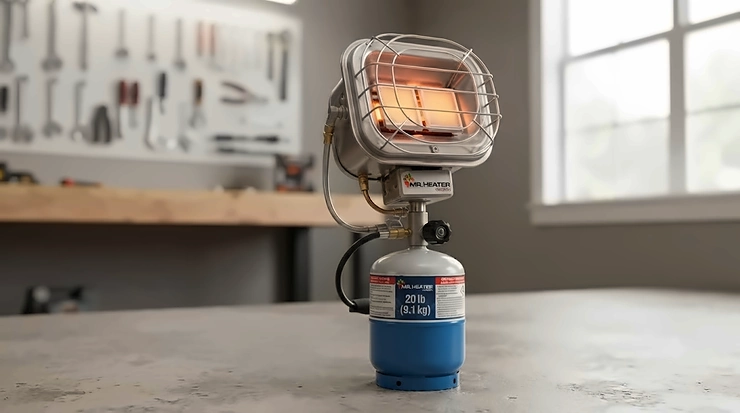
So what is a propane tank top heater, exactly? It’s a compact radiant burner that mounts directly onto a 20 lb (or similar) propane cylinder, using the tank itself as its base and fuel source, and it throws directional heat outward without any fan, motor, or electrical hookup. That “no plug required” quality is precisely why it shows up on job sites, at ice-fishing huts, on patios, and in unheated garages across the country.
This guide digs into seven real, currently available models, weighs their BTU output against realistic Canadian use cases, and works through the comparisons and safety questions that actually matter before you buy — not just a spec dump copied from a listing page. We’ll also get into how a propane tank top heater stacks up against a full portable propane heater workshop setup, when tank top heater btu output numbers are marketing fluff versus genuine performance, and where the line sits on propane heater indoor outdoor use under Canadian rules. According to Health Canada’s guidance on carbon monoxide exposure, that last point isn’t optional reading — it’s the difference between a cozy garage and a 911 call.
Quick Comparison Table
Here’s the fast-scan version before we go deep on each unit.
| Product | BTU Output | Best For | Price Range (CAD) |
|---|---|---|---|
| Mr. Heater MH15TS Single Tank Top | 10,000–15,000 | Easiest overall pick for beginners | around C$90-110 |
| Flame King GS4200EP | up to 13,000 | Budget-conscious job site use | around C$85-105 |
| Dyna-Glo TT15CDGP | 9,000–15,000 | Wind-heavy outdoor sites on a budget | around C$95-115 |
| Mr. Heater MH30TS Double Tank Top | 10,000–30,000 | Two-car garages and larger patios | C$150-180 range |
| Dyna-Glo TT360DG | up to 40,000 | All-direction coverage in tight sheds | C$170-200 range |
| Mr. Heater MH540T | 30,000–45,000 | Wide, swiveling heat over big spaces | C$190-220 range |
| Mr. Heater MH15C Tank Top Heater and Cooker | up to 15,000 | Combining heat and cooking in one trip | C$120-140 range |
Reading this table on its own would already steer most Canadian shoppers in the right direction, but the numbers only tell part of the story. Based on the spec comparison, the jump from a 15,000 BTU single burner to a 30,000-45,000 BTU double or swivel model isn’t just “more heat” — it’s a shift from personal-zone warmth to genuinely heating a structure, and that shift comes with a real jump in propane consumption and price. What most buyers overlook is that a bigger BTU number also means a shorter runtime on the same 20 lb tank, so the “biggest heater wins” instinct can backfire on anyone who forgot to budget for extra refills.
💬 Just one click — help others make better buying decisions too!😊
Top 7 Propane Tank Top Heaters: Expert Analysis
1. Mr. Heater MH15TS Single Tank Top — best all-rounder for easy starts
The Mr. Heater MH15TS Single Tank Top is the model most Canadians picture when they hear “tank top heater,” and the electronic spark ignition is the feature that earns it the top spot on this list — no matches, no lighters, just a push-button start even with cold or gloved hands. It puts out 10,000 to 15,000 BTU through a high-medium-low regulator, mounts directly to a 20 lb cylinder via a soft-nose P.O.L. connection, and is built with chrome and stainless steel components designed for repeated seasonal use rather than a single trip. On paper this means roughly 29 to 43 hours of runtime per tank depending on the heat setting, which lines up well with a weekend of garage work or several evenings of ice fishing without swapping cylinders. Reviewers consistently report that assembly takes only a couple of minutes out of the box and that the flame stays lit reliably in light wind, though a few note the wire guard gets warm enough that curious pets and kids should be kept at a distance. This is the sensible starting point for anyone buying their first Mr. Heater MH15TS Single Tank Top-style unit, since it’s forgiving, well-documented, and easy to service.
Pros:
- ✅ Spark ignition works reliably in cold, gloved hands
- ✅ Three heat settings stretch a single tank further
- ✅ Widely available parts and accessories in Canada
Cons:
- ❌ 15,000 BTU ceiling limits it to smaller spaces
- ❌ Wire guard runs hot enough to need supervision
At around C$90-110, the Mr. Heater MH15TS Single Tank Top delivers strong value for anyone whose heating needs are personal-zone rather than whole-structure, and it’s the unit we’d point a first-time buyer toward.
2. Flame King GS4200EP — best budget pick for job sites
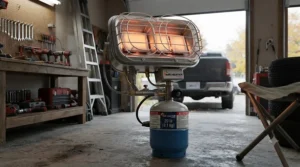
The Flame King GS4200EP trades a bit of brand recognition for a genuinely lower price point, and its 13,000 BTU steel heat reflector is more efficient at throwing radiant warmth outward than its compact size would suggest. It connects to 20, 30, or 40 lb cylinders through a standard QCC fitting with an included regulator, so it scales up naturally if someone later buys a bigger tank for a workshop setup. Here’s what to weigh: the built-in safety fuel shutoff, tip-over shutoff, and exterior grate guard are the same category of protection you’d find on pricier models, which suggests Flame King is competing on price rather than cutting corners on the safety side. Reviewers on major retail platforms note that it runs up to roughly 32 hours on a 20 lb tank at maximum output and that the Piezo push-button starter lights consistently even after the unit has sat in a cold shed overnight. The main trade-off is a smaller parts and accessories ecosystem compared to Mr. Heater, so replacement hoses or regulators may take a bit more searching to track down locally.
Pros:
- ✅ Genuinely lower price than most brand-name rivals
- ✅ Grate guard and tip-over shutoff included as standard
- ✅ Compatible with 20, 30, and 40 lb tanks
Cons:
- ❌ Smaller accessory and parts ecosystem in Canada
- ❌ 13,000 BTU cap rules out larger garages
In the C$85-105 range, the Flame King GS4200EP is the pick for anyone who wants dependable radiant heat without paying a premium for a bigger brand name on the box.
3. Dyna-Glo TT15CDGP — best wind-resistant burner on a budget
The Dyna-Glo TT15CDGP is CSA certified and built around an advanced burner design specifically engineered to keep the flame lit in windy conditions — a detail that matters far more in practice than it looks on a spec sheet, since most tank top heater complaints online trace back to a flame blowing out on an exposed patio or job site. It runs 9,000 to 15,000 BTU across a variable supply valve, heats roughly a 15-foot radius, and connects via a quick-connect P.O.L. fitting that assembles in a couple of minutes without tools. What most buyers overlook about this model is that the CSA-certified tip switch and support leg aren’t just a checkbox feature; they’re the reason Dyna-Glo markets it as one of the safest tank top options in its price tier. Reviewers describe easy setup and reliable ignition, with the most common complaint being a support leg that some users feel could be sturdier on uneven ground. For anyone doing outdoor cooking prep, tailgating, or exposed-site work where wind is a constant factor, this wind-resistant burner design is the differentiator that justifies choosing it over a cheaper unbranded alternative.
Pros:
- ✅ CSA certified for verified Canadian safety compliance
- ✅ Burner specifically engineered to resist wind gusts
- ✅ Quick-connect fitting assembles in minutes, no tools
Cons:
- ❌ Support leg feels less stable on uneven ground
- ❌ 15-foot heating radius suits smaller open areas only
Priced around C$95-115, the Dyna-Glo TT15CDGP earns its spot as the wind-conscious budget choice on this list.
4. Mr. Heater MH30TS Double Tank Top — best for a two-car garage
Stepping up to the Mr. Heater MH30TS Double Tank Top roughly doubles the heat output of the single-burner models above, with a 10,000 to 30,000 BTU range and independently swiveling burner heads that let you aim warmth at two different work zones simultaneously. Built from chrome and stainless steel components similar to its single-burner sibling, it includes electronic spark ignition and the same soft-nose P.O.L. connection, so anyone upgrading from the MH15TS will find the controls immediately familiar. Based on the spec comparison, the real advantage here isn’t just more BTUs — it’s flexibility: reviewers frequently mention running just one burner on low to maintain a comfortable temperature overnight in an insulated garage, then firing up both burners on high for a quick recovery after opening the garage door. Aggregated feedback on major retail sites reports runtimes in the 14 to 43 hour range depending on which burners are lit and at what setting, with one common theme being that this unit can genuinely overheat a small, well-insulated space if left on both burners too long. That’s less a flaw than a sign of real output.
Pros:
- ✅ Independently swiveling burners heat two zones at once
- ✅ Enough output for an uninsulated two-car garage
- ✅ Familiar spark-ignition controls for existing Mr. Heater owners
Cons:
- ❌ Heavier and bulkier than single-burner tank top models
- ❌ Burns through propane noticeably faster on full output
At C$150-180, the Mr. Heater MH30TS Double Tank Top is the mid-range sweet spot for anyone heating more than a single work bay.
5. Dyna-Glo TT360DG — best 360-degree coverage in its class
The Dyna-Glo TT360DG is, according to the manufacturer, the smallest 40,000 BTU heater currently on the market, and its patent-pending 360-degree burner design is the standout feature that separates it from every directional radiant heater on this list. Instead of throwing heat in one general direction, it warms an entire circle around itself, which the brand states can cover up to 1,000 square feet — a figure that reviewers on Home Depot’s site generally treat as optimistic for a fully insulated space but broadly accurate for open sheds, barns, and detached garages. The variable output lets you dial between low, medium, and high, and the CSA-certified tip switch combined with a safety shutoff valve puts its protection tier on par with pricier competitors. Reviewers consistently praise how much heat it produces relative to its compact footprint, with a recurring theme being that owners who bought a smaller tank top heater first later upgraded to the TT360DG specifically because their old unit couldn’t keep an uninsulated space above freezing. The most repeated complaint is a slightly wobbly head-to-base connection on some units, tied to a single-screw assembly point that a few owners have reinforced themselves.
Pros:
- ✅ All-directional heat instead of one fixed side
- ✅ Compact footprint for a genuine 40,000 BTU output
- ✅ CSA-certified safety shutoff and tip switch included
Cons:
- ❌ Head can feel slightly wobbly on its mounting screw
- ❌ Real-world coverage runs smaller than the marketed 1,000 sq. ft.
At C$170-200, the Dyna-Glo TT360DG is the go-to option whenever the room you’re heating doesn’t have a single “front” that heat should be aimed at.
6. Mr. Heater MH540T — best swivel head for wide open spaces
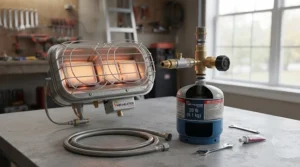
The Mr. Heater MH540T takes a different approach to all-around coverage: rather than a fixed 360-degree burner, it uses an adjustable head that swivels up to 180 degrees, letting you manually aim a 30,000 to 45,000 BTU flame exactly where it’s needed and then reposition it as the sun moves or the crowd shifts. Reviewers note the push-button TE valve makes ignition noticeably easier than older match-light Mr. Heater models, and the stainless steel components hold up well over years of seasonal storage — several long-term owners on retail review pages mention using the same unit for over a decade of hunting, ice fishing, and tailgating. What the spec sheet won’t tell you, but reviewers note, is that the standard tip-over safety shut-off switch on this model has genuinely triggered during real accidental knocks at crowded events, which for anyone heating a patio full of people is a meaningfully different risk profile than a stationary job-site unit. On the downside, that flexibility and higher BTU ceiling come with a shorter runtime per tank than the single-burner options, and the swivel mechanism is one more moving part that eventually needs occasional cleaning or lubrication.
Pros:
- ✅ 180-degree swivel head aims heat precisely
- ✅ Tip-over shutoff performs reliably in crowded settings
- ✅ Stainless components hold up over many seasons
Cons:
- ❌ Higher BTU output drains a 20 lb tank faster
- ❌ Swivel mechanism needs occasional maintenance over time
At C$190-220, the Mr. Heater MH540T is the premium pick for tailgates, sporting events, and any wide outdoor gathering where heat needs to move with the crowd.
7. Mr. Heater MH15C Tank Top Heater and Cooker — best dual heat-and-cook combo
The Mr. Heater MH15C Tank Top Heater and Cooker solves a problem the other six products on this list don’t even attempt to address: what happens when you want warmth and a cooking flame from the same 20 lb tank without packing two separate appliances. It delivers up to 15,000 BTU of radiant heat and doubles as a stovetop burner, which is exactly the kind of practical, dual-purpose transformation that justifies including it alongside straightforward heaters. Reviewers consistently frame this as their go-to for ice fishing huts and hunting camps, where one propane cylinder now handles boiling water for coffee, warming a hut, and keeping hands from going numb, cutting down on the gear you need to haul in. Based on the spec comparison against the single-purpose MH15TS, you’re not sacrificing meaningful heat output to gain the cooking function, which makes this a genuinely efficient use of a single fuel source rather than a compromise. The trade-off is that it’s a specialty pick rather than a default: anyone who only wants heat, with no interest in cooking on the same unit, is better served by a simpler dedicated heater.
Pros:
- ✅ Combines radiant heat and a cooking burner
- ✅ Cuts down gear needed for camps and huts
- ✅ Matches the heat output of single-purpose models
Cons:
- ❌ Overkill for anyone who only needs heat
- ❌ Cooking surface is small for full meal prep
Around C$120-140, the Mr. Heater MH15C Tank Top Heater and Cooker rewards anyone whose winter outings genuinely call for both warmth and a hot meal from the same tank.
Practical Usage Guide: Setup, First Use, and Avoiding Rookie Mistakes
Getting a propane tank top heater running safely the first time takes about five minutes, but the details matter more than most instructions let on. Start by inspecting the tank’s O-ring and the heater’s connection point for cracks before you thread anything together — a $2 replacement O-ring beats discovering a leak with a lit flame nearby. Hand-tighten the connection fully, then do a soap-and-water leak test around the fitting (bubbles mean a leak, no exceptions) before ever reaching for an ignition source. On first use, always light the heater outdoors and let it burn for a few minutes with good airflow, since new units can carry light manufacturing oils that produce a faint smell as they burn off.
For ongoing maintenance, wipe down the emitter screen and burner ports every few uses to clear dust, spider webs, or debris that can restrict airflow and cause uneven flame patterns — this is the single most common cause of a “weak” heater that isn’t actually broken, just dirty. Store the unit disconnected from the tank between uses, ideally indoors in a dry space, since moisture on the regulator threads is a slow but steady cause of corrosion over multiple Canadian winters. In the first 30 days, the most common mistakes are running a heater at maximum output in a small enclosed space, forgetting to check the tank’s fill level before an outing, and skipping the leak test because “it worked fine last time.” None of these mistakes are dramatic on their own, but each one compounds the risk of a bad outcome exactly when you’re depending on the heater most.
Real-World Scenarios: Matching the Heater to the Person
Consider three different Canadian buyers and how their needs actually diverge. A university student in a cold-climate town commuting by bike and doing occasional roadside bike repairs in an unheated apartment storage locker has modest needs — the Flame King GS4200EP or Mr. Heater MH15TS Single Tank Top covers a personal work zone without overspending on BTUs they’ll never use. A contractor running a two-car garage workshop through the winter, doing engine work and woodworking on weekends, needs sustained coverage across a bigger space and benefits far more from the Mr. Heater MH30TS Double Tank Top or the Dyna-Glo TT360DG, both of which can keep a detached garage above freezing during an eight-hour work session.
A family that tailgates regularly and also uses the same equipment for backyard bonfires and patio gatherings gets the most mileage from the Mr. Heater MH540T, since its swivel head adapts to whichever direction the crowd happens to be sitting that week — a fixed radiant heater would leave half the group cold. Finally, an ice-fishing or hunting camp group that values minimizing gear per trip is the ideal audience for the Mr. Heater MH15C Tank Top Heater and Cooker, since one 20 lb tank now covers both the hot coffee and the warm hands that make an all-day sit in a fishing hut bearable.
How to Choose a Propane Tank Top Heater
- Match BTU output to your actual space, not your ambition. A 15,000 BTU single burner is genuinely enough for a personal work zone or a small patio; don’t pay for 40,000 BTU you’ll never use outdoors.
- Check the connection type against your existing tanks. Most tank top heaters use a soft-nose P.O.L. or QCC fitting for 20-40 lb cylinders, but always confirm before buying if you’re working with an unusual tank size.
- Prioritize ignition style based on how you’ll use it. Spark ignition matters far more in cold, gloved-hand conditions than it does for someone lighting a heater from inside a warm garage.
- Look for CSA certification specifically, since it confirms independent testing against Canadian safety standards rather than relying solely on the manufacturer’s own claims.
- Factor in wind exposure for your typical use case. A wind-resistant burner design like the Dyna-Glo TT15CDGP matters enormously for open job sites and patios, and barely at all inside a shed.
- Think about runtime, not just output. Higher BTU heaters drain a 20 lb tank faster, so if you’re heating for long stretches, budget for a second tank or a lower sustained setting.
- Decide whether you actually need indoor-rated equipment. Most tank top heaters on this list are outdoor-only by design, and using them inside an enclosed space is a genuine safety violation, not a grey area.
Propane Tank Top Heater vs Traditional Alternatives: Heater for a Garage Without Electricity
For anyone specifically hunting for a heater for garage without electricity, the comparison really comes down to three practical options: propane tank top heaters, kerosene forced-air heaters, and battery-powered electric heaters. Here’s how they stack up on the factors that actually matter for a Canadian garage in winter.
| Factor | Propane Tank Top Heater | Kerosene Forced-Air | Battery Electric Heater |
|---|---|---|---|
| Needs electricity | No | Usually no | Yes (battery-dependent) |
| Startup time to full heat | Seconds | 1-2 minutes | Instant, but weaker output |
| Typical odor | Minimal when maintained | Noticeable fuel smell | None |
| Best For | Mr. Heater MH30TS Double Tank Top for mid-size garages | High-output job sites with ventilation | Small, well-insulated spaces with power access |
Looking at the comparison above, a propane tank top heater wins decisively for anyone who wants meaningful heat output with no electrical dependency and minimal lingering smell, which is exactly the profile of most detached, unwired Canadian garages. Kerosene units generally produce more raw BTU per dollar for large uninsulated shops but come with a fuel odor that many owners find harder to live with in an attached space. Battery electric heaters are the cleanest option by far, but their runtime and heat output both drop sharply in genuinely cold conditions, making them a poor primary choice once temperatures fall much below freezing.
✨ Don’t Miss These Exclusive Deals!
🔍 Take your winter garage setup to the next level with these carefully selected propane heaters. Click on any highlighted product to check current pricing and availability on Amazon.ca. These picks will help you create a genuinely warm workspace your whole family can rely on this season!
Tank Top Heater BTU Output: What the Numbers Actually Mean
Marketing copy loves throwing around BTU output ranges, but the practical meaning gets lost in translation. One BTU is the energy needed to raise one pound of water by one degree Fahrenheit, and in heater terms, it roughly correlates to how much cold air the unit can offset per hour in a given space — but “roughly” is the key word, because insulation, wind, and ceiling height change the real-world result dramatically.
| BTU Output | Realistic Coverage | Typical Use Case |
|---|---|---|
| 10,000–15,000 | Personal zone, small patio | Camping, ice fishing, single work bay |
| 20,000–30,000 | Single-car garage, larger patio | Weekend workshop, backyard gatherings |
| 40,000–45,000 | Two-car garage, small shed, open barn | Sustained job site or shop heating |
Based on the spec comparison across all seven products reviewed here, the practical lesson is that tank top heater btu output figures listed by manufacturers assume open, unobstructed radiant throw — a number that shrinks noticeably once you account for a garage’s insulation gaps, an open door, or a persistent draft. What most buyers overlook is that choosing a heater rated slightly above your calculated need, rather than exactly at it, buys a meaningful margin for genuinely cold days without dramatically increasing propane consumption on milder ones.
Propane Heater Indoor Outdoor Use: Where Canadian Rules Draw the Line
This is the single most misunderstood aspect of propane heater indoor outdoor use, and it’s worth being blunt about it: the overwhelming majority of tank top heaters, including every single-burner and double-burner model reviewed above, are certified for outdoor use only. That’s not a suggestion — it’s a certification boundary tied directly to how much carbon monoxide the unit produces relative to the ventilation an enclosed space can provide. Federal guidance on this exact scenario states plainly that fuel-burning equipment designed for outdoor use should never be operated inside an enclosed structure, including garages with the door closed, tents, or ice-fishing huts without dedicated ventilation.
CBC has reported on multiple Canadian carbon monoxide deaths traced directly back to outdoor-rated heating equipment being used indoors, and the symptoms — headache, dizziness, confusion — often arrive too gradually for victims to recognize what’s happening before it’s too late. If you genuinely need heat inside an enclosed space, that calls for equipment specifically certified for indoor use, complete with an oxygen depletion sensor, alongside a working carbon monoxide detector in the same room — not a tank top heater rated for open air pressed into service somewhere it was never designed to go.
Tank Top Heater Safety Features Worth Paying For
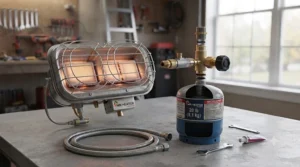
Not every safety feature on a spec sheet carries equal weight, and understanding tank top heater safety features helps separate genuine protection from marketing checkboxes. A tip-over safety shut-off is close to non-negotiable — it cuts fuel flow automatically if the unit is knocked over, which matters enormously at crowded tailgates or windy job sites where a bump is a matter of when, not if. CSA certification, as covered by CSA Group’s fuels and transportation standards, confirms independent third-party testing against Canadian code rather than relying purely on a manufacturer’s own claims, and it’s the single clearest signal of genuine safety engineering versus marketing language.
A wire emitter guard reduces accidental contact burns and debris intake, though reviewers note it still runs hot enough that pets and small children need active supervision around any lit unit. Soft-nose P.O.L. connections resist cross-threading better than older hard-nose designs, cutting down on a surprisingly common source of slow leaks. What the spec sheet won’t tell you, but reviewers note repeatedly, is that a wind-resistant burner design matters just as much for safety as it does for convenience, since a flame that gets blown sideways or extinguished unpredictably is a bigger real-world hazard than most buyers initially assume.
Mr. Heater Tank Top Propane Review: How the Brand Stacks Up
Given how often Mr. Heater tank top propane review searches turn up the brand’s name specifically, it’s worth addressing the company’s reputation directly rather than product by product. Mr. Heater has been manufacturing tank top heaters in Cleveland, Ohio for decades, and that longevity shows up in the consistency of its P.O.L. connections, regulator design, and parts availability across Canadian retailers — a genuine advantage for anyone who wants to source a replacement hose or regulator without hunting through obscure import listings. Aggregated reviewer sentiment across the MH15TS, MH30TS, and MH540T models reviewed above skews strongly positive on reliability and longevity, with several owners on retail platforms reporting a decade or more of seasonal use from a single unit.
The recurring criticism across the brand’s lineup isn’t really about any one product — it’s that higher-output models burn through a 20 lb tank noticeably faster than their BTU-per-dollar ratio might suggest, which is simply physics rather than a flaw unique to Mr. Heater. On balance, the brand’s reputation for durable construction and widely available parts is earned rather than purely marketing, which is a meaningful part of why four of the seven products on this list carry the Mr. Heater name.
Portable Propane Heater Workshop Setups: What Changes at Scale
Running a portable propane heater workshop setup for regular use, rather than occasional weekend heating, changes a few practical calculations. First, propane consumption at scale adds up fast — a 30,000 BTU heater running several hours a day, several days a week, will burn through a 20 lb tank in roughly a day or two on higher settings, which means budgeting for either a larger cylinder (30-40 lb) or a rotation of spare 20 lb tanks rather than relying on a single one. Second, a workshop environment typically has more airflow disruption from open doors, dust, and stored materials than an open patio, so a heater with a wind-resistant or 360-degree burner design tends to perform more consistently than a fixed single-direction unit positioned awkwardly around obstacles.
Third, and often overlooked: a workshop setting usually means the heater runs unattended for longer stretches while you’re focused on a project, which makes tip-over protection and CSA certification less of a nice-to-have and more of a genuine requirement. For anyone setting up a dedicated winter workshop routine, the Mr. Heater MH30TS Double Tank Top or Dyna-Glo TT360DG are the strongest fits from this list, since both are built for sustained higher-BTU operation rather than occasional short bursts.
Common Mistakes When Buying a Propane Tank Top Heater
The single biggest mistake is buying based on brand recognition alone rather than matching BTU output and burner style to the actual space being heated — a Mr. Heater MH540T is genuinely overkill and wasteful for someone who only needs to warm a single work bench. A close second is skipping the connection-type check, assuming every tank top heater fits every propane cylinder, when soft-nose P.O.L. and QCC fittings aren’t always interchangeable without an adapter. Buyers also frequently underestimate how much a wind-resistant burner design matters until their first outdoor use on a gusty day leaves them relighting the unit every few minutes.
Another recurring error is treating CSA certification as optional detail rather than a genuine safety filter — an uncertified unit from an unfamiliar overseas brand may work fine for months and still lack the independent testing that catches design flaws before they become a real hazard. Finally, plenty of buyers forget to budget for propane itself as an ongoing cost, focusing entirely on the sticker price of the heater while ignoring that a higher-BTU model can meaningfully increase how often they’re refilling tanks over a full winter.
Long-Term Cost & Maintenance
The heater’s purchase price is only part of total cost of ownership; the bigger long-term variable is propane consumption. A 15,000 BTU single-burner unit run for roughly 40 hours over a winter will use noticeably less propane than a 45,000 BTU model run for the same number of hours, so buyers should weigh their realistic annual usage hours against the BTU tier they’re considering rather than defaulting to the biggest available option. Maintenance costs stay low across every product on this list — periodic O-ring replacement, occasional regulator checks, and basic emitter cleaning are the extent of it, typically costing a few dollars a year in parts.
Where long-term value diverges most is in build quality and parts availability. Mr. Heater’s decades-long presence in Canadian retail means replacement components remain easy to source years down the line, which extends realistic product lifespan well beyond the one-year warranty period most of these units carry. A cheaper unbranded alternative might save money upfront but can become a disposable purchase the moment a regulator fails and no replacement part exists.
Frequently Asked Questions
❓ Can I use a tank top propane heater inside my garage?
❓ How long does a 20 lb propane tank last on a tank top heater?
❓ What BTU output do I actually need for a two-car garage?
❓ Are CSA-certified propane heaters actually safer than uncertified ones?
❓ Do tank top propane heaters work well in windy conditions?
Conclusion
Choosing the right propane tank top heater really comes down to being honest about the space you’re heating and how often you’ll actually use it, rather than chasing the biggest BTU number on the shelf. For most Canadians tackling a single work zone, a patio, or an ice-fishing trip, the Mr. Heater MH15TS Single Tank Top or Flame King GS4200EP covers the job without wasting propane on unused capacity. Anyone heating a genuine two-car garage or a drafty shed through a full winter gets far more practical value from the Mr. Heater MH30TS Double Tank Top or the all-directional Dyna-Glo TT360DG, both of which are built for sustained higher-output use.
Whatever model ends up on top of your tank, the safety fundamentals stay constant: check connections before every use, respect the outdoor-only certification on nearly every unit in this category, and keep a working carbon monoxide detector nearby whenever fuel-burning equipment is running close to an enclosed space. Get those basics right, and a propane tank top heater earns its reputation as one of the simplest, most dependable ways to push back against a Canadian winter.
✨ Ready to Stay Warm This Winter?
🔍 Browse the full lineup of propane tank top heaters above and click through to check current Amazon.ca pricing on the model that fits your space. A warmer garage, patio, or ice hut is just one click away!
Recommended for You
- Space Heater for Workshop: 7 Picks That Actually Work (2026)
- Propane Garage Heater 2026: 7 Best Picks for Canada
- Best Natural Gas Garage Heater in Canada (2026): Top 7 Picks
Disclaimer: This article contains affiliate links. As an Amazon Associate, I earn from qualifying purchases. If you purchase products through these links, we may earn a small commission at no additional cost to you.
✨ Found this helpful? Share it with your friends! 💬🤗
