
In This Article
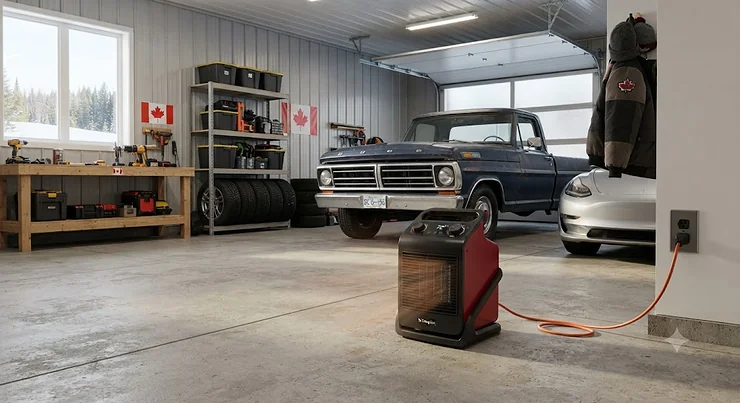
There’s a very specific kind of cold that lives in a Canadian garage in January — the kind that seeps up through the concrete slab and settles into your knuckles before you’ve even opened the toolbox. A portable garage heater promises to fix that, and for a lot of people, it genuinely does. But “portable garage heater” is a phrase that gets stretched to cover everything from a C$35 milkhouse-style box to a 5,600-watt 240V beast that needs its own dedicated outlet, and those two products solve completely different problems. What is a portable garage heater? In plain terms, it’s a self-contained, movable electric or propane heating unit designed to add warmth to an unheated or under-heated space like a garage, workshop, or shed, without permanent wiring or ductwork. Some plug into a standard household outlet; others need a 240V circuit like your dryer uses. This guide breaks down seven real, currently available models, explains what their specs actually mean once you’re standing in a cold garage at 6 a.m., and — just as importantly — tells you honestly what a portable unit can and can’t do for a Canadian winter. According to Health Canada’s home safety guidance, portable electric heaters can pose a real fire risk when used carelessly, and a few basic habits go a long way toward preventing that. We’ll cover that too, alongside real spec comparisons, aggregated review sentiment, and price ranges in CAD so you can shop with your eyes open rather than guessing from a product photo.
Quick Comparison Table: Portable Garage Heater Picks at a Glance
| Heater | Power | Best For | Price Range (CAD) |
|---|---|---|---|
| Comfort Zone CZ798 | 1,500W (120V) | Budget daily garage use | around C$40–C$55 |
| PELONIS PSH20Q3ABB | 1,500W (120V) | Quiet, renter-friendly heating | under C$40 |
| Lasko 5919 Pro-Ceramic | 1,500W (120V) | Spot-heating a workbench | C$45–C$60 range |
| Vornado VH200 | 1,500W (120V) | Even, whole-room warmth | C$70–C$90 range |
| Mr. Heater Big Buddy MH18B | Up to 18,000 BTU (propane) | Garages with no electrical outlet | C$150–C$200 range |
| Dr. Infrared Heater DR-988 | 5,600W (240V) | Full two-car garage | C$180–C$230 range |
| NewAir G56 | 5,600W (240V) | Large detached workshops | C$200–C$260 range |
What this table can’t fully capture is the wattage cliff that trips up most first-time buyers: every 120V unit on this list tops out at 1,500 watts because that’s the ceiling for a standard household outlet, full stop. If your garage is drafty, uninsulated, or bigger than a single-car bay, you’re going to feel that ceiling fast, and no amount of clever marketing changes the electrical code. The 240V options solve that problem by drawing more amperage on a dedicated circuit, but they also require an electrician’s involvement or an existing outlet, which changes the buying calculus considerably.
💬 Just one click — help others make better buying decisions too!😊
Top 7 Portable Garage Heaters: Expert Analysis
1. Comfort Zone CZ798 — toughest budget pick for daily garage use
The Comfort Zone CZ798 has been a fixture in North American garages for over a decade, and its milkhouse-style all-metal housing is exactly why. Running at 1,500W with two heat settings plus fan-only mode, it uses a simple thermostat dial rather than digital controls — which sounds basic until you realize digital touchpads are usually the first thing to fail in a dusty, unheated space. The Comfort Zone CZ798 includes overheat protection and a tip-over safety switch, both essential given how often garage heaters get bumped, kicked, or knocked by a rolling toolbox. Based on the spec comparison with pricier competitors, this is the model that makes the most sense if you just need reliable heat near a workbench and don’t care about app connectivity or oscillation. Aggregated review sentiment across major retailers consistently points to durability as the standout trait, with several reviewers reporting five-plus years of daily use without failure; a smaller number of reviews mention the fan getting louder over time. What most buyers overlook about a heater this size is that its compact 2.2-pound frame makes it genuinely easy to move between a garage, a shed, and a basement workshop as the season demands.
Pros:
- ✅ All-metal housing holds up to years of garage use
- ✅ Tip-over switch and overheat protection built in
- ✅ Compact enough to move between spaces easily
Cons:
- ❌ Analog thermostat lacks precise temperature readout
- ❌ Fan noise increases noticeably on high setting
Priced around C$40–C$55, the Comfort Zone CZ798 is hard to beat as a no-frills value pick for anyone heating a small workspace on a budget.
2. PELONIS PSH20Q3ABB — quietest option for apartment-attached garages
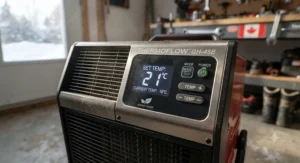
The PELONIS PSH20Q3ABB takes a different approach entirely: instead of a fan-forced element, it uses a quartz infrared element that radiates heat directly rather than pushing warm air around the room. That distinction matters more than it sounds — a fanless design means no moving parts to wear out and, more importantly, no drone of a motor running for hours. At 1,500W with three heat settings, the PELONIS PSH20Q3ABB won’t heat a whole two-car garage, but it excels at warming the specific spot where you’re standing, which is often exactly what a renter working on a hobby bench actually needs. Reviewers frequently describe the operation as near-silent, a genuine point of differentiation from ceramic fan models, though a handful of aggregated reviews mention inconsistent cycling on some units over time. Here’s what to weigh: infrared heat feels different from convection heat — it warms objects and skin directly rather than the air, so it’s less effective if you move around a lot but noticeably pleasant if you’re parked at a workbench.
Pros:
- ✅ Silent radiant operation with no fan noise
- ✅ Tip-over switch and thermal cut-off protection
- ✅ No wall marks or ductwork — ideal for rental units
Cons:
- ❌ Radiant heat doesn’t circulate well in larger spaces
- ❌ Some units report inconsistent thermostat cycling
At under C$40, the PELONIS PSH20Q3ABB delivers one of the best value-per-dollar ratios on this list, particularly for renters who need heat without leaving a trace.
3. Lasko 5919 Pro-Ceramic Utility Heater — best pivoting head for workbench spot-heating
The Lasko 5919 Pro-Ceramic Utility Heater‘s defining feature is right in its name: a pivoting head that lets you angle 1,500 watts of warmth exactly where your hands are working, rather than heating the whole room evenly. Built on a tubular steel base with a comfort-grip carry handle, the Lasko 5919 Pro-Ceramic Utility Heater offers two heat settings and a fan-only mode, controlled by an adjustable thermostat rather than digital buttons. What the spec sheet won’t tell you, but reviewers note, is how much that pivot function matters in a real workshop — pointing heat at a specific task, like a workbench or a car you’re leaning into, is far more efficient than trying to warm the whole garage air volume. Aggregated customer sentiment is strongly positive on longevity, with multiple long-term owners reporting reliable operation after many winters, though one independent test noted the tip-over shutoff didn’t always trigger as expected, which is worth factoring into placement decisions.
Pros:
- ✅ Pivoting head directs heat precisely where needed
- ✅ Durable tubular steel construction rated for job sites
- ✅ Quiet ceramic operation compared to older fan heaters
Cons:
- ❌ Tip-over shutoff reliability has been inconsistent in testing
- ❌ No digital display or precise temperature setting
In the C$45–C$60 range, the Lasko 5919 Pro-Ceramic Utility Heater is best suited to anyone whose garage time is really “one corner of the garage” time.
4. Vornado VH200 Whole Room Heater — best for even, whole-room warmth without hot spots
Rather than blasting a narrow stream of hot air, the Vornado VH200 Whole Room Heater uses the brand’s signature vortex circulation technology to pull room air through the heating element and push it back out in a wide, even pattern. At 1,500W with seven heat settings and three fan speeds, it’s rated for spaces of roughly 75 to 150 square feet — meaningfully smaller than a typical single-car garage, but well matched to an insulated workshop corner or a converted garage office. Based on the spec comparison with fan-forced competitors, the trade-off here is subtlety over raw force: independent testing found the VH200 quieter than nearly every other unit in its class, reaching only around 45 decibels even on its highest setting. Reviewers overwhelmingly praise the even heat distribution and low noise, though a consistent minority complaint across retailer reviews is that the unit underperforms in larger or drafty rooms, since it was never designed to substitute for a furnace.
Pros:
- ✅ Vortex circulation eliminates uneven hot and cold spots
- ✅ Notably quiet even on the highest fan setting
- ✅ Backed by a five-year manufacturer warranty
Cons:
- ❌ Rated coverage area is smaller than a typical garage
- ❌ Lacks oscillation, so placement matters more
Expect to pay in the C$70–C$90 range for the Vornado VH200 Whole Room Heater, a fair premium for buyers who prioritize quiet, even comfort over maximum BTU output.
5. Mr. Heater Big Buddy MH18B (Massachusetts/Canada version) — best no-outlet option for unpowered garages
For detached garages without electrical service — a common reality in older Canadian homes — the Mr. Heater Big Buddy MH18B solves a problem electric heaters simply can’t: it runs entirely on propane, connecting to two 1-lb cylinders or an external tank via hose adapter, and outputs up to 18,000 BTU across four heat settings. This is the Massachusetts/Canada-approved version specifically, which matters because standard U.S. propane heaters aren’t all certified for use in Canadian indoor spaces. On paper, this means significantly more raw heat than any 1,500W electric unit can produce — roughly 3.5 times the output of a maxed-out household-circuit heater — which explains why it’s a favourite for larger or poorly insulated garages. The Mr. Heater Big Buddy MH18B includes an oxygen depletion sensor and automatic tip-over shutoff, both non-negotiable safety features for any fuel-burning indoor heater. Reviewers consistently praise the heat output and reliability, with several noting it performed well even in older, drafty garages, though a recurring aggregated complaint involves occasional difficulty getting the pilot to light in very cold conditions.
Pros:
- ✅ Far higher heat output than any electric 1,500W unit
- ✅ Doesn’t require an electrical outlet at all
- ✅ Oxygen depletion sensor for indoor safety
Cons:
- ❌ Requires propane cylinders and careful ventilation
- ❌ Pilot ignition can be finicky in extreme cold
Budget C$150–C$200 for the Mr. Heater Big Buddy MH18B plus ongoing propane costs — a legitimate option, but one that demands more safety diligence than a simple plug-in unit.
6. Dr. Infrared Heater DR-988 — best 240V heater for a full two-car garage
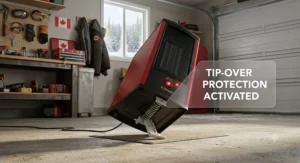
Once you’ve accepted that a 1,500W plug-in heater can’t realistically warm a full garage, the Dr. Infrared Heater DR-988 is where most serious buyers land. Drawing 5,600 watts on a dedicated 240V circuit (the same type your dryer or an EV charger might use), it’s built with an all-metal housing, a steel safety grille, and heavy-duty aluminum fan blades designed for industrial and jobsite conditions. Key specs translate directly into real-world performance: this unit can raise the temperature of a two-car garage from deep freeze to comfortable working conditions noticeably faster than stacking multiple 1,500W units ever could, and it’s UL and C-UL listed to North American safety standards. The adjustable thermostat runs from roughly 3°C to 45°C, and the fan can be set to continuous or automatic cycling. Aggregated reviews are strikingly consistent: owners frequently report years of trouble-free operation in genuinely large, sometimes only partially insulated shops, describing it as a clear upgrade over propane in terms of daily convenience — though a minority of buyers note an initial unusual odour during the first few uses, which several attribute to the protective coating burning off.
Pros:
- ✅ 5,600W output handles full two-car garages
- ✅ UL and C-UL listed for North American safety standards
- ✅ Can be used portable or wall/ceiling mounted
Cons:
- ❌ Requires a dedicated 240V outlet or electrician install
- ❌ Some units report a temporary odour when new
Expect a C$180–C$230 range for the Dr. Infrared Heater DR-988, which is real money — but for a genuinely under-heated garage, it’s often the difference between a heater that works and one that just spins its fan.
7. NewAir G56 — widest coverage for large detached workshops
The NewAir G56 competes directly with the DR-988 in the 240V, 5,600W category, and the choice between them often comes down to coverage claims and finish preferences rather than dramatic performance differences. Rated to heat spaces up to roughly 560 square feet, the NewAir G56 draws 30 amps on its 240V plug and produces around 19,000 BTU, with a steel construction and black powder-coated finish built to withstand rough shop conditions. What most buyers overlook about heaters in this power class is that the “instant blast” expectation set by propane heaters doesn’t quite apply — independent testing found it took a meaningful amount of running time to noticeably raise the temperature in a large, drafty garage, which is simply physics at this wattage rather than a flaw specific to this model. Reviewers frequently note it performs reliably over multiple winters and describe it as a genuine alternative to running propane, particularly for anyone who already has 240V service available. A consistent theme in aggregated feedback is that the fan can be somewhat loud at close range, worth knowing if you’ll be working directly beside it for hours.
Pros:
- ✅ 240V power handles up to roughly 560 sq ft
- ✅ Rugged steel build suited to workshop conditions
- ✅ No propane storage or refills required
Cons:
- ❌ Fan noise is noticeable at close range
- ❌ Needs professional 240V outlet installation if none exists
In the C$200–C$260 range, the NewAir G56 is a strong pick for anyone who has 240V access and wants electric convenience without sacrificing real heat output.
Top 7 Portable Garage Heaters: Full Spec Comparison
| Heater | Wattage/BTU | Power Type | Ideal Space Size | Best For |
|---|---|---|---|---|
| Comfort Zone CZ798 | 1,500W | 120V plug-in | Small workbench area | Budget daily use |
| PELONIS PSH20Q3ABB | 1,500W | 120V plug-in | Personal/spot heating | Quiet renter use |
| Lasko 5919 Pro-Ceramic | 1,500W | 120V plug-in | Single workbench zone | Directed spot heat |
| Vornado VH200 | 1,500W | 120V plug-in | 75–150 sq ft | Even whole-room warmth |
| Mr. Heater Big Buddy MH18B | Up to 18,000 BTU | Propane | Up to 450 sq ft | No-outlet garages |
| Dr. Infrared Heater DR-988 | 5,600W | 240V dedicated | Two-car garage | Serious full-garage heat |
| NewAir G56 | 5,600W | 240V dedicated | Up to 560 sq ft | Large workshops |
Looking at this table as a whole, the split is really between four 120V units that top out at 1,500W by law of physics, one propane unit that sidesteps electrical limits entirely, and two 240V units that solve the coverage problem the “right” way if you have the electrical infrastructure. Budget-focused buyers should note that jumping from a Comfort Zone CZ798 to a Dr. Infrared Heater DR-988 isn’t really an upgrade in the usual sense — it’s a jump to a different power category that may require an electrician, so factor that install cost into your real budget before comparing sticker prices alone.
Practical Usage Guide: Setting Up and Maintaining Your Portable Garage Heater
Getting a portable garage heater running safely takes about ten minutes, but skipping the setup steps is where most problems start. First, plug the unit directly into a wall outlet — never a power bar or extension cord, since both can overheat under sustained heater draw and are a leading cause of space heater fires according to Canadian electrical safety authorities. Second, give the heater a minimum of one metre of clearance on all sides, away from cardboard boxes, oily rags, paint cans, and anything else combustible that tends to accumulate in a garage. Third, place the unit on a flat, stable surface — concrete is ideal, since it won’t scorch and gives the tip-over switch a fair chance to trigger if the heater gets bumped.
For maintenance, dust buildup is the enemy of every fan-forced heater on this list; a garage naturally generates more dust and debris than a living room, so wipe down the intake grille every few weeks during heavy-use months. If you’re running a 240V unit like the NewAir G56 or Dr. Infrared Heater DR-988, have an electrician confirm the outlet and breaker are correctly rated before first use — this isn’t optional, and it’s a common mistake in the first 30 days of ownership for buyers moving up from a household heater. For propane units like the Mr. Heater Big Buddy MH18B, check the hose connections for leaks using a soapy water test before every use, and never store propane cylinders inside the heated space overnight.
Real-World Scenarios: Which Portable Garage Heater Fits Your Life
Picture three different garage owners, each with a completely different problem. The first is a condo-adjacent renter with a single attached garage bay used mostly for bike storage and the occasional weekend repair; for her, a compact, quiet, 120V unit like the PELONIS PSH20Q3ABB makes sense because it needs zero installation, leaves no marks, and can travel with her if she moves. The second is a hobbyist woodworker who spends three or four evenings a week at a dedicated workbench in an insulated single-car garage; the pivoting, spot-heating design of the Lasko 5919 Pro-Ceramic Utility Heater suits that pattern far better than a whole-room unit, since he’s warming a task, not a room. The third is a homeowner with an older, uninsulated two-car detached garage used as a full workshop on weekends throughout winter; for him, the math simply doesn’t work with a 1,500W plug-in heater, and either the 240V Dr. Infrared Heater DR-988 or the propane Mr. Heater Big Buddy MH18B is the realistic starting point, depending on whether he already has 240V service run to the garage.
The common thread across all three: matching the heater to the actual use pattern, not the biggest wattage number on the box, is what determines whether the purchase feels like a smart buy six months later or a heater gathering dust in the corner.
Problem → Solution: Common Portable Garage Heater Headaches Solved
Problem: The heater trips my breaker. This usually means it’s sharing a circuit with other high-draw appliances, or the outlet itself is older and undersized. Solution: run the heater on its own dedicated circuit where possible, and if you’re consistently tripping breakers with a 1,500W unit, that’s a strong signal you actually need a 240V option like the NewAir G56 rather than a second household-circuit heater.
Problem: The garage still feels cold even with the heater running. Solution: check for obvious heat loss first — an uninsulated garage door alone can undo most of what a portable heater contributes. Weatherstripping the door and insulating exposed walls will do more for comfort than upgrading wattage in many cases.
Problem: I’m not sure my heater is actually safe to leave running. Solution: no portable heater, electric or propane, should be left unattended or running overnight. This applies equally to the budget Comfort Zone CZ798 and the premium Dr. Infrared Heater DR-988 — always shut it off when you leave the space.
Problem: My propane heater smells odd or the pilot won’t stay lit. Solution: this points to either a low-oxygen environment or a connection issue; stop use immediately, ventilate the space, and don’t attempt to troubleshoot a lit gas appliance in a poorly ventilated room. Recurring pilot issues on units like the Mr. Heater Big Buddy MH18B often trace back to cold-weather regulator performance and are usually covered under manufacturer warranty.
How to Choose a Portable Garage Heater
Choosing the right unit comes down to seven practical checks, in roughly this order:
- Measure your actual space, not the whole garage. If you only heat the area around a workbench, a spot heater like the Lasko 5919 Pro-Ceramic Utility Heater will outperform a whole-room unit for less money.
- Check what electrical service you actually have. A 240V unit is meaningless if you don’t already have — or can’t easily add — a dedicated circuit.
- Confirm certification. Look for CSA, UL, or ULC marks; Technical Safety BC’s heater guidance points out that any space heater sold in Canada should carry a certification label from an agency recognized by the Standards Council of Canada, and that standard holds nationwide, not just in BC.
- Prioritize tip-over and overheat protection. These aren’t optional extras — treat any heater without them as disqualified.
- Decide between radiant and convection heat. Radiant (like the PELONIS PSH20Q3ABB) suits a fixed spot; convection or vortex circulation (like the Vornado VH200) suits moving around a room.
- Factor in noise tolerance. If you’ll be near the heater for hours, decibel level matters more than most buyers expect going in.
- Price the true cost, including installation. A 240V heater’s sticker price is only part of the equation if an electrician needs to run new wiring.
1500w Portable Heater Garage: What the Wattage Actually Buys You
Here’s the number every shopper eventually needs to internalize: a 1500w portable heater garage unit produces roughly 5,100 BTU of heat. A typical two-car garage in a Canadian winter — especially anywhere temperatures regularly drop below -15°C — often needs somewhere in the neighbourhood of 30,000 to 60,000 BTU to reach a genuinely comfortable working temperature. That’s not a knock on any specific product; it’s simple physics tied to the maximum current a standard 15-amp household circuit can safely deliver. What this means in practice is that a 1500w portable heater garage purchase is an excellent decision for spot heating, a small insulated space, or supplemental warmth — and a poor decision if the goal is bringing an entire uninsulated two-car garage up to living-room comfort. Reviewers who report disappointment with 1,500W units almost always describe exactly this mismatch: buying for whole-garage heating and getting spot heating instead. If your square footage genuinely calls for more, the 240V or propane options further up this list are the honest answer, not a bigger-looking 120V box with different marketing copy.
Best Portable Heater for Workshop: Matching Heat Type to the Job
The best portable heater for workshop use isn’t necessarily the most powerful one — it’s the one that matches how you actually work. Woodworkers and detail-focused hobbyists tend to stay in one spot for long stretches, which makes directed, pivoting heat like the Lasko 5919 Pro-Ceramic Utility Heater genuinely more efficient than a unit trying to warm the whole shop air volume. Mechanics and anyone moving constantly between a vehicle bay and a tool bench, by contrast, benefit more from the even circulation of something like the Vornado VH200, since a narrowly directed heater leaves them cold the moment they step out of its throw. For a serious dedicated workshop run several days a week through a full Canadian winter, the calculation shifts again toward 240V units — the Dr. Infrared Heater DR-988 and NewAir G56 both make more sense as a long-term investment than cycling through multiple 1,500W units, both in comfort and, over several seasons, likely in energy cost per degree of warmth delivered.
Portable Heater Tip-Over Safety Shutoff: Why This Feature Is Non-Negotiable
A portable heater tip-over safety shutoff is a simple mechanical or electronic switch that cuts power the moment a unit is knocked off its base — and it is, without exaggeration, one of the single most important features on this entire list. Ontario’s Electrical Safety Authority points out that space heater fires usually trace back to missing safety features, placement too close to combustible clutter, or improper plugging in — and a working tip-over shutoff directly addresses the first of those three causes. Garages are cluttered, high-traffic spaces where a heater is far more likely to get bumped by a rolling cart, a dropped tool, or an excited dog than it would be in a living room. Every electric model on this list — the Comfort Zone CZ798, PELONIS PSH20Q3ABB, Lasko 5919 Pro-Ceramic Utility Heater, Vornado VH200, Dr. Infrared Heater DR-988, and NewAir G56 — includes some version of this feature, though independent testing has occasionally found reliability gaps even among reputable brands, which is worth keeping in mind when deciding where and how a unit is placed. Reviewers rarely comment on tip-over safety directly, for the simple reason that a working shutoff means nothing bad happens, and that’s exactly the point.
Best Heater for Renters Garage: What You Can Use Without Landlord Hassles
Finding the best heater for renters garage use comes down to one core constraint most homeowners don’t think about: you generally can’t run new electrical wiring or mount anything permanent. That immediately rules out hardwired wall units and most 240V installs unless the outlet already exists, and it points squarely toward the 120V, plug-and-go category on this list. The PELONIS PSH20Q3ABB is arguably the strongest fit here — its radiant design leaves no residue on walls or ceilings, it requires zero installation, and its quiet operation won’t draw complaints if the garage shares a wall with a neighbouring unit. The Comfort Zone CZ798 is a close second for renters who want more raw output without any electrical modification. If your rental agreement is silent on portable propane appliances, always confirm with your landlord before introducing one — the Mr. Heater Big Buddy MH18B is genuinely useful for unpowered spaces, but combustion appliances in a shared or attached structure often carry lease restrictions that a simple plug-in heater does not.
Budget Portable Heater Canada: Getting Warmth Without Blowing the Bill
Shopping for a budget portable heater canada option means balancing upfront price against ongoing electricity cost, and the two don’t always move in the same direction. Both the Comfort Zone CZ798 and PELONIS PSH20Q3ABB sit under C$55, and since all 1,500W units draw the same maximum wattage, their hourly running cost is essentially identical regardless of price — the difference between them comes down to build quality, noise, and how the heat is delivered, not energy efficiency. A rough cost-per-use estimate: running a 1,500W heater for four hours a day through a typical Canadian winter adds a noticeable but manageable amount to a monthly electricity bill, figures worth checking against your specific provincial electricity rate. Total cost of ownership matters too — a C$40 heater that fails after one season isn’t actually the budget option once you’ve bought two or three replacements, which is why the aggregated durability track record of the Comfort Zone CZ798 carries real weight for value-focused buyers, not just its low sticker price.
Portable Garage Heater vs Permanent Garage Heating
The honest comparison between a portable garage heater and a permanently installed system (like a hardwired 240V wall unit or a ceiling-mounted radiant heater) comes down to flexibility versus efficiency.
| Factor | Portable Garage Heater | Permanent Garage Heating |
|---|---|---|
| Installation | None to minimal | Often requires an electrician |
| Upfront cost | C$40–C$260 typical range | Usually C$400+ installed |
| Flexibility | Movable between spaces | Fixed to one location |
| Best For | Renters, occasional use, spot heating | Full-time workshops, finished garages |
A portable unit wins decisively on flexibility and upfront cost — you can take it with you when you move, and there’s no installation commitment. A permanent system wins on consistent, whole-space efficiency for anyone using their garage daily through the entire winter. Value-conscious buyers who use their garage only occasionally rarely recoup the cost of permanent installation, while daily-use workshop owners often find a permanent system pays for itself in convenience within a season or two.
It’s also worth being direct about the limits of portable propane heaters used indoors: a Technical Safety BC investigation covered by Global News linked two fatal carbon-monoxide incidents back to improperly installed or uncertified propane appliances, a reminder that carbon monoxide forms any time a fuel like propane burns incompletely. That’s a strong argument for choosing only Canada-certified models like the Mr. Heater Big Buddy MH18B, pairing any propane heater with a working carbon monoxide detector, and never assuming “indoor-rated” means “unlimited ventilation isn’t necessary.”
✨ Don’t Miss These Exclusive Deals!
🔍 Take your garage heating setup to the next level with these carefully selected picks. Click on any highlighted product above to check current pricing and availability. The right portable garage heater turns a miserable cold workspace into somewhere you actually want to spend your Saturday. 🔥🧰
Frequently Asked Questions
❓ Can a portable garage heater heat a whole two-car garage?
❓ Is it safe to leave a portable garage heater on overnight?
❓ What's the difference between a 120V and 240V garage heater?
❓ Do propane garage heaters produce carbon monoxide?
❓ How much does it cost to run a 1,500W heater for a winter in Canada?
Conclusion
There’s no single best portable garage heater — there’s only the right heater for your specific garage, your electrical setup, and how you actually use the space. If you’re heating a small spot for occasional weekend projects, the budget-friendly Comfort Zone CZ798 or the whisper-quiet PELONIS PSH20Q3ABB will likely serve you well without any installation headaches. If you spend serious hours at a dedicated workbench, the directed heat of the Lasko 5919 Pro-Ceramic Utility Heater or the even warmth of the Vornado VH200 makes more sense than raw wattage. And if you’re honest with yourself about heating an entire uninsulated two-car garage through a real Canadian winter, the 240V Dr. Infrared Heater DR-988 and NewAir G56, or the propane Mr. Heater Big Buddy MH18B, are where the physics actually points — no 1,500W plug-in unit is going to get you there, no matter how the packaging is worded. Whichever direction you go, prioritize certification marks, a working tip-over shutoff, and sensible placement over raw marketing claims, and your garage will feel noticeably more livable by the first hard frost.
Recommended for You
- 7 Best Garage Insulation Picks for -30°C Winters (2026 Guide)
- Insulation for Garage Walls: 7 Best Picks to Try in 2026
- 7 Best Propane Tank Top Heater Picks for Canadian Winters (2026)
Disclaimer: This article contains affiliate links. As an Amazon Associate, I earn from qualifying purchases. If you purchase products through these links, we may earn a small commission at no additional cost to you.
✨ Found this helpful? Share it with your friends! 💬🤗
